THE PERFORMANCE OF THE ELDERLY WITH
NEUROSENSORIAL HEARING LOSS IN AUDITORY
PROCESSING TESTS: A LONGITUDINAL STUDY
O desempenho de idosos com perda auditiva neurossensorial
nos testes de processamento auditivo: um estudo longitudinal
Gabriela Cavagnoli Rodrigues da Fonseca(1), Maria Inês Dornelles da Costa-Ferreira(2)
(1) Faculdade Nossa Senhora de Fátima, Caxias do Sul, RS, Brasil.
(2) Curso de Fonoaudiologia do Centro Universitário Metodista do Instituto Porto Alegre, Porto Alegre, RS, Brasil.
Conlict of interest: non-existent
In the case of hearing loss, the individual experi -ences both emotional and social unstability to be
able to adapt to the society, since there is a decrease in speech intelligibility which causes dificulty in
maintaining social relations and dialogs, generating
frustration and stress. Therefore, the individual
gradually begins to become isolated 4,5.
In the aging process, the hearing loss tends to happen to the majority of individuals and to cause a great impact on their quality of life 1,4. Due to this
sensory deprivation, there is usually an auditory processing disorder, affecting one or more auditory abilities of the individual. With the objective of minimizing all these aspects caused by hearing loss, there are strategies that may help the elderly to listen better and to understand speech again.
With the brain aging, auditory processing difi
-culties in elderly people with hearing loss may be potentiated, manifesting through dificulties in
INTRODUCTION
Communication is the primary means of inter
-action between the individual and the world and, for a perfect interaction, an intact auditory pathway is necessary. For the hearing and, consequently, for an effective communication, both the peripheral and the central auditory systems must be in perfect conditions. The disorder occurs when the individual
is not able to use thoroughly the auditory stimulus,
failing in one or more strategies. Any failure in the perception, analysis and full interpretation of auditory information generates a decrease in auditory function1-3.
ABSTRACT
Purposes: to verify the performance of elderly in tests of auditory processing at the delivery of the
hearing aids, after a month of use and after the auditory training. Methods: the study was carried
out with 11 elderly people, between 60 and 79 years old, wearing hearing aids, at Centro de Saúde Clélia Manfro. All patients were submitted to Speech in Noise tests, normal or expanded Random Gap Detection Test and to the binaural integration stage of the Dichotic digits test, in three different moments: at the delivery of the hearing aids, after a month of use, and after ive auditory training
sessions. Results: in relation to sex, 7 (63.64 %) were women. The mean age was 71.27 (± 5.33).
The average time of daily use of the hearing aids was 10.18 hours (± 2.44), and of sensory deprivation was 5.82 years (± 5.29). All participants gradually increased the scores in tests of auditory processing, reaching better performance after the auditory training, and the comparison between the three moments resulted statistically signiicant (p< 0.001). Conclusion: the process of adaptation to the
hearing aids as well as the auditory training led to an improvement in speech recognition with and without competing message as relecting the period of acclimatization after the second evaluation and the effect of auditory training after the third assessment.
de Fátima, protocol number 340.168 /2013. The Term of Institutional Knowledge was signed by the coordinator of Centro de Saúde Auditiva. The data collection was preceded by authorization of the subjects through the signed Informed Consent
Form.
It is a prospective, longitudinal and contemporary study. The instrument of study is an initial question
-naire containing data of the subject, time of sensory deprivation (period between the irst diagnosis of hearing loss and the use of hearing aid) and daily time of use of hearing aid (informed by participant and confronted with the programming software of the hearing aid device); also, the records of the results of the following tests- Speech in Noise, the conventional and the expanded RGDT (the latter performed just in case the patient is not able to meet
the conventional test) and Dichotic Digit.
The sample was composed of 11subjects between 60 and 79 years old with audiological diagnosis of symmetric, mild to moderate, bilateral
sensorineural hearing loss, residents in Caxias
do Sul and wearing HA properly prescribed in the Health Center of average complexity of the Institution, having passed through the stages of delivery of hearing aid, revision of the device and
auditory training.
In the irst session was applied the advice guide, prepared by the Audiology Service, with the objective of verifying the general functioning of HA, as well as their handling and care. The patients and their families’ doubts were clariied and some general guidelines were provided. It was also possible to observe the communication strategies in different environments and the use of telephone.
The subsequent sessions included tasks of stimulation of the following skills: detection, discrimi -nation, recognition and understanding. All the
performed tasks required some degree of cognitive
demand (attention, memory, language and executive
functions). The level of dificulty of the activities was gradual and in agreement with the results obtained
in each session.
The irst contact was made on the delivery of the hearing aid. After the informed consent for partici
-pation in the research, the auditory processing tests were conducted. After a month of use of HA, partici
-pants returned for the equipment checking and after ive sessions of auditory training, as recommended by the Policy of Hearing Health, the same tests were performed aiming to compare the results.
In the second moment of evaluation the partic
-speech understanding in noisy situations, and in information processing both verbal and non-verbal. Thus, it is possible to infer that most patients with sensorineural hearing loss and in aging process present deicits in some ability of the auditory processing6,7.
The irst step in the rehabilitation process is the selection and the adaptation of the Hearing Aid (HA), which will be selected and adapted uni- or bilaterally and will have the necessary characteristics for each individual. In addition to the auditory aspects, the
non-auditory needs that limit and restrict the
individ-ual’s activities in his daily life should be assessed. These aspects, affected by hearing loss, can also affect the intervention prognosis8.
However, it is known that even wearing Hearing Aids (HA), the complaints related to the dificulties in speech intelligibility remain. For this reason, it is recommended to perform an auditory training after receiving the hearing aid. During this process, activities that aim to optimize the functional gain of the hearing aid will be carried out, improving the
auditory abilities that have been altered due to the
sensory deprivation9.
Another point to be emphasized is the eficiency of binaural adaptation because there is a small percentage of individuals adapted bilaterally who present many complaints due to a lack of inter-hemispheric communication. Thus, the ability of bilateral speech perception becomes impoverished when compared to the same ability of the ear with better performance. Thus, the individual would need to perform an auditory training for greater effec
-tiveness of binaural adaptation10,11.
The auditory training is a set of strategies used to rehabilitate the auditory abilities, promoting plasticity
and cortical reorganization12. The auditory plasticity
may be understood as the capacity of reorgani
-zation of the nerve cells by means of a variation of input stimulus through enhancement and training. Thus, the auditory processing tests lead the speech pathologist to the more appropriate type of auditory training for each individual13.
Due to the lack of studies in this area and to the importance of the comparative tests in the three moments of hearing aid itting (on delivery, after a month of use and after the auditory training), this study aimed to verify the performance of elderly people in tests of auditory processing on the delivery of the hearing aid, after a month of using this device and after the auditory training.
version 9.2. To describe the proile of the sample, according to the variables in study, analyses of the categorical variable (gender), with values of absolute frequency (n) and percentage ( % ), and of the continuous variables (age, times and test scores) were made, with average values, standard
deviation, minimum and maximum values, median
and quartiles.
To compare the values of the auditory processing
tests among the three assessments, the Friedman
test and the Wilcoxon’s tests were used for the comparison between two assessments, due to the small size of the sample and absence of normal distribution of scores. To compare the perfor -mance in the tests according to the gender the
Mann-Whitney test was used, due to the absence of normal distribution of the variables.
To analyze the relationship between the tests and the numerical variables we used the Spearman correlation coeficient. The level of signiicance in this study was 5 %, i.e., P<0.05.
RESULTS
Of the 11 participants, 7 (63.64 %) were female and 4 (36.36 %) were males. The minimum age was 61 and the maximum, 78, being 71.27 (± 5.33) the
average age obtained.
As to the number of hours of use of HA, the minimum daily time was 7 hours and the maximum was 16 hours, with an average of 10.18 hours (± 2.44). All participants maintained their answers in the two moments they were questioned about the daily time of use of hearing aid. Besides the participants’information, the time was checked in the software used to adjust the hearing aid.
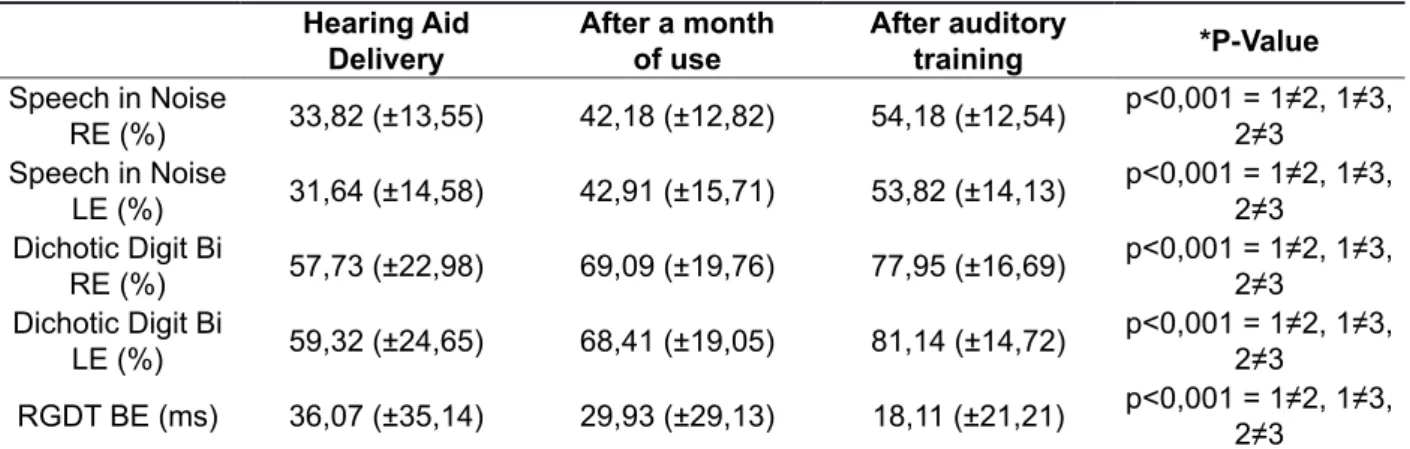
In relation to the time of sensory deprivation, i.e., the period between the irst diagnosis of hearing loss and the irst use of HA, the minimum time was 2 years, maximum, 20 years and the average was 5.82 years (± 5.29). Table 1 shows the participants’ performance in the auditory processing tests carried out in the three moments of collection (when the hearing aid was delivered, after a month of use and after the auditory training).
aid. By the last evaluation, this question was made
once again.
For the tests of auditory processing, the partic
-ipant, with supra-aural headphones and without the hearing aid, remained in an acoustic booth. The
verbal tests in Portuguese14 and the non-verbal test
in English15 are available in CD and were applied
by means of a two-channel audiometer (AC 33 Interacoustics) connected to a notebook, at 40 dBNS, above the average of audiometric frequencies from 500Hz to 2000Hz of the participant.
Firstly, the test of Speech in Noise was performed. It consists of the simultaneous presentation of 25 monosyllabic words and of white noise in the same ear. Patient was requested to repeat the words he heard ignoring the ipsilateral noise. The signal-to-noise ratio used was 0 dB, i.e. monosyllables and white noise at the same intensity.
Negative relations were not used because the participants with sensorineural hearing loss tend to have great dificulty to discriminate the message. Afterwards, the same procedure was repeated in the other ear. This test evaluates the ability of auditory
closure.
Soon after, the Random Gap Detection Test (RGDT), marketed by Auditec15, was applied. It
consists in identifying the shorter interval between two pure tones. The participant was instructed to hear the pure tone, identify if one or two tones were heard, and inform it with his ingers16. If the participant
could not respond to conventional RGDT, whose time intervals range from 0 to 40 ms, the expanded form in which the time intervals are wider, ranging from 50 to 300 ms was applied to facilitate the tones identiication . The ability evaluated is the temporal resolution, required for the speech discrimination.
And inally the Dichotic Digit test, stage of binaural integration, was applied. It consists of the simultaneous presentation of two pairs of digits, each pair presented in one ear. The participants were instructed to repeat the four digits heard in both ears. The purpose of the test is to evaluate the function of binaural integration14,17.
collection were considered. Regarding the RGDT, a descending graph may be observed, but this is also an indicator of an increase in performance, since it is expressed in milliseconds.
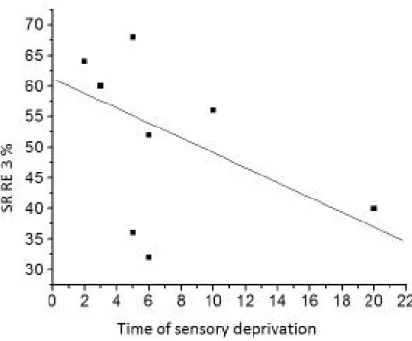
The participants’ performance in auditory processing tests was compared according to the sex, but no statistically signiicant differences were identiied. After the auditory training, the analysis of the correlation between the variables showed that the lower the performance in the Speech in Noise test for the right ear, the greater the time of sensory deprivation (r = -0,68692; p= 0.0195), as shown in
Figure 4.
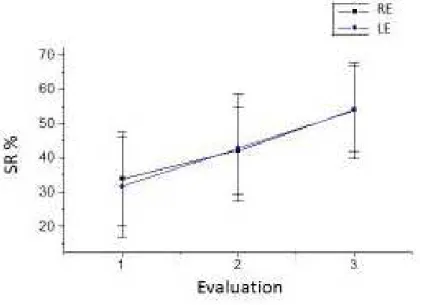
The data collected in the three assessment moments were compared and the results were statistically signiicant p<0.001, according to the Figures 1, 2 and 3. Figure 1 shows the participants’ performance in the Speech in Noise test, for both
ears, in the three assessment moments.
Figure 2 shows the performance in the RGDT and Figure 3, the performance in binaural integration for the Dichotic Digit test.
The performance in the Speech in Noise and Dichotic Digit tests (expressed by percentage of correct answers) was directly proportional, i.e., the performance increased as the three phases of data
Table 1 - Average Performance and standard deviation obtained by participants in auditory processing tests carried out in the three moments of data collection (n= 11)
Hearing Aid Delivery
After a month of use
After auditory
training *P-Value
Speech in Noise
RE (%) 33,82 (±13,55) 42,18 (±12,82) 54,18 (±12,54) p<0,001 = 1≠2, 1≠3, 2≠3
Speech in Noise
LE (%) 31,64 (±14,58) 42,91 (±15,71) 53,82 (±14,13) p<0,001 = 1≠2, 1≠3, 2≠3
Dichotic Digit Bi
RE (%) 57,73 (±22,98) 69,09 (±19,76) 77,95 (±16,69) p<0,001 = 1≠2, 1≠3, 2≠3
Dichotic Digit Bi
LE (%) 59,32 (±24,65) 68,41 (±19,05) 81,14 (±14,72) p<0,001 = 1≠2, 1≠3, 2≠3
RGDT BE (ms) 36,07 (±35,14) 29,93 (±29,13) 18,11 (±21,21) p<0,001 = 1≠2, 1≠3, 2≠3
Caption: RE=right ear; LE=left ear; BE=both ears; Bi=binaural integration; ms=milliseconds * P-Value for the Friedman test for rela
-ted samples for comparison between 3 assessments, followed by the Wilcoxon test for rela-ted samples for comparison between two
*P Value = p<0,001 = 1≠2, 1≠3, 2≠3
SN-Speech in Noise; RE-right ear. Friedman Test and Wilcoxon Test
*Pvalue-for the Friedman test for the related samples for comparison between 3 assessments, followed by the Wilcoxon test for related samples for comparison between 2 assessments
Figure 1 - Performance of the participants in the Speech in Noise test for both ears when comparing the three moments of evaluation (n=11).
P Value = p<0,001 = 1≠2, 1≠3, 2≠3
caption: RGDT=Random Gap Detection Test; BE=both ears. Friedman and Wilcoxon tests
* P-Value for the Friedman test for related samples for comparison between 3 assessments, followed by the Wilcoxon test for related samples for comparison between 2 assessments
P value = p<0,001 = 1≠2, 1≠3, 2≠3
caption: DD=dicótico de dígitos; RE=right ear; LE=left ear. Friedman and Wilcoxon tests
* P-value for the Friedman test for the related samples for comparison between the 3 assessments,followed by Wilcoxon test for related samplesfor comparison between 2 assessments.
Figure 3 - Participants’ performance in the stage of binaural integration of Dichotic Digit test for both ears when comparing the three moments of assessment (n= 11).
P value = p<0,05
caption: SN=Speech in Noise; RE=right ear. Coeficient of Spearman * p value for coeficient of Spearman
According to the foregoing, the recognition and the speech understanding require the integrity of the
auditory abilities mediated by the central auditory
nervous system. Thus, the test of Speech in Noise aims to evaluate the ability of auditory closure,ability to understand the whole - word or message, even when incomplete, as well as the ability of igure-ground, that means recognition of the message in a
noisy environment22.
Another skill essencial for the understanding of the message is the temporal resolution, assessed by RGDT test. It is responsible for understanding both the continuous speech and its isolated segments; based on this assumption, changes of temporal resolution result in dificulties to identify small varia
-tions of acoustic speech and in dificulty to produce correct speech sounds or to interpret the message
heard23,24. With the aging, the speech recognition
become altered, and when it is associated with a hearing loss this dificulty is reinforced25.
A study was carried out with 42 elderly people with sensorineural hearing loss, divided into two groups: the experimental and the control group. Only the experimental group performed the auditory training, but both performed the tests of Listening with Digits and Speech in Noise. The study showed that, after the completion of the auditory training with the experimental group, there was statistically signiicant difference in the results of both perfomed
tests3.
In this study, as shown in igures 1 and 2, after the hearing aid itting and the auditory training there was considerable improvement in auditory discrimination of the participants in the study, emphasizing the importance of auditory training after the adaptation.
In the dichotic tests with verbal message it is expected advantage for the right ear in right-handed individuals. The association between this advantage and the verbal discrimination can be explained by the neural process involved in the passage of verbal sounds from the cochlea to the cortex, since it is known that there is a more intense activation of the
cortex contralateral to the stimulated ear.
Thus, since the left cortex is responsible for the linguistic aspects, it receives the information more rapidly from the right ear, while the infor
-mation coming from the left ear is forwarded to the right cortex and, from this, to the left via corpus
callosum26. This path may be slower in the elderly
due to deterioration of the corpus callosum.
In case of discrepancy between the percentages of correct answers in the binaural integration stage of the dichotic digit test, it characterizes binaural interference27. In this study, as presented in table
1, comparing right and left ear, it was not observed discrepancy in the results and thus, absence of
DISCUSSION
This study started with an 18-participant sample, but seven were excluded due to lack of adherence to the auditory training. Even showing the impor
-tance of auditory training to improve the adaptation of the hearing aid and the speech understanding, it was found that this whole process is not yet part of the culture of participant sample. Therefore, it is necessary a wider dissemination of information about the importance of the auditory training after the hearing aid adaptation, aiming to increase the
elderly adherence to the auditory training.
Eleven elderly people, aged between 60 and 79, being the average age 71.27, participated in this
research. Another study that evaluated individuals
in the same age group had an average age of 70.8 for elderly users of HA7. In relation to daily use of
hearing aid, other studies have reported indings similar to those in the present work18,19.
According to a recent survey, 46.67% of the subjects used the hearing aid for eight or more hours per day18. Another study had an average of
8.6 hours per day, and 60.5% of the participants reported wearing it for eight or more hours per day19.
In this study, the average daily use of the hearing aid was 10.18 hours. Thus, it is possible to conclude that the majority of the elderly people wore the hearing aid the totality of time, contributing to a more rapid adaptation.
In relation to sensory deprivation, several studies have shown that elderly people with hearing loss increased the scores in tests of auditory processing and improved their quality of life with the adaptation of the HA20,21. A recent study compared
the scores from the self-assessment questionnaire Abbreviate Proile of Hearing Aid Beneit (APHAB), with and without the use of HA, and showed positive differences in the sub-scales Facility for of
Communication, Reverberation and Environmental
Noise after the use of the hearing aid20.
Another study analyzed the results of auditory processing tests performed by the elderly without complaints and noted that the results in the tests became worse with age, identifying, at an early stage, the degenerative processes of the central auditory nervous system, characteristic of age21.
With this data, it is possible to infer that the auditory processing may be altered in the elderly without complaints. In the case of hearing loss, such degen
-erative process may be reinforced, turning into greater dificulties.
GM/MS No 2,07332 and, after the completion of those
sessions, each participant was reassessed, showing improvement, with scores statistically signiicant in all tests, as shown in igures 1, 2 and 3. This fact reinforces other indings in the literature12,33.
A study compared the results of an auditory processing test of a group of elderly users of HA, without training, with the results of another group of users of HA that had received auditory training. Assessments were made at the initial stage and at the end of the study. The elderly people who had performed the auditory training obtained signiicant improvement between the two assessments. When compared with the group without auditory training, they obtained scores signiicantly better. On the basis of these data, it should be highlighted the importance of auditory training to maximize the gain of the hearing aid and to enhance the skills of
auditory discrimination and binaural integration33.
Figure 4 shows that the longer the duration of sensory deprivation, the lower the results in the test of speech in noise in both ears, but getting values statistically signiicant only for the right ear. From these data, it can be inferred that the time of hearing deprivation was an indicator of the worst outcomes in igure-ground skill and in auditory closure. No other researches that could reinforce this inding were found in the literature. Thus, there is a need to carry out further studies to investigate the relationship between time of sensory deprivation and the igure-ground and the auditory closure skills.
CONCLUSION
Comparing the results of the tests of auditory processing, in the three assessment moments, we could see a gradual improvement in RGDT, Speech in Noise and Dichotic Digit tests performed during the delivery of the hearing aid, after a month of use and after the auditory training, relecting the validity of the acclimatization period after the second evalu
-ation and the effect of auditory training after the third
assessment.
Based on the results of this study, it can be concluded that the adaptation of the HA and the auditory training promote auditory plasticity and thus, the neuronal reorganization of the auditory pathways, contributing to the rehabilitation of igure-ground and auditory closure, temporal resolution and binaural integration skills.
binaural interference. A recent study examined individuals wearing HA, some with preference for binaural and some for monaural use.
Participants who opted for binaural adaptation had statistically signiicant better scores compared to those who have opted for monaural, suggesting the absence of binaural interference28. As the three
assessments in different moments were compared, there was a statistically signiicant improvement in the results after the second and the third assessment, showing the relevance of adaptation of the HA and of the auditory training of these individuals.
Between the irst and the second evaluation, the individual spent a period of acclimatization. The literature reveals that there is an improvement in recognition of speech, over time, after the hearing aid itting. As the individual is once again exposed to the acoustical environment, he learns to use, through ampliication, the new speech clues available. This phenomenon was called “perceptual acclimatization”. This period lasts from 4 to 12 weeks on average, but according to some studies, up to six months after the adaptation29. Considering this,
this period is essential for the speech pathologist and for the patients in their process of adaptation of the hearing aid30. This study showed signiicant
improvement in all three tests, after a four-week period of acclimatization, as shown in igures 1, 2 and 3, corroborating with other recent indings
in the literature. A recent study conducted tests
of Sentences Recognition Thresholds in Noise and in Silence, before the hearing aid itting, after two weeks of use and after three months of use. 80% of the participants presented improvement between the irst and the second evaluation, and 82.5%, between the irst and the third, indicating the inluence of acclimatization on the improvement in auditory processing tests31. Another study, already
mentioned, has brought the same indings: the SSW test was performed by individuals with sensorineural hearing loss, some without hearing aid itting and some already wearing HA for from 4 months to 6
years.
The users of HA obtained better results when compared to non-users, also showing the effec
-tiveness of acclimatization in the adaptation process of hearing aid and in the rehabilitation of auditory
abilities7.
8. Iório MCM. Avaliação de Resultados – Estudos
de Qualidade de Vida. In: Bevilacqua MC, Martinez MAN, Balen SA, Pupo AC, Reis ACMB, Frota S. Tratado de Audiologia. São Paulo: Santos; 2012. P
389-403.
9. Mondelli MFCG, Souza PJS. Qualidade de vida
em idosos antes e após a adaptação do AASI. Braz. jor. otorhinolaryngol. 2012;78(3):49-56.
10. Kobler S, Lindblad AC, Olofsson A, Hagerman B. Successful and unsuccessful users of bilateral ampliication: differences and similarities in binaural performance. Int. J. Audiol. 2010;49(9):613-27.
11. Bauer JC, Aita ADC, Costa-Ferreira MID. Análise
do desempenho em testes de processamento auditivo pré e pós adaptação de AASI: estudo de quatro casos. Rev Cientíica Virvi Ramos. 2011;1(1):6-10.
12. Cruz ACA, Andrade AN, Gil D. A eicácia do treinamento auditivo formal em adultos com distúrbio do processamento auditivo (central). Rev CEFAC. 2013;15(6):1427-34.
13. Kappel V, Moreno ACP, Buss CH. Plasticity of the auditory system: theoretical considerations. Braz. j. otorhinolaryngol. 2011;77(5):670-4.
14. Pereira LD, Schochat E Testes auditivos comportamentais para avaliação do processamento auditivo central. Barueri/SP: Pró-fono, 2011.
15. Keith RW. Random gap detection test. St Louis:
Auditec; 2000
16. Costa LP, Pereira LD, Santos MFC. Auditory fusion test in scholars. Pró-Fono R Atual. Cient. 2004;16(2):187-96.
REFERENCES
1. Chermark GD, Musiek FE. Central Auditory Processing Disorderes: new perspectives. San
Diego: Singular; 1997.
2. Buss LH, Graciolli LS, Rossi AG. Processamento
auditivo em idosos: implicações e soluções. Rev CEFAC. 2010;12(1):146-51.
3. Megale RL, Iório MCM, Schochat E. Treinamento Auditivo: avaliação do benefício em idosos usuários de próteses auditivas. Pró-Fono R Atual. Cient. 2010;22(2):101-6.
4. Anderson S, White-Schwoch T, Parbery-Clark A, Kraus N. Reversal of age-related neural timing delays with training. PNAS. 2013;110(11):4357-62. 5. Paiva KM, Cesar CLG, Alves MCGP, Barros
MBA, Carandina L, Goldbaum M. Envelhecimento
e deiciência auditiva referida: um estudo de base populacional. Cad. Saúde Pública.
2011;27(7):1292-300.
6. American Academy of Audiology Clinical Practice Guidelines. (August, 2010) Diagnosis, Treatment and Management of Children and Adults with Central Auditory Processing Disorder. Available from www.
audiology.org
7. Freitas MS, Naves K, Frizzo ACF, Gonçales AS. Aplicação do teste SSW em indivíduos com perda
auditiva neurossensorial usuários e não usuários
de aparelho de ampliicação sonora individual. Rev CEFAC. 2013;15(1):69-78.
RESUMO
Objetivos: veriicar o desempenho de idosos nos testes de processamento auditivo na entrega do
Aparelho de Ampliicação Sonora Individual, após um mês de uso deste dispositivo e após o treina -mento auditivo. Métodos: o estudo foi realizado com 11 idosos, entre 60 e 79 anos, protetizados num
Centro de Saúde. Todos foram submetidos aos testes Fala no Ruído, Random Gap Detection Test normal ou expandido e Dicótico de Dígitos na etapa de integração binaural em três momentos: na entrega do Aparelho de Ampliicação Sonora Individual, após um mês de uso do mesmo e após as cinco sessões de treinamento auditivo. Resultados: em relação ao sexo, 7 (63,64%) eram mulheres.
A média de idade foi 71,27 (±5,33) anos. O tempo médio de uso diário do Aparelho de Ampliicação Sonora Individual foi de 10,18 horas (±2,44) e o de privação sensorial foi 5,82 anos (±5,29). Todos os participantes aumentaram os escores nos testes de processamento auditivo gradativamente, obtendo melhor desempenho após o treinamento auditivo, sendo o comparativo entre os três momen
-tos estatisticamente signiicantes (p<0,001). Conclusão: o processo de adaptação do Aparelho de
Ampliicação Sonora Individual bem como o treinamento auditivo proporcionou melhora no reconhe
-cimento de fala com e sem mensagem competitiva pois reletindo o período de aclimatização após a segunda avaliação e o efeito do treinamento auditivo após a terceira avaliação.
DESCRITORES: Perda Auditiva; Percepção Auditiva; Auxiliares de Audição; Correção de Deiciência
resolução temporal em tarefa de ordenação de séries de sons. Rev CEFAC. 2013;15(5):1163-9. 26. Jerger J. Asymmetry in auditory function in elderly persons. Semin Ear. 2001;22(3):255-69. 27. Azevedo MM, Vaucher AVA, Duarte MT, Biaggio EPV, Costa MJ. Interferência Binaural no Processo de Seleção e Adaptação de Próteses
Auditivas: revisão sistemática. Rev CEFAC.
2013;15(6):1672-8.
28. Cox RM, Schwartz KS, Noe CM, Alexander GC. Preference for One or Two Hearing Aids among
Adult Patients. Ear Hear. 2011;32(2):181-97.
29. Bucuvic EC, Iório MCM. Benefício e diiculdades auditivas: um estudo em novos usuários de próteses auditivas após dois e seis meses de uso. Fono
Atual. 2004;29(7):19-29.
30. Lopes AS, Costa MJ, Aurélio NHS, Santos SN, Vaucher AV. A satisfação e o desempenho de usuários de próteses auditivas atendidos em um programa de atenção à saúde auditiva. Rev CEFAC. 2011;13(4):698-709.
31. Santos SN, Petry T,Costa MJ. Efeito da aclimatização no reconhecimento de fala: avaliação sem as próteses auditivas. Pró-Fono R Atual. Cient.
2010;22(4): 543-8.
32. Portaria GM/MS nº 2.073, de 28 de setembro de 2004. [Texto on-line] 2004. Disponível em: http://www.saude.mg.gov.br/images/documentos/ PORTARIA_2073.pdf
33. Lessa AH, Henning TG, Costa MJ, Rossi AG. Results of auditory rehabilitation in elderly users of
hearing aids evaluated by a dichotic test. CoDAS.
2013;25(2):169-75. 17. Samelli AG, Mecca FFDN. Treinamento auditivo
para transtorno do processamento auditivo: uma proposta de intervenção terapêutica. Rev CEFAC.
2010;12(2):235-41.
18. Ávila VD, Guia ACOM, Friche AAL, Nacimento LS, Rosa DOA, Carvalho SAS. Relationship between Beneits and Effectiveness of Hearing Aid and Cognitive Perfonmance in Elderly People. Rev.
Bras. Geriatr. Gerontol. 2011;14(3):475-84.
19. Iwahashi JH, Jardim IS, Bento RF. Results of hearing aids use dispensed by a publicly-funded health service. Braz J Otorhinolaryngol. 2013;79(6):681-7.
20. Flores NGC, Iório MCM. Limitação de atividades
em idosos: estudo em novos usuários de próteses auditivas por meio do questionário APHAB. Rev
Soc Bras Fonoaudiol. 2012;17(1):47-53.
21. Gonçales AS, Cury MCL. Assessment of two central auditory tests in elderly patients without hearing complaints. Braz. j. otorhinolaryngol.
2011;77(1):24-32.
22. Pfeifferr M, Frota S. Processamento auditivo e potenciais evocados auditivos de tronco cerebral
(BERA). Rev CEFAC. 2009;11(1):31-7.
23. Pinheiro MMC, Dias KZ, Pereira LD. Acoustic stimulation effect on temporal processing skills in elderly subjects before and after hearing aid itting Braz. j. otorhinolaryngol. 2012;78(4):9-16.
24. Queiroz DS, Branco-Barreiro FCA,
Momensohn-Santos TM. Desempenho no Teste de Detecção de Intervalo Aleatório – Random Gap Detection Test (RGDT): estudo comparativo entre mulheres jovens e idosas. Rev. soc. bras. fonoaudiol.
2009;14(4):503-7.
25. Mesquita LG, Pereira LD. Processamento Temporal em Idosos: o efeito da habilidade de
Received on: July 15, 2014
Accepted on: November 12, 2014
Mailing address:
Maria Inês Dornelles da Costa Ferreira Rua Luis Afonso, 158 - Apartamento 702,