Drug use prevalence at FEBEM, Porto Alegre
Prevalência do consumo de drogas na FEBEM, Porto Alegre
Maristela Ferigoloa, Fabiane Silva Barbosab, Elisangela Arbob, André Sérgio Malyszb, Airton Tetelbon Steinc and Helena Maria
Tannhauser Barrosd
aMedical Sciences in the Federal University of Rio Grande do Sul (UFRGS). Porto Alegre, RS, Brazil. bFoundation Federal School of Medical Sciences of
Porto Alegre (FFCMPA). Porto Alegre, RS, Brazil. cProgram in Medicine: Medical Sciences of the UFRGS. Porto Alegre, RS, Brazil. dInformation Service on
Psychoactive Drugs (SISP) of the FFFCMPA. Porto Alegre, RS, Brazil
The study has been performed by Information Service on Psychoactive Drugs (SISP) of the FFFCMPA. Porto Alegre, RS. This work was supported by Foundation Federal School of Medical Sciences of Porto Alegre.
Received on 15/5/2003. Approved on 5/8/2003.
Introduction: Different Brazilian and regional surveys detected a high prevalence of drugs use among children and adolescents, particularly among individuals under social risk conditions.
Objective: This study aimed to determine the prevalence of drug use among institutionalized children and adolescents; to assess the degree of associated use of illicit drugs with alcohol and tobacco; and to determine which is the gateway drug to illicit drug use.
Methods: A cross-sectional study was carried out in the Fundação Estadual do Bem Estar do Menor, in Porto Alegre (FEBEM) Southern Brazil. A questionnaire developed by the World Health Organization to determine prevalence off drug use was answered anonymously by a population of literate minors who were in FEBEM because of delinquency or due to social risk. The analysis aimed to describe the frequency of use of each drug and relate it to gender, age of beginning, and reason of institutionalization.
Results: A total of 382 participants answered the questionnaire. The substances most frequently used on an experimental basis were: alcohol (81,3%), tobacco (76,8%), marijuana (69,2%), cocaine (54,6%), inhalants (49,2%), anxiolytic drugs (13,4%), hallucinogens (8,4%), amphetamines (6,5%) and barbiturates (2,4%). Overall, around 80% of the respondents reported having used some illicit drug at least once in the past. Licit drugs, like alcohol and tobacco, were used mainly by males, while medicines were used mostly by females. Adolescents with delinquency records showed a significantly higher frequency of alcohol, marijuana, cocaine, and solvent use. The mean age of beginning was under 12 years for alcohol and tobacco use, under 13 years for marijuana and inhalants, and under 14 years for cocaine. Concomitant use of illicit and licit drugs was found to be high in this population.
Conclusions: A high prevalence of precocious drug use was found among institutionalized children and adolescent, with alcohol and tobacco being used earlier than illicit drugs. Delinquent males were more likely to have used illicit drugs.
Adolescents. Licit and illicit drugs. Substance abuse.
Objetivo: Identificar a prevalência do uso de drogas entre crianças e adolescentes institucionalizados e avaliar o uso associado das substâncias lícitas, álcool e tabaco, com drogas ilícitas e verificar qual a droga de uso inicial para o consumo das substâncias psicoativas ilícitas.
Métodos: Realizou-se um estudo transversal na Fundação Estadual do Bem-Estar do Menor do Rio Grande do Sul, na cidade de Porto Alegre. Um questionário elaborado pela Organização Mundial da Saúde, anônimo, sobre o uso de drogas e sua quantificação, auto-aplicado em salas de aula, foi respondido pela população de crianças e adolescentes alfabetizados que cumpriam medidas sócio-educativas ou medidas protetivas. A análise visou descrever o uso de drogas entre os dois subgrupos levando em conta gêneros e idades de início de uso.
Resultados: Os resultados foram obtidos a partir de 382 indivíduos. As substâncias mais experimentadas fo-ram: álcool (81,3%), tabaco (76,8%), maconha (69,2%), cocaína (54,6%), solventes (49,2%), ansiolíticos (13,4%), alucinógenos (8,4%), anorexígenos (6,5%) e barbitúricos (2,4%). Em torno de 80% afirmaram ter usado expe-rimentalmente alguma droga ilícita. As meninas usaram principalmente medicamentos e os meninos drogas
original article
Abstract
Keywords
Introduction
The differences between population groups and their cultural contexts use to determine specific patterns of drug consump-tion.1 Several studies have estimated the use of licit or illicit
drugs in different places.2-4 Studies performed with first- and
second-grade students of the public state schools in 10 Brazil-ian state capitals show that 65% of the students of the state of Rio Grande do Sul consume alcohol experimentally, 40% con-sume tobacco, 15% cannabis, 13% inhalants, 8% anxiolytics, 7% amphetamines and 4.5%, cocaine. This epidemiological survey has also evidenced a great difference in the frequency of use of each drug, ranging from 18 and 30% of the student population, according to the researched Brazilian capital. On the other hand, the age range also determines a difference in the frequency of drug consumption, as between 10 and 12 years of age there has been a lower use, whereas at 16 years of age students achieved their peak of experimental use.5
Surveys about drug use among street children, in non-gov-ernmental special shelters, in six Brazilian capitals, revealed that the experimental use of drugs, besides alcohol and tobacco, is near to 90%. In Porto Alegre, the use of inhalants prevailed (64%), followed by cannabis (39%) and cocaine (28%).6 On
the other hand, children who wander on the streets for some hours per day, but who actually live with their families and attend school, stated having used illicit drugs in a frequency lower than 12%, i.e., near to what is reported by children who attend public schools.5 Street children, without contact with
their families and not attending school, have four-fold rates of illicit drugs use, near to 68%.7
Children and adolescents at institutions such as Fundação Estadual do Bem Estar do Menor (FEBEM) – a Brazilian pub-lic institution for juvenile correction - are also in a social risk situation, although protected by the State. Up to the year 2002, FEBEM-RS took care of delinquent adolescents by means of institutionalization or semi-freedom, as well as sheltered aban-doned or children and adolescents at social risk. All those ado-lescents received educational, health and psychological assis-tance. In cases in which psychiatric treatment was necessary, adolescents were referred to external assistance. The issue of drug use among institutionalized adolescents in Rio Grande do Sul is dealt with in workshops or debated in classrooms in the educational branch. In these activities, boarding school
stu-dents who attend the fourth up to the sixth grade are included. In May 2002, in Rio Grande do Sul, FEBEM was closed according to the State Act n. 11,800, becoming the Foundation of Socio-educational Assistance (FASE-RS). FASE-RS is the agency responsible for the socioeducational measures of de-tention and semi-freedom, legally applied to adolescents who committed misdemeanors. At social-risk or abandoned chil-dren and adolescents currently serve protective measures by means of the Foundation of Special Protection under the re-sponsibility of the State Secretary of Labor and Social Assis-tance.8 As our study was performed before the alteration
FEBEM/FASE we chose to maintain the name FEBEM in this article. The results of this study are still applicable to the two groups of children and adolescents assisted by the above-men-tioned institutions.
International researches have shown that the use of psycho-active drugs is related to delinquency.9-11 On the other hand,
adolescents with conduct problems have higher probability of using drugs, which contribute for the maintenance and escala-tion of delinquent activities.10 Although delinquent adolescents
represent a vulnerable population and which is exposed to risk behaviors, few Brazilian studies have been published in order to determine the use of psychoactive drugs in this group.
However, specific studies directed to this population are still scarce and, therefore, more information is needed to know the extension of the use and abuse of drugs among institutional-ized adolescents, as to support the educational approaches of-fered to this population. These data could also be used as an instrument to perform preventive activities and for the expan-sion of the knowledge about drug consumption among young-sters in a social risk situation in the Southern part of Brazil.
The present study aimed to estimate and compare the preva-lence of licit and illicit drug consumption among children and adolescents under the protection of government institutions, due to delinquency or social risk in the city of Porto Alegre. We have also aimed to assess the associated use of licit sub-stances, alcohol and tobacco, concomitantly with illicit drugs and to verify which was the gateway drug for the consumption of illicit psychoactive drugs.
Methods
This study was performed at Fundação Estadual do Bem Estar ilícitas, álcool e tabaco. As crianças albergadas por atos infracionais mostraram uso significativamente mais freqüente de álcool, maconha, cocaína e solventes. A idade de início do álcool e tabaco ocorreu antes dos 12 anos; maconha e solventes, antes dos 13 e cocaína antes de completar 14, em média. Verificou-se alta freqüência de uso concomitante de drogas lícitas e ilícitas por esta população.
Conclusões: A prevalência de experimentação e uso de drogas entre crianças e adolescentes institucionalizados é alta e precoce. As drogas lícitas foram usadas mais precocemente que as ilícitas. Indivíduos do sexo masculino e albergados por atos infracionais apresentam maior probabilidade de já terem utilizado drogas ilícitas.
Adolescentes. Drogas lícitas e ilícitas. Abuso de substâncias.
do Menor do Rio Grande do Sul - (FEBEM/RS) in 1999, in the city of Porto Alegre, encompassing all the institutionalized population. All children and adolescents aging 10 to 20, liter-ate and able to read and to fill in the questionnaires (n=402) participated in the study. Seven adolescents were excluded: five who were serving disciplinary measures and, therefore, unable of having contact with other people, and two of them who re-fused to answer the questionnaire. Thirteen incoherently an-swered questionnaires were excluded. Among the studied ado-lescents, a subgroup was serving socioeducational measures and lived in the detention facilities (n=252), and other one was under protection, living in shelter units (n=130).
We designed a cross-sectional study to assess the prevalence of drug consumption among children and adolescents at FEBEM/RS. The first studied factor was the use of licit and illicit drugs and the outcome was to live at FEBEM (shelter and infraction). The second factor was alcohol and tobacco and the outcome, illicit drugs. The used instrument was a closed, self-reported questionnaire with 42 questions, mostly pre-codi-fied, proposed and developed by World Health Organization12
- adapted for Brazil - to collect data among children and ado-lescents of developing countries and which had been already used in multicentric Brazilian studies.5 For each group of
psy-choactive substances the following categories were studied: use in lifetime, (at least once in lifetime or experimental); use in the year (at least once in the twelve months prior to the study); use in the month (at least once in the thirty days prior to the study); frequent use (six or more times in the thirty days prior to the study) and heavy use (six or more times in the thirty days prior to the study).5,6
The data collection was performed from July up to middle August, 1999, by a team of five interviewers, medical students of the Medical School of the FFFCMPA, trained according to the rules of the Interviewer Manual used in the surveys of CEBRID (Brazilian Information Center on Psychotropic Drugs).5,6 The application of questionnaires was collectively
performed in schoolrooms at FEBEM-RS by a researcher of the team, without the presence of the institution’s teachers or moni-tors. The questionnaires were collected in a brown envelope. Before the application of the questionnaires subjects were in-structed about the voluntary nature of the study and were as-sured secrecy and anonymity. The project was assessed and ap-proved by the Ethical and Research Committee of FEBEM/RS. Chi-square test was used to assess the statistical significance
in the comparisons between the variables: gender, frequency and regularity of use, age of beginning and association of use of different drugs. ANOVA test followed by Student Newmann-Keuls test was used to compare all means of age of drug initia-tion. The assessment of association between the use of licit and illicit drugs included the calculation of the cross-product ratio (CPR) and its confidence intervals (CI). T test and CPR were used to verify the association of drug consumption and the fact of living at FEBEM. Calculated confidence intervals were 95%. P values <0.05 were considered as statistically sig-nificant. The software EPI-INFO, version 6.0, was used for these calculations.13
Results
We used data from questionnaires of 382 participant chil-dren, being 81.4% males (76% of delinquent subjects) and 18.6% females (81.7% sheltered). Age range of the interviewed varied from 10 to 12 years old (8%), 13 to 15 years old (24%), 16 to 18 years old (53%), and above 18 years old (9%). Six percent have not given this information.
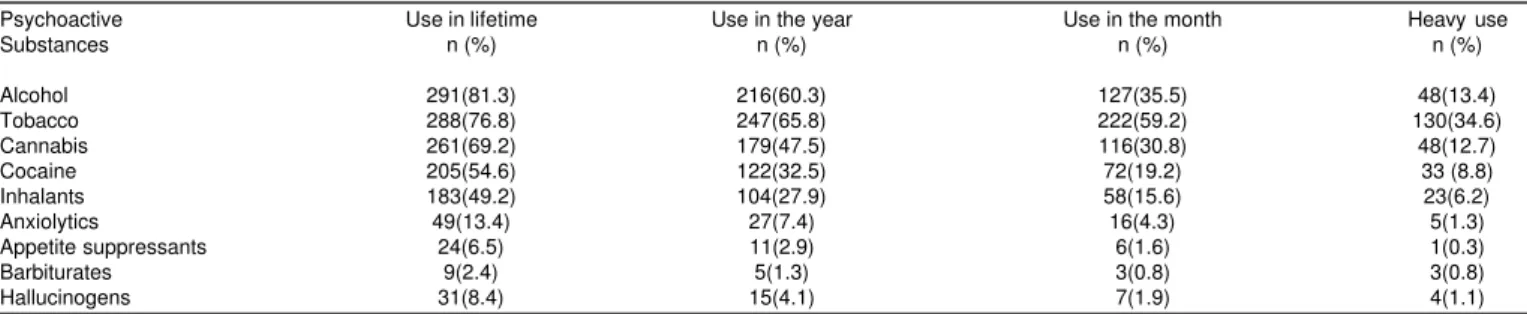
Table 1 shows the prevalence of psychotropic substances according to the use categories for all asked substances. Life-time use of licit drugs, alcohol and tobacco, was reported by 81.3% and 76.8% of interviewed children, respectively. To-bacco was more prevalent than alcohol in the categories of use in the year, in the month, and heavy use. Out of the interviewed, 80.9% claimed having already experienced any illicit drug. Among them, cannabis ranged first (69.2%), followed by co-caine (54.6%), inhalants (49.2%), anxiolytics (13.4%),
hallu-Table 1 - Use of psychotropic substances by children and adolescents institutionalized at Fundação do Bem Estar do Menor of Rio Grande do Sul, according to the categories of use.
Psychoactive Use in lifetime Use in the year Use in the month Heavy use
Substances n (%) n (%) n (%) n (%)
Alcohol 291(81.3) 216(60.3) 127(35.5) 48(13.4)
Tobacco 288(76.8) 247(65.8) 222(59.2) 130(34.6)
Cannabis 261(69.2) 179(47.5) 116(30.8) 48(12.7)
Cocaine 205(54.6) 122(32.5) 72(19.2) 33 (8.8)
Inhalants 183(49.2) 104(27.9) 58(15.6) 23(6.2)
Anxiolytics 49(13.4) 27(7.4) 16(4.3) 5(1.3)
Appetite suppressants 24(6.5) 11(2.9) 6(1.6) 1(0.3)
Barbiturates 9(2.4) 5(1.3) 3(0.8) 3(0.8)
Hallucinogens 31(8.4) 15(4.1) 7(1.9) 4(1.1)
Figure 1 - Comparison of prevalence of use in lifetime of psychoactive substances among children and adolescents living in shelter (n=130) and infraction (n=252) units at Fundação Estadual do Bem Estar do Menor of Rio Grande do Sul, in the year 1999.
cinogens (8.4%), appetite suppressants (6.5%) and barbiturates (2.4%). Regarding use in the year, in the month, and heavy use, the prevalence followed the same pattern of experimental use for most illicit drugs. Barbiturates (0.8%) prevailed over appetite suppressants (0.3%) only in the category heavy use.
Assessing the percentage of use in lifetime of the most used licit and illicit drugs by children, according to the conditions of living at FEBEM, we observed that children who had expe-rienced more drugs were those living in juvenile detention houses, except for tobacco, which had not a significant differ-ence (Figure 1).
In Table 2 we note that male children and adolescents com-mitted more infractions. Furthermore, boys living at those houses experienced more drugs than sheltered ones. On the other hand, sheltered girls experienced more drugs than delin-quent ones.
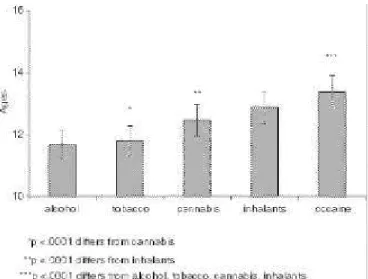
The first experience with tobacco or alcohol occurred be-tween 10 and 12 years of age in most of the interviewed. Mean age of drug consumption onset was 11.8±2.6 years for tobacco and 11.7±3.3 years for alcohol, without significant difference between them. As to the first experience with illicit drugs, it was significantly more tardive, in the range from 13 and 15 years. Cannabis was used after tobacco (12.4±2.3 years), fol-lowed by inhalants (12.9±2.4 years) and by cocaine (13.4±2.4 years) (p<0.001) (Figure 2).
Data analysis allowed us to detect a positive association be-tween the use of licit and illicit drugs. Of the interviewed who used alcohol at least once in lifetime, 84.6% claimed having already used tobacco, 80.1%, cannabis, 64.3% cocaine and 58,4% inhalants. The probability of an alcohol user using ex-perimentally tobacco, cannabis or inhalants was 8- to 11-fold than that of alcohol non-users (Table 3).
Of those who reported tobacco use, in the same category, 90% had already used alcohol, 86.6%, cannabis, 69.5%, cocaine and 61.3%, inhalants. The chance of a tobacco user utilizing experi-mentally alcohol, cannabis, cocaine or inhalants was six- to ten-fold than that of a non-user of tobacco (Table 3).
The experimental use of alcohol was two-fold among males than among females (CPR=2.10; CI95%=1.09-4.04). Alcohol use prevalence among males and females for all categories of use in the previous year and month, and heavy use, had not a significant difference. Of alcohol users, 26.7% ranged 10 to 15 years of age, and 73.3%, in the age range from 16 to 20 years. Mean age for the initiation of alcohol use was 10.6±2.7 years for females, and 11.9±3.3 years for males. Females had
three-Table 2 - Distribution by gender and living condition of the most used psychoactive substances in lifetime among children and adolescents at Fundação do Bem Estar do Menor of Rio Grande do Sul, in the year 1999.
Living condition
Psychoactive substance Gender Infraction Shelter CPR (CI 95%)
Alcohol Male 204 (84.3) 38 (15.8) 14.87 (6.85-32.77)*
(n=291) Female 13 (26.5) 36 (73.5)
Tobacco Male 201 (85.5) 34 (14.5) 22.57 (10.02-51.91)*
(n=288) Female 11 (20.8) 2 (79.2)
Cannabis Male 205 (88.4) 27 (11.6) 3.42 (1.29-8.94)*
(n=261) Female 20 (69) 9 (31)
Cocaine Male 170 (93.4) 12 (6.6) 26.56 (8.46-86.68)*
(n=205) Female 8 (34.8) 15 (65.2)
Inhalants Male 133 (86.4) 21 (13.6) 16.63 (6.0-47.49)*
(n=183) Female 8 (27.6) 21 (72.4)
*Cross-product ratio of a male child compared to a female one of having consumed once in lifetime the corresponding drug, being in infraction units compared to being in shelter units. Significant difference (p <0.001).
Table 3 - Consume of alcohol and tobacco, cannabis and inhalants among children and adolescents at Fundação Estadual do Bem Estar do Menor of Rio Grande do Sul, in the year 1999, according to use in lifetime of alcohol or tobacco, *p< 0.001 for all associations.
Substance Alcohol Alcohol CPR Tobacco Tobacco CPR
users non-users (CI 95%) users non-users (CI 95%)
(n=286) (n=66) alcohol (n=269) (n=83) Tobacco
(%) (%) (%) (%)
Alcohol - - - 89.9 53.0 7.94 (4.22 –15.01)
Tobacco 84.6 40.9 7.94 (4.22-15.01) - -
-Cannabis 80.1 25.8 11 (5.65 –21.64) 86.6 31.3 10.15 (5.64 –18.36)
Cocaine 64.3 16.6 8.76 (4.19 –18.74) 69.5 20.5 8.02 (4.30 –15.13)
Inhalants 58.4 12.2 10.29 (4.51-24.4) 61.3 19.3 6.42 (3.41-12.23)
fold chances of using alcohol before 12 years of age (CPR=2.96; CI95%=1.34-6.68).
Regarding problematic alcohol use by adolescents, 73% of the interviewed answered that they had already used alcohol up to drunkenness, once in their lifetime. Twenty per cent re-ported having consumed alcohol up to drunkenness in the month prior to the interview, without significant difference between genders. The interviewed reported other problems stemming from alcohol use, such as involvement in fights (64%), absence at school (19%), absence at work (8.5%), involvement in some kind of accident (5.5%) and traffic infraction when driving under the effect of alcohol (3.5%). More than 50% of the young-sters claimed that they had no family member with alcohol abuse, although 23.5% of them mentioned that their fathers drank excessively, followed by relatives (12%), siblings (6%) and mothers (5%).
Tobacco use at least once in lifetime, in the last year, and heavy use, was not significantly different between genders. Regarding the use in the previous month, however, males showed three-fold chances of using tobacco (CPR=2.6; CI95%=1.19-5.66). From those who claimed having already smoked, 62% had used tobacco for the first time under 12 years of age, and 38% after that age. Mean age for the initiation of tobacco use was 11.2±1.6 years of age for females and 11.9±2.8 years of age for males. Females had two-fold chances of smoking under 12 years of age than males (CPR=2.41; CI95%=1.11-5.35).
We noticed that the experimental use of cannabis was higher among males, who had four-fold chances of using the drug (CPR=4.54; CI95%=2.54-8.13). Among the interviewed who reported having already used cannabis there was no significant difference regarding gender and the use in the previous year, or month or heavy use. Seventy-eight percent of cannabis users were between 16 and 20 years of age and 21.6% were between 10 and 15 years of age. There was no significant difference be-tween genders regarding age of initiation of cannabis use.
Experimental cocaine use was more prevalent among males, whose chance of using the drug was three-fold when compared to females (CPR=3.11; CI95%=1.73-5.62). There was no significant difference regarding the remaining categories of use. Eighty-three percent of cocaine users were in the age range between 16 and 20 years and 17%, between 10 and 15 years. Otherwise, gender did not interfere with the age of initiation of this drug.
The use of inhalants did not differ significantly between gen-ders considering the parameters of use in lifetime, in the year and heavy use. We have also not observed significant differ-ences between gender and age of beginning of use of ants. However, females had three-fold chances of using inhal-ants in the previous month than males (CPR=3.28; CI95%=1.34-8.06). Of inhalant users, 26.1% were in the age range between 10 and 15 years and 73.9%, between 16 and 20 years. Of inhalant users, 53.4% informed having bought it, 6.7% reported having it at home, and 26% received from ‘friends’. Thirty-one percent had experienced inhalants for the first time at their friends’ house and 26.8%, in some kind of bar or night-club. The remaining users claimed not remembering the site or having used them in other sites.
Discussion
In this study, we verified that children from the state of Rio Grande do Sul, institutionalized at FEBEM, used licit drugs, alcohol and tobacco, in levels similar to other subjects of the same age range, be them street boys or students of state public schools.2,4,14 Of note, in spite of the fact that the Brazilian law
forbids the selling and distribution of alcohol beverages and tobacco for minors5,14,15 most of interviewed children and
ado-lescents had no difficulties to obtain these substances, as it was observed in other studies.14
Cannabis, cocaine and inhalants were the most used illicit drugs by these subjects, surpassing anxiolytics, hallucinogens, appetite suppressants and barbiturates. These rates are much higher than those presented by the state public school students5
or by street youngsters who attended school and have a reason-ably structured family7. The high rate of experimental users of
illicit drugs (80.9%) was similar to what was found in previous studies with Brazilian street youngsters6,7 and with young
American inmates,16 which are populations deemed at risk for
the use of drugs.
The use of illicit drugs does not occur because children are institutionalized, but it is previous to their entrance in the insti-tution. As it was previously mentioned, FEBEM sheltered, in differentiated conditions, both youngsters who committed de-linquent acts or infractions and those who were in conditions of family frailty, abuse or family abandonment. In this study we verified that the rates of use of illicit drugs in lifetime are significantly higher in youngsters submitted to socioeducational measures at FEBEM, i.e., among those who committed infrac-tions or delinquent acts, and who in this moment would be receiving attention at FASE-RS. However, we cannot state if the infractions perpetrated were concomitant or occurred after drug initiation. In fact, this and other studies10,17-20 showed an
association between the use of different drugs, licit and illicit, and delinquency or infractions. In a previous study, based on interviews performed with street children before any institu-tionalization, it was verified that social risk and abandonment by the family were related with delinquent activities and drug consumption.7 The use of drugs is part of a problem of
delin-quency and violent acts involving children and adolescents. It is still controversial whether the use of drugs is a cause or a consequence of social violence. However, there is consensus in that the activities to obtain money to buy drugs and drug traffic per se generate infracting acts and violent behaviors.21
According to the bi-directional model, the influence of drug consumption on juvenile delinquency is intense and earlier, and the effect of delinquency on the use of drugs in small but everlasting.11 That is, it is possible that the involvement in
delinquent behaviors, which led to the institutionalization and to the condition of family abandonment, increased the chances of drug initiation, which was perpetuated by the continuing of delinquency.10,11,18,19,22 On the other hand, despite the fact
interper-sonal relationships,20,23 sexual abuse, negligence, family
con-flicts, negative influences, such as drug-addicted parents, lim-ited job opportunities, inadequate homes, crimes in the neigh-borhood9,16,23,24 could be related to the use of drugs by
shel-tered children. These characteristics of abuse and negligence, which favor the drug consumption, were reported by the chil-dren and the institution’s researching team and health profes-sionals. Therefore, the activities with adolescents seen at the units of FASE or the Foundation for Special Protection should take into account not only the rates of drug consumption, but also the possible causes for that use.
However, our data point to a difference between genders in the issue of juvenile delinquency and drug use, as females showed higher association of the use of licit and illicit drugs with the condition of being institutionalized, under the form of shelter. Despite the attempts of explanation, based on the different op-portunities of initiation the use of drugs between genders,25 it is
recognized that the bi-directional model is only valid for males.11
It is proposed, therefore, that more studies with female popula-tions at risk should be performed to clarify this issue.
The associated use of multiple substances is increasingly more frequent among chemically-dependent subjets,2,18,19,22
what was also observed in this population. These data de-serves future investigation. Our results show a strong asso-ciation between the use of licit and illicit drugs. Alcohol us-ers have ten- to eleven-fold risk of being usus-ers of inhalants or cannabis compared to adolescents who did not use alcohol. Besides, tobacco users have ten-fold risk of being cannabis users and both alcohol and tobacco use increase eight-fold the risk of using cocaine. Due to these strong associations, we could infer that the studied adolescents are or become polydrug users, as it was seen in studies performed in other countires.1,26,27 In those studies, there is more evidence of
as-sociation between alcohol and cannabis use1,27 and tobacco or
alcohol and cannabis28 among student populations. Among
adolescents at social risk, there is evidence of association of the use of licit drugs with the use of cocaine.
The earlier subjects start using alcohol or tobacco, the higher will be their vulnerability for the development of abuse or de-pendence of the same substances and the concomitant use of illicit drugs.14,17,18,29,30 As the studied youngsters had also
dem-onstrated early consumption of licit drugs, in average at 11 years of age, we could verify that this use preceded that of illicit drugs, as well as that observed in other studies with
ado-lescents of populations at risk.10,20 According to the theory of
drug consumption progression,31 adolescents become initially
involved with alcohol, progress to cannabis and, in a third phase, to heavier drugs, such as cocaine.31-33 Our findings also point
out in this direction, but insert the use of inhalants after the initiation of cannabis and before the initiation of cocaine. There is still a wide discussion whether each of the used drugs func-tions as a risk factor for the use of multiple drugs or for the use of heavier drugs, or if the use of several drugs is related to the subjects’ individual, biological, social or cultural factors.28,34
Data of children at risk situations indicate that both situa-tions are possible, but studies about the interaction and pro-gression of the use of drugs in several populations should be performed in order to reach to any conclusion about the issue. As this is cross-sectional study, it is not possible to establish a causal relationship between the uses of each drug in the group of delinquent or sheltered subjects. Future studies should clarify if, for these populations, there is a more important relationship between delinquency and the sequential use of drugs, what has been already tested in other countries.18,19
The limitations of this survey are connected to the confi-dence in the self-reported data, reason why we made the deci-sion of not asking questions which could embarrass the inter-viewed, keeping therefore a greater compliance to the research. We have not, thus, obtained data related to the socioeconomic level, family situation and dynamics, use of drugs by family members and easiness of access to drugs. The interviewed also were not questioned about the time of internment and the qual-ity of the committed offense.
The applicability of the study is based on the observations that the institutionalized youngsters revealed having started substance use and delinquent behaviors at early age and, therefore, that preventive programs should start early, be-fore ten years of age and providing adequate conditions to their living environments. The need of delaying the use of al-cohol and tobacco should be emphasized as these drugs were first used and are considered as the gateway for other drugs. Therefore, the prevention could control the initial and regu-lar use of both licit and illicit drugs and could diminish the use of multiple drugs.
Acknowledgments
We are thankful to Dr. Flávio Danni Fuchs for his valuable suggestions in the preparation of this article.
References
1. Smart RG, Ogborne AC. Drug use and drinking among students in 36 countries. Addict Behav 2000;25(3):455-60.
2. Andrade AG, Bassit AZ, Kerr-Corrêa F et al. Fatores de risco associados ao uso de álcool e drogas na vida, entre estudantes de medicina do Estado de São Paulo. Rev ABP-APAL 1997;19(4):117-26.
3. Dewit DJ, Adlaf EM, Offord DR, Ogborne AC. Age at first alcohol use: risk factor for the development of alcohol disorders. Am J Psychiatry 2000;157:745-50.
4. Tavares BF, Béria JU, Lima MS. Prevalência do uso de drogas e desem-penho escolar entre adolescentes. Rev Saúde Pública 2001;35(2):150-8.
5. Galduróz JCF, Noto AR, Carlini EA. lV Levantamento sobre o uso de drogas entre estudantes de 1o e 2o graus em 10 capitais brasileiras, 1997.
São Paulo: Departamento de Psicobiologia da Escola Paulista de Medicina e Centro Brasileiro de Informações Sobre Drogas Psicotrópicas -CEBRID; 1997.
7. Forster LMK, Barros HMT, Tannhauser SL, Tannhauser M. Drug use among street children in southern Brazil. Drug Alcohol Dep 1996;43:57-62. 8. Lei Estadual no 11.800. DOE no 101, de 29 de maio de 2002. Porto Alegre
(RS). Disponível em URL: http://www.fase.rs.gov.br
9. Anderson NLR. Perceptions about substance use among male adolescents in juvenile detention. West J Nurs Res 1999;21:652-72.
10. Hays RD, Ellickson PL. Associations between drug use and deviant behavior in teenagers. Addict Behav 1996;21:291-302.
11. Mason WA, Windle M. Reciprocal relations between adolescent substance use and delinquency: a longitudinal latent variable analysis. J Abnormal Psychol 2002;111:63-76.
12. Smart RG, Hughes DPH, Johnston LD et al. A methodology for students drug-use surveys. Geneva: World Health Organization; 1980. p. 55. (Off-set Publication, 50)
13. Dean AG, Dean JA, Coulombier D et al. Epi Info, Version 6: a word processing, database, and statistics program for epidemiology on microcomputers. Center for Disease Control and Prevention, Atlanta, Georgia: USA and World Health Organization, Geneva - SW; 1994. 14. Pechansky F. Patterns of alcohol use among adolescents living in Porto
Alegre, Brazil. J Psychoactive Drugs 1998;30:45-51.
15. Estatuto da Criança e do Adolescente. Lei Federal 8069/1990. Porto Alegre (RS): Conselho Municipal dos Direitos da Criança e do Adolescente; 1997. 16. Hossain S, Hossain A. Substance abuse and need for treatment among juvenile arrested (SANTA) in Utah. Utah State Division of Substance Abuse, September, 1997. Disponível em URL: http//www.hsdsa.state.ut.us/ pdfiles/sfinal97.pdf
17. Fergusson DM, Lynskey MT, Horwood LJ. Alcohol misuse and juvenile offending in adolescence. Addict 1996;91:483-94.
18. Macgarvey EL, Canterbury RJ, Waite D. Delinquency and family problems in incarcerated adolescents with and without a history of inhalant use. Addict Behav 1996;21:537-42.
19. Mackesy-Amiti ME, Fendrich M. Inhalant use and delinquent behavior among adolescents: a comparison of inhalant users and other drug users. Addict 1999;94:555-64.
20. aylor J, Malone S, Iacono W G, McGue M. Development of substance dependence in two delinquency subgroups and nondelinquents from a male twin sample. J Am Acad Child Adolesc Psychiatry 2002;41:386-93. 21. Collins JJ. Summary thoughts about drugs and violence. NIDA Res Mono
Ser 1990;103:265-75.
22. Ellickson PL, Collins RL, Bell, RM. Adolescent use of illicit drugs other than marijuana: how important is social bonding and for which ethnic groups? Subst Use Misuse 1999;34(3):317-46.
23. Patton GC, Hibbert M, Rosier MJ, Carlini JB, Caust J, Bowes G. Patterns of common drug use in teenagers. Aust J Public Health 1995;19(4):393. 24. Micheli D, Formigoni MLOS. Are reasons for the first use of drugs and
family circumstance predictors of future use patterns? Addict Behav 2000;25:1-4.
25. Van Etten ML, Neumark YD, Anthony JC. Male-female differences in the earliest stages of drug involvement. Addiction 1999;94:1413-9. 26. Galaif ER, Newcomb MD. Predictors of polydrug use among four ethnic
groups: a 12-year longitudinal study. Addict Behav 1999;24:607-31. 27. Collins RL, Ellickson PL, Bell RM. Simultaneous polydrug use among
teens: prevalence and predictors. J Subst Abuse 1999;10:233-53. 28. Lynskey MT, Fergusson DM, Horwood LJ. The origins of the correlations
between tobacco, alcohol, and cannabis use during adolescence. J Child Psychol Psychiatr 1998;39:995-1005.
29. Escobedo LG, Marcus SE, Holtzman D, Giovino GA: Sports participation, age at smoking initiation, and the risk of smoking among US high school students. JAMA 1993;269:1391-5.
30. Grueber E, Diclemente RJ, Anderson MM, Lodico M. Early drinking onset and its association with alcohol use and problem behavior in late adolescence. Prev Med 1996;25:293-300.
31. Kandel DB, Yamaguchi K, Chen K. Stages of progression in drug involvement from adolescence to adulthood: further evidence for the gateway theory. J Stud Alcohol 1992;53:447-57.
32. Dunn J, Laranjeira R. Cocaine - profiles, drug histories, and patterns of use of patients from Brazil. Subst Use Misuse 1999;34(11):1527-48. 33. Kandel D. Stages in adolescent involvement in drug use. Science
1975;190:912-4.
34. Lynskey MT, Heath AC, Bucholz KK et al. Escalation of drug use in early-onset cannabis users vs co-twin controls. JAMA 2003;289:427-33.
Correspondence:
Maristela Ferigolo
Rua Sarmento Leite, 245 3º andar - Farmacologia 90050-170 Porto Alegre, RS, Brazil