ENFERMEIROS COM CARGOS DE CHEFIA E MEDIDAS PREVENTIVAS À EXPOSIÇÃO OCUPACIONAL: FACILIDADES E BARREIRAS
ENFERMEROS CON CARGOS DE JEFE Y MEDIDAS PREVENTIVAS A LA EXPOSICIÓN OCUPACIONAL: FACILIDADES Y BARRERAS
Silmara Elaine Malaguti1, Miyeko Hayashida2, Silvia Rita Marin da Silva Canini3, Elucir Gir4
RESUMEN
En este estudio descriptivo se tuvo como objetivo evaluar las facilidades y barreras enfrentadas por enfermeros con cargo de jefe en cuanto a las medidas preventivas a la exposición ocupacional que involucre material biológico, teniendo como base el Modelo de Creencias en Salud de Rosens-tock. El estudio fue realizado con 87 enfer-meros de un hospital escuela del interior de Sao Paulo, en el 2006. Los datos fueron recolectados a través de una guía de entre-vista semi-estructurada, con preguntas a-biertas y cerradas y analizados con la técni-ca del Análisis de Contenido. El equipamien-to de protección individual fue citado como la mayor facilidad para la prevención de accidentes, no obstante la falta de adhe-sión al uso y uso incorrecto fueron referidos como barreras para la prevención de acci-dentes y como los principales motivos para que éstos ocurran. Es importante que estos enfermeros estén preparados para desa-rrollar estrategias individualizadas y moti-vadoras para la adhesión al uso del equipa-miento de protección individual en sus sectores de trabajo.
DESCRIPTORES
Exposición ocupacional. Riesgos ocupacionales. Supervisión de enfermería.
ABSTRACT
This descriptive study aimed to assess the facilities and barriers that nurses in leading positions endure with respect to the nursing team’s compliance to measures for preventing occupational exposure invol-ving biological materials, based on Rosens-tock’s Health Belief Model. The study was carried out with 87 nurses of a university hospital in Sao Paulo, Brazil, in the year of 2006. Data were collected through a semistructured form with open and closed questions and analyzed through Content Analysis. Individual protection equipment was mentioned as the greatest form for preventing accidents, but lack of complian-ce to usage and incorrect use were indica-ted as barriers to accident prevention and as the main reasons for their occurrence. It is important for these nurses to be prepa-red to develop individualized and motiva-ting strategies focused on compliance to the use of individual protection equipment in their work sectors.
KEY WORDS
Occupational exposure. Occupational risks. Nursing supervisory.
RESUMO
Este estudo descritivo teve como objetivo avaliar as facilidades e barreiras enfren-tadas por enfermeiros com cargo de chefia quanto às medidas preventivas à exposição ocupacional envolvendo material bioló-gico, tendo como base o Modelo de Crenças em Saúde de Rosenstock. O estudo foi reali-zado com 87 enfermeiros de um hospital-escola do interior paulista em 2006. Os da-dos foram coletada-dos através de um roteiro semi-estruturado, com questões abertas e fechadas e analisados pela técnica de Aná-lise de Conteúdo. O equipamento de prote-ção individual foi citado como a maior facilidade para a prevenção de acidentes, porém a falta de adesão ao uso e o uso incor-reto foram referidos como barreiras para a prevenção de acidentes e como os princi-pais motivos para a ocorrência destes. É importante que estes enfermeiros estejam preparados para desenvolver estratégias individualizadas e motivadoras para ade-são ao uso do equipamento de proteção individual em seus setores de trabalho.
DESCRITORES
Exposição ocupacional. Riscos ocupacionais. Supervisão de enfermagem.
* Extracted from the thesis “Crenças de enfermeiros com cargo de chefia em um hospital universitário sobre os riscos ocupacionais com material biológico”, University of São Paulo at Ribeirão Preto College of Nursing, 2006. 1Nurse. Nursing graduate at the University of São Paulo at Ribeirão Preto College of
Nursing (EERP-USP). Ribeirão Preto, SP, Brazil. [email protected] 2 Nurse. Laboratory specialist of University of São Paulo at Ribeirão Preto
College of Nursing (EERP-USP). Ribeirão Preto, SP, Brazil. [email protected] 3 Professor of Fundamental Nursing, University of São Paulo at Ribeirão
Preto College of Nursing (EERP-USP). Ribeirão Preto, SP, Brazil. [email protected] 4 Full Professor of University of São Paulo at Ribeirão Preto College
Nurses in leading positions and measures
to prevent occupational exposure:
facilities and barriers
*O
RIGINAL
A
R
INTRODUCTION
Nursing professionals are constantly exposed to the risk of acquiring infections transmitted by blood-borne pathogens, since their work is closely and frequently related to blood and organic fluids (1). Studies show that over 20 agents may be transmitted through percutaneous exposure, through the blood (2), and this is the main pathway of transmission of the human immunodeficiency virus (HIV), hepatitis B virus (HBV) and hepatitis C virus (HCV)(3).
The first confirmed case of the AIDS virus transmission by percutaneous exposure to a healthcare professional occurred in 1984(4). Worldwide, there were 57 cases of healthcare professionals infected by the HIV during occupational exposure. In 48 cases, percutaneous exposure was the main reason for infection and 139 other cases involving health professionals are being investi-gated to confirm whether there was HIV infection during occupational exposure (5).
In Brazil, there are reports that a nursing assistant was infected by the HIV and also three other reports with nursing professionals exposed to contaminated blood through percutaneous injuries, acquiring the virus (6).
Among the risk factors, the accident with needlestick injuries is the main occupational exposure cause in health institutions (7), ac-counting for 87.5% of the accidents occurred in a health institution(8).
Studies show that accidents with nee-dlestick injuries represent greater incidence with biological materials and more effective measures should be implemented, such as update courses, educative programs, medi-cal accompanying, vaccination and the use of safety equipment to perform invasive procedures (9-10).
Prevention measures designed to avoid and reduce occupational exposure were implemented in several coun-tries through training and personal development programs, service education, lectures and courses. In the USA, these programs are being annually reviewed so as to evaluate the new technologies implanted in order to reduce occupational exposure risks involving biological materials (9).
The adoption of these preventive measures poses a challenge to nursing. They require a change of habits, which many experienced professionals have difficulties to deal with. It turns out to be an obstacle that hinders occupational accident prevention involving potentially contaminated bio-logical materials. The measures are theoretically accepted but not always performed (10).
The participation of head nurses is extremely impor-tant, since when they know the service complexity and
dynamics, they are able to develop more effective strat-egies to prevent occupational exposure. These stratstrat-egies were elaborated from the difficulties and activities develo-ped by other professionals. Head nurses also provide guidance regarding the existing care routines at work.
Thus, this study was carried out with the purpose of evaluating the facilities and barriers faced by nurses who perform leading roles at a university hospital in the coun-tryside of the State of São Paulo, regarding the professional compliance with preventive measures against occu-pational exposure involving biological materials. The study was based on Rosenstock’s Health Belief Model (HBM) (11-12).
The HBM is concerned with people’s preventive actions and behaviors regarding health. It evidences people’s com-mon resistance in accepting disease prevention and it is composed of four dimensions: perceived susceptibility, referred as the subjective perception of personal risk of contracting diseases; perceived severity, that is, gravity of disease and its consequences; perceived benefits, which are the beliefs regarding action effectiveness; and percep-tion of positive consequences and perceived barriers as negative aspects of the action(11-12). Hence, the action potential is the result of combined levels of susceptibility and sever-ity, which are perceived in the disease. The action modality is chosen in function of the benefit perception minus perceived barriers in the behavioral alternatives.
METHOD
This is a descriptive study, performed from May 31 to August 30, 2006 at a large school hospital in a city of the State of São Paulo, composed by two units. In this study, they are named Unit A and Unit B.
The criteria to include nurses in the study sample were: being a nurse, being the head of a nursing team, being a head nurse or in charge of hospitalization or ambulatory units and handing the data collection form after no more than three visits by the researcher.
According to the inclusion criteria, the sample was composed of 126 nurses who had leading positions, nurses in charge and lead-nurses. However, 87 nurses answered the form and 17 were unwilling to participate. The form was not handed by 13 nurses within the pre-determined time for data collection and 9 were not acting as leaders when data were collected.
The study was approved by the institution’s Ethics Com-mittee (Process HCRP no. 15336/2005) and took the re-search norms involving human beings (Resolution no. 196/ 1996) into consideration. The information provided by the participants was kept anonymous and confidential.
The adoption of these preventive measures poses a challenge to nursing. They require a change of habits, which
many experienced professionals have difficulties to deal with.
It turns out to be an obstacle that hinders occupational accident prevention involving
potentially contaminated biological
The semi-structured script for data collection elabo-rated for this investigation was composed by multiple-choice questions regarding the professionals’ profiles. The questions were open-ended when the themes were related to occupational exposure and the HBM dimensions. The instrument was subjected to validation, regarding form and content, by five specialists in the thematic. Their con-siderations were then obeyed.
Data were collected during all shifts and the instrument to collect data was applied after the nurses showed willing-ness in participating in the research and after they signed the term of consent.
The data extracted from the multiple-choice questions were analyzed quantitatively through the software EpiInfo, version 3.3.2. There was also descriptive statistical anal-ysis, whose results are displayed in tables, percentages, averages and intervals.
The qualitative answers were analyzed descriptively and categorized so as to enable the interpretation of the answer percentage, through content analysis(13), whose steps consist of careful speech analyses, pre-analyses, exploration, treatment and result interpretation.
RESULTS AND DISCUSSION
Of the 87 (100.0%) nurses participating in the study, 69 (79.3%) work at unit A and 18 (20.7%) at unit B. The difference is explained by the lower number of beds available and nurses working at unit B. There are also differences when it comes to hierarchical structure and forms of work organ-ization between the units of the institution.
Regarding leading roles, 41 (47.1%) were working as nurses in charge, 41 (47.1%) as head nurses and 05 (5.7%) as direct-ors. The predominance of women in the nursing team is con-firmed in this study, accounting to 90.8% of the sample.
The participants’ age group ranged from 25 to 56 years, with an average age of 41 years. The experience in the institution ranged from 2 to 30 years, with an average period of 14 years. Overall, 35 (40.2%) of them had been working in the institution for less than 10 years. Regarding the time after they graduated, 02 (2.3%) nurses did not answer. The interval of the other 85 (97.7%) nurses ranged from 02 to 31 years, with an average interval of 13 years. However, 38 (43.7%) had graduated less than 10 years before.
When inquired about the participation of the lead-nurse in biosecurity courses, 53 (60.9%) reported that they had participated in biosecurity courses. However, only 43.6% acknowledged that the participation in a course occurred between 1 and 14 years (average = 3 years), 14 (26.4%) in two years and 06 (11.3%) in three years.
When it comes to participation in specific SP training, only 41 (47.1%) of the nurses reported that they had re-ceived some sort of specific training. Some of their answers
...I received specific training about the thematic every year, through the nineteen years I’ve worked for this institution (E71).
...I participated in a SP training when I was admitted in the institution eight years ago (E23).
...the only training I had was through an educational folder about preventive measures, four years ago (E69).
The 41 (47.1%) remaining nurses claimed not to have received SP training during their activities in the institution and 05 (5.7%) did not know how to answer.
Regarding the time when they participated in courses, 61 (70.1%) nurses did not remember or did not know how to answer. Among those who answered, the participation varied from 1 and 12 years (average = 1 year). 06 answered that their participation had occurred one year before.
When the professional realizes their own vulnerability and that the risky situations occurred due to a lack of protective measures, they are more likely to make decisions towards behaving preventively. The acceptance of personal susceptibility to risk and the belief that this is dangerous produces a propelling power to action(12-13).
The 70 (81%) nurses considered themselves susceptible to HIV, HBV and HCV by occupational exposure. Seventeen (19.5%) other nurses did not consider themselves susceptible because they adopted IPE. They were fully aware of the procedures involving biological materials and cor-rect disposal of contaminated materials, as the follow-ing answers show.
...because I use all SP with attention when performing the procedures (E13).
...because I use all the IPE recommended by the hospital (E56).
Authors of a study carried out with healthcare workers demonstrated that they have superficial information about their work. Their knowledge is not turned into effective action to prevent accidents and occupational diseases. The study shows the need of actions that may cause this situation to change(14).
The HBM describes that severity is related to the level of severity a given disease has over physiological func-tioning, its reflex over mental, psychological and social status and the implications of the disease over work, over family life and workers’ social relationships(11-12).
The following answers describe the consequences for the injured professionals, from the perspective of nurses in leading positions.
... risk of contracting diseases, and when you’re not using IPE at the moment of the accident, you may be punished (E68). ... acquiring the disease and having your paycheck reduced because of the leave (E75, E83).
...temporary or permanent loss of functional capacity, physical and psychological damage which may be reversible or not, onset of diseases, financial restriction and difficulties to survive (E23).
Emotional problems related to a likely infection and uncertainty of the exam results, which may lead to family and partner instability, were also mentioned as conse-quences of a professional accident, as described here.
...emotional impairment, being likely to acquire one of these diseases and transmit them to your spouse (E26). ...damage to physical and psychological health, which may eventually compromise your family stability (E19, E38, E63, E86, E87).
Nevertheless, the risk of falling ill was also mentioned in the subsequent answers, as one of the main conse-quences of the accident for the professionals, since they are likely to acquire a disease that will cause temporary or permanent physical impairment, with risk of death.
... acquiring a disease that may cause future damage and even death (E3, E14, E17, E20, E25, E27, E43, E44, E49, E51, E53, E61, E70, E85).
...chronic or occupational disease and treatment with
aggressive drugs (E5, E56).
...health problems, stress, work leave and routine alter-ations (E7, E9, E28, E29).
The conflicts experienced by the workers performing their activities, as well as the subjective aspects that may influence their jobs, should be considered when accidents are analyzed. As it is a predominantly female profession, several subjective aspects should be considered. Many nurses have double work shifts and perform household chores and take care of their children(15).
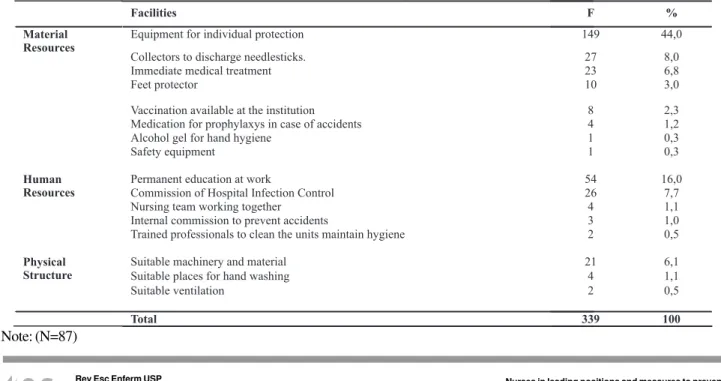
In relation to the facilities, the nurses were asked to cite five measures, available at the institution, that they considered favorable to be adopted as preventive mea-sures regarding exposure to potentially contaminated bio-logical materials. This item was not answered by two nurses and 339 answers were obtained. They were put in three categories: a) material resources, b) human re-sources and c) physical structure, shown in table 1.
The availability of IPE to prevent accidents was cited in 149 (44.0%) answers and stood out as the greatest facil-ity. The use of disposable collectors for needlesticks was cited by 27 (31%) participants. However, only one (1.1%) cited availability of safety equipment as a prevention measure. This is curious, since this strategy has been con-sidered one of the main measures to reduce occupational accidents in several countries(5,9-10).
Permanent education at work using SP is appointed by 54 (16.0%) answers related to the institution’s human re-sources. It is a key strategy to diminish occupational ex-posure to biological materials, especially when handling needles and other sharp materials.
Table 1 - Distribution of answers shown by nurses in leading positions, according to available facilities that they have to prevent
accidents - Ribeirão Preto - 2006
Facilities F %
Equipment for individual protection 149 44,0
Collectors to discharge needlesticks. 27 8,0
Immediate medical treatment 23 6,8
Feet protector 10 3,0
Vaccination available at the institution 8 2,3
Medication for prophylaxys in case of accidents 4 1,2
Alcohol gel for hand hygiene 1 0,3
Material Resources
Safety equipment 1 0,3
Permanent education at work 54 16,0
Commission of Hospital Infection Control 26 7,7
Nursing team working together 4 1,1
Internal commission to prevent accidents 3 1,0
Human Resources
Trained professionals to clean the units maintain hygiene 2 0,5
Suitable machinery and material 21 6,1
Suitable places for hand washing 4 1,1
Physical Structure
Suitable ventilation 2 0,5
The occurrence of accidents in their work sectors is linked to several factors and thus, the nurses were asked to cite five reasons that determine the occurrence of acci-dents in their units. There were 184 answers that were put
Table 2 - Table 2 - Table 2 - Table 2 -
Table 2 - Distribution of answers given by nurses in leading positions, according to reasons that determine the occur-rence of accidents at the unit, which are related to professional, institutional and patient aspects - Ribeirão Preto - 2006
Note: (N=87)
into three categories: a) professional-related aspects, b) institution-related aspects and c) patient-related aspects, as shown in Table 2.
Of all nurses, only 01 (1.1%) did not know how to answer the reasons related to the occurrence of accidents at the unit. However, the professional resistance in using IPE was cited in 76 answers that refer to the professional-related category.
A study carried out on nursing compliance to SP demon-strated that the lack of credibility of the protection meas-ure effectiveness, including IPE, associated with the diffi-culty in training staff, non-compliance with the pre-established norms and the workers’ apathy. These are the situations found on a daily basis(16).
Attitudes as recapping the needles and incorrectly
dis-posing the contaminated materials were found in 16 (8.7%) and 32 (17.4%) answers. They are the main causes of ac-cidents among nursing professionals in a hospital setting(17). In the patient-related aspects category, the movement of the patient was the only reason mentioned in 6 (3.2%) answers. It also appears in other nursing studies.
When they were asked to cite five barriers found on a daily basis to adhere to preventive measures of occupational exposure with biological materials, 190 answers were obtained. They were divided into three categories: a) related to the nursing professionals; b) related to the institution and c) related to the patients, as shown in Table 3.
Reasons that determine the occurrence of accidents at the unit f %
Resistance from the professional to use equipment for individual protection 76 41,3
Inappropriate disposal of contaminated material 32 17,4
Contaminated needles being recapped 16 8,7
1
Lack of attention during procedure performance 1 6,0
Professional
Negligence, incompetence and imprudence 5 2,7
Isolation for infectious diseases in sufficient number 2 1,1
Inadequate number of professionals 18 9,8
Institution
Materials without safety equipment 2 1,1
Patient Movement of patient during the procedure performance 6 3,2
Total 184 100
16 8,7
Belief of the professional that accidents will not happen
Table 3 - Table 3 - Table 3 - Table 3 -
Table 3 - Distribution of answers attributed by nurses in leading positions of a university hospital, according to barriers that impair or impede the prevention of occupational accidents with biological risk - Ribeirão Preto - 2006
ote: (N=87
Barriers endured to prevent accidents with biological materials F %
Professional
Lack of compliance with SP 58 30,6
No information about the risks 41 22,0
Hurried procedures 12 6,3
Individual beliefs that accidents will not occur 11 5,9
Not informing the accident due to fear of contracting an infectious disease 4 2,1
Institution
Insufficient number of nursing professionals 17 14,2
Work overload 13 6,9
Insufficient number of material to perform the procedures 10 5,2
Bureaucracy and delay in medical treatment of the injured professionals 9 4,7
Inappropriate physical space 3 1,7
Unknown contaminated material 3 1,7
Lack of safety equipment 2 1,0
Insufficient number of isolation units 2 1,0
Patient
Movement of patient during procedure 2 1,0
Patient's gravity 2 1,0
Late diagnosis for application of isolation measures 1 0,6
The lack of compliance to SP and the lack of information about the risks were cited as the main barriers related to nursing professionals, showing the importance of nurses in leading positions when it comes to professional educa-tion regarding biosecurity.
Insufficient number of professionals, work overload and an insufficient amount of material to perform the pro-cedures were cited as being the main barriers related to the institution. Regarding patients, besides their movement during the procedures that involved needlestick injuries, the clinical status gravity and late diagnosis of an infec-tious disease were cited as barriers that impede or impair the accident prevention. Regarding late diagnosis,
it is often impossible to identify, surely and quickly, the status and the transmission probabilities. This fact is shown at the moment of assistance. Any person should be seen as potentially infected, which demands the adoption of special measures to protect health care workers(18).
Preventive programs are fundamental. When the efforts are focused on motivation and compliance with the SP norms, the frequency to blood exposure can be reduced (4).
Thus, the lead-nurse will be able to influence the actions of other members to determine and meet objectives. They can guide other workers, providing assistance in how, what and where to do. They can also establish bilateral commu-nication with people, providing attention, support and en-couragement (19).
This nurse will also be able to develop activities so as to stimulate the professionals to become aware of the work-related risks. Hence,
health service management has been historically performed by female nurses. They have used their skills of organization and routine systematization, making the hierarchy and discipline present in public institutions legitimate. However, female nurses lack the awareness of the potential of change that their managerial activities have. Through their work process, they may introduce new instruments to reorganize their activities.
The participation of nurses in coordination positions is fundamental regarding the reporting of work accidents. They can advise the injured professionals and lead them to specialized services, not only for clinical treatment, but also in order to register the accident officially. It helps the institution to implement effective safety measures based on the service reality.
CONCLUDING REMARKS
The data analysis has allowed us to conclude that the main difficulties endured by nurses in leading positions to prevent accidents among nursing workers are related to the lack of compliance of other professionals in the nursing team to the measures established by the SP.
Nearly all the study participants realized that they were susceptible to contracting some pathogens or diseases, and they described that the pathogen infection may cause health problems such as the development of chronic diseases, the risk of developing generalized infections or skin injuries. Also, risk of developing diseases that may lead to death.
However, although they may resort to facilities avail-able at the institution, such as the appropriate equipment to implement all the prevention measures against occu-pational exposure, nursing professionals resist using these materials.
It is essential that these professionals often receive proper guidance and training. Therefore, they will be able to develop new, creative strategies to stimulate the nursing team and comply with the practices of prevention against occupational exposure, such as the appropriate use of the IPE.
Permanent education as an educational and transfor-mational strategy at work may aid these nurses to perform their leading positions. They will be able to work directly with their service sectors, with more individualized and effective strategies, based on the reality found on a daily basis by the work team.
REFERENCES
1. Marziale MHP, Nishima KYN, Ferreira MM. Riscos de con-taminação ocasionados por acidentes de trabalho com material pérfuro-cortante entre trabalhadores de en-fermagem. Rev Lat Am Enferm. 2004;12(1):36-42.
care workers: a review of pathogens transmitted in published cases. Am J Infect Control. 2006;34(6):367-75.
4. Brasil. Ministério da Saúde. Secretaria de Vigilância em Saúde. Recomendações para atendimento e acompa-nhamento de exposição ocupacional a material bioló-gico: HIV e hepatites B e C. Brasília; 2004.
5. Do AN, Ciesielski CA, Metler RP, Hammett TA, Li J, Fleming PL. Occupational acquired human immunodeficiency virus (HIV) infection: national case surveillance data during 20 years of the HIV epidemic in the Unites States. Infec Control Hosp Epidemiol. 2003;24(2):86-96.
7. Almeida CAF, Benatti, MCC. Exposições ocupacionais por fluídos corpóreos entre trabalhadores da saúde e sua adesão à quimioprofilaxia. Rev Esc Enferm USP. 2007; 41(1):120-6.
8. Balsamo AC. Estudo sobre os acidentes de trabalho com exposição dos líquidos corporais humanos em traba-lhadores de saúde [dissertação]. São Paulo: Escola de Enfermagem, Universidade de São Paulo; 2002.
9. Rogues AM, Verdum-Esquer C, Laville MF, Lasheras A, Sarrat A, Beaudelle H, et al. Impact of safety devices for preventing percutaneous injuries related to phlebotomy procedures in health care workers. Am J Infect Control. 2004;32(8):441-4.
10. Reddy SG, Emery RJ. Assessing the effect of long-term availability of engineering controls on needlestick inju-ries among health care works: a 3 year pre-imple-mentation and post-implepre-imple-mentation comparison. Am J Infect Control. 2001;29(6):425-7.
11. Rosenstock IM. Historical origins of the Health Belief Model. Health Educ Monogr. 1974;2(4):328-35.
12. Rosenstock IM. The Health Belief Model and preventive health behavior. Health Educ Monogr. 1974;2(4):354-86.
13. Bardin L. Análise de conteúdo. Lisboa: Edições 70; 1997.
14. Oliveira BRG, Livieira BRG, Murofuse, NT. Acidentes de trabalho e doença ocupacional: estudo sobre o conhe-cimento do trabalhador hospitalar dos riscos à saúde de seu trabalho. Rev Lat Am Enferm. 2001;8(5):13-20.
15. Neves TP, Cortez EA, Moreira COF. Biossegurança como ação educativa: contribuições à saúde do trabalhador. Cogitare Enferm. 2006;11(1):50-4.
16. Gir E, Takahashi RF, Oliveira MAC, Nichiata LYI, Ciosak SI. Biossegurança em DST/AIDS: condicionantes da ade-são do trabalhador de enfermagem às precauções. Rev Esc Enferm USP. 2004;38(3):245-53.
17. Moura JP, Gir E, Canini SRMS. Acidentes ocupacionais com material perfurocortante em um hospital regio-nal de Minas Gerais, Brasil. Cienc Enferm. 2006;12(1): 29-37.
18. Souza ACS. Risco biológico e biossegurança no cotidi-ano de enfermeiros e auxiliares de enfermagem [dis-sertação]. Ribeirão Preto: Escola de Enfermagem de Ribeirão Preto, Universidade de São Paulo; 2001.
19. Galvão CM, Trevizan MA, Sawada NO, Dela Coleta JA. Liderança situacional: estrutura de referência para o trabalho do enfermeiro-líder no contexto hospitalar. Rev Lat Am Enferm. 1998;6(1):81-90.
20. Ermel RC, Fracolli LA. Processo de trabalho de gerência: uma revisão da literatura. Rev Esc Enferm USP. 2003; 37(2):89-96.
This is part of an Integrated Project, supported by CNPq and FAPESP, titled