Influence of social support on the quality
of life of family caregivers while caring
for people with dependence
*O
riginal
a
r
ticle
InfluêncIa do apoIo socIal na qualIdade de vIda do cuIdador famIlIar de pessoas com dependêncIa’
InfluencIa del apoyo socIal en la calIdad de vIda del cuIdador famIlIar de personas con dependencIa
* Taken from the thesis “qualidade de vida de cuidadores de pacientes com perdas funcionais e dependência atendidos em domicílio pelo programa saúde da família do município de são paulo”, university of são paulo school of nursing, 2007. 1 rn. ph.d. student, Graduate program in collective Health,
university of são paulo school of nursing. são paulo, sp, Brazil. [email protected] 2 rn. full professor, collective Health nursing department, university
RESUmo
O objeivo deste estudo foi avaliar a qua
-lidade de vida de cuidadores familiares de pessoas dependentes atendidas por equi
-pes de Saúde da Família e a relação com o apoio social. Foram entrevistados 66 cuida
-dores, uilizando o WHOQOL-bref para ava
-liação da qualidade de vida, e Zarit Burden Interview para a sobrecarga. O domínio Relações Sociais do WHOQOL-bref obteve o segundo melhor escore. Na análise de regressão linear múlipla, cuidadores do sexo feminino com menores escores de so -brecarga e aqueles que recebiam ajuda de alguém para realizar o cuidado alcançaram os maiores escores. Da mesma forma, cui
-dadoras com companheiros apresentaram maior escore médio na avaliação global da qualidade de vida e saúde do que as sem companheiros. Os resultados fornecem in
-dícios da inluência da rede de apoio social na qualidade de vida e sobrecarga dos cui
-dadores familiares.
dEScRitoRES
Qualidade de vida Cuidadores Família Apoio social Enfermagem familiar
AbStRAct
The objecive of this study was to evaluate the Quality of Life (QOL) of family caregiv -ers of handicapped people atended at home by Family Health Teams and the rela
-ionship with their social support. Sixty-six family caregivers were interviewed using the WHOQOL-bref for a QOL evaluaion and Zarit Burden Interview for the burden. The Social Relaions domain of the WHO
-QOL-bref received the second best score within the domains of the instrument. During muliple linear regressions analysis, female caregivers, with low burden scores and who had received help from someone to perform the care, obtained the high
-est scores. Similarly, caregivers with part
-ners had higher mean scores in the over
-all global assessment for QOL and health than those without partners. The results provide evidence of the inluence of social support regarding Quality of Life and the burden perceived by family caregivers.
dEScRiPtoRS
Quality of life Caregivers Family Social support Family nursing
RESUmEn
El estudio objeivó evaluar la calidad de vida de cuidadores familiares de personas dependientes atendidas por equipos de Sa
-lud de la Familia y la relación con el apoyo social. Fueron entrevistados 66 cuidadores, uilizando el WHOQOL-bref para evalua
-ción de calidad de vida y Zarit Burden In
-terview para la sobre varga. El dominio Re
-lacionas Sociales del WHOQOL-bref obtuvo el segundo mejor puntaje. En el análisis de regresión linear múliple, cuidadores de sexo femenino con menores puntajes de sobrecarga y recibiendo ayuda de alguien para efectuar los cuidados presentaron mayores puntajes medios en la evaluación global de la calidad de vida y salud que las que no ienen compañero. Los resultados brindan indicios de la inluencia de la red de apoyo social en la calidad de vida y so
-brecarga de los cuidadores familiares.
dEScRiPtoRES
Calidad de vida Cuidadores Familia Apoyo social
intRodUction
Taking care of a dependent relaive at home entails diferent physical, psychological and social changes for caregivers. One of the most afected aspects is the social network and support, due to the lack of opportuniies for leisure aciviies, impossibility to go out to work and changes in family rouines.
The terms social network, social support and social relaions are oten used as synonyms. Social network, however, refers to the group of people with whom the individual keeps contact or some kind of social bond and mainly involves quanitaive aspects of social contacts(1). Therefore, it is related to that person’s structural and insi -tuional dimension.
Social support, on the other hand, is a reciprocal pro -cess, regarding any informaion or support ofered by people or groups whom we usually have contact with and which entails a posiive efect for support
receivers or also for the providers. It refers to having someone to count on in diicult situaions in order to receive, for example, material, emoional or afecive help and, in addiion, relates to inding oneself valued in the context of the groups one is part of(2). Thus, it considers the funcional or qualita -ive dimension of the social network.
The role of family caregiver can afect both caregivers’ social network and social support. Many studies have revealed that the caregiver’s main network comprises rel
-aives and friends. It should be highlighted that many caregivers do not receive help from anyone(3) or have few people to count on in comparison with the number they considered part of their social network(4).
Specialists consider that the social network entails posi -ive and nega-ive efects for individual health, as: a) the presence of family igures miigates the reacion of alert -ness (greater safety); b) social relaions contribute to give meaning to members’ lives and c) the network provides daily feedback, monitoring perceived health alteraions(5).
Diseases can also afect this network, due to an in -terpersonal aversive efect (in case of sigmaizing con -diions), restricions to the subject’s mobility (reducing opportuniies for social contacts and causing isolaion), weakness (limiing the subject’s iniiaives to acivate the network), impossibility to produce reciprocal behaviors, in case of caregivers, and the litle graiicaion resuling from care delivery to paients with chronic condiions(5).
Although these restricions seem to be paricularly evi -dent, in case of family caregivers, the posiive and negaive efects deriving from home care may not be so easily visible. Many caregivers deny facing diiculies to perform care ,
perhaps due to a feeling of self-acknowledgement for the role played, and demonstrate that there are posiive aspects atached to care, including the feeling of polyvalence for tak -ing care of the paient and other daily life tasks. These as -pects contribute to a posiive subjecive assessment(7)
.
In recent years, some studies have been accomplished to assess the inluence of the social network and support on caregivers’ physical and mental health(4,8-9). Among the results, however, great disagreement exists on the extent to which the caregiver’s social network inluences difer -ent health aspects.
If, on the one hand, caregivers are deprived of contact with much of their network due to care delivery to the fam -ily member, on the other, the internal circle of inimate rela -ions can be strengthened or overlap with the intermediary or external circle that is impaired. In other words, taking care of a loved one can me more signiicant and rewarding than the social losses the burden and coninement entail for the caregiver. It should be highlighted that family caregivers do not always take care of a loved one, which undoubtedly makes the
situaion less pleasant and more exhausing. In this study, we selected socio-demo -graphic variables related to social support, understood as any informaion, spoken or not, and/or material help ofered by groups and/or people who know each other and which result in emoional efects and/or posi
-ive behaviors(10) and assess the associaion between objecive characterisics of the care -giver’s social support and their relaion with subjecive quality of life. We also atempt to idenify the inluence of social support and the burden level on subjecive assessment of the Social Relaions domain in the quality of life assessment quesionnaire WHOQOL-bref.
objEctivES
To invesigate objecive data related to social network and support and assess their associaion with caregivers’ subjec -ive assessment of diferent aspects of their life and burden.
mEtHod
A descripive and cross-secional study was carried out, involving 66 family caregivers to dependent paients regis -tered and atended in the Family Health Strategy (FHS) be -tween December/2006 and March/2007. The FHS Primary Care Units are located in the South of São Paulo City and administered under the Sub-Prefecture Cidade Ademar.
Inclusion criteria to select the subjects were: family caregivers aged 16 years or older, non-remunerated and delivering care for more than two months. Families in which the main caregiver could not be ideniied were excluded. The role of family
caregiver can affect both caregivers’ social
network and social support. many studies
have revealed that the caregiver’s main
network comprises relatives and friends. It
should be highlighted that many caregivers do not receive help
Approval was obtained from the Insituional Review Boards at the University of São Paulo School of Nursing (No 488-2005) and the São Paulo Municipal Health Secre -tary (No 041/06). Ater being informed about the research aims, paricipants signed the Informed Consent Term. Funding for this research was obtained from the São Paulo Research Foundaion (Process No 2007/00532-1).
To measure the caregivers’ burden, the Zarit Burden Interview (ZBI)(11) was used, with 22 items that assess the caregiver-paient relaion, health status, psychological wellbeing, inance and social life. The total score ranges from 0 to 88. The higher the score, the greater the burden. The quesionnaire used to assess the caregivers’ QoL, the WHOQOL-bref(12), contains 26 quesions, two of which are general (general quality of life and saisfacion with health) and 24 addressing the Physical, Psychological, Social Relaions and Environment domains. The two gen -eral quesions are calculated jointly to produce one single score, independently of domain scores, called the Overall Quality of Life Index (OQLI).
In a similar study(13), most correlaion coeicients be
-tween socio-demographic and health characterisics and WHOQOL-bref total and domain scores exceeded 0.35. Based on this inding and assuming a 5% type I error and 80% power, it was esimated that at least 62 caregivers would be necessary. Data were treated using Staisical Package for the Social Sciences sotware, version12.0.
To analyze the associaion between family caregivers’ QoL and social support characterisics, the mean OQLI and domain scores were compared.
The Kolmogorov-Smirnov test was used to assess the variables’ adherence to normal distribuion, some of which did not present normal distribuion. Non-parametrical tests were used, mainly due to the nature of the variables (scores).
For the qualitaive variables, the Mann-Whitney test for diferences in mean ranks was used for two scores and the Kruskal-Wallis test for three or more scores. In those situaions, Tukey’s muliple comparison test was also ap -plied, with a view to idenifying staisically signiicant dif -ferences between the groups.
To assess the correlaion between the caregiver and paient’s quanitaive variables and the caregiver’s QoL, Spearman’s correlaion coeicient was used.
Finally, a muliple linear regression model was esimat -ed, using the Social Relaions domain of the WHOQOL-bref as the dependent variable and the social support charac -terisics and burden score as independent variables. The Social Relaions domain of the WHOQOL-bref covers three quesions, related to the saisfacion level with sexual ac -ivity, personal relaions and support (social support).
For the muliple modeling process, those variables with p<0.20 were chosen. The stepwise forward selecion
process was used and the independent variable coninued in the muliple model when p<0.05. Signiicance for the study was set at 5%.
RESULtS
Most caregivers were female (83.3%), with a mean age of 50.5 years (sd=14.8), generally daughters (37.9%) or wives (24.2%), married (62.2%), housewives (43.9%) and menioning no sexual acivity (60.6%). On average, they lived with 3.7 people per home, ranging from two to eight people. The most menioned social aciviies were relat -ed to religion (39.0%) and visits to family members and friends (14.2%), but 35.1% indicated no social acivity. The type of support they most cited was informal help from relaives (57.8%), followed by 26.8% who said they do not receive help from anyone.
Table 1 presents the mean domain scores, calculated on a scale from 0 to 100, according to WHOQOL-group orien -taions. The Physical and Social Relaions domains showed the highest scores (66.7 and 60.9, respecively), while the Environment domain showed the lowest score (52.5).
Table 1 - Descriptive statistics of Overall Quality of Life Index and WHOQOL-bref domains - Family Health Strategy - São Pau-lo - 2007
Domains Mean (sd) Min-max Median Cronbach's
alpha
OQLI 54,6 (21,4) 0,0 – 87,5 62,5 0,58 Physical 66,7 (17,8) 21,4 – 96,4 67,9 0,82
Psicológico 57,8 (14,8) 25,0 – 87,5 58,3 0,74
Social Relations
60,9 (13,6) 25,0 – 100,0 58,3 0,49
Environment 52,5 (9,4) 31,3 – 75,0 53,1 0,45
Table 1 reveals that instrument reliability, assessed through Cronbach’s alpha, showed a good internal consis -tency rate in the Physical and Psychological domains (0.82 and 0.74, respecively) and a low internal consistency rate in the Social Relaions and Environment domains (0.49 and 0.45, respecively). The low alpha rates in this case seem to indicate heterogeneity among sample members, instead of the instrument’s lack of coherence.
Scores on the Zarit Burden Interview ranged from 0 to 67, with a mean 32.1 (sd=14.7) and median 31.0, indi -caing that the caregivers under analysis did not menion high burden levels.
In the Social Relaions domain, when asked whether they were saisied with their personal relaions, 75.8% of caregivers reported that they were saisied or very dis
-saisied. Only two menioned being dissaisied or very dissaisied. Regarding sexual life, most answered being
The mean domain and OQLI scores were compared with the caregiver’s qualitaive variables regarding social support: marital status, level of parenthood, religious ac -ivity, help received, sexual acivity.
Among caregivers with and without partners, a sta -isically signiicant diference in mean OQLI was found. Caregivers with partners obtained a higher mean score than those without partners (p=0.037).
When comparing caregivers’ mean quality of life scores according to the level of parenthood, a signiicant diference was observed in the Environment domain only. Caregivers who were wives, daughters or mothers showed a beter QoL in the Environment domain than others with diferent levels of parenthood (54.3x53.5; p=0.009). No staisically signii -cant diferences were observed among wives, daughters and mothers and caregivers who were husbands, sons or fathers.
Caregivers who obtained some type of help scored worse means in the Physical Domain (73.5x64.0; p=0.050), although with a signiicant marginal value, and beter scores in the Social Relaions domain (55.3x63.1; p=0.038), with staisical signiicance.
Caregivers who menioned sexual aciviies obtained higher mean scores, with staisical signiicance (p=0.017; p=0.001; p= 0.006, respecively), in OQLI and Physical and Social domains. These caregivers also displayed higher scores in the Psychological domain.
Regarding the quanitaive variable, the correlaion was assessed between the number of people living at the caregiver’s home and his/her burden score on the one hand and the caregiver’s QoL on the other. In the
Social Relaions domain, the number of people living at the home showed a staisically signiicant correlaion (r = 0.30; p=0.014) and, the higher the number of people liv
-ing at the home, the higher the score in that domain. The Zarit Burden Interview also showed an inversely proporional staisically signiicant correlaion (r = -0.26; p=0.033), that is, the higher the burden, the lower the mean Social Relaions score.
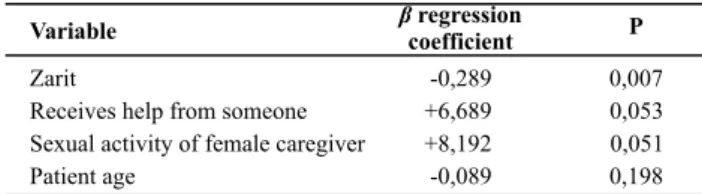
Table 2 presents the inal muliple linear regression mod -el The caregiver’s age only coninued to adjust the mod-el.
Table 2 - Final multiple linear regression model for the Social
Relations Domain - Family health Strategy - São Paulo - 2007
Variable βcoefficientregression P
Zarit -0,289 0,007
Receives help from someone +6,689 0,053 Sexual activity of female caregiver +8,192 0,051
Patient age -0,089 0,198
adjusted r2 = 0.19; p (model) < 0.001
It was observed that, for each point on the Zarit, on av -erage, an 0.289 decrease occurred in the Social Relaions
Domain. On average, caregivers who receive help from someone score 6.689 points more in this domain, while female caregivers score 8.192 points more.
diScUSSion
Caregivers who indicate they receive some informal support scored beter in the Social Relaions domain, with staisically signiicant diferences, and worse in the Physi -cal domain.
In the Physical domain, there seems to be a case of re -verse causality, that is, it is not because they receive help from someone that caregivers score worse in the domain. Instead, it is because they score worse in this domain that they receive help from somebody. The most menioned help came from relaives themselves. Hence, one can in -fer that people with more physical problems needed more help or even more constant alternaions in paient care.
In the Social Relaions domain, which assesses saisfac -ion with interpersonal rela-ions and support from friends and relaives, the fact that they receive help from someone indicated greater saisfacion with regard to these issues.
Informal support has been deined as
care and attention altruistically delivered to people with some level of disability or dependence, fundamentally by relatives, but also by other agents and distinct formalized care service networks(14).
Many studies have shown that the main support net
-work is informal(14) and that many caregivers indicate they do not receive help(7,15), in line with the present indings (26.8%). Caregivers need help from other relaives to al -ternate in care as well as orientaions from the health team to deal with speciic aspects of the paient’s illness or dependence level. Services and trained professionals to support caregivers to cope with their diiculies have shown to be quite favorable means to strengthen them and decrease the care burden. Experiences with caregiver groups appoint the use of strategies with a problemaizing approach, based on experienced situaions, and indicate good results, based on the planning of coping strategies shared with the group, graning caregivers moivaion as well as valuaion(16).
The increased burden was associated with a decreased mean score in the Social Relaions domain. In a study that involved caregivers to elderly paients with chronic illness -es, lack of support from other relaives was indicated as one of the main causes of using the emoion instead of problem-centered coping strategy. This means that care -givers prefer to face their problems not by solving them objecively, but by trying to miigate them, mainly through religion and renunciaion(17).
male caregivers. As reported by diferent authors and proven in scieniic research(6-7), women serve as the main family caregivers for historical and cultural reasons. Men who deliver care more probably do this due to a lack of opion, because they do not have close relaives or be
-cause these are distanced. That would explain their higher level of dissaisfacion with their social relaions.
In a study carried out in Russia(18), women showed lower mean scores on saisfacion with health (quesion 2) and in the Physical domain, and also showed to be sig -niicantly more stressed than male caregivers.
In a qualitaive research that invesigated male expe
-rience in care delivery to a relaive with Alzheimer(19), a posiive view of the caregiver was found behind negaive feelings, quesioning the supremacy of the burden con -cept as a predominant aspect of care.
Another author(7), ater observing daily care pracice at paients’ homes, believes that the quality of care de
-livered by men is no worse than by women, as men also showed concern with good care and demonstrated being equally (or more) considerate and concerned than female caregivers.
Caregivers with partners showed higher mean OQLI scores than those without partners. The fact of having a partner seems to represent potenial strengthening, indi -caing good relaions with these partners.
The level of parenthood showed a higher mean score in the Environment domain among wives, daughters and mothers than with other relaives (except for husbands, sons and fathers). In the other domains, no diferences were observed.
In the study accomplished in Russia(18), scores in all domains except for Environment were signiicantly lower among daughters and wives than among other relaives-caregivers.
The close parenthood relaion (nuclear family) showed a staisically signiicant posiive correlaion with care -giver burden in a study that involved care-givers to elderly demenia paients(20). The history of the relaionship be
-tween paient and caregivers should also be taken into ac
-count, as well as personal coping resources.
When present, sexual acivity increased mean OQLI and scores in the Physical and Social Relaions domains.
Again, this may be a reverse causality relaion, that is, it is not because they were sexually acive that caregivers scored beter in these domains, but because beter con -diions in these domains made them sexually acive. One study(15) found that care afects caregivers’ sexual acivity. There are no detailed studies on the theme that permit discussing these data in further depth.
A posiive correlaion was found between the number of people living in the same home and the Social Relaions domain. This variable also showed a staisically signiicant posiive correlaion in another study(21), but with regard to the Physical domain. The number of people living in the same home also seem to entail a beter support network, as there are more close people who can help and alter -nate in care, although that sill does not guarantee that they will receive help.
concLUSion
There are some limitaions to this study, as the collected data are part of an original research on caregiver QoL, in which social support was a focus secondary to primary data collecion. This limited methodological depth of the social network and support concept. The data, however, evi -denced important aspects for the sake of comparison with other studies, besides contribuing to the producion of lit -erature on the theme, which remains scarce in our midst.
In Brazil, one of the most used instruments for social support assessment, the Medical Outcomes Study (MOS) was translated and validated(22-23) for employees from a public university in Rio de Janeiro. The use of this instru -ment, validated for caregivers, can be very useful to beter explore the concept and accomplish future comparaive studies.
It should be highlighted that, although this study did not cover all variables described as part of social support, and mainly those related to quanitaive social network assessment, some related important indicators were ad -dressed, atemping to associate them with subjecive data on saisfacion with social relaions, indicaing that caregivers who are less saisied with their social relaions present higher perceived burden levels. Research is need -ed to indicate the inluence of social network and support on caregiver health, so as to idenify factors of exhaus
-ion that support health promo-ion and preven-ion ac-ion planning for caregivers followed by Family Health Teams.
REFEREncES
1. Ostergren PO, Hanson BS, Isacsson SO, Tejler L. Social network, social support and acute chest complaints among young and middle-aged paients in an Emergency Department: a case-control study. Soc Sci Med. 1991;33(3):257-67.
3. Rodriguez PR. EL apoyo informal a las personas mayors en Es -paña y la protección social a la dependencia: del facilismo a los derechos de ciudadanía. Rev Esp Geriatr Gerontol. 2005; 40 Supl 3:5-15.
4. Sit JW, Wong TK, Clinton M, Li LS, Fong YM. Stroke care in the home: the impact of social support on the general health of family caregivers. J Clin Nurs. 2004;13(7):816-24.
5. Sluzki CE. A rede social na práica sistêmica: alternaivas ter -apêuicas. São Paulo: Casa do Psicólogo; 1997.
6. Perlini MNOG, Faro ACM. Cuidar de pessoa incapacitada por acidente vascular cerebral no domicílio: o fazer do cuidador familiar. Rev Esc Enferm USP. 2005;39(2):154-63.
7. Laham CF. Percepção de perdas e ganhos subjeivos entre cuidadores de pacientes atendidos em um programa de as -sistência domiciliar [dissertação]. São Paulo: Faculdade de Medicina, Universidade de São Paulo; 2003.
8. Schwarz KA, Roberts BL. Social support and strain of family caregivers of older adults. Holist Nurs Pract. 2000;14(2):77-90.
9. Aienza AA, Collins R, King AC. The mediaing efects of situaional control on social support and mood following a stressor: a prospecive study of demenia caregivers in their natural environments. J Gerontol B Pyschol Sci Soc Sci. 2001;56(3):S129-39.
10. Valla VV. Educação popular, saúde comunitária e apoio so -cial numa conjuntura de globalização. Cad Saúde Publica. 1999;15 Supl 2:7-14.
11. Scavufca M. Versão brasileira da escala Burden Interview para avaliação de sobrecarga em cuidadores de indivíduos com doenças mentais. Rev Bras Psiquiatr. 2002;24(1):12-7.
12. Fleck MPA, Lousada S, Xavier M, Chachamovich E, Vieira G, Santos L, et al. Aplicação da versão em português do instru -mento abreviado de avaliação da qualidade de vida “WHO -QOL-bref”. Rev Saúde Pública. 2000;34(2):178-83.
13. Peñaranda AP, Oriz LG, Góngora JN. El cuidador primário de familiares con dependência: calidad de vida, apoyo social y salud mental. Salamanca: Universidad de Salamanca, Facul -tad de Medicina; 2006.
14. Rodriguez PR. EL apoyo informal a las personas mayors en España y la protección social a la dependencia. Del facilis -mo a los derechos de ciudadanía. Rev Esp Geriatr Gerontol. 2005; 40 Supl 3:5-15.
15. Ballester Ferrando D, Jovinyà Canal D, Brugada Motjé N, Doutra Centellas J, Domingo Roura A. Cambios en los cuida -dores en cuanto a esilos de vida, relaciones y alteraciones de salud mental. Presencia [Internet]. 2006 [citado 2009 abr. 15];2(4). Disponível em: htp://www.psiquiatria.com/aricu -los/psiq_general_y_otras_areas/enfermeria/29904/
16. Golimbet V, Trubnikov V. Evaluaion of the demenia carees situaion in Russia. Int J Geriatr Psychiatry 2001;16(1):94-9.
17. Santana RF, Almeida KS, Savoldi NAM. Indicators of the applicability of nursing instrucions in the daily lives of Al -zheimer paient caregivers. Rev Esc Enferm USP [Internet]. 2009 [cited 2009 Jun 22];43(2):459-64. Available from: htp://www.scielo.br/pdf/reeusp/v43n2/en_a28v43n2.pdf
18. Simonei JP, Ferreira JC. Estratégias de coping desenvolvi -daspor cuidadores de idosos portadores de doenças crôni -cas. Rev Esc Enferm USP. 2008;42(1):19-25.
19. Parsons K. The male experience of caregiving for a fam -ily member with alzheimer’s disease. Qual Health Res. 1997;7(3):391-407.
20. Garrido R, Menezes PR. Impacto em cuidadores de idosos com demência em um serviço psicogeriátrico. Rev Saúde Pública 2004;38(6):835-41.
21. Schestatsky P, Zanato VC, Margis R, Chachamovich E, Reche M, Baista RG, et al. Quality of life in a brazilian sample of paients with parkinson’s disease and their caregivers. Rev Bras Psiquiatr. 2006;28(3):209-11.
22. Griep RH, Chor D, Faerstein E, Werneck GL, Lopes CS. Vali -dade de constructo de escala de apoio social do Medical Outcomes Study adaptada para o português no Estudo Pró-Saúde. Cad Saúde Pública. 2005;2(3):703-14.