Reflection 1179
-THEORY OF HUMAN BECOMING IN NURSING ECOLOGY: APPLYING
MELEIS’ EVALUATION METHOD
Glauce Araújo Ideião Lins1, Marinez Kellermann Armendaris2, Diana Lúcia MouraPinho3, Ivone Kamada4, Cristine Alves Costa de Jesus5, Paula Elaine Diniz dos Reis6
1 M.Sc. in Nursing. Environmental Surveillance Manager of Non-Biological Factors. Board of Environmental Surveillance in Health. Federal District State Health Secretary. Distrito Federal, Brazil. E-mail: [email protected]
2 M.Sc. in Nursing. Nursing Supervisor, Outpatient/Imaging Unit, Instituto de Cardiologia do Distrito Federal. Distrito Federal, Brazil. E-mail: [email protected]
3 Ph.D. in Psychology. Adjunct Professor, Universidade de Brasília (UnB). Distrito Federal, Brazil. E-mail: [email protected] 4 Ph.D. in Fundamental Nursing. Adjunct Professor, UnB. Distrito Federal, Brazil. E-mail: [email protected]
5 Ph.D. in Nursing. Adjunct Professor, UnB. Distrito Federal, Brazil. E-mail: [email protected]
6 Ph.D. in Fundamental Nursing. Adjunct Professor, UnB. Distrito Federal, Brazil. E-mail: [email protected]
ABSTRACT: The objective was to conduct a relection on the Theory of Human Becoming Rosemarie Rizzo Parse, as well as designing
a theoretical framework applied to the process of caring in nursing ecological. It is a research and interpretative critical relection, which used the evaluation method proposed by Meleis, restricted to the stage of description, which considers the identiication of structural and functional components. This strategy allowed us to subsidize the relection of the interpretive theory of Becoming Human Ecology
in the context of nursing. Thus, it was possible to direct attention to the meanings of health and quality of life of the individual, the prioritization of values and nursing care in the area of ecology.
DESCRIPTORS: Nursing theory. Occupational health nursing. Environmental health. Nursing.
TEORIA DE TORNAR-SE HUMANO NA ENFERMAGEM ECOLÓGICA:
APLICANDO O MÉTODO DE AVALIAÇÃO DE MELEIS
RESUMO: Objetivou-serealizar uma relexão acerca da Teoria de Tornar-se Humano de Rosemarie Rizzo Parse, bem como, desenhar
uma estrutura teórica aplicada ao processo de cuidar no âmbito da enfermagem ecológica. Trata-se de uma relexão crítico-interpretativa, que utilizou o método de avaliação proposto por Meleis, restringindo-se à etapa de descrição, que considera a identiicação de componentes estruturais e funcionais. Essa estratégia permitiu subsidiar a relexão interpretativa da Teoria de Tornar-se Humano no contexto da enfermagem ecológica. Assim, foi possível dirigir a atenção aos signiicados de saúde e a qualidade de vida do indivíduo, para a priorização de valores e cuidados na área de enfermagem ecológica.
DESCRITORES: Teoria de enfermagem. Enfermagem do trabalho. Saúde ambiental. Enfermagem.
TEORÍA DE LOS DERECHOS HUMANOS CONVERTIRSE EN ECOLOGÍA
DE ENFERMERÍA: APLICACIÓN DEL MÉTODO DE EVALUACIÓN DE
MELEIS
RESUMEN: El objetivo fue llevar a cabo una relexión sobre la Teoría de Convertirse Humano de Rosemarie Rizzo Parse, así como el
diseño de un marco teórico aplicado al proceso de cuidar en enfermería ecológica. Es una relexión crítica interpretativa, en que se utilizó el método de evaluación propuesto por Meleis, limitada a la etapa de descripción, que considera la identiicación de los componentes estructurales y funcionales. Esta estrategia nos ha permitido subsidiar el relejo de la teoría interpretativa de convertirse Humano en el contexto de la enfermería ecológica. Por lo tanto, ha sido posible dirigir la atención a los signiicados de la salud y la calidad de vida de la persona, para la priorización de los valores y los cuidados de enfermería en el área de ecología.
INTRODUCTION
Care actions should be linked with the real-ity people experience, as a fundamental tool to outline health interventions. These should picture the different manifestations of risk, including the environmental risks deriving from the destruction of ecosystems, the increasing contamination of the atmosphere, soil and water, as well as global warming, resulting from human activities in the environment, besides occupational risks, mainly due to the harmful conditions present in the work environment, which affect the health of workers, their relatives and populations living in the pro-duction units’ area of inluence.
Considering the environment as directly related with the health-disease process, health workers, including nursing professionals, should integrate this dimension into their practices, as-suming the possibility of developing and consoli-dating actions within a socio-environmental focus, with a view to adapting different health actions based on comprehensive strategies to improve people’s quality of life and the sustainability of natural and social biota.1
This gives rise to a new care attitude, called ecological care, which drives actions in defense of the environment, at home, at the workplace and everywhere, permeating the relations, interactions and associations among human beings and other beings in nature.2 Thus, understanding human beings in their different relational environments in the focus of nursing actions and knowledge, demanding further attention to environmental issues as components of their knowledge.1
In that sense, theoretical models have contrib-uted when they are used as a reference framework to structure care, adapted to the needs/particulari-ties of patients and social and environmental con-texts. Nursing theories are foundations elaborated based on a broad and complex view of reality, considered as fundamental epistemological con-tributions to the construction of knowledge and professional practice, supporting the development of the triad nursing theory, research and practice.3
Allied with human health experiences, the theories attempt to explicitly formulate the com-plexity and multiple nature of the phenomena present in health and nursing, with a view to describing, explaining, foreseeing or prescribing nursing care.3-4
With a view to the evolution and enhance-ment of theoretical-scientiic knowledge in nursing,
its professionals should develop philosophical and methodological relections about existing theoreti -cal proposals, as a profession that does not acknowl-edge the importance of its own currents of thought ends up detaching the knowledge on how to do from that on how to think, thus compromising the development of its science.4 Thus, nursing theories support professional practice and permit express-ing the proposals, contexts, variables, theoretical explanations, empirical evidence and the use of new approaches in practice, which determine the nature of the phenomena’s descriptive elements.5
Hence, the deinition of a nursing method based on a theoretical framework is a process that involves thinking, doing and feeling, turning the implementation of care into a grounded, complex and continuous process. This study is justiied by the relevance of discussing nursing ecology based on Parse’s Theory, which proposes an innovative theoretical structure to approach human beings and the environment, emphasizing nursing activi-ties within the perspective of health promotion and quality of life.
Departing from Heidegger’s perspective, which addresses care based on the ontological determinations of the human condition, assuming its existence and limitations,6 one may ask: can the Theory of Human Becoming be assessed, taking into account the complexity and abstraction of the proposed care forms? How can its theoretical-philosophical contents be applied in occupational and environmental health nursing? Therefore, the following objectives were set: to relect on Rosema -rie Rizzo Parse’s Theory of Human Becoming, as well as to design a theoretical structure applied to the care process in the context of nursing ecology.
METHOD
As the assessment of nursing theories rep-resents an essential component with a view to the testability, applicability and reinement of differ -ent care areas, this study permitted a critical-in-terpretative relection, based on Meleis’ evaluation method.7 This assessment method can be used as
a whole or partially and consists of ive segments, which are: description, analysis, criticism, test and theoretical support.8
elements focused on in the theory and how it ad-dresses the patient nursing, health environment, nurse-client interactions, nursing problems and nursing therapeutics).7-8
Although the Theory of Human Becoming cannot be submitted to experiments, as it is neither predictive, nor based on a cause-effect perspective, it can actually be tested, as it identiies phenomena experienced based on the interrelations among man, universe and health.5,9
This strategy granted support for an interpre-tative relection on the Theory of Human Becoming in the context of nursing ecology, through a deduc-tive logical correlation between Parse’s concepts, principles and theoretical structure and the prem-ises of occupational and environmental health, cul-minating in the elaboration of a distinct theoretical structure and applied to this nursing area.
DISCUSSION
Description of the Theory of Human
Becoming
Next, the theoretician’s history and perspec-tives on care are highlighted, which signiicantly inluenced the construction process of a nursing theory.
Rosemarie Rizzo Parse is one of the most re-cent nursing theoreticians. In 1981, she published the book Nursing Fundamentals, in which she presented her ideas, proposing the nursing subject based on human sciences.5 She obtained an M.Sc. and Ph.D. from the University of Pittsburgh and is currently serving as a lecturer at Loyola Uni-versity in Chicago; she is the founder and editor of Nursing Science Quarterly and the president of Discovery International and the Institute of Human Becoming. Also, she has authored eight books and different papers.10
Parse inserted two paradigms into the dis-cussion of nursing theories, the totality paradigm, in which man is the sum of system and considered as a bio-psycho-social-spiritual being, who inter-acts with the environment through internal and external stimuli. The second is the simultaneity paradigm, in which man is a “unitary being in a mutual inter-relationship with the environment, and health is the negentropic development”,9:267 considered as a reactive process to obtain energy reserves in order to stop the entropic process.8-9,11
The Theory of Human Becoming, formerly called the Theory of Man-Living-Health, is
classi-ied among the main theories of the unitary pro -cess, as its theoretical framework is complex and described at a philosophical and highly abstract level.8 It was constructed based on the principles and concepts of Martha E. Rogers and borrowed its three main principles of integrality, resonancy and helicy from this model, as well as its four main concepts energy ield, openness, pattern and pan -dimensionality.9-11 The theoretician also received
inluence from the existential-phenomenological ideas of Heidegger, Sartre and Merleau-Ponty, synthetizing the principles of intentionality, hu-man subjectivity, co-constitution, coexistence and freedom to choose. In view of the inter-relation among these concepts, Parse deined the human being as a vital unit, within the simultaneity paradigm.9 The research method is characterized as a hermeneutical-phenomenological method, which directly emerges from the ontology and epistemology of the Theory of Human Becoming, which comprise the following processes: dialecti-cal engagement, extraction of synthesis of becom-ing human and heuristic interpretation, based on structural transposition, emergence of phrases in poetic language and artistic expressions of the hu-man meaning attributed to experiences.12
According to the theory assessment method,5 the descriptive phase of the theory comprises structural and functional components.
The theoretician believes that the human being, the environment and health are closely linked, making it dificult to characterize their premises individually.5 Initially, nine premises were presented, which were revised in 1995 and summarized in three main premises, described as follows: 1) Becoming human means freely choos-ing the personal meanchoos-ing of the situation in the intersubjective process of the experience of value priorities; 2) Becoming human means co-creating rhythmic patterns of relationship in the mutual process with the universe; and 3) Becoming human means co-transcending with possible emerging patterns in multidimensional terms.
considered as an open exchange in combination with the universe, that is, one participates in the creation of the other. In the third premise, the hu-man being is capable of moving beyond the self at all levels of the universe.9,11
Departing from the theme that emerges from the three main premises and their inter-relations based on the concept of meaning, rhythmicity and co-transcendence, the theoretician takes us to three fundamental principles that inter-relate three concepts each and are described as follows.5,9,12
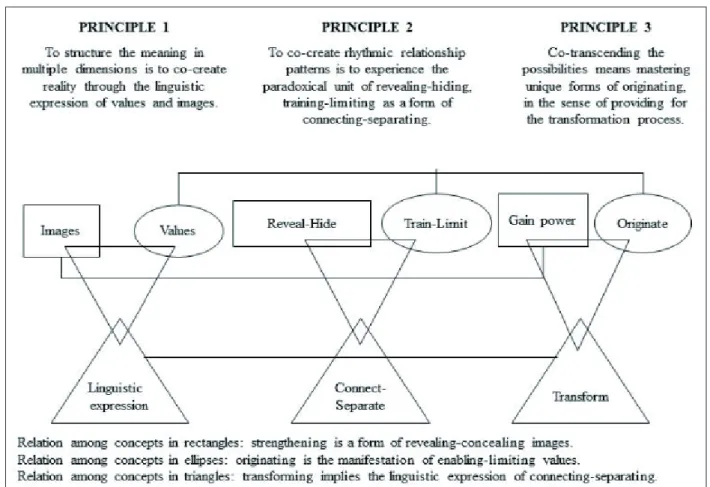
1st Principle: structure the meaning, in mul-tidimensional terms, means cooperating in the creation of reality through the expression of values and images. This principle inter-relates three con-cepts: image, valuation and language, and estab-lishes that the human being inds meaning for the situation that is happening based on experiences. According to this principle, co-creation refers to the mutual participation man-environment. Lan-guage relects the images values through signs and movements, which take place at multidimensional levels. Image refers to knowledge, which includes both explicit and tactic knowledge.
In this sense, clarifying the meaning is identi-ied as the practical dimension of nursing care, in which the nurses guide individuals and families to relate the meanings of a situation and make them more explicit, based on each person’s experiences.9
2nd Principle: cooperate in the creation of rhythmic patterns of relationships means living the paradoxical unit of revealing/concealing, enabling/limiting and, at the same time, join-ing/separating. The importance of rhythmicity is observed, in which rhythmic patterns of man’s relation with the universe are experienced through paradoxes that are not opposed, but will determine choices across the lifetime, experienced in multiple dimensions and simultaneously. The principle explains that, by experiencing the paradoxes, the person reveals a bit of him/herself and, at the same time, hides other parts, that is, the human being gradually reveals him/herself in the transforma-tion process.
For the practical dimension of nursing care, the synchrony of rhythms is identiied, in which the nurse, through bonds with the individual/ family/community, attempts to harmonize the subjects’ relation with the universe, in each con-text, thus facilitating the understanding of the meanings.9
3rd Principle:co-transcending the possibili-ties means seems unique ways to start the
trans-formation process. It inter-relates the concepts of strengthening, originating and transforming. The change that takes place in the reality experienced and its possibilities is the transformation process, culminating in the creation/origin of new patterns and personal values.
In this principle, the importance of nursing care is underlined, in the sense of mobilizing the transcendence, driving the individual to move beyond. The nurse helps the person in the process of planning changes in the health patterns that are experienced.9
The concepts are the most important compo-nents of the theory, as they deine an idea or com -plex mental image of a phenomenon.5 This theory proposes, within a simultaneity perspective, a new nursing paradigm that is focused on the human being. This fact can be better understood based on the description of the four meta-paradigms of nursing science:
- the concept of human being/universe is considered as an open being, in a mutual process with the universe, co-creating relationship pat-terns with the others; it is an active and relexive being of dialogue, capable of learning, relearning and teaching, and of freely choosing health pat-terns; it is a unique being, bringing beliefs, values, culture, a way of seeing and living in the world, as part of a collective environment and capable of transforming itself.9,11
- the concept of environment is inseparable from and complementary to the human being, which together create life experiences reciprocally and mutually exchange energy to create what ex-ists in the world.8
- health is deined as a process of becom -ing a person in the individual’s experience, co-constituted to the extent that (s)he interacts in the universe and gains experience, thus relecting the paradoxical nature of the person’s relations in the world as part of a rhythmic process.8,9
- nursing is understood as science and art, creative and humanistic and responsible for orienting individuals, families and communities in making choices among different possibilities in the multidimensional process of the human being-universe.9
inter-relation among man, the universe and health, resulting in the promotion of health and quality of life, based on the person’s perspective.5,9
Describing the purpose of the theory is im-portant, in the attempt to explain why the theory was formulates and speciies the context and situ -ations in which it is to be applied.8 The theory of Human Becoming is explanatory, as it mutually relates the concepts and describes and speciies their inter-relations. The theory originated in Parse’s experiences in nursing practice, although its foundations started in childhood, through the values she received from her parents regarding respect for human beings.10
The theory, addressed in this theoretical relection, is mainly focused on the human being, according to a phenomenological attitude, to the extent that nurses get closer to the patients, show-ing interest in the meanshow-ing of their experiences, moving together with them, without labeling or indicating a solution for the situation, thus respect-ing individual co-participation in the creation of the experience of living and understanding cure as a gradual process of human becoming.9,13
The Theory of Human Becoming is applied in crisis and/or change situations individuals/ families and communities go through. Countless researchers have validated it, developing perspec-tives on the human science of nursing.8 Thus, the application of the theory in research has been demonstrated through its comprehensive use by the nursing community in practice, research and teaching.5
Through the use of Parse’s Theory, nurses, as agents of change to improve the quality of life based on individual perspectives, attempt to understand the nursing problems in the process of being with the person instead of doing by the person, turning these professionals into facilita-tors in the implementation process of the practical dimensions.
Its theoretical structure rests on three practi-cal dimensions: strengthening (to reveal and con-ceal the image), originating (as a manifestation of value limitations) and transforming (unfolds into connection and separation).5
Concerning the therapeutics, it is relevant to understand the meaning of the nursing pro-cess the theoretician proposes, which is clearly described as a problem-solving method that is not exclusive to nursing, understanding people as co-authors of their health condition. An innovative, creative, solidary and distinguished care method
is proposed, permitting discoveries and a better understanding of people’s meanings and needs, as care is individualized.11
Used as an appropriate guide for profession-als who want to create respectful partnerships with people seeking healthcare, nursing practice involves all individuals and families, ignoring social designations of the health-disease condition and thus attempting to modify health patterns.5,9
Applicability in nursing ecology
Parse’s theoretical structure addresses three principles that are inter-related with nine concepts of human becoming: transmission through lan-guage, valuation, formation of images, revelation/ dissimulation, permission, limitation, connection-separation, energizing, originating and transform-ing,5 as described in igure 1.
The theoretical structure, described above, does not refer to a model, in view of its concepts, principles and inter-relations are deined at a high -ly abstract level, which can further, in the research context, the creation of structures that demonstrate the relations between the theoretical constructs to understand the speciic phenomena in a given context.5 In that perspective, this theoretical relec -tion permitted the design of a theoretical structure and its interrelations between the concepts and principles applied to nursing ecology.
Figure 1 - Relation among the principles, concepts and theoretical structures of the Theory of Human
Becoming10
In that sense, health promotion tightens its relation with the theory of Human Becoming, to the extent that it represents a singular manner to face health and provide insights about how indi-viduals create and choose to live freely, among paradoxical ways of being.8
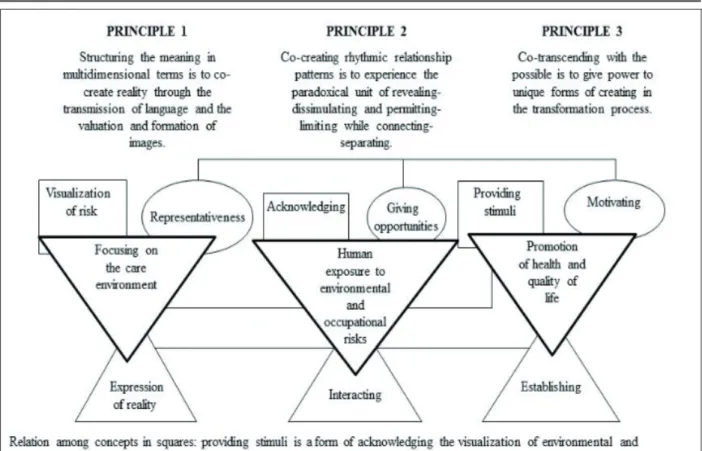
Therefore, based on the theoretical structure of Human Becoming, its concepts and theoretical principles could be related with the deinitions proposed by environmental and occupational health, describing the speciic phenomena in this area, according to igure 2.
Departing from the irst principle, it is con -sidered that the co-creation of health patterns through the expression of reality, representative-ness and perception of environmental and occu-pational risks give rise to the multidimensional structure of meaning. As regards the second prin-ciple, co-creating the rhythmic nature of
relation-ships paradoxically means acknowledging/not-acknowledging and giving opportunities or not, as the nurse’s interaction with the client, with a view to the construction of ecological care based on an innovative nursing process that enhances individuals’ quality of life. Finally, what the third principle is concerned, co-transcendence is driven by the motivation to establish quality of life deriv-ing from a mobilization process, to the extent that it stimulates and facilitates the change in life habits and standards adopted in the individual sphere of the human being-environment.
Figure 2 – Relation among the principles, concepts and theoretical structures of the Theory of Human Becoming applied to nursing ecology.
CONCLUSION
Based on the adopted method, the concepts and principles of the theory could be correlated in a logical theoretical structure, with a view to focusing on the meanings of individual health and quality of life, so as to prioritize nursing ecology values and care. Although the theoretical structure outlined, in this study, was described at a theoretical and abstract level, it can serve as a reference framework for application in other qualitative studies, using the hermeneutic method to validate the applicability of occupational and environmental nursing actions.
In that context, Parse’s Theory represents a signiicant structure to understand the inter-relationship human-universe-health, to the extent that it accelerates the transformation process of the mechanical approach to health care towards a new individual care model.
It should be highlighted that, in the develop-ment of Parse’s Theory, Carper’s four knowledge
patterns (empirical, esthetic, ethical and personal knowledge) are articulated, particularly the es-thetic pattern, which reveals the interaction that relects the nature of care. Thus, emphasizing human beings and their experiences, humanistic nursing attempts to facilitate the change process in individuals’ unitary health perception.
REFERENCES
1. Cezar-Vaz MR, Soares MCF, Martins SR, Sena J, Santos LR, Rubira LT, et al. Saber ambiental: instru-mento interdisciplinar para a produção de saúde. Texto Contexto Enferm. 2005 Jul-Set; 14(3):391-7. 2. Backes MTS, Erdmann AL, Backes DS. Cuidado
ecológico: o signiicado para os proissionais de um hospital geral. Acta Paul Enferm. 2009; 22(2): 83-91.
3. Shaurich D, Crossetti MGO. Produção do
conhecimento sobre teorias de enfermagem: análise de periódicos da área, 1998-2007. Esc Anna Nery Rev Enferm. 2010 Jan-Mar; 14(1):182-8.
4. Rosa LM, Sebold LF, Arzuaga MA, Santos VEP, Randuz V. Referenciais de enfermagem e produção do conhecimento cientíico. Rev Enferm UERJ. 2010 Jan-Mar; 18(1):120-5.
5. Tomey AM, Alligood MR. Teóricas de enfermagem e a sua obra: modelos e teorias de enfermagem. 5ª ed. Loures (PT): Lusociências; 2004.
6. Silva IJ, Oliveira MFV, Silva SED, Palaro SHI, Radunz V, Santos EKA, et al. Cuidado, autocuidado e cuidado de si: uma compreensão paradigmática
para o cuidado de enfermagem. Rev Esc Enferm.
2009 Set; 43(3):697-703.
7. Rodrigues DP, Pagliuca LMF, Silva RM. Modelo de Roy na enfermagem obstétrica: análise sob a óptica de Meleis. Rev Gaúcha Enferm. 2004 Ago; 25(2):165-75. 8. Mcewen M, Wills EM. Bases teóricas para
enfermagem. 2ª ed. Porto Alegre (RS): Artmed; 2009.
9. Coelho RCHA. Cuidando da mulher gestante com HIV fundamentado na Teoria de Parse: um novo referencial para a prática da enfermagem [dissertação]. Florianópolis (SC): Universidade Federal de Santa Catarina, Programa de Pós-Graduação em Enfermagem; 2001.
10. Vicente FR, Campregher G. Gerência do cuidado de enfermagem nos programas de saúde na Unidade Local de Saúde da Trindade [monograia]. Florianópolis (SC): Universidade Federal de Santa Catarina, Departamento de Enfermagem; 2007. 11. George J. Teorias de enfermagem: os fundamentos à
prática proissional. 4ª ed. Porto Alegre (RS): Artes Médicas Sul; 2000.
12. Naef R, Bourns D. The lived experience of waiting: a parse method study. Nurs Sci Q. 2009 Apr; 22(2):141-53.
13. Ketchum PH. Parse’s Theory in practice: an interpretive analysis. J Holist Nurs. 2004 Mar; 22(1):57-72.
14. Ministério da Saúde (BR). Subsídios para construção da Política Nacional de Saúde Ambiental, Conselho Nacional de Saúde. Brasília (DF): MS; 2007.
15. Brasil. Lei n. 8.080, de 19 de setembro de 1990. Dispõe sobre as condições para a promoção, proteção e recuperação da saúde, a organização e o funcionamento dos serviços correspondentes e dá outras providências. Diário Oicial da União, 19 Set 1990.
Correspondence: Glauce Araújo Ideião Lins
QRSW 01, Bloco A-07, ap. 304
71000-000 – Sudoeste, Brasília, DF, Brazil E-mail: [email protected]