- 980 - Original Article
FEMALE MORTALITY AND YEARS OF LIFE LOST DUE TO HOMICIDE/
AGGRESSION IN A BRAZILIAN CAPITAL AFTER THE MARIA DA
PENHA LAW WAS ENACTED
Nádia de Araújo Amaral1, Cledir de Araújo Amaral2, Thatiana Lameira Maciel Amaral3
1 Bachelor’s in Law and Philosophy. Technician in Education Affairs at City Hall in Rio Branco. Rio Branco, Acre, Brazil. E-mail: [email protected]
2 Master’s student in Collective Health at the Graduate Program in Collective Health at the Federal University of Acre. Professor at the Federal Institute of Acre. Rio Branco, Acre, Brazil. E-mail: [email protected]
3 MSc. in Collective Health and Parasitology. Professor, Nursing undergraduate program at the Federal University of Acre. Rio Branco, Acre, Brazil. E-mail: [email protected]
ABSTRACT: Violence against women is a phenomenon that affects everyone around the world. In Brazil, in 2006, law 11.340/2006, named after Maria da Penha, was enacted with the purpose to inhibit domestic, family and intimate partner violence. This study’s objective was to compare female mortality due to assault/homicide in Rio Branco, Acre, Brazil, before and after the law came into effect. For that, an ecological study was conducted with victims of aggression and homicide registered in the Mortality Information System from 2002 to 2010. The women, victims of homicide, were aged between 21 and 25 years of age (28.6%), had a low level of education (39.3%) and no occupation (64.3%). There was a decrease in the incidence of deaths followed by an increase in the last two years, with repercussions of Potential Years of Life Lost among women from 16 to 39 years old. The Maria da Penha Law is a reality in Brazil and
plays a relevant role in society, thus, should be analyzed in terms of its effectiveness and inluence.
DESCRIPTORS: Violence against women. Mortality. Potential years of life lost.
MORTALIDADE FEMININA E ANOS DE VIDA PERDIDOS POR
HOMICÍDIO/AGRESSÃO EM CAPITAL BRASILEIRA APÓS
PROMULGAÇÃO DA LEI MARIA DA PENHA
RESUMO: A violência contra a mulher é um fenômeno que atinge todas as pessoas, em todas as partes do mundo. No Brasil, no ano de 2006, entra em vigor a Lei n. 11.340/2006, batizada como Lei Maria da Penha, com a função basilar de coibir a violência doméstica, familiar e afetiva. O objetivo deste estudo foi comparar a mortalidade feminina por agressão/homicídio, antes e após a implantação da lei, em Rio Branco, Acre, Brasil. Para tanto, foi realizado um estudo ecológico com vítimas de agressão e homicídios registrados no Sistema de Informação de Mortalidade, de 2002 a 2010. As mulheres vítimas de homicídio tinham entre 21 e 25 anos de idade (28,6%), baixo nível de escolaridade (39,3%) e estavam sem ocupação (64,3%). A incidência de óbitos apresentou declínio seguido de aumento
nos últimos dois anos, com relexo nos Anos Potenciais de Vida Perdidos na faixa etária de 16 a 39 anos. A Lei Maria da Penha é uma realidade no país e tem papel relevante na sociedade, por isso, deve ser analisada em pesquisas quanto a sua efetividade e inluência.
DESCRITORES: Violência contra a mulher. Mortalidade. Anos potenciais de vida perdidos.
LA MORTALIDAD FEMENINA Y LOS AÑOS POTENCIALES DE VIDA
PERDIDOS POR HOMICIDIO/AGRESIÓN EN LA CAPITAL BRASILEÑA,
DESPUÉS DE LA PROMULGACIÓN DE LA LEY MARIA DA PENHA
RESUMEN: La violencia contra la mujer es un fenómeno que afecta a todas las personas en todas las partes del mundo. En Brasil, en 2006, se promulgó la Ley 11.340/2006, bautizada como Ley Maria da Penha, con la función basilar de cohibir la violencia domestica,
familiar y afectiva. La inalidad del estudio fue comparar la mortalidad femenina por agresión/homicidio antes y después de la Ley
en Rio Branco, Acre, Brasil. Fue desarrollado un estudio ecológico con víctimas de agresión y homicidios registrados en el Sistema de Información de Mortalidad, del 2002 al 2010. Las mujeres víctimas de homicidio tenían entre 21 e 25 años (28,6%), bajo nivel de escolaridad (39,3%) y sin ocupación (64,3%). La incidencia de óbitos mostró disminución seguido por aumento en los últimos dos años,
con relejos en los Años Potenciales de Vida Perdidos en el rango de edad de 16 a 39 años. La Ley Maria da Penha es una realidad en
el país y tiene papel relevante en la sociedad por esa razón su efectividad e inluencia deben ser analizadas en otras investigaciones.
INTRODUCTION
Violence has always been part of human history and is a subject seldom addressed in its complexity in an attempt to ignore, in many cases, its consequences.1 It has its own and separable
characteristics, such as physical, psychological, socioeconomic, domestic violence or violence against women, among others.2
In regard to violence against women, which is this study’s object, it is undeniably a world phenomenon affecting all social classes. Therefore, various countries have applied preventive and control measures to stop these actions. As a result, violence against women is now a problem to be countered with public policies.2
In this sense, violence against women has an endemic nature and can manifest around the world in different ways and in the most varied spaces of society, not restricted to a certain envi-ronment, ethnicity, age or social status.3
Latin America has the highest homicide rates in the world and the probability of a young individual dying as a victim of homicide is 30 times greater than a young individual dying in Europe and 70 times greater than in Greece.4
The rate of homicides in Brazil in 2003 was 20/100,000 inhabitants, while in 2005 this rate jumped to 25.2 homicides for every 100,000 inhabitants.5-6
In 2003, the rate of mortality due to ho-micide reached 28.6 deaths per 100,000 inhabit-ants, followed by a period of decrease between 2003 and 2006. Analyzing the different Brazilian states, the homicide rate in 2003 in Pernambuco was 56/100,000, 48/100,000 in Rio de Janeiro, 18/100,000 in Rio Grande do Sul, and 12/100,000 inhabitants in Santa Catarina.5
In 2004, homicides were the leading cause of death among external causes in the North.7 The
state of Acre, with a rate of 18.7/100,000 inhabit-ants in 2004, ranked 12th in the country.8 In 2006, it
ranked 16th with 22.1/100,000 inhabitants. When
the murder weapon was veriied, the capital of Acre, Rio Branco, ranked the 25th in the country
in the use of irearms.9
Between 2003 and 2007, approximately 20,000 women died as victims of aggression in Brazil. The states of Espírito Santo, Pernambuco, Mato Grosso, Rio de Janeiro, Rondônia, Alagoas,
Mato Grosso do Sul, Roraima and Amapá where those with the highest coeicients.8
Approximately 4,000 women were mur-dered between 2000 and 2005 in Brazil. These data show the need for greater focus on female deaths due to external causes. These are pre-ventable deaths that indicate deiciencies in the security system.10 Most of those who perpetrate
such an act are familiar to the victim (husbands, partners, and close relatives).11 Proximity of the
victim to the offender is reported in numerous studies.12-16
Due to the situation of violence against women, social movements became engaged in demanding a legal review from institutions of the criminal justice system. As a result, Law n. 11,340/2006, called the Maria da Penha Law, was created. It was designed to curb all forms of violence, whether physical, moral, sexual, psycho-logical, injurious or resulting in death, suffered by women, fatal victims, who, most of time, have their partners or former partners as the active subject of aggression.17
This law was a milestone in Brazilian legisla-tion and is marked by an emphasis on the valori-zation and inclusion of the victim in the context of the criminal process, in addition to heeding the needs of thousands of Brazilian women, as victims of violence, who have been deprived for centuries of participating in the diverse social and legal sectors.18
The Maria da Penha Law has generated positive social effects and its effectiveness has been achieved in society.19 This law came to meet
the aspirations of countless victims. Its real effec-tiveness, however, should be assessed in different Brazilian cities. There is a provision in Article 8 of the law, as one of the integrated measures to prevent violence against women, to promote studies and research, statistics and other relevant information concerning the causes, consequences, and frequency of this problem.17
MATERIAL AND METHOD
This ecological, descriptive and retrospec-tive study with a quantitaretrospec-tive approach was conducted in Rio Branco, capital of Acre, Brazil, located in the western Amazon. The study’s population was composed of women, victims of aggression/homicide recorded in the Mor-tality Information System (MIS) between 2002 and 2010, all of whom were residents of Rio Branco, Acre.
Access to the MIS was possible through the epidemiological surveillance of Rio Branco, the agency responsible for providing data obtained from the death certiicates to the information sys -tem. Inclusion criteria were women 16 to 39 years old, residents of Rio Branco and whose basic cause of death was aggression/homicide that occurred between 2002 and 2010, coded according to the International Classiication of Diseases and Re -lated Health Problems, 10th review (ICD10, codes
X85 to Y09).20
The population considered for the calcula-tion of the mortality rate per year was the simple average of the population of years in the middle of the period, according to the Demographic Census of 2000 and 2010, while the number of deaths was obtained according to the basic cause and analyzed using the statistical software SPSS, version 10.0 for Windows.
Deaths due to aggression/homicide were selected and classiied by sex, color, and age, using the same criteria and same area for 2002 to 2010. Information concerning the place of occurrence and type/means of aggression/homicides was also obtained.
We considered the age groups to estimate the Potential Years of Life Lost (PYLL), for which the remaining years of life were calculated by subtracting the years of life that would be lived if the woman had not died, based on life expec-tancy. Then, these values were multiplied by the number of deaths in each age group; the values were then totaled. The PYLL were calculated in its raw form, i.e., according to data contained in the database.
Criteria suggested by the Ministry of Health, which establishes the limit age for the calcula-tion of PYLL (70 years old), was used to base the calculation of the PYLL coeficient. Hence, this
study complied with the ethical recommendations established for studies of this nature.
RESULTS
A total of 56 homicides of women 16 to 39 years old were recorded between 2002 and 2010 in Rio Branco. Data were restricted to external causes and related to homicides/aggression against women living in the capital.
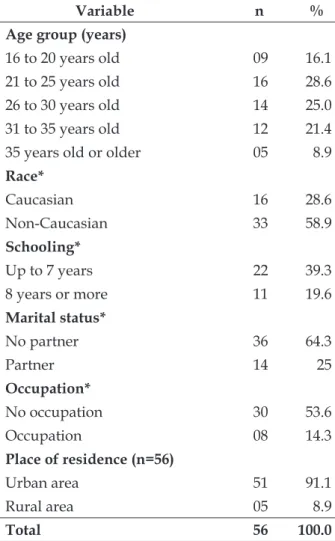
A predominance of victims aged between 21 and 25 years old was observed, while in the second decade of life 53.6% of them were Cau-casian with a low level of education, no partners and no occupation. Of the victims, 91.1% (51 deaths) lived in an urban area of the capital, as shown in table 1.
Pregnancy was reported in two deaths (3.6%); there was no report of pregnancy in 21 (37.5%) cases; and most reports, 33/58.9%, had no information regarding pregnancy. Among the homicides, there was one case of criminal uterine perforation, a fact that shows the vulnerability of both victims (mother and child).
The primary place where the homicides occurred was the victim’s home, followed by the hospital. That hospitals appear in the report may distort the information, because it does not reveal the place where the event that resulted in the victim’s death actually occurred. Therefore, the number of deaths that occurred at home, in public areas, or in other places, is higher than what is reported. Nevertheless, this informa-tion can be considered relevant concerning the severity of injuries because even after receiv-ing specialized care, the victim still dies. It is worth noting that for basic causes, the option non-speciied place of occurrence was chosen in 80.4% (45) of the reports.
the victim’s family members and neighbors. Narratives provided in the reports contribute to the clariication of doubts that may emerge in the report’s previous items. Narratives were provided in 25 reports (46.4%).
Table 1 - Distribution of female deaths due to aggression/homicides according to age, race, schooling, marital status, occupation and place of residence in Rio Branco, Acre, between 2002 and 2010
Variable n %
Age group (years)
16 to 20 years old 09 16.1
21 to 25 years old 16 28.6
26 to 30 years old 14 25.0
31 to 35 years old 12 21.4
35 years old or older 05 8.9
Race*
Caucasian 16 28.6
Non-Caucasian 33 58.9
Schooling*
Up to 7 years 22 39.3
8 years or more 11 19.6
Marital status*
No partner 36 64.3
Partner 14 25
Occupation*
No occupation 30 53.6
Occupation 08 14.3
Place of residence (n=56)
Urban area 51 91.1
Rural area 05 8.9
Total 56 100.0
* The values are smaller due to MIF’s lack of information.
The main basic causes of death, accord-ing to ICD-10, were aggression with slashaccord-ing, piercing or cutting objects, characteristic of inner cities or poorly developed cities, followed by the use of irearms and bodily force, as shown in table 2. Aggression with sharp or penetrat-ing objects, non-speciied place of occurrence, code X99.9, was reported in 53.6% (30) of the homicides, while aggression with a irearm or
non-speciic gun, non-speciic place of occur -rence, code X95.9, was reported in 19.6% (11 deaths) of the cases.
Table 2 - Distribution of female deaths due to aggression/homicide according to place of occurrence and type/means of aggression in Rio Branco, Acre, between 2002 and 2010
Variable n %
Place of occurrence
At home 25 44.6
Hospital 22 39.3
Public area 06 10.7
Others 3 5.4
Type/form of aggression
Firearm 13 23.2
Slashing, cutting, piercing
object 42 75.0
Bodily strength 1 1.8
Total 56 100.0
Figure 1 shows that only in 2004 was there an inversion in the type/means of aggression with a higher occurrence of irearms at the expense of slashing, cutting and perforating objects. In the remaining years of the study, the second type of weapon had a higher rate. In 2008, there was a decrease in the mortality rate in both types/means of aggression/homicide followed by an increase in the use of irearms in 2010.
Table 3 shows the coefficients of mortal-ity by homicide over the historical series in Rio Branco. In the studied period, a higher magnitude of coefficients was observed in
2006, the year when the Maria da Penha Law was enacted in Brazil. The previous year (2005) presented the lowest rate of mortality among the studied years.
Table 3 - Number of female deaths due to aggression/homicide per year, Mortality rate by 100,000 inhabitants and Potential Years of Life Lost in Rio Branco, Acre, between 2002 and 2010
Year n % MR PYLL* %
2002 07 12.5 25.8 1062 13.6
2003 06 10.7 21.4 882 11.3
2004 04 7.1 13.8 499 6.4
2005 03 5.4 10.1 481 6.2
2006 10 17.9 32.6 1542 19.8
2007 08 14.3 25.4 979 12.6
2008 04 7.1 12.3 405 5.2
2009 07 12.5 21.0 922 11.8
2010 07 12.5 20.4 1011 13.0
Total 56 100.0 7.783 100.0
* Potential years of life lost.
The impact on productivity, estimated with the number of PYLL, was higher among women between 21 and 25 years old (753; 29.5%). A de-crease was observed in the quantity of years lost in the remaining age groups. Homicides among women in the third decade of life resulted in 1,427 PYLL (55.9%). The results in the other age groups were: 520 PYLL (20.4%) among women aged from 16 to 20 years old; 674 PYLL (26.4%) from 26 to 30 years old; 440 PYLL (17.3%) from 31 to 35 years old; and 162 PYLL from 35 to 39 years old (6.4%).
The proile of PYLL differs when the years from 2002 to 2010 were considered. A decreasing trend up to 2005 was observed. There was a peak in 2006 in the values of potential years of life lost, followed by two years of decline, while since 2009, PYLL have been increasing in the age group from 16 to 39 years old due to the occurrence of homicides. Total PYLL was high in the nine years assessed, a fact that results in loss of productivity for the collectivity, as shown in table 3.
In Rio Branco, there was in the years prior to the Maria da Penha Law a sequence of decreasing rates, a trend that continued through 2009, when there was an increase followed by stabilization in the following year. There is, however, a trend of decline over the course of the historical series, with the exception of 2006 and the two last years.
DISCUSSION
Deaths due to external causes relect violence in different regions.21 Information on mortality is
obtained from the Mortality Information System, the database of which is fed with data contained in the death certiicates that are completed by physi -cians or forensic physi-cians (non-natural deaths).22
Hence, all the death certiicates entered should have been completed by a forensic-physician. De-spite possible errors in the information provided in the death certiicates, these data are an important source for the analysis of deaths due to external causes.23-24
In the health ield, the magnitude of violence is analyzed through mortality data, classiied ac -cording to Chapter XX of the International Clas-siication of Diseases – 10th review (ICD 10), codes
X85 to Y09, which include homicides, suicides and accidents.20,25 Data presented are restricted
to deaths due to homicide and do not represent the dimension the full spectrum of events of this classiication.
The use of homicides in studies assessing the different variables contributes to understand-ing factors associated with violence.5 Homicides
ranked 1st in the country26 and are deined by WHO
In 2005, a WHO report estimated that 14% of the deaths among males and 7% of the deaths among females are attributed to violence.28
Re-search on the rate of mortality between men and women show a signiicant difference for males.29
The high rates among men has compromised analysis of speciic factors for females because data are underestimated.8
In Brazil, deaths due to external causes stand out among women of childbearing age and are the leading cause of death among women 15 to 35 years old.10 Homicides account for up to 50% of
deaths in women of childbearing age among ex-ternal causes.30 Identifying the reality of different
Brazilian cities in regard to female mortality due to homicide contributes to the design of strategies to prevent violence against women.
It is important to keep in mind that up to the 1970s, the discussions presented here were meaningless in the face of a sexist society, sum-marized in the saying: “nobody should meddle in a ight between husband and wife.” Female op -pression was present in all spheres, including the law. Feminist struggles have achieved numerous accomplishments over the past years.
One of these accomplishments was Law n. 11,340/06, known as the Maria da Penha Law, which treats violent offenses against women within the domestic and family spheres more rig-orously. Nonetheless, not all women seek out the institutions responsible for ensuring their safety due to a fear of social judgment, which results from a historical memory of patriarchal and sexist foun-dations.31 Not seeking to assert their rights may
result in the perpetuation of violent acts, which in some cases culminate in the death of women, helpless victims of force and ignorance.
The most frequent ages in this study were from 21 to 30 years old, coinciding with those found in São Paulo and Recife.29,32 A greater
pro-portion of cases occurred among non-Caucasian women, while in São Paulo, 56% of deaths due to external causes resulting from aggression occurred with Afro-Brazilian women33 though it is not a
constant in the country.31
Violence against women that does not result in death is concentrated among women 20 to 39 years old with a low level of education.34
Addi-tionally, lack of an occupation reveals a common characteristic among assaulted women, that of economic dependence, which is associated with a history of repression and neglect and jointly provides the basis for the perpetuation of violence.
Women excluded from the basic rights of citizens seldom free themselves from the oppressive and violent environment in which they live, becoming subjugated by the imposed reality.
Lack of a partner is not reported in studies addressing female homicides because these are the offenders in 50% of cases.14 The studies with
non-fatal victims, however, show that most have stable relationships. Additionally, it is worth noting that most people report being single when asked about their marital status due to a view that their union does not characterize a common law marriage.35
Homicides in Brazil have grown sharply, especially in urban areas, mainly due to the rapid and uncontrolled urbanization process, largely occurring in neighborhoods with low-quality infrastructure.36
Being pregnant results in higher rates of homicides and can be considered a risk factor.37
Considering this possibility and the cruelty of interrupting the lives of helpless people displays the need for differentiated interventions when the subject is violence. For this reason, The Maria da Penha Law, treats unequal people unequaly.38
In studies addressing female mortality due to external causes, hospitals are the most commonly reported place for occurrences, followed by the victim’s homes. The same is the case of female mortality due to homicide.39 This information on
deaths due to aggression is not meaningful, since the relevant event did not occur in the hospital but at home, in a public area, or other places, as reported in one study comparing information pro-vided in death certiicates and accident reports.40
Information indicating the hospital as the place of occurrence falsiies the records and prevents a correct analysis of indings. This is a fact that is corroborated by the use of ICD codes referring to a non-speciied place, hindering studies addressing deaths due to accidents and violence.41
Aggression is common in households. At home, which should represent safety, there is fear and oppression.42 Statistical reports, however,
are underestimated because there is a portion of victims who do not seek help, and many do not acknowledge the violence they face.43 It seems that
home is not as ‘sweet’ as it would irst appear. Transformations in interpersonal relationships have not changed relationships of hierarchy and domination between men and women.44 The case
Nineteen years later, nothing had been done to punish the offender, her own husband.45
This reality, imposed by gender inequality, is common in the violence perpetrated against wom-en.13,33 When considering representations of family,
a man at home represents strength and the woman represents docility and caring; this difference culmi-nates in an association of homicides at home where the male igure is the offender. Being a man seems to be associated with virility and power among indi-viduals with aggressive and dominating behavior.6
That a third of deaths occur at home reinforces the idea that deaths were caused by an intimate partner, a relative or someone familiar to the victims.8
The homicides that occurred from 1999 to 2001 in the North represent the main cause of death among women aged 20 to 24 years.46 In Rio
Branco, 2006 was the year with the highest rate of mortality, 32.6/100,000 inhabitants.
The year when the Maria da Penha Law was enacted did not see the elimination of homicides in the capital. There is, however, a trend of decline in the rate mortality in the following years. The Maria da Penha Law enabled mechanisms to limit these types of violence to prevent future aggressions.47
In this study, information concerning the type/means of offense that resulted in death and the high percentage of slashing, perforating and cutting objects differs from the reality experienced in other cities that indicates, in those contexts, that irearms are the main mechanism used in homicides.5,10,46 Even though Rio Branco presents a
high mortality rate, the use of weapons other than irearms as the means of aggression, differentiates Rio Branco from urbanized cities.
PYLL gives an estimation of the years the person would have lived and is used to measure the occurrence of deaths and to establish health actions.30 A total of 27,205 PYLL were estimated in
the city of Duque de Caxias, with approximately 42 potential years of life lost as a consequence of violence for every 1,000 inhabitants.48
In the city of Belo Horizonte, homicide ac-counted for 61.5% of deaths by external causes.49
The ages from 21 to 25 and from 26 to 30 years old presented the highest PYLL due to homicides among women in Rio Branco. The highest esti-mates in Recife were among women aged from 10 to 29 years old and the PYLL coeficients due to homicides were 8.82.30
The total PYLL from 2002 to 2010 show the severity of the situation in Rio Branco, because
they show the social impact of preventable deaths in the female population of childbearing age.
FINAL CONSIDERATIONS
In summary, women, victims of homicides in Rio Branco, were from 21 to 25 years old, Cauca-sian, with a low level of education, no occupation, living in an urban area who were murdered mainly with slashing, perforating or cutting objects.
In this study, we verify that the incident of deaths of victims of aggression/homicides between 2002 and 2010 presented a sequence of results that were initially decreasing, while in the year the Maria da Penha Law was enacted, 2006, there was an increase in homicides followed by another decrease in the next two years, though indicating an increase from 2009 on. Such a fact should be analyzed by society and competent agencies in order to avoid the trivialization of law and also to seek preventive actions and promote a more humane and less sexist society.
PYLL revealed a high loss in the years of life of women 16 to 39 years old due to homicides, which results in a loss of productivity. Informa-tion collected in a database on mortality expresses the reality concerning the completion of death certiicates in the city. These certiications should be fully completed to ground future studies and to devise strategies in the health ield without compromising the variables.
The Maria da Penha Law is a reality in Brazil, a feminist accomplishment with the objective to equalize justice between genders. It plays an im-portant role in society and should be analyzed in studies addressing its effectiveness and inluence. Admittedly, the Maria da Penha Law alone is not able to reduce violence against women, because in addition to coercive measures, the promotion of educational actions and valorization of women in society is needed.
REFERENCES
1. Macedo AC, Paim JS, Silva LMV, Costa MCN. Violência e desigualdade social: mortalidade por homicídios e condições de vida em Salvador, Brasil. Rev Saúde Pública. 2001 Dez; 35(6):515-22.
2. Safioti H. Gênero, patriarcado, violência. São Paulo
(SP): Fundação Perseu Abramo; 2004.
3. Ministério da Saúde (BR). Secretaria de Políticas de Saúde. Violência intrafamiliar: orientações para
prática em serviço/Secretaria de Políticas de Saúde.
4. Waiselisz JJ. Mapa da violência IV: os jovens do Brasil (síntese). Brasília (DF): UNESCO, Instituto Airton Sena, Secretaria Especial dos Direitos Humanos; 2004.
5. Soares Filho AM, Souza MFM, Gazal-Carvalho C,
Malta DC, Alencar AP, Silva MMA, et al. Análise
da mortalidade por homicídios no Brasil. Epidemiol
Serv Saúde.2007 Mar; 16(1):7-18.
6. Coelho SMPF, Carloto CM. Violência doméstica, homens e masculinidades. Texto Contexto Enferm. 2007 Jul-Dez; 6(2):395-409.
7. Ministério da Saúde (BR). DATASUS: Mortalidade
– Brasil [página na Internet]. Óbitos por ocorrência
por sexo por causa-CID-BR-10. Brasília (DF): MS;
2010 [atualizado 2011 Fev 05; acesso 2011 Mar 15].
Disponível em: http://tabnet.datasus.gov.br/cgi/ deftohtm.exe?sim/cnv/mat10ac.def
8. Meneghel SN, Hirakata VN. Femicídios: homicídios femininos no Brasil. Rev Saúde Pública. 2011 Jun; 45(3):564-74.
9. Ministério da Saúde (BR), Secretaria de Vigilância
em Saúde. Saúde Brasil 2007: uma análise da
situação de saúde. Brasília (DF): MS; 2008.
10. Romio JAF. Mortalidade feminina e violência contra
a mulher: abordagem segundo raça/cor. In:Anais
do 17º Encontro Nacional de Estudos Populacionais,
2010 Set 20-24 [acesso 2011 abr 18]; Minas Gerais,
Brasil. Caxambu (MG): Associação Brasileira de Estudos Populacionais; 2010. Disponível em: http:// www.abep.nepo.unicamp.br/encontro2010/docs_ pdf/tema_4/abep2010_2665.pdf
11. Garbin CAS, Garbin AJI, Dossi AP, Dossi MO.
Violência doméstica: análise das lesões em mulheres.
Cad Saúde Pública. 2006 Dez; 22(12):2567-73. 12. Garcia MV. Aspectos epidemiológicos e clínicos
da violência contra a mulher no município de
Uberlândia, MG [dissertação]. Uberlândia (MG):
Universidade Federal de Uberlândia. Programa de Pós-graduação em Ciências da Saúde; 2007.
13. Côrtes GR. Violência doméstica contra mulheres:
Centro de Referência da Mulher – Araraquara [tese].
São Paulo (SP): Universidade Estadual Paulista Júlio de Mesquita Filho. Programa de Pós-Graduação em Sociologia da Faculdade de Ciências e Letras; 2008. 14. Dantas JAA. Violência contra a mulher no Brasil e a
constitucionalidade da Lei Maria da Penha. In: Anais do 4º Encontro Anual da ANDHEP, 2008 Out 8-10
[acesso 2011 Mai 25]; Espírito Santo, Brasil. Vitória
(ES): Associação Nacional de Direitos Humanos, Pesquisa e Pós-graduação; 2008. Disponível em: http://www.andhep.org.br/images/downloads/ encontros/anais/ivencontro/JaquelineDantas.pdf 15. Borges LM. Homicídio conjugal: comparações
quanto ao sexo dos agressores. Est Pesq Psicologia. 2009; 9(3):775-80.
16. Gomes CC. A operação da Lei Maria da Penha e a construção social da “violência contra a mulher”
em um juizado do Rio de Janeiro. In: Anais do
Fazendo Gênero, 2010 Ago 23-26 [acesso 2011 Mar 20]; Santa Catarina, Brasil. Florianópolis
(SC): Universidade Federal de Santa Catarina. Disponível em: http://www.fazendogenero.ufsc. br/9/resources/anais/1278299792_ARQUIVO_ comunicacaofazendogenero.pdf
17. Brasil. Lei n. 11.340, de 07 de agosto de 2006. Dispõe sobre a violência doméstica e familiar
contra a mulher [online]. 2006 [acesso 2011 Fev 19]. Disponível em: http://www.planalto.gov.br/
ccivil_03/_ato2004-2006/2006/lei/l11340.htm 18. Hermann ML. Maria da Penha Lei com nome de
mulher. 2ª ed. São Paulo (SP): Servanda, 2008.
19. Marques LHO. A eicácia social da Lei Maria da
Penha em seus três anos de vigência. In: Anais
do Fazendo Gênero, 2010 Ago 23-26 [acesso 2011 Mar 20]; Santa Catarina, Brasil. Florianópolis
(SC): Universidade Federal de Santa Catarina. Disponível em: http://www.fazendogenero.ufsc. br/9/resources/anais/1278437202_ARQUIVO_ ArtigoFazendoGenero9.pdf
20. Organização Mundial da Saúde. Classificação Estatística Internacional de doenças e problemas relacionados à saúde: 10ª ed. São Paulo (SP):
Centro da OMS para Classiicação das Doenças em
Português; 1999.
21. Organização Mundial da Saúde. Relatório
Mundial sobre violência e Saúde [online].Genebra
(CH): OMS; 2002 [acesso 2011 Fev 15]. Disponível
em: http://www.opas.org.br/cedoc/hpp/ ml03/0329.pdf
22. Laurenti R, Mello Jorge MHP. O atestado de óbito.
São Paulo: Centro Brasileiro de Classiicação de
Doenças (CBCD); 2006.
23. Mello Jorge MHP, Gawryszewski VP, Latorre
MRDO. Análise dos dados de mortalidade. Rev
Saúde Pública. 1997; 31(supl.4):5-25.
24. Minayo MCS. Mortes violentas no Brasil: 1980-2005. Divulg Saúde Debate. 2008 Abr; 41: 23-35.
25. Hennington EA, Meneghel SN, Barros FS, Silva LB, Gano MS, Siqueira TP, et al. Mortalidade por homicídios em Município da Região Sul do
Brasil, 1996 a 2005. Rev Bras Epidemiol.2008 Set;
11(3):431-41.
26. Ministério da Saúde (BR). Secretaria de Vigilância
em Saúde. Departamento de Análise e Situação de Saúde. Saúde Brasil 2006: uma análise da situação
de saúde. Brasília (DF): MS; 2006.
27. Organização Mundial de Saúde. World report on violence and health. Geneva (CH): OMS; 2002. 28. Organização Mundial de Saúde. Multi-country
29. Barata RB, Ribeiro MCSA, Moraes JC. Tendência temporal da mortalidade por homicídios na cidade de São Paulo, Brasil, 1979-1994. Cad Saúde Pública. 1999 Out-Dez; 15(4):711-8.
30. Arnold MW, Silva MA, Falbo Neto GH. Anos potenciais de vida perdidos por mulheres em idade fértil na cidade do Recife, Pernambuco, vítimas de morte por homicídio nos anos de 2001 e 2002. Rev Bras Saúde Matern Infant. 2007 Nov; 7(Supl 1):23-8. 31. Saraiva JC, Rodrigues AC. A violência contra as
mulheres no Estado de Pernambuco: retrato de uma realidade. In: Anais do Fazendo Gênero, 2010 Ago
23-26 [acesso em 2011 mar 20]; Santa Catarina, Brasil.
Florianópolis (SC): Universidade Federal de Santa Catarina. Disponível em: www.fazendogenero.ufsc. br/9/resources/anais/1278298021_ARQUIVO_ FAZENDO_GENERO_TRAB.pdf
32. Figueira MCS, Figueira F, Falbo Neto GH, Amorin MMR, Alencar LC. Mortalidade por causas externas de mulheres em idade fértil na cidade do Recife. An Fac Med Univ Fed Pernamb. 2007 Jan; 52(1):18-23. 33. Romio JAF. Femicídio na cidade. RLAGG. 2011
Ago-Dez; 2(2):15-25.
34. Galvão EF, Andrade SM. Violência contra mulher:
analise de casos atendidos em serviço de atenção á
mulher no município do Sul do Brasil. Saúde Soc. 2004 Mai-Ago; 13(2):89-99.
35. Mota JC, Vasconcelos AGG, Assis SG. Análise de
correspondência como estratégia para descrição do
peril da mulher vítima do parceiro atendida em
serviço especializado. Ciênc Saúde Coletiva.2007
Mai-Jun; 12(3):799-809.
36. Ramão PF, Wadi YM. Espaço urbano, desigualdade sócioespacial e a dinâmica dos homicídios em Cascavel. Rev Sociol Polit. 2010 Set-Out; 18(35):207-30. 37. Peres MFT, Santos PC. Mortalidade por homicídios
no Brasil na década de 90: o papel das armas de fogo.
Rev Saúde Pública2005 Jan; 39(1):58-66.
38. Freitas MT, Lima LRB. Lei Maria da Penha: efetivação e suas implicações sociais. Dataveni. 2009 Jan; 1(1):264-76.
39. Faúndes A, Parpinelli MCJG. Mortalidade de mulhe-res em idade fértil em Campinas, São Paulo (1985-1994). Cad Saúde Pública. 2000 Jul-Set; 16(3):671-9.
40. Romio JAF.Mortes femininas violentas segundo
raça/cor [dissertação]. Campinas (SP): Universidade
Estadual de Campinas. Programa de Pós-Graduação
em Demograia; 2009.
41. Cavalcanti AL, Monteiro BVB. Mortalidade por causas externas em adultos no município de Campina Grande, Paraíba, Brasil. Scientia Medica. 2008 Out-Dez; 18(4):160-5.
42. Sant’anna ME. Violência doméstica. Med Soc. 2003 Jan; 16(1):25-8.
43. Alvim SF, Souza L. Violência conjugal em uma perspectiva relacional: homens e mulheres
agredidos/agressores. Psicol Teor Prát.2005 Ago;
7(2):171-206.
44. Gomes JJ. Discurso feminino: uma análise crítica de
identidades sociais de mulheres vítimas de violência
de gênero [dissertação]. Recife (PE): Universidade
Federal de Pernambuco. Pós-graduação em Letras; 2008.
45. Piovesan F, Ikawa D. A violência doméstica contra
a mulher e a proteção dos direitos humanos.In:
Grupo de Trabalho de Direitos Humanos - Direitos humanos no cotidiano jurídico. São Paulo: Centro de Estudos da Procuradoria Geral do Estado, 2004. 46. Ribeiro KT, Gotlieb SLD. Mortalidade feminina na
idade reprodutiva, Brasil, 1980/2000. In:Anais do
17º Encontro Nacional de Estudos Populacionais,
2010 Set 20-24 [acesso 2011 abr 18]; Minas Gerais,
Brasil. Caxambu (MG): Associação Brasileira de Estudos Populacionais; 2010. Disponível em: http:// www.abep.nepo.unicamp.br/encontro2008/ docspdf/ABEP2008_1319.pdf
47. Benincá AP, Cechinel B. Lei Maria da Penha
( L e i 1 1 . 3 4 0 / 0 6 ) e V i o l ê n c i a d e G ê n e r o : monitoramento processual das medidas protetivas para as mulheres no município de Criciúma-SC, entre os anos de 2008 e 2009. In: Anais do
Fazendo Gênero, 2010 Ago 23-26 [acesso 2011 Mar 20]; Santa Catarina, Brasil. Florianópolis
(SC): Universidade Federal de Santa Catarina. Disponível em: http://www.fazendogenero.ufsc. br/9/resources/anais/1277947761_ARQUIVO_ artigoLeiMariadaPenha2010FazendoGenero.pdf 48. Souza ER. Concealed and revealed violence: an
epidemiological study of mortality from external causes in Duque de Caxias, Rio de Janeiro (RJ). Cad
Saúde Pública.1993 Jan-Mar;9(1):48-64.
49. Ishitani LH, Rezende EM, Mendonça ML, Lopes HMRO, Souza DAP, Miranda PSC. Mortalidade por homicídios em bairros e favelas na região Centro-Sul de Belo Horizonte. Rev Med Minas Gerais. 2001 Jan-Mar; 11(1):7-10.
Correspondence: Thatiana Lameira Maciel Amaral
Campus Universitário Universidade Federal do Acre
Centro de Ciências da Saúde e do Desporto. Curso de Enfermagem
BR 364, Km 04. Caixa postal 500
69920-900 – Distrito Industrial, Rio Branco, AC, Brazil
E-mail: [email protected]