- 304 - Original Article
BURDEN AND THE EMOTIONAL DISTRESS IN CAREGIVERS OF
ELDERLY INDIVIDUALS
1Aline Cristina Martins Gratao2, Thaís Ramos Pereira Vendrúscolo3, Luana Flávia da Silva Talmelli4,Leandro Correa Figueiredo5, Jair Lício Ferreira Santos6, Rosalina Aparecida Partezani Rodrigues7
1 Excerpted from the doctoral dissertation – The burden experienced by caregivers of elderly individuals living in the community, presented at University of São Paulo at Ribeirão Preto, College of Nursing (EERP-USP), 2010.
2 PhD in Sciences. Adjunct Professor at the University of Brasilia, Faculty of Health Sciences, Department of Nursing. Distrito Federal, Brazil. E-mail: [email protected]
3 Master’s student, Graduate Program at the General and Specialized Nursing Department, EERP-USP. São Paulo, Brazil. E-mail: [email protected]
4 MSc in Nursing. Doctoral student, Graduate Program at the General and Specialized Nursing Department, EERP-USP. São Paulo, Brazil. E-mail: [email protected]
5 Physical therapist. Master’s student, Graduate Program in Health Sciences and Technology, University of Brasília, Ceilândia Campus. Distrito Federal, Brazil. E-mail: [email protected]
6 PhD in Public Health. Full Professor, University of São Paulo at Ribeirão Preto, Medical School, Social Medicine Department. São Paulo, Brazil. E-mail: [email protected]
7 PhD in Nursing. Full Professor, General and Specialized Nursing Department, EERP-USP. São Paulo, Brazil. E-mail: rosalina@ eerp.usp.br
ABSTRACT: This epidemiological and cross-sectional study describes the burdens and emotional distress observed among caregivers of elderly people. It was carried out in 2009 with 124 caregivers living in the city of Ribeirao Preto, SP, Brazil, using the following instruments: the Zarit Burden Scale and the Self-Reporting Questionnaire (SRQ-20) for caregivers. Data analysis was carried out in the SPSS, version 15.0, using descriptive, univariate (frequency tables) and bivariate (contingency tables for qualitative variables) statistics. Among the caregivers, 85.6% were women, with an average age of 56.5 years, spent an average of 12.4 hours daily with care, and 57.6% of them had mild to moderate burdens. Multiple linear regressions revealed that older adults’ functional dependence and caregivers’ gender and time spent weekly providing daily care were predictors of being burdened (p<0.05). Burden is also a risk factor for emotional distress (p<0.05). It is important for nurses to use protocols based on risk factors to evaluate caregivers in order to prevent burdens from developing.
DESCRIPTORS: Caregivers. Psychological stress. Aged.
SOBRECARGA E DESCONFORTO EMOCIONAL EM CUIDADORES DE
IDOSOS
RESUMO: A inalidade deste estudo foi descrever a sobrecarga e o desconforto emocional dos cuidadores de idosos. Estudo
epidemiológico e transversal conduzido em 2009 com 124 cuidadores residentes na comunidade de Ribeirão Preto-SP, por meio dos instrumentos: Escala de Sobrecarga de Zarit e Self-Reporting Questionaire (SRQ-20) para o cuidador. A análise dos dados foi realizada no aplicativo SPSS, 15.0, de forma descritiva, univariada (tabelas de frequência) e bivariada (tabelas de contingência para variáveis qualitativas). Os cuidadores, 85,6% do sexo feminino, média de 56,5 anos, utilizaram, em média, 12,4 horas diárias para o cuidar e 57,6% dos cuidadores apresentaram de leve a moderada sobrecarga. Dependência funcional do idoso, sexo do cuidador e tempo em horas para o cuidado, foram preditores da sobrecarga (p<0,05). Encontrou-se, também, que a sobrecarga é fator de risco para desconforto emocional (p<0,05). Cabe aos enfermeiros utilizarem protocolos de avaliação, com base nos fatores de risco, para prevenir a sobrecarga.
DESCRITORES: Cuidadores. Estresse psicológico. Idoso.
LA SOBRECARGA Y DESÁNIMO EN LOS CUIDADORES DE ADULTOS
MAYORES
RESUMEN: La inalidad del estudio fue describir la sobrecarga y desánimo de los cuidadores de adultos mayores. Estudio epidemiológico
y transversal realizado en el 2009 con 124 cuidadores que viven en la ciudad de Ribeirão Preto, SP, por medio de los instrumentos de: Escala de Sobrecarga de Zarit y Self-Reporting Questionaire (SQR-20) para el cuidador. El análisis de los datos fue ejecutado en el sistema SPSS, 15.0, de forma descriptiva, univariada (tablas de frecuencia) y bivariada (las tablas de contingencia para las variables cualitativas). Con respecto a los cuidadores, 85,6% fueron del sexo femenino, con edad promedio de 56,5 años, utilizaron en promedio 12,4 horas diarias para el cuidado de los adultos mayores y 57,6% de los cuidadores presentaron de una leve a moderada sobrecarga. La dependencia funcional del adulto mayor, sexo del cuidador y el número de horas para el cuidado fueron factores predictivos de sobrecarga (p<0,05). Se encontró que la sobrecarga es el factor de riesgo para el desánimo (p<0,05). Compete a los enfermeros utilizar protocolos de evaluación, con base en los factores de riesgo, para prevenir la sobrecarga en el cuidador.
INTRODUCTION
The results from the last Census conducted in Brazil revealed that most elderly individuals live with family, which is considered their main source of care.1 Given the importance of the social
position assigned by the elderly to the family and the Brazilian culture itself, the family has become the focus of studies and interventions.
‘Caregiver’ is defined as an individual responsible for caring for a sick or dependent individual, who helps this individual to perform daily tasks such as eating and personal hygiene, in addition to administering routine medication and accompanying the individual to health care services or other services, necessary in their daily routine, excluding techniques or procedures
iden-tiied as being exclusive to other legally established
professions. 2-3
When assuming the responsibility for and providing care to an elderly person, caregivers generally do it in an uninterrupted fashion, that is, without rest. The caregiver works for many hours in a row, mainly with activities related to bodily care, feeding, elimination, environment, health control and other situations, which leads caregivers to experience stressful situations and burdens. 4
Burdens generated in caregivers can lead to the development of psychiatric symptoms, fatigue, the use of psychotropic medication, in addition to a worsened health condition, depleting a caregiver’s suitable condition to care elderly individuals. The caregiver activity can also affect the caregivers’ social and economic spheres, hurting all aspects of their lives.5
The conception of the term ‘burden’ includes physical, psychological or emotional, social or
inancial problems experienced by family caregiv -ers, represented by both subjective and objective aspects, arising from the caregiver role. 6
Burden can be expressed by physical prob-lems such as multiple somatic complaints, among them mechanical pain in the limbs, tension head-aches, asthenia, chronic fatigue, changes in the sleep-wake cycle, as well as psychological prob-lems manifested by disorders such as depression, anxiety and insomnia, which are routes through which emotional discomfort manifests.7
Study in this ield is crucial for health work -ers to carefully evaluate and care for this popula-tion affected with the problems this activity may cause. Hence, considering this theme, we opted to conduct a study with the objective to evaluate burden and emotional distress among caregivers of elderly individuals living in the community in Ribeirão Preto, SP, Brazil.
SUBJECTS AND METHODS
This epidemiological, descriptive and cross-sectional study was conducted in the urban area of Ribeirão Preto, SP, Brazil with elderly individuals, both genders, living in the community, and their respective caregivers.
Two-stage cluster sampling was used. In the
irst stage, we considered the Census Sectors* to
be the Primary Sampling Unit (PSU). Therefore, 30 census sectors were randomly drawn from the 600 sectors in the city, with a probability proportional to the number of households. The
second stage included visiting a ixed number
of households in order to ensure a self-weighted sampling; the street and block where the process began were randomly drawn. A minimum of 110 households in each sector was visited in order to reach the expected number of elderly individuals in each sector.
After the sectors were drawn, they were
identiied on a map of the city of Ribeirão Preto,
SP, Brazil and the visited neighborhoods and streets were visualized. The streets of each drawn sector were listed so a new random drawing would be performed in order to determine which streets would be visited by the interviewers. Concomitantly, maps of each drawn sector were printed and the interviewer teams were assigned. Elderly individuals were excluded from the sample if interviewers were not received after three visits.
Interviews were held in the drawn sectors following a clockwise direction. If at the end of the 110 households interviewed in each sector, interviewers were not able to reach the proposed intra-house density, visits continued until the expected number of elderly individuals per
sec-tor was achieved. Sampling errors were ixed around 10%. Regarding conidence intervals for prevalence, estimated post-strata deined ac
cording to age and gender, 10% was considered the upper limit for tolerated error. Only 164 of the 574 interviewed elderly individuals had a caregiver. There was 24% loss due to moves and individuals who did not agree to participate in the interview.
During visits in each household, elderly individuals and their respective caregivers were invited to participate in the study. Those who consented and met the inclusion criteria signed two copies of free and informed consent forms.
Inclusion criteria were: elderly individuals 65 years old or older, either gender; living in the community by themselves or with family mem-bers; and having family caregivers. Exclusion criteria were institutionalized individuals and paid caregivers.
Data collection was conducted from January to July 2009 after approval was obtained from the Ethics Research Committee at the University of São Paulo at Ribeirão Preto, College of Nursing (pro-tocol No. 0884/2008). The following instruments were used to collect data from the caregivers:
Instrument to characterize the caregiver: the instrument addressed the caregivers’ gender, age, marital status, kinship, knowledge concerning the disease, whether the caregiver had attended a formal course to learn how to care, how many hours were spent providing care, care activities and support received. It was developed by the researcher together with her advisor and
submit-ted to the analysis of three experts in the ield of
gerontology. Suggestions were provided and some items were changed.
The Zarit Burden Interview: developed in 19876, translated and validated for the Brazilian
culture in 2002. 8 This scale, with 22 items,
as-sesses the perceived impact of the caregiver role on one’s physical and emotional health. The 22
items are answered according to a ive-point scale
that describes the degree of each statement. The total score is obtained by totaling all the items and ranges from 0 to 88. The higher the score, the greater the caregiver’s perceived burden. Cut-off points were used to diagnose burden: scores between 61 and 88 were considered to describe intense burden; scores between 41 and 60 express moderate to severe burden; scores between 21 and
40 are considered to express moderate to mild burden; and scores below 21 points characterize an absence of burden. 4,9
Self-Reporting Questionnaire (SRQ-20): this instrument was developed in 198010 and validated
in Brazil 198611. It detects emotional distress in
the population in general. Scores range from 0 to 20 and the cut-off point used of 7/8 is based on a Brazilian study to discriminate cases in which there are emotional disorders.
Data concerning the elderly individuals receiving care were collected through a social
proile identiication instrument, the Mini Mental
State Exam (MMSE). This scale was developed in the United States, 12 translated and validated in
Brazil in 1994.13 It is used to aid the investigation
of potential cognitive deicits. The Functional In -dependence Measure (FIM), developed in 1986,14
and translated and validated in Brazil in 2004,15
was used to evaluate the individuals’ functional impairment.
Data analysis was performed using the Statistical Package for the Social Science (SPSS) version 15.0. Descriptive, univariate (frequency tables) and bivariate (contingence tables for qualitative variables) statistics were performed. The averages of categorical variables were sta-tistically analyzed by Student’s t test and the one-factor ANOVA was utilized to compare more than two groups. Spearman’s correlation was computed between ordinal and quantitative variables while Pearson’s correlation was used for quantitative variables. Correlations were
considered weak (r<0.3), moderate (0.3≤ r0.7) or strong (r≥7).
RESULTS
A total of 124 caregivers were interviewed: 107 (85.6%) were women and 17 (14.4%) were men. The average age of caregivers was 56.6 (±13.4), while male caregivers were older (61.8; ±18) than female caregivers (55.7; ±55.7).
Table 1 – Distribution of the caregivers’ characteristics according to the averages of burden and emotional distress. Ribeirão Preto, SP, Brazil 2009
Caregivers characteristics Zarit-Average (SD)27.8 (17.5) SRQ-Average (SD)6.0(4.4)
p-value p-value
Gender 0.691* 0.042*
Female 28.1(17.5) 6.3(4.6)
Male 26.2(16.4) 4.0(2.8)
Age 0.049* 0.810*
60 years or younger 29.9(17.6) 5.8(4.6)
60 + years old 30.8(17.2) 6.2(4.1)
Educational Level 0.100 0.054
Illiterate 26.1(16.9) 4.9(3.2)
1 to 4 years 31.1(19.6) 7.0(4.2)
5 to 8 years 26.7(14.2) 6.2(4.9)
9 to 11 years 21.6(14.9) 4.1(3.2)
12 years or more 31(22.3) 6.1(6.1)
Kinship 0.647 0.256
Spouse 31.7(18.1) 6.9(3.7)
Child/child-in-law 27.3(14.7) 6.1(4.6)
Siblings/brother- sister-in-aw/grand-child
21.9(13.7) 5.6(4.6)
24.7(11.4) 7.4(5.1)
Live with the elderly person? 0.273 0.062
Yes 28.8(15.8) 6.4(4.5)
No 24.4(23.6) 4.7(3.7)
Has knowledge concerning care delivery? 0.398 0.341
Yes 27.5(17.8) 5.9(4.5)
No 31.7(13.2) 6.9(2.5)
*t= Student’s t test.
Pearson’s correlation showed that the age of caregivers (p<0.05) and daily hours spent with care during the week and weekends (p<0.05), an average of 12.4 hours and 12.3 hours respectively,
were signiicantly related to burden. A positive
correlation with hours spent with daily care during the week and weekends was observed in relation to emotional distress (p<0.05) (Table 2).
Table 2 – Pearson’s correlation concerning burden and emotional distress related to age, and hours spent and number of days care is provided. Ribeirão Preto, SP, Brazil 2009
Pearson’s correlation
Caregiv-er age
Hours/week (Average=12.4horas)
Hours/Weekend (Average=12.3 hours)
Day/week (A=4.95)
Day/weekend (A=1.94)
Burden 0.178* 0.252* 0.260* -0.018 0.040
SRQ -0.022 0.237* 0.227* -0.043 0.019
*p<0. 05.
The multiple linear regressions to explain the total scores obtained on the Zarit scale and SRQ
and during weekends’ and also the SRQ values as predictors of burden, showed that the caregiver’s gender was a good predictor of emotional distress (b=-0.161; p=0.042) as were the hours spent daily providing care (b=-0.237; p=0.009) for burden.
These indings reveal statistically signiicant data,
adjusting for the remaining variables. Caregiver’s burden was a strong and revealing predictor of
emotional distress (b=-0.454; p<0.001).
In analyzing the characteristics of elderly individuals as determinants of caregiver burden
and emotional distress, a statistically signiicant
difference was observed only when burden was
associated with cognitive deicit and FIM score. Emotional distress presented signiicant associa -tion only with FIM (Table 3).
Table 3 – Distribution of the socio-demographic characteristics of elderly individuals in relation to the averages of burden and emotional distress for caregivers. Ribeirão Preto, SP, Brazil 2009
Elderly individuals’ characteristics Burden average (SD) p-value SRQ (DP)Average p-value
Age range -
-65–69 30.0(16.6) 5.2(2.9)
70–74 21.3(11.6) 5.1(4.1)
75–79 26.6(17.2) 6.6(4.6)
80 years old or older 30.7(18.7) 6.1(4.7)
Gender 0.876* 0.243*
Female 27.5(18) 5.6(4.4)
Male 28.1(16.3) 6.7(4.6)
Marital status 0.692 0.880
Married 27.1(16.9) 5.7(4.1)
Widowed 28.1(18.2) 6.2(4.6)
Single 24.5(15.5) 5.0(4.9)
Divorced/separated 39.0(19.9) 6.3(5.0)
Education Level 0.812 0.087
Illiterate 27.1(15.6) 6.7(4.6)
1 to 4 years 27.7(18.9) 5.6(4.4)
5 to 8 years 36.8(13.9) 7.4(3.9)
9 to 11 years 17.8(22.1) 3.2(2.9)
12 years old 27.7(12.3) 3.3(4.2)
Cognitive deicit (MMSE) 0.035* 0.137*
Yes 29.9(18.6) 6.1(4.3)
No 24.8(15.8) 5.8(4.7)
Functional Independence Measure (FIM) 0.004 0.014
Complete dependence 33.3(9.2) 6.9(2.7)
Moderate dependence 32.5(16.8) 6.7(5.3)
Minimum dependence 29.9(19.3) 6.8(4.7)
Modiied/complete independence 22.3(15.2) 4.5(3.6)
*t = Student’s t test.
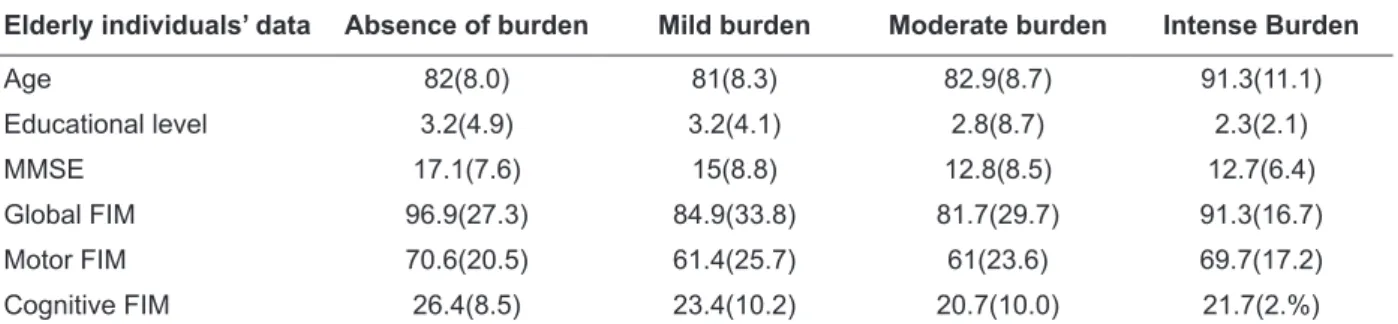
According to the diagnosis of burden (Table 4), caregivers diagnosed with intense burden are those caring for older elderly individuals (average
= 91 years old), with lower educational levels, and
Table 4 – Distribution of averages presented by the elderly individuals in terms of age, MMSE, Global FIM, Motor FIM, Cognitive FIM related to the ordinal categories of burden. Ribeirão Preto, SP, Brazil 2009
Elderly individuals’ data Absence of burden Mild burden Moderate burden Intense Burden
Age 82(8.0) 81(8.3) 82.9(8.7) 91.3(11.1)
Educational level 3.2(4.9) 3.2(4.1) 2.8(8.7) 2.3(2.1)
MMSE 17.1(7.6) 15(8.8) 12.8(8.5) 12.7(6.4)
Global FIM 96.9(27.3) 84.9(33.8) 81.7(29.7) 91.3(16.7)
Motor FIM 70.6(20.5) 61.4(25.7) 61(23.6) 69.7(17.2)
Cognitive FIM 26.4(8.5) 23.4(10.2) 20.7(10.0) 21.7(2.%)
The linear regression analysis to explain the total scores of the Zarit Burden Scale and SQR and the elderly individuals’ predictor variables, such as global FIM and cognitive performance, showed that the de-pendency of the elderly individuals was statistically associated (b=-0.179, p=0.046), and is a predictor of burden when adjusted for the remaining variables. Associated with emotional distress, the regression
analysis showed marginally signiicant values. Data
suggest that the dependency of elderly individuals is a risk factor for caregiver burden.
DISCUSSION
The analysis of the characteristics of the caregivers related to burden showed that female caregivers older than 60 years of age obtained a higher average compared to male caregivers. Such a result is in agreement with studies addressing caregivers of elderly individuals with dementia16-18
and depression. 7
Older caregivers seem to be more vulnerable to burden, though younger individuals may suffer more with isolation and greater social restrictions, proportional to the greater possibilities of social activities and leisure available for their age range.19
The social inclusion of women, who have progressively participated in the job market, characterizes changes in current society. For this reason, women add to their caregiver role, work outside the home and domestic tasks inherent to the role of mother, wife and often, the role of grandmother, generating an accumulation of work at home and burden in various domains of life, such as the social, physical, emotional, and spiri-tual domains. Altogether, these factors contribute to their neglect of their own health. 5
Data related to educational level revealed greater averages of burden for those who studied
from one to four years and those who studied more than 12 years. Therefore, a negative linear association was not observed between these vari-ables. The caregivers’ educational level did not indicate a strong association related to burden in a study addressing caregivers of demented elderly individuals.20
The greatest burden was also observed in caregivers who are the spouses of the elderly individuals requiring care. Studies show that the spouse often manifests distress and feelings of loneliness when s/he assumes the care of the elderly individual at home alone. 4 Thus, the
importance of other family members providing support to the caregiver is evident, even if such support is provided only during visits. A study evaluating the population of elderly individuals 80 years old or older in the city of Ribeirão Preto, SP, Brazil showed that the older elderly individu-als (26.5%), especially those aged between 80 and 84 years old, lived with their spouses only, which may indicate reduced family support. 21
This study showed intense and uninterrupt-ed hours of care delivery, with an average of 12.3 hours/day and 4.95 days/week. Such averages, however, were below those reported in another study22: an average of 15.6 hours/day, though this
result refers to care provided to demented indi-viduals, who present greater care demands. Often, the caregivers’ feelings of burden or exhaustion are associated with symptomatology characterized in individuals who suffer burdens resulting from the great dedication and effort exerted in the care ac-tivity in which the caregiver neglects his/her own needs, and constitutes a psychosocial problem. 6
individuals obtained an average of 6.7 on the SRQ.23 This study’s results indicate that emotional
distress experienced by caregivers is strongly associated with burden while being burdened is indicated as a risk factor for emotional distress. It is important to prevent caregiver burden because, in addition to causing numerous problems in the lives of caregivers, symptoms of emotional distress may also manifest, such as headaches, insomnia, poor appetite, sadness, and anxiety, among others. Similar to burden, emotional distress was potentially associated with time spent daily pro-viding care, in agreement with other Brazilian studies.7,23 It is common to ind family caregiv
-ers with depression as a response to prolonged exposure to a situation of physical and emotional exhaustion, a potential generator of stress.4
When analyzing the characteristics of elderly individuals, we observed that caregivers of older elderly individuals experience greater burden than those caring for younger elderly
individu-als, though the data were not statistically signii -cant. These results are similar to those reported by another study indicating greater burden for caregivers of older elderly individuals. Elderly
individuals usually have speciic demands of care
due to the decline of some of their abilities experi-enced over the years.19 In contrast, other
research-ers show some divergence concerning decreased levels of burden over the years, possibly explained by an adaptive process. During the adaptive pro-cess and with experience gained over time in care
activities, caregivers report more conidence with
experiences, which reduce feelings of burden. 20
No signiicant differences were observed
in this study concerning averages of burden between female and male caregivers, the elderly individual’s marital status, education or income. Another study addressing caregivers of elderly individuals with depression7 does not report any
statistically signiicant association, either, between
burden and socio-demographic characteristics (age, gender, educational levels and income) of the elderly individuals.
The comparison of the cognitive ability of the elderly individuals with caregiver burden resulted in variables inversely proportional, that is, the lower the individual’s cognitive ability, the greater the burden. Researchers defend the view that the responsibility for caring for an elderly
in-dividual with cognitive deicit caused by dementia
generates physical and psychological changes in caregivers, making them potentially sick
individu-als and constantly putting their functional capacity at risk. 4,15-16,23
Functional ability was the only factor
statis-tically signiicant to the caregiver’s burden, also
with inversely proportional averages: the lower the score obtained in FIM, the greater the burden. Such a result reveals that the greater the depen-dence of the elderly individual, the greater the chances of the caregiver being burdened, similar to the results found in other studies.7,17,21,23
According to the burden diagnosis based on the cut-off points previously mentioned, 72 (57.6%) caregivers presented mild to moderate burden. A study describing the burden of 36 caregivers of elderly individuals with Alzheimer’s disease in Alegre, RS, Brazil reported that 20 (55.6%) of the caregivers presented moderate burden.4 We did
not identify other Brazilian studies comparing the scores of caregiver burden with the characteristics of elderly individuals. Therefore, we consider
these indings to be essential to planning care
delivered to elderly individuals and support pro-vided to caregivers.
The task of caring for an elderly individual requires from caregivers almost exclusive dedica-tion, especially in the case of elderly individuals with a disabling disease. Caregivers are oftentimes required to leave their jobs and occupations, and put aside their own lives, while only a few can de-pend on the help of others to share the care task. .23
Society, composed of social actors, govern-ment and non-governgovern-mental organizations, needs to jointly promote effective social participation, in order to improve the condition of the lives of caregivers of elderly individuals to prevent or even reduce the burden they experience. The Government Action Plan sets the guidelines for care, however, state and city health care services, universities, NGOs and other networks should coordinate their efforts and devise formal and informal interventions for family caregivers of elderly individuals.
CONCLUSIONS
This study contributed to improving knowl-edge concerning symptoms arising from burden and emotional distress experienced by the caregiv-ers of elderly individuals living in the community, showing that 72 (57.6%) of the caregivers experi-ence mild to moderate burden.
were adult female caregivers, when women have numerous social roles: mother, spouse, and home-maker, among others. Often the female caregiver has other social responsibilities, such as work outside the home, in addition to providing care to already elderly parents.
The study also shows that care activities led caregivers to experience emotional distress in ad-dition to burden, associated with impairment of elderly individuals in the performance of daily life activities, revealing that the dependence of elderly individuals was an important predictor of caregiver burden.
Time spent daily providing care was fre-quently uninterrupted while many caregivers pro-vided care without pausing for rest or leisure. The variables concerning caregivers, such as being a woman and spending an average of 12 hours daily, correlated with the variables related to the elderly individuals, such as functional dependence. These are factors that should draw the attention of health workers to the possibility that caregivers may ex-perience burden. Hence, the role of health workers is to use assessment protocols based on risk factors to diagnose and prevent this problem.
Further studies are suggested in the ield re -garding interventions with caregivers living with elderly individuals that use assessment tools vali-dated for the Brazilian population, since research
conducted in the ield usually focuses on caregivers
of elderly individuals with dementia. Such work
will beneit not only caregivers but also patients, since caregivers can provide more eficient care
when not experiencing burden or distress.
REFERENCES
1. Instituto Brasileiro de Geograia e Estatística. Censo
demográico de 2010: resultado do universo. [acesso
2011 Set 15]. Disponível em: http://www.ibge. gov.br/home/estatistica/população/censo2010/ tabelabrasil1.12.shtm
2. Ministério da Saúde (BR). Secretaria de Assistência à Saúde. Portaria nº 1395, de 9 de dezembro de 1999: aprova a Política Nacional de Saúde do Idoso
e dá outras providências. Diário Oicial da União,
Brasília, p.20-24, 13 dezembro de 1999. Seção 1 3. Ministério do Trabalho e Emprego/Secretaria de
Políticas Públicas e de Emprego. Classificação Brasileira de Ocupações: CBO 2002. Brasília: MTE, 2002.
4. Luzardo AR, Gorini MIPC, Silva APSS. Características de idosos com doença de Alzheimer e seus cuidadores: uma série de casos em um serviço de
neurogeriatria. Texto Contexto Enferm. 2006 Out-Dez; 15(4):587-94.
5. Marques S, Rodrigues RAP, Kusumota L. O idoso após acidente vascular cerebral: alterações no relacionamento familiar. Rev Latino-am Enfermagem. 2006 Mai-Jun; 14(3):364-71.
6. Zarit SH, Zarit JM. The memory and behavior problems checklist – 1987R and the burden interview (technical report). University Park (PA): Pennsylvania State Universiy, 1987.
7. Scazufca M, Menezes PR, Almeida OP. Caregivers burden in na elderly population with depression in São Paulo, Brazil. Soc. Psychiatry Psychiatr. Epidemiology. 2002 Abr; 37:416-22.
8. Scazufca M. Brazilian version of the Burden Interview Scale for the assessment of care in carers of people with mental illnesses. Rev Bras Psiquiatr. 2002 Mar; 24(1):12-7.
9. Hébert R, Bravo G, Préville M. Reliability, validity and reference values of the Zarit Burden Interview for assessing informal caregivers of community-dwelling older persons with dementia. Can J Aging. 2000 Dec; 19:494-507.
10. Harding TW, Arango MV, Baltazar J. Mental disorders in primary health care: a study of their frequency and diagnosis in four developing countries. Psych Medicine. 1980 Jul; 10:231-41. 11. Mari JJ, Williams P. A validity study of a psychiatric
screening questionnaire (SRQ-20) in primary care in the city of São Paulo. Bras J Psychiatry. 1986 Jan; 148:23-6.
12. Folstein MF, Folstein SE, Mchugh PR. Mini-mental state: a pratical method for grading the cognitive state of patients for the clinicians. J Psych Research. 1975 Nov; 12:189-98.
13. Bertolucci PHF, Brucki SMD, Campcci SR, Juliano Y. O mini exame do estado mental em uma população geral: impacto da escolaridade. Arq Neuropsiquiatr. 1994; 52:1-7.
14. Granger CV, Hamilton BB, Keith RA, Zielezny M, Sherwin FS. Advances in functional assessment for rehabilitation. Top Geriatr Rehabil. 1986 Apr;1(3):59-74.
15. Riberto M, Miyazaki MH, Jucá SSH, Sakamoto H, Pinto PPN, Battistella LR. Validação da versão brasileira da Medida de Independência Funcional. Acta Fisiatr. 2004 Ago; 11(2):72-6.
16. Aminzadeh F, Byszewski A, Dalziel WB. A prospective study of caregiver burden in an outpatient comprehensive geriatric assessment program. Clinical Gerontol. 2006 Oct; 29(4):47-60. 17. Gort AM, Mingot M, Gomez X, Soler T, Torres G,
18. Fialho PPA, Koenig AM, Santos HCG, Beato RG, Carvalho VA, Machado TH, Caramelli P. Dementia caregiver burden in Brazilian sample: association to neuropsychiatric symptoms. Dement Neuropsychol. 2009 Apr-Jun; 3(2):132-5.
19. Amêndola F, Oliveira MA, Alvarenga MRMA. Qualidade de vida dos cuidadores de pacientes dependentes no programa de saúde da família. Texto Contexto Enferm. 2008 Abr-Jun; 17(2):266-72. 20. Cassis SVA, Karnakis T, Moraes TA, Curiati JAE,
Quadrante ACR, Magaldi RM. Correlação entre o estresse do cuidador e as características clínicas do paciente portador de demência. Rev Assoc Med
Bras. 2007 Set; 53(6):497-501.
21. Pedrazzi EC, Della-Mota TT, Vendrúsculo TRP, Fabrício-Wehbe SCC, Cruz IR, Rodrigues RAP. Arranjo domiciliar dos idosos mais velhos. Rev Latino-am Enfermagem. 2010 Jan-Fev; 18(1):08 telas. 22. Gratão ACM, Vale FAC, Cruz MR, Haas VJ, Lange
C, Talmelli, LFS, et al. Family caregivers demands from elderly individuals with dementia. Rev Esc Enferm USP. 2010 Dec; 4(4):873-80.
23. Garrido R, Menezes PR. O Brasil está envelhecendo: boas e más notícias por uma perspectiva epidemiológica. Rev Bras Psiquiatr. 2004 Abr; 24(I):3-6.