www.atmos-chem-phys.net/11/4289/2011/ doi:10.5194/acp-11-4289-2011
© Author(s) 2011. CC Attribution 3.0 License.
Chemistry
and Physics
Oxalate metal complexes in aerosol particles:
implications for the hygroscopicity of oxalate-containing particles
T. Furukawa and Y. Takahashi
Department of Earth and Planetary Systems Science, Graduate School of Science, Hiroshima University, Higashi-Hiroshima, Hiroshima 739-8526, Japan
Received: 20 October 2010 – Published in Atmos. Chem. Phys. Discuss.: 9 November 2010 Revised: 3 April 2011 – Accepted: 4 April 2011 – Published: 10 May 2011
Abstract. Atmospheric aerosols have both a direct and an indirect cooling effect that influences the radiative balance at the Earth’s surface. It has been estimated that the degree of cooling is large enough to weaken the warming effect of car-bon dioxide. Among the cooling factors, secondary organic aerosols (SOA) play an important role in the solar radiation balance in the troposphere as SOA can act as cloud condensa-tion nuclei (CCN) and extend the lifespan of clouds because of their high hygroscopic and water soluble nature. Oxalic acid is an important component of SOA, and is produced via several formation pathways in the atmosphere. However, it is not certain whether oxalic acid exists as free oxalic acid or as metal oxalate complexes in aerosols, although there is a marked difference in their solubility in water and their hy-groscopicity. We employed X-ray absorption fine structure spectroscopy to characterize the calcium (Ca) and zinc (Zn) in aerosols collected at Tsukuba in Japan. Size-fractionated aerosol samples were collected for this purpose using an im-pactor aerosol sampler. It was shown that 10–60% and 20– 100% of the total Ca and Zn in the finer particles (<2.1 µm) were present as Ca and Zn oxalate complexes, respectively. Oxalic acid is hygroscopic and can thus increase the CCN activity of aerosol particles, while complexes with various polyvalent metal ions such as Ca and Zn are not hygroscopic, which cannot contribute to the increase of the CCN activity of aerosols. Based on the concentrations of noncomplexed and metal-complexed oxalate species, we found that most of the oxalic acid is present as metal oxalate complexes in the aerosols, suggesting that oxalic acid does not always increase the hygroscopicity of aerosols in the atmosphere. Similar re-sults are expected for other dicarboxylic acids, such as mal-onic and succinic acids. Thus, it is advisable that the cooling
Correspondence to:Y. Takahashi ([email protected])
effect of organic aerosols should be estimated by including the information on metal oxalate complexes and metal com-plexes with other dicarboxylic acids in aerosols.
1 Introduction
Some anthropogenic aerosols, such as organic aerosols and sulfate aerosols, have a direct cooling effect by scattering solar radiation, and an indirect cooling effect by acting as cloud condensation nuclei (CCN) because of their hygro-scopic properties (Novakov and Penner, 1993; Claeys et al., 2004; Kanakidou et al., 2005; IPCC, 2007; Hallquist et al., 2009). The global average contribution of the indirect cool-ing effect (i.e., the cloud albedo effect) is estimated to be
nature (Kawamura and Ikushima, 1993; Kawamura and Sak-aguchi, 1999; Yao et al., 2002; Crahan et al., 2004; Lohmann and Leck, 2005; IPCC, 2007).
Oxalic acid is a major component of DCA and also an im-portant component of identified secondary organic aerosols (Kawamura and Ikushima, 1993; Kawamura and Sakaguchi, 1999; Yu, 2000). In this study, we focused on oxalic acid as a representative component of low molecular weight DCA in the atmosphere, and our results can be extended to other DCA, such as malonic and succinic acids. We expect that oxalic acid can form metal oxalate complexes in aerosols by reacting with metal ions due to several reasons: (i) aerosols contain various metal ions originating from sea salts, desert dusts, continental soils, and anthropogenic sources; (ii) ox-alic acid is formed in the aqueous phase at aerosol surfaces in the atmosphere or cloud droplet (Warneck, 2003; Crahan et al., 2004; Lim et al., 2005; Carlton et al., 2007), where the aqueous phase can be a reaction field for metal complexa-tion; (iii) polyvalent metal ions can form stable complexes with oxalate ion (Table 1). However, metal oxalate com-plexes are not detected using conventional methods, such as gas chromatography and ion chromatography (IC). In the lat-ter analysis, a large volume of walat-ter sufficient to dissolve metal oxalate complexes in aerosols is usually employed dur-ing the water extraction procedure. In this case, metal ox-alate complexes can be readily dissolved, despite the low solubility of some metal oxalate complexes (for more details, see Sect. 3.5), and it is difficult to distinguish between non-complexed and metal-non-complexed oxalate species in aerosols. Hence, only a few studies have suggested that DCA can re-act with metal ions and mineral aerosols (Mochida et al., 2003, 2007; Sullivan et al., 2007). However, these studies employed indirect methods that cannot show direct evidence of the formation of metal oxalate complexes in aerosols.
In this study, we applied X-ray absorption fine structure (XAFS) spectroscopy to show the presence of metal oxalate complexes in aerosols, coupled with IC and inductively cou-pled plasma atomic emission spectrometry (ICP-AES) anal-yses, to determine the ratio of metal oxalate and noncom-plexed oxalate species. XAFS data consists of X-ray ab-sorption near edge structure (XANES) and extended X-ray absorption fine structure (EXAFS), which enables us to de-termine chemical species of each element in aerosols directly (e.g., Takahashi et al., 2006; Higashi and Takahashi, 2009). For the XAFS analysis, size-fractionated aerosol samples were collected during 2002 in the winter (from January to February) and summer (from July to August) in Tsukuba, Japan. Based on our results, it was possible to obtain the ratio of metal-complexed and noncomplexed oxalate species in the aerosols. In this study, Ca edge XANES and Zn K-edge XANES and EXAFS were performed to demonstrate the presence of metal oxalate complexes. The ratio deter-mined in this study can contribute to the precise evaluation of the influence of oxalic acid and other DCA on the hygro-scopicity and CCN activity of aerosol particles.
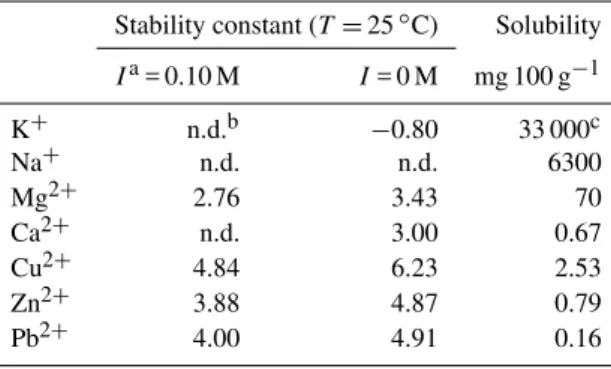
Table 1.Stability constant (log K) of oxalate with some metal ions at 25◦C (Martell and Smith, 1977) and the solubility of the com-plexes in water (David, 1994).
Stability constant (T=25◦C) Solubility
Ia= 0.10 M I= 0 M mg 100 g−1
K+ n.d.b −0.80 33 000c
Na+ n.d. n.d. 6300
Mg2+ 2.76 3.43 70
Ca2+ n.d. 3.00 0.67
Cu2+ 4.84 6.23 2.53
Zn2+ 3.88 4.87 0.79
Pb2+ 4.00 4.91 0.16
aI: ionic strength (M). bn.d.: no data. csolubility in hot water.
2 Materials and methods
2.1 Aerosol samples and characterization
The aerosol samples examined in this study were collected in Tsukuba (a city approximately 60 km northeast of Tokyo: 36.06◦N, 140.14◦E; Table S1 in Supplement) in Japan dur-ing the winter (21 January to 12 February) and summer (28 July to 13 August) of 2002 (Kanai et al., 2003) as a part of the Japan–China joint “Asian Dust Experiment on Climate Impact” project (Mikami et al., 2006). In this study, size-fractionated aerosol samples were collected using a low-volume Andersen-type air sampler (AN-200, Sibata, Tokyo). The flow rate of the sampler was stabilized at 28.3 L min−1 to achieve the ideal size separation of the aerosols. The sam-pler had eight stages and a back-up filter. The particle diam-eter was classified by the aerodynamic diamdiam-eter as follows:
2.2 Water soluble components in the aerosol samples
Bulk chemical analysis of the water soluble components (WSCs) in the aerosol was conducted using the procedure used by Kanai et al. (2005). A 1/8 section of the filter was soaked in a Teflon beaker containing 200 µl of ethanol and 5 ml of MQ water. The WSCs were leached by subjecting the solution to an ultrasonic treatment for a period of 30 min. The water soluble fraction was then recovered as a filtrate after filtration through a 0.20 µm hydrophilic polytetrafluo-roethylene filter. The solution containing various extracted ions was used to determine the quantity of major anions (Cl−, NO−3, SO24−, and C2O24−)and cations (Na+, NH
+ 4, and
K+). The WSCs were measured using IC (IC7000, Yoko-gawa, Japan, relative precision = 2%) employing Shodex IC YK-421 and Shima-pack IC-SA1/-SA1(G) columns for the cations and anions, respectively. The eluent composition was a mixed solution containing 24 mM of boric acid, 5 mM of tartaric acid, and 1 mM of 2,6-pyridine dicarboxylic acid for the cations and 14 mM of NaHCO3for the anions. The flow
rate of the elutant was 1.0 ml min−1for both cations and
an-ions. A part of the extraction solution was used to deter-mine the concentration of the water soluble fraction of Zn2+, Ca2+, and Mg2+using ICP-AES (SEIKO EG&G, SP 500).
2.3 XAFS measurements
Calcium (Ca) K-edge XANES experiments were performed at Beamline 9A (Takahashi et al., 2006, 2009) at the KEK Photon Factory in Tsukuba, Japan. Beamline 9A has Si (111) double-crystal monochromators. The beam size was smaller than 1×0.5 mm2at the sample position. The aerosol samples located on each filter appeared as a dark spot (spot size = 0.5–2 mm), and were directly exposed to the incident X-ray beam. The entire beam path of Beamline 9A was filled with He gas to suppress any X-ray absorption and scattering from air. The energy of the Ca K-edge XANES was cali-brated by defining the peak maximum of the XANES data of CaCl2·2H2O at 4038.1 eV. For the aerosol samples,
flu-orescence yield (FL) mode was employed to record the Ca K-edge XANES spectra. The CEY mode was used to obtain XAFS for reference materials, since the mode is not affected by overabsorption effect for concentrated sample (Manceau et al., 2002; Takahashi et al., 2009). XANES spectra for aerosol samples were measured in the FL mode using a Ly-tle detector or a 19-element Ge solid state detector. The FL mode was suitable for the analysis of the ambient aerosol samples, since this mode is more sensitive than the CEY mode. We confirmed that the two modes gave identical spec-tra when the samples were prepared appropriately to each mode (Takahashi et al., 2008, 2009). In the FL mode, the sample was placed at an angle of 45◦to the incident beam. The Ca K-edge XANES spectra were recorded using a step size of 0.25 eV and a count per step of 0.5 s.
The zinc (Zn) K-edge XANES and EXAFS data were measured at Beamline 12C at the KEK-PF in Tsukuba, Japan. Beamline 12C also had a Si (111) double-crystal monochromator and the beam size<1×0.5 mm2at the sam-ple position. XANES reflects valence and symmetry of the element, while EXAFS shows interatomic distance and coor-dination number. Applications of both XANES and EXAFS result in higher reliability of the speciation data. The EX-AFS was not used for Ca speciation due to the poor quality of the spectra. It is usual that EXAFS quality is worse than XANES, since EXAFS needs measurement for longer en-ergy range with smaller oscillations. The enen-ergy of the Zn K-edge XANES was calibrated by defining the peak maxi-mum of Zn metal foil at 9660.7 eV. The transmission and FL modes were employed to measure the Zn K-edge XANES and EXAFS data of the reference materials and samples. In the FL mode, the aerosol sample was placed at an angle of 45◦from the incident beam, and the fluorescent X-rays were measured using a 19-element Ge solid state detector. Sup-plementary data for Zn K-edge XAFS were also obtained at Beamline BL01B1 in SPring-8 (Hyogo, Japan), which has a similar set-up to that of Beamline 12C in Photon Factory.
The fitting of the spectra of natural samples to those of the reference materials was conducted using a least-squares fitting method. To estimate the goodness-of-fit in fitting the XANES and EXAFS spectra, theR value in the energy re-gion for the fitting was
R=X(Is(E)−Ical(E))2/
X
Ical(E)2
whereIsandIcalare the normalized absorption of the aerosol
samples and the calculated values, respectively. The energy range for fitting the Ca K-edge XANES was 4030–4060 eV, while for the Zn K-edge XANES the energy range was 9650– 9680 eV. The fitted range of the Zn K-edge EXAFS was from k=2 to k=6−7.5 ˚A−1, where k is the photoelec-tron wave vector. All the speciation results based on the XANES and EXAFS fitting were determined when the R
value was minimal in the fitting procedures. In the proce-dure, the maximum number of possible species (end mem-bers) was limited to three, since it is possible that the in-crease of the number simply makes theRvalue lower. Errors related to the least-squares analysis for the fraction of each species obtained from the XANES fitting were calculated us-ing the Athena XAFS analysis software package (Ravel and Newville, 2005).
3 Results and discussion
3.1 Characterization of the aerosol samples
The results of backward trajectory (HYSPLIT4) analysis suggested that the air mass in winter in Tsukuba was trans-ported through northeastern China, Korea, and Japan which was possibly subject to the influences of (i) anthropogenic aerosols from the mega cities in the three countries, (ii) min-eral aerosols from arid area in northeast part of China (Mikami et al., 2006), and (iii) sea salts from Japan Sea (Fig. S1). In summer, the air mass mainly came from the Pacific Ocean, but can also be affected by anthropogenic aerosols from industrial areas in Japan, since the trajectory passed through Tokyo and Osaka. The seasonal trend is typi-cal for the air mass around Japan, and the chemitypi-cal composi-tion of the aerosols can reflect the source of the air mass (Var et al., 2000).
Two peaks in the aerosol mass distribution were observed in the fine (particle size around 0.7 µm) and coarse (2– 6 µm) modes in both winter and summer (Fig. 1). Most of the aerosols with finer fractions (<2 µm) may be secondary aerosols from anthropogenic sources. These aerosols were formed by the conversion from the gas phase to particles to form agglomerates of smaller sized particles (Seinfeld and Pandis, 2006). On the other hand, the coarse fraction mainly consists of mineral aerosols transported from conti-nental deserts, soil components, and sea salts (Seinfeld and Pandis, 2006).
The size-segregated chemical compositions also reflect the sources. Briefly, relative composition of sulfate to Na+ showed that more than 95% of sulfate is of non-sea salt ori-gin (nss-sulfate; Table S2), most of which should be anthro-pogenic. The concentration of nss-sulfate was calculated as (e.g., Uematsu et al., 2010)
[nss−SO24−]=[totalSO24−]aerosol−([SO24−]/[Na+])seawater
×[Na+]aerosol
where molar ratio of ([SO24−]/[Na+])
seawaterwas 0.051
(Bru-land and Lohan, 2003). Thus, the aerosols samples in both periods are affected largely by anthropogenic activities. The concentration of Na+ in summer was approximately three times larger than that in winter, suggesting that aerosol sam-ples in summer was affected by the Pacific Ocean to a larger degree than in winter. These results agreed well with the back trajectory analysis (Fig. S1).
3.2 Size distribution of the WSCs in the aerosols
The formation process of oxalate in the aerosols can be de-duced from the concentrations of the WSCs at various par-ticle sizes of the aerosols (Yao et al., 2002). The size dis-tribution of oxalate is usually similar to that of sulfate, as the in-cloud process is important for the formation of both
0 5 10 15 20 25
0.1 1 10
Winter Summer
Aerodynamic diameter (m)
dM
/d
lo
gD
(mg
/m
3)
Fig. 1.Size distribution of the aerosol mass during winter (21 Jan-uary to 12 FebrJan-uary 2002) and summer (28 July to 13 August 2002) at Tsukuba, Japan.
oxalate and nss-sulfate (Yao et al., 2002; Warneck, 2003). The peak in sulfate concentration occurs at 0.8 µm in both winter and summer, whereas the concentration of sulfate is higher in summer than in winter (Fig. 2). It is well estab-lished that the peak in sulfate particle size is formed by an in-cloud process noted as droplet mode (Yao et al., 2002; Seinfeld and Pandis, 2006). In the oxalate size distribution, however, the peak is shifted towards coarser particle size than that of sulfate in summer (Fig. 2). A similar shift has also been observed by Yao et al. (2002), Mochida et al. (2003, 2007), and our observation at Okinawa island (Hedo, Oki-nawa, Japan). Details of the information of Hedo and Beijing were shown in Supplement (Table S1 and Fig. S2). The re-sults suggested that the aerosol samples affected by air mass from ocean can have the shift of the oxalate peak to larger particle in the size distribution, as clearly observed in Hdo (Fig. S2). Oxalate in aerosols can be formed by several mechanisms: (i) oxalic acid in aerosols are formed by gas to particle conversion (condensation), (ii) oxalic acid parti-cles can be captured in preexisting aerosols such as sulfate aerosols (coagulation), and (iii) oxalate can formed in the aqueous in cloud droplets or fog drop by chemical reaction. In these processes, photooxidation is important as it can pro-duce oxalate from its precursors such as unsaturated hydro-carbons and volatile organic compounds (VOCs) with OH radical or O3(e.g., Satsumabayashi et al., 1990; Sullivan and
0 0.5 1 1.5 2 2.5 0 20 40 60 80 100 120 140 160
0.1 1 10
C2O4
2-Cl -NO3 -SO4
2-(a) d C /dl ogD ( C2 O4
2- nmol
m -3) d C /d logD ( C l
-, N
O3
-, S
O4 2-nm o l m -3) 0 100 200 300 400 500 600 0 20 40 60 80 100 120
0.1 1 10 NH4+
Ca2+ Na+ Mg2+ dC/dl o gD ( N H4 + nmo
l m -3) dC /d lo g D ( C a
2+, N
a
+ Mg 2+ nmo
l m -3) (b) 0 0.5 1 1.5 2 2.5 3 0 20 40 60 80 100 120
0.1 1 10 Aerodynamic diameter (m)
dC /d lo g D ( Cl
-, NO
3
-, SO
4 2-nmo l m -3) (c) dC /d lo g D (C 2 O4 2- nm
o l m -3) 0 100 200 300 400 500 600 0 50 100 150 200
0.1 1 10
dC /dl o gD ( N H4 + nmol
m -3) dC /dl og D ( C a
2+, N
a
+ , Mg
2+
nmo
l m
-3)
Aerodynamic diameter (m) (d)
Fig. 2.Size distribution of WSCs in aerosols at Tsukuba:(a)anions and(b)cations in winter;(c)anions and(d)cations in summer.
second and third processes can explain the shift towards a coarser particle size by: (a) evaporation of oxalic acid in the finer particle sizes, which would result in an increase in the relative amount of oxalate in the coarser particles (Yao et al., 2002); and (b) a heterogeneous reaction of oxalic acid with coarser particles, such as mineral dusts (Yao et al., 2002; Mochida et al., 2003, 2007; Russell et al., 2002; Sullivan and Prather, 2007). Further discussion regarding the shift in particle size will be given in Sect. 3.6.
The size distribution of Cl−and NO−3 was similar in each period (Fig. 2), and the correlation coefficient between Cl− and NO−3 for various particles in each period was high (Ta-ble S4). Moreover, the size distribution of these ions was different between winter and summer. The peak in Cl−and NO−3 was found in the finer particle size in winter, but larger size in summer. Thus, Cl− in the coarser mode in summer reflects the composition of sea salts (NaCl), while NO−3 re-sulted from the uptake of HNO3 gas by NaCl particle with
water shell (Zhuang, 1999). Consequently, their correlation coefficient (R2)was very high (>0.9). This result is also consistent with the backward trajectory analysis (Fig. S1).
On the other hand, distribution of these ions into finer par-ticles resulted from the gas to particle conversion of NH4Cl
and NH4NO3,respectively, both in the presence and absence
of water (Seinfeld and Pandis, 2006): NH3(gas)+HCl(gas)↔NH4Cl(particle)
NH3(gas)+HNO3(gas)↔NH4NO3(particle).
These chemical reactions depend on the surrounding envi-ronment, because Cl− and NO−3 ions in the aerosols are likely to be affected by the ambient conditions, such as the RH (%), temperature, and photochemical factor (Oum et al., 1998; Zhuang et al., 1999; Yao et al., 2003; Seinfeld and Pandis, 2006; Thornton et al., 2010). Moreover, the ori-gins of HCl (gas) and HNO3(gas) are mainly anthropogenic
(Kaneyasu et al., 1999; Seinfeld and Pandis, 2006), show-ing that anthropogenic air masses affected the composition of aerosols in Tsukuba during winter in our samples.
A peak in the size distribution of Ca2+and Mg2+ions was observed in the coarser particle size in each period (Fig. 2), suggesting that the source of these ions was mainly natural, such as mineral dust from soil and arid areas and sea salt particles (Seinfeld and Pandis, 2006). The correlation coef-ficient of Ca2+and Mg2+ions with Na+was relatively high (Table S3). However, the enrichment factor normalized by sea salt (EFss)for Ca2+suggested that its source was not only
0.1
1
10
winter
summer
0
0.5
1
1.5
2
Aerodynamic diameter (
m)
dC
/ dl
og
D
(
Z
n
2+
nm
o
l m
-3
)
Fig. 3.Size distribution of Zn in aerosols during winter and summer at Tsukuba.
than that of Ca2+, suggesting that the source of Mg2+ was mainly sea salt (Fig. S3).
Tsukuba was affected by anthropogenic air mass in both seasons (Fig. S1). Zinc ion is included in anthropogenic aerosols (Kauppinen and Pakkanen, 1990; Manoli et al., 2002; Adachi and Tainosho, 2004; Councell et al., 2004; Rauch and Pacyna, 2009), and may have an important role on the formation of metal oxalate complexes due to its high stability constant with oxalate.
Among various heavy metals (Co, Ni, Zn, Mo, and Cd), concentration of Zn was larger than the other metals by more than an order of magnitude in the aerosols collected in Tsukuba (Ohta et al., 2003). The size distribution of Zn2+ ions was similar to the total oxalate distribution (Fig. 3). The peak in the size distribution of Zn2+ion in the aerosols was found in 0.8 and 3 µm in winter and only in 3 µm in summer, respectively. Hence, the source of Zn2+ion in the aerosols can be mainly anthropogenic, such as from the exhausts of motor vehicles, tire wear, brake wear, biomass burning, coal burning, and incineration (Kauppinen and Pakkanen, 1990; Manoli et al., 2002; Adachi and Tainosho, 2004; Councell et al., 2004; Moffet et al., 2008; Rauch and Pacyna, 2009). 3.3 Ca oxalate in the finer particles
XAFS measurements at the Ca K-edge were carried out to demonstrate the presence of Ca oxalate (CaC2O4·H2O)
complexes in the aerosols. From their stability constants, Ca ion is the dominant divalent metal ion in aerosols that can form stable oxalate complex (Table 1). Figure 4 shows the
CaC2O4 H2O
.
.
CaSO4 2H2O
Ca(NO3)2 4H
.
2O4030 4040 4050 4060
N
o
rm
ali
z
ed absorpt
ion
Energy (eV)
1.1-0.65 m
2.1-1.1 m
0.65-0.43 m
1.1-0.65m
2.1-1.1 m
summer
winter
Fig. 4. Calcium K-edge XANES spectra (open circles = samples, lines = fitting) of finer particles during winter and summer at Tsukuba with those of the standard materials used for fitting.
spectra of aerosol samples and Ca species used to fit the sam-ple spectra. The fractions of Ca species obtained from the fitting are shown in Table 2, and the results of the XANES spectra of various Ca species are shown in Fig. S4. Based on these results, it is suggested that Ca oxalate was observed in the finer particles as 0.43–2.1 µm and 0.65–2.1 µm during the winter and the summer, respectively. The XANES fitting showed that the Ca oxalate fraction among the total Ca con-centration was 10–60% (Fig. 4 and Table 2). The peak in the size distribution of the total oxalate occurred in this particle size range where Ca oxalate is the main Ca species. In this range, the molar concentration of Ca2+ion was lower than that of the total oxalate concentration, supporting the pres-ence of Ca oxalate in this particle size.
Gypsum (CaSO4·2H2O) and Ca nitrate
(Ca(NO3)2·2H2O) were also observed in the same
Table 2.Fraction of various Ca species at Tsukuba in winter and summer determined by XANES fitting (mol%).
Season Particle diameter Calcite Gypsum Ca oxalate Ca nitrate Anhydrite (µm)
Winter >11 31%±2% 38%±4% 31%±4%
11–7.0 28%±1% 40%±3% 32%±3%
7.0–4.7 19%±1% 47%±3% 34%±3%
4.7–3.3 23%±1% 61%±3% 16%±3%
3.3–2.1 85%±0% 15%±0%
2.1–1.1 56%±4% 30%±3% 14%±2% 1.1–0.65 58%±3% 20%±4% 22%±2% 0.65–0.43 37%±3% 63%±3%
Summer >11 18%±1% 23%±3% 59%±3%
11–7.0 50%±3% 50%±3%
7.0–4.7 71%±3% 29%±3%
4.7–3.3 71%±3% 29%±3%
3.3–2.1 67%±4% 33%±4%
2.1–1.1 63%±3% 11%±2% 26%±2% 1.1–0.65 54%±1% 40%±2% 6%±3%
result confirms that Ca oxalate is the main Ca species in the finer particles (0.43–2.1 µm and 0.65–2.1 µm during the winter and the summer, respectively).
In the coarser particles (>2.1 µm), the Ca species de-termined from the fitting were calcite (CaCO3), gypsum
(CaSO4·2H2O), and anhydrite (CaSO4) in both periods
(Fig. S4 and Table 2). These chemical species are observed by other studies (e.g., Buseck and Psfai, 1999; Takahashi et al., 2009). However, the XANES spectra of the finer parti-cles (1.1–0.65 µm) could not be fitted using these three com-ponents (Fig. S4). For example, assuming that gypsum and Ca nitrate were the end members of Ca in the aerosols in the fitting, the sample spectrum could not be fitted – especially around 4047 eV (Fig. S4) – where theRfactor was 0.00436. On the other hand, the spectrum could be fitted perfectly – even around 4047 eV – by assuming that Ca oxalate was one of main Ca species withR=0.00104. This result also sug-gested the presence of Ca oxalate in the finer particles. Gyp-sum and anhydrite can be formed from sea salt particles or from a reaction of calcite and SOx gas at the particle
sur-face in the atmosphere (Buseck and Psfai, 1999; Takahashi et al., 2009). Calcium nitrate can be formed from the re-action of calcite and NOxgas (Krueger et al., 2003; Li and
Shao, 2009).
Sullivan et al. (2009) suggested that the hygroscopicity and CCN activation property of oxalic acid can be reduced by reacting with Ca2+ in aerosols. Generally speaking, chem-ical species with low water solubilities are not hygroscopic, which results in the low CCN activity. Thus, Ca oxalate has low hygroscopicity and CCN activity due to the low solu-bility (0.617 mg 100 g−1; Table 1). Similar characteristics can be extended to other metal oxalate complexes such as Zn and lead (Pb) oxalate due to their low water solubilities
(Ta-ble 1). Formation of Zn and Pb complexes can be important, considering their high abundances in anthropogenic aerosol particles (Espinosa et al., 2001; Manoli et al., 2002; Hao et al., 2007). To quantify the role of oxalic acid on the CCN activity of aerosol particles, the ratio of oxalic acid and to-tal meto-tal oxalate complexes such as Ca oxalate is important, which will be determined in Sect. 3.5 in this study.
3.4 Zn oxalate in the finer particles
Although the formation of Ca oxalate was suggested in the previous section, it is still necessary to confirm the results us-ing independent data from other metal ions. Among the vari-ous divalent cations that can form stable complexes with ox-alate (Table 1), Zn K-edge XAFS was examined to show the formation of Zn oxalate, or other metal oxalate complexes, because: (i) Zn is the second most abundant divalent cation in the aerosol samples, and (ii) the stability constant of Zn oxalate is large and its water solubility is low (Table 1). In addition, (a) for other cations such as Pb and copper (Cu), it was not possible to obtain good quality spectra for the spe-ciation analysis due to their low concentrations, and (b) our system using hard X-ray cannot be applied to Mg. Thus, we confined our XAFS measurements to Ca and Zn.
Fig. 5
N
o
rm
al
iz
e
d
ab
so
rp
ti
o
n
0.65-0.43 m 1.1-0.65 m 2.1-1.1 m < 0.43m 3.3-2.1 m
< 0.43 m 0.65-0.43 m 1.1-0.65 m
2.1-1.1 m summer
winter
9640 9650 9660 9670 9680 9690 Energy (eV)
ZnC2O4 2H2O
ZnSO4 7H. 2O
.
3.3-2.1 m
ZnCl2. 2H2O
Fig. 5. Zinc K-edge XANES spectra (open circles = samples, lines = fitting) of finer particles during winter and summer at Tsukuba with those of the standard materials used for fitting.
in the aerosols was observed in the finer particles that also contained Zn sulfate (ZnSO4·7H2O). On the other
hand, the Zn species in the coarser particles were Zn chlo-ride (ZnCl2·2H2O), Zn carbonate (ZnCO3), and Zn sulfide
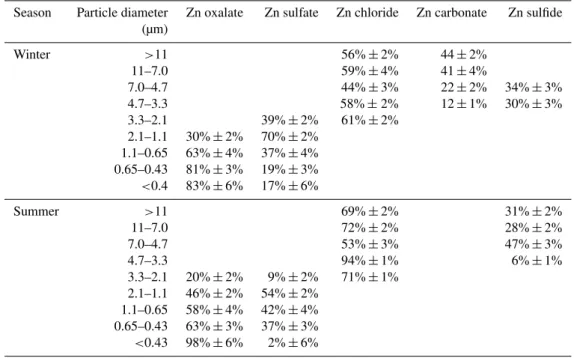
(ZnS), the details of which, including the sources of these species in the coarser particles, will be described elsewhere. All the related R values for the fitting were shown in Ta-ble S4. In this study, the variation of Zn species from finer to coarser particle size is important, because the effect of ox-alate formation should be more marked in the finer particle sizes. Zinc oxalate was not needed to fit the spectra of the coarser particles, but was essential to fit the XANES spectra of the finer particles. For example, when Zn K-edge XANES spectra of 11–7 µm (coarse mode) in winter was fitted by those of Zn sulfate and Zn oxalate, theR factor was 0.0475. When Zn sulfide and Zn carbonate were used by fitting in that particles range, itsRfactor was the lowest value (0.00228), which discounts the presence of Zn oxalate. In finer particles (<2.1 µm in winter and 3.3 µm in summer), contribution of Zn oxalate was needed to fit the spectra with lowestRvalues.
1 2 3 4 5 6 7 8
ZnC2O4 2H2O
ZnCl2 2H2O
summer winter
ZnSO4 7H2O
. .
k
3
(k)
k (Ao-1 )
.
(b)
summer
winter
1 2 3 4 5 6 7
o
k (A-1 )
k
3
(k
)
0.65-0.43 m
2.1-1.1 m 0.65-0.43 m 1.1-0.65 m 2.1-1.1 m ZnSO4 7H2O
ZnC2O4 .2H2O .
(a)
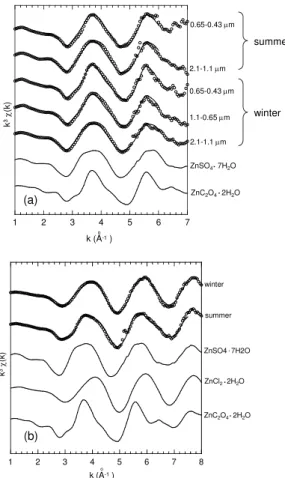
Fig. 6. Zinc K-edge EXAFS spectra (open circles = sample, lines = fitting) of finer particles during winter and summer at Tsukuba with standard materials used for fitting:(a)2.1–1.1, 1.1– 0.65 s and 0.65–0.43 µm in winter, and 2.1–1.1 and 0.65–0.43 µm in summer, and(b)3.3–2.1 µm in winter and summer.
Figure 6 and Table 4 show the fitting of the EXAFS data in
kspace and the Zn speciation data, respectively. The fitting results of the EXAFS data can be more reliable than that of the XANES data, because EXAFS spectra are dependent on the neighboring atoms, interatomic distances, and coordina-tion number, which are sensitive to the Zn speciacoordina-tion. The ra-tio of Zn oxalate to total Zn species (= [Zn oxalate]/[Zn]total)
obtained from the XANES and EXAFS fitting were similar (Tables 3 and 4, Fig. S7), which suggests the presence of Zn oxalate particularly in the finer particle region. Moreover, the [Zn oxalate]/[Zn]total ratio in each period clearly increased
0.25 0.54 0.88 1.6 2.7
Ca-oxalate Zn-oxalate Total oxalate (Summer)
Aerodynamic diameter (m)
0.25 0.54 0.88 1.6
0 0.5 1 1.5 2 2.5 3
d
C
/d
lo
gD
(nmo
l m
-3)
(Winter)
Aerodynamic diameter (m)
Fig. 7.Atmospheric concentrations of Ca oxalate, Zn oxalate, and total oxalate during winter and summer.
with the decrease in the particles size (Table 4 and Fig. S7), suggesting that the reaction of particle surface was impor-tant for the formation of Zn oxalate, though heterogeneous uptake on aerosol particles cannot be ruled out. This result corresponds to the scanning transmission X-ray microscopy data, which suggests that the formation of organic aerosols in Asian aerosols occurs at the particle surface (Maria et al., 2004). Russell et al. (2002) also detected carboxylic acids as particle coatings. In addition, the increase in the fraction of Zn oxalate may reflect that the concentration of free oxalate was higher in the finer particles, because the concentrations of Ca2+and Mg2+ions (= competitive ions) decreases with decreasing particle size. This means that free oxalate in the finer particles can react with Zn2+ions.
3.5 Noncomplexed and metal-complexed oxalate species in the aerosols
In this section, the ratio of metal oxalate complexes to total oxalate or noncomplexed oxalate species will be discussed. For this purpose, the concentration of Ca and Zn oxalates were determined by multiplying: (a) the total concentration of Zn and Ca obtained from ICP-AES data, and (b) the ox-alate complex fractions of these ions obtained from XAFS data. On the other hand, the concentration of total oxalate (i.e., the sum of noncomplexed and metal complexed oxalate species) was quantified using IC. The total concentration of oxalate, Ca, and Zn could be obtained using this method despite the low solubility of Ca and Zn oxalate complexes in the water extraction procedure, because these complexes were completely dissolved in our experiments, as we added an excess of water in the water-extraction procedure. For ex-ample, the total weight of the aerosols (in the 1/8 cut filter) was<1 mg, or the Ca oxalate on the filter was<0.025 mg assuming that the Ca in the sample was 5 wt% and the frac-tion of Ca oxalate among the total Ca was 50 mol%. Note
that the concentration of Ca and the fraction of Ca oxalate assumed in the calculations were larger than the values mea-sured in our samples. On the other hand, the solubility data (Table 1) showed that the amount of Ca oxalate that could be dissolved in 5 ml of the MQ water employed in this study was 0.035 mg, which was larger than the 0.025 mg. Thus, the Ca oxalate in the aerosols could be completely dissolved in 5 ml water in our experiments. A similar case can be discussed to validate the Zn oxalate data. Thus, we can obtain the concen-trations of the total oxalate, Ca, and Zn in the samples using our water extraction procedure.
The{[Zn oxalate] + [Ca oxalate]}/[oxalate]totalratio,
deter-mined as described above, is important to evaluate whether or not oxalate species contribute to the increase of hygro-scopicity of aerosols. As discussed in the introduction and in Sect. 3.3, noncomplexed oxalic acid in aerosols can con-tribute to enhancement of the CCN activity and can have a cloud lifetime effect (Peng et al., 2001; Crahan et al., 2004; Kanakidou et al., 2005; Lohmann and Leck, 2005; IPCC, 2007; Chan et al., 2008; Hallquist et al., 2009; Sullivan et al., 2009), whereas Ca and Zn oxalates do not have this po-tential because of their low hygroscopic and insoluble na-tures (Table 1). In winter, Ca and Zn oxalates accounted for about 60% of the total oxalate in the size ranges 1.1– 2.1 µm and 0.65–1.1 µm, while the values were 60–80% in the summer (Fig. 7). The sum of the Ca and Zn oxalate frac-tions in the 0.43–0.65 µm range among the total oxalate con-centration was approximately 30% in both periods (Fig. 7). The fraction of Zn oxalate among the total oxalate concen-tration under 0.43 µm in winter was low, while in summer it was very high (Fig. 7). Calcium oxalate in the 2.1–3.3 µm range in summer could not be detected because of the low [oxalate]/[Ca] ratio.
Table 3.Fraction of various Zn species at Tsukuba in winter and summer determined by XANES fitting (mol%).
Season Particle diameter Zn oxalate Zn sulfate Zn chloride Zn carbonate Zn sulfide (µm)
Winter >11 56%±2% 44±2%
11–7.0 59%±4% 41±4%
7.0–4.7 44%±3% 22±2% 34%±3%
4.7–3.3 58%±2% 12±1% 30%±3%
3.3–2.1 39%±2% 61%±2%
2.1–1.1 30%±2% 70%±2% 1.1–0.65 63%±4% 37%±4% 0.65–0.43 81%±3% 19%±3% <0.4 83%±6% 17%±6%
Summer >11 69%±2% 31%±2%
11–7.0 72%±2% 28%±2%
7.0–4.7 53%±3% 47%±3%
4.7–3.3 94%±1% 6%±1%
3.3–2.1 20%±2% 9%±2% 71%±1%
2.1–1.1 46%±2% 54%±2% 1.1–0.65 58%±4% 42%±4% 0.65–0.43 63%±3% 37%±3% <0.43 98%±6% 2%±6%
Table 4.Fraction of various Zn species at Tsukuba in the winter and summer determined by EXAFS fitting (mol%).
Season Particle diameter Zn oxalate Zn sulfate Zn chloride (µm)
Winter 3.3–2.1 2%±1% 33%±3% 65%±2%
2.1–1.1 28%±2% 72%±2%
1.1–0.65 59%±4% 41%±4%
0.65–0.43 79%± 4% 21%± 4%
Summer 3.3–2.1 26%±2% 41%±17% 33%±15%
2.1–1.1 38%±8% 62%±8%
0.65–0.43 51%±12% 49%±12%
that of Ca. The concentration of Mg was approximately 10– 90% and 10–20% of Ca in the summer and winter, respec-tively (Table S3). Although Mg oxalate is more soluble than Ca oxalate, it is much less soluble than K and Na oxalates. Thus, it is possible that complexation with Mg also con-tributes to make oxalate species more insoluble or less hygro-scopic than noncomplexed oxalate species. Other metal ox-alate species, such as with Pb2+and Cu2+ions supplied from anthropogenic sources, can be formed considering their high stability constants with oxalate ions (Table 1) in finer particle size ranges. Some other metal ions that were not measured may also form metal oxalate complexes in this particle range, because some anthropogenic metals in the aerosols are usu-ally rich in finer particles (e.g., Espinosa et al., 2001; Manoli et al., 2002; Hao et al., 2007).
3.6 Implications for oxalate species in the aerosols
The size distribution of oxalate reflects the possible forma-tion pathways of oxalate in aerosols suggested in Sect. 3.2: (i) gas to particle conversion, (ii) capture by preexisting aerosols, (iii) reactions in aqueous phase in droplet or at particle surface, and (iv) photooxidation process. Previous studies have supported that a chemical reaction in an aque-ous phase, such as in-cloud or on a particle surface, leads to the formation of oxalate (Warneck, 2003; Crahan et al., 2004; Lim et al., 2005; Carltona et al., 2007). If oxalate ions are dissolved in an aqueous phase with other metal ions, then metal oxalate complexes can precipitate depending on the solubility of each complex. For example, cloud water contains oxalate, Ca2+, Na+, and Mg2+ ions (L¨oflunda et al., 2002). In this case, Ca and Mg oxalates would precip-itate, but Na oxalate would not; this would be controlled by their solubility (Table 1). Similarly, NH+4 ions are also present in an aqueous phase on the particle surface and in-cloud droplets, but ammonium oxalate ((NH4)2C2O4)does
not precipitate because of its highly soluble nature and the low stability constant of the complex.
In our XAFS study, Ca oxalate was found in the droplet mode, suggesting that Ca oxalate in this particle range formed by evaporation of cloud droplets (in-cloud process). When cloud droplets evaporate, the low solubility species precipitate preferentially with the evaporation of the water. In addition, there is also a possibility that oxalate complex is formed in an aqueous phase on the particle surface, as has been suggested for Zn. The distinct difference between Ca and Zn lies in their source, natural and anthropogenic, respectively. Being different from Zn, which is distributed in the finer fractions, Ca is chiefly supplied as mineral dust and/or sea salt in the form of calcite and gypsum, mainly in the coarser particles (Takahashi et al., 2009). As a conse-quence, the abundance of Ca in the finer region is relatively low. Mochida et al. (2003) suggested that the uptake of DCA by mineral dust particles can change the size distribution of DCA such as oxalate. Thus, Ca in aerosols rich in coarser particles can change the oxalate size distribution by oxalate uptake, where it is more likely that Ca oxalate is formed. This mechanism can explain the shift in the oxalate peak in the size distribution to larger sizes in summer, because the abundance of Ca in the coarser particle size range is larger in the summer.
One may think that speciation of Ca and Zn by XAFS as-sumes that oxalic acid exists in the form of external mixture of oxalic acid, sulfate, and nitrate in the aerosols. However, the speciation results do not mean that the metal oxalate com-plex exists in the form of external mixture. Considering that oxalic acid is formed in cloud droplets and/or at aerosol sur-faces, it is most likely that the oxalic acid is produced in a form of “internal mixture” with other chemical species such as sulfate, nitrate, and organics. XAFS results are compatible with the form of aerosol as internal mixture, since the
spec-tra only show the local structure around Ca and Zn limited within second neighboring atoms from the center atoms (= Ca and Zn), which cannot be affected by whether the oxalate is in external or in internal mixture.
Zinc oxalate can be the main oxalate species consider-ing its high concentration in aerosols and the large stabil-ity constant of the oxalate. In our XAFS study, the [Zn oxalate]/[Zn]totalratio increased with the decreasing particle
size, suggesting that Zn oxalate was rich at the particle sur-face. Thus, the fraction of Zn oxalate among the total Zn concentration depends on the surface condition of the partic-ulate Zn and the concentration of other competing ions, such as Mg2+or Ca2+.
The speciation of oxalate depends on the concentrations of various metal ions. For example, in a remote marine at-mosphere, Ca and Mg oxalates can become the main metal oxalate species in aerosols because: (i) a remote marine at-mosphere is not affected by air pollution without heavy metal ions, such as Zn2+, Pb2+, and Cu2+, which have high stabil-ity constants with oxalate (Table 1); (ii) free oxalate is pro-duced in a marine atmosphere by photochemical oxidation of precursor organic compounds (Kawamura and Sakaguchi, 1999; Warneck, 2003); and (iii) Ca2+ and Mg2+ ions are abundant in sea salts. On the other hand, in an atmosphere containing anthropogenic compounds, Zn oxalate can be the main species, because the concentration of Zn2+ions is high and its complex with oxalate is stable.
4 Conclusions
In our study using XAFS spectroscopy, the fraction of the sum of Ca and Zn oxalate complexes among the total ox-alate concentration was 20–80%. Considering the presence of other metal ions, such as Mg2+, Pb2+, and Cu2+, the con-centration of free oxalic acid can be much lower than that expected. Therefore, the contribution of oxalic acid to hygro-scopicity of aerosol particles must have been overestimated. Thus, the present study may claim reevaluation of the con-tribution of oxalic acid to CCN activity of aerosols, because most of the oxalic acid can exist as non-hygroscopic metal oxalate complexes. Similar to oxalic acid, other WSOCs, such as malonic and succinic acids, can transform to metal complexes in aerosols. Therefore, in discussing the hygro-scopicity and related effects of organic aerosols, it is neces-sary to evaluate the contribution of the complexation of di-carboxylic acids with metal ions.
Supplementary material related to this article is available online at:
Acknowledgements. We are grateful to H. Kamioka, Y. Kanai, S. Yabuki, and A. Ohta for collecting the aerosol samples in the ADEC project. We very much appreciate the careful and con-structive review comments given by M. Gysel and two anonymous reviewers. This research was supported by a Grant-in-Aid for Scientific Research in Priority Areas, “Western Pacific Air–Sea Interaction Study (W-PASS)”. This work was performed with the approval of KEK-PF (2007G669, 2008G683, and 2010G072) and SPring-8 (2009A1170, 2009B1383, and 2010A1452). This research is a contribution to the Surface Ocean Lower Atmosphere Study (SOLAS).
Edited by: M. Gysel
References
Adachi, K. and Tainosho, Y.: Characterization of heavy metal par-ticles embedded in tire dust, Environ. Int., 30, 1009–1017, 2004. Bruland, K. W. and Lohan, M. C.: Controls of Trace Metals in Sea-water, The Oceans and Marine Geochemistry, 6, Treatise on Geo-chemistry, Elsevier Ltd, 2003
Buseck, P. R. and Psfai, M.: Airborne minerals and related aerosol particles: Effects on climate and the environment, P. Natl. Acad. Sci. USA, 96, 3372–3379, 1999.
Carlton, A. G., Turpin, B. J., Altieri, K. E., Seitzinger, S., Reff, A., Lim, H. J., and Ervens, B.: Atmospheric oxalic acid and SOA production from glyoxal: Results of aqueous photooxidation ex-periments, Atmos. Environ., 41, 7588–7602, 2007.
Chan, M. N., Kreidenweis, S. M., and Chan, C. K.: Measurements of the hygroscopic and deliquescence properties of organic com-pounds of different solubilities in water and their relationship with cloud condensation nuclei activities, Environ. Sci. Technol., 42, 3602–3608, 2008.
Charlson, R. J., Schwartz, S. E., Hales, J. M., Cess, R. D., Coakley, J. A., Hansen Jr., J. E., and Hofmann, D. J.: Climate forcing by anthropogenic aerosols, Science, 255, 423–430, 1992.
Claeys, M., Graham, B., Vas, G., Wang, W., Vermeylen, R., Pashyn-ska, V., Cafmeyer, J., Guyon, P., Andreae, M. O., Artaxo, P., and Maenhaut, W.: Formation of secondary organic aerosols through photooxidation of isoprene, Science, 303, 1173–1176, 2004. Councell, T., Duckenfield, K., Landa, E., and Callender, E.:
Tire-wear particles as a source of zinc to the environment, Environ. Sci. Technol., 38, 4206–4214, 2004.
Crahan, K. K., Hegg, D., Covert, S. D., and Jonsson, H.: An ex-ploration of aqueous oxalic acid production in the coastal marine atmosphere, Atmos. Environ., 38, 3757–3764, 2004.
David, R. L.: Handbook of Chemistry and Physics, 75th Edition, CRC Press, Inc., USA, 1994.
Draxler, R. R. and Rolph, G. D.: HYSPLIT (HYbrid Single-Particle Lagrangian Integrated Trajectory) Model access via NOAA ARL READY Website, available at: http://ready.arl.noaa.gov/ HYSPLIT.php, NOAA Air Resources Laboratory, Silver Spring, MD, USA. 2003.
Espinosa, A. J. F., Rodr´ıguez, M. T., de la Rosa, F. J. B., and S’anchez, J. C. J.: Size distribution of metals in urban aerosols in Seville (Spain), Atmos. Environ., 35, 2595–2601, 2001. Hallquist, M., Wenger, J. C., Baltensperger, U., Rudich, Y.,
Simp-son, D., Claeys, M., Dommen, J., Donahue, N. M., George, C., Goldstein, A. H., Hamilton, J. F., Herrmann, H.,
Hoff-mann, T., Iinuma, Y., Jang, M., Jenkin, M. E., Jimenez, J. L., Kiendler-Scharr, A., Maenhaut, W., McFiggans, G., Mentel, Th. F., Monod, A., Pr´evˆot, A. S. H., Seinfeld, J. H., Surratt, J. D., Szmigielski, R., and Wildt, J.: The formation, properties and impact of secondary organic aerosol: current and emerging is-sues, Atmos. Chem. Phys., 9, 5155–5236, doi:10.5194/acp-9-5155-2009, 2009.
Hao, Y., Guo, Z., Yang, Z., Fang, M., and Feng, J.: Seasonal varia-tions and sources of various elements in the atmospheric aerosols in Qingdao, China, Atmos. Res., 85, 27–37, 2007.
Higashi, M. and Takahashi, Y.: Detection of S(IV) species in aerosol particles using XANES spectroscopy, Environ. Sci. Tech-nol., 43, 7357–7363, 2009.
IPCC Climate Change 2007: Synthesis Report, the Intergovernmen-tal Panel on Climate Change, Cambridge University Press, UK, 2007.
Kanai, Y., Ohta, A., Kamioka, H., Terashima, S., Imai, N., Mat-suhisa, Y., Kanai, M., Shimizu, H., Takahashi, Y., Kai, K., Xu, B., Hayashi, M., and Zhang, R.: Variation of concentrations and physicochemical properties of aeolian dust obtained in east China and Japan from 2001 to 2002, Bull. Geol. Surv. Jpn., 54, 251–267, 2003.
Kanakidou, M., Seinfeld, J. H., Pandis, S. N., Barnes, I., Dentener, F. J., Facchini, M. C., Van Dingenen, R., Ervens, B., Nenes, A., Nielsen, C. J., Swietlicki, E., Putaud, J. P., Balkanski, Y., Fuzzi, S., Horth, J., Moortgat, G. K., Winterhalter, R., Myhre, C. E. L., Tsigaridis, K., Vignati, E., Stephanou, E. G., and Wilson, J.: Organic aerosol and global climate modelling: a review, At-mos. Chem. Phys., 5, 1053–1123, doi:10.5194/acp-5-1053-2005, 2005.
Kaneyasu, N., Yoshikado, H., Mizuno, T., Sakamoto, K., and Sou-fuku, M.: Chemical forms and sources of extremely high nitrate and chloride in winter aerosol pollution in Kanto plain of Japan, Atmos. Environ., 33, 1745–1756, 1999.
Kauppinen, E. I. and Pakkanen, A. T.: Coal combustion aerosols: A field study, Environ. Sci. Technol., 24, 1811–1818, 1990. Kawamura, K. and Ikushima, K.: Seasonal changes in the
distribu-tion of dicarboxylic acids in the urban atmosphere, Environ. Sci. Technol., 27, 2227–2235, 1993.
Kawamura, K. and Sakaguchi, F.: Molecular distributions of wa-ter soluble dicarboxylic acids in marine aerosols over the Pa-cific Ocean including tropics, J. Geophys. Res., 104, 3501–3509, 1999.
Krueger, B. J., Grassian, V. H., Laskin, A., and Cowin, J. P.: The transformation of solid atmospheric particles into liq-uid droplets through heterogeneous chemistry: Laboratory in-sights into the processing of calcium containing mineral dust aerosol in the troposphere, Geophys. Res. Lett., 30, L1148, doi:10.1029/2002GL016563, 2003.
Li, W. J. and Shao, L. Y.: Observation of nitrate coatings on at-mospheric mineral dust particles, Atmos. Chem. Phys., 9, 1863– 1871, doi:10.5194/acp-9-1863-2009, 2009.
Lim, H. J., Carlton, A. G., and Turpin, B. J.: Isoprene forms sec-ondary organic aerosol through cloud processing: Model simu-lations, Environ. Sci. Technol., 39, 4441–4446, 2005.
Lohmann, U. and Leck, C.: Importance of submicron surface-active organic aerosols for pristine Arctic clouds, Tellus B, 57, 261– 268, 2005.
Hitzen-bergerb, R., and Puxbauma, H.: Formic, acetic, oxalic, malonic and succinic acid concentrations and their contribution to organic carbon in cloud water, Atmos. Environ., 36, 1553–1558, 2002. Manceau, A., Marcus, M. A., and Tamura, N.: Quantitative
specia-tion of heavy metals in soils and sediments by synchrotron X-ray techniques, Rev. Mineral. Geochem., 49, 341–428, 2002. Manoli, E., Voutsa, D., and Samara, C.: Chemical characterization
and source identification/ apportionment of fine and coarse air particles in Thessaloniki, Greece, Atmos. Environ., 36, 949–961, 2002.
Maria, S. F., Russell, L. M., Gilles, M. K., and Myneni, S. C. B.: Or-ganic aerosol growth mechanisms and their climate-forcing im-plications, Science, 306, 1921–1924, 2004.
Martell, A. E. and Smith, R. M.: Critical Stability Constants. Vol-ume 3, Other Organic Ligands, Plenum, New York, USA, 1977. Mikami, M., Shi, G. Y., and Uno, I.: Aeolian dust experiment on
cli-mate impact: An overview of Japan-China joint project ADEC, Global Planet. Change, 52, 142–172, 2006.
Mochida, M., Umemoto, N., Kawamura, K., and Uematsu, M.: Bimodal size distribution of C-2-C-4 dicarboxylic acids in the marine aerosols, Geophys. Res. Lett., 30, 1672, doi:10.1029/2003GL017451, 2003.
Mochida, M., Umemoto, N., Kawamura, K., Lim, H. J., and Turpin, B. J.: Bimodal size distributions of various organic acids and fatty acids in the marine atmosphere: Influence of anthropogenic aerosols, Asian dusts, and sea spray off the coast of East Asia, J. Geophys. Res., 112, D15209, doi:10.1029/2006JD007773, 2007. Moffet, R. C., Desyaterik, Y., Hopkins, R. J., Tivanski, A. V., Gilles, M. K., Wang, Y., Shutthanandan, V., Molina, L. T., Abraham, R. G., Johnson, K. S., Mugica, V., Molina, M. J., Laskin, A., and Prather, K. A.: Characterization of aerosols containing Zn, Pb, and Cl from an industrial region of Mexico City, Environ. Sci. Technol., 42, 7091–7097, doi:10.1021/es7030483, 2008. Novakov, T. and Penner, J. E.: Large contribution of organic
aerosols to cloud-condensation- nuclei concentrations, Nature, 365, 823–826, 1993.
Ohta, A., Terashima, S., Kanai, Y., Kamioka, H., Imai, N., Mat-suhisa, Y., Shimizu, H., Takahashi, Y., Kai, K., Hayashi, M. and Zhang, R.: Grain-size distribution and chemical composition of water-insoluble components in aeolian dust collected in Japan in spring 2002, Bull. Geol. Surv. Japan, 54, 303–322, 2003. Oum, K. W., Lakin, M. J., DeHaan, D. O., Brauers, T., and
Finlayson-Pitts, B. J.: Formation of molecular chlorine from the photolysis of ozone and aqueous sea-salt particles, Science, 279, 74–77, 1998.
Peng, C., Chan, M. N., and Chan, C. K.: The hygroscopic properties of dicarboxylic and multifunctional acids: Measurements and UNIFAC predictions, Environ. Sci. Technol., 35, 4495–4501, 2001.
Rauch, J. N. and Pacyna, J. M.: Earth’s global Ag, Al, Cr, Cu, Fe, Ni, Pb, and Zn cycles, Global Biogeochem. Cy., 23, GB2001, doi:10.1029/2008GB003376, 2009.
Ravel, B. and Newville, M.: ATHENA, ARTEMIS, HEPHAES-TUS: Data analysis for X-ray absorption spectroscopy using IF-EFFIT, J. Synchrotron Rad., 12, 537–541, 2005.
Russell, L. M., Maria, S. F., and Myneni, S. C. B.: Mapping organic coatings on atmospheric particles, Geophys. Res. Lett., 29, 1779, doi:10.1029/2002GL014874, 2002.
Satsumabayashi, H., Kurita, H., Yokouchi, Y., and Ueda, H.: Photo-chemical formation of particulate dicarboxylic acids under long-range transport in Japan, Atmos. Environ., 24A, 1443–1450, 1990.
Seinfeld, J. H. and Pandis, S. N.: Atmospheric Chemistry and Physics: From Air Pollution to Climate Change, Second Edition, John Wiley and Sons, NY, USA, 2006.
Sullivan, R. C. and Prather, K. A.: Investigations of the diurnal cycle and mixing state of oxalic acid in individual particles in Asian aerosol outflow, Environ. Sci. Technol., 41, 8062–8069, 2007. Sullivan, R. C., Moore, M. J. K., Petters, M. D., Kreidenweis, S. M.,
Roberts, G. C., and Prather, K. A.: Effect of chemical mixing state on the hygroscopicity and cloud nucleation properties of calcium mineral dust particles, Atmos. Chem. Phys., 9, 3303– 3316, doi:10.5194/acp-9-3303-2009, 2009.
Takahashi, Y., Kanai, Y., Kamioka, H., Ohta, A., Maruyama, H., Song, Z., and Shimizu, H.: Speciation of sulfate in size-fractionated aerosol particles using sulfur K-edge X-ray absorp-tion near-edge structure, Environ. Sci. Technol., 40, 5052–5057, 2006.
Takahashi, Y., Miyoshi, T., Higashi, M., Kamioka, H., and Kanai, Y.: Observation of transformation of calcite to gypsum in min-eral aerosols by Ca K-edge X-ray absorption near-edge structure (XANES), Atoms. Environ., 42, 6535–6541, 2008.
Takahashi, Y., Miyoshi, T., Higashi, M., Kamioka, H., and Kanai, Y.: Neutralization of calcite in mineral aerosols by acidic sulfur species collected in China and Japan studied by Ca K-edge X-ray Absorption Near-Edge Structure, Environ. Sci. Technol., 43, 6535–6540, 2009.
Thornton, J. A., Kercher, J. P., Riedel, T. P., Wagner, N. L., Cozic, J., Holloway, J. S., Dube, W. P., Wolfe, G. M., Quinn, P. K., Middle-brook, A. M., Alexander, B., and Brown, S. S.: A large atomic chlorine source inferred from mid-continental reactive nitrogen chemistry, Nature, 464, 271–274, 2010.
Uematsu, M., Hattori, H., Nakamura, T., Narita, Y., Jung, J., Mat-sumoto, K., Nakaguchi, Y., Kumar, M. D.: Atmospheric trans-port and deposition of anthropogenic substances from the Asia to the East China Sea, Mar. Chem., 120, 108–115, 2010. Var, F., Narita, Y., and Tanaka, S.: The concentration trend and
seasonal variation of metals in the atmosphere in 16 Japanese cities shown by the results of National Air Surveillance Network (NASN) from 1974 to 1996, Atmos. Environ., 34, 2755–2770, 2000.
Warneck, P.: In-cloud chemistry opens pathway to the formation of oxalic acid in the marine atmosphere, Atmos. Environ., 37, 2423–2427, 2003.
Yao, X., Fang, M., and Chan, C. K.: Size distributions and forma-tion of dicarboxylic acids in atmospheric particles, Atmos. Env-iron., 36, 2099–2107, 2002.
Yao, X., Fang, M., and Chan, C. K.: The size dependence of chlo-ride depletion in fine and coarse sea-salt particles, Atmos. Envi-ron., 37, 743–751, 2003.
Yu, S. C.: Role of organic acids (formic, acetic, pyruvic and oxalic) in the formation of cloud condensation nuclei (CCN): a review, Atom. Res., 53, 185–217, 2000.