C
ONVERSION OF DISUSED SPACES
INTO THEATRICAL SPACES
Ruxandra ANTAL
Architect, Faculty of Architecture, "Ion Mincu" University of Architecture and Urbanism, Bucharest PhD student, Faculty of Theatre, "I.L.Caragiale" National University of Theatre and Cinematography Arts, Bucharest e-mail: [email protected]
Alexandra ANTAL
Architect at URBAN-INCERC Bucharest Branch of National Institute for Research and Development in Constructions, Urbanism and Sustainable Spatial Development e-mail: [email protected]
Abstract. Tributary to the theatrical practices of the ‘60s or ‘70s, the traditional theatre building is being left in search of the unknown resources of the city. Consequently performances that are being held in unusual places, marginal or abandoned, develop new relations between actors, audience and building itself. Therefore, we witness an architectural reconversion phenomenon with cultural finality that is not only architectural but also communitarian.
Key words: Urban areas, unconventional places, theatrical practices, regeneration tactics, architectural and communitarian experiments
1. Background In an age when “notions of what constitutes culture are being continually redefined” (Slessor, 2007) the evolution of urban context has brought to the fore a complex architectural issue, animated by the desire to disseminate in the hidden places of the city: the conversion of disused spaces or whose function has been redefined. From industrial to worship spaces, inexpressive buildings or architectural jewels, all are undergoing a process of conversion that brings off a museum, theatre or a community centre with both cultural and social functions (Davey, 2007; Webb, 2008; Ayers, 2012; Cohn, 2012; Mead, 2013). Therefore, we witness new conversion tactics that are
not only architectural but also communitarian. The history of SoHo* Manhattan (*city planner's acronym for "SOuth of HOuston Street", a run-down industrial area, transformed in the ‘70s through the means of artistic squats in a cultural quarter where art, music, theatre, dance, and cinema had a chance to blossom amongst the dilapidated buildings) can be considered to be the archetypal example of regeneration and gentrification, involving socio-economic, cultural, political and architectural developments.
experiences, opposed to the mainstream culture” (Banu, 2004), the traditional theatre building is being left in search of unknown resources of the city. Consequently performances that are being held in unusual places, marginal or abandoned, develop new relations between actors, audience and building itself. The idea of a group and the understanding of art as an active and integrative gesture will make the prestige of the unique vision to decline, as the performance is no longer understood as “the exposure of a predetermined text or a singular concept, but a collective proposal, aiming to engage the public in a dramatic action” (Rusiecki, 2004).
This article will explore the common ground of the desire to experiment with new forms of theatre in unconventional places, those buildings “which have never been theatres and which have nevertheless been converted into theatres with surprising success” (MacKintosh, 1993).
2. Case studies
2.1. Ariane Mnouchkine & Théâtre du Soleil Collaborative Theater
Ariane Mnouchkine together with Philippe Léotard and fellow students of L'École Internationale de Théâtre Jacques Lecoq founded in 1964 „La Société coopérative ouvrière de production le Théâtre du Soleil” as a reaction against traditional theatrical institutions in France (Bablet and Bablet, 2010). Successfully using collective creation, improvisation and experimental theatre techniques they managed to transform the art of theatre into a fighting stand for the affirmation of revolutionary ideas.
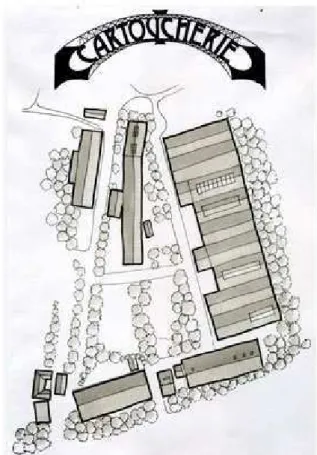
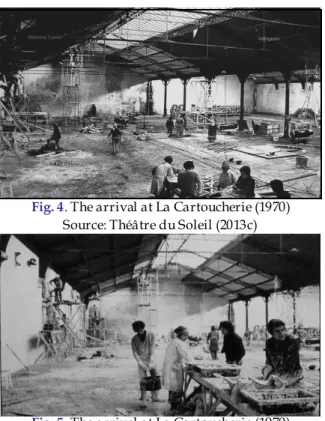
In 1970, Théâtre du Soleil occupied „La Cartoucherie de Vincennes” (Fig. 1, Fig. 3, Fig. 4, Fig. 5), located on the eastern edge
of Paris, in the largest public park in the city „Bois de Vincennes”.
Fig. 1. La Cartoucherie de Vincennes, Site plan Source: Théâtre du Soleil (2013)
Ariane Mnouchkine converted this abandoned ammunition factory into a community-oriented space, a theatre where both experimental and educational dimensions will merge (Fig. 2).
Fig. 2. Théâtre du Soleil, Exterior perspective Source: Personal Archive
“Why does a factory often make a better theatre than any other place? Because it has been built to house creations, productions, works, invention and explosions! La Cartoucherie is the opposite of the “black box” theatre – the famous multi-purpose technical box which in fact bristles with limitations” (cited in MacKintosh, 1993).
Fig. 3. The arrival at La Cartoucherie (1970) Source: Théâtre du Soleil (2013)
“Since we were the first ones to arrive, we could choose the most spacious warehouse, double vaulted, separated by columns. I immediately fell in love with this huge house deprived of comfort, without too many partitions” (Mnouchkine, 2010).
Fig. 4. The arrival at La Cartoucherie (1970)
Source: Théâtre du Soleil (2013c)
Fig. 5. The arrival at La Cartoucherie (1970)
Source: Théâtre du Soleil (2013d)
With a collective structure, Théâtre du Soleil Company works like a community building together an edifice:
“Over the years, what have we added as spaces separated by walls? The kitchen and its counterpart, a room located at the front, for supplies; at the back, a space for the power station and the hot water boiler. That is all for safety and hygiene. In an existing wing, we installed the toilets and shower cabins. Apart from these, the warehouses are completely open” (Mnouchkine, 2010).
The four identical, linked warehouses they inhabit are deliberately kept bare to preserve their authentic atmosphere. Depending on the performance, the only detail that changes is the color of the woodwork. Therefore the space has a multifunctional structure and the artists have the freedom to rebuild its performance space for each production (Fig. 6, Fig. 7, Fig. 8, Fig. 9, Fig. 10, Fig. 11). Ariane Mnouchkine found the perfect flexible space in which the conventional classic theatre auditorium, frozen in the tradition of illusion, is replaced by a multitude of possible spatial relations. The novelty of these experiences originates in performance spaces new architecture that became a reference for the way theatrical spaces can be modelled in terms of collective theatre creation. Offering total modular space dynamism for actors to move in, the viewers’ homogeneous mass is being disrupted and forced to completely change its psychology of perception. The audience is required to change its habits and renew its routes as the relation with the stage will never be frontal again, but always different because of the redistribution of the relations actor-audience (Fig. 12).
Fig. 6. 1789, Set Design (1970) Source: Théâtre du Soleil (2013)
Fig. 7. 1789, Performance Space (1970) Source: Théâtre du Soleil (2013)
Description: Ruxi's iMac
HD:Users:ruxandra:Desk top:articol:sche madispositif1.jpg
Fig. 8. 1793, Set Design (1972) Source: Théâtre du Soleil (2013)
Fig. 9. 1793, Performance Space 1972) Source: Théâtre du Soleil (2013h)
Fig. 10. Le Dernier Caravansérail, Set Design (2004) Source: Théâtre du Soleil (2013)
Fig. 11. Les Ephémères, Set Design (2008) Source: Théâtre du Soleil (2013)
Fig. 12. Et soudain des nuits d'éveil, Performance Space
Source: Magnum Photos (2013)
Recherche des Traditions de l'Acteur and l'Atelier de Paris - Carolyn Carlson.
2.2. Patrick Bouchain Democratic Construction Process
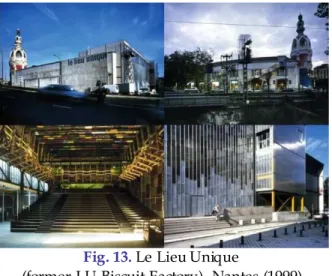
For many years now, Patrick Bouchain has been the architect that supported a democratic way to build, always open to the public. He was the first one to transform industrial sites into cultural factories such as the former LU biscuit factory in Nantes, now Le Lieu Unique, La Condition Publique in Roubaix or Le Magasin in Grenoble (Fig. 13, Fig. 14, Fig. 15).
Fig. 13. Le Lieu Unique
(former LU Biscuit Factory), Nantes (1999) Source: Reconstruire & Construire (2013)
Fig. 14. La Condition Publique, Roubaix (2004) Source: Reconstruire & Construire (2013)
In the field of performing arts, he is the architect who built the Zingaro equestrian theater in Aubervilliers and Fratellini Circus
Academy of Arts in Saint-Denis (Fig. 16, Fig. 17).
Fig. 15. Le Magazin, Grenoble (1985) Source: Reconstruire & Construire (2013)
Fig. 16. Zingaro Equestrian Theatre, Aubervillier Source: Reconstruire & Construire (2013)
Fig. 17. Fratellini Circus Academy of Arts, Saint Denis (2002)
Source: Reconstruire & Construire (2013)
make architecture" to leave the place to "mobility of things" and "human conviviality": "For a long time, architects considered that the so-called rehabilitation or restoration is not synonymous with modernity [...] I am against the concept of tabula rasa and in favour of transformation of existing things. You do not have to keep everything under the pretext that the past is essential, but rather to transform it, to become contemporary" (Bouchain, 2010).
Patrick Bouchain works with small budgets and transforms derelict industrial sites into places sometimes-downright avant-garde, testifying without restraint that "he will always prefer utility to aesthetics" (Vladareanu, 2010). For him, rehabilitation is not a simple restoration but an investment of new meanings to abandoned old buildings, therefore trying to overcome the classic, traditional term: "there is no need to demolish, when you can transform" (Ioanid, 2010). His main thesis is to involve as many people in the process of building; this way architecture is being put in direct relationship with democracy, with the active participation of residents. One could associate this ideal with the 60′s experiments of people choosing on a little model where the walls of their apartment would stand, but Bouchain’s creative process is much more interesting than that. In his case, architects, clients, workers and citizens are all involved in the building process.
Therefore, collaborations play an important role in this type of alternative urban planning; Patrick Bouchain prefers to hire a group of experts rather than a single contractor. Most of his projects begin with the establishment of a network of stakeholders, employees, residents, local government officials, community neighbourhood etc. Once this
network is established, the site is socially activated, usually by opening a space that acts as restaurant and an information area where passers-by and those interested can learn about the new project and express their opinions. It is the initial phase that creates a series of relationships between architects, builders and local community, which solves all existing problems before something permanent is being built. Because of this approach his projects are sustainable in the true sense of the word. What eventually gets build is appropriate and useful to the site, using to a large extent the existing resources: his projects comply the urban scale of the site location and assume renovation and reuse of old industrial buildings, with minimal intervention.
"Architecture is something for everybody, since we are all using it, I believe that it is everywhere, in a sidewalk curb, the quality of a good acoustics, the relationship between a building and a landscape… in those “unthought” places as well, industrial wild lands or landscapes that have been abandoned by development but which are still occupied by people, and whose existence allows us to reconsider our way to inhabit, to share or live together"(Bouchain, 2006).
These spaces of freedom are needed in order to produce "an architecture which is charged with meaning and not with norms, and that tells how we can experience / experiment other ways to build a garden, a shelter, a meeting place… Because, by considering the “small”, the “micro”, the individual, that we can understand and act on the ensemble, the “macro”, the collectivity" (Bouchain, 2006).
of innovative programs, intelligent use of materials and illusions.
3. Conclusions During the event-meetings organized by La Maison des Écrivains and Paris-La Villette School of Architecture, Jean Baudrillard and Jean Nouvel approached a common topic -the shelter for culture- from a thought provoking point of view. They acknowledged that while architecture’s relation to culture and society can be expressed it is precisely “the lack of a possible definition of a building’s social impact” that provides the necessary freedom to produce an architecture of what cannot be defined i.e. “a real-time architecture, characterized by randomness and the uncertainty that drives social life” that artists have tried to provoke in derelict buildings that no one wants (Baudrillard and Nouvel, 2002).
Therefore, the rigorous process of design is guided from spatial perception to future users. Delugan Meissl Associated Architects theoretical approach provides a deeper kind of insight, as their architectural concepts do not see space as static, but rather as “dynamic and variable interaction between people and their environment” (Delugan Meissl Associated Architects, 2009). All these “found or adapted places” are malleable in their temporality, neither entirely of the present, nor historically specific enough to be dated. They have a chameleon ability to take on the shade of the world created on stage and reinforce the current, which links it with our own, present existence.
Both Ariane Mnouchkine, a theatre director and Patrick Bouchain, an architect are “people engaged in and making their living from forms of creativity, cultural pursuits and caring professions (…) depending on empathy to sense and make connections: social and ecological, intellectual and emotional” (Buchanan, 2006).
They have a critical position regarding conventional construction, closely linked to low budget, ephemeral performance art projects often on marginal urban sites. Their journey resulted into a “sensation of true sense of democracy of having created new conditions through consensus, engagement and convivial participation (both moral and emotional)” (Tompkins and Todd, 2007) reconnecting “culture and its built form with the larger civic organism from which it emerged” (Slessor, 2008).
REFERENCES
Ayers A. (2012), French twist, The Architectural Review: Schools Special Issue 232(1380-2) :30-39.
Bablet M.L., Bablet D. (2010), Towards a new theatre. Theatre of the Sun Company [in Franch],Paris, 7-9.
Banu G. (2004), In Search of the Specificity of Theatre, essay in: Tonitza - Iordache M., Banu G., The Art of Theatre [in R omanian], Nemira, Bucharest, pp.203.
Baudrillard J., Nouvel J. (2002), The Singular Objects of Architecture, University of Minnesota Press, USA, pp.4.
Bouchain P. (2006), Building Differently. How shall we do it? [in French],Actes Sud, Arles, Paris, pp. 7-8. Buchanan P. (2006), From doing to being, The
Architectural Review: Culture in the city
220(1316-10): 44-45.
Cohn D. (2012), Joint Winner - Red Bull Music Academy, The Architectural Review: Emerging Architecture 1390:46-51.
Davey P. (2007), Diocesan dialogue, The Architectural Review: Layers of meaning 222(1329-11):36-43. Delugan Meissl Associated Architects (2009), Deep
surface, a+u Architecture and Urbanism, Special issue: Photography/Inspiration: Readings of Architectural Inspirati on Through Photographs (460-01):30.
Ioanid D. (2010), Interview with Patrick Bouchain: “There is no need to demolish, you can always transform” [in Romanian], The Cultural Observer Magazine 518(4), http://www. observatorcultural.ro/Nu-i-nevoie-sa- demolezi-poti-transforma*articleID_23444-articles_details.html.
Mackintosh I. (1993), Architecture, Actor and Audience, Routledge, London-New York, pp. 82. Mead A. (2013), White Out, The Architectural
Mnouchkine A. (2010), The Art of Present. Conversations with Fabienne Pascaud [in Romanian], „Camil Petrescu” Cultural Foundation, Theatre Today Magazine (addition), Bucharest, 127pp.
Rusiecki C. (2004), Interview with Monique Borie: The Analogy or the Abolishment of Limits [in Romanian], The Cultural Magazine 6,
http://atelier.liternet.ro/articol/2126/Crist ina-Rusiecki-Monique-Borie/Monique-Borie-Analogia-sau-abolirea-limitelor.html Slessor C. (2007), The s tone and the feather, The
Architectural Review: Architecture for the arts 232(1328-10):40-41.
Slessor C. (2008), Urbane Guerrillas, The Architectural Review: Culture and the city 232(1336-6) :34-35.
Tompkins S., Todd A. (2007), The Unfinished Theatre, The Architectural Review: Performance
232(1325-7):32-35.
Vladareanu E. (2010), Interview with Patrick Bouchain, [in Romanian], The Culture Supplement Magazine 268(4), http://www.suplimentul decultura.ro/index/continutArticolAllCat/ 7/5696
Webb M. (2008), Cultural levitation, The Architectural Review: Culture and the city 233(1336-6):46-55.