The use of Hypochlorous Acid as a Model for Investigating
Bladder Overactivity
_______________________________________________
Miriam Dambros
2, Mara Celia Dambros
2, Fábio Lorenzetti
2, E.L.H.M. Dassen
1, G.A. van Koeveringe
11Department of Urology,University Hospital Maastricht, The Netherlands and 2Animal Research Center,
School of Medicine São Leopoldo Mandic, SP, Brazil
ABSTRACT
ARTICLE
INFO
______________________________________________________________ ______________________
Involuntary detrusor contractions play an important role in the development of urge incontinence. Also in an in-vitro situation contractions which develop spontaneously can be seen; a parallel with the in vivo observations is likely. In order to study this muscle overactivity we investigated the possibility to induce this phenomenon with oxidative stress using hypochlorous acid (HOCl).
Materials and Methods: Urinary bladder muscle strips from pigs were mounted in a custom made organ bath and incubated for 20 minutes in Krebs solution. Next HOCl (10µM) was added to the organ bath and the onset of overactive contractions was closely followed. Overactivity was defined as a development of more than 5 phasic detrusor contractions per minute without any other provocation in the 30 minutes following addition of HOCl to the organ bath.
Results: Of the 50 strips which were used 36 (72%) became overactive after exposure to HOCl during 30 minutes recording. In 76% of the overactive strips overactivity oc-curred within 5 minutes, in 19% between 5 and 15 minutes, and in 5% it took longer than 15 minutes. The overactivity could be stopped by washing out HOCl for 10 minu-tes after which still a significant contraction after EFS and ACh stimulation was seen. Conclusions: It can be concluded that an oxidative stressor, like HOCl, is capable of inducing smooth muscle overactivity. This model can be used for the development and testing of new treatment modalities for the overactive detrusor. Furthermore, this study provides evidence for a causal relationship between oxidative stress and detrusor overactivity.
Key words:
Urinary Bladder; Hypochlorous Acid; Therapeutics
Int Braz J Urol. 2014; 40: 408-13
_____________________
Submitted for publication: September 19, 2013
_____________________
Accepted after revision: January 14, 2014
INTRODUCTION
Overactivity bladder (OAB) has become the focus of intense interest because this term is used to describe the symptom complex of urinary ur-gency with or without urge incontinence, usually with frequency and nocturia (1). Drug treatment continues to have an important role of women with OAB.
Concerning the basic mechanisms of bla-dder overactivity, increasing evidence has shown
that the generation of free radicals plays a role in the development of overactivity bladder (2).
evoked by a process with a fast pathway to the contractile units. From our previous study we could conclude that selective inhibition of the IP3 pathway with the calcium blocking agent Xesto-spongin C significantly (P = 0.036) slowed down the rate of force development while still a signifi-cant (P = 0.003) contraction amplitude remained through the CICR pathway. We could assume that the IP3 pathway is the prevailing pathway for the ‘fast’ spontaneously developing detrusor muscle contractions.
Overactivity is seen when in vitro detrusor muscle strips are cut. To some extent they become more overactive when they are cut smaller but in the majority of the cases they become overactive at all (5). In order to induce overactivity we designed an in vitro model for the development of research-ers on the field of new treatment modalities for the overactive detrusor, using oxidative stress.
MATERIALS AND METHODS
Experiments were performed on pig uri-nary bladders obtained from the slaughterhouse approximately 30 minutes after slaughter. Strips of 2 x 2cm were cut from the dorsal side of the bladder dome and transported to the laboratory in oxygenated Krebs solution. The mucosa and the submucosal fat layer were removed using a binocular microscope, and strips of 0.3mm diam-eter and length between 1 and 2mm were excised. To facilitate diffusion the thin layer covering the muscle fiber was opened and for the greater part removed. Each strip was positioned horizontally in our custom made organ bath (IDEE University Maastricht) between two tweezers of which one was attached to the KG4 force transducer connect-ed to the BAM4C amplifier (Scientific instruments, Heidelberg, Germany). The other tweezer was con-nected to a translation stage which was regulat-ed by a controller (translation stage M111,1DG; Mercury Controller C860, Physic Instrumente). An electrical field was generated between two plati-num electrodes connected to the HM8130 Func-tion Generator from Hameg Instruments. Flow in the organ bath (volume 0.23mL) was regulat-ed with separate in and outflow syringe pumps (Vickers Medical, IP4). Temperature was kept at 37º
C using infrared radiation from a halogen lamp (Philips, Eindhoven, Netherlands 12V, 20W, 6º) and controlled using a 200µm diameter thermo-couple (Omega ChAl/005).
The strips were incubated in modified Krebs solution: NaCl, 118mM; KCl, 4.7mM; NaH-CO3, 25mM; KH2PO4, 1.2mM; CaCl, 1.8mM; MgS04, 1.2mM; glucose 11mM; pH 7.4; aereted with 95% O2 / 5% CO2. All agents were manufactured by Cal-biochem. For pharmacological stimulation a 10µM acetylcholine solution (Sigma, St-Louis, MO, USA) was used.
Measurement protocol
The muscle strips were placed in the organ bath and incubated in Krebs. We determined L0 the length at which maximum isometric force was de-veloped at 37º C. After that, the strips were stim-ulated at this length. Before incubation with HOCl the strips were stimulated in a random order twice electrically and once with acetylcholine. EFS was applied (10s, 15V amplitude,50ms,100Hz). When a muscle strip developed less than 100µN force it was excluded from further measurements. Be-tween each stimulation, an interval of 10 minutes was introduced. After these initial stimuli 50 strips were incubated with the HOCl solution in order to see whether they became overactive. Control group with 10 muscle strips underwent the same stimulation protocol without treating them with HOCl. Overactivity in this study was defined as a development of more than 5 phasic detrusor con-tractions per minute without any other provoca-tion in the 30 minutes following addiprovoca-tion of HOCl to the solution. After washing out HOCl for twenty minutes a last EF and pharmacological stimula-tion with acetylcholine was applied.
At the end of the experiment the strips were analysed in order to quantity the isoprostane 8-epi PGF2 alpha amount.
Data analysis
exponential isometric smooth muscle contractions can be characterized by a straight line where Fis the measured force, Fiso is the maximum extrap-olated isometric force, t is time, and C (Eq.1) is the time constant for isometric force development. The time constant is an indicator of the rate limit-ing process in the excitation-contraction coupllimit-ing and indicates in which period of time 66% of the saturation level of maximum force development is reached. The smaller the value of C, the faster the rate of force development.
F = Fiso [ 1 - e-(t/C) ] Eq.1
The value of EF-stimulation at L0 was seen as the optimal stimulation and therefore as the baseline value of Fiso and time constant. This is maximum force development without treatment with the HOCl solution. When the strips became overactive, Fiso and C of the spontaneously devel-oped contractions were calculated. After washing out the HOCl solution the percentage of reduction of force development was compared to the initial force development. These normalized percentages were averaged for all 49 muscle strips. The time constants were not normalized.
Oxidative Products
EIA of the oxidatively modified prod-uct isoprostane 8-epi PGF2alpha was performed. Briefly, HOCl-treated and control bladder tissues were equilibrated for 2 hours in culture medium at 37º C. The medium was exchanged with fresh medium every hour. After the last hour of incuba-tion the levels of isoprostane 8-iso PGF2alpha in supernatant were assayed in triplicate with com-mercially available EIA kits (Cayman Chemical, Brazil). Microtiter assay plates were scanned with a SpectraMax Plus 384 computer controlled mi-croplate reader. The quantity of isoprostane 8-epi PGF2alpha was standardized as pg/100mg wet weight of tissue per hour.
Statistical analysis
A paired t-test was used for statistical analysis. Changes in provoked electric and phar-macological stimulation with acetylcholine were
calculated. Fiso and rate of force development of the overactive contractions were also calculated. All calculations were processed in Matlab® 6.1. For statistical analysis SPSS® version 10 was used.
RESULTS
Percentage of overactivity after HOCl treatment After treatment with HOCl, 72% (36 out 50) of the muscle strips became overactive, 20% (10 out 50) of the muscle strips did not show ove-ractivity, defined as a development of more than 5 phasic detrusor contractions per minute without any other provocation in the 30 minutes following addition of HOCl. 8% (4 out 50) of the muscle strips became overactive spontaneously within a few seconds before the HOCl solution was added.
Time the strips became overactive
Most of the muscle strips (76%) showed overactivity within 5 minutes. In 19% they be-came overactive between 5-15 minutes and in 5% it took 15-30 minutes. In 5 muscle strips the re-cording was continued for 60 minutes and after that time, none of them showed overactivity.
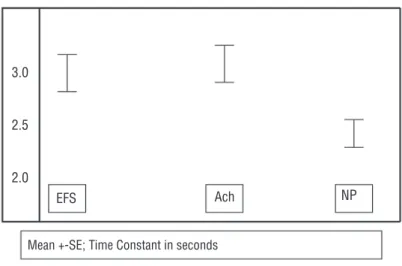
In Figure-1 the bars represent the rate of force development (C). It shows no significant dif-ference between Electrical Field Stimulation (2.45 seconds) and pharmacological stimulation with acetylcholine (2.55 seconds). Using a paired t-test the provoked overactive contractions have a fast-er rate of force development (1.20 seconds) (P = 0.001) compared to the Electrical Field Stimula-tion and acetylcholine stimulated contracStimula-tions.
Marker of Oxidative Stress
Isoprostane 8-epi PGF2alpha levels signif-icantly increased in HOCl-treated bladders com-pared to control group (Figure-2).
DISCUSSION
of the efferent nerve supply of the bladder or by an intrinsic overactivity of the detrusor muscle itself (1). Previous research also indicated that a dener-vation of the bladder leads to an increase in the development of overactive bladder contractions (5). It appears that an adequate innervation reduces the overactive detrusor contractions. Our own experi-mental in vitro observations showed the same re-sults: to some extent the muscle strips became more overactive, the smaller they were cut.
This study showed that a small number (4%) of the muscle strips became overactive spon-taneously while more than half (53%) the strips became overactive after incubation with HOCl. This validates the results seen in previous studies where the role of several reactive oxidative stress-ors like hydrogen peroxide and hypochlorous acid led to overactivity of smooth muscle (6-8).
This model makes it possible to study overactivity of smooth muscle in more detail. The
Figure 1 - Time constants for EFS, ACh and non provoked (NP) overactive contractions.
Figure 2 – A) Levels of oxidatively modified product isoprostane 8-epi PGF2alpha after HOCl to be added to organ bath vs control bladder. B) It represents the levels of isoprostane 8-epi PGF2alpha in strips that became overactive vs not overative strips.
3.0
2.5
2.0
Ach
EFS NP
Mean +-SE; Time Constant in seconds
HOCItreated Bladder Control Bladder
7.5
5.0
2.5
0.0 7.5
5.0
2.5
0.0
Overactivity Not overactivity
* p < 0.05
contractions caused by HOCl have the same rate and amplitude as the spontaneously developing contractions. Therefore, the induction of overac-tivity-resembling (overactivity-like) contractions with HOCl makes it possible to study which in-tracellular pathway is more or less responsible for the development of overactivity in smooth muscle and in particular smooth muscle of the urinary bladder. Changes in amplitude and rate of force development can be observed by using different intracellular pathway inhibiting agents.
During incubation with the oxidative stressor (HOCL 10µM) and after washing out, EFS and acetylcholine were still able to provoke a sim-ilar contraction. Therefore it can be assumed that exposure to a 10µM concentration of HOCl causes overactivity but minimal damage.
In our model incubation longer than 15 minutes has no benefit. HOCl is capable of mod-ulating the intracellular calcium pathways or at least cause changes to the contractile units.
Experimental studies that have exami-ned the association between oxidative stress and bladder dysfunction have supported the hypo-thesis that the generation of free radicals might be linked to bladder dysfunction (9-11). Possibly, the detrusor dysfunction is caused by activation of specific hydrolytic enzymes including calpain and phospholipase A2 with subsequent damage to intracellular organelles such as the mitochondria and sarcoplasmic reticulum and via generation of reactive oxygen species and subsequent membra-ne lipid peroxidation (12,13).
A common effect of the activation of the-se pathways is a change in pattern of gene ex-pression mediated largely through modulation of
the activities of transcription factors. Accordin-gly, a large number of oxidative stress-respon-sive transcription factors and genes have been identified (14) and some of theses have been im-plicated in influencing aging processes as well as overactive bladder.
CONCLUSIONS
In conclusion, it can be concluded that the HOCl can induce in vitro smooth muscle overac-tivity. Thus, it can be very helpful for the inves-tigation of the different pathways responsible for overactivity of the detrusor, mainly in cases where oxidative stress can associated to the disease.
CONFLICT OF INTEREST
None declared.
REFERENCES
1. Srikrishna S, Robinson D, Cardozo L, Vella M: Management of overactive bladder syndrome. Postgrad Med J. 2007; 83: 481-6.
2. Dambros M, de Jongh R, van Koeveringe GA, Bast A, van Kerrebroeck PE: Galangin protects pig detrusor nerves from repetitive field stimulation and anoxia/glucopenia injury. Urology. 2005; 66: 1327-31.
3. Sommerville LE, Hartshorne DJ: Intracellular calcium and smooth muscle contraction. Cell Calcium. 1986; 7: 353-64. 4. Van Koeveringe GA, Van Mastrigt R: Excitatory pathways
in smooth muscle investigated by phase-plot analysis of isometric force development. Am J Physiol. 1991; 261: R138-44.
5. Fry CH, Wu C: The cellular basis of bladder instability. Br J Urol. 1998; 81: 1-8.
Table 1 - Three month follow-up of patients with the first episode of spontaneous AUR.
Patients with successful TWOC Combination therapy Monotherapy P value
During 24 hours after catheter removal (41/50) 82% (37/51) 72.5% 0.039
7th day after catheter removal (35/50) 70% (32/51) 62.7% 0.3
One month following first episode of AUR (32/50) 64% (28/51) 55% 0.07
6. Levin RM, Danek M, Whitbeck C, Haugaard N: Effect of ethanol on the response of the rat urinary bladder to in vitro ischemia: protective effect of alpha-lipoic acid. Mol Cell Biochem. 2005; 271: 133-8.
7. Changolkar AK, Hypolite JA, Disanto M, Oates PJ, Wein AJ, Chacko S: Diabetes induced decrease in detrusor smooth muscle force is associated with oxidative stress and overactivity of aldose reductase. J Urol. 2005; 173: 309-13. 8. Beshay E, Carrier S: Oxidative stress plays a role in
diabetes-induced bladder dysfunction in a rat model. Urology. 2004; 64: 1062-7.
9. Krebs HA: Untersuchungen uber die Harnstoffbildung im Tierkorper. Physiol. Chem. 1932; 210: 33-67.
10. Tarcan T, Siroky MB, Krane RJ, Azadzoi KM: Isoprostane 8-epi PGF2alpha, a product of oxidative stress, is synthesized in the bladder and causes detrusor smooth muscle contraction. Neurourol Urodyn. 2000; 19: 43-51.
11. Ohnishi N, Liu SP, Horan P, Levin RM: Effect of repetitive stimulation on the contractile response of rabbit urinary bladder subjected to in vitro hypoxia or in vitro ischemia followed by reoxygenation. Pharmacology. 1998; 57: 139-47.
12. Zhao Y, Levin SS, Wein AJ, Levin RM: Correlation of ischemia/reperfusion or partial outlet obstruction-induced spectrin proteolysis by calpain with contractile dysfunction in rabbit bladder. Urology. 1997; 49: 293-300.
13. Levin RM, Leggett R, Whitbeck C, Horan P: Effect of calcium and calcium chelator on the response of the bladder to in vitro ischaemia. Br J Urol. 1998; 82: 882-7.
14. Allen RG, Tresini M: Oxidative stress and gene regulation. Free Radic Biol Med. 2000; 28: 463-99.