Prospective comparison of ligation and bipolar cautery
technique in non-scalpel vasectomy
_______________________________________________
Muammer Altok
1, Ali Feyzullah
Ş
ahin
2, Rauf Taner Divrik
2, Ümit Yildirim
3, Ferruh Zorlu
41 Department of Urology, Süleyman Demirel University, Faculty of Medicine, Isparta, Turkey; 2 Department
of Urology, Şifa University, Faculty of Medicine, Izmir, Turkey; 3 Department of Urology, Gazi Hospital,
Izmir, Turkey; 4 Department of Urology, M.H. Tepecik Research and Education Hospital, Izmir, Turkey.
ABSTRACT
ARTICLE
INFO
______________________________________________________________ ______________________ Objectives: There is no trial comparing bipolar cautery and ligation for occlusion of
vas in non-scalpel vasectomy. This study aimed to compare the effectiveness of these vasectomy occlusion techniques.
Materials and Methods: Between January 2002-June 2009, patients were allocated in alternate order. We recruited 100 cases in cautery group and 100 cases in ligation group. Non-scalpel approach was performed during vasectomy and fascial interposi-tion was performed in all cases. First semen analysis was done 3 months after vasec-tomy. Vasectomy success was defined as azoospermia or non-motile sperm lower than 100.000/mL.
Results: Four patients from the cautery group were switched to the ligation group due to technical problem of cautery device. Thus, data of 96 patients as cautery group and 104 patients as ligation group were evaluated. After vasectomy, semen analyses were obtained from 59 of 96 (61.5%) patients in cautery group and to 66 of 104 (63.5%) patients in ligation group. There was no statistical significant difference between the two groups in terms of the success of vasectomy (p=0.863).
Conclusion: Although bipolar cautery technique is safe, effective and feasible in non--scalpel vasectomy, it has no superiority to ligation. There was no statistically signi-ficant difference in terms of the success and complications between the two groups.
Key words:
Cautery; Ligation; Vasectomy
Int Braz J Urol. 2015; 41: 1172-7
_____________________ Submitted for publication: July 18, 2014
_____________________ Accepted after revision: January 27, 2014
INTRODUCTION
Vasectomy is a popular and effective fa-mily planning method today. Vasectomy has two main steps: exposing the vas out of the scrotum and occluding the vas. Conventional, non-scalpel, and percutaneous methods are used for the isola-tion of the vas (1, 2). The non-scalpel vasectomy technique, which is commonly used for the isola-tion of the vas, was described in 1974 in China by Dr. Li Shunqiang (3).
There are various methods to occlude the vas when performing a vasectomy, such as the
di-vision and excision of a segment, the ligation of the vas with metal clips or suture materials, cau-terization of the mucosa of the vas lumen, fascial interposition, and a folding back of the divided vas. A fascial interposition (FI) is the only va-sectomy occlusion that was well evaluated in a randomized trial. (4) Sokal et al. (5) demonstrated that adding an FI to the ligation with the suture material and the excision of a 1cm segment signi-ficantly reduced the failures by about half based on the semen analysis, from 12.7% to 5.9%.
of the vas (6). However, in low-income countries, the ligation and excision is the most widely used occlusion technique (7). Comparative studies sug-gested that intraluminal cauterization of the ends of the vas, is more effective than ligation (8-10). However, there is no randomized trial comparing these two approaches, yet (4).
Intraluminal cauterization was the main technique of the trials when an electro-cautery or thermal cautery was used (7, 11, 12). There is no prospective comparative trial with a bipolar cau-tery and ligation for the occlusion of the vas. Our study aimed to compare the effectiveness of these techniques when both are combined with FI.
MATERIALS AND METHODS
From January 2002 to June 2009, patients were divided and given a number in order of their applications. Odd numbers were given to patients who were included in the ligation group, and even numbers were given to patients who were inclu-ded in the cautery group. The study was planned with 100 cases in each group. The information about vasectomies was given to the couples befo-re the operation, and their informed consent was obtained. Patients who chose the vasectomy as a family planning method, who agreed to participa-te in the study, and who did not have a history of a vasectomy, scrotal, inguinal, or pelvic surgeries were included in the study.
The procedure was performed by three ex-perienced surgeons in the Urology Department of Tepecik Research and Education Hospital, a spe-cialized urology clinic. After a local anesthesia was given, the isolation of the vas was performed using the non-scalpel approach (3, 13). In the cau-tery group, approximately 1cm segment of the vas was excised, and the extremities of both ends of the divided vas were cauterized using a bipolar cautery. In this technique, unlike the classic intra-luminal cauterization, only the mucosal mouth of the lumen was sandwiched and fulgurated/caute-rized between the two tips of the bipolar cautery from different sides until the lumen was closed. Bipolar cautery was not inserted into the lumen of the vas. In the ligation group approximately 1cm segment of the vas was excised and both ends of
the vas were ligated using a silk 3/0. FI was per-formed on the prostatic end of the vas in all of the patients in both groups (3, 13). Patients were evaluated for complications one week after va-sectomy. The first semen analysis was done three months after vasectomy. Vasectomy success was defined as azoospermia or presence of non-moti-le sperm lower than 100.000/mL (12, 14). Semen analysis was repeated one month later in the pa-tients with motile sperm. If motile sperm was still detected in a repeated semen analysis, these cases were classified as an unsuccessful vasectomy (Fi-gure-1).
The study was approved by the Local Ethics Committee. The chi-squared test was used to assess the differences between the study groups. P value <0.05 was considered significant.
RESULTS
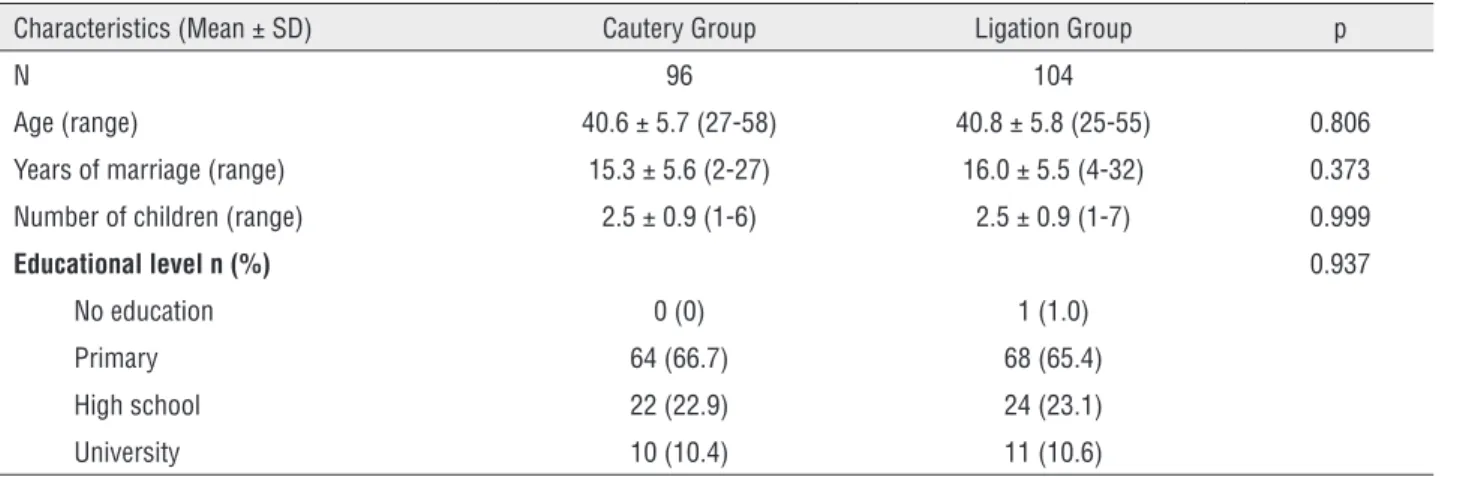
Four patients from the cautery group were switched to the ligation group due to a malfunc-tion of the cautery device. Thus, the data of 96 patients in the bipolar cautery group and 104 pa-tients in the ligation group were evaluated. The characteristics of the patients, including age, du-ration of marriage, number of children, and edu-cation level were similar in both groups (Table-1). Vasectomy was performed without any problem in all of the patients.
After vasectomy, semen analyses were ob-tained from 59 of the 96 (61.5%) patients in the cautery group and from 66 of the 104 (63.5%) patients in the ligation group. The proportion of patients with successful occlusions was similar in the cautery (55/59, 93.2%) and the ligation (61/66, 92.4%) groups (p=0.863; Table-2). All of the patients in the cautery group who were consi-dered successful were azoospermic. However, four patients had rare non-motile sperm in the liga-tion group (Table-2). The proporliga-tion of patients with presumed recanalization was similar in both groups (7.8% vs. 7.6%, Table-2).
success rate could be estimated as 95% (76/80) in the cautery group and 93.9% (78/83) in the liga-tion group (p=0.76; Table-3).
Intraoperative complications were not ob-served in the bipolar cautery group. However, a vasovagal reflex occurred in one patient in the li-gation group. Postoperative hematomas were ob-served in three (3.1%) cases in the cautery group, one with epididymitis requiring antibiotics and one requiring drainage, and none were obser-ved in the ligation group (p=0.07). In the ligation group, no surgical complications were observed, but three patients had psychological problems
as-sociated with the vasectomy and emotional dis-tress was observed in these patients (2.8%).
DISCUSSION
Very few studies that address vasectomy occlusion techniques are prospective and even fewer studies are randomized or quasi-rando-mized (4, 10, 12). The review of the failure ra-tes for the intraluminal cautery technique with FI ranged from 0% to 0.55% (12). According to the American Urological Association (AUA) (12) and the European Association of Urology (EAU)
Table 1 - Characteristics of patients.
Characteristics (Mean ± SD) Cautery Group Ligation Group p
N 96 104
Age (range) 40.6 ± 5.7 (27-58) 40.8 ± 5.8 (25-55) 0.806
Years of marriage (range) 15.3 ± 5.6 (2-27) 16.0 ± 5.5 (4-32) 0.373
Number of children (range) 2.5 ± 0.9 (1-6) 2.5 ± 0.9 (1-7) 0.999
Educational level n (%) 0.937
No education 0 (0) 1 (1.0)
Primary 64 (66.7) 68 (65.4)
High school 22 (22.9) 24 (23.1)
University 10 (10.4) 11 (10.6)
SD = Standard Deviation
Table 2 - Semen analysis results.
Group N Azoospermia or Immotil Sperm<100.000 Motil Sperm
Cautery 59 55 (93.2%) 4 (6.8%)
Ligation 66 61 (92.4%) 5 (7.6%)
Total 125 116 (92.8%) 9 (7.2%)
Chi-square test p:0.863
Table 3 - If avoiding pregnancy is accepted as vasectomy success.
Group Azoospermia or Immotil Sperm<100.000 Pregnancy (-)
Cautery 55 (93.2%) 76 (95%)
Ligation 61 (92.4%) 78 (93.9%)
Chi-square test p:0.76
(14) vasectomy guidelines, the most effective vas occlusion technique is the intraluminal mucosal cauterization with FI; however, without FI is also likely to be consistently effective. In our study, we used a bipolar cautery and occluded only the mucosal mouth of the lumen with cauterization instead of intraluminal cauterization. To our kno-wledge, this is the first prospective trial for a bi-polar cautery with FI in a non-scalpel vasectomy. The occlusive failure rate (presumed recanaliza-tion) of 6.8% in our study was much higher than those reported in the other studies about intralu-minal cautery. In the bipolar technique, unlike the
classic intraluminal mucosal cautery method, only the mucosal mouth of the vas was occluded until it seems to be closed. We considered that the re-sults were inadequate because of the insufficient necrosis and subsequent occlusion. The occlusive failure of over 1% is considered unacceptable ac-cording to the AUA guidelines (12).
In our study, vasectomy success was not statistically or significantly different between the study groups. However, our study lacked the statistical power to observe a small difference between the groups. If the bipolar cautery tech-nique with FI had been as effective as the other cautery technique reported in the literature (under 1%), the difference with the ligation group (7.6%) would have been highly significant.
Of all the patients, 75 (37 (38.5%) from the cautery group and 38 (36.5%) from the ligation group) patients did not return for semen analy-sis after vasectomy. Thomas et al. evaluated the compliance of 1,892 patients after vasectomy and reported that 34% of patients did not return after the procedure (15). Sheynkin et al. also evalua-ted the compliance of 214 vasectomy-performed patients and detected that 46.2% of the patients did not return for the semen analysis (16). They reported that the rate of noncompliance was inde-pendently higher in men with four or more chil-dren, smokers, and those with a lower education level (16). These results are similar to our study. We phoned these 75 patients and reached 38 pa-tients (21 from the cautery group and 17 from the ligation group). The main factor of noncompliance was the religious and cultural effect of masturba-tion. Pregnancy was not detected in any of these patients. If pregnancy was accepted as a vasec-tomy success, the failure rate of our study would be a little lower (Table-3). In this case, the failu-re rate (6.1%) in the ligation group of our study would be similar to the literature (5).
In regard to complications, there was no statistically significant difference between the two groups in our study, and the rate of postoperative surgical complications in the cautery group (3.1%) could be attributed to chance or to a lack of sta-tistical power. However, all of the hematomas were related to the vas isolation and not to the occlusion technique. Overall, the rate of hematomas (1.5%, 3/200) in our study is in the range of 1%-2%, which is considered acceptable by the AUA (12).
Although the bipolar cautery technique combined with FI appears to be as safe as the liga-tion with FI as an occlusion vasectomy technique, the failure rate was much higher than the intralu-minal mucosal cautery techniques. In light of
the-se results, we no longer perform bipolar cautery in our clinic and we are considering alternative occlusion techniques to the ligation and FI to im-prove our occlusion effectiveness.
CONFLICT OF INTEREST
None declared.
REFERENCES
1. Goldstein M. Surgical management of male infertility and other scrotal disorders. In: Walsh PC. RAB, Vaughan ED, Wein AJ, editor. Campbell’s Urology. Eight Edition ed. Philadelphia: Saunders; 2002; pp. 1541-7.
2. Pryor JL. Vasectomy. In: Graham SD. GJF, Keane TE, editor. Glenn’s Urologic Surgery Six Edition ed: Lippincott Williams Wilkins; 2006; pp. 450-4.
3. Li SQ, Goldstein M, Zhu J, Huber D. The no-scalpel vasectomy. J Urol. 1991;145:341-4.
4. Cook LA, Van Vliet HA, Lopez LM, Pun A, Gallo MF. Vasectomy occlusion techniques for male sterilization. Cochrane Database Syst Rev. 2014;3:CD003991.
5. Sokal D, Irsula B, Hays M, Chen-Mok M, Barone MA; Investigator Study Group. Vasectomy by ligation and excision, with or without fascial interposition: a randomized controlled trial [ISRCTN77781689]. BMC Med. 2004;2:6. 6. Haws JM, Morgan GT, Pollack AE, Koonin LM, Magnani RJ,
Gargiullo PM. Clinical aspects of vasectomies performed in the United States in 1995. Urology. 1998;52:685-91. 7. Labrecque M, Pile J, Sokal D, Kaza RC, Rahman M, Bodh
SS, et al. Vasectomy surgical techniques in South and South East Asia. BMC Urol. 2005;5:10.
8. Sokal D, Irsula B, Chen-Mok M, Labrecque M, Barone MA. A comparison of vas occlusion techniques: cautery more effective than ligation and excision with fascial interposition. BMC Urol. 2004;4:12.
9. Labrecque M, Dufresne C, Barone MA, St-Hilaire K. Vasectomy surgical techniques: a systematic review. BMC Med. 2004;2:21.
10. Labrecque M, Hays M, Chen-Mok M, Barone MA, Sokal D. Frequency and patterns of early recanalization after vasectomy. BMC Urol. 2006;6:25.
11. Barone MA, Irsula B, Chen-Mok M, Sokal DC; Investigator study group. Effectiveness of vasectomy using cautery. BMC Urol. 2004;4:10.
12. Sharlip ID, Belker AM, Honig S, Labrecque M, Marmar JL, Ross LS, et al. American Urological Association. Vasectomy: AUA guideline. J Urol. 2012;188:2482-91.
14. Dohle GR, Diemer T, Kopa Z, Krausz C, Giwercman A, Jungwirth A; Grupo de Trabajo de la Asociación Europea de Urología sobre la Infertilidad Masculina. [European Association of Urology guidelines on vasectomy]. Actas Urol Esp. 2012;36:276-81.
15. Maatman TJ, Aldrin L, Carothers GG. Patient noncompliance after vasectomy. Fertil Steril. 1997;68:552-5.
16. Sheynkin Y, Mishail A, Vemulapalli P, Lee J, Ahn H, Schulsinger D. Sociodemographic predictors of postvasectomy noncompliance. Contraception. 2009;80:566-8.