ABSTRACT
Purpose: Although nonselective nonsteroidal anti-inlammatory drugs (nsNSAIDs) and opioids are effective treatments for acute renal colic, they are associated with adverse events (AEs). As cyclooxygenase-2 selective NSAIDs may provide a safer alternative, we compared the eficacy and safety of parecoxib versus an nsNSAID in subjects with acute renal colic.
Materials and Methods: Phase i.v., multicenter, double-blind, noninferiority, active-controlled study: 338 subjects with acute renal colic were randomized to parecoxib 40 mg i.v. plus placebo (n = 174) or ketoprofen 100 mg i.v. plus placebo (n = 164). 338 subjects with acute renal colic were randomized to parecoxib 40 mg i.v. (n = 174) or ketoprofen 100 mg i.v. (n = 164) plus placebo. Subjects were evaluated 15, 30, 45, 60, 90 and 120 minutes after treatment start and 24 hours after discharge. Primary endpoint was the mean pain intensity difference (PID) at 30 minutes by visual analog scale (VAS) (per-protocol population). An ANCOVA model was used with treatment group, country, and baseline score as covariates. Noninferiority of parecoxib to ketoprofen was declared if the lower bound of the 95% conidence interval (CI) for the difference between the two groups excluded the pre-established margin of 10 mm for the primary endpoint.
Results: Baseline demographics were similar. The mean (SD) mPID30 min was 33.84 (24.61) and 35.16 (26.01) for parecoxib and ketoprofen, respectively. For treatment difference (parecoxib-ketoprofen) the lower bound of the 95% CI was 6.53. The mean change from baseline in VAS 30 minutes after study medication was ~43 mm; AEs were comparable between treatments.
Conclusions: Parecoxib is as effective as ketoprofen in the treatment of pain due to acute renal colic, is well tolerated and has a comparable safety proile.
Key words: parecoxib; ketoprofen; renal colic; lithiasis; pain; analgesia; COX-2 selective Int Braz J Urol. 2011; 37: 697-705
INTRODUCTION
Acute renal colic or nephrolithiasis occurs when mineral or organic solids pass though the upper urinary tract and obstruct the urinary low (1). It is a common, often recurrent condition with an annual incidence of 1-2 cases per 1000 and a lifetime risk
that is greater in men than women (between 10-20% and 3-5%, respectively) (2). Patients usually pres -ent with a sudden onset of severe urinary pain that radiates from the lank to the groin and requires im -mediate treatment (within 30 minutes of the onset of symptoms) (1). In addition to severe pain, the main signs and symptoms of renal colic include nausea,
Eficacy and Safety of Parecoxib in the Treatment of Acute Renal
Colic: A Randomized Clinical Trial
Sidney Glina, Ronaldo Damiao, Joao Aif-Abdo, Carlos Francisco Santa Maria, Raúl Novoa,
Carlos Eurico Dornelles Cairoli, Dalia Wajsbrot, Gaston Araya
vomiting, hypertension, swollen abdomen, fever and chills and hematuria.
Pain relief often takes the form of a nonse-lective, nonsteroidal anti-inlammatory drug (nsN -SAID) or an opioid (1). Nonselective NSAIDs such as ketoprofen reduce pain and inlammation by in -hibiting the cyclooxygenase (COX) enzyme (3). The COX enzyme exists in two distinct isoforms: COX-1, the primary site of action for nsNSAIDs, is present in many tissues and is necessary for physiological (homeostatic) functions such as gastric mucosal pro-tection and normal platelet aggregation (4,5); COX-2 is an inducible form of the COX enzyme and is expressed locally in inlamed tissues (6,7). Although nsNSAIDs have been shown to be effective for acute and chronic pain relief, a number of adverse events (AEs) have been associated with their use. Common side effects from their use include rash, headaches, dizziness, drowsiness, abdominal pain, nausea, diar-rhea, constipation and the retention of luid.
Parecoxib, an injectable COX-2 selective NSAID, is currently the only available nonopioid analgesic and anti-inlammatory agent indicated for parenteral use that does not interfere with platelet aggregation (8,9). As parecoxib is intended for the short-term treatment of acute pain it may, therefore, offer advantages versus nsNSAIDs in the treatment of acute renal colic; however, to date, no clinical studies have evaluated the use of parecoxib in acute pain due to renal colic.
The objective of this study was to com-pare the analgesic eficacy and safety of com-parecoxib 40 mg intravenous (i.v.) administration versus ke -toprofen 100 mg i.v. to demonstrate noninferiority of parecoxib related to ketoprofen for reducing pain during an acute renal colic attack.
MATERIALS AND METHODS Study Population
Subjects aged 18-65 years, with a conirmed diagnosis of renal colic either prior to or after ran-domization (as conirmed by radiography, i.v. py -elogram, helical computed tomography, magnetic resonance imaging, ultrasonography, or who had a diagnosis of renal colic conirmed by the subject’s self-reported spontaneous elimination of the kidney
stone at any time during the study) who presented with moderate to severe pain (baseline pain intensity [PI] score on a 100-mm visual analog scale [VAS] of > 50 mm and “moderate to severe” on a PI categori-cal scategori-cale) were eligible for inclusion in this study. All subjects provided written informed consent be -fore entering the trial.
Subjects were excluded if they had signii -cant renal or hepatic conditions (other than uncom-plicated kidney stones), acute pain (other than renal colic), had been a recipient of a renal allograft, or were being treated for a urinary tract infection, py-elonephritis or clinical suspicion of such infection. In addition subjects were excluded if they had: a history of active peptic ulceration, active dyspep-sia, gastrointestinal bleeding (i.e. Crohn’s disease or ulcerative colitis), and an esophageal, gastric or duodenal ulcer within 1 month prior to the screening evaluation.
The study was conducted in accordance with the ethical principles outlined in the Declara-tion of Helsinki, InternaDeclara-tional Conference on Har -monisation (ICH) Good Clinical Practice Guidelines and local regulatory requirements. The protocol was approved by the local institutional review boards and independent ethics committees and all subjects provided written informed consent. The ClinicalTri -als.gov identiier is NCT00553605.
Study Design
This study was a phase i.v., multicenter, ran-domized, double-blind, double-dummy, compara-tive, active-controlled study to assess the analgesic activity and safety of i.v. doses of parecoxib 40 mg relative to i.v. doses of ketoprofen 100 mg for the treatment of renal colic in outpatients presenting at emergency room settings and was designed to show noninferiority of parecoxib related to ketoprofen.
randomiza-tion schedule was distributed in a sealed envelope to the pharmacist in charge of preparation and dis-pensing of the study drug. Subjects were evaluated at screening, initiation of drug infusion (time 0), and at 15, 30, 45, 60, 90 and 120 minutes after study drug administration; follow-up was conducted 24 hours after discharge. If required, rescue medication (i.v. morphine) was allowed.
Eficacy Assessments
The primary eficacy variable was the mean pain intensity difference (PID) at 30 minutes after administration of study medication (mPID30min) as-sessed by VAS for the per-protocol (PP) population. The mPID30min for each subject is the sum of the PID at 15 minutes (VAS at baseline - VAS at 15 min -utes) and at 30 minutes (VAS at baseline - VAS at 30 minutes), divided by two. This represents the mean reduction in PI across 30 minutes.
Secondary endpoints included: 1) PI as -sessed through VAS scores at all time points; 2) PID - change from baseline in VAS scores - at all time points; 3) mean PID at 120 minutes after the admin -istration of study medication (mPID120min);
mPID120min = 15(PID15+PID30+ PID45+ PID60)+30(PID90+PID120) 120
4) response in PI (decrease of > 20 mm on the pain VAS score) at 30 minutes; 5) pain relief (PR) at 30 and 120 minutes; 6) sum of time inter -val weighted PR scores through 120 minutes (TOT -PAR120min) - TOTPAR120min = 30 PR30min+90PR120min ; 7) subjects’ global evaluation of study medication at 30 and 120 minutes, and at day 2; 8) physician’s global evaluation of study medication at 30 and 120 min -utes, and at day 2; and 9) time to rescue medication up to 120 minutes.
The PP population was used for the analy-sis of the primary eficacy variable and included all subjects from the modiied intent-to-treat (mITT) population who also satisied the following criteria: 1) had no major pre-existing protocol violations; 2) received the appropriate dose of study medication; 3) had valid baseline (time 0), 15- and 30-minute VAS pain assessments according to the protocol; 4) did not take rescue medication during the irst 30
minutes; and 5) had a conirmed diagnosis of neph -rolithiasis or urete-rolithiasis. The mITT population included all randomized subjects who took at least one dose of study drug and provided at least one postbaseline pain assessment. The mITT population was used for the analysis of all secondary eficacy endpoints.
Safety Assessments
The safety population included all subjects who were randomized and received at least one dose of study medication.
Statistical Analysis
The trial was intended to show noninferiority of parecoxib versus ketoprofen. Using a sample size of 168 subjects per group and assuming a standard deviation of 25 mm and a Type I error rate of 0.050, the trial had 80% power to reject the null hypothesis (that parecoxib and ketoprofen were not equivalent) in favor of the alternative hypothesis of noninferi-ority. Noninferiority would have been declared for parecoxib if the lower bound of the two-sided 95% conidence interval (CI) of the treatment difference (parecoxib - ketoprofen) was greater than - 10 mm. The CI of the treatment difference was generated from the least squares means of an analysis of cova -riance (ANCOVA) model with terms for treatment, baseline VAS scores and country. All continuous variables were analyzed using this type of ANCOVA model. The Cochran-Mantel-Haenszel method with Ridits score (controlling for country) was used for the analysis of categorical variables; Kaplan-Meier techniques and log-rank tests were used for the anal -ysis of the time to rescue medication.
RESULTS Subjects
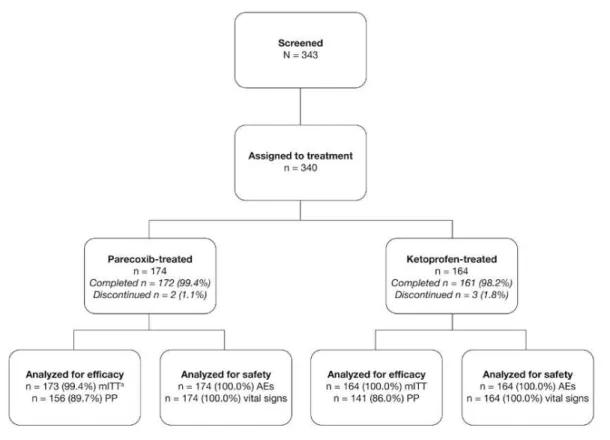
total of 10 (5.7%) subjects from the parecoxib group and 14 (8.5%) subjects from the ketoprofen group were excluded from the primary analysis because they did not have a conirmed diagnosis of renal col -ic. One subject in the parecoxib group and three sub-jects in the ketoprofen group discontinued the study because they did not meet the entrance criteria and one subject in the parecoxib group discontinued due to infusion problems (Figure-1). Demographics and clinical characteristics of subjects at randomization were similar in both treatment groups (Table-1). The majority of subjects were aged 18-64 years (99.1%), 63.0% of subjects were male and 58.9% were white (Table-1). In addition, 60.3% and 57.3% of subjects in the parecoxib and ketoprofen groups, respective-ly, had severe pain at screening.
Eficacy Results
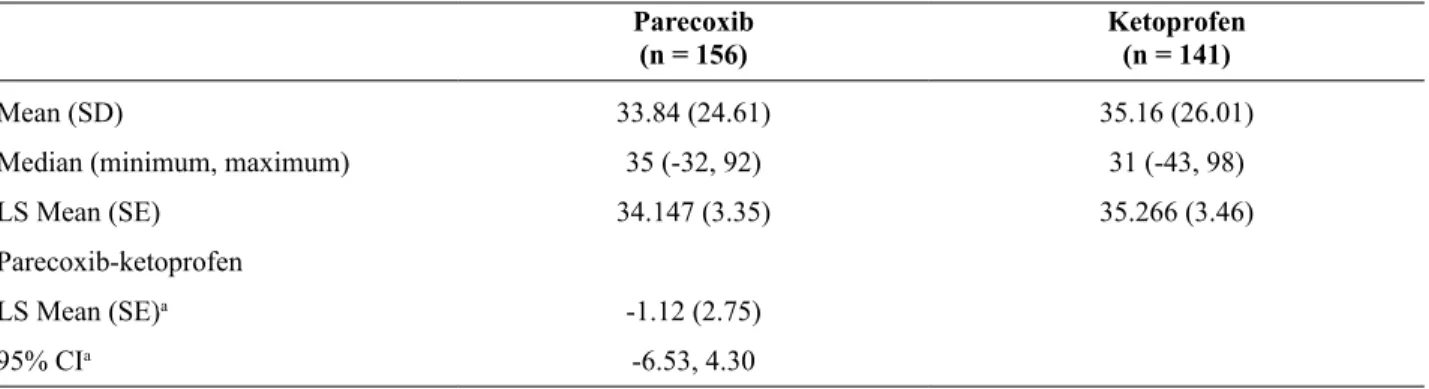
The noninferiority criterion was met for the primary eficacy endpoint, the mPID30min. The 95%
CI of the treatment difference (parecoxib - ketopro -fen) was -6.53; 4.30 and it excluded the noninferi -ority margin of -10 mm (Table-2). There were no signiicant differences observed between the treat -ment groups with regard to the secondary eficacy endpoints.
There were no signiicant differences ob -served between the two treatment groups with re-gard to pain VAS scores at any time (Figure-2).
The average mPID120min of both treatment groups was approximately 52 mm (SD of ~26) and ~77% of subjects had a decrease of at least 20 mm on the pain VAS score at 30 minutes.
Although differences between treatment groups were not statistically signiicant, more sub -jects in the parecoxib group reported “a lot” or “complete” pain relief at minute 30: 61% of subjects in the parecoxib group and 55% of subjects in the ketoprofen group. The percentage of subjects who reported “a lot” or “complete” pain relief by minute
Figure 1 – Subject disposition.
120 in the parecoxib and ketoprofen groups was 88% and 91% respectively.
Subjects treated with parecoxib reported a slightly higher mean (± SD) score for TOTPAR120min than subjects in the ketoprofen group (365.6 ± 122.8
vs. 355.0 ± 126.1, respectively); however, this differ -ence was not statistically signiicant.
The percentage of subjects that assessed the medication as “good” or “excellent” at minute 30, minute 120 and day 2 time points, was 81%, 86% Table 1 – Summary of baseline demographic characteristics.
Parecoxib (n = 174)
Ketoprofen (n = 164)
Gender, number (%) of subjects
Male 110 (63.2) 103 (62.8)
Female 64 (36.8) 61 (37.2)
Age, years
Mean (SD) 38.6 (10.3) 40.1 (12.1)
Range (minimum-maximum) 16-69 19-71
Ethnicity, number (%) of subjects
White 99 (56.9) 100 (61.0)
Black 2 (1.1) 3 (1.8)
Asian 2 (1.1) 3 (1.8)
Other 71 (40.8) 58 (35.4)
Weight, kg
Mean (SD) 75.4 (15.1)a 74.4 (15.3)
Range (minimum-maximum) 46-130a 50-125
Categorical Pain Scale, number (%) of subjects
Moderate Pain 69 (39.7) 70 (42.7)
Severe Pain 105 (60.3) 94 (57.3)
n = number of subjects; SD = standard deviation a n = 172
Table 2 - Mean pain intensity difference at minute 30 by VAS (mm) for the PP population.
Parecoxib (n = 156)
Ketoprofen (n = 141)
Mean (SD) 33.84 (24.61) 35.16 (26.01)
Median (minimum, maximum) 35 (-32, 92) 31 (-43, 98)
LS Mean (SE) 34.147 (3.35) 35.266 (3.46)
Parecoxib-ketoprofen
LS Mean (SE)a -1.12 (2.75)
95% CIa -6.53, 4.30
n = number of subjects; SD = standard deviation; LS = least squares; SE = standard error; CI = conidence interval; VAS = visual analog scale; PP = per-protocol
and 90% for the parecoxib group and 83%, 87% and 86% for the ketoprofen group, respectively. Again, no signiicant treatment differences were observed.
Similarly the physician’s assessment of the medication was “good” or “excellent” at minute 30, minute 120 and day 2 time points for 81%, 87% and 89% for the parecoxib group and 79%, 86% and 86% for the ketoprofen group, respectively.
The time to rescue medication was similar for both treatment groups. Twenty-six subjects took rescue medication up to 120 minutes after the admin-istration of study medication in the parecoxib group compared with 25 subjects in the ketoprofen group. For both treatments, more than one-half of these sub-jects took the rescue medication within 60 minutes of dosing.
Safety
The incidence of AEs was similar for the two treatment groups. In the parecoxib group 25.9% of subjects experienced a total of 56 AEs; for the ke
-toprofen group 28.0% of subjects experienced a total of 63 AEs. Overall, AEs were mainly mild or moder -ate in severity. A total of 16 subjects reported seri -ous AEs; eight in each group (4.6% in the parecoxib group and 4.9% in the ketoprofen group); none were considered by the investigator to be related to study drug and all resolved. No deaths were reported in either treatment group.
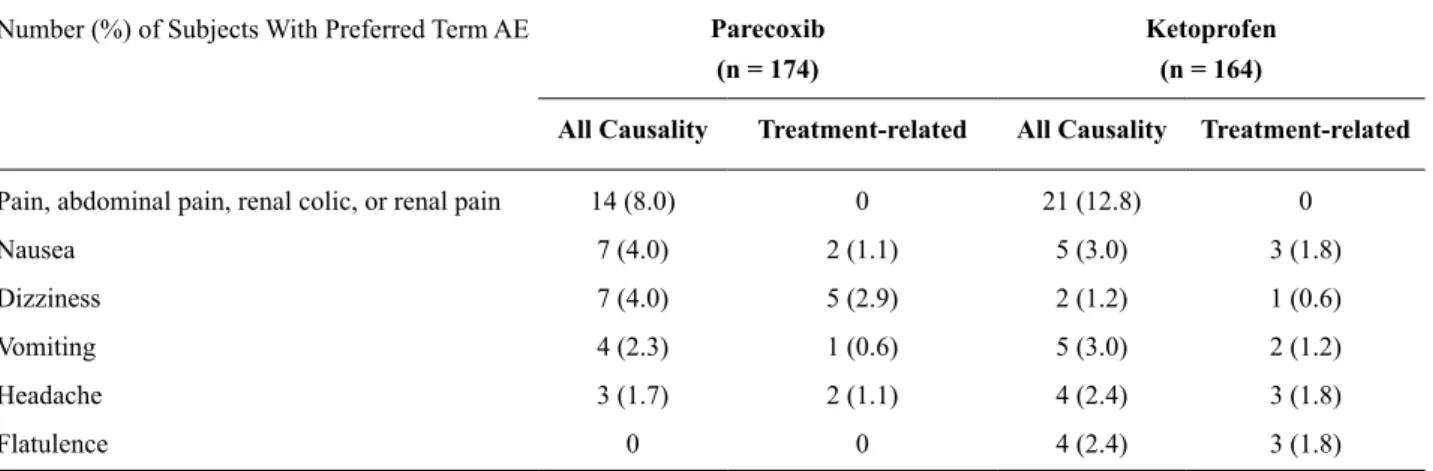
Pain (preferred terms pain, abdominal pain, renal colic and renal pain) was the most frequently reported AE, experienced by 8% of subjects in the parecoxib group and 12.8% of subjects in the ketopro -fen group (Table-3); again, none of these pain episodes was considered to be treatment-related. Although nau -sea was the second most frequently reported AE only two subjects in the parecoxib group and three subjects in the ketoprofen group experienced nausea that was considered to be treatment-related.
In terms of treatment-related AEs, dizzi -ness was the most frequently reported. Furthermore, dizziness was more frequently reported for sub
jects treated with parecoxib (2.9%) than ketoprofen (0.6%). Worsening of renal colic was reported by 2.9% of subjects in the parecoxib group and by 4.3% of subjects in the ketoprofen group.
DISCUSSION
A common cause of acute severe pain, renal colic requires rapid medical attention, often prior to a diagnosis being made. Strong opioids such as mor-phine are commonly used in the treatment of pain as-sociated with renal colic; however, although highly effective, opioids can cause a number of serious side effects in the central nervous system (i.e. dizziness, somnolence, respiratory depression, confusion and addiction), which may limit their use in the long-term.
Current evidence suggests that, like opioids, nsNSAIDs are eficacious in controlling the signs and symptoms of renal colic (1); those drugs reduce urinary system distension and the associated pain through the inhibition of prostaglandins (10). As nsNSAIDs lack the addiction risk and known side effects of opioids, they may be the preferred treat-ment choice for the majority of patients with acute pain due to renal colic.
The COX-2 selective NSAID parecoxib has also been used in the treatment of acute pain; how -ever, unlike ketoprofen, parecoxib -another largely used drug to treat pain associated with renal colic-
does not cause inhibition of platelet function (11,12) and, thus, avoids the risk of bleeding. In contrast to certain parenteral NSAID formulations that require setting up a slow i.v. infusion, parecoxib can be in-jected rapidly and directly into a vein; a useful prop -erty in the busy emergency room setting.
Phillips and colleagues have previously evaluated the use of celecoxib, the only other cur-rently approved COX-2 selective NSAID available for the management of acute renal colic (13). In this prospective, randomized, controlled clinical trial of 53 patients they found that there were no signiicant differences between celecoxib and placebo for either pain scores or narcotic requirements (13). However in our study, reporting here for the irst time the use of parecoxib in this study population, and based on the indings of the primary analysis, parecoxib was shown to be noninferior to ketoprofen in the treat-ment of acute pain due to renal colic. In addition, there were no signiicant treatment differences be -tween parecoxib and ketoprofen for any of the sec-ondary eficacy endpoints.
Parecoxib was well-tolerated in this study and demonstrated a comparable safety proile to ketoprofen. Although there were no obvious safe -ty concerns relating to the administration of either parecoxib or ketoprofen in this study, previous re-ports suggest that parecoxib is associated with fewer side effects than ketoprofen (8,9).
Table 3 - Most frequently reported adverse events by preferred term.
Number (%) of Subjects With Preferred Term AE Parecoxib (n = 174)
Ketoprofen (n = 164)
All Causality Treatment-related All Causality Treatment-related
Pain, abdominal pain, renal colic, or renal pain 14 (8.0) 0 21 (12.8) 0
Nausea 7 (4.0) 2 (1.1) 5 (3.0) 3 (1.8)
Dizziness 7 (4.0) 5 (2.9) 2 (1.2) 1 (0.6)
Vomiting 4 (2.3) 1 (0.6) 5 (3.0) 2 (1.2)
Headache 3 (1.7) 2 (1.1) 4 (2.4) 3 (1.8)
Flatulence 0 0 4 (2.4) 3 (1.8)
AE = adverse event; n = number of subjects
One of our main study limitations was that many patients with severe pain were unable to tol-erate their pain for long enough to be able to read and sign the informed consent form prior to re-ceiving pain-relief medication. As a result, many of these patients took additional medications and were, therefore, ineligible for enrollment in the study, which could have potentially created a se-lection bias.
CONCLUSIONS
Parecoxib is as effective as ketoprofen in the treatment of pain due to acute renal colic, is well tol-erated and has a comparable safety proile.
ACKNOWLEDGMENTS
As the corresponding author, I can conirm that all authors had access to all the study data, took responsibility for the accuracy of the analysis, and had full authority concerning preparation of the manuscript and the decision to submit the man-uscript for publication. This study was sponsored by Pizer Inc. Editorial support was provided by L. Prevost, BSc, of PAREXEL, and was funded by Pizer Inc.
We would also like to thank Dr Raymond Cheung for his invaluable input and support at the study design phase. In addition, we would also like to thank all the principal investigators who partici-pated in this study (please see Appendix 1) and who have provided support and technical assistance dur-ing the development of this manuscript.
We can also conirm that results from this trial were presented in poster form at the Confedera -tion of American Urology (CAU) meeting in Chile (September 8-11, 2010).
DISCLOSURES
Drs. Sidney Glina, Ronaldo Damiao, Joao Aif-Abdo, Carlos Francisco Santa Maria, Raul No -voa, Carlos Eurico Dornelles Cairoli do not have any conlicts of interest to disclose.
ABBREVIATIONS: AE = adverse event
ANCOVA = analysis of covariance CI = conidence interval
COX = cyclooxygenase i.v. = intravenous
mITT = modiied intent-to-treat ns = nonselective
NSAID = nonsteroidal anti-inlammatory drug PI = pain intensity
PID = pain intensity difference PP = per protocol
PR = pain relief
SD = standard deviation VAS = visual analog scale Appendix 1: Investigators Dr. Eduardo Berna Bertero, Brazil Dr. Ronaldo Damiao, Brazil Dr. Sidney Glina, Brazil
Dr. Carlos Eurico Dornelles Cairoli, Brazil Dr. Eric Roger Wroclawski, Brazil Dr. Walter J. Koff, Brazil
Dr. João Aif-Abdo, Brazil Dr. Antonio Martins BRAZIL
CONFLICT OF INTEREST
Drs Dalia Wajsbrot and Gaston Araya are both currently full-time employees of Pizer Inc.
REFERENCES
1. Holdgate A, Pollock T. Nonsteroidal anti-inlammato -ry drugs (NSAIDs) versus opioids for acute renal col -ic. Cochrane Database Syst Rev [Internet]. 2005 Apr 18 [Accessed 2011 May 25]; (2). Available at: http:// www2.cochrane.org/reviews/en/ab004137.html 2. Clinical Knowledge Summaries. Renal colic - acute
3. Vane JR: Inhibition of prostaglandin synthesis as a mechanism of action for aspirin-like drugs. Nat New Biol. 1971; 231: 232-5.
4. Gudis K, Sakamoto C: The role of cyclooxygenase in gastric mucosal protection. Dig Dis Sci. 2005; 50(Suppl 1): S16-23.
5. Brzozowski T, Konturek PC, Konturek SJ, Brzozows -ka I, Pawlik T: Role of prostaglandins in gastropro -tection and gastric adaptation. J Physiol Pharmacol. 2005; 56(Suppl 5): 33-55.
6. Seibert K, Zhang Y, Leahy K, Hauser S, Masferrer J, Perkins W, et al.: Pharmacological and biochemi -cal demonstration of the role of cyclooxygenase 2 in inlammation and pain. Proc Natl Acad Sci U S A. 1994; 91: 12013-7.
7. Otto JC, Smith WL: Prostaglandin endoperoxide syn -thases-1 and -2. J Lipid Mediat Cell Signal. 1995; 12: 139-56.
8. Emery P: Clinical implications of selective cyclooxy -genase-2 inhibition. Scand J Rheumatol Suppl. 1996; 102: 23-8.
9. Simon LS: Nonsteroidal antiinlammatory drugs and their effects. J Clin Rheumatol. 1996; 2: 135-40. 10. Tiselius HG, Ackermann D, Alken P, Buck C, Conort
P, Gallucci M, et al.: Guidelines on urolithiasis. Eur Urol. 2001; 40: 362-71.
11. Noveck R, Laurent A, Kuss M, Talwalker S, Hubbard RC: Parecoxib sodium does not impair platelet func -tion in healthy elderly and non-elderly individuals: Two randomized, controlled trials. Clin Drug Invest. 2001; 21: 465-76.
12. Munsterhjelm E, Niemi TT, Ylikorkala O, Neuvonen PJ, Rosenberg PH: Inluence on platelet aggregation of i.v. parecoxib and acetaminophen in healthy volun-teers. Br J Anaesth. 2006; 97: 226-31.
13. Phillips E, Hinck B, Pedro R, Makhlouf A, Kriedberg C, Hendlin K, et al.: Celecoxib in the management of acute renal colic: a randomized controlled clinical trial. Urology. 2009; 74: 994-9.
_____________________ Submitted for publication:
December 20, 2010
___________________ Accepted after revision: June 24, 2011 ______________________
Correspondence address: Dr. Sidney Glina
Rua Cincinato Braga 37 / 102 São Paulo, SP, 01333-011, Brazil Fax: +55 11 3515-7900