Statistical analysis of event-related
potential elicited by verb-complement
merge in Brazilian Portuguese
1Departamento de Epidemiologia e Bioestatística, Universidade Federal Fluminense, 2Programa de Engenharia Biomédica, COPPE, 3Departamento de Lingüística,
Faculdade de Letras, Universidade Federal do Rio de Janeiro, Rio de Janeiro, RJ, Brasil
M. Cagy1,
A.F.C. Infantosi2,
A.I. França3
and M. Lemle3
Abstract
An interesting fact about language cognition is that stimulation in-volving incongruence in the merge operation between verb and comple-ment has often been related to a negative event-related potential (ERP) of augmented amplitude and latency of ca. 400 ms - the N400. Using an automatic ERP latency and amplitude estimator to facilitate the recog-nition of waves with a low signal-to-noise ratio, the objective of the present study was to study the N400 statistically in 24 volunteers. Stimulation consisted of 80 experimental sentences (40 congruous and 40 incongruous), generated in Brazilian Portuguese, involving two distinct local verb-argument combinations (nominal object and pronominal object series). For each volunteer, the EEG was simulta-neously acquired at 20 derivations, topographically localized accord-ing to the 10-20 International System. A computerized routine for automatic N400-peak marking (based on the ascendant zero-cross of the first waveform derivative) was applied to the estimated individual ERP waveform for congruous and incongruous sentences in both series for all ERP topographic derivations. Peak-to-peak N400 ampli-tude was significantly augmented (P < 0.05; one-sided Wilcoxon signed-rank test) due to incongruence in derivations F3, T3, C3, Cz, T5, P3, Pz, and P4 for nominal object series and in P3, Pz and P4 for pronominal object series. The results also indicated high inter-indi-vidual variability in ERP waveforms, suggesting that the usual proce-dure of grand averaging might not be considered a generally adequate approach. Hence, signal processing statistical techniques should be applied in neurolinguistic ERP studies allowing waveform analysis with low signal-to-noise ratio.
Correspondence A.F.C. Infantosi Caixa Postal 68510 21941-972 Rio de Janeiro, RJ Brasil
Fax: +55-21-2562-8591 E-mail: [email protected]
Research supported by CNPq and FAPERJ.
Received July 20, 2005 Accepted June 26, 2006
Key words
•Event-related brain potentials
•Verb-complement merges
•Averaging
•N400 identification
Introduction
Long-latency evoked potentials usually occur 100 ms after a stimulus and behave according to the context of stimulation, hence being named event-related potentials (ERP). In records of the cortical activity related to
(N400) (1). This phenomenon has been widely
described as a consequence of increased difficulty in morpho-syntactic integration due to the semantic anomaly (2,3).
Three parameters from the resulting aver-aged ERP waveform are usually analyzed in order to characterize the N400: latency,
ampli-tude and topographic (spatial) distribution (4). The latency of the cortical response is refer-enced to a specific instant in time (for ex-ample, the target stimulus presentation) and usually ranges from 300 to 500 ms. Ampli-tude is commonly related to the level of facility to perform morpho-syntactic inte-gration (5,6). Thus, it can also be seen as the inverse function of context: the lower the supporting context for semantic satisfaction, the larger the amplitude of the waveform as a direct result of the integration challenge (7). Amplitude is also inversely correlated with recency and priming effects. Topogra-phy is usually reported to be centro-parietally distributed in visually stimulated experiments and more diffuse in acoustic ones (8).
Nonetheless, most of the N400 findings
are chiefly related to the merge operation between a verb adjacent to a full noun phrase. Hence, characterizing the neurophysiology of subtly different types of merge already formally and clearly described in the lin-guistics literature on verbal complementa-tion, such as the merge to a pronoun, is of great theoretical importance to neurolinguis-tics.
Since the protocols for eliciting N400 in
the language context are considerably ex-tensive, only reduced numbers of target sentences can be presented to the subjects -usually 30 (3) or 40 (9) sentences, resulting in individual ERPs with low signal-to-noise ratios. Hence, the classic protocol recom-mends grand averaging the waveforms for all individual subjects as the best practice (2,9). Nevertheless, we noticed striking dif-ferences among ERP waveforms stemming from different individuals in the data col-lected for the França et al. (10) study. Based
on this observation, in a previous study (11) we proposedan alternative to the standard grand averaging: an automatic ERP latency and amplitude estimator as a tool for helping the treatment of N400 waveforms per
indi-vidual, and applied it to the analysis of dis-tinct local verb-complement merge condi-tions.
In the present study, we compare the statistical results obtained for local verb-nominal object merge (for example, Joe ate
sandals) with another local
verb-comple-ment merge where the compleverb-comple-ment receives its semantic properties from a nominal ante-cedent (local verb-pronominal object merge, for example, Joe bought sandals and ate them). Moreover, we compared the results obtained using the proposed analysis to those obtained by the usual grand-average tech-nique.
Material and Methods
Experimental protocol
A computerized grammaticality judgment test was presented to 24 right-handed volun-teers (14 males). All volunvolun-teers were within the 18-39-age bracket (mean age, 26.3 years), had a complete or partial college education and had been previously screened for sys-temic diseases and for the current use of antidepressants.
Stimulation consisted of sentences in-volving the most studied type of verb-argu-ment combinations, i.e., the local one. The verb finds its argument right beside it and incongruence is established by the local in-compatibility between the selection require-ments of the verb and the semantic proper-ties of the complement. The latter can be semantically meaningful (nominal object series) or receive its semantic properties from a nominal antecedent (pronominal object series).
syntactic-categorical structuring of a phrase marker and the assignment of a conceptually felici-tous or infelicifelici-tous local thematic role. In turn, the sub-processes involved in pronomi-nal object series include: i) the syntactic-categorical structuring of a phrase marker; ii) then, since the pronoun is devoid of con-ceptual content, there is a search for an antecedent with which co-reference can be established; iii) finally, similarly to the nomi-nal object series, a conceptually felicitous or infelicitous local thematic role is assigned. Sentences in Table 1 exemplify congruous and incongruous merges.
Volunteers were visually stimulated with 80 experimental sentences (40 congruous and 40 incongruous) and 80 distractor sen-tences (also, 40 congruous and 40 incongru-ous) for each series, all in Brazilian Portu-guese, displayed in random order. The dis-tractors were mixed with the experimental stimuli and were formulated so as not to present the same types of selection as those in the target stimuli. For instance, some dis-tractors included intransitive verbs or subor-dinate clauses, despite having the same num-ber of words as the experimental sentences. Subjects read test instructions on the com-puter screen followed by a warm-up drill that checked their comprehension of the pro-tocol. After the warm-up, subjects could receive additional instructions from the ex-perimenter if any doubts about the protocol persisted. When ready, subjects would start the grammaticality judgment test.
The stimulus sentences were presented kinetically, word-by-word, on the computer screen, commanded by a script written in Presentation 0.5 (Neurobehavioral Systems, Albany, NY, USA). Each word was cen-trally displayed on the monitor for 200 ms, formatted with white, 20-point, Times New Roman font over a black screen (800 x 600 resolution on a 17' monitor with the subject’s eyes about 50 cm distant, resulting in aver-age vertical and horizontal angles of 0.75° and 3.7°, respectively). The sentences had 5
and 8 words for the nominal and pronominal object series, respectively, and the last word was used as target for both series. After the presentation of the last word of each sen-tence, subjects were requested to judge the stimulus by pressing either the red or the green key on the keyboard for incongruence or congruence, respectively. This response was assessed so that attention from the sub-jects could be inferred. Waiting for a re-sponse wait would time-out after 1000 ms. Following the event of judgment or time-out, a white fixation cross was displayed for 2000 ms before the first word of the next sentence was presented.
The EEG signal was recorded continu-ously during the whole experimental session from 20 unipolar derivations. Silvertip elec-trodes were positioned according to the In-ternational 10-20 System, with averaged-mastoid reference and ground at Fpz.
Elec-trode impedance was controlled to normal values (for EEG, lower than 10 kΩ). The signal was amplified (gain = 18,000) and treated with low-pass (cut-off frequency of 32 Hz) and high-pass filtering (0.8 Hz). The latter removes all slow and constant electri-cal waves from the signal. All EEG deriva-tions were then digitized with a sampling frequency of 200 Hz (12-bit analog-to-digi-tal resolution) and were stored for off-line processing.
Table 1. Examples of congruous and incongruous sentences for both series.
Nominal object Pronominal object
Congruous
Minha professora leu um livro Maria vai limpar a cadeira e também guardá-la
My teacher read a book Maria will clean the chair and also put it away
A moça perdeu o anel Teresa está escrevendo um livro e tentará ilustrá-lo
The lady lost her ring Thereza is writing a book and will try to illustrate it
Incongruous
Meu primo rasgou a geladeira Eu vou jogar a bola e então almoçá-la
My cousin tore the fridge I will throw the ball and then lunch it
A mulher cortou o vácuo Ela está misturando o suco e quer queimá-lo
The woman cut the vacuum She is mixing the juice and (wants to) burn it
ERP waveform estimation
The original signal of each subject was segmented into epochs of 800-ms duration triggered by the onset of the target words. Then, an algorithm for artifact rejection was applied to each signal epoch. This algorithm consisted of a simple comparison to a thresh-old, defined as 1.35 times the root mean squared value of an artifact-free individual EEG raw signal. The epochs that presented any sample with a module above this thresh-old were discarded.
The ERP was then estimated by coher-ently averaging the epochs relative to con-gruous (or inconcon-gruous) EEG response for each electrode site of a subject. Hence, ERPs were time-locked to the onset of the stimu-lus-trigger for each condition, congruous and incongruous. Due to the analog high-pass filtering, the use of a baseline preset
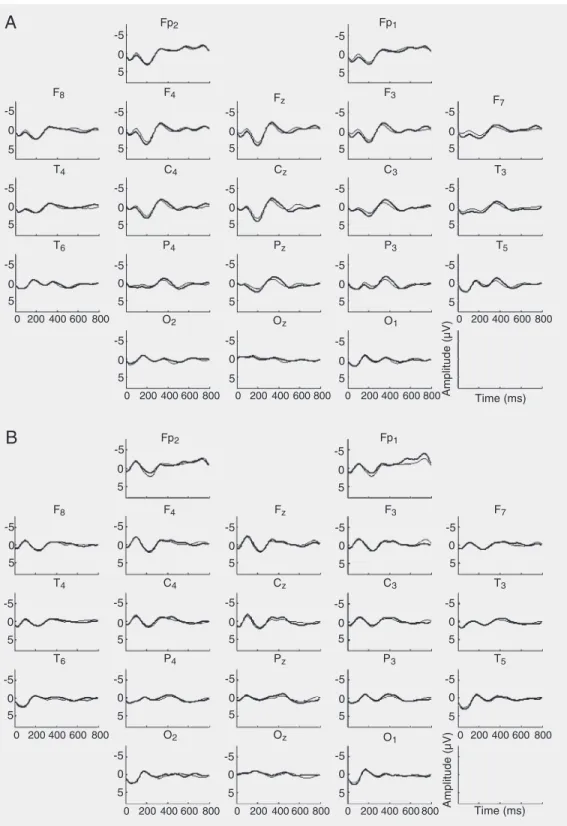
before the stimulus could be avoided. Indi-vidual ERPs were then low-pass filtered (cut-off frequency of 7 Hz, 2nd order Butter-worth, applied bi-directionally for obtaining a null phase frequency-response, i.e., no phase distortion). Figure 1 shows the result-ing ERPs for one of the volunteers, illustrat-ing the high inter-individual waveform variability, which makes the visual recogni-tion of N400 a difficult task. Figure 2 depicts
the resulting grand-averaged waveforms re-garding all volunteers. Thick and thin lines refer to incongruous and congruous sen-tences, respectively, and negative waves are plotted upwards in accordance with ERP literature.
Automatic N400 marker and peak-to-peak
amplitude estimation
A computerized routine for automatic N400-peak marking was applied to the
result-ing individual ERP for all derivations, as described in Figure 3. Negative peaks were recognized from the ascendant zero-cross of the first approximate waveform derivative within the 200-600 ms window. This could be carried out using simply the sign of the derivative. If multiple peaks were found within this time window, the most pro-nounced one was chosen. In cases of very poor waveforms a manual correction of the estimation was performed. Once the N400
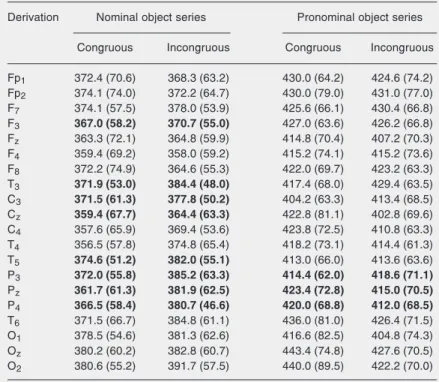
was identified, the amplitude between this wave and the highest positive peak around it was automatically calculated. Table 2 sum-marizes the mean and standard deviation (SD) of N400 latency in the 20 ERP
deriva-tions for both series. It can be noticed that in most of them latency was slightly more de-layed for incongruous (mean = 356.7 and 422.5 ms, for nominal and pronominal ob-ject series, respectively) than for congruous sentences (355.7 and 421.9 ms), although the mean latency for pronominal object se-ries was nearly 20% more delayed than that for nominal object series.
Table 2. Mean and standard deviation (in parentheses) of N400 latency in all
event-related potential (ERP) derivations (in ms).
Derivation Nominal object series Pronominal object series
Congruous Incongruous Congruous Incongruous
Fp1 372.4 (70.6) 368.3 (63.2) 430.0 (64.2) 424.6 (74.2)
Fp2 374.1 (74.0) 372.2 (64.7) 430.0 (79.0) 431.0 (77.0)
F7 374.1 (57.5) 378.0 (53.9) 425.6 (66.1) 430.4 (66.8)
F3 367.0 (58.2) 370.7 (55.0) 427.0 (63.6) 426.2 (66.8)
Fz 363.3 (72.1) 364.8 (59.9) 414.8 (70.4) 407.2 (70.3)
F4 359.4 (69.2) 358.0 (59.2) 415.2 (74.1) 415.2 (73.6)
F8 372.2 (74.9) 364.6 (55.3) 422.0 (69.7) 423.2 (63.3)
T3 371.9 (53.0) 384.4 (48.0) 417.4 (68.0) 429.4 (63.5)
C3 371.5 (61.3) 377.8 (50.2) 404.2 (63.3) 413.4 (68.5)
Cz 359.4 (67.7) 364.4 (63.3) 422.8 (81.1) 402.8 (69.6)
C4 357.6 (65.9) 369.4 (53.6) 423.8 (72.5) 410.8 (63.3)
T4 356.5 (57.8) 374.8 (65.4) 418.2 (73.1) 414.4 (61.3)
T5 374.6 (51.2) 382.0 (55.1) 413.0 (66.0) 413.6 (63.6)
P3 372.0 (55.8) 385.2 (63.3) 414.4 (62.0) 418.6 (71.1)
Pz 361.7 (61.3) 381.9 (62.5) 423.4 (72.8) 415.0 (70.5)
P4 366.5 (58.4) 380.7 (46.6) 420.0 (68.8) 412.0 (68.5)
T6 371.5 (66.7) 384.8 (61.1) 436.0 (81.0) 426.4 (71.5)
O1 378.5 (54.6) 381.3 (62.6) 416.6 (82.5) 404.8 (74.3)
Oz 380.2 (60.2) 382.8 (60.7) 443.4 (74.8) 427.6 (70.5)
O2 380.6 (55.2) 391.7 (57.5) 440.0 (89.5) 422.2 (70.0)
Values in bold indicate the ERP topographic derivations where N400 amplitude
Figure 1. Example of resulting individual event-related poten-tials for all derivations in nomi-nal (A) and pronominomi-nal (B) ob-ject series. Thick and thin lines refer to incongruous and con-gruous sentences, respective-ly.
Statistical test for the differential waveform
Due to the close values of N400 latencies
for congruous and incongruous sentences (Table 2), as well as to the high SD, no
statistical comparison was performed for this measure. Moreover, the N400 peak-to-peak
amplitude could not be considered normally distributed within all volunteers according to the Anderson-Darling test for P < 0.05
-5 0 5 800 600 400 200 -5 0 5 -5 0 5 -5 0 5 -5 0 5 -5 0 5 -5 0 5 -5 0 5 -5 0 5 -5 0 5 -5 0 5 -5 0 5 -5 0 5 -5 0 5 -5 0 5 -5 0 5 -5 0 5 -5 0 5 -5 0 5 -5 0 5 Amplitude (µV)
F4 F3
T3
C3
Cz
C4
T4
T6 P4 Pz P3 T5
O1
Oz
O2 0
800 600 400 200 0 800 600 400 200
0 0 200400600800 0 200400600800 Time (ms)
Fp2 Fp1
F7 Fz F8
B
-5 0 5 800 600 400 200 -5 0 5 -5 0 5 -5 0 5 -5 0 5 -5 0 5 -5 0 5 -5 0 5 -5 0 5 -5 0 5 -5 0 5 -5 0 5 -5 0 5 -5 0 5 -5 0 5 -5 0 5 -5 0 5 -5 0 5 -5 0 5 -5 0 5 Amplitude (µV)F4 F3
T3
C3
Cz
C4
T4
T6 P4 Pz P3 T5
O1
Oz
O2 0
800 600 400 200 0 800 600 400 200
0 0 200400600 800 0 200400600 800 Time (ms)
Fp2 Fp1
F7
Fz
F8
-5 0 5 800 600 400 200 -5 0 5 -5 0 5 -5 0 5 -5 0 5 -5 0 5 -5 0 5 -5 0 5 -5 0 5 -5 0 5 -5 0 5 -5 0 5 -5 0 5 -5 0 5 -5 0 5 -5 0 5 -5 0 5 -5 0 5 -5 0 5 -5 0 5 Amplitude (µV)
F4 F3
T3
C3
Cz
C4
T4
T6 P4 Pz P3 T5
O1
Oz
O2 0
800 600 400 200 0 800 600 400 200
0 0 200400600800 0 200400600800 Time (ms)
Fp2 Fp1
F7 Fz F8
A
-5 0 5 800 600 400 200 -5 0 5 -5 0 5 -5 0 5 -5 0 5 -5 0 5 -5 0 5 -5 0 5 -5 0 5 -5 0 5 -5 0 5 -5 0 5 -5 0 5 -5 0 5 -5 0 5 -5 0 5 -5 0 5 -5 0 5 -5 0 5 -5 0 5 Amplitude (µV)F4 F3
T3
C3
Cz
C4
T4
T6 P4 Pz P3 T5
O1
Oz
O2 0
800 600 400 200 0 800 600 400 200
0 0 200400600800 0 200400600800 Time (ms)
Fp2 Fp1
F7
Fz
F8
B
(12). In turn, a one-sided Wilcoxon signed-rank test (paired non-parametric) was used to statistically assess the null hypothesis of equal median amplitudes of the congruent
and incongruent ERPs (P < 0.05) (13). Another statistical approach, the running t-test, was employed (14). This test is based on the difference between the individual
Figure 2. Example of resulting grand-averaged event-related potentials for all derivations in:
ERPs of incongruous (I) and congruous (C) sentences for all volunteers. Using the dif-ferential waveform (I-C), normality could be assumed and the t-test was then applied on a sample-by-sample basis within the time interval of interest, from 200 to 600 ms. Two one-sided tests comparing (I-C) to zero, i.e., the null hypothesis of zero difference, were performed using a 2.5% level of signifi-cance for each side. At a given instant of time, if the null hypothesis was rejected for the positive side, one could infer that the resulting grand average for incongruous sen-tences would be statistically more positive or less negative then that for congruous sen-tences. The counterpart reasoning was ap-plied to the instants of time for which the null hypothesis was rejected for the negative side.
Results
Table 3 shows the results (P values) of the Wilcoxon signed-rank test in both series for all derivations. Regarding nominal ob-ject series, only derivations F3, T3, C3, Cz, T5,
P3, Pz, and P4 had a significantly increased
N400 amplitude (P < 0.05) due to
incongru-ence (bold in Table 3). The same applied to pronominal object series, but only for deri-vations P3, Pz and P4.
The results of the running t-test for time intervals between 200 and 600 ms are shown in Table 4. All derivations that picked up augmented N400 amplitude related to
seman-tic incongruence based on the Wilcoxon signed-rank test showed a significant differ-ence (I < C) within the time intervals of 315 and 475 ms for nominal object series and of 285 to 435 ms for pronominal object series (bold in Table 4). These intervals contain the respective mean N400 latency for both series
(bold in Table 2).
Discussion
Concerning the grand-averaged
wave-Waveform (µV)
2
0
-2
-4
800 Peak-to-peak amplitude
600 400
200 0
Derivative sign
2
1 0
-1
-2
800 600
400 200
0
Post-stimulus time (ms)
Time window Figure 3. Description of the au-tomatic N
400 locating procedure:
negative peaks are recognized from the ascendant zero-cross of the first approximate wave-form derivative within the 200-600-ms window, which could be done by simply using the sign of the derivative. In case of multiple findings, the most pronounced negative peak is chosen. forms (Figure 2), although the results for
nominal object series reproduced those com-monly described in the N400 literature, i.e.,
the semantic anomaly increases wave ampli-tude, as reported by Osterhout et al. (3), an increase of the depth of the preceding val-leys related to incongruous sentences was
Table 3. Results (P value) of the Wilcoxon signed-rank test comparing congruous and incongruous N400 peak-to-peak amplitude in both series.
Derivation Nominal Pronominal object series object series
Fp1 0.2862 0.6567
Fp2 0.1320 0.6468
F7 0.4570 0.4678
F3 0.0148 0.0731
Fz 0.1220 0.1597
F4 0.0636 0.5641
F8 0.4380 0.6954
T3 0.0084 0.1597
C3 0.0167 0.1664
Cz 0.0167 0.1350
C4 0.0551 0.2860
T4 0.5239 0.5429
T5 0.0014 0.0850
P3 0.0069 0.0072
Pz 0.0200 0.0264
P4 0.0429 0.0191
T6 0.1480 0.4043
O1 0.7299 0.2098
Oz 0.3820 0.0809
O2 0.6452 0.2769
Values in bold indicate the event-related potential topographic derivations where N400 amplitude
also noticed. This effect can be explained considering that the nominal series has the verb and object with all their semantic fea-tures right next to each other, i.e., all the elements for the verb-object integration are there. The verb has to either reject or accept the object “on the spot”. Thus, this configu-ration imposes a greater integconfigu-ration urgency than if the verb needed to select a displaced object or needed to fetch semantic features of the object that were expressed by a non-local word, technically named antecedent, as in the pronominal object series.
Regarding the pronominal object series, since the target merge (second one) is de-pendent on semantic material already nego-tiated in the previous verb selection, its range of conceptual options is possibly narrowed. Thus, considering that semantic context is inversely related to amplitude, the percep-tion of the congruous or incongruous mate-rial was facilitated, accounting for the lower amplitude of N400 in comparison with the
nominal object series.
The centroparietal topographic N400
dis-tribution achieved for nominal object series has also been reported by Kutas and Kluender (8) for visually stimulated experiments. Nev-ertheless, frontal and temporal derivations also resulted in significant changes between congruous and incongruous sentences. Fur-thermore, the statistics points out the left-medial topography (odd and ‘z’ derivations) of N400 changes due to incongruence,
al-ready visually noted by Friederici et al. (9). Furthermore, the derivations with least sig-nificant changes (accepting the null hypo-thesis of no increase) were frontopolar and occipital, a not surprising result since these areas are not involved in language process-ing. On the other hand, for pronominal ob-ject series, the significant increase in N400 for
incongruous sentences occurred bilaterally only in parietal derivations. This could be due to the need for semantic recall for the complement from short-term memory.
The running t-test showed that the more Table 4. Time intervals where the waveforms for congruous (C) and incongruous (I)
sentences differ (in ms).
Derivation Nominal object series Pronominal object series
I > C I < C I > C I < C
Fp1 - - - [520-585]
Fp2 - - - [235-270], [515-525]
F7 [200-250] [330-430] - [510-595]
F3 - [315-430] -
-Fz - - -
-F4 - [300-430] -
-F8 [530-605] [320-425] - [485-515]
T3 [200-275] [345-460] - [395-520]
C3 [200-255] [320-455] - [515-540]
Cz [200-240], [535-595] [335-430] - [325-380]
C4 - [375-420] - [240-325], [445-480]
T4 - [425-455] -
-T5 [205-265] [325-470] - [260-460]
P3 [200-255] [315-475] - [310-435]
Pz [200-220] [315-465] - [285-415]
P4 - [355-450] - [295-410]
T6 [560-580] [390-465] - [300-375]
O1 - [410-505] - [280-340]
Oz [200-270] [395-490] - [320-350]
O2 [200-265] [405-485] - [320-355]
Values in bold indicate the event-related potential topographic derivations where N400
amplitude significantly increased (P < 0.05) due to incongruence (Wilcoxon signed-rank test).
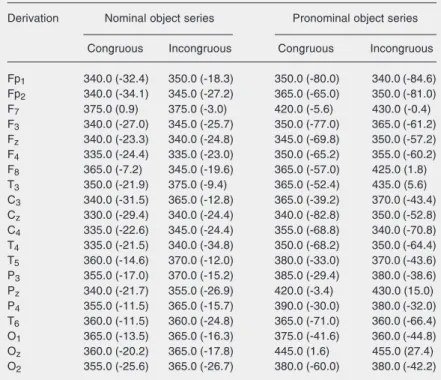
Table 5. N400 latency in all event-related potential (ERP) topographic derivations (in
ms) for the grand-averaged ERP.
Derivation Nominal object series Pronominal object series
Congruous Incongruous Congruous Incongruous
Fp1 340.0 (-32.4) 350.0 (-18.3) 350.0 (-80.0) 340.0 (-84.6)
Fp2 340.0 (-34.1) 345.0 (-27.2) 365.0 (-65.0) 350.0 (-81.0)
F7 375.0 (0.9) 375.0 (-3.0) 420.0 (-5.6) 430.0 (-0.4)
F3 340.0 (-27.0) 345.0 (-25.7) 350.0 (-77.0) 365.0 (-61.2)
Fz 340.0 (-23.3) 340.0 (-24.8) 345.0 (-69.8) 350.0 (-57.2)
F4 335.0 (-24.4) 335.0 (-23.0) 350.0 (-65.2) 355.0 (-60.2)
F8 365.0 (-7.2) 345.0 (-19.6) 365.0 (-57.0) 425.0 (1.8)
T3 350.0 (-21.9) 375.0 (-9.4) 365.0 (-52.4) 435.0 (5.6)
C3 340.0 (-31.5) 365.0 (-12.8) 365.0 (-39.2) 370.0 (-43.4)
Cz 330.0 (-29.4) 340.0 (-24.4) 340.0 (-82.8) 350.0 (-52.8)
C4 335.0 (-22.6) 345.0 (-24.4) 355.0 (-68.8) 340.0 (-70.8)
T4 335.0 (-21.5) 340.0 (-34.8) 350.0 (-68.2) 350.0 (-64.4)
T5 360.0 (-14.6) 370.0 (-12.0) 380.0 (-33.0) 370.0 (-43.6)
P3 355.0 (-17.0) 370.0 (-15.2) 385.0 (-29.4) 380.0 (-38.6)
Pz 340.0 (-21.7) 355.0 (-26.9) 420.0 (-3.4) 430.0 (15.0)
P4 355.0 (-11.5) 365.0 (-15.7) 390.0 (-30.0) 380.0 (-32.0)
T6 360.0 (-11.5) 360.0 (-24.8) 365.0 (-71.0) 360.0 (-66.4)
O1 365.0 (-13.5) 365.0 (-16.3) 375.0 (-41.6) 360.0 (-44.8)
Oz 360.0 (-20.2) 365.0 (-17.8) 445.0 (1.6) 455.0 (27.4)
O2 355.0 (-25.6) 365.0 (-26.7) 380.0 (-60.0) 380.0 (-42.2)
The deviation from the mean N400 latency calculated from the individual ERP is given
pronounced negativity for incongruous sen-tences in the vicinity of 400 ms occurred in more derivations than expected (8). One possible interpretation for this finding is that the differential waveform can result in no-ticeable values if the original individual ERPs have different latencies, even having close amplitudes. If that does occur, the running t -test becomes less specific. On the other hand, only for nominal object series, one can infer that some derivations show a significantly higher positivity before and/or after the N400
period, suggesting the presence of P300 and
P500.
In agreement with our previous study (11), the high variability of inter-individual waveforms, particularly concerning N400
la-tency (SD of ca. 50 ms for nominal object series and of 70 ms for pronominal object series) suggests that the waveform resulting from the common procedure of grand aver-aging (1,2,7) might not be considered to be the best representation of the set. This can be noticed by comparing Figure 1 to the grand-averaged ERP shown in Figure 2, where N400
is widened and attenuated. Furthermore, from Table 5 it can be noted that the N400 latency
of the grand-averaged ERP differs consider-ably from the mean N400 latency calculated
from the individual waveforms, with devia-tions of up to 35 ms for nominal object series and 85 ms for pronominal object series. Although the individual ERPs showed a con-siderably low signal-to-noise ratio, mainly due to the reduced number of target stimuli, the automatic N400 wave marker approach
facilitated this kind of analysis.
The striking inter-individual variability suggests that the use of normalization, such as using the individual peak-to-peak N400
amplitude and triggering the waveforms by
the N400 latency instead of by the stimulus
onset, would be a more adequate ERP ex-traction procedure. In this case, when the grand-averaging procedure is applied, it would more accurately depict an averaged waveform and not the intervening effects of inter-individual neurophysiological differ-ences. Based on this procedure, such varia-bility could be reduced within a neighbor-hood of ± 200 ms wide, which includes the N400 wave.
In the language context, the estimated grand-average ERP is built up from a re-duced number of epochs for each subject and for a limited casuistry. Thus, the result-ing waveform might not be considered to be the best representation of the set. On the other hand, the individual ERP waveform has low signal-to-noise ratio and does pres-ent considerably high inter-individual varia-bility, which can affect both amplitude and latency. Despite this variability, the effect of incongruity was investigated by applying two distinct statistical tests. The Wilcoxon signed-rank test applied to the peak-to-peak N400 amplitude provides more reliable
re-sults than the use of the running t-test with the differential waveform. Moreover, the use of an automatic N400 wave marker
facili-tated the identification of individual N400
waves. Based on all of these findings, one should point out the need of using signal processing statistical techniques in ERP stud-ies on neurolinguistics allowing waveform analysis with low signal-to-noise ratio.
Acknowledgments
References
1. Kutas M, Hillyard SA. Reading senseless sentences: brain poten-tials reflect semantic incongruity. Science 1980; 207: 203-205. 2. Van Petten C, Kutas M. Interactions between sentence context and
word frequency in event-related brain potentials. Mem Cognit 1990; 18: 380-393.
3. Osterhout L, Holcomb PJ. Event-related potentials and language comprehension. In: Rugg MD, Coles MGH (Editors), Electrophysiol-ogy of mind: event-related brain potentials and cognition. New York: Oxford University Press; 1995. p 171-215.
4. Kotz SA, Friederici AD. Electrophysiology of normal and pathologi-cal language processing. J Neurolinguistics 2003; 16: 43-58. 5. Kutas M, Hillyard SA. Brain potentials during reading reflect word
expectancy and semantic association. Nature 1984; 307: 161-163. 6. Fonteneau E, Frauenfelder U, Rizzi L. On the contribution of ERPs
to study of language comprehension. Bull Suisse Linguistique Appliquée: Etudes Neurolinguistique 1998; 68: 111-124.
7. Holcomb PJ, Neville HJ. Natural speech processing: An analysis using event-related brain potentials. Psychobiology 1991; 19: 286-300.
8. Kutas M, Kluender R. What is who violating? A reconsideration of
linguistic violations in light of event-related brain potentials. In: Heinze HT, Mangun GR, Muente T (Editors), Cognitive electrophysi-ology. Boston: Birkhaeuser; 1994. p 183-210.
9. Friederici AD, Hahne A, Saddy D. Distinct neurophysiological pat-terns reflecting aspects of syntactic complexity and syntactic repair.
J Psycholinguist Res 2002; 31: 45-63.
10. França AI, Lemle M, Cagy M, Constant P, Infantosi AFC. Discrimi-nating among different types of verb-complement merge in Brazilian Portuguese: an ERP study of morpho-syntactic sub-processes. J Neurolinguistics 2004; 17: 425-437.
11. Cagy M, Infantosi AFC, França AI, Lemle M. Event-related potential study for incongruous verb-complement merge in Brazilian Portu-guese. IFMBE Proceedings 2004; 5: 1115-1118.
12. D’Agostino RB, Stephens MA. Goodness-of-fit techniques. New York: Marcel-Dekker; 1986.
13. Lehman EL, D’Abrera HJM. Non-parametrics: statistical methods based on ranks. San Francisco: Holden-Day, Inc.; 1975.