Participation of ATP-sensitive K
+
channels in the peripheral
antinociceptive effect of fentanyl
in rats
Departamento de Farmacologia, Instituto de Ciências Biológicas, Universidade Federal de Minas Gerais, Belo Horizonte, MG, Brasil A.R.A. Rodrigues,
M.S.A. Castro, J.N. Francischi, A.C. Perez and I.D.G. Duarte
Abstract
We examined the effect of several K+ channel blockers such as glibenclamide, tolbutamide, charybdotoxin (ChTX), apamin, tetra-ethylammonium chloride (TEA), 4-aminopyridine (4-AP), and ce-sium on the ability of fentanyl, a clinically used selective µ-opioid receptor agonist, to promote peripheral antinociception. Antinocicep-tion was measured by the paw pressure test in male Wistar rats weighing 180-250 g (N = 5 animals per group). Carrageenan (250 µg/ paw) decreased the threshold of responsiveness to noxious pressure (∆
= 188.1 ± 5.3 g). This mechanical hyperalgesia was reduced by fentanyl (0.5, 1.5 and 3 µg/paw) in a peripherally mediated and dose-dependent fashion (17.3, 45.3 and 62.6%, respectively). The selective blockers of ATP-sensitive K+ channels glibenclamide (40, 80 and 160 µg/paw) and tolbutamide (80, 160 and 240 µg/paw) dose dependently antagonized the antinociception induced by fentanyl (1.5 µg/paw). In contrast, the effect of fentanyl was unaffected by the large conduc-tance Ca2+-activated K+ channel blocker ChTX (2 µg/paw), the small conductance Ca2+-activated K+ channel blocker apamin (10 µg/paw), or the non-specific K+ channel blocker TEA (150 µg/paw), 4-AP (50 µg/paw), and cesium (250 µg/paw). These results extend previously reported data on the peripheral analgesic effect of morphine and fentanyl, suggesting for the first time that the peripheral µ-opioid receptor-mediated antinociceptive effect of fentanyl depends on acti-vation of ATP-sensitive, but not other, K+ channels.
Correspondence I.D.G. Duarte
Departamento de Farmacologia ICB, UFMG
Av. Antônio Carlos, 6627 31270-100 Belo Horizonte, MG Brasil
Fax: +55-31-499-2695 E-mail: [email protected]
Research supported by CNPq.
Received December 19, 2003 Accepted October 6, 2004
Key words
•Peripheral antinociception •Fentanyl
•K+ channel
•µ-Opioid receptor agonist •Glibenclamide
Introduction
Opioids can produce analgesia by inhib-iting nociceptive input at supraspinal and spinal sites (1,2). In the central nervous sys-tem, the opening of K+ channels seems to
play a role in opioid-mediated antinocicep-tion, since the ATP-sensitive K+ channel
blockers (sulfonylureas) antagonize the nociceptive effect of opioids (3-6). The anti-nociceptive effect of opioid agonists was also enhanced by ATP-sensitive K+ channel
openers such as pinacidil (7) and cromakalin (8). Evidence that some opioids induce open-ing of calcium-activated K+ channels has
diver-sity of K+ channels (10) with different
elec-trophysiological and pharmacological char-acteristics in neurons suggests that other types of K+ channels may be involved in this
ef-fect.
Several studies have indicated that exog-enous as well as endogexog-enous opioids can act on peripheral nociceptors to produce an anti-nociceptive effect against the hyperalgesia induced by local inflammation (11,12). Al-though the presence of opioid receptors on the peripheral terminals of primary afferents has been demonstrated, the mechanism by which opioid agonists induce peripheral an-tinociception is unclear (13). It was previ-ously shown that opioid receptors at periph-eral sites are coupled with inhibitory G pro-teins since pertussis toxin inhibits the pe-ripheral antinociception induced by morphine (14) and are also coupled to the L-arginine-NO-cGMP pathway (15,16). Morphine has been shown to exert its peripheral antinoci-ceptive effect by also activating ATP-sensi-tive K+ channels (17).
The purpose of the present study was to determine whether specific and non-specific K+ channel blockers have any effect on the
peripheral antinociception induced by fenta-nyl, since this drug is very potent and is extensively used in clinical practice (18). Thus, we tested the effects of glibenclamide and tolbutamide, sulfonylureas that specifi-cally block ATP-sensitive K+ channels (19),
apamin, a selective blocker of small conduc-tance Ca2+-activated K+ channels (20),
cha-rybdotoxin (ChTX), a blocker of large con-ductance Ca2+-activated K+ channels (21),
and the non-selective K+ channel blockers
4-aminopyridine (4-AP), tetraethylammonium chloride (TEA) and cesium (22).
Material and Methods
Animals
The experiments were performed on male Wistar rats weighing 180-250 g (from the
Animal Facilities of the Federal University of Minas Gerais, CEBIO-UFMG). The ani-mals were housed in a temperature-controlled room (23 ± 1ºC) on an automatic 12-h light/ dark cycle (lights on at 6:00 am). All testing was conducted during the light phase (12:00 to 17:00 h). Food and water were freely available until the beginning of each experi-ment. Naive animals were used throughout.
Measurement of hyperalgesia
Hyperalgesia was induced in the hind paw by intraplantar administration of a car-rageenan suspension (250 µg) and measured according to paw pressure test (23). An anal-gesia meter (Ugo-Basile, Varese, Italy) with a cone-shaped paw-presser with a rounded tip, which applies a linearly increasing force to the plantar surface of the paw, was used. The weight in grams required to elicit noci-ceptive responses such as paw flexion was taken to be the nociceptive threshold. A cut-off value of 300 g was used to prevent dam-age to the paw. The nociceptive threshold was always measured in the right hind paw (except when indicated) and reported as the average of three consecutive trials recorded before and 3 h after carrageenan injection. The result was calculated as the difference between these two averages (∆ of nocicep-tive threshold) and is reported in grams.
Experimental protocol
Fentanyl was administered once subcu-taneously into the right hind paw 135 min after local injection of the carrageenan sus-pension. All the K+ channel blockers were
injected subcutaneously into the right hind paw. The sulfonylureas (glibenclamide and tolbutamide) were administered 5 min be-fore fentanyl while all the other K+ channel
while fentanyl was administered 2 h later into the left or right paw and only the right paw was measured.
Drugs
The drug used as the hyperalgesic agent was lambda carrageenan (Sigma, St. Louis, MO, USA) and the µ-opioid receptor agonist was fentanyl (Janssen, Titusville, NJ, USA). The K+ channel blockers and their suppliers
were: glibenclamide, ChTX, apamin, TEA, 4-AP, and cesium (Sigma) and tolbutamide (ICN Biomedicals Inc., Aurora, OH, USA). Fentanyl and carrageenan were dissolved in isotonic saline and injected in a volume of 100 µl per paw. The K+ channel blockers
were dissolved in demineralized water im-mediately before use, with the exception of sulfonylureas which were dissolved in sa-line and 2% Tween, and injected in a volume of 50 µl per paw. For acidic or alkaline solutions of drops the pH was adjusted closer to 7.
Statistical analysis
Data were analyzed statistically by one-way analysis of variance (ANOVA) followed by the Bonferroni test for multiple compari-sons. Probabilities of less than 1% (P < 0.01) were considered to be statistically signifi-cant.
Results
Antinociceptive effect of fentanyl
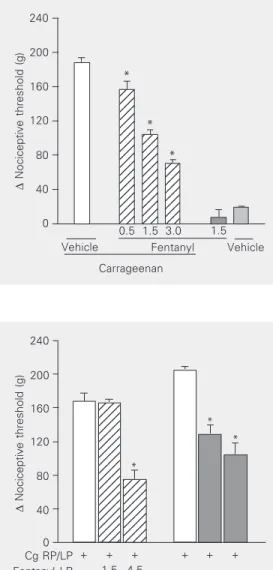
The administration of fentanyl (0.5 to 3.0 µg) into the right hind paw produced an antinociceptive response against the hyper-algesia induced by prior local ipsilateral in-jection of carrageenan (Figure 1). Fentanyl at the dose of 1.5 µg, when administered into the left paw, did not produce an antinocicep-tive effect in the right paw, whereas fentanyl at the dose of 4.5 µg when injected into the
Figure 1. Fentanyl inhibition of the nociceptive threshold of car-rageenan-induced hyperalgesia in rats. Fentanyl (µg) was admin-istered intraplantarly 135 min af-ter the local administration of 100 µl of a carrageenan suspen-sion (250 µg). Each column indi-cates the mean ± SEM (N = 5). *P < 0.01 vs carrageenan + ve-hicle-injected control (ANOVA/ Bonferroni test).
∆
Nociceptive threshold (g)
240
200
160
120
80
40
0
Vehicle Fentanyl Vehicle 0.5 1.5 3.0 1.5
123 123 123 123 123 123 123 123 123 123 123 123 123 123 123 123 123 123
123 123 123 123 123 123 123 123 123 123 123 123
123 123 123 123 123 123 123 123 123 *
*
*
Carrageenan
left paw induced a potent antinociceptive effect in the contralateral paw (Figure 2).
Antagonism of fentanyl-induced antinociception by glibenclamide and tolbutamide
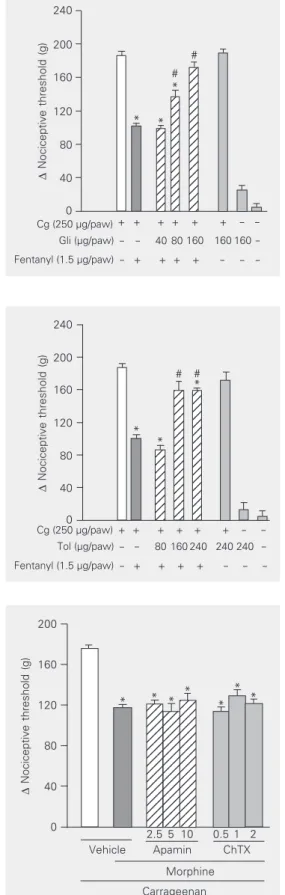
Glibenclamide (40, 80 and 160 µg/paw) significantly reduced the magnitude of fen-tanyl-induced antinociception (1.5 µg/paw) in a dose-dependent manner (Figure 3). As shown in Figure 4, the other sulfonylurea tested, tolbutamide (80, 160 and 240 µg/ paw) also significantly inhibited the fenta-nyl-induced antinociceptive effect. Neither
∆
Nociceptive threshold (g)
240
200
160
120
80
40
0
1234 1234 1234 1234 1234 1234 1234 1234 1234 1234 1234 1234 1234 1234 1234 1234 1234 1234
1234 1234 1234 1234 1234 1234 1234 1234 1234
Cg RP/LP Fentanyl LP Fentanyl RP
+ + + + + +
- 1.5 4.5
- 1.5 4.5 *
* *
sulfonylurea tested significantly modified the nociceptive threshold in control animals, or induced any overt behavioral effect at the doses used. Furthermore, the maximum dose of glibenclamide administered by the same route did not significantly alter the plasma glucose level (data not shown).
Effect of apamin, ChTX, 4-AP, TEA, or cesium on fentanyl-induced antinociception
Intraplantar injection of apamin (10 µg) had no significant effect on fentanyl-induced antinociception. ChTX (2.0 µg/paw) also failed to significantly counteract the antino-ciception induced by fentanyl (Figure 5). As also shown in the same Figure, 4-AP (50 µg/ paw), TEA (150 µg/paw) and cesium (250 µg/paw) did not significantly modify the antinociception induced by fentanyl.
Discussion
It has been suggested that the molecular mechanism of peripheral (15) and central (16) analgesia induced by morphine involves activation of the L-arginine/nitric oxide/ cGMP pathway. Morphine has been shown to exert its peripheral antinociceptive effect by activating ATP-sensitive K+ channels (17).
Recent studies carried out in our laboratory demonstrated that the peripheral antinoci-ceptive action of the nitric oxide donor so-dium nitroprusside (26) and dibutyryl cGMP (27) is associated with ATP-sensitive K+
channels, thus establishing a link between the participation of the nitric oxide/cGMP pathway in the analgesia induced by certain drugs and the activation of ATP-sensitive K+
channels.
The present findings demonstrate that the sulfonylureas glibenclamide and tolbuta-mide can reverse the peripheral antinocicep-tive effect induced by intraplantar adminis-tration of fentanyl in rats. Other K+ channel
blockers such as apamin, ChTX, 4-AP, TEA, and cesium did not exhibit any inhibitory
12 12 12 12 12 12 12 12 12 12 12 12 12 12 12 12 12 12 12 12 12 12 12 12 12 12 12 12 123 123 123 123 123 123 123 123 123 123 123 123 123 123 123 123 123 123 ∆
Nociceptive threshold (g)
240 200 160 120 80 40 0 Cg (250 µg/paw)
Tol (µg/paw)
Fentanyl (1.5 µg/paw)
- - 80 160 240 240 240 -- + + + + - - -+ -+ + + + + -
-* *
# # Figure 4. Antagonism induced by
intraplantar administration of tolbutamide of the peripheral anti-nociception produced by fentanyl in hyperalgesic paws. Tolbuta-mide (Tol, µg/paw) was adminis-tered 5 min before fentanyl (1.5 µg). Each column indicates the mean ± SEM (N = 5). The sym-bols “–” and “+” indicate the ab-sence and preab-sence of treatment, respectively. *P < 0.01 compared to carrageenan (Cg) + vehicle-in-jected controls and #P < 0.01
compared to Cg + fentanyl + ve-hicle-injected controls (ANOVA/ Bonferroni’s test).
∆
Nociceptive threshold (g)
240 200 160 120 80 40 0 12 12 12 12 12 12 12 12 12 12 12 12 12 12 12 12 12 12 12 12 12 12 12 12 12 12 12 12 12 12 12 12 12 12 12 12 12 12 12 12 12 12 12 12 12 12 12 12 Cg (250 µg/paw)
Gli (µg/paw)
Fentanyl (1.5 µg/paw)
+ + + + + + - -- - 40 80 160 160 160
-* *
* #
#
- + + + + - - -Figure 3. Antagonism induced by
intraplantar administration of gli-benclamide of the peripheral anti-nociception produced by fentanyl in hyperalgesic paws. Glibencla-mide (Gli, µg/paw) was adminis-tered 5 min before fentanyl (1.5 µg). Each column indicates the mean ± SEM (N = 5). The sym-bols “–” and “+” indicate the ab-sence and preab-sence of treatment, respectively. *P < 0.01 compared to carrageenan (Cg) + vehicle-in-jected controls and #P < 0.01
compared to Cg + fentanyl + ve-hicle-injected controls (ANOVA/ Bonferroni’s test).
∆
Nociceptive threshold (g)
200 160 120 80 40 0 123 123 123 123 123 123 123 123 123 123 123 123 123 123 123 123 123 123 123 123 123 123 123 123 123 123 123 123 123 123 123 123 123 123 123 123 123 123 123 123 123 123 123 123 123 123 123 123 123 123
Vehicle Apamin ChTX Morphine Carrageenan
2.5 5 10 0.5 1 2 Figure 5. Inhibition by intraplantar
administration of apamin (Apa, 10 µg), charybdotoxin (ChTX, 2 µg), 4-aminopyridine (4-AP, 50 µg), tet-raethylammonium (TEA, 150 µg), and cesium (250 µg) of the pe-ripheral antinociception induced by fentanyl in hyperalgesic paws. Antagonists were administered 30 min after fentanyl (1.5 µg). Each column indicates the mean ± SEM (N = 5). No statistically significant differences were de-tected between the groups treated with fentanyl + vehicle and fentanyl + Apa, ChTX, 4-AP, TEA, or cesium in any case. *P < 0.01 vs carrageenan + vehicle-in-jected control (ANOVA/Bonfer-roni’s test).
*
* * * * *
effect. The doses of the ineffective blockers are compatible with those used to examine the involvement of potassium channels in the inhibitory prejunctional effect of a µ-opioid agonist on peripheral sensory nerves in vivo (25), and in peripheral antinocicep-tion by morphine (17).
A growing number of both experimental and clinical studies have demonstrated that locally administered opioids produce pro-nounced analgesic effects by interacting with peripheral opioid receptors (11-13,28). Ac-cording to Stein (29), µ-opioid agonists are more potent than δ or κ agonists in inducing peripheral antinociceptive effects. Thus, we used fentanyl because it has been described as an agonist of µ-opioid receptors (30) and has been extensively used as an analgesic (18).
Many strategies can be used to exclude the central effects of opioids (29). In the present study, we used the strategy of evalu-ating the efficacy of ipsi- versus contralat-eral paw administration because the route and site of administration would be the same. Carrageenan was administered into both hind paws, thus creating the same tissue condi-tions and providing an equal possibility that fentanyl would reach sites outside the in-jected paw. Since the nociceptive threshold was always measured in the right hind paw, fentanyl at a dose of 1.5 µg was ineffective when administered into the contralateral paw, suggesting that at this dose fentanyl has a peripheral site of action in inflamed tissue. This effect seems to be specific and receptor mediated, since 50 µg naloxone (when in-jected into the right paw, but not into the left), totally blocked the antinociceptive ef-fect of fentanyl (data not shown).
Patch-clamp studies have shown that the sulfonylureas are selective inhibitors of ATP-sensitive K+ channels in pancreatic ß-cells,
cardiac myocytes and skeletal muscle cells (19). Indeed, the sensitivity to sulfonylureas, especially the potent glibenclamide, is com-monly used to characterize the KATP channel
(31). However, glibenclamide also blocks an ATP-independent K+ current in a human
neuroblastoma cell line (32) and a delayed rectifier K+ current in neural and cardiac
cells (33). Blockade of these currents might mimic the effects expected from KATP
block-ade, thus potentially confusing the interpre-tation of the results. Delayed rectifying K+
channels are blocked by TEA, 4-AP and cesium (34) and if fentanyl were acting through the activation of these channels both sulfonylureas and these other blockers should reverse this effect.
It has been demonstrated that glibencla-mide cannot bind directly to µ-, δ- or κ -opioid receptors because this drug cannot alter the binding of specific agonists of these receptors (35). The effect of sulfonylureas against fentanyl-induced antinociception should not be interpreted as a counteraction by a possible increased excitability induced by the blockers, since these drugs do not cause any hyperalgesic effect when adminis-tered alone. Our results are consistent with reports (36) describing glibenclamide as more potent in blocking ATP-sensitive K+
chan-nels than tolbutamide in pancreatic ß-cells and in smooth and cardiac muscle. In the present study, the maximum dose of gliben-clamide (240 µg/paw) did not significantly alter the plasma glucose levels (data not shown). Furthermore, all sulfonylureas tested to date, when administered by the intracere-broventricular or intrathecal route, dose de-pendently antagonized the antinociception induced by systemic administration of fenta-nyl (4,37), suggesting that opening of ATP-sensitive K+ channels in neurons of the
cen-tral nervous system underlies the antinoci-ceptive effect of fentanyl. Interestingly, pe-ripheral antinociception of bremazocine, a
κ-opioid, is not due to K+ channel activation
(38).
In the present study, apamin, a protein extracted from bee venom and a selective blocker of small conductance Ca2+-activated
blocks large conductance calcium-activated K+ channels (21), failed to antagonize the
peripheral antinociceptive effect induced by the selective µ-opioid receptor agonist fenta-nyl. It was demonstrated that activation of ChTX-sensitive, but not apamin-sensitive K+
channels may be the mechanism through which µ-opioid receptor agonists exert pre-junctional modulation of sensory nerves in guinea pig airways (9). These investigators (9) also suggested that activation of the same type of K+ channel could be involved in the
modulation of pain sensation by opiates. Our results disagree with this hypothesis and ex-clude the involvement of both types of Ca2+
-activated K+ channels in the peripheral
anti-nociception induced by fentanyl. According to others (39), ChTX is not specific for the large conductance Ca2+-activated K+
chan-nels, but blocks a number of other K+
chan-nels.
Our results show that 4-AP, TEA, and cesium administered intraplantarly had no significant effect on the peripheral antinoci-ception induced by fentanyl. These drugs block different types of K+ channels,
includ-ing calcium-activated and voltage-depend-ent K+ channels, although they are not
spe-cific for any of them in particular (22). Ocaña et al. (4) showed that 4-AP and TEA have no effect on the central antinociception induced by µ-opioid receptor agonists, including fen-tanyl. Finally, K+ channels activated by
µ-opioid agonists are not sensitive to 4-AP or TEA (40).
Thus, we have shown that two different sulfonylureas, glibenclamide and tolbuta-mide, antagonized the peripheral antinoci-ceptive effect induced by the µ-opioid recep-tor agonist fentanyl in rats, suggesting that ATP-sensitive K+ channels play an
impor-tant role in this effect. It is imporimpor-tant to consider that other potassium channels such as G protecoupled channels might be in-volved. Since other K+ channel blockers
failed to reverse this effect it may be inferred that other types of K+ channels such as large
conductance Ca2+-activated, small
conduc-tance Ca2+-activated and voltage-dependent
K+ channels appear not to be involved in the
peripheral antinociceptive effect of fenta-nyl.
References
1. Herz A & Teschemacher HJ (1971). Activities and sites of antinoci-ceptive action of morphine-like analgesics and kinetics of distribu-tion following intravenous, intracerebral and intraventricular applica-tion. Advances in Drug Research, 6: 79-119.
2. Yaksh TL & Rudy TA (1976). Analgesia mediated by a direct spinal action of narcotics. Science, 192: 1357-1358.
3. Ocaña M, Del Pozo E, Barrios M, Robles LI & Baeyens JM (1990). An ATP-dependent potassium channel blocker antagonises mor-phine analgesia. European Journal of Pharmacology, 186: 377-378. 4. Ocaña M, Del Pozo E, Barrios M & Baeyens JM (1995). Subgroups among µ-opioid receptor agonists distinguished by ATP-sensitive K+ channel-acting drugs. British Journal of Pharmacology, 114:
1296-1302.
5. Wild KD, Vanderah T, Mosberg HI & Porreca F (1991). Opioid δ
receptor subtypes are associated with different potassium chan-nels. European Journal of Pharmacology, 193: 135-136.
6. Roane DS & Boyd NE (1993). Reduction of food intake and mor-phine analgesia by central glibenclamide. Pharmacology, Biochem-istry, and Behavior, 46: 205-207.
7. Vergoni AV, Scarano A & Bertolini A (1992). Pinacidil potentiates fentanyl analgesia. Life Sciences, 50: 135-138.
8. Ocaña M, Barrios M & Baeyens JM (1996). Cromakalin differentially
enhances antinociception induced by agonists of alpha2
adrenocep-tors, γ-aminobutyric acid, mu and kappa opioid receptors. Journal of Pharmacology and Experimental Therapeutics, 276: 1136-1142. 9. Stretton D, Miura M, Belvisi MG & Barnes PJ (1992).
Calcium-activated potassium channels mediate prejunctional inhibition of peripheral sensory nerves. Proceedings of the National Academy of Sciences, USA, 89: 1325-1329.
10. Halliwell JV (1990). K+ channels in the central nervous system. In:
Cook NS (Editor), Potassium Channels: Structure, Classification, Function, and Therapeutic Potential. Ellis Horwood Limited, Chi-chester, UK, 348-381.
11. Ferreira SH & Nakamura M (1979). Prostaglandin hyperalgesia: the peripheral analgesic activity of morphine, enkephalins and opioid antagonists. Prostaglandins, 18: 191-200.
12. Bentley GA, Newton SH & Starr J (1981). Evidence for an action of morphine and the enkephalins on sensory nerve endings in the mouse peritoneum. British Journal of Pharmacology, 73: 325-332. 13. Stein C, Hassan AHS, Przewlocki R, Gramsch C, Peter K & Herz A
(1990). Opioids from immunocytes interact with receptors on sen-sory nerves to inhibit nociception in inflammation. Proceedings of the National Academy of Sciences, USA, 87: 5935-5939.
recep-tor in peripheral analgesia. Neuroscience, 32: 571-575.
15. Ferreira SH, Duarte IDG & Lorenzetti BB (1991). The molecular mechanism of action of peripheral morphine analgesia: stimulation of the cGMP system via nitric oxide release. European Journal of Pharmacology, 201: 121-122.
16. Duarte IDG, dos Santos IR, Lorenzetti BB & Ferreira SH (1992). Analgesia by direct antagonism of nociceptor sensitisation involves the arginine-nitric oxide-cGMP pathway. European Journal of Phar-macology, 217: 225-227.
17. Rodrigues ARA & Duarte IDG (2000). The peripheral antinociceptive effect induced by morphine is associated with ATP-sensitive K+
channels. British Journal of Pharmacology, 129: 110-114. 18. Savoia G, Loreto M & Gravino E (2001). Sufentanil: An overview of
its use for acute pain management. Minerva Anestesiologica, 67: 206-216.
19. Edwards G & Weston AH (1993). The pharmacology of ATP-sensi-tive potassium channels. Annual Review of Pharmacology and Toxi-cology, 33: 597-637.
20. Romey G, Hughes M, Schmid-Antomarchi H & Lazdunski M (1984). Apamin: a specific toxin to study a class of Ca2+-dependent K+
channels. Journal of Physiology, 79: 259-264.
21. Miller C, Moczydlowski E, Latorre R & Phillips M (1985). Charybdo-toxin, a protein inhibitor of single Ca2+-activated K+ channels from
mammalian skeletal muscle. Nature, 313: 316-318.
22. Cook NS & Quast U (1990). Potassium channel pharmacology. In: Cook NS (Editor), Potassium Channels: Structure, Classification, Function, and Therapeutic Potential. Ellis Horwood Limited, Chi-chester, UK, 181-255.
23. Randall LD & Selitto JJ (1957). A method for measurement of analgesic activity on inflamed tissues. Archives Internationales de Pharmacodynamie et de Therapie, 113: 233-249.
24. Ocaña M & Baeyens JM (1993). Differential effects of K+ channel
blockers on antinociception induced by α2-adrenoceptor, GABAb
and κ-opioid receptor agonists. British Journal of Pharmacology, 110: 1049-1054.
25. Yonehara N & Takiuchi S (1997). Involvement of calcium-activated potassium channels in the inhibitory prejunctional effect of mor-phine on peripheral sensory nerves. Regulatory Peptides, 68: 147-153.
26. Soares AC, Leite R, Tatsuo MAKF & Duarte IDG (2000). Activation of ATP-sensitive K+ channels: mechanism of peripheral
antinocicep-tive action of the nitric oxide donor, sodium nitroprusside. European Journal of Pharmacology, 400: 67-71.
27. Soares AC & Duarte IDG (2001). Dibutyryl-cyclic GMP induces peripheral antinociception via activation of ATP-sensitive K+
chan-nels in the PGE2-induced hyperalgesic paw. British Journal of Phar-macology, 134: 127-131.
28. Smith TW, Buchan P, Parsons DN & Wilkinson S (1982). Peripheral antinociceptive effects of n-methyl morphine. Life Sciences, 31: 1205-1208.
29. Stein C (1993). Peripheral mechanisms of opioid analgesia. Anes-thesia and Analgesia, 76: 182-191.
30. Satoh M & Minami M (1995). Molecular pharmacology of opioid receptors. Pharmacology and Therapeutics, 68: 343-364.
31. Babenko AP, Aguilar-Bryan L & Bryan J (1998). A view of sur/kir 6.x,
katp channels. Annual Review of Physiology, 60: 667-687.
32. Reeve HL, Vaughan PFT & Peers C (1992). Glibenclamide inhibits a voltage-gated K+ current in the human neuroblastoma cell line
sh-sy5y. Neuroscience Letters, 135: 37-40.
33. Rosati B, Rochetti M, Zaza A & Wanke E (1998). Sulfonylureas blockade of neural and cardiac herg channels. FEBS Letters, 440: 125-130.
34. Hille B (2001). Potassium channels and chloride channels. In: Sandler M & Collins J (Editors), Ionic Channels of Excitable Membranes. Sinauer Associates Inc., Sunderland, MA, USA, 131-161.
35. Raffa RB & Codd EE (1994). Lack of glibenclamide or TEA affinity for opioid receptors: further evidence for in vivo modulation of antinoci-ception at K+ channels. Brain Research, 650: 146-148.
36. Nichols CG & Lederer WJ (1991). Adenosine triphosphate-sensitive potassium channels in the cardiovascular system. American Jour-nal of Physiology, 261: H1675-H1686.
37. Yamazumi I, Okuda T & Koga Y (2001). Involvement of potassium channels in spinal antinociception induced by fentanyl, clonidine and bethanechol in rats. Japanese Journal of Pharmacology, 87: 268-276.
38. Amarante LH, Alves DP & Duarte IDG (2004). Study of the involve-ment of K+ channels in the peripheral antinociception of the κ-opioid
agonist bremazocine. European Journal of Pharmacology, 494: 155-160.
39. Garcia ML, Hanner M, Knaus HG, Koch R, Schmalhofer W, Slaugh-ter RS & Kaczorowski GJ (1997). Pharmacology of potassium chan-nels. Advances in Pharmacology, 39: 425-471.