Opposite page: Crossing hands for action, Reunion. © Anne Lamahieu.
Most, if not all, of the recommendations contained in this State of the Coast Report, relies on two cross-cutting and fundamental qualities. Firstly, managers, decision- and pol-icy-makers and the various end-users have access to the products of scientific research in order to wisely govern and manage the use and exploitation of resources. In this con-text, data, information and knowledge are the basis for real-ising the benefit of an Ocean Economy. Secondly, both the management of resources and the underpinning knowl-edge base relies on the availability of people with the appropriate capability to be responsible custodians of such resources. Accordingly, education, awareness and training offer a long-term solution for the sustainable development of a coastal and ocean economy.
The core objectives of this chapter are first, to help in the understanding of how national and regional research agendas can contribute to a consistent and complete “big-ger picture” of data, information and knowledge required to manage the coastal and marine resources of the West-ern Indian Ocean (WIO), and secondly, present processes that contribute to the regional and national knowledge-base. The first part of the chapter will examine the past, current and future coastal and marine research priorities at various scales and how research has been or is con-ducted in the region. The second part of the chapter will explore the development of regional capacity for coastal and marine research and how existing research has been supported in the past. The chapter will conclude with successes on how science has contributed to decision- and
policy-making in the region.
NATIONAL AND REGIONAL RESEARCH
National research and development (R&D) activities and supporting institutional frameworks in the WIO are not homogenous. Each nation has distinctive R&D character-istics, which are a reflection of the heterogeneity of struc-tures and the concentration of R&D by region, institution, sector and even project (UIS, 2010). The heterogeneity of the R&D landscape is reflected in the supporting institu-tional frameworks and directly influences the coastal and marine research landscape.
Despite the differences in how countries structure their research infrastructure and priorities, Davis and Carden (1998) point out three related and common charac-teristics of developing countries also relevant to the WIO region. They suggest that not only is R&D in many devel-oping countries highly constrained by funding, but also, that resource allocation procedures are sensitive to per-sonal or political affiliations or entitlements. This is often not balanced out by considerations of efficiency, effective-ness, relevance, utility, or excellence. Secondly, they sug-gest that developing countries depend on international scientific assistance, which has its own frequently changing investment agenda. Finally, Davis and Carden (1998) argue that to be effective, R&D must be part of an “innovation system” or “innovation community”, in which active rela-tionships and communication exists between researchers
35
Coastal and Marine Research
and Capacity Building
and other actors such as intermediaries, coordinating insti-tutions, educators, extension agents and, especially, users.
Research Investment
Socio-economic disparities between WIO states are stark, especially comparing literacy and unemployment rates. There are also large disparities in key socio-economic indi-cators that can influence R&D potential such as Gross Domestic Product (GDP), which varies from US$ 592 000 million for South Africa to less than US$ 1 000 million for Comoros. According to the World Bank (The World Bank, undated) R&D expenditure (per cent of GDP) is defined as the current and capital expenditures (both public and private) on creative work undertaken systematically to increase knowledge, including knowledge of humanity, culture, and society, and the use of knowledge for new applications. R&D covers basic research, applied research, and experimental development. Based on this indicator, less than 1 per cent of GDP is provided to R&D in all of the WIO countries (see Table 35.1). South Africa spends on average 0.8 per cent on R&D (intermittently measured between 1997 and 2009) while most other WIO countries report expenditure between 0.1 and 0.4 per cent on R&D. This does not compare favourably to developed countries which spend between 1.5 and 3 per cent of GDP on R&D. Encouragingly, Kenya has taken a formal position on the value of R&D for national development by passing into law the Science, Technology and Innovation Act of 2012, which mandates a 2 per cent GDP spend on R&D.
Systems of Innovation
Most countries in the WIO hold some level of
institution-alised science, technology and innovation (STI) “system”. These are primarily organised by ministries assigned to manage science and technology. In many cases, there are institutions specifically constituted to facilitate and develop STI. These innovation systems often attempt to create a relationship between national growth and development objectives, and scientific research priorities.
Over and above our understanding of the regional R&D landscape as demonstrated by the examples in Table 35.2, some general comments can be made relating to countries in the region:
• The extent to which the coastal and marine environ -ment is acknowledged as an important ele-ment of national growth and development varies between countries;
• Most countries in the WIO spends less than 1 per -cent of GDP on R&D activities;
• National science, technology and innovation strate -gies and institutional frameworks exist in some WIO coun-tries;
• The connectedness between coastal and marine
research institutions and the national STI frameworks of the WIO is often weak;
• Coastal and marine research needs are not always
clearly expressed within national STI frameworks.
A HISTORY OF MARINE RESEARCH AND CAPACITY BUILDING IN THE WESTERN INDIAN OCEAN
Despite being regarded as the least studied region of the Indian Ocean, the WIO region has a long history of coastal and marine research and capacity building. Associates of Carl Linnaeus undertook the first known investigation of
Table 35.1. Research and development (R&D) expenditure (per cent of gross domestic product) of selected countries in the Western Indian Ocean compared with India, Portugal and the United States of America.
Country Name 1 9 9 6 1 9 9 7 1 9 9 8 1 9 9 9 2 000 2 0 01 2 0 02 2 0 03 20 0 4 2 0 05 20 0 6 2 0 07 20 0 8 20 0 9 2 0 10 2 0 11 M e a n %
India* 0.6 0.7 0.7 0.7 0.7 0.7 0.7 0.7 0.7 0.8 0.8 0.8 0.7
Kenya 0.4 0.4
Madagascar 0.2 0.1 0.1 0.1 0.2 0.2 0.3 0.2 0.2 0.2 0.1 0.1 0.1 0.1 0.1 0.2
Mozambique 0.5 0.5 0.2 0.5 0.4
Mauritius 0.3 0.3 0.3 0.3 0.4 0.4 0.3 0.4 0.4 0.3
Portugal* 0.6 0.6 0.6 0.7 0.7 0.8 0.7 0.7 0.7 0.8 1.0 1.2 1.5 1.6 1.6 1.5 1.0
Tanzania 0.4 0.4
United States* 2.6 2.6 2.6 2.6 2.7 2.7 2.6 2.6 2.5 2.6 2.7 2.7 2.9 2.9 2.8 2.8 2.7
marine life in the WIO region in the mid-1700s (Richmond 2011). Further investigations followed years later and were undertaken as part of major global exploratory expeditions. These include expeditions such as H.M.S. Endeavour (1768-71), H.M.S. Beagle (1831-1935) and Challenger (1873-76) (Richmond 2011). Since then, scientific cruises and expeditions have continued to be an important means
for conducting scientific research, particularly in offshore areas. Importantly, most of the cruises in the region were conducted by foreign countries such as Belgium, Norway, Germany, the Netherlands and United Kingdom. South Africa is the only country in the region that has organized regional cruises. In the other countries, locally organized cruises have concentrated on waters within national bor-Table 35.2. Science, technology and innovation in selected countries (in alphabetic order) of the Western Indian Ocean.
Recognisable Science, Technology
and Innovation System Legislation and Policy
Status in relation to Coastal and Marine Relevance
Comoros - Science and technology is primarily driven by the Ministry of National Education, Research, Culture, and Arts charged with youth and sports.
National Policy of Higher Education and Research 2020 (UDC 2013)
The focus is on strengthening the higher education and research systems which are considered extremely weak.
Does not identify research priorities in any particular area. The concept of identifying or recognising coastal land marine issues with the national system of innovation is weakly developed.
kenya – The National Commission for Science, Technology and Innovation (NACOSTI, undated) has the goal of establishing a strong foundation on science, technology and innovation (STI), with research playing a key role in
generating a critical mass of technical and skilled manpower.
Science, Technology and Innovation Act, 2013 Science, Technology and Innovation Policy and Strategy (RoK 2008).
The Kenya Marine and Fisheries Research Institute is listed as an institution to which the act applies. This institute deals with natural resources, water development, health, and power and communica-tions. Research into the marine and coastal environment features strongly in their mandate, as does environmental and ecological management studies.
The STI policy specifically mentions the need for environmental management in order to provide a clean and safe environment for citizens while also protecting livelihoods.
Mauritius - There are a number of agencies dealing with STI ie Ministry of Industry, Science and Research, Mauritius
Research Council, Rajiv Gandhi Science Centre.
Transforming Mauritius into a Knowledge Hub (HRDC 2006)
The concept of identifying or recognising coastal land marine issues with the national system of innovation is weakly developed.
Mozambique - Explicit policy measures are integrated into the Mozambique Strategy for Science, Technology and Innovation, which was proposed by the Ministry of Science and Technology.
Mozambique Strategy for Science, Technology and Innovation (RoMZ 2006)
The ability of the Strategy to drive coastal and marine
research was difficult to assess but appears to be
limited. The concept of identifying or recognising specific coastal land marine issues within the national system of STI is weakly developed. It does not appear to facilitate a process for the expression of national research priorities, and the engagement of research with national research funding instruments appears to be limited.
South Africa – The Department of Science and Technology (DST) is responsible for scientific research in the country and oversees the management of the country’s relatively well-developed science system. The key institution, in the context of this strategy, for promoting science, is the National Research Foundation, which is linked to the higher education sector through the National Plan for Higher Education
National Research and Development Strategy (RSA 2002)
The strategy document does not make any special mention of the biophysical environment or the coastal/ marine environment. The concept of identifying or recognising coastal land marine issues with the national system of innovation is moderately developed.
Tanzania – The Commission for Science and Technology (COSTECH) is a semi-state organization with the responsibil-ity of co-ordinating and promoting research and technology development activities in the country (COSTECH, undated).
It is the chief advisor to the Government on all matters
pertaining to science and technology and their application to the socio-economic development of the country. Major
national research and development institutes are affiliated to
COSTECH.
National Research and Development Policy (URT 2010)
It’s quite difficult to discern the relevance of this
ders. Accordingly, most of the marine research conducted in the region to date has encompassed nearshore waters using small vessels that are limited in range and technical capacity. One outcome of this situation is that there is some reasonable understanding of a few of the key habitats and ecosystems close to shore, but the regional knowledge of deep-water habitats and resources is rather limited.
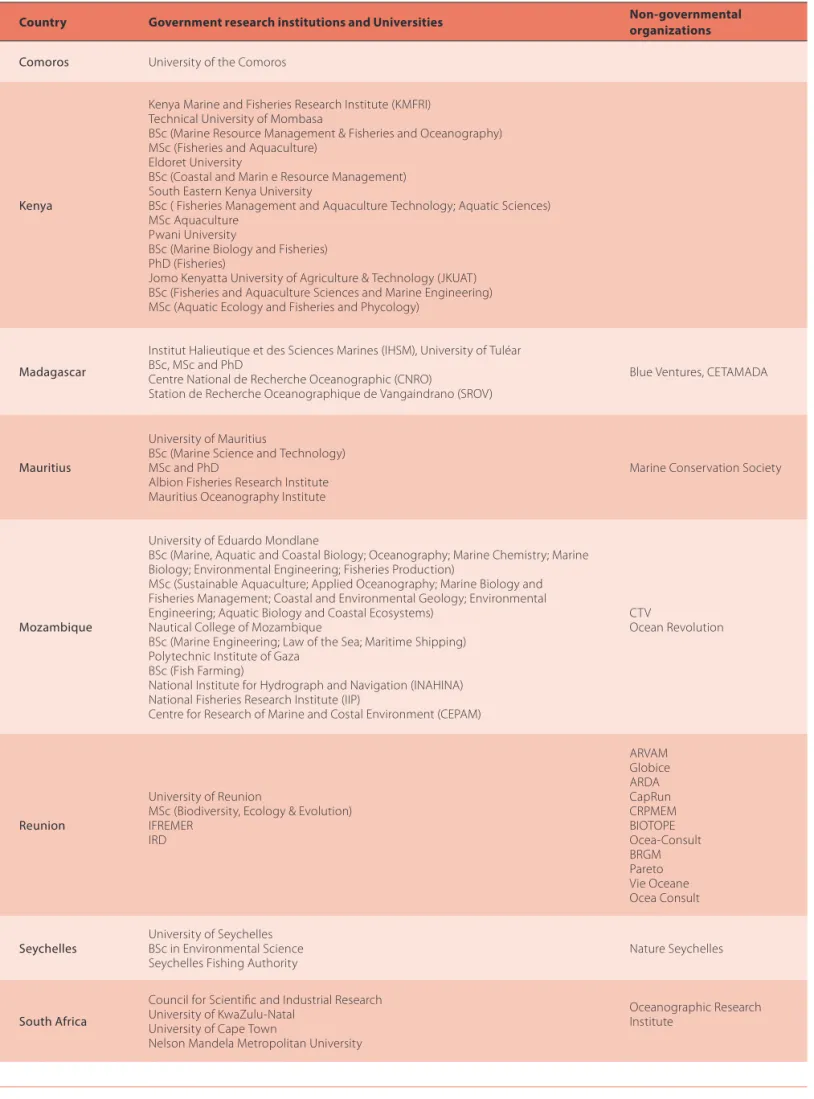
By the early 1960s, only five research institutions/sta-tions existed in the WIO region. These were: the Maritime and Fisheries School of Mogadishu; the East African Marine Fisheries Research Organization (EAMFRO), with substations in Mombasa and Zanzibar; the Institut de Recherche Scientifique (Madagascar); the Inhaca Island Marine Biological Station (Mozambique) and the Oceano-graphic Research Institute (ORI) (South Africa). Their main focus was to compile inventories of marine life and resources, particularly fisheries. The situation is different today, as the number of academic and research institutions that deal with different aspects of marine science has increased significantly, with all the WIO countries having more than one institution (Table 35.3).
Most of the research institutes in the region have basic field instruments, boats, diving gear, and specialized labo-ratories, with infrastructure and laboratories in most cases developed intermittently through externally funded pro-jects. Various capacity-building activities have been under-taken within and outside the region under the auspices of a range of donor organisations. Examples include support from the governments of Sweden (through Sida and SAREC), Norway (through NORAD), Japan (through JICA), and overseas development assistance (ODA) facili-ties offered by many other governments, as well as struc-tured partnerships between local and foreign universities (historic), and China and South Korea, more recently. Within these initiatives, short-courses and training work-shops (1-3 weeks), with some longer-term degree courses (1-4 years) has been a primary vehicle for improving local capacity.
The relationship between science and policy in the region has changed considerably over the years. Tradition-ally the pipeline mode existed in which scientists set the research agenda, conduct the research, and then transfer the results to potential users. This has evolved into co-pro-duction of knowledge under a more modern approach, whereby scientists and decision-makers define the research agenda and on a regular basis scientists provide feedback to the policy community. Whilst the full gains from this
transition have not yet been totally appraised or audited (accounted) for, the extent to which this new approach has improved awareness and engagement in marine resource management is reflected by the investments being made in this domain. This change has been possible due to the associated change occurring in the way in which research topics are selected. Historically, research topics were com-monly selected to meet academic criteria and most of the times reflected the interests of either students or supervi-sors with limited or no links to priority resource manage-ment questions. In the recent past, and through programmes such as Marine Science for Management (MASMA), through WIOMSA, inter and multi-disciplinary research has been promoted to address urgent societal and resource management issues.
Pre-independence
Prior to the 1960s most countries in the WIO region were under colonial rule. Accordingly, marine and coastal research in these countries was driven by the perspectives of remote decision-makers who relied on reports rather than direct local engagement. Importantly, however, a number of developments which took place during this period are the foundation for some of the institutional capacity currently existing in the region.
In addition to oceanic expeditions, this period was also characterised by the establishment of the first initiatives leading to the founding of marine biological stations. These were:
• The founding of the Zanzibar Marine Station in 1948
with the Mombasa Marine Station and the ensuing forma-tion of the East African Marine Fisheries Research Organi-zation (EAMFRO), in 1953. The Zanzibar Marine Station has become the Institute of Marine Science (IMS) of the University of Dar es Salaam and the Mombasa Marine Sta-tion is now the Kenya Marine Fisheries Research Institute (KMFRI).
• The Inhaca Island Marine Biological Station, estab -lished by the Portuguese administration in 1953 in con-junction with the University of the Witwatersrand, is now part of the Universidade Eduardo Mondlane (UEM).
• Between 1962 and1973, the French organization
‘Office de la Recherche Scientifique et Technique d’Outre-Mer’ (OSTROM) established and managed a marine sta-tion in Nosy-Be, Madagascar, later reopened in 1978 as the Centre National de Recherches Oceanographiques (CNRO).
• In 1961, the University of Marseille established ‘Sta -tion Marine de Tuléar’, attached to the Faculty of Science, University of Antananarivo. This station became L’Institut Halieutique et des Sciences Marines de l’Universite de Tuléar.
• The Oceanographic Research Institute (ORI) was
established as the research wing of the South African Asso-ciation for Marine Biological Research, a non-profit NGO affiliated to the University of Natal, in 1953/4.
Despite the existence of these stations during the IIOE, their limited human resources and technical capac-ity largely prevented them from participating in the expe-dition or benefitting directly from training and educational opportunities provided by the International Oceanographic Commission (IOC) of the United Nations Educational, Scientific and Cultural Organization (UNESCO).
In addition, there were no universities or colleges in the region offering courses in marine sciences during this period, such that apart from ORI, all of the scientists work-ing in these research stations were foreigners.
Post-independence to the 1980s
Most of the countries in the WIO region achieved inde-pendence between 1961 and 1976. As governments across the region strived to consolidate their economies and
infra-structure in the early 1960’s, marine science research was not given priority. For instance, in 1962, a decision was taken to close the EAMFRO as it was argued that marine science was unlikely to provide immediate economic ben-efit to East Africa. This decision was later rescinded (EAM-FRO 1965).
From the 1970s onwards, a change in thinking began to emerge, resulting in the implementation of a range of ini-tiatives that played a catalytic role in the development of marine science in the region, including capacity-building programmes. In April 1974, the International Centre for Marine Resources Development of the University of Rhode Island organized the International Conference on Marine Resource Development in East Africa in collabora-tion with the University of Dar es Salaam. This conference was specifically aimed at providing a discussion forum for scientific and developmental issues pertaining to marine science capabilities in the region. It also encompassed issues related to the marine resource potential and capacity needs of the East Africa region. Notably, the conference recommended the establishment of an institute of marine sciences at the University of Dar es Salaam (Morcos 2002). Three years later, with the collapse of the East African Community (EAC) and EAMFRO, the University of Dar es Salaam took over the facilities in Zanzibar and estab-lished the Institute of Marine Sciences in 1978.
Another important event that played a key role in the development of scientific research in the region was the creation of a regional body, the Cooperative Investigations in the North and Central Western Indian Ocean (IOC-INCWIO), by the IOC of UNESCO. Two preparatory meetings were held to prepare for the establishment of the IOCINCWIO, the first in Zanzibar in 1975, and the second in Nairobi the following year. Several oceanographic and atmospheric research programmes were undertaken in the region between these meetings and the first session of the IOCINCWIO was convened in 1982. The initial research programmes included the Special Observing Period Pro-gram of the Monsoon Experiment (MONEX) which took place in 1978 to 1979 and carried out oceanographic and atmospheric observations on the whole of the Indian Ocean north of 10°S. In the WIO region, the studies focused on phenomena such as the Equatorial Current, Somali Cur-rent and upwelling curCur-rents off Somalia (Morcos 2002).
This was significant in influencing the Third UN Confer-ence on the Law of the Sea, which started in 1973, and culminated with the adoption of the UN Convention for the Law of the Sea in 1982. The latter resulted in the establishment of the United Nations Environment Pro-gramme (UNEP) in 1973 and subsequently a Regional Seas Programme by UNEP that also helped to enhance technical support on marine research from UN organiza-tions and developed countries. Between 1970 and 1980, technical assistance and financial support for national and regional marine science projects came from UN organiza-tions such as the IOC, UNESCO, FAO, and World Mete-orological Organization (WMO). Developed countries, such as the US, Norway, UK, Canada and France provided technical assistance and opportunities for undergraduate and postgraduate training through bilateral programmes. The Norwegian Government provided the R/V Fridtjof Nansen to the Mozambique Government, and later to other governments, to conduct fisheries and oceanographic surveys in Mozambican waters in 1977-1978.
The 1970s were also marked by missions to the region by developed countries on their own initiative or in col-laboration with the UN organizations. These commonly aimed to investigate the priorities and needs for capacity-building in the marine sciences and included visits to Kenya, Madagascar, Somalia and Tanzania.
From the 1980s to the present
As a reflection of the importance of marine and coastal resources, the past 35 years has seen a remarkable growth in marine science research across countries in the WIO region. This is exhibited by both the enhancement of existing programs and the development of new initiatives. This has encompassed regional legal and institutional frameworks, academic and research institutions, regional research programmes, increased financial and technical support, and increased partnerships.
New and Existing Regional research and management Frameworks for marine and coastal environment
A number of collaborative activities between funding agencies, donors and regional governments were imple-mented between 1997 and 2001. Notably, the IOC-INCWIO, funded by IOC, Sida, the Belgian Government and UNEP implemented a number of activities. These included providing funds for regional cooperation in
scien-tific information exchange, ocean mapping, a regional nutrient and water quality monitoring network, the instal-lation and maintenance of sea level stations and strength-ening regional institutions such as WIOMSA. Activities on scientific information exchange were built on the founda-tion laid by the Belgium Government-supported project ‘Regional Cooperation in Scientific Information Exchange in the Western Indian Ocean region’ (RECOSCIX-WIO), which was established in 1989 and focused on the develop-ment of capacity and infrastructure for the collection, pro-cessing, archiving, analysis, interpretation and dissemination of data and information. The RECOSCIX-WIO project ended in 1997 and was replaced by the Ocean Data and Information Network for Africa (ODINAFRICA), which started in 1997 and is now in its fourth phase. The focus of the current phase of the project is on product development and dissemination and strengthening of the Pan African network of National Oceanographic Data Centre (NODCs). The project has produced directories, catalogues, atlases and portals.
With more of a focus on management and coastal pro-tected areas, the Convention for the Protection, Manage-ment and DevelopManage-ment of the Marine and Coastal Environment of the Eastern Africa Region (Nairobi Con-vention) was enacted in 1985 and came into force in 1996 through its East Africa Action Plan. This initiative supported the implementation of a number of projects focusing on management and protection of coastal areas (EAF/5), the control of marine pollution (EAF/6) and a regional database and atlas of coastal and marine resources (EAF/14). In con-trast to the historic situation in the 1970s and 1980s, the pro-jects in this program were implemented by research and academic institutions in the Convention countries rather than by external research organisations or institutions.
In 2004, the Nairobi Convention facilitated the estab-lishment of the Forum of Heads of Academic/Research Institutions (FARI). Core objectives of the Forum were to facilitate the sharing of information between these institu-tions and the Nairobi Convention, as well as amongst themselves; engage and facilitate opportunities for collabo-rative research that are relevant to the Nairobi Convention; and offer scientific and technical advice on priorities for management, assessments and information dissemination within the Nairobi Convention.
Project), which undertook a region-wide assessment of transboundary problems and issues affecting the marine environment in the WIO region between 2004 and 2010. The outputs of these assessments led to the formulation of a Transboundary Diagnostic Analysis (TDA), detailing key problems and causes of degradation of the coastal and marine environment in the WIO region, with special emphasis on land-based sources and activities (LBSA) and the Strategic Action Programme (SAP) to address the chal-lenges faced by governments in the region.
Both IOCINCWIO and the Nairobi Convention lever-aged national support by involving research and academic institutions in the region in the implementation of their activities and, thereby, contributed to strengthening national institutional and human capacity.
New and Existing Legal and Institutional Frameworks
Both the 1992 UN Conference on Environment and Development in Rio de Janeiro, and the 2002 World Sum-mit for Sustainable Development in Johannesburg, prompted many countries, including the WIO countries, to revise or develop national legal instruments, on environ-ment, by incorporating principles of sustainable develop-ment. For instance, Tanzania developed the following environmental-related policies and acts after these major conferences: the Marine Parks and Reserves Act (1995), the National Environment Policy (1997), the National Fisheries Sector Policy (1997) and the National Integrated Coastal Management Strategy (2003). Similar action was taken by the other WIO countries.
Research and academic institutions were involved in the revision and development of new legal instruments, and further provided technical inputs to the processes and benefitted from the policy-making community thereby strengthening the relationship between science and policy making. Research and academic institutions have contrib-uted to the implementation of some of the aspects of the legal instruments. In Tanzania, research and academic institutions were actively involved in the drafting of the Marine Parks and Reserves Act and the National Inte-grated Coastal Management Strategy and their implemen-tation. As an example of the latter, the Institute of Marine Sciences played an important role in the establishment of the Mafia Island Marine Park and Mnazi Bay Marine Park between 1995-2000 as part of the implementation of the Marine Parks and Reserves Act.
New and Existing Academic and Research Institutions
The increase in human capacity for marine science research, as well as increasing recognition of the impor-tance of the marine ecosystem goods and services by gov-ernments has led to the establishment of new academic and research institutions (Table 35.3). More universities in the region are now offering postgraduate degree pro-grammes in areas of marine and coastal science and associ-ated resource management disciplines. For instance, in Kenya, the number of universities that teach courses with a marine and coastal focus has increased from one before 1980 (ie University of Nairobi) to more than five. In the 1980s, the University of Dar es Salaam offered courses on marine systems in the Department of the Zoology and Marine Biology but this was changed first to the Faculty of Aquatic Sciences and Technology and later to the Depart-ment of Aquatic Sciences and Fisheries, which currently offers two degrees programmes at the undergraduate level. Both the Department of Aquatic Sciences and Fisheries and the Institute of Marine Sciences now offer Masters and PhD degree programmes. In Mauritius, both the Albion Fisheries Research Institute and the Mauritius Oceanogra-phy Institute were established after 1980.
At present, there is at least one University offering degree programmes on marine related field in all the coun-tries in the region except Somalia. Additionally, a number of non-governmental organizations have increased their support to research by publishing seminal papers to com-plement the traditional academic and research institutions. The Wildlife Conservation Society, through its Kenya and Madagascar offices, and CORDIO have been the most active.
Development of Bilateral and Regional Research Programmes
Since the 1980s the region has benefited from a number of bilateral and regional research programmes which have contributed significantly to strengthening of human and institutional capacity in regional academic and research institutions. Perhaps just as importantly, these programmes have also underpinned the development of strong partner-ships between regional institutions and their counterparts in developed countries. Examples of such programmes include the following:
research on the sustainable use of coastal and marine resources, and environmental management of the coastal zone. This Programme supported the two Ministerial Con-ferences on Integrated Coastal Zone Management (ICZM) in Arusha, Tanzania (1993), and the Seychelles (1996). These events set the stage for coastal management initia-tives at local and national levels in the region and success-fully initiated dialogue between the scientific community and high-level policy-makers. The programme made mod-est invmod-estments in capacity building in the social sciences, which resulted in notable achievements in this arena. This Programme also facilitated the establishment of WIOMSA and CORDIO.
• The Sida/SAREC Marine Science Bilateral Pro-gramme for Tanzania and Mozambique. The Bilateral Program for Mozambique was initiated in 1985 while the Bilateral Program for Tanzania started in 1990. Both grammes are still ongoing. Their combined impact has pro-duced significant advances towards the goal of a diversified resident capacity in the marine sciences that will contrib-ute towards effective management of coastal ecosystems. This has, in turn, prompted greater local investments in the natural sciences to increase this diversity and the wider local capability in coastal resource management disciplines. The programme’s most notable achievement has been the transformation of the Institute of Marine Sciences (IMS) of the University of Dar es Salaam into an internationally rec-ognized institution. IMS is attracting funds from a diversity of sources, hosts visiting scholars from many nations, and is making significant contributions to public policy and resource management in Zanzibar, Tanzania and the region.
• The Kenya – Belgium Programme in Marine Sci-ences. This programme started in 1985 and involved the Free University of Brussels (VUB) and the KMFRI, result-ing in the trainresult-ing of a number of Kenyan students to Mas-ters and PhD level. The programme also supported a number of studies in Kenya undertaken by Kenyan and Belgium scientists. It also constructed and equipped labo-ratories at KMFRI.
• GEF-funded regional programmes. The region
implemented three regional GEF-funded projects during the ten years from 2004 to 2014. These were ‘Addressing Land-Based Activities in the Western Indian Ocean’ (WIO-LaB), ‘the Southwest Indian Ocean Fisheries Project’ (SWIOFP) and the Agulhas and Somali Current Large Marine Ecosystems Project’ (ASCLME). Scientists and experts from regional universities and research institutions,
as well as government agencies, were closely involved in project activities including through participation in regional and national task forces and working groups, preparation of the TDA and SAP and in advisory roles to the demonstra-tion projects. The project collaborated closely with WIOMSA and facilitated creation of the Forum of Heads of Academic and Research Institutions (FARI) in the region as a mechanism to coordinate research activities and assure the quality of scientific work in the region. The ASCLME and SWIOFP Projects, together with partners in the EAF Nansen Project, NOAA, NIOZ, IUCN and the IRD, undertook or co-funded over 50 offshore expeditions in the WIO region (Box 35.1).
• EU-funded projects. From the mid-1990s up to
2010, the European Union supported a number of research programmes in the region through its framework pro-gramme: Specific Measures in Support of International Co-operation (INCO-DEV). These included the ‘Transboundary networks of marine protected areas for integrated conservation and sustainable development: bio-physical, socio-economic and governance assessment in East Africa (TRANSMAP)’ and the ‘Peri-urban mangrove forests as filters and potential phytoremediators of domes-tic sewage in East Africa (PUMPSEA)’. A total of 24 research and management authorities in regional partici-pating countries and European institutions were involved in these projects. They supported a number of Masters and PhD candidates, undergraduate students, provided equip-ment, and produced a number of high quality publications and scientifically based advisory documents for application in policy development and management.
• Marine Science for Management (MASMA). In
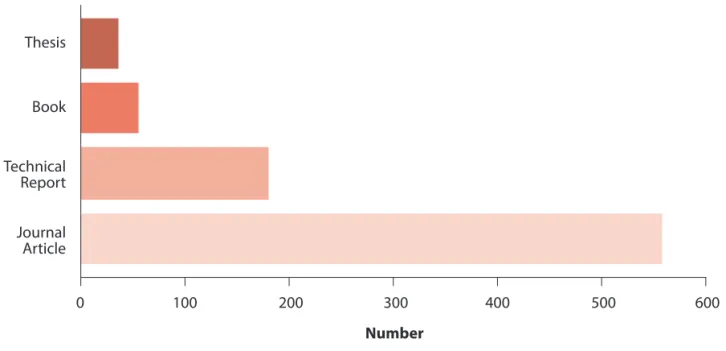
Journal of Marine Science in 2002, produced 16 books under its Book Series, and supported other books pub-lished by prominent publishing firms such the Oxford Uni-versity Press and UniUni-versity of Cape Town Press. Between 2000 and 2014, WIOMSA supported at least 210 Marine Research Grant (MARG-I) projects and 46 large regional research projects, which were implemented in all the coun-tries in the region except Somalia. Over 600 publications have been produced through these grants (Figure 35.1).
Increased financial and technical support
In most of the countries in the region budgetary allocations for research and capacity-building by governments are generally insufficient and highly variable. Government funds are almost exclusively sed to pay for salaries alone. This funding limitations means that most of the research and capacity-building initiatives in the region have been, or are funded by bilateral and multilateral funding agen-cies, international NGOs and foundations.
As indicated previously, marine sciences and capacity-building initiatives in the WIO region have historically received significant levels of support from these external sources. This support has been directed towards research projects, the provision of scholarships for postgraduate training, organisation of workshops and courses, and, in some cases, the provision of physical infrastructure (includ-ing laboratories, libraries and lecture rooms) and supplies. To illustrate the increasing levels of support received in the WIO through WIOMSA, the Government of Sweden
financial support to WIOMSA from its establishment in 1995 to 2011 is used as an example (Figure 35.2).
Increased Partnerships
Different types of partnerships have been developed through bilateral and regional programmes, including south-north and south-south partnerships. These partner-ships have resulted in enhanced collaboration in research and capacity-building amongst experts, both within the region and between the region and outside. Successes of these partnerships are reflected in the increased number of joint proposals developed and implemented, an exchange of students and staff, and the joint production of publica-tions.
The Sida/SAREC Regional Marine Science gramme, Sida/SAREC Marine Science Bilateral Pro-gramme for Tanzania and Mozambique, the Kenya – Belgium Programme in Marine Sciences, EU-funded programmes under the Framework programme and MASMA, have all contributed to strengthen the collaboration between research and academic institutions in the WIO and those in Europe (such as the Stockholm University in Sweden, Uni-versity of Lisbon, Free UniUni-versity of Brussels), Australia (the University of Queensland and James Cook Univer-sity) and USA (University of Rhode Island).
Partnerships between and among institutions in the region have also improved over the last decade. This improvement is also largely attributable to the bilateral and regional programmes that have catalysed exchange,
inter-Figure 35.1. Publications produced with support of WIOMSA between 2000 and 2014. Source: data from Google Scholar.
Thesis
Book
Technical Report
Journal Article
0 100 200 300 400 500 600
action and dialogue between organisations such that new relationships have been supported to become strong long-standing partnerships (eg KMFRI-IMS, ORI-UEM). MASMA has also played a key role in strengthening south-south partnerships by having this prerequisite as one of its main requirements to secure funding. Partnerships between academic and research institutions in Kenya and Tanzania, Tanzania and Mozambique, Mozambique and South Africa and South Africa with Mauritius and Reunion have been established through MASMA and EU-funded projects, a number of which are on-going.
WHO IS CONDUCTING RESEARCH?
In the WIO, government research institutions are impor-tant actors in the production of knowledge relevant to the coastal and marine environment. This is particularly the case in fisheries, but some countries also have research institutions concerned with a variety of coastal and marine environment domains. In some government-affiliated research institutions, and in particular kinds of research, there is a direct linkage between the production of knowl-edge and its application. Management authorities in the region often meet their knowledge needs by commission-ing studies to government research institutions,
consult-ants and, sometimes, universities (Figure 35.3). In this case, there is also a direct link between research and its application. However, there are also a number of institu-tions producing unsolicited research that could contribute to coastal and marine management but there are no for-mal mechanisms that could be used to channel them through.
RESEARCH UPTAKE
The use of research outputs by decision- and policy-mak-ers cannot be represented as a linear relationship between supply and demand. How and why science is produced and balanced between national and local needs is influenced by, amongst other things, the availability of funds which may or may not be linked to national and sub-national (pro-vincial, district, local) priorities. Given the significant per-centage of the research budget that comes into the WIO from external sources, and not national budgets, research agendas may sometimes not be well harmonised with national or sub-national needs. In the WIO, lack of clearly expressed national research priorities for marine and coastal management is an important factor that limits the potential to improve this alignment need and, accordingly, the appli-cability of research for management, decision and policy Figure 35.2. Government of Sweden support to WIOMSA from 1995 to 2015.
90
80
70
60
50
40
30
20
10
0
Pre-M ASM
A (1995-1999) I (2000-2003) II (2004-2007) III (2007-2012) IV (2012- )
Phase
S
w
edish F
unding in SEK (M
Table 35.3. Research and academic institutions in the WIO region (those with degree programmes in marine sciences are bulleted).
Government research institutes
Consultancy firms NGOs
Universities
Unsolicited Management Solicited
• Research papers • Research reports • Conferences • Popular articles • Policy briefs
• Commissioned studies • Reports
• Expert opinion • Participation in technical bodies
purposes.
The mechanisms used by research institutions to cou-ple science to management, and barriers to achieve this, are contextual and vary between countries. Research institu-tions in the region are generally committed to producing research that contributes to national development needs, including those related to the sustainable management of the coastal and marine environment. Similarly, scientists in both government-affiliated and academic institutions rec-ognise the importance of undertaking applied research and transmitting research results to potential users. Despite wide acceptance of the need to link science and manage-ment, the mechanisms to identify research priorities in the coastal and marine environment and to communicate research results to managers and policy-makers are often still poorly developed.
It is also clear that simply transmitting scientific results to decision-makers, while important, is not sufficient to effectively enable their uptake by managers. The use of science by decision-makers in the region, and elsewhere in the world, is influenced by many procedural, technical, and
political factors. The role of individual and institutional values is also important. In this context, there continues to be a need for the development of new and innovative approaches to better integrating research agendas with management planning and decision-making processes such that both the development of research and the prod-ucts it delivers are better integrated into an overall approach to natural resource management.
Figure 35.3. Reported flow of communication between institutions producing science and agencies that use science related to research, development and management of the coastal and marine domain of the Western Indian Ocean states.
Country Government research institutions and Universities Non-governmental organizations
Comoros University of the Comoros
Kenya
Kenya Marine and Fisheries Research Institute (KMFRI) Technical University of Mombasa
BSc (Marine Resource Management & Fisheries and Oceanography) MSc (Fisheries and Aquaculture)
Eldoret University
BSc (Coastal and Marin e Resource Management) South Eastern Kenya University
BSc ( Fisheries Management and Aquaculture Technology; Aquatic Sciences) MSc Aquaculture
Pwani University
BSc (Marine Biology and Fisheries) PhD (Fisheries)
Jomo Kenyatta University of Agriculture & Technology (JKUAT) BSc (Fisheries and Aquaculture Sciences and Marine Engineering) MSc (Aquatic Ecology and Fisheries and Phycology)
Madagascar
Institut Halieutique et des Sciences Marines (IHSM), University of Tuléar BSc, MSc and PhD
Centre National de Recherche Oceanographic (CNRO)
Station de Recherche Oceanographique de Vangaindrano (SROV)
Blue Ventures, CETAMADA
Mauritius
University of Mauritius
BSc (Marine Science and Technology) MSc and PhD
Albion Fisheries Research Institute Mauritius Oceanography Institute
Marine Conservation Society
Mozambique
University of Eduardo Mondlane
BSc (Marine, Aquatic and Coastal Biology; Oceanography; Marine Chemistry; Marine Biology; Environmental Engineering; Fisheries Production)
MSc (Sustainable Aquaculture; Applied Oceanography; Marine Biology and
Fisheries Management; Coastal and Environmental Geology; Environmental
Engineering; Aquatic Biology and Coastal Ecosystems) Nautical College of Mozambique
BSc (Marine Engineering; Law of the Sea; Maritime Shipping)
Polytechnic Institute of Gaza
BSc (Fish Farming)
National Institute for Hydrograph and Navigation (INAHINA) National Fisheries Research Institute (IIP)
Centre for Research of Marine and Costal Environment (CEPAM)
CTV
Ocean Revolution
Reunion
University of Reunion
MSc (Biodiversity, Ecology & Evolution) IFREMER
IRD
ARVAM
Globice
ARDA CapRun CRPMEM BIOTOPE Ocea-Consult
BRGM
Pareto Vie Oceane Ocea Consult
Seychelles
University of Seychelles BSc in Environmental Science Seychelles Fishing Authority
Nature Seychelles
South Africa
Council for Scientific and Industrial Research University of KwaZulu-Natal
University of Cape Town
Nelson Mandela Metropolitan University
Country Government research institutions and Universities Non-governmental organizations
Tanzania
University of Dar es Salaam
Department of Aquatic Sciences and Fisheries (Aquatic Environmental Sciences and Conservation and Fisheries and Aquaculture and MSc in Fisheries and Aquacul-ture and PhD )
Institute of Marine Sciences (MSc in Marine Science and PhD) Tanzania Fisheries Research Institute (TAFIRI)
Sea Sense
Regional NGOs
Wildlife Conservation Society CORDIO
WWF CI IUCN WIOMSA
involved in the fishing of grouper spawning aggregations) to agree to stop the practise after being presented with the project’s results (Robinson and others, 2007).
Finally, projects that involve high degrees of collabora-tion between scientists, managers and resource users at all stages of the work are more likely to result in outputs that have a probability of being used by managers, decision- and policy-makers. Through another MASMA-funded pro-ject, “Developing a model for strategic adaptive management of MPAs in the Western Indian Ocean”, project members work-ing with the staff and stakeholders of the Mombasa Marine Park and using their research results as the basis assisted the Park to set new management objectives with measur-able targets. They have also used their research results to evaluate progress and determine necessary management actions, and evaluated effectiveness of actions (O’Leary and Tuda 2015).
The main barriers between scientific and policy-mak-ing/management communities in the region include:
• A paucity of relevant and timely research, coupled
with a willingness and concomitant capacity of decision-makers to use it are important factors. An inadequate knowledge-base and the lack of an evidence-based man-agement culture, technical capacity and funding are also important barriers ensuing from this.
• Several countries lack mechanisms and institutions
to promote science-based management and decision-mak-ing. Such mechanisms and institutions are developing, often as part of the growing implementation of ICZM, or they may be project-based. Examples include working groups, forums and roundtables, where decision-makers
and key stakeholders are engaged collectively. However, many of these mechanisms or institutions are short-lived if not supported by long-term commitment by stakeholders, or government institutions, and backed up by sufficient resources.
• Overall levels of funding for research and knowledge
generation remain inadequate. This may be related to a continued lack of recognition of the socio-economic sig-nificance of marine and coastal issues in national systems of science and innovation, including research councils or their equivalent.
• Research in the countries in the WIO region for long
periods has been dependent on donor funding. Donor funding, while valuable, does not promote an overall national research portfolio geared towards addressing national research priorities. Accordingly, whilst providing critical support and often strong catalytic inputs, donor-funded research contributions often do not fill research gaps since they are driven by donor priorities rather than specific national goals and needs.
• Local management authorities face many capacity
challenges, which result from inadequate funding, a lack of suitably skilled staff, management tools and technical knowledge. The use of science and its products are particu-larly weak under these conditions.
• Many researchers and scientists do not understand
development of policy. Scientist often fail to appreciate the fact that research products, no matter how well-devel-oped and tested, can often not be incorporated directly into decision-making without the inclusion of political, eco-nomic or social realities. Similarly, the outputs provided by scientists are often in a form that is not readily assimilated by decision-makers.
• Conversely, policy-makers expect science to provide
definite answers and a full cost-benefit analysis of the implications of decisions. They also often assume that sci-entists fully understand and describe complex problems. These may be outdated ways of thinking about science and policy but they remain common.
• A greater emphasis on co-design of trans-disciplinary
projects by stakeholder including scientists, managers and civil society, and the growing importance of the contribu-tion of all stakeholders to the scientific process (co-produc-tion of knowledge) is not fully realised or practised in the region.
RESEARCH PRIORITIES AND CAPACITY NEEDS
The Africa Progress Panel recently proclaimed that “the time has come to unleash Africa’s green and blue revolutions”, and, also that “Africa’s farmers and fishers are equal to the challenge, but they need the opportunity. They need their govern-ments to demonstrate more ambition on their behalf. African governments must now scale up the appropriate infrastructure and ensure that financial systems are accessible for all” (APP 2014). This State of the Coast Report has argued through-out that access to, and the use of defensible scientific data, information and knowledge is integral to manage-ment options, decisions, and policies, that the region requires to attain sustainability, as defined in the Scenario chapter (no. 32). Research funding in the region is scarce and should be optimised to achieve the most effective and longest-term outcomes possible. Regional coordina-tion of research agendas could manage the necessary overlap of research activities in trans-boundary areas. Common priorities and coordinated research efforts could also attract funding from outside the region, especially where synergistic partnerships can be developed and co-investment can be leveraged. The sections below briefly consider some current global and regional research priori-ties. In most cases, these are embraced in reports or pro-grammes that identify priority themes which are then translated into action.
Global and regional research priorities
On a global scale, the Global Biodiversity Outlook (CBD 2014) reported on progress in meeting the Aichi Biodiver-sity Targets; achieving the 2050 Vision on ‘Living in Har-mony with Nature’; and on the importance of biodiversity in meeting broader goals for sustainable human develop-ment during this century. The Outlook identified a num-ber of strategic goals aimed to achieve the objectives stated above. Most of the goals can be further refined for the global coastal and marine environment. The strategic goals were to:
• Address the underlying causes of biodiversity loss by
mainstreaming biodiversity issues in governance processes; Reduce the direct pressures on biodiversity and promote sustainable use;
• Improve the protection of biodiversity by safeguard -ing ecosystems, species and genetic diversity;
• Enhance the benefits of biodiversity and ecosystem
services to all; and
• Enhance implementation of biodiversity protection
through participatory planning, knowledge management and capacity-building.
Similarly, the WWF published a Living Planet Report (WWF International 2014) which identified priorities to achieve sustainable use of the planet’s resources. These priorities were:
• Equitable Resource Governance - Share the availa -ble resources, make fair and ecologically informed choices, measure success beyond GDP.
• Redirect Financial Flows - Value nature, account for
environmental and social costs, support and reward conser-vation, sustainable resource management and innovation.
• Consume More Wisely - Through low-footprint life -styles, sustainable energy use and healthier food consump-tion patterns.
• Produce Better - Reduce inputs and waste, manage
resources sustainably, scale-up renewable energy produc-tion.
• Preserve Natural Capital - Restore damaged ecosys -tems, halt the loss of priority habitats, and significantly expand protected areas.
har-monise, mobilise and communicate the growing knowl-edge base on vulnerability, impacts and adaptation (UNEP 2013). A PROVIA report (UNEP 2013) emphasises the understanding of climate change vulnerability through mapping and measurement; development and strengthen-ing of indicator and monitorstrengthen-ing systems; an understandstrengthen-ing of the risks of extreme climate events, non-linear impacts and tipping points. It also promotes:
• Advancing vulnerability reduction and adaptation
solutions;
• Developing more inclusive cost estimates and prior -itization criteria; and,
• Enhancing communication and stakeholder/public
participation.
PROVIA has also identified key systems that need attention namely: food, water, ecosystems, energy, infra-structure and the built environment. Some of the emerg-ing topics identified by the report include impacts of geo-engineering; legal principles and the role of law; food-water-energy-security; participatory processes for climate change mitigation and adaptation scenarios; decision the-ory; risk perception, climate knowledge and behaviour; governance, collaborative frameworks and networks; and long-term planning and design.
Coastal and marine research priorities
In recognition of threats to global sustainability of human activities in the ocean and coastal environment, IOC/ UNESCO, IMO, FAO, UNDP (2011) has identified the following problems as being the priority concerns:
• Unsustainable fishing;
• Climate change and ocean acidification; • Pollution and waste; and
• Loss of habitats and biodiversity, in some cases
because of invasive species.
Many international programmes have either been developed on climate change and variability, social needs and ecosystems, or have recently changed emphasis to focus on these issues. Examples include the International Geosphere-Biosphere Programme (IGBP), Intergovern-mental Platform for Biodiversity and Ecosystem Services (IPBES), Scientific Committee on Oceanic Research (SCOR), Global Ocean Observing System (GOOS) together with its regional alliances, DIVERSITAS, the International Human Dimensions Programme (IHDP), the World Climate Research Programme (WCRP), Science Partnership for the Assessment of Complex Earth System
Processes (SPACES), Ecosystem Services and Poverty Alleviation (ESPA), Global Ocean Ecosystem Dynamics (GLOBEC) and the Global Change, Biodiversity, Ecosys-tems and Society in Africa (GCBESA) programme.
A recent WWF International report on the develop-ment of the Ocean Economy (Hoegh-Guldberg and others, 2015) is of direct interest to the coastal and marine environ-ment. In this, it is contended that assets that rely on a healthy ocean environment generate more than two thirds of the annual base economic value of the ocean. As a result of a decline in the state of these assets, the associated eco-nomic activities are faltering and not delivering to their full potential. There is, however, a growing need for food and resources from the ocean. The report identified eight actions to secure our ocean assets and restore the ocean economy:
• Ensure that ocean recovery features strongly in the
UN Post-2015 Agenda, including the Sustainable Develop-ment Goals;
• Take global action to avoid dangerous climate change
and further damage to the ocean;
• Conserve and effectively manage 10 per cent of rep -resentative coastal and marine areas by 2020, increasing coverage to 30 per cent by 2030;
• Rebuild fish stocks to ecologically sustainable har -vest levels;
• Drive new global cooperation and investment in the
ocean;
• Reinvent public/private partnerships;
• Build transparent accounting of the value of ocean
assets to improve decision-making; and
• Share knowledge more effectively and drive institu -tional collaboration.
Finally, the UNEP Coastal and Marine Strategy (2011) provided some clear directives on coastal and marine actions (UNEP 2011) relevant to the need for scientific products in support of management, decision- and policy-making:
• Land-Ocean Connections: to integrate the manage -ment of coastal watersheds, the coastal area (including cit-ies) and the marine environment to optimise the ecosystem services and resilience of marine and coastal systems. Meeting this objective will address the issue of degraded water quality in coastal water due to land-based activities.
• Ecosystems for Human Well-being: to identify, assess
human well-being. The need for a better understanding of ecosystem services and their value will be addressed to meet this objective.
• Reconciling Use and Conservation: to ensure that
appropriate governance frameworks, management tools, capacity and options are available for regions, countries, communities and the private sector, to effectively engage in the sustainable management of marine and coastal eco-systems, including reconciling competing uses.
• Vulnerable People and Places: to strengthen the eco -logical, economic and social security of vulnerable commu-nities and places, including SIDS, to adapt and respond to natural disasters and climate change, by enhancing the resilience of marine and coastal ecosystems and social cap-ital, and improving access and benefit sharing. Meeting this objective will help to address issues specific to SIDS, coral reefs, seamounts and other sensitive marine ecosystems.
DEVELOPMENT OF CAPACITY FOR RESEARCH
The National Research Council (NRC) of the National Academy of Science (NAS) (NRC-NAS 2008) describes capacity building as “programs designed to strengthen the knowledge, abilities, relationships and values that enable organi-zations, groups and individuals to reach their goals for sustain-able use of ocean and coastal resources. It includes strengthening the institutions, processes, systems and rules that influence collec-tive and individual behaviour and performance in all related endeavours. Capacity building also enhances people’s ability to make informed choices and fosters their willingness to play new developmental roles and adapt to new challenge.” This holistic definition of the capacity building encompasses much more than training but also includes different levels (indi-vidual, institutional, enabling environment) and all phases of the knowledge generation and knowledge transla-tion cycle (from setting the research agenda and research design to research use and communication). This is an important distinction as it reflects the reality of variable capacities across countries and regions, and also recognises that there are strong needs at all phases from research data collection through to the assimilation and mainstreaming of the knowledge gained into decision-making.
Though most of the countries in the region achieved independence between the early 1960s and mid-1970s, it was not until the 1970 that a noticeable increase in the number of marine scientists occurred. During this period the first marine scientists were completing their
postgradu-ate studies. They were initially few in number and mainly fisheries biologists by specialisation. During the 1980s and 2000s, more marine scientists from a spectrum of disci-plines (both in natural and social science) were trained.
Capacity-building needs in resource management authorities
Different types of management authorities, from national ministries responsible for policy development to local gov-ernments and protected area management structures, are responsible for policy implementation and day-to-day management of coastal and marine resource use. These are vastly different in character and, as a result, have different capacity-building requirements.
Institutions responsible for development of policies, programmes and strategies at the national level include both politically-appointed officials as well as technical staff. The extent to which politically-appointed officials have adequate technical competence for marine and coastal management varies. However, these institutions also have technical personnel that are often highly qualified, in many cases in areas directly relevant to coastal and marine man-agement, and with a good understanding of science. On the whole, at the national level in some countries, there is often requisite capacity (if not always the political will) to source and apply science to policies, legislation, plans and strate-gies.
At this level, and in view of the findings presented in previous sections of this chapter, some relevant capacity-building interventions are needed, aimed at management authorities. These include:
• Reinforcing the capacity of decision-makers to
formulate policy and associated research needs through forward-looking methodologies such as envision-ing future scenarios. These involve considerenvision-ing how emerging trends and developments might affect policy and practice. Policy-makers need to understand current and future drivers of change and plan accordingly, identifying and prioritizing research issues that will address emerging challenges.
• Enhancing mutual understanding of how
Capacity-building strategies to overcome barriers to effective integration of science
Overcoming the barriers to effective integration of science into decision-making and management processes cannot be achieved through capacity building alone. There are, however, a number of additional strategies that would strengthen the link between science and marine and coastal management. These include:
• Support for knowledge brokerage in boundary organ -isations. These could identify, review and synthesise all available scientific information relevant for a particular policy or management issue and effectively interact with decision-makers.
• Compile project-level lessons-learned that link sci -ence and policy and management, highlighting successes.
• Support projects that combine research and demon -stration or implementation activities. There are successful cases in the WIO that will yield useful lessons such as the Rodrigues octopus fisheries project (Yvergniaux, undated) and the MASMA-funded project “Developing a model for strategic adaptive management of MPAs in the Western Indian Ocean” (O’Leary and Tuda 2015).
Regional capacity-building initiatives
Capacity-building initiatives have taken different forms in the region, including capacity building of individuals, insti-tutions and society in general. Such efforts have aimed at improving their understanding of processes in, and the value of, coastal and marine environments. Capacity-build-ing initiatives have also targeted institutions to improve their decision-making processes and build their technical skills to better fulfil their mandates. Some capacity-build-ing initiatives have also targeted civil society with the aim of building their capacity to empower people to under-stand, engage in, and resolve issues associated with the better use and management of resources to maximize their opportunities for livelihood improvement.
In this context, several mechanisms have been used to deliver these different forms of capacity-building, includ-ing:
• Technical short-term courses. These types of
courses have covered different types of specialised techni-cal subjects that often represent enabling knowledge or skill sets such as nutrient analysis, coral reef monitoring, algal physiology, coastal erosion and leadership. The Nai-robi Convention, in collaboration with the IOC-UNESCO and WIOMSA, organized a number of leadership courses
targeting senior scientists and heads of research and aca-demic institutions. Such short-term courses have been instrumental in laying the foundation for collaboration between national and regional institutions. They have pro-moted of the use of the same or comparable techniques in fieldwork and laboratory studies, as well as raised aware-ness and information dissemination and promoted leader-ship for marine related research and management at the highest levels of governance.
• Writing workshops. WIOMSA, through its MASMA
Programme, has been providing grants for writing work-shops. Specifically, these workshops seek to assist partici-pants to attain a level of scientific and grant writing that can compete on a global scale for grants and publications. In these workshops, participants are asked to bring their own data with the aim of synthesizing information from multi-disciplinary projects as well as information from relevant projects supported by other partners, leading to publica-tions in peer-reviewed journals or books or policy briefs. Writing workshops have become a common feature of most of the MASMA-funded projects. They have provided opportunities to brainstorm on key research results, as well as for capacity building amongst emerging scientists in terms of approaches to data analysis, information synthesis and access, and the best methods for the dissemination of information and results.
• Practitioner Short Courses. These include
broad-based training on marine protected area or natural resource management and ICZM that combine learning in a work-shop setting with field visits and opportunities for the exchange of experience. Courses of this kind aim to address the need to rapidly develop a general understanding of emerging issues where there is limited capacity. Introduc-tion level and general courses are then superseded by more specialised technical courses and /or integration into voca-tional and masters training courses.
• Multi-Stage Courses. Multi-stage courses combine
on-the-job-learning and assignments with one or more intensive training sessions, often involving exposure to projects or other real-life management situations that pro-vide the experience participants need to build their own capabilities. Participants then complete assignments and projects based on their workplace (or volunteer) experi-ence (Coley and others, 2002).
• Certification of professionals. WIOMSA
BOX 35.1. THE AGULHAS AND SOMALI CURRENT LARGE MARINE ECOSySTEM PROJECT
(ASCLME) – ACHIEVEMENTS IN RESEARCH AND CAPACITy BUILDING by David Vousden
This Project ran from 2007 until 2014 and supported nine
coun-tries in the western Indian Ocean region to undertake an
envi-ronmental baseline assessment of the Agulhas and Somali
Current Large Marine Ecosystems, to fill the information gaps
needed to develop a Transboundary Diagnostic Analysis (TDA)
and to support improved management decision-making
through development and adoption of a Strategic Action
Pro-gramme (SAP).
The main achievements from the Project included the
develop-ment of National MEDAs (Marine Ecosystem Diagnostic
Analy-ses) as ‘state of the marine environment’ reports for each
country; integration of the MEDAs into a single, regional
Trans-boundary Diagnostic Analysis; a draft Strategic Action
Pro-gramme for Management of the LMEs; and a Western Indian
Ocean Sustainable Ecosystem Alliance of partners that agreed to
support scientific research, monitoring, capacity building and
training.
More specifically in the context of actual scientific research as
well as capacity building and training, the project has listed the
following deliveries and successes in collaboration with its many
partners:
Scientific Studies and Research
• 50 individual cruises ‘legs’ around the western Indian Ocean
• Deployment of permanent ocean-atmosphere monitoring mooring systems
• Use of satellite imagery to track productivity hotspots and identify upwelling incidents
• Study of ocean kinetics, particularly in relation to eddies associated with the Mozambique channel
• Substantial data collected on primary and secondary pro-ductivity as well as fish biodiversity and genetics (including
comprehensive fish collections)
• Fisheries data reconstructions to demonstrate significance of small-scale fisheries
• Studies on marine-based pollutants and extent of land-based pollution impacts offshore
• Mapping of invasive species distributions
• Mapping of critical habitats and vulnerable/endangered species along with proposed management measures
• National and regional policy and governance baseline assessments completed with recommendations for
strengthen-ing and harmonisstrengthen-ing across the region
• Regional ‘Cost-Benefit of the Ecosystem Approach’ assess-ment completed
Individual national demonstration on community engagement
and evolution of local economic development plans)
Capacity Building and Training
• Nearshore and coastal monitoring programmes developed