RESEARCH ARTICLE
Does the 6-minute walk test predicts functional capacity
in a sample of elderly women?: A pilot-study.
Andreia Garcia1; Ana Marta Santos1; Elisabete Carolino1; Beatriz Fernandes1; Maria Teresa Tomás1
1
Escola Superior de Tecnologia da Saúde de Lisboa (ESTeSL)
Av. D. João II, Lote 4.69.01, 1990 - 096 Lisboa, Portugal
Abstract
Introduction: Functional capacity is the capacity to conduct daily activities in an independent
way. It can be estimated with the 6-minutes’ walk test (6MWT) and other validated functional tests.
Objectives: Verify associations between functional capacity measured with two different
instruments (6MWT and Composite Physical Function (CPF) scale) and levels of physical activity and between those and characterization variables.
Methods: This sample consisted of 30 apparently healthy elderly women from Loures
municipality. Essentially they should be independent and community-dwelling. Characterization data were collected, containing characterization of physical activity levels and anthropometric data. Functional capacity was assessed with CPF scale and distance walked by the 6MWT. Results were analysed using a SPSS v21.0 through correlation tests.
Results: The walked distance in 6MWT was positively associated with height (r = 0.406; p =
0.026), physical activity level (r = 0.594; p = 0.001) and functional capacity (r = 0.682; p = 0.000). For each point more obtained in CPF, the distance walked increases on average by 7.5 meters. Relatively to sedentary participants, being insufficiently active increases, on average, the distance walked in 85.8 meters; and being active increases, on average, the distance walked in 108.8 meters. No other associations were observed in our sample.
Conclusion: Based on the collected sample, walked distance in 6MWT has a high correlation
with results in CPF scale, so this test can be used to predict functional capacity. More attention should be taken to promote strategies to increase walking in older adults.
Keywords: 6-minute walk test; Composite Physical Function scale; elderly people; functional capacity; walked distance.
Introduction
According to 2011 Census, Portugal presents a quite marked aging, with elderly population (persons aged 65 years and over) counting of 19.2 % versus 14.9 % of younger population (persons under 14 years old). (Direcção Geral da Saúde, 2004)
Citation: Garcia, A., Santos, A. M., Carolino, E., Fernandes, B. & Tomás, M. T. (2015). Does the 6-minute walk test predicts functional capacity in a sample of elderly women?: A pilot-study. Res Net Health 1, e1-9. Received: 30th March 2015 Accepted: 5th October 2015 Published: 20th November 2015
Corresponding Author: Maria Teresa Tomás [email protected]
Active aging is an aging pattern described by the World Health Organization (WHO) (World Health Organization (WHO), 2002) as “the process of optimizing opportunities for health, participation and security, in order to enhance quality of life as people age” (page 12). This definition is associated with autonomy, self-determination and preservation of mental and physical independence, promotion of healthy aging and maintenance of functional capacity.
Functional Capacity has been defined as the ability to perform activities within a socio-cultural and physical environment usually necessary for independent living in the community. Assess elderly functional capacity is important in order to find strategies to prevent or delay the onset of physical weakness that occurs in advanced age (Barata, Gastaldi, Mayer, & Sologuren, 2005; Lord & Menz, 2002; Troosters, Gosselink, & Decramer, 1999).
Walking tests are used in clinical practice to evaluate physical fitness and functional capacity (ATS, 2002; Enright, 2003). The 6-minutes’ walk test (6MWT) is a simple and well tolerated test , uses activity of daily living (the gait) and has been commonly used to assess physical performance in various clinical conditions. It is considered a functional test and a submaximal exercise for healthy elderly. (ATS, 2002; Singh et al., 2014). Total distance in 6MWT is an indicator of functional independence and an indirect measure of balance, strength, cognitive function, vision and related with the presence or absence of chronic pain (Lord & Menz, 2002). Although the test is a good indicator of functional capacity and even the equations to predict the expected value are already studied, several factors such as age, gender, height, weight, presence of disability and illness, medication, motivation and others, could influence this test (ATS, 2002; Singh et al., 2014; Spruit et al., 2013). Studies by Casanova et col. showed that factors such as perception of maximum speed, lifestyle, humour, attitude and motivation can influence the test results (Casanova et al., 2011)
Difficulties in performing daily living activities, gait and balance deficits are identified as important risk factors for falls and for disability. Hence, it is important to quantify the perception of performing daily living activities. The CPF (Composite Physical Function) scale contains twelve self-report items designed to assess the perception of the individual about their ability to perform basic and complex instrumental daily living activities (Rikli & Jones, 1999).
In literature the importance of 6MWT has already been widely described as a test to assess functional status in patients following different interventions and to predict morbidity and mortality in heart and lung patients. However, according literature review, there were no enough studies that assess associations between walked distance in 6MWT and the results of questionnaire of daily living activities (Soares & Pereira, 2011).
The aim of this study was to verify the associations between functional capacity (measured with two different instruments: 6MWT and CPF scale), levels of physical activity and anthropometric variables.
Materials and Methods
Our sample consisted of 30 community-dwelling women aged 65 years and older, from Loures Municipality with ability to move independently to the assessment place (Loures Senior University). Assessment protocol was explained to each subject individually and a verbal informed consent was obtained.
The exclusion criteria were inability to ambulate independently or any musculoskeletal condition that may affect the tests. Characterization data were collected in a structured interview.
The study was approved by scientific committee of Lisbon Higher School of Health Technologies and Loures Municipality.
Anthropometric Data. Weight and height were assessed using a digital balance with a
stadiometer (SECA). Body Mass Index (BMI) or weight-to-height ratio was calculated comparing individual’s weight (in kg) to his or her height (in meters squared) (kg/m2). Waist circumference was measured with an anthropometric tape at smallest circumference above the umbilicus and below the xiphoidal process (American College of Sports Medicine, 2010)
Levels of Physical Activity. Physical activity levels were assessed and subjects were
classified in sedentary/inactive, insufficiently active or active according classification of physical activity behaviour (American College of Sports Medicine, 2010).
Functional Capacity. Composite Physical Function scale (CPF) was used to assess
functional ability to perform some daily life tasks, referred by subjects. Results were classified in three classes according Rikli & Jones (Rikli & Jones, 1999): high level with 24 points; moderate level between 14 and 23 points and low level of functionality with a classification equal or low than 13 points. This scale has three possible answers for each example of daily life activity: Cannot do (score 0), can do with difficulty or with help (score 1) and can do without any help (score 2). Final score is obtained by the sum of the 12 items points.
6-minutes’ Walk Test (6MWT). The 6MWT was used to measure walked distance,
according ATS (2002) guidelines (ATS, 2002; Singh et al., 2014; Spruit et al., 2013). The test purpose was explained and was mentioned that if necessary they could stop or decrease gait speed.
Statistical analysis was performed using SPSS (Statistical Package for Social Sciences) v21.0.
In characterizing the sample was used descriptive statistics (frequencies, means, standard deviations, graphical representations appropriate to the nature of the data). To study the relationship between the walked distance and the age, weight, height, waist circumference, BMI, physical activity level and functional capacity (results obtained by CPF scale), the multiple linear regression analysis was used. First, it was examined which variables that would be more related to the distance, through the Pearson and Spearman correlation coefficients, as well as the analysis of scatter plots to assess the existence of a linear trend.
Results
The sample consisted of 30 women, aged between 65 and 70 years, with a mean age of 68 ± 2 years, with an average height of 1.54 ± 0.06 m (range 1.44 – 1.66 m), an average weight of 70.1 ± 11.6 kg (range 58.8 – 105.6 kg), mean waist circumference 90.8 ± 11.9 cm (range 68 – 108 cm) and a BMI average 29.4 ± 4.5 kg/m2 (range 21.42 – 38.3 kg/m2). Considering the classification of the physical activity level, 9 women were classified as active (30.00 %), 14 as insufficiently active (46.67 %) and 7 as inactive (23.33 %). As for the measurement of functional capacity, the average results obtained by applying the CPF scale was 19.5 points, with a maximum of 24 points and a minimum of 3 points. Of the 30 women evaluated, nine were classified as high functional capacity level, 17 as moderate functional capacity level and 4 as low functional capacity level.
The average distance covered in 6MWT ranged between 200.70 m and 561.20 m (418.92 ± 92.99 m). None of the participants interrupted or abandoned test.
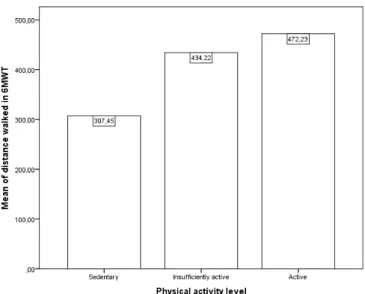
When we analysed the average distance walked in 6MWT in each sub-group of physical activity, it was found that active women walked 472.2 m, insufficiently active women walked 434.4m and inactive women walked 307.5m on average (Figure 1). That means the average distance decreases with lower levels of physical activity.
Figure 1 - Walked distance and physical activity level
To study the relationship between the walked distance and the age, weight, height, waist circumference, BMI, physical activity level and functional capacity (results obtained by CPF scale) the multiple linear regression analysis, where first it was examined which variables that would be more related to the distance, through the Pearson and Spearman correlation coefficients, as well as the analysis of scatter plots to assess the existence of a linear trend.
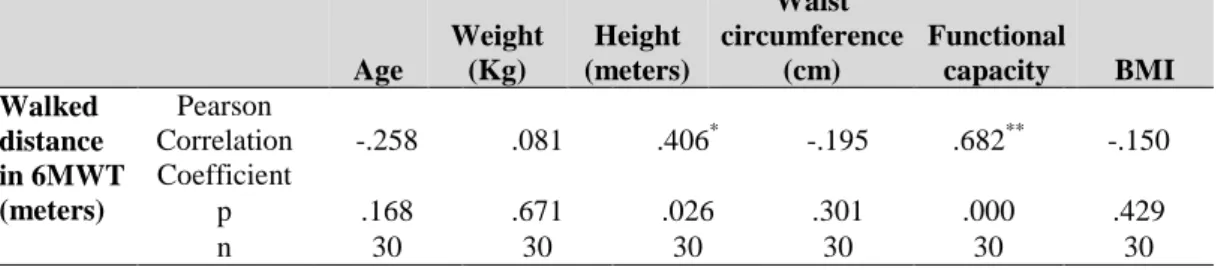
Analysing the correlation coefficients shown in Table 1 and 2, there is a statistically significant positive correlation with moderate intensity between walked distance and
height (r = 0.406, p = 0.026), and strong intensity between walked distance and functional capacity (r = 0.682, p = 0.000). Regarding the physical activity level, also obtained a significant positive correlation with strong intensity (r = 0.594, p = 0.001). There was no statistically significant correlation between age, weight, waist circumference, body mass index and the walked distance in 6MWT.
Table 1: Pearson Correlation Coefficient between walked distance in 6MWT and age, weight,
height waist circumference, functional capacity and BMI.
Age Weight (Kg) Height (meters) Waist circumference (cm) Functional capacity BMI Walked distance in 6MWT (meters) Pearson Correlation Coefficient -.258 .081 .406* -.195 .682** -.150 p .168 .671 .026 .301 .000 .429 n 30 30 30 30 30 30
**. Correlation is significant at the 0.01 level (2-tailed). *. Correlation is significant at the 0.05 level (2-tailed).
Table 2: Spearman Correlation Coefficient between walked distance in 6MWT and physical
activity level
physical activity level
Walked distance in 6MWT (meters) Spearman Correlation Coefficient .594**
P .001
N 30
**. Correlation is significant at the 0.01 level (2-tailed).
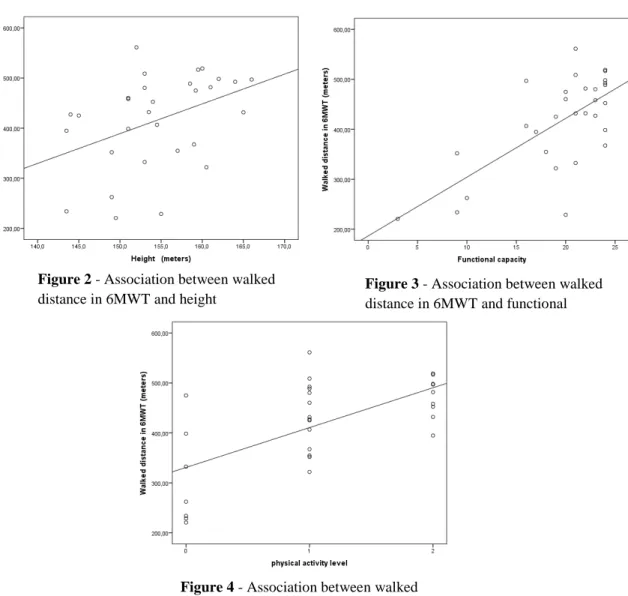
Analysis of the scatter plots (Figure 2, 3 and 4) it appears that there is a linear trend in a positive direction between the walked distance in 6MWT and the height, functional capacity and physical activity level.
Based on the obtained values of the correlation coefficients, we chose to put in multiple linear regression the height, physical activity level and functional capacity as independent variables. Concerning the physical activity level of, dummy variables were created to better understand the results, considering the reference category being sedentary. The obtained model is significant (F4, 25 = 11.275, p = 0.000) and explained 64.3 % of the variation in the walked distance. From the analysis of Table 3 it can be seen that the height is not significant for explaining the variation of the walked distance. However, the functional capacity, being insufficiently active and being active contributes significantly for this variation. We also see that the functional ability and being active are the ones that contribute most to the explanation of the variation of the walked distance in 6MWT.
Table 3 - Results of multiple regression analysis: dependent variable - walked distance,
independent variables - height, functional ability, insufficiently active and active.
Coefficientsa Model Unstandardized Coefficients t p Partial Correlations Collinearity Statistics
B Std. Error Tolerance VIF
(Constant) -12.162 284.505 -.043 .966 Functional capacity 7.530 2.450 3.074 .005 .524 .708 1.413 Height (meters) 1.350 1.937 .697 .492 .138 .813 1.231 Insufficiently Active 85.840 29.917 2.869 .008 .498 .532 1.879 Active 108.779 34.002 3.199 .004 .539 .488 2.048
a.Dependent Variable: Walked distance in 6MWT (meters)
Figure 2 - Association between walked
distance in 6MWT and height
Figure 3 - Association between walked
distance in 6MWT and functional
Figure 4 - Association between walked
The obtained regression model has a power of 0.9999, which is obtained from the expression
= 1 − ( (1 − , 1, 2 , 1, 2, , lower. tail = TRUE, log. p = FALSE),
Where (1 − , 1, 2 is the 1 − quantil of the F distribution, 1 is the number of explanatory variables in the model, 2 is given by ( − 1 − 1 , is the non-centrality parameter given by ) *+*+,, where -.= 0,643. Therefore,
= 1 − (2,75871047, 4, 25, 54,03361, lower. tail = TRUE, log. p = FALSE = 0,9999.
The obtained model also checks the Gauss-Markov conditions, i.e. the residuals has average equal to zero, the residuals has constant variance and the assumption of normality of residuals is verified. The existence of multicollinearity between the independent variablesdoes not exist, as can be seen from the tolerance values (close to 1) or the VIF values (below 10). In summary, we can consider the obtained model is a good model.
Discussion
The Functional ability is the individual capacity to carry out daily living activities independently. Most of these activities are developed at a submaximal level. Since 6MWT is performed at submaximal level it has been described as a predictor of functional capacity (Lord & Menz, 2002).
Results presented in this study show a positive correlation between height, physical activity level, functional capacity and distance during 6MWT.
Height is associated with a higher step by increased leg length, a fact that makes the most efficient gait. Hence the taller women walk greater distances. Furthermore, Callisaya and col. (2008) reported that the stride length and cadence are determinants of speed (Callisaya, Blizzard, Schmidt, McGinley, & Srikanth, 2008). Bone and muscle mass are decreased in elderly people, and when associated with the decline of cardiorespiratory function, all together may lead to a reduction in functional capacity. Regular physical activity can reduce the negative effects of aging which explain the best results in 6MWT by more active persons in our sample. Different studies show, in fact, that women who engage in regular physical activity have a greater walked distance (ATS, 2002). In our pilot study, it seems that there is a positive and high correlation between the results obtained in a specific functional capacity scale and the walked distance in 6MWT. It seems also that the walked distance is more associated with CPF scale than the height or physical activity level.
In this pilot study with elderly women, anthropometric variables such as weight, age, and waist circumference, by themselves were not sufficient to influence the walked distance. For example, lean body mass was not assessed, and this is considered a predictor of exercise capacity.
Unlike other studies age was not a significant predictor of walked distance. Since our sample is a fairly homogeneous (aged between 65 and 75 years) could not in fact influence greatly distance walked. Results on 6MWT were similar to other studies with a similar group (elderly women)(Gouveia et al., 2013)
A limitation of our study is the small sample size. This limitation should be considered in further studies in order to achieve strongest conclusions. However is an objective study for a specific group of population (elderly women) in a specific region (Loures municipality).
Conclusion
The results of this study lead to that to be regarded as the walked distance in 6MWT has a good correlation with the obtained results in the CPF scale, confirming that this submaximal test is representative of functional capacity and can be used for its prediction. It can be said even for each unit more in functional capacity, the distance walked increases on average by 7.53 meters; relative to sedentary participants, being insufficiently active increases, on average, the distance walked in 85.84 meters; and being active increases, on average, the distance walked in 108.78 meters.
In summary, it can be concluded that the functional capacity and physical activity level influence the distance walked in this small sample. However, further studies will be needed to identify objectively associations between functional capacity measured subjectively by the CPF scale and objectively by 6MWT and physical activity level in a larger sample.
References
American College of Sports Medicine. (2010). ACSM’s Health-Related Physical Fitness
Assessment Manual. (L. Kaminsky, Ed.) (Third Edit). Baltimore: Wolters Kluwer, Lippincott
Williams & Wilkins.
ATS. (2002). ATS Statement: Guidelines for the Six-Minute Walk Test. Am J Respir Crit Care
Med, 166, 111–117.
Barata, V., Gastaldi, A., Mayer, A., & Sologuren, M. (2005). Avaliação das equações de referencia para predição da distancia percorrida no teste de caminhada de seis minutos em idosos saudáveis brasileiros. Revista Brasileira de Fisioterapia, 9(2), 165–171.
Callisaya, M. L., Blizzard, L., Schmidt, M. D., McGinley, J. L., & Srikanth, V. K. (2008). Sex modifies the relationship between age and gait: a population-based study of older adults. The
Journals of Gerontology. Series A, Biological Sciences and Medical Sciences, 63(2), 165–170.
Casanova, C., Celli, B., Barria, P., Casas, A., Cote, C., Torres, J., & Jardim, J. (2011). The 6-min walk distance in healthy subjects: reference standards from seven countries. European
Respiratory Journal, 37, 150–156.
Direcção Geral da Saúde. (2004). Programa Nacional para a Saúde das Pessoas Idosas. Retrieved from http://www.portaldasaude.pt/portal.
Gouveia, É. R., Maia, J. A., Beunen, G. P., Blimkie, C. J., Fena, E. M., & Freitas, D. L. (2013). Functional fitness and physical activity of portuguese community-residing older adults. Journal of
Aging and Physical Activity, 21(1), 1–19.
Lord, S. R., & Menz, H. B. (2002). Physiologic, psychologic, and health predictors of 6-minute walk performance in older people. Archives of Physical Medicine and Rehabilitation, 83(7), 907– 911.
Rikli, R., & Jones, C. (1999). Development and validation of a functional fitness test for community-residing older adults. Journal of Aging and Physical Activity, 7, 129–161.
Singh, S. J., Puhan, M. A., Andrianopoulos, V., Hernandes, N. A., Mitchell, K. E., Hill, C. J., … Holland, A. E. (2014). An official systematic review of the European Respiratory Society/American Thoracic Society: measurement properties of field walking tests in chronic respiratory disease. European Respiratory Journal, 44, 1447–1478.
Soares, M., & Pereira, C. (2011). Six-minute walk test: reference values for healthy adults in Brazil. Jornal Brasileiro de Pneumologia, 37, 576–583.
Spruit, M. A., Singh, S. J., Garvey, C., Zu Wallack, R., Nici, L., Rochester, C., … Wouters, E. F. M. (2013). An official American thoracic society/European respiratory society statement: Key concepts and advances in pulmonary rehabilitation. American Journal of Respiratory and Critical
Care Medicine, 188.
Troosters, T., Gosselink, R., & Decramer, M. (1999). Six minute walking distance in healthy elderly subjects. European Respiratory Journal, 14(2), 270–274.