PERSISTENCE
OF THE
SALMONELLA TYPH.7-PARA TYPHICARRIER
STATE AFTER GALLBLADDER
REMOVAL1
Conrad0 Ristori,’
HCctor Rodriguez,2 Patricia Vicent,2
Catterine Ferreccio,” Julio Garcia,3 Her&n
Lobos,3
and Karen D’Ottone,s
Tests conducted on 45 carriers of Salmonella typhi or S. paratyphi who had undergone gallbladder removal showed that 10 remained residual car&s six months or more aftm surgep The findings suggest that S . typhi tenh to persist in both the gallbladder and the bile ducts of carriers, that surgical removal of the gallbladder does not ensure elimination of the S. typhi-para- typhi carrier state, and that such surgey is not justified $pe$ormed merely to counteract the car&r state.
Introduction
As reported previously, the authors have in- vestigated the proportion of Salmonella typhi and S. fiaratrphi carriers existing among gall- bladder disease patients in Santiago for whom surgery was indicated (1). This work, sup- ported by the surgical departments of seven
Santiago hospitals, involved bacteriologic
testing of bile and blood specimens obtained from 1,000 cholecystectomy patients between July and October 1980. Most of these patients
had been suffering from gallstones.
The tabulated and published results indi-
cated that cholecystectomies were being per- formed on over four times as many women as men and that 7.3 per cent of these surgical pa- tients were carriers of A’. typhi or S. @araty@hi, these organisms being isolated from more bile
specimens than any other bacteria except
E. coli.
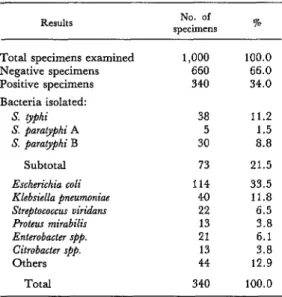
A summary of the previously published
bacteriologic results are presented in Table 1, which lists the microbes most frequently iso- lated from the 340 bile specimens that tested
‘Also appearing in Spanish in the Boletin de la Of&a Sanitaria Panamericana 93(4), 1982.
ZEpidemiologist, Program Support Department, Ministry of Health of Chile.
3Bacteriologist, Institute of Public Health of Chile.
positively and the number ofisolates identified as salmonellae of the S. typhi-paratyphi group.
A number of authors have suggested that cholecystectomy, by removing the gallbladder
from which salmonellae are discharged into
the intestine, offers a way of eliminating the carrier state (2, 3, 4, 5, 6). In support of this point of view they cite the observed failure of attempts to eliminate the focus of infection in the gallbladder by using a variety of chemo- therapeutic and antibiotic agents-including chloramphenicol, which has been used so suc- cessfully in treating the disease (6, 7). How- ever, even under ideal conditions surgery is not without risk, cost, and inconvenience, and so there may be reasons for objecting to it on ethical grounds (2). In the case at hand, of course, such criticism would be considerably more justified if it were found that cholecystec- tomy failed to ensure elimination of the carrier state.
The object of the work reported here was to assess the utility of cholecystectomy for elimi- nating the carrier state. This was done by examining fecal and bile specimens from pre- viously cholecystectomized subjects whose bile (collected at the time of excision of the blad- der) had been found to contain S. typhi or S. paragphi. These followup tests were all per- formed at least six months after the original surgical intervention.
362 PAHO BULLETIN . vol. 16, no. 4, 1982
Table 1. Bacterial isolates yielded by 1,000 bile specimens obtained from cholecystectomy patients at
seven Santiago hospitals in July-October 1980.
Results specimens No. of %
Total specimens examined Negative specimens Positive specimens Bacteria isolated:
S. typhi S. paratyphi A S. paratyphi B
Subtotal
Escherzkhia coli Klebsiella pneumoniae Streptococcus uiridam Proteus mirabilis Enterobacter ~pp. Citrobacter spp. Others
Total
1,000 100.0
660 66.0
340 34.0
38 11.2
5 1.5
30 8.8
73 114 40 22 13 21 13 44 340
21.5 33.5 11.8 6.5 3.8 6.1 3.8
12.9
100.0
Materials and Methods
Forty-five carriers who underwent cholecys-
tectomies between July and October 1980
were examined again starting in April 1981 at the Chilean Institute of Public Health. As Table 2 shows, nine of these subjects were
men and 36 were women-a proportion simi-
lar to that of the patients receiving this type of surgery (1). Only one man was below 35 years
Table 2. The age and sex distribution of cholecystectomy patients positive for S. @phi or S. paratvphi who were given followup examinations.
Total
Age in years
< 25 25-34 35-44 45-54 z 55
Total
SIX
No. of % of Males Females subjects subjects
1 10 11 24.4
- 6 6 13.3
3 10 13 28.9
4 4 8 17.8
1 6 7 15.6
9 36 45 100.0
of age, most being clustered between 35 and 54. The age distribution of the women was more regular, 10 of the female subjects being below 25 years of age.
A series of three fecal specimens were ob- tained from each subject at intervals of one or two days. The first specimen was procured with a swab, and the other two were obtained from spontaneously ejected feces.
Material from all three fecal specimens was cultured. When the results obtained with all three specimens were negative, another series of three were taken 30 days later, so that in some cases as many as six fecal specimens were obtained from a given subject.
At the time the first fecal specimen in any series was taken, a bile specimen was obtained
by the “enterotest” procedure recommended
by the University of Maryland (8, 9, 10). This procedure entails having the patient swallow a string. One end of the string is free, and this is attached to one of the patient’s cheeks. The rest of the string, rolled up and contained in a special capsule, is ingested. Three to four hours later the whole string, its distal end im- pregnated with bile, is gently withdrawn up the esophagus.
The fecal specimens were inoculated direct- ly onto the following media: salmonella-shigel- la, bismuth, xylose-lactose desoxycholate, and selenite. The material inoculated onto selenite media was transferred to salmonella-shigella media after 16 hours. The resulting colonies were then inoculated onto triple sugar agar
(T.S.I.) and lysine-iron-agar (L.I.A.), and
biochemical and serologic tests were per-
formed.
The bile-impregnated ends of the retrieved strings were inoculated directly onto salmonel-
la-shigella and blood agar media, and the
R&on’ et al. l GALLBLADDER REMOVAL AND S. TYPHI-PARA TYPHICARRIERS 363
Results and Discussion
Not all the scheduled examinations were
performed on every patient. Several patients dropped out because of stated reluctance to take a second “enterotest.” The cause they cited was distinct dysphagia attributable to pharyngeal irritation caused by withdrawal of the string. Others stopped coming for a varie- ty of reasons and could not be located.
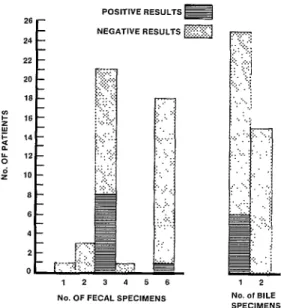
As Table 3 and Figure 1 show, fecal speci- mens were obtained from all but one of the 45 selected patients- 18 providing six specimens (two series of three), 21 providing three (one series), and five providing other numbers of specimens. The initial series of specimens pro-
vided by seven patients yielded positive
results, and so those patients were not asked to provide a second series of specimens. Of those asked to provide a second series of specimens, 18 did so. One patient provided only an initial (fourth) specimen. In this regard it should be noted that only the sixth specimen from one patient tested positively for S. paratyphi B, the first live having all yielded negative results.
In regard to the bile specimens, six patients refused to provide them, 24 were tested once, and 15 were tested twice. Six of those tested initially yielded positive results, and so they were not asked to provide a second specimen.
Table 3. The numbers of fecal and bile specimens obtained from the 45 selected
cholecystectomy patients. No. of
fecal No. of patients
SpeChenS
providing
SPXimCtlS
% ofall patients
0 1
2 3 4 6
Total
No. of bile specimens
0
1 2
1 2.2
1 2.2
3 6.7
21 46.7
1 2.2
18 40.0
45 100.0
6 13.3
24 53.3
15 33.3
Total 45 100.0
Figure 1. The nun&s of fecal and bile specimens provided by the 45 selected patients and the numbers of patients whose specimens
yielded positive results.
POSITIVE RESULTS m NEGATIVE RESULTS @gj
1 2 3 4 5 6
No. OF FECAL SPECIMENS
1 2 No. of SlLE SPECIMENS
All 15 of those tested a second time yielded negative results.
In all cases, the type of salmonellae isolated from a given patient’s fecal or bile specimen coincided with the type isolated from the bile specimen obtained from that patient during surgery.
As Table 4 shows, 10 (22.2 per cent) of the
Table 4. The proportions of 45 cholecystectomy patients found to be S. typhi or S. parat~hi carriers
at surgery who were also found to be carriers six or more months after surgery.
Type of
Sal~O~~lI~
isolated
Carriers at Residual carriers the time of (at least six
surgery months after surgery)
NO. % NO. %
None (negative results)
Positive for:
S. yphi S. paratyphi A
S. /mratyphi B Total positive
0 0 35 77.8
22 48.9 3 6.7 3 6.7 0 0.0 20 44.4 7 15.5
364 PAHO BULLETIN l vol. 16, no. 4, 1982
45 subjects found to be carriers at the time of their surgery were still positive for S. lyPhi or S. paratyphi at least six months later. The rela- tive proportions of the salmonellae isolated
differed somewhat from the proportions
isolated initially, with S. paratyphi B predomi- nating the second time around. S. pphi, which had initially accounted for 48.9 per cent of the carrier states detected in the surgical speci- mens, was responsible for only 30 per cent of the positive followup results; but S. paratyphi B, originally responsible for 44.4 per cent of the carrier states, was isolated from 70 per cent of the residual carriers. 5’. paratyphi A, iso- lated from 6.7 per cent of the carriers at the time of surgery, was not found in any of the subsequent examinations.
Two of the 10 patients regarded as residual carriers had undergone their cholecystecto- mies several years before, and second opera- tions on their bile ducts had yielded positive bile specimens, one containing S. typhi and the other containing S. paratyphi B. Both patients had histories of enteric infection preceding their cholecystectomies.
The results obtained with each specimen obtained from the 10 residual carriers are shown in Table 5. The main reason why not all the scheduled tests were performed is that no further specimens were requested if a fecal specimen or bile specimen in the initial series yielded positive results.
In general, S. paratyphi B clearly predomi- nated in the isolates made from fecal speci- mens, accounting for seven out of 10 isolates. In contrast, S. typhi accounted for most (three out of five) of the isolates obtained from bile specimens. As previously noted, however, the salmonellae isolated from any given patient were of the same type previously isolated at the time of surgery.
The fact that one patient (number 6) yield- ed negative results for S. paratyphi B on all tests except those performed on the last (sixth) fecal specimen suggests that the proportion of chole-
cystectomy patients who remain residual
carriers may be higher than the proportion detected by this study. It also suggests that a considerable number of additional examina- tions would be needed in order to obtain con- clusive evidence about this matter.
As previously indicated, the first fecal speci- men in each series was extracted with a swab, while the other two were obtained through
spontaneous ejection. The results derived
from testing these various fecal specimens
tend to support a finding made by other
authors (12), the finding that specimens ob- tained by rectal swab tend to yield somewhat less sensitive results than those obtained through spontaneous ejection. Specifically, the swab specimens yielded five positive find- ings while the spontaneously ejected speci- mens in the first series yielded seven-these
Table 5. The results of coproculture and bile culture of specimens obtained from the 10 residual carriers.
Patient Culture results with fecal and bile specimens
identifying Fecal specimen no. Bile specimen no. Salmonellae
number isolated
1 2 3 6 1 2
1 f + + + S. &phi
2 + + + + ,I
3 + + - - S. paratyphi B
4 + + + f ,>
5 + + + - I,
6 - - - + - - ,,
7 - f - - ,,
8 - f + - ,t
9 - - - + >,
Ristori et al. l GALLBLADDER REMOVAL AND S. TYPHI-PARA TYPHI CARRIERS 365
consisting of the isolation of S. paratrphi B in ejected specimens from patients 7 and 8. This observation, though of no statistical signifi- cance because of the small numbers involved, tends to bear out the distinction noted be- tween the superior techniques for isolating S. typhi-paratyphi and shigellae, rectal swab ex-
traction of fecal specimens being recom-
mended for isolation of shigellae.
Regarding isolation of S. trphi, in the two cases where this microbe was detected in both fecal and bile specimens, all the specimens ob- tained yielded positive results. In the third
case (patient 10) where the organism was
detected, only the bile specimen tested posi- tively-but it should be noted that the patient was one of two residual carriers who yielded a positive bile specimen during bile duct sur-
gery subsequent to the cholecystectomy. In
contrast, the residual carriers of 5’. paratyphi B
yielded intermittent negative and positive
results, most bile specimens testing negative- ly, and so it was harder to reach definite con- clusions about these carriers.
Overall, the predominance of S. paratyphi B in isolates from fecal specimens and the rela- tive preponderance of S. typhi in isolates from bile specimens suggests S. typhi has a greater affinity for the gallbladder and S. paratyphz’ for the bile ducts. This finding, involving a statis- tically significant difference, supports a view
of the 5’. pphi carrier state proposed by other authors.
Conclusions
In general, the results of this study provide grounds for reaching the following conclu- sions:
1. Cholecystectomy does not guarantee
elimination of the S. typhi-paratyphi carrier state. These organisms persisted in at least 22.2 per cent of the patients carrying them at surgery, and this percentage could turn out to be larger if the number of fecal specimens
examined were increased beyond the six
examined in this study.
2. Fecal specimens obtained with swabs
yielded less sensitive test results than speci- mens taken from spontaneously ejected feces. 3. Fecal specimens led to detection of 5’. paratyphi B carriers relatively more often, while bile specimens appeared relatively more sensitive for S. typhi. This evidence reinforces the view that S. pphi persists not only in the gallbladder but in the bile ducts as well.
4. Since cholecystectomy is not without risks, expense, and inconvenience, there ap- pears no justification for using it merely in an attempt to eliminate the 5’. typhi-paratyphi car- rier state.
ACKNOWLEDGMENTS
We wish to express our appreciation for the collaboration provided by nurses Irma Canepa and Evelyn Stevens and by technicians Aurora Maldonado and Luz Zapata at the Insti- tute of Public Health of Chile.
SUMMARY
366 PAHO BULLETIN l vol. 16, no. 4, 1982
of specimens was obtained. All the specimens were cultured on appropriate media for isolation of S. &phi, S. paratrphi A, and S. para@phi B.
In all, 10 of the 45 patients tested were found to be residual carriers of S. typhi or S. paragphi B, and in each case the organism isolated corresponded to the organism previously isolated at the time of sur- gery. In three cases the isolated microbe was S. @hi and in seven cases it was S. paratyphi B. No residual infections with S. paratyphi A (found in 6.7 per cent of the cholecystectomy patients at the time of sur- gery) were detected. A relatively greater proportion of the residual S. typhi infections were detected in
bile specimens, while a larger share of the S. para- typhi B infections were detected in fecal specimens. Also, fecal specimens obtained from spontaneously expelled feces yielded better results than did those obtained from specimens extracted with a swab.
Overall, the findings support the theory that S. typhi has a greater affinity for the gallbladder and S. paratyphi for the bile ducts. They also demonstrate that cholecystectomy does not ensure elimination of the S. typhi-parapphi carrier state, and suggest there is scant justification for using this operation merely to counteract that state.
REFERENCES
(1) Ristori, C., H. Rodriguez, P. Vicent, H. Lobos, K. D’Ottone, J. Garcia, M. E. Pinto, P. Nercelles, and L. Cisneros. Investigation of the Sal- monella typhi-paratyphi carrier state in cases of sur- gical intervention for gallbladder disease. Bull Pan Am Health Organ 16(Z), 1982.
(2) Whipple, A. 0. The surgical treatment of bile typhoid carriers. Ann Surg 90:631-642, 1929.
(3) Perkins, J. C., R. L. Devetski, and H. F. Dowling. Ampicillin in the treatment of salmonella carriers: Report of six cases and summary of the literature. N Engl J Med 274:808-815, 1966.
(4) Tynes, B. S., and J. P. Utz. Factors i&u- encing the cure of salmonella carriers. Ann lnlern Med 57:871-882, 1962.
(5) Dinbar, A., G. Altmann, and D. B. Tul- cinsky. The treatment of chronic biliary salmonella carriers. Am J Med 47:236-242, 1969.
(6) McFadzean, A. J., and G. B. Ong. Intra- hepatic typhoid carriers. Br Med J 5503: 1567-1571, 1966.
(7) Armijo, R., A. Pizzi, and H. Lobos. Preva-
lencia de portadores tificos despues de1 tratamiento con cloramfenicol Bol Of Sanit Panam 62:295-302, 1967.
(8) Gilman, R. H., and R. B. Hornick. Duode- nal isolation of Salmonella typhi by string capsule in acute typhoid fever. J Clin Microbial, April 1976, pp. 456-457.
(9) Gilman, R. H. Identification of gallbladder typhoid carriers by a string device. Lancet, 14 April
1979, pp. 795-796.
(10) Beal, C. B., P. Viens, R. G. Grant, and J. Hughes. A new technique for sampling duodenal contents: Demonstration of upper small-bowel pathogens. Am J Trap Med 19:349-352, 1970.
(11) Bezpok, B. Evaluation of a new technic for sampling duodenal contents in parasitologic diag- nosis. Digestive Diseases 17(9), 1972.
(12) Shaughnessy, H. J., F. Friewer, and A. Snyder. Comparative efficiency of rectal swabs and fecal specimens in detecting typhoid and salmonella cases and carriers. Am J Public Health 38~670-675,