Original Research Article
The in
fl
uence of anti-predator training, personality and sex in
the behavior, dispersion and survival rates of translocated
captive-raised parrots
Alice R.S. Lopes
a, Magda S. Rocha
b, Mozart G.J. Junior
b, Wander U. Mesquita
b,
Gefferson G.G.R. Silva
b, Daniel A.R. Vilela
c, Cristiano S. Azevedo
a,*aUniversidade Federal de Ouro Preto, Instituto de Ci^encias Exatas e Biologicas, Pos-graduaçao em Biomas Tropicais, Campus Morro do~
Cruzeiro, s/n, Bauxita, CEP: 35400-000, Ouro Preto, Minas Gerais, Brazil
bWaita - Instituto de Pesquisa e Conservaçao, Av. Waldomiro Lobo, 86, Guarani, CEP: 31814-620, Belo Horizonte, MG, Brazil~ c
Instituto Brasileiro do Meio Ambiente e dos Recursos Naturais Renovaveis, Av. Do Contorno, 8121, Cidade Jardim, CEP: 30110-051, Belo Horizonte, MG, Brazil
a r t i c l e
i n f o
Article history:
Received 3 April 2017
Received in revised form 12 May 2017 Accepted 12 May 2017
Keywords:
Blue-fronted Amazon parrot Bold
Psittacidae Relaease Shy Survive
a b s t r a c t
Predation is one of the main factors responsible for the failure of reintroduction/trans-location programs. Animal's personality and sex can also influence key behaviors for survival and reproduction. This study aimed to evaluate the influence of anti-predator training, personality and sex on the survival and behaviors of translocated blue-fronted Amazon parrots. Thirty-one captive-raised parrots were translocated to aCerradoarea in Brazil. Parrots were separated into two groups: anti-predator trained group (ATG) and control group (CG). Personality tests were performed with individuals of the ATG group. Data were collected using focal sampling with instantaneous recording of behavior every minute. Anti-predator training, personality and sex did not influenced parrots' survival after release. However, anti-predator training proved to be efficient in eliciting more natural behaviors in parrots after release. Shy individuals and males showed to be more sociable than bold individuals and females. Personality and sex did not influence behavior exhibition. Parrots interacted more, positively or negatively, with individuals of its own group. Training session closer to the release date should be tried. Behavioral data and not just survival rates should be used to evaluate the efficiency of the techniques, because behavior can give clues about the adaptation of the individuals to the new habitat, increasing the success of the conservation program.
©2017 Published by Elsevier B.V. This is an open access article under the CC BY-NC-ND license (http://creativecommons.org/licenses/by-nc-nd/4.0/).
1. Introduction
Translocations and pan-situ conservation [the exchange of animals between in situ populations (in the wild) and ex situ populations (in human care);Keulartz, 2015] are important tools for the management of animal species facing the risk of
*Corresponding author.
E-mail addresses:[email protected](A.R.S. Lopes),[email protected](M.S. Rocha),[email protected](M.G.J. Junior),wanderum@
gmail.com(W.U. Mesquita), [email protected] (G.G.G.R. Silva), [email protected] (D.A.R. Vilela), [email protected] (C.S.
Azevedo).
Contents lists available atScienceDirect
Global Ecology and Conservation
j o u r n a l h o m e p a g e : h t t p : / / w w w . e l s e v i e r . c o m / l o c a t e / g e c c o
http://dx.doi.org/10.1016/j.gecco.2017.05.001
2351-9894/©2017 Published by Elsevier B.V. This is an open access article under the CC BY-NC-ND license (http://creativecommons.org/licenses/by-nc-nd/
extinction (Seddon et al., 2012). The mortality caused by predation is one of the main factors responsible for the failure of the conservation projects (Beck et al., 1991; Seddon et al., 2012; Cortez et al., 2015). Predation of the released animals is due mainly to the loss of skills in recognizing and responding to a predator, especially if the released animals are captive-bred (Griffin et al., 2000; Aaltonen et al., 2009). Anti-predator training techniques have being used to reduce this problem and increase appropriate behavioral responses to predators (Azevedo and Young, 2006a,b), however, studies that evaluated the effectiveness of anti-predator training after the release are rare (Gaudioso et al., 2011; Alonso et al., 2011; Cortez et al., 2015). Individuals’personalities are normally not considered in conservation programs when selecting the animals for release (Teixeira et al., 2007), although some studies indicate that personality can influence key behaviors for survival and repro-duction in nature (anti-predator, aggressiveness, sociability, exploration, feeding behaviors;Hollander et al., 2008; Aplin et al., 2013). Animal personality can be understood as differences in the behaviors exhibited by different individuals of the same species that is consistent across time and situations (Reale et al., 2007). Different dimensions of animal personalities can be evaluated: exploration, sociability, aggressiveness, risk-taking, etc (Gosling and John, 1999). In one of these contexts, per-sonalities can be classified in a shy-bold continuum, based on the propensity to take risks of each individual: some individuals seem to thrive on risk and novelty (boldness) while others shrink from the same situations (shyness) (Wilson et al., 1994). Released individuals with inappropriate levels of boldness can theoretically survive less in nature (Azevedo and Young, 2006c; Oers and Naguib, 2013). Bolder animals probably have insufficient wariness of predators and this can be a non-adaptive response, but, in another context, they can be more willing to explore the environment andfind food, which can be seen as an adaptive response (Coleman and Wilson, 1998; Watters and Meehan, 2007). Personality tests can be used as a method to better chose the animals in conservation programs, helping in the avoidance of choosing animals that scored higher on traits linked to risky behaviors (Bremner-Harrison et al., 2004).
The animals’sex is another important parameter that is not usually evaluated in conservation programs (Lambertucci et al., 2013), but sex can be linked to personality (Titulaer et al., 2012), stress (Keller et al., 2015), dispersion (Le Gouar et al., 2012), reproduction (Ball and Ketterson, 2007) and can influences in the survival rate and in the behavior of the released individuals. In a translocation program of swift foxes in Canada, females presented lower survival rates than males, thus researchers suggested that it should be translocated a greater proportion of females in comparison to males, in order to establish balanced sex ratios in the released population (Moehrenschlager and Macdonald, 2003).
The blue-fronted Amazon parrot (Amazona aestiva) is found in eastern Bolivia, northern Argentina, southern Paraguay and central-southern Brazil (Sick, 2001), inhabiting theCaatinga, Cerrado, PantanalandChacobiomes (Schunck et al., 2011). It is one of the parrot species most removed from the wild in the world (Schunck et al., 2011). In Brazil, it is among the most received species in the Wild Animal Triage Centers (CETAS), governmental facilities destined to receive animals rescued from the illegal trade, and are normally released into nature without any systematic study or monitoring (Vilela, 2012). Although this species are considered of least concern byIUCN (2017), the species was included in the“National Action Plan for the Conservation of Threatened Parrots of the Atlantic Forest”in Brazil, due to the high pressure that this species suffers from the trafficking of wild animals (Schunck et al., 2011). Studies directed to this species can help in the development and improvement of techniques for release this parrots and endangered species, as the study ofRodrigues (2013), who evaluated if rescued blue-fronted Amazon parrots were able to learn anti-predator skills.
In this study, it was examined the influences of the anti-predator training, personality and sex of the captive-raised blue-fronted Amazon parrots on the survival, behavior and dispersal of the individuals after release. We hypothesized that these parameters would influence survival and dispersal of release parrots and expected that trained, female and shyer parrots would survive more after release due to acquired anti-predator skills, and the tendency to the to take less risk than bold males.
2. Methods
2.1. Animals, housing and maintenance
Thirty-one reproductive adult blue-fronted Amazon parrots were selected from CETAS in Belo Horizonte City after general health exams. These parrots were illegally removed from the wild while chicks and were raised in captivity, being rescued from the owners. Thus, their ages and places of birth were unknown. All parrots lived for at least 5 years in captivity. They were randomly assigned into two groups: the anti-predator trained group (ATG), with 15 parrots(seven males and eight females); and the control group (CG), with 16 parrots (ten males and six females) (Table A.1).
Each parrot received a microchip and was marked on the chest with a non-toxic Expo®low odor dry-erase marker; the ink marks indicated the sex and the group of the individual (right side for females and left side for males; blue color for ATG and red color for CG). Parrots also received one colored leg ring and one stainless steel leg ring, with an identification number and a contact telephone number. Three individuals from each group also received a VHF radio collar; model TXE304CP, Telenax Company®.
Parrots were kept separated by group in two similar aviaries for at least ten months before the release. The aviaries were partially shaded and had 12 m length, 4 m width and 3.5 m height each, and were placed 2 m distant from each other in the release area, away from human interferences and surrounded by natural habitat. Aviaries were covered with a black plastic canvas to avoid individuals of the CG to see individuals of the ATG. Birds were daily fed at 8:30 AM with a mixture of industrialized parrot food (Megazoo®), sunflower seeds and seasonal fruits; fruits and seed of plants found in the release site
were offered to the birds whenever available. No visual barriers existed between the keeper and the parrots during food provisioning. Water was providedad libitum.
2.2. Anti-predator training
Anti-predator training sessions were conducted with the parrots from ATG on February 2012 byRodrigues (2013)and reinforcement occurred on October 2012, eight months prior to the transference to the release site. The ATG received predator aversion training using stuffed models (ocelot -Leopardus pardalis,and Harris’hawk -Parabuteo unicinctus)and a human being as potential predators. The human predator was represented by a person who always wore the same clothes (red shirt and straw hat) during the tests. A chair was used as a control model. Predators were associated to an aversive stimuluse persecution by a camouflaged man carrying a net, simulating a capture. Anti-predator training protocol followedGriffin et al. (2001)andAzevedo and Young (2006a,b). Captive results showed that the parrots enhanced their aversion to humans and to predators, displaying appropriated anti-predator behaviors even two months after the test (Rodrigues, 2013). CG did not received anti-predator training.
2.3. Personality tests
Personality tests were performed only with individuals of the anti-predator training group (15 individuals). Tests were conducted before and after the application of the anti-predator training sessions to the parrots, and thefinal scores were used in the analysis (Rodrigues, 2013). For personality tests, two objects unknown to the parrots were used: a traffic signaling beacon and a combination of a pot of chips connected to a milk bottle. In the center of the enclosure stood a pedestal where the objects were exposed to the parrots. Boldness scores were calculated for each parrot followedBremner-Harrison et al. (2004)according to their behavior (number of recordings of shy and bold behaviors) in front of novel objects. More details about anti-predator training and the personality tests can be found inRodrigues (2013). Parrots of the CG had their per-sonalities not accessed due to logistical problems (time to release).
Table A.1
Identification and characteristics of the thirty-one blue-fronted Amazon parrots released in aCerradoarea of Minas Gerais state,
southeastern Brazil.
Parrot id number Group Sex Personality
299 ATG Female Shy
298 ATG Male Shy
521 ATG Male Shy
442 ATG Female Shy
425 ATG Female Shy
362 ATG Male Shy
349 ATG Male Shy
326 ATG Male Shy
313 ATG Male Shy
376 ATG Male Bold
242 ATG Female Bold
432 ATG Female Shy
403 ATG Female Bold
237 ATG Female Shy
1147 ATG Female Bold
902 CG Female No data
988 CG Male No data
257 CG Male No data
755 CG Male No data
816 CG Male No data
693 CG Male No data
682 CG Male No data
853 CG Female No data
513 CG Female No data
781 CG Male No data
176 CG Male No data
904 CG Male No data
992 CG Female No data
374 CG Female No data
906 CG Female No data
600 CG Male No data
ATG: anti-predator group; CG: control group. Personality of each parrot where calculated byRodrigues (2013).
2.4. The release and monitoring campaigns
The individuals were released in June 2013 using the soft release method in a Cerrado area of Minas Gerais state, southeastern Brazil. Aviary doors were open and birds leave it by themselves (from immediately to 3 months later). After the last parrot leaves the aviary, the doors were closed and no bird could return to it. Until we reach three months, some in-dividuals returned to sleep inside the aviary. Seven artificial nests andfive feeders were distributed through the release site to facilitate the rehabilitation process and they were maintained throughout thefirst year of the project. Feeders were placed around the release aviary. Four-dayfield trips were conducted during 12 months, with an interval of 15 days between each trip, totaling 24field trips. Parrots were tracked using one portable VHF-signal receiver (model: RX-TLNX of Telenax com-pany), connected to a manual three-element Yagui directional antenna, a compass (Nautika Tour 30170) and a GPS (Garmin Etrex Legend); binoculars (Bushnell H2O 1042 m) and a digital camera (Canon 60D with 70e300 mm lens) were used to
locate and record parrots’behaviors. It was used the triangulation method to locate the parrots (Piovezan and Andriolo, 2004). Birds were identified using the artificial markings (ink, leg bands) and the natural markings on the face of each individual.
2.5. Post-release data collection
Behavioral data recordings started one month after release. At this moment, only 14 individuals of each group were considered for data analysis, because three parrots disappeared soon after release (id numbers 906, 600 and 326). In eachfield trip, it was registered the number of parrots found, their distance from the release site, their behavior and group (ATG or CG). Data were recorded in three different time periods: 5 h-7h; 7 h-9h and 16 h-18 h (periods chosen because parrots were more active at these periods;Sick, 2001; Andrade and Azevedo, 2011). Data were collected using focal sampling with instantaneous recording of behavior every minute, during 25 min in each time period (Altmann, 1974). Therefore, if an individual was found during the three time periods, than it would have 75 min of his behavior recorded. Data were collected by four trained observers concomitantly. An ethogram was created before the release, based onAndrade and Azevedo (2011)and on 80 h of behavioral observations of the captive parrots using thead libitummethod (Altmann, 1974;Table A.2).
Dispersion zones were created to determine how far individuals moved from the release point (buffers) and the frequency that these areas were used by the released parrots: 0e50m from the release point¼yard (Y); 51e100m ¼nearby (N);
101e500m surroundings (S); greater than 500m¼distant (D). All dispersion zones were visited equally during the field
monitoring campaigns.
2.6. Data analysis
T-tests (parametric data) and ManneWhitney tests (non-parametric data) were performed to evaluate differences in the number of exhibited behaviors and in the use of the dispersal zones between ATG and CG, male and female, and bold and shy parrots. Differences in the use of each dispersion zone by ATG and CG groups were evaluated using the Friedman ANOVA test with Dunn's post-hoc. The KaplaneMeier Log-rank test was run to evaluate if the survival of the parrots differ between these groups (Kaplan and Meier, 1958). Comparisons on the survival of the ATG and CG parrots were run considering two possi-bilities for the missing parrots: as if they were alive and as if they were dead. For all statistical analyses, the confidence level was 95% (
a
¼0.05) (Zar, 1999).3. Results
3.1. Survival after release
No significant differences were found between the survival rates of the ATG and CG, bold and shy parrots and male and females, neither considering missing parrots as alive nor considering missing parrots as dead (Table A.3).
3.2. Behavior
ATG parrots exhibited more behaviors than CG parrots after release (t¼3.19, df¼26, p<0.004). Females exhibited the same number of behaviors than males (t¼0.20, df¼26, p¼0.83), and bold parrots exhibited the same number of behaviors
than shy parrots (t¼0.80, df¼12, p¼0.43) after release.
ATG parrotsflew more (t¼2.16, df¼46, p¼0.035), stood more active (t¼2.49, df¼46, p¼0.016), fed more on the
feeders (t¼2.88, df¼46, p¼0.005), expressed more positive (U¼78.000, Z¼4.33, p<0.001) and negative (U¼200.500,
Z¼1.80, p¼0.008) interactions with parrots of the same group, expressed less positive (U¼50.000, Z¼ 4.89, p<0.001) and negative (U¼222.000, Z¼ 1.99, p<0.05) interactions with parrots of the other group, interacted more with wild parrots (U¼180.000, Z¼2.22, p<0.05) and exhibited more reproductive behaviors (U¼181.000, Z¼2.20, p<0.05) than CG
parrots (Fig. A.1). Moreover, ATG parrots fed more upon the artificial feeders than upon native fruits (t¼ 4.39, df¼23,
p<0.001); CG parrots fed equally on both native and provided fruits (t¼0.48, df¼23, p¼0.063).
Bold parrots emitted more human vocalizations (U¼187.000; Z¼2.14; p<0.04) and interacted positively (U¼176.000;
Z¼ 2.30; p<0.02) and negatively (U¼219.500; Z¼ 2.17; p<0.03) less with parrots of the ATG and positively less with native parrots (U¼209.000; Z¼ 2.21; p<0.03) than shy parrots (Fig. A.2).
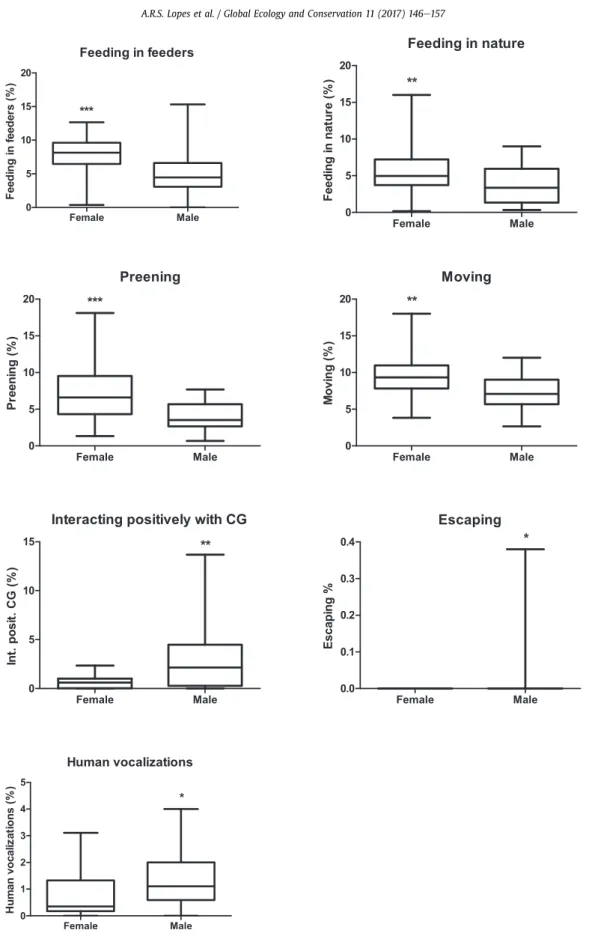
Females preened (U¼124.000; Z¼3.51; p<0.001), moved (U¼155.000; Z¼2.90; p<0.005) and fed both in the feeders (U¼125.500; Z¼3.49; p<0.001) and upon natural fruits (U¼178.000; Z¼2.44; p<0.001) more than males, but males interacted positively more with parrots of the control group than females (U¼176.500; Z¼ 2.47; p<0.02). Males also
escaped (U¼250.000; Z¼ 2.10; p<0.03) and exhibited human vocalizations (t¼ 2.06; df¼47; p<0.05) more than females (Fig. A.3).
Table A.2
Ethogram forA. aestivabased onAndrade and Azevedo (2011)and on 80 h of preliminary behavioral observations of captive parrots using thead libitum
method (Altmann, 1974).
Behavioral category Behavior Description
Activity Activity behaviors other than those
discriminated
Behaviors: pecking (leg rings, feeders, perches, branches, wires), defecating, alert (neck stretched and eyes wide open, focusing on something).
Inactivity Parrot is inactive and/or sleeping.
Moving Behaviors: walking and climbing the wire/tree.
Flying Parrot isflying.
Natural vocalizations Parrot emits natural vocalizations, similar to those of the wild parrots.
Human vocalizations Parrots emit human vocalizations, like whistles, words, phrases, songs, animals'
imitations (barks, mews, etc.).
Captivity vocalizations Parrots emits grunt, loud vocalizations, different from natural and human
vocalizations.
Escaping Parrotflies away from potential predators or lower his head in the presence of a
predator. Using also when theyflies away in agonistic interaction with other
individuals.
Maintenance Preening Behaviors: preening, beak cleaning (parrot rubs its beak on a perch/wire to remove
food wastes) or water or dust bath.
Foraging behaviors Feeding in nature Parrot eats fruits collected from the trees.
Feeding in feeders Parrot eats fruits from the artificial feeders.
Foraging Parrot search for food in the area.
Social interactions Interacting positively with parrots from
ATG
Parrot positively interacts with parrot of the ATG.
Interacting negatively with parrots from ATG
Parrot aggressively interacts with parrot of the ATG.
Interacting positively with parrots from CG
Parrot affectively interacts with parrot of the CG.
Interacting negatively with parrots from CG
Parrot aggressively interacts with parrot of the ATG.
Positive interaction with wild parrots Parrot affectively interacts with wild parrots.
Negative interaction with wild parrots Parrot aggressively interacts with wild parrots.
Positive interaction with humans Parrot affectively interacts with humans.
Negative interaction with humans Parrot aggressively interacts with humans.
Abnormal behaviors Abnormal behaviors Abnormal behaviors: swinging upside down, rotating head, making repetitive
movements, and pacing.
Reproduction Reproduction behaviors Behaviors: nest building, nest defense (when a parrot lowers his head and raises its
tail to another individual), courtship, and mating.
Parental care Behaviors: nesting, interaction with nestlings, feeding nestling and cleaning
nestling.
Other behaviors Behaviors not previously described.
Not visible When the parrot is not visible.
Table A.3
Parrots survival after release [lifetime in days (mean)], considering missing parrots as alive and considering missing parrots as dead, for the different groups. Parrots were selected from Belo Horizonte's CETAS (Wild Animal Triage Centers), received anti-predator training, had their personalities evaluated and were
release in aCerradoarea of Minas Gerais State, southeastern Brazil.
Group Parrots survival in days (mean)
considering missing parrots as alive
Test result between groups Parrots survival in days (mean)
considering missing parrots as dead
Test result between groups
ATG 338±25 c2¼0.173, df¼1, p¼0.67 230±34 c2¼0.001, df¼1, p¼0.97
CG 345±28 214±38
Bold a a 199±62
c2¼0.372, df¼1, p¼0.54
Shy parrots a 243±40
Female 335±27 c2¼0.001, df¼1, p¼0.97 252±39 c2¼1.469, df¼1, p¼0.22
Male 329±30 197±33
ATG: anti-predator group; CG: control group.
aNo statistics analyses were possible due to a low N.
3.3. Dispersion zones
There were no differences in the frequency of use of each dispersal zone between ATG and CG, shy and bold, and female and male parrots.
Both ATG and CG groups differed in the use of the dispersion zones (ATG ¼
c
2 ¼ 28.783, df ¼ 3, p < 0.001; CG¼c
2¼21.530, df¼3, p<0.001), being the yard more used than the other zones. Yard was the zone most used by shy and bold parrots (Shy ¼c
2 ¼19.520, df ¼3, p<0.001; Bold ¼c
2¼9.727, df ¼3, p <0.05), and by males and females(Female¼
c
2¼27.548, df¼3, p<0.001; Male¼c
2¼22.565, df¼3, p<0.001) (Table A.4). Overall, no data were available for 39% of the parrots, since these birds were not located during the monitoring.4. Discussion
4.1. Anti-predator training
Predation is considered a problem in translocation programs, mainly those using captive-raised animals, since most of the release animals are naïve and do not recognize or respond properly to predators (Beck et al., 1991; Cortez et al., 2015). Anti-predator training was an effective tool to diminish this unwanted captivity effect in conservation programs of little owls (Athene noctua), red-legged partridges (Alectoris rufa) and prairie dogs (Cynomys ludovicianus) where the trained animals Fig. A.1.Percentage of behavioral recordings of parrots trained against predators (ATG) and parrots of the control group (CG). Parrots were selected from Belo
Horizonte's CETAS (Wild Animal Triage Centers), received anti-predator training, and were release in aCerradoarea of Minas Gerais State, southeastern Brazil.
*¼p<0.05; **¼p<0.01; ***¼p<0.001.
survived longer than untrained animals (Shier and Owings, 2006; Alonso et al., 2011; Gaudioso et al., 2011). In the present study, however, this technique was not effective, although the trained group survived a little longer than the untrained group only when the missing parrots were considered dead (16 days longer). In fact, only two parrots (6,4%) were confirmed killed by predators, both from the trained group (id number: 237 and 521).
For species that have great commercial value, likeA. aestiva,humans represent the most important potential predator (Vilela, 2012). Twelve parrots (38.7%) (eight from ATG and four from CG) exhibited interactions with humans after the release, and three individuals were even captured by people from the local community after the release (two ATG and one CG). Despite anti-predator training had elicited appropriate behavioral responses to avoid humans by the parrots in captive, and these responses were maintained for two months after the end of the training sessions (Rodrigues, 2013), the reinforcement session occurred eight months prior to the release which seems to be too long for the parrots to still remember the condi-tioning. Besides, the fact that no visual barrier existed between the trained parrots and its keeper during their captivity period may had messed the conditioning against humans, since parrots could be associating the humans with food. Thus, anti-predator training sessions near to the release date should be preferred and visual barriers between the parrots and their keepers should existed, and both strategies should be tested in future release programs.
The anti-predator training promoted the exhibition of a wider range of behaviors by the ATG group once released. Moreover, essential behaviors related to adaptation to the wild, such as alert,flying, reproduction and interaction with wild parrots, were more recorded in ATG than in CG. This means that, somehow, the anti-predator animal training influenced the triggering of positive behavioral responses in the released blue-fronted Amazon parrots. These positive results may be achieved because anti-predator training may acted as environmental enrichment for the parrots. Important behavioral changes are associated with enriched environments: an increase in the cognitive capacity, a quantitative and qualitative increase in exploratory behaviors, and changes in brain morphology, such as increase in cortical thickness and weight, in the size, number and complexity of nerve synapses (Widman et al., 1992). Besides, this acute stress event (anti-predator training) could be responsible for the release of so many different hormones in the parrots’bodies that increased the condition of the birds, preparing them to cope with a variety of stressors later in life (Crofton et al., 2015). These factors may be explaining the effects of anti-predator training in the behavior elicitation of ATG.
Fig. A.2.Percentage of behavioral recordings according to the parrot personality (bold and shy). *¼P<0.05. Parrots were selected from Belo Horizonte's CETAS
(Wild Animal Triage Centers), had their personalities evaluated and were release in aCerradoarea of Minas Gerais State, southeastern Brazil.
Fig. A.3.Average number of behavioral recordings according to the parrot sex (female and male). *¼p<0.05; **¼p<0.01; ***¼p<0.001. Parrots were selected
from Belo Horizonte's CETAS (Wild Animal Triage Centers), and were release in aCerradoarea of Minas Gerais State, southeastern Brazil.
4.2. Social behavior
The released parrots interacted more, positively or negatively, with individuals of its own group (ATG interacted more with ATG and CG interacted more with CG), when the released individual was alone, in pairs or in small groups. The biggest social interaction with individuals of their own group could be due to the establishment of agonistic and affiliative relations be-tween the individuals during the captivity period. These relationships have the function to maintain the group cohesion and hierarchy (Matos et al., 2017). Another interesting point is that birds can learn from observing what other birds are doing (McLean et al., 1999; Gaudioso et al., 2011). Thus, interacting with members of its own group can be beneficial by enhancing individuals’skills, and parrots should be translocated in groups.
Blue-fronted amazon parrots tend to use scattered food resources and passing crops, which are difficult to monopolize and defend (Junniper and Parr, 1998; Sick, 2001). Throughout the monitoring period, the parrots received food in artificial feeders, easy places to access and monopolize, which was done by ATG parrots. The behavior“feeding in feeders”was more observed in the trained group (ATG). This monopolization of feeders by parrots of the ATG group probably forced the parrots of CG to sought more food resources in nature, feeding more upon native fruits than in the feeders. The reasons why ATG parrots monopolize feeders were unknown; aggressiveness towards parrots of the CG was discarded since ATG parrots showed little negative interactions with CG parrots. This fact was not seen as a negative point, since there was no difference in the survival rate of both groups. However, the gradual decrease in the food available in the feeders, as suggested bySnyder et al. (2000), could also stimulated parrots of ATG to sought more natural food resources.
4.3. Dispersion
The dispersal zones were used in the same way by the parrots of different groups, personalities and sex. The zones“yard” and“nearby”were the most used for the monitored parrots, which means that these parrots spent most of their time at a distance of only 100 m from the release point. This should be beneficial in the establishment phase when they are adapting to wildlife and have the support provided by the project team (food supplementation and artificial nest). Besides, food sup-plementation was given to the parrots in the yard zone, and the continuous use of this food source influenced parrots’ dispersion. The distribution of food supplementation far from the release aviary could result in more dispersion of the release parrots. Yet, the use of the closest dispersion zones could be responsible for the lack of difference in survival between trained and untrained groups. However, data about the use of dispersal zones were not collected for 39% of the parrots, since these birds were not found during the monitoring campaigns, which mean death, re-capture by humans or dispersion far from the release area. Data collection for longer periods of time or more punctual data, such as those collected by GPS collars, could generate different and accurate results, thus, in future studies, these ideas should be considered.
All these possible results are considered negative for translocation projects, because individuals that dispersed far away from the release area will not contribute demographically to the translocated population and the consequences of dispersing towards urban areas or to areas without the necessary resources to survive could be negative (Tweed et al., 2003; Le Gouar et al., 2012). The habitat where parrots were released could have influenced most in their dispersion, death or re-capture. The released area, despite being an area where the species naturally occur, is near to small urban centers and this proximity could attract human-raised parrots. Three things can be done to solve this problem in future translocations: 1) choose an area far from urban centers (not always possible); 2) create some cues in captive (e.g., lights, colors, structural features, odor, wild conspecific sounds) similar to the release area, which can make the captive-bred animals associate those cues with favorable experiences in captivity, and then prefer to settle in new habitats that contain those same cues after being released into the wild (Stamps and Swaisgood, 2007); 3) apply anti-predator training observing the considerations outlined in this study (anti-predator training session closer to the release date; behavioral data supporting the changing in anti-(anti-predator behaviors after training, such as escaping, hiding, etc., should be collected).
4.4. Personality
Personality (shyness and boldness) involves the propensity to take risks and may vary adaptively within populations (Wilson et al., 1994). In the wild, individuals face many situations that require different adaptive responses and these re-sponses can determine if the individuals will survival and have reproductive success (Bremner-Harrison et al., 2004).Azevedo Table A.4
Percentage of use of each dispersion zone by parrots trained against predators (ATG) and control group (CG), shy and bold, and females and males, released in aCerradoarea of Minas Gerais State, southeastern Brazil.
Dead Yard (0e50m) Nearby (51e100m) Surroundings (101e500m) Distant (>500m) No data Total
ATG 8.92% 38.09% 14.58% 1.48% 2.67% 34.22% 100%
CG 5.65% 30.96% 12.20% 0.59% 6.85% 43.75% 100%
Shy 12.5% 40.02% 15.41% 1.66% 3.33% 27.08% 100%
Bold 0% 33.34% 12.50% 1.04% 1.04% 52.08% 100%
Female 2.88% 48.39% 12.20% 1.28% 2.24% 33.01% 100%
Male 11.12% 22.50% 14.45% 0.83% 6.94% 44.16% 100%
and Young (2006c)suggested that the ideal situation in reintroduction/translocation programs would be selecting individuals with intermediary values of boldness scores, because they would not be shy enough to avoid exploring the environment, finding food or mates, and also would not be bold enough to take fatal risks. In the present study, however, it was not found any significant differences between the survival, number of expressed behaviors and distance of dispersion between bold and shy parrots.
Some studies suggest that companions had a complex effect on subjects’response to a startle, where slow explorers of both sexes became more bold in the presence of a companion, whereas the response of fast explorers depended on sex, with females becoming less bold in the presence of a companion (Bandura, 1963; Van Oers et al., 2005; Bergmuller and Taborsky, 2010). This may explain the fact that we found no significant differences between survival of bold and shy parrots; once we had a blended group, bold individuals may have influenced shy individuals and vice versa.
“Human vocalization”was more performed by bold parrots than by shy ones. This behavior may represent a highly plastic trait shaped by experience and influences from the vocal environment (Garamszegi et al., 2008). Individuals of both groups were raised by humans in captivity, passing through the song imprinting period with direct contact with them (Bateson, 1979). Bold adult individuals had the propensity to approach their caretakers more often than shy individuals (Coleman and Wilson, 1998), besides, their high cognitive abilities allows them to quick learn vocalizations that increases the chan-ces of being rewarded with food by humans (Sick, 2001). However, individuals who vocalizes more becomes more exposed to predators when in nature (Garamszegi et al., 2008). Thus, it seems that bold parrots learned better the human vocalizations, which is not a good behavior to express after the release, but further experiments are needed to assess whether there is a relationship between this behavior, personality and survival.
Behavioral traits can influence social structures of animals (Croft et al., 2009), but there are few empirical studies of the role of personality in social interactions (Bergmuller and Taborsky, 2010; Aplin et al., 2013; Jolles et al., 2015). Shy individuals tend to have stronger associations with a few other individuals, maintaining these associations over a relatively longer period of time; in contrast, bold animals have more social associations, but these tend to be weak and persist over a relatively shorter period of time (Croft et al., 2009; Aplin et al., 2013). In the present study, it was observed that shy parrots exhibited more social behaviors than bold individuals, interacting more with individuals of their own group and with native parrots; one shy female (id number: 299) even paired with a native male parrot and remained paired for at least eight months. The majority of the shy parrots interacted with its partner (paired birds), and this was responsible to the great number of occurrences of these behaviors. Similar results were found for Trinidadian guppies (Poecilia reticulata)and great tits (Parus major), wherein shy animals had more stronger network connections than bold animals (Croft et al., 2009; Aplin et al., 2013). This result indicates that shy parrots could be preferred than bold parrots to release, because they have a greater ability to interact socially with conspecific and less likely to learn human vocalizations. However, studies using social networks associated with personality evaluations could be run to test such hypothesis.
4.5. Sex
Studies of species’translocation and reintroduction considered sex differences only in terms of sex ratios of released groups (Teixeira et al., 2007), but it would be important to consider other aspects of the biology of males and females (how they cope with stress, how they interact with the environment and with other individuals, etc.), since these aspects could influence the survival of the released individuals and, ultimately, the establishment of viable populations. Significant dif-ferences associated to sex were found in the present study for some behaviors:“preened”, feeding in nature”,“feeding in feeders”and“locomotion”were more exhibited by females;“interaction positive with parrots of CG”,“escape”and“human vocalization”were more exhibited by males. Despite these behavior variations, no differences were found in the survival, number of expressed behaviors and dispersion related to sex, thus, for conservation programs of blue-fronted Amazon parrots, the proportion of males and females should be equal. A study with griffon vulturesGyps fulvusin France explain the absence of sex bias in mortality and dispersal by low competition between sexes and equal investment in reproduction by males and females (Bose et al., 2007), what can also be used to explain the lack of differences of these aspects found in the present study.
Reproduction for females is usually more energetically costly than for males, even in species considered monogamous and with bi-parental care, like the blue-fronted Amazon parrot (Trivers, 1972). The female's clutch size was determined by the size of her nutrient reserves and females might be expected to be selected for consistency in their foraging intensities (Ankney and MacInnes, 1978). Thus, this can explain why females fed more than males in the present study, wherein these can be interpreted from an adaptive perspective, resulting from both viability and sexual selection (Schuett and Dall, 2009). The behaviors“preened”and“locomotion”could be related to“feeding”, because when feeding, parrots can become dirty and need to spend time cleaning their beaks and feathers. In the same way, most of the parrots accessed the feeders walking towards them.
It was observed in this study that parrots interact more with parrots of their own captive group. The CG group was composed of 67% of males, discarding the individuals who disappeared soon after the release; in addition CG had a male trio, which justifies a higher interaction of males with the CG group than females, which represents only 35% of the group. Therefore, there was a higher probability of males to have a higher number of social interactions in the group where they were more abundant. A study with blue-fronted Amazon parrots in captive showed that, on average, males occupy a position higher in the hierarchy than females, and to maintain this hierarchy, they build affiliative networks (Matos et al., 2017). This
could also explain a higher positive number of interactions by the males of the CG group, where they were majority. Social bond, thus, is a key factor influencing intra-group interactions, since blue-fronted Amazon parrots are highly social (Seixas and Mour~ao, 2000; Salinas-Melgoza and Wright, 2012; Matos et al., 2017).
While both males and females produced vocalizations, anecdotal evidence from captive birds suggests that in many species, males are more adept at modifying their vocalizations in captive settings (Scarl, 2009). This may explain why males exhibited more“human vocalization”than females in the present study. However, it is important to note that in this analysis, the relationship of the variables sex and personality was not considered, because there were no personality data of the in-dividuals of the CG group.
5. Conclusion
Despite the anti-predator training in the present study did not resulted in more survival of the trained parrots, this technique proved to be efficient in eliciting more natural behaviors in parrots after release. Therefore, we recommend this technique to be improved and applied observing the considerations outlined in this study and used in future conservation programs for parrots (anti-predator training session closer to the release date; behavioral data supporting the changing in anti-predator behaviors after training should be collected; the use of GPS-collars). Personality and sex did not influence survival, dispersion or behavior exhibition, but shyer and females lived a bit longer than bold and males after release simply because the general behaviors and sociality were greater in these individuals. We suggested that shyer animals should be releasedfirst since it has greater capacity to establish lasting social relationships with others and thus learn with the experienced individuals in the area. Bolder animals should be used to reinforce the reintroduced population, since it has higher propensity to explore. It is really important to document failures in management and rehabilitation techniques for reintroduction/translocation programs to avoid wasting efforts, time and money, and to think better strategies to enhance survival of the released animals. Another relevant point is the use of behavioral data to evaluate the efficiency of the tech-niques and not just survival rates, because behavior can give clues about the adaptation of the individuals to the new habitat and where the technique should be changed to achieve/enhance the expected results, i.e., the success of the conservation program.
Funding
This study was support by Fundaçao Grupo Botic~ ario de Proteç~aoa Natureza (Project 0931-20121).
Acknowledgements
This project was carried out by WAITAeInstituto de Pesquisa e Conservaç~ao and was possible thanks to all volunteers involved. We also thank the owner and employees of the farm used as a release area, the IBAMA and IEF-MG environmental agencies, the UFMG's Laboratorio de Doenças das Aves, and the labs ADN and TECSA. This study was undertaken while A.R.S.L. was in receipt of a post-graduate scholarship from CAPES. The research conducted in this article has all environmental license according of Brazil laws: IBAMA license no 170/2012; release site register: IBAMA-ASAS 005/2010.
Appendix A. Supplementary data
Supplementary data related to this article can be found athttp://dx.doi.org/10.1016/j.gecco.2017.05.001.
References
Aaltonen, K., Bryant, A.A., Hostetler, J.A., Oli, M.K., 2009. Reintroducing endangered Vancouver Island marmots: survival and cause-specific mortality rates of
captive-born versus wild-born individuals. Biol. Conserv. 142, 2181e2190.
Alonso, R., Orejas, P., Lopes, F., Sanz, C., 2011. Pre-release training of juvenile little owlsAthene noctuato avoid predation. Animal Biodivers. Conservation 34,
389e393.
Altmann, J., 1974. Observational study of behavior: sampling methods. Behavior 49, 227e267.
Andrade, A.A., Azevedo, C.S., 2011. Efeitos do enriquecimento ambiental na diminuiç~ao de comportamentos anormais exibidos por papagaios-verdadeiros
(Amazona aestiva, Psittacidae) cativos. Rev. Bras. Ornitol. 19, 56e62.
Ankney, C.D., MacInnes, C.D., 1978. Nutrient reserves and reproductive performance of female Lesser Snow Geese. Auk 95, 459e471.
Aplin, L.M., Farine, D.R., Morand-Ferron, J., Cole, E.F., Cockburn, A., Sheldon, B.C., 2013. Individual personalities predict social behavior in wild networks of great tits (Parus major). Ecol. Lett. 16, 1365e1372.
Azevedo, C.S., Young, R.J., 2006a. Behavioral responses of captive-born greater rheasRhea americanaLinnaeus (Rheiformes, Rheidae) submitted to
anti-predator training. Rev. Bras. Zool. 23, 186e193.
Azevedo, C.S., Young, R.J., 2006b. Do captive-born greater rheasRhea americanaLinnaeus (Rheiformes, Rheidae) remember antipredator training? Rev. Bras.
Zool. 23, 194e201.
Azevedo, C.S., Young, R.J., 2006c. Shyness and boldness in greater rheasRhea americanaLinnaeus (Rheiformes, Rheidae): the effects of antipredator training on the personality of the birds. Rev. Bras. Zool. 23, 202e210.
Ball, G.F., Ketterson, E.D., 2007. Sex differences in the response to environmental cues regulating seasonal reproduction in birds. Philosophical Trans. R. Soc. B Biol. Sci. 363, 231e246.
Bandura, A., 1963. The role invitation in personality development. J. Nursey Educ. 18 (3).
Bateson, P., 1979. How do sensitive periods arise and what are they good for? Anim. Behav. 27, 470e486.
Beck, B.B., Kleiman, D.G., Dietz, J., Castro, M.I., Carvalho, C., Martins, A., Rettberg-Beck, B., 1991. Losses and Reproduction in Reintroduced Golden Lion
Tamarins, pp. 50e61. Leontopithecus rosalia. Dodo.
Bergmuller, R., Taborsky, M., 2010. Animal personality due to social niche specialization. Trends Ecol. Evol. 25, 504e511.
Bose, M., Le Gouar, P., Arthur, C., Lambourdiere, J., Choisy, J.P., Henriquet, S., Lecuyer, P., Richard, M., Tessier, C., Sarrazin, F., 2007. Does sex matter in reintroduction of griffon vulturesGyps fulvus? Oryx 41, 503e508.
Bremner-Harrison, S., Prodohl, P.A., Elwood, R.W., 2004. Behavioral trait assessment as a release criterion: boldness predicts early death in a reintroduction programme of captive-bred swift fox (Vulpes velox). Anim. Conserv. 7, 313e320.
Coleman, K., Wilson, D., 1998. Shyness and boldness in pumpkinseed sunfish: individual differences are context-specific. Anim. Behav. 56, 927e936.
Cortez, V.M., Valdez, D.J., Navarro, J.L., Martella, M.B., 2015. Efficiency of antipredator training in captive-bred greater rheas reintroduced into the wild. Acta Ethologica 18, 187e195.
Croft, D.P., Krause, J., Darden, S.K., Ramnarine, I.W., Faria, J.J., James, R., 2009. Behavioral trait assortment in a social network: patterns and implications. Behav. Ecol. Sociobiol. 63, 1495e1503.
Crofton, E.J., Zhang, Y., Green, T.A., 2015. Inoculation stress hypothesis of environmental enrichment. Neurosci. Biobehav. Rev. 49, 19e31.
Garamszegi, L.Z., Eens, M., Torok, J., 2008. Birds reveal their personality when singing. PLoS ONE, e2647.http://dx.doi.org/10.1371/journal.pone.0002647.
Gaudioso, V.R., Perez, J., Sanchez-García, C., Armenteros, J., Lomillos, J.M., Alonso, M.E., 2011. Does early antipredator training increase the suitability of captive red-legged partridges (Alectoris rufa) for releasing? Poult. Sci. 90, 1900e1908.
Gosling, S.D., John, O.P., 1999. Personality dimensions in nonhuman animals: a cross-species review. Curr. Dir. Psychol. Sience 8, 69e75. Griffin, A.S., Blumstein, D.T., Evans, C.S., 2000. Training captive-bred or translocated animals to avoid predators. Conserv. Biol. 14, 1317e1326. Griffin, A.S., Evans, C.S., Blumstein, D.T., 2001. Learning specificity in acquired predator recognition. Anim. Behav. 62, 577e589.
Hollander, F.A., Van Overveld, T., Tokka, I., Matthysen, E., 2008. Personality and nest defence in the great tit (Parus major). Ethology 114, 405e412.
IUCN, 2017. The IUCN Red List of Threatened Species. Version 2016-3. Available from:http://www.iucnredlist.org(Accessed May 2017).
Jolles, J.W., Fletwood-Wilson, A., Nakayama, S., Stump, M.C., Johnstone, R.A., Manica, A., 2015. The role of social attraction and its link with boldness in the
collective movements of three-spined stickelbacks. Anim. Behav. 99, 147e153.
Junniper, T., Parr, M., 1998. Parrots: a Guide to Parrots of the World. Pica Press, Sussex, p. 594.
Kaplan, E.L., Meier, P., 1958. Nonparametric estimation from incomplete observations. J. Am. Stat. Assoc. 53 (282), 457e481.
Keller, S.M., Schreiber, W.B., Staib, J.M., Knox, D., 2015. Sex differences in the single prolonged stress model. Behav. Brain Res. 286, 29e32. Keulartz, J., 2015. Captivity for conservation? Zoos at crossroads. J. Agric. Environ. Ethics 28, 335e351.
Lambertucci, S.A., Carrete, M., Speziale, K.L., Hiraldo, F., Donazar, J.A., 2013. Population sex ratios: another consideration in the reintroduction -
rein-forcement debate? PLoS ONE, e75821.http://dx.doi.org/10.1371/journal.pone.0075821.
Le Gouar, P., Mihoub, J., Sarrazin, F., 2012. Dispersal and habitat selection: behavioral and spatial constraints for animal translocations. In: Ewen, J.G.,
Armstrong, D.P., Parker, K.A., Seddon, P.J. (Eds.), Reintroduction Biology: Integrating Science and Management. Wiley-Blackwell, London, pp. 138e164.
Matos, L.S.S., Palme, R., Vasconcellos, A.S., 2017. Behavioural and hormonal effects of member replacement in captive groups of blue-fronted amazon parrots (Amazona aestiva). Behav. Process. 138, 160e169.
McLean, I.G., Holzer, C., Studholme, B.J.S., 1999. Teaching predator-recognition to a naive bird: implications for management. Biol. Conserv. 87, 123e130.
Moehrenschlager, A., Macdonald, D.W., 2003. Movement and survival parameters of translocated and resident swift foxesVulpes velox. Anim. Conserv. 6,
199e206.
Oers, K. Van, Naguib, M., 2013. Avian personality. In: Carere, C., M. D (Eds.), Animal Personalities: Behavior. University of Chicago Press, pp. 66e95.
Piovezan, U., Andriolo, A., 2004. A Vida Selvagem e as Ondas do Radio : apenas Uma Tecnica Chamada Telemetria. Documentos/Embrapa Pantanal 71, 28.
Reale, D., Reader, S.M., Sol, D., McDougall, P.T., Dingemanse, N.J., 2007. Integrating animal temperament within ecology and evolution. Biol. Rev. 82, 291e318. Rodrigues, L.S.F., 2013. Treinamento antipredaç~ao de papagaios verdadeiros - Amazona aestiva (Linnaeus, 1758). Programa de pos-graduaç~ao em Ecologia de
Biomas Tropicais. Universidade Federal de Ouro Preto (Dissertaç~ao de mestrado).
Salinas-Melgoza, A., Wright, T.F., 2012. Evidence for vocal learning and limited dispersal as dual mechanisms for dialect maintenance in a parrot. PLoS ONE 7, e48667.
Scarl, J.C., 2009. Sex Differences and Vocal Flexibility in Wild Parrot Communication. Dissertation Abstracts International: Section B: The Sciences and Engineering.
Schuett, W., Dall, S.R.X., 2009. Sex differences, social context and personality in zebrafinches,Taeniopygia guttata. Anim. Behav. 77, 1041e1050. Schunck, F., Somenzari, M., Lugarini, C., Soares, E.S., 2011. Plano de aç~ao nacional para a conservaç~ao dos papagaios da mata atl^antica. MMA, Brasil, p. 130. Seddon, P.J., Strauss, W.M., Innes, J., 2012. Animal Translocations: what are they and why do we do them? Pages: 1e32. In: Ewen, J.G., Armstrong, D.P.,
Parker, K.A., Seddon, P.J. (Eds.), Reintroduction Biology: Integrating Science and Management. Wiley-Blackwell, London.
Seixas, G., Mour~ao, G., 2000. Assessment of restocking blue-fronted amazon (Amazona aestiva) in the pantanal of Brazil. Ararajuba 8, 73e78.
Shier, D.M., Owings, D.H., 2006. Effects of predator training on behavior and post-release survival of captive prairie dogs (Cynomys ludovicianus). Biol. Conserv. 132, 126e135.
Sick, H., 2001. Ornitologia Brasileira. Ediç~ao revista e ampliada por Jose Fernando Pacheco. Editora Nova Fronteira, p. 862. Rio de Janeiro. Snyder, N., Mcgowan, P., Gilardi, J., Grajal, A., 2000. Parrots: Status Survey and Conservation Action Plan 2000-2004 (Iucn).
Stamps, J.A., Swaisgood, R.R., 2007. Someplace like home: experience, habitat selection and conservation biology. Appl. Animal Behav. Sci. 102, 392e409.
Teixeira, C.P., Azevedo, C.S., Mendl, M., Cipreste, C.F., Young, R.J., 2007. Revisiting translocation and reintroduction programmes: the importance of considering stress. Anim. Behav. 73, 1e13.
Titulaer, M., van Oers, K., Naguib, M., 2012. Personality affects learning performance in difficult tasks in a sex-dependent way. Anim. Behav. 83, 723e730.
Trivers, R.L.L., 1972. Parental Investment and Sexual Selection. Available from:
http://www.mendeley.com/research/parental-investment-and-sexual-selection/(Accessed March 2016).
Tweed, E.J., et al., 2003. Survival, dispersal, and home-range establishment of reintroduced captive-bred puaiohi, Myadestes palmeri. Biol. Conserv. 111, 1e9. Van Oers, K., Klunder, M., Drent, P.J., 2005. Context dependence of personalities: risk-taking behavior in a social and a nonsocial situation. Behav. Ecol. 16,
716e723.
Vilela, D.A.R., 2012. Diagnostico de situaçao dos animais silvestres recebidos nos CETAS brasileiros e Chlamydophila psittaci em papagaios (Amazona~
aestiva) no CETAS de Belo Horizonte. MG. Universidade Federal de Minas Gerais, Belo Horizonte, Minas Gerais, Brasil, p. 107.
Watters, J.V., Meehan, C.L., 2007. Different strokes: can managing behavioral types increase post-release success? Appl. Animal Behav. Sci. 102, 364e379.
Widman, D.R., Abrahamsen, G.C., Rosellini, R.A., 1992. Environmental enrichment: the influences of restricted daily exposure and subsequent exposure to
uncontrollable stress. Physiology Behav. 51, 309e318.
Wilson, D.S., Clark, A.B., Coleman, K., Dearstyne, T., 1994. Shyness and boldness in humans and other animals. Trends Ecol. Evol. 9, 442e446.
Zar, J.H., 1999. Biostatistical Analysis, fourth ed. Prentice Hall, New Jersey, p. 663.