Available online at www.scielo.br/zool
Cyrtoneuropsis Malloch, 1925 is a Neotropical genus com-prising 35 described species in Muscidae (DE CARVALHO et al. 2005, COURI et al. 2008, COURI & SOUSA 2011). While the genus is usually placed in the Cyrtoneurininae Snyder, 1954, the monophyly of the subfamily is unsupported (COURI & DE CARVALHO 2002) and a recent, broad cladistic analysis resulted in the placement of Cyrtoneuropsis in the Dichaetomyiinae (COURI & DE CARVALHO 2003).
Two main contributions are important for understand-ing the Cyrtoneuropsis: first, a revision, identification key and redescription of 16 species along with the description of 10 new species by SNYDER (1954); and, more recently, the phylog-eny of the genus and of its putative sister group, Cyrtoneurina Giglio-Tos, 1893 (as Paracyrtoneurina Pamplona, 1999) was re-constructed by PAMPLONA (1999). According to the latter, the monophyly of Cyrtoneuropsis is supported by the presence of setulae on the ventral surface of vein R1 and the shape of the female ovipositor and cercus (among other characters of the female genitalia). Thus, formerly considered a subgenus of Cyrtoneurina (MALLOCH 1925), Cyrtoneuropsis was then revali-dated (PONT & PAMPLONA 2000). PAMPLONA (1999) used 45 char-acters and 41 species (31 of Cyrtoneuropsis) in her analysis using implied weights, and reported, as a result, a cladogram with five polytomies and 172 steps (PAMPLONA 1999: 22, fig. 37).
Here, we describe Cyrtoneuropsis nisae sp. nov. from the states of Paraná and Amazonas, Brazil. We place this new spe-cies within the key to spespe-cies by PAMPLONA (1999), and conduct a cladistic analysis of Cyrtoneuropsis based on a modified ver-sion of her matrix.
MATERIAL AND METHODS
The studied material is deposited in the DZUP – Coleção Entomológica Padre Jesus Santiago Moure Curitiba, Brazil, and INPA – Instituto Nacional de Pesquisas da Amazônia, Manaus, Brazil.
The morphological terminology follows MCALPINE (1981) with the following modifications (DE CARVALHO 1989): humeral callus for postpronotum; posthumeral and presutural setae for presutural intra-alar setae; prealar setae for the first postsutural supra-alar setae; calcar for the developed setae at the distal third of the posterodorsal surface of the hind tibiae. For the anten-nal structures we use the terminology from STUCKENBERG (1999) and for the scutal setae, we follow NIHEI & DE CARVALHO (2007). We used the character-states matrix for Cyrtoneurina and Cyrtoneuropsis (PAMPLONA 1999) to determine the phylogenetic position of Cyrtoneuropsis nisae sp. nov. The matrix was par-tially modified using information available from redescriptions and original descriptions (SNYDER 1954, COURI 1982, 1995) (see Phylogeny section).
We carried out a parsimony analysis using TNT (GOLOBOFF et al. 2008). Tree search was heuristic with 1,000 replications (10 trees saved in each replication) and tree-bisection reconnection branch swapping; clades were collapsed after search when branch lengths equaled zero; characters were treated as unordered; character optimization and tree edition were performed using Winclada (NIXON 2002). Analyses were carried out using both equal weights and implied weighting approaches (GOLOBOFF 1993). Under implied weighting, we
A new species of
Cyrtoneuropsis
(Diptera: Muscidae)
with considerations on the phylogeny of the genus
Kirstern L.F. Haseyama
1,2& Claudio J.B. de Carvalho
11 Departamento de Zoologia, Universidade Federal do Paraná. Caixa Postal 19020, Curitiba, Paraná, Brazil. 2 Corresponding author. Email: [email protected]
ABSTRACT. We describe a new species of Cyrtoneuropsis Malloch, 1925 (Diptera, Muscidae) from Brazil. The new species is included in a previously published key to species. Additionally, we review a previously published matrix to Cyrtoneurina Giglio-Tos, 1893 and Cyrtoneuropsis. A total of 52 character states were modified and the new species was added to it. The modified matrix was analyzed under equal and implied weights. In all topologies, Cyrtoneuropsis spiloptera (Wiedemann, 1830) came up as the sister group of the new species. The monophyly of Cyrtoneurina and Cyrtoneuropsis were recovered, but the relationships among their species, in our data, differ from those obtained in the past.
tested the constant concavity (k) values between 1 and 10. We used the same outgroups as PAMPLONA (1999) in order to be able to compare our results against hers. Accordingly, Morelia humeralis (Stein, 1918) was used to root the trees for display and character optimization.
TAXONOMY
Key to the species of
Cyrtoneuropsis
(modified from
P
AMPLONA1999)
1. Female: interfrontal seta absent. Male: pre-alar seta not developed or, if present, not more than 2/3 as long as posterior notopleural seta ... 2
1’. Female: interfrontal seta present. Male: pre-alar seta fully developed ... (see step 15: PAMPLONA 1999: 23)
2. Dorsocentral setae 2:3 ... 3
2’. Dorsocentral setae 2:4 ... (see step 3: PAMPLONA 1999: 16)
3. Fore tibia with a median seta ... ...Cyrtoneuropsis gluta (Giglio-Tos, 1893) 3’. Fore tibia without a median seta ... 4
4. Prosternum bare ...Cyrtoneuropsis walkeri (Pont, 1972) 4’. Prosternum setulose ...Cyrtoneuropsis nisae sp nov.
Cyrtoneuropsis nisae
sp. nov.
Figs 1-8
Diagnosis. This new species can be easily recognized by the following combination of characters: interfrontal seta ab-sent in both sexes; dorsocentral setae 2:3; prosternum setulose; fore tibia without median setae; first sternite bare.
Description. Male: measurements (holotype): 3.2 mm – body length (from the head to the posterior tip of the scutel-lum), 5.6 mm – wing length, 0.16 mm – distance between eyes at level of anterior ocellus. Color. General color dark brown with silver pruinosity (Figs 1 and 2). Palpus dark brown, yellow apically; post-pedicel yellow to light brown with silver pruinosity; arista yellow to light brown on basal fourth, reddish-brown apically; frontal vitta and ocellar triangle dark grey. Humeral callus light brown to yellow. Calypters yellowish. Wing hyaline yellowish with conspicuous brown spots at the apex of veins R1, R2, and less conspicuously on R4+5 and M apex (the latter just before the apex), cross veins dm-cu, r-m and bm-cu well marked. Legs dark brown with paler tibiae. Head. Holoptic, but fronto-orbital plates not in contact; eye with short, sparse setulae; antero-internal ommatidia slightly larger than remaining ommatidia; post-pedicel ending before insertion of vibrissa; parafacial and fronto-orbital plate bare; vibrissa fully developed, inserted be-low the ventral margin of the eye, twice as long as sub-vibrissal setae; 6 pairs of frontal setae, the second pair well developed; 1 pair of short proclinated setae and 1 pair of long reclinated fronto-orbital setae; inner vertical setae convergent; outer vertical setae divergent; arista plumose with about 25 hairs; developed
sec-ondary setulae on inner-dorsal surface of arista; palpus cylindri-cal but slightly dilated apicylindri-cally. Thorax. Scutum uniformly cov-ered by setulae; acrostichal setae 0:1; dorsocentral setae 2:3, anterior presutural about half length of posterior presutural; parahumeral seta absent; posthumeral seta present; presutural seta present and twice as long as posthumeral seta; notopleuron with 2 setae, with a few setulae near posterior seta; prealar seta present, about one third length of anterior supra-alar seta; su-pra-alar setae 2, posterior slightly longer than prealar; intra-alar seta 1; postsupra-alar setae 2; intrapostalar seta not developed; basal scutellar setae: 1 pair; lateral scutellar setae: 1 pair, shorter than basal pair; preapical scutellar setae: 1 pair, same size as late-ral pair; apical scutellar setae: 1 pair, same size as basal pair; prosternum setulose; propleuron, anatergite, katatergite, katepimeron, meron and greater ampulla, bare; anepimeron, anepisternum, katepisternum, metakatepisternum and anterior lateral portion of scutellum setulose; katepisternal setae 1:2; anepisternum with row of 5 setae and one seta at anterodorsal corner; metathoracic spiracle setulose on posterior margin. Wing. Distal portion of M slightly converging to R4+5; microtrichia cover Figures 1-2.Cyrtoneuropsis nisaesp. nov.,male: (1) lateral habi-tus; (2)dorsal habitus. Scale bar: 0.5 mm.
1
entire membrane; R1 entirely setulose dorsally; R1 with few setulae ventrally before curve to costal vein and fully setulose on apex; R4+5 setulose to r-m dorsally and ventrally. Legs. Fore femur with a complete row of setae on posterodorsal, dorsal and posteroventral surfaces. Mid femur with 1 stout preapical anterodorsal seta and 3 dorsal to posterodorsal subapical setae; mid tibia with 2 posterior setae, 1 median and 1 on apical third.
Hind coxa bare on posterior surface; hind femur with an anteroventral row of setae on distal half; a complete row of setae on anterodorsal surface; 2 subapical dorsal to posterodorsal se-tae and an irregular posteroventral row of sese-tae; hind tibia with 2 median anteroventral seta and 1 strong median anterodorsal seta; calcar slightly differentiated from covering setulae. Abdo-men. First sternite bare.
Figures 3-8.Cyrtoneuropsis nisaesp. nov. (3-6) Male terminalia: (3) fifth sternite, ventral view; (4) epandrium, surstylus and cercal plate, ventral view; (5) epadrium, surstylus and cercal plate, lateral view; (6) aedeagal complex, lateral view; (7-8) female terminalia: (7) ovipositor, ventral view; (8) ovipositor, dorsal view. Scale bar: 0.5 mm.
5
3 4
8 7
Female: measurements (n = 20): 3.6 mm – body length (head to the posterior tip of the scutellum), 5.6 mm – wing length, 0.5 mm – distance between eyes at level of anterior ocellus. Dif-fers from male in the following: ocellar triangle light brown; humeral callus yellow; eyes dichoptic; interfrontal seta absent; 6-7 pairs of frontal setae, the second more developed; 2 pairs of reclinated fronto-orbital setae; R4+5 setulose beyond r-m (about half its extension) both dorsally and ventrally.
Variations. Humeral callus can vary from brown with grey pruinosity to yellow; upper calypter can be entirely yellowish; 6-8 frontal setae; arista with 20-25 hairs; R1 can be entirely setulose on ventral surface; hind tibia on anteroventral surface with 2-3 median setae; metakatepisternum bare.
Type material (label quoted verbatim, a slash (/) indi-cates a new paragraph). Holotype male, BRAZIL, Paraná: White, rectangular, printed label “P. GROSSA (V. VELHA) PR / Reserva IAPAR Br376 / BRASIL 10. XI. 1986 / Lev. Ent. PROFAUPAR / MALAISE”; a white printed label “Cyrtoneuropsis sp n 1 / N.C. Costacurta det. 2000”; and a red rectangular with black frame printed label “Holotype” was added to the specimen (DZUP). Specimen in perfect condition. Paratypes: BRAZIL, Amazonas: Parque Nacional Jaú (Garabinani, Malaise trap), 1 male, 27.IV.-03.V.1995, Rafael, J.A. & Vidal, J. leg. (INPA). Paraná: Jundiaí do Sul (Fazenda Monte Verde, Malaise trap), 1 male, 03.VII.1987, Levantamento Entomológico PROFAUPAR leg.; 1 male, 01.VIII.1987; 1 female, 10.VIII.1987; 1 male, 24.VIII.1987; Guarapuava (Estação Águas Santa Clara, Malaise trap), 1 fe-male, 01.IX.1986, Levantamento Entomológico PROFAUPAR leg.; 2 females, 27.IV.1987; Ponta Grossa (Vila Velha, Reserva IAPAR Br376, Malaise trap), 3 males, 24.XI.1986, Levantamento Entomológico PROFAUPAR leg.; 2 males, 11.VIII.1986; 1 male, 25.VIII.1986; 2 males, 03.XI.1986; 1 male, 17.XI.1986; 1 male, 15.XII.1986; 1 male, 12.I.1987; 1 male, 9.II.1987; 1 female, 20.X.1987; 1 female, 23.III.1987; 1 male, 06.IV.1987; 1 male, 13.VI.1987; 1 male, 06.VIII.1987; 1 male, 20.VIII.1987; 1 fe-male, 27.VIII.1987; Ponta Grossa (Vila Velha, Reserva IAPAR Br 376, Malaise trap number 4) 1 male, 04.X.1999, Ganho & Marinoni leg; 1 male, 13.XI.1999; 1 male, 22.XI.1999; 1 male, 29.XI.1999; 1 female, 01.XII.1999; 1 male, 06.XII.1999; 1 male, 20.XII.1999; 1 female, 17.IV.2000; 2 males, 08.V.2000; 1 male, 13.V.2000; 1 male, 05.VI.2000; 3 males, 12.VI.2000; 1 male, 22.V.2000; 1 female, 26.VI.2000; 1 male, 28.VIII.2000; Colombo (EMBRAPA BR 476 km 20, Malaise trap), 1 male, 04.VIII.1986, Levantamento Entomológico PROFAUPAR leg.; 2 males, 20.VII.1987; 2 females, 15.IX.1986; 1 male, 01.IX.1986; 1 male 04.V.1987; Colombo, (Fazenda Canguiri, UFPR, Malaise), 1 fe-male, 11.XI.2003, Bonatto, S.R. leg. All paratypes are deposited at the DZUP, except where noted.
Additional material examined. BRAZIL, Amazonas: Manaus (Reserva Florestal Adolfo Ducke, Platô norte/sul, hanging trap), 1 male, 16-30.XI.2006, J. Vidal & G. Freitas leg. (INPA); Manaus (Reserva Florestal Adolfo Ducke, Platô norte/sul, sub-bosque, hanging trap), 1 male, 21.IV-06.VIII.2007, G. Freitas & M.
Feitosa leg. (INPA). Paraná: Jundiaí do Sul (Fazenda Monte Verde, Malaise trap), 2 males, 16.xi.1987, Levantamento Entomológico PROFAUPAR leg., male, 23.XI.1987; Ponta Grossa (Vila Velha Reserva, IAPAR BR 376, Malaise trap), 1 male, 11.VIII.1986, Levantamento Entomológico PROFAUPAR leg.; 1 female, 25.VIII.1986; 1 female, 01.IX.1986; 1, female, 15.IX.1986; 1 male, 24.XI.1986, 2 females, 17.XI.1986; 1 female, 13.IV.1987; Colombo (EMBRAPA BR 476 km 20, Malaise trap), 1 female, 04.VIII.1986, Levantamento Entomológico PROFAUPAR leg.; 1 female, 22.VI.1987; 1 male, 20.VII.1987. All specimens are de-posited at the DZUP, except where noted.
Geographic distribution. Brazil (states of Paraná and Amazonas).
Etymology. The species name is dedicated to M.Sc. Nise do Carmo Costacurta, who first studied this new species.
Remarks. Cyrtoneuropsis nisae sp. nov. is closely related to C. spiloptera by having the dorsocentral setae 2:3 and prosternum with setulae. Cyrtoneuropsis nisae sp. nov. differs by the bare first sternite and the absence of interfrontal cruci-ate seta on the female.
Phylogeny
The character-state matrix of PAMPLONA (1999) has note-worthy issues. The two most conspicuous problems are typing errors: the presence of a state “7” for character 31 for Cyrtoneu-ropsis gluta; and the persistent error in character 11 (presence of setulae on the ventral surface of R4+5) (see below). Many other mismatches between the redescriptions or original descriptions and the matrix are likely to be due to different interpretations of characters. However, incongruences can also be found be-tween the character states in the matrix and those given in the key (PAMPLONA 1999). For example: even though Cyrtoneuropsis conspersa (Stein, 1911) is coded as “0” for character 6 (bare prosternum), it is described as having a setulose prosternum in the identification key (PAMPLONA 1999: 11) and in the redescrip-tion (SNYDER 1954: 431).
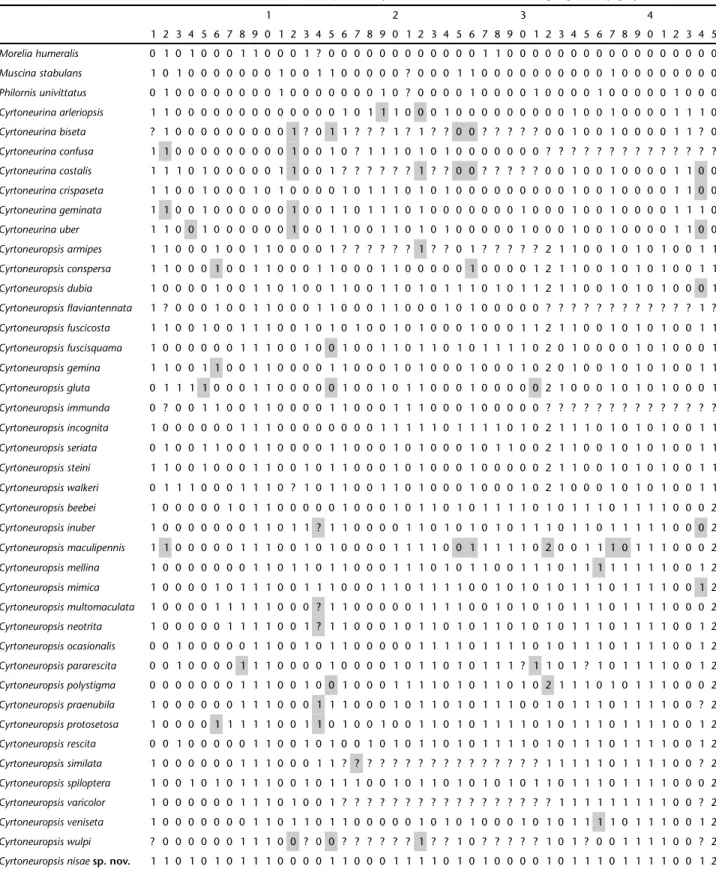
Given the problems mentioned above, we modified some character states using information available from both rede-scriptions and original derede-scriptions (SNYDER 1954, COURI 1982, 1995). A total of 52 character states were modified (Tab. I). The character coding was maintained as in the original description, except for character 11 (Pamplona 1999: 12): “Ciliae on ven-tral surface of R4+5: (0) absent; (1) present”. Upon analysis of the literature and a set of specimens, we found that the coding is inverted, therefore, (0) should be present and (1) absent.
Table I. Modified character states matrix for Cyrtoneurina and Cyrtoneuropsis. The modified states are highlighted by gray-filled cells.
1 2 3 4
1 2 3 4 5 6 7 8 9 0 1 2 3 4 5 6 7 8 9 0 1 2 3 4 5 6 7 8 9 0 1 2 3 4 5 6 7 8 9 0 1 2 3 4 5
Morelia humeralis 0 1 0 1 0 0 0 1 1 0 0 0 1 ? 0 0 0 0 0 0 0 0 0 0 0 0 1 1 0 0 0 0 0 0 0 0 0 0 0 0 0 0 0 0 0
Muscina stabulans 1 0 1 0 0 0 0 0 0 0 1 0 0 1 1 0 0 0 0 0 ? 0 0 0 1 1 0 0 0 0 0 0 0 0 0 0 1 0 0 0 0 0 0 0 0
Philornis univittatus 0 1 0 0 0 0 0 0 0 0 1 0 0 0 0 0 0 0 1 0 ? 0 0 0 0 1 0 0 0 0 1 0 0 0 0 1 0 0 0 0 0 1 0 0 0
Cyrtoneurina arleriopsis 1 1 0 0 0 0 0 0 0 0 0 0 0 0 0 1 0 1 1 1 0 0 0 1 0 0 0 0 0 0 0 0 0 1 0 0 1 0 0 0 0 1 1 1 0
Cyrtoneurina biseta ? 1 0 0 0 0 0 0 0 0 0 1 ? 0 1 1 ? ? ? 1 ? 1 ? ? 0 0 ? ? ? ? ? 0 0 1 0 0 1 0 0 0 0 1 1 ? 0
Cyrtoneurina confusa 1 1 0 0 0 0 0 0 0 0 0 1 0 0 1 0 ? 1 1 1 0 1 0 1 0 0 0 0 0 0 0 ? ? ? ? ? ? ? ? ? ? ? ? ? ?
Cyrtoneurina costalis 1 1 1 0 1 0 0 0 0 0 1 1 0 0 1 ? ? ? ? ? ? 1 ? ? 0 0 ? ? ? ? ? 0 0 1 0 0 1 0 0 0 0 1 1 0 0
Cyrtoneurina crispaseta 1 1 0 0 1 0 0 0 1 0 1 0 0 0 0 1 0 1 1 1 0 1 0 1 0 0 0 0 0 0 0 0 0 1 0 0 1 0 0 0 0 1 1 0 0
Cyrtoneurina geminata 1 1 0 0 1 0 0 0 0 0 0 1 0 0 1 1 0 1 1 1 0 1 0 0 0 0 0 0 0 1 0 0 0 1 0 0 1 0 0 0 0 1 1 1 0
Cyrtoneurina uber 1 1 0 0 1 0 0 0 0 0 0 1 0 0 1 1 0 0 1 1 0 1 0 1 0 0 0 0 0 1 0 0 0 1 0 0 1 0 0 0 0 1 1 0 0
Cyrtoneuropsis armipes 1 1 0 0 0 1 0 0 1 1 0 0 0 0 1 ? ? ? ? ? ? 1 ? ? 0 1 ? ? ? ? ? 2 1 1 0 0 1 0 1 0 1 0 0 1 1
Cyrtoneuropsis conspersa 1 1 0 0 0 1 0 0 1 1 0 0 0 1 1 0 0 0 1 1 0 0 0 0 0 1 0 0 0 0 1 2 1 1 0 0 1 0 1 0 1 0 0 1 1
Cyrtoneuropsis dubia 1 0 0 0 0 1 0 0 1 1 0 1 0 0 1 1 0 0 1 1 0 1 0 1 1 1 0 1 0 1 1 2 1 1 0 0 1 0 1 0 1 0 0 0 1
Cyrtoneuropsis flaviantennata 1 ? 0 0 0 1 0 0 1 1 0 0 0 1 1 0 0 0 1 1 0 0 0 1 0 1 0 0 0 0 0 ? ? ? ? ? ? ? ? ? ? ? ? 1 ?
Cyrtoneuropsis fuscicosta 1 1 0 0 1 0 0 1 1 1 0 0 1 0 1 0 1 0 0 1 0 1 0 0 0 1 0 0 0 1 1 2 1 1 0 0 1 0 1 0 1 0 0 1 1
Cyrtoneuropsis fuscisquama 1 0 0 0 0 0 0 1 1 1 0 0 1 0 0 1 0 0 1 1 0 1 1 0 1 0 1 1 1 1 0 2 0 1 0 0 0 0 1 0 1 0 0 0 1
Cyrtoneuropsis gemina 1 1 0 0 1 1 0 0 1 1 0 0 0 0 1 1 0 0 0 1 0 1 0 0 0 1 0 0 0 1 0 2 0 1 0 0 1 0 1 0 1 0 0 1 1
Cyrtoneuropsis gluta 0 1 1 1 1 0 0 0 1 1 0 0 0 0 0 1 0 0 1 0 1 1 0 0 0 1 0 0 0 0 0 2 1 0 0 0 1 0 1 0 1 0 0 0 1
Cyrtoneuropsis immunda 0 ? 0 0 1 1 0 0 1 1 0 0 0 0 1 1 0 0 0 1 1 1 0 0 0 1 0 0 0 0 0 ? ? ? ? ? ? ? ? ? ? ? ? ? ?
Cyrtoneuropsis incognita 1 0 0 0 0 0 0 1 1 1 0 0 0 0 0 0 0 0 1 1 1 1 1 0 1 1 1 1 0 1 0 2 1 1 1 0 1 0 1 0 1 0 0 1 1
Cyrtoneuropsis seriata 0 1 0 0 1 1 0 0 1 1 0 0 0 0 1 1 0 0 0 1 0 1 0 0 0 1 0 1 1 0 0 2 1 1 0 0 1 0 1 0 1 0 0 1 1
Cyrtoneuropsis steini 1 1 0 0 1 0 0 0 1 1 0 0 1 0 1 1 0 0 0 1 0 1 0 0 0 1 0 0 0 0 0 2 1 1 0 0 1 0 1 0 1 0 0 1 1
Cyrtoneuropsis walkeri 0 1 1 1 0 0 0 1 1 1 0 ? 1 0 1 1 0 0 1 1 0 1 0 0 0 1 0 0 0 1 0 2 1 0 0 0 1 0 1 0 1 0 0 1 1
Cyrtoneuropsis beebei 1 0 0 0 0 0 1 0 1 1 0 0 0 0 0 1 0 0 0 1 0 1 1 0 1 0 1 1 1 1 0 1 0 1 1 1 0 1 1 1 1 0 0 0 2
Cyrtoneuropsis inuber 1 0 0 0 0 0 0 0 1 1 0 1 1 ? 1 1 0 0 0 0 1 1 0 1 0 1 0 1 0 1 1 1 0 1 1 0 1 1 1 1 1 0 0 0 2
Cyrtoneuropsis maculipennis 1 1 0 0 0 0 0 1 1 1 0 0 1 0 1 0 0 0 0 1 1 1 1 0 0 1 1 1 1 1 0 2 0 0 1 1 1 0 1 1 1 0 0 0 2
Cyrtoneuropsis mellina 1 0 0 0 0 0 0 0 1 1 0 1 1 0 1 1 0 0 0 1 1 1 0 1 0 1 1 0 0 1 1 1 0 1 1 1 1 1 1 1 1 0 0 1 2
Cyrtoneuropsis mimica 1 0 0 0 0 1 0 1 1 1 0 0 1 1 1 0 0 0 1 1 0 1 1 1 1 0 0 1 0 1 0 1 0 1 1 1 0 1 1 1 1 0 0 1 2
Cyrtoneuropsis multomaculata 1 0 0 0 0 1 1 1 1 1 0 0 0 ? 1 1 0 0 0 0 0 1 1 1 1 0 0 1 0 1 0 1 0 1 1 1 0 1 1 1 1 0 0 0 2
Cyrtoneuropsis neotrita 1 0 0 0 0 0 1 1 1 1 0 0 1 ? 1 1 0 0 0 1 0 1 1 0 1 0 1 1 0 1 0 1 0 1 1 1 0 1 1 1 1 0 0 1 2
Cyrtoneuropsis ocasionalis 0 0 1 0 0 0 0 0 1 1 0 0 1 0 1 1 0 0 0 0 0 1 1 1 1 0 1 1 1 1 0 1 0 1 1 1 0 1 1 1 1 0 0 1 2
Cyrtoneuropsis pararescita 0 0 1 0 0 0 0 1 1 1 0 0 0 0 1 0 0 0 0 1 0 1 1 0 1 0 1 1 1 ? 1 1 0 1 ? 1 0 1 1 1 1 0 0 1 2
Cyrtoneuropsis polystigma 0 0 0 0 0 0 0 1 1 1 0 0 1 0 0 1 0 0 0 1 1 1 1 0 1 0 1 1 0 1 0 2 1 1 1 0 1 0 1 1 1 0 0 0 2
Cyrtoneuropsis praenubila 1 0 0 0 0 0 0 1 1 1 0 0 0 1 1 1 0 0 0 1 0 1 1 0 1 0 1 1 1 0 0 1 0 1 1 1 0 1 1 1 1 0 0 ? 2
Cyrtoneuropsis protosetosa 1 0 0 0 0 1 1 1 1 1 0 0 1 1 0 1 0 0 1 0 0 1 1 0 1 0 1 1 1 1 0 1 0 1 1 1 0 1 1 1 1 0 0 1 2
Cyrtoneuropsis rescita 0 0 1 0 0 0 0 0 1 1 0 0 1 0 1 0 0 1 0 1 0 1 1 0 1 0 1 1 1 1 0 1 0 1 1 1 0 1 1 1 1 0 0 1 2
Cyrtoneuropsis similata 1 0 0 0 0 0 0 1 1 1 0 0 0 1 1 ? ? ? ? ? ? ? ? ? ? ? ? ? ? ? ? 1 1 1 1 1 0 1 1 1 1 0 0 ? 2
Cyrtoneuropsis spiloptera 1 0 0 1 0 1 0 1 1 1 0 0 1 0 1 1 1 0 0 1 0 1 1 0 1 0 1 0 1 0 1 1 0 1 1 1 0 1 1 1 1 0 0 0 2
Cyrtoneuropsis varicolor 1 0 0 0 0 0 0 1 1 1 0 1 0 0 1 ? ? ? ? ? ? ? ? ? ? ? ? ? ? ? ? ? 1 1 1 1 1 1 1 1 1 0 0 ? 2
Cyrtoneuropsis veniseta 1 0 0 0 0 0 0 0 1 1 0 1 1 0 1 1 0 0 0 0 0 1 0 1 0 1 0 0 0 1 0 1 0 1 1 1 1 0 1 1 1 0 0 1 2
Cyrtoneuropsis wulpi ? 0 0 0 0 0 0 1 1 1 0 0 ? 0 0 ? ? ? ? ? ? 1 ? ? 1 0 ? ? ? ? ? 1 0 1 ? 0 0 1 1 1 1 0 0 ? 2
were used, and k values were 3 and 4, the topologies recovered had the outgroup taxa within the ingroup. The analysis stabi-lized at k = 5 (that is, k values five to ten yielded the same results) and 6 trees were recovered with total fit = 14.49-14.61; 190 steps; CI = 24 and RI = 70. The trees differed mainly in the relationships within the clades containing: Cyrtoneuropsis mellina (Stein, 1918), Cyrtoneuropsis varicolor (Hough 1900), Cyrtoneuropsis inuber (Giglio-Tos, 1863), Cyrtoneuropsis veniseta (Stein 1904) and Cyrtoneuropsis ocasionalis (Couri, 1982), Cyrtoneuropsis pararescita (Couri, 1995), Cyrtoneuropsis rescita (Walker, 1861).
In the discussion that follows, we present the strict con-sensus cladogram of the six fittest trees recovered (Fig. 9). Our topology substantially differs from PAMPLONA’s (1999) in the rela-tionships within both Cyrtoneurina and Cyrtoneuropsis. In PAMPLONA’s (1999) hypothesis, Cyrtoneurina uber (Giglio-Tos, 1893) is basal to the remaining Cyrtoneurina. In our hypothesis, by contrast, C. uber is placed in an apical clade as the sister group of Cyrtoneurina geminata (Stein, 1904); the basalmost species of the genus, in our topology, is Cyrtoneurina arleriopsis Couri, 1982. In the case of Cyrtoneuropsis, even though the species level rela-tionships between the two hypotheses were different, for the
Figures 9-10. Topologies recovered with the modified matrix: 9, strict consensus cladogram of the six best fit trees obtained with implied weighting (k = 5) and Cyrtoneuropsis nisae sp. nov. excluded. A-C and 1-3 are clades discussed in the Phylogeny section. Total fit = 14.49-14.61; 190 steps; CI = 24 and RI = 70. (10) Clade showing the position of Cyrtoneuropsis nisae sp. nov. (clade C) in the analysis including that species. The remaining cladogram is the same as in Fig. 9. Fittest trees obtained with implied weighting (k = 6). Total fit = 13.34-13.45; length = 192-194 steps; CI = 24; RI = 69.
10
most part species clustered in groups that are similar in compo-sition. For example, PAMPLONA’s (1999) clade (Cyrtoneuropsis ocasionalis, (C. pararescita, C. rescita)) was recovered in our analysis as (C. pararescita, (C. ocasionalis, C. rescita)). On the other hand, the positions of some species are radically different. For instance, Cyrtoneuropsis maculipennis (Macquart, 1843), which clustered with Cyrtoneuropsis praenubila (Snyder, 1954) and C. spiloptera in Pamplona’s topology, in the present study is the sister-group of the clade indicated by letter A (Fig. 9). It is in the clade indicated by letter B (Fig. 9), however, that most differences are concen-trated. Cyrtoneuropsis similata (which clustered with C. mimica and C. multomaculata in Pamplona’s topology), clustered with (C. spiloptera, (C. similata, C. praenubila)) in our data. The species C. wulpi, C. beebei, C. protosetosa, C. neotrita, C. mimica and C. multomaculata, which were in three independent clades in Pamplona’s topology, are successive sisters in ours.
The analysis using equal weights in the modified matrix with Cyrtoneuropsis nisae sp. nov. resulted in 551 trees with 190 steps. A total of 25 nodes were collapsed in the strict con-sensus cladogram, leaving 13 informative nodes. When implied weights was used, low k values (3-5) resulted in topologies in which the outgroup was within the ingroup. The analysis sta-bilized when k was set to six. Six topologies were recovered, with total fit = 13.34-13.45; length = 192-194 steps; CI = 24; RI = 69. In all analyses under equal and implied weighting, Cyrtoneuropsis spiloptera is the sister species of Cyrtoneuropsis nisae sp. nov. The addition of Cyrtoneuropsis nisae sp. nov. pro-moted a single change in the fittest trees recovered using the modified matrix (clade C, Fig. 9): Cyrtoneuropsis spiloptera is now the sister species of C. nisae sp. nov., and they form a monophyletic clade with the sister species C. praenubila and C. similata (Fig. 10). In spite of the aforementioned differences, the hypothesis of monophyly was corroborated for both gen-era. Furthermore, even though our topology differed from PAMPLONA’S (1999), the main trends in character evolution re-covered by both hypotheses are not significantly different.
One of the most interesting characters in the phylogeny of Cyrtoneuropsis is the general shape of the ovipositor. Cyrtoneurina has a delicate, narrow and long ovipositor, whereas Cyrtoneuropsis has a less delicate and wider ovipositor. The ovi-positor in the clade represented by number 1 (Fig. 9) is medium-sized, but in clade 2 it is shorter. Also, all Cyrtoneuropsis lost the setae on the intersegmental membranes. The wider and shorter ovipositor is associated with the habit of larviposition (MEIER et al. 1999). Though the biology of most species is unknown, we conjecture that species of Cyrtoneurina lay eggs and those of Cyrtoneuropsis lay larvae (SNYDER 1954). Cyrtoneuropsis maculipennis and Cyrtoneuropsis polystigma (Wulp, 1896) were found to bear a single third instar larva (SNYDER 1954). Species in clade 2 also have spicules on sternite VIII, whereas species in clade 3 have strong spines instead. We hypothesize that these spicules and spines are associated with shifts in the reproductive strategy, but this conjecture will require further study.
The consistency index (CI) of the analysis of Pamplona’s original matrix was 27 (PAMPLONA 1999), whereas that obtained with our modified matrix was 25. This low CI value indicates a high degree of homoplasy in our data (KLUGE & FARRIS 1969). Thus, our data should be re-evaluated against other character systems with a stronger phylogenetic signal.
ACKNOWLEDGEMENTS
We are grateful to Márcia Souto Couri (MNRJ) for help-ing us to define the methodology of the phylogenetic reanaly-sis. We are also in debt with her for reviewing some Cyrtoneuropsis species that were not available in DZUP. We ac-knowledge Augusto L. Henriques (INPA) for loaning part of the material used in this study and Rosaly Ale-Rocha (INPA) for allowing the examination of material and letting us use her laboratory. We are grateful to the Conselho Nacional de Desenvolvimento Científico e Tecnológico (CNPq) for gradu-ate scholarship (process number 157808/2010-6) and grant (process number 304713/2011-2). We are thankful to Taxonline – Rede Paranaense de Coleções Biológicas for taking photo-graphs of the specimens and to the Willi Hennig Society for the sponsorship of the TNT license. This is the contribution number 1875 of the Departamento de Zoologia da Universidade Federal do Paraná, Curitiba, Brazil. James J. Roper reviewed and revised the English.
LITERATURE CITED
DE CARVALHO, C.J.B. 1989. Revisão das espécies e posição siste-mática de Palpibracus Rondani (Diptera, Muscidae). Revista Brasileira de Zoologia 6 (2): 325-376. doi: 0.1590/S0101-81751989000200016.
DE CARVALHO, C.J.B.; M.S. COURI; A.C. PONT; D.M. PAMPLONA & S.M. LOPES. 2005. A Catalogue of the Muscidae (Diptera) of the Neotropical Region. Zootaxa 860: 1-282.
COURI, M.S. 1982. Adenda ao trabalho de Snyder. 1954 sobre Cyrtoneurina Giglio-Tos 1893 (Diptera, Muscidae, Cyrtoneu-rininae). Revista Brasileira de Entomologia 26 (1): 37-53. COURI, M.S. 1995. Uma nova espécie de Cyrtoneurina Giglio-Tos do Brasil (Diptera, Muscidae). Revista Brasileira de Zoologia 12 (2): 229-232. Doi: 10.1590/S0101-81751995000200001. COURI, M.S.; G.P. DA S. BARROS & M.P. ORSINI. 2008. Descrição de
uma nova espécie de Cyrtoneuropsis Malloch 1925 (Diptera, Muscidae) e primeiro registro do gênero no estado do Maranhão, Brasil. Arquivos do Museu Nacional, Rio de Janeiro 66 (2): 351-353.
COURI, M.S. & C.J.B. DE CARVALHO. 2002. Part II. Apical groups, p. 133-262. In: C.J.B. DE CARVALHO (Ed.). Muscidae (Diptera) of the Neotropical Region. Curitiba, Editora Universidade Federal do Paraná, 287p.
and allied genera (Diptera, Muscidae). Brazilian Journal of Biology 63 (2): 223-232. doi: 10.1590/S1519-69842003000 200007.
COURI, M.S. & V.R. DE SOUSA. 2011. A new Cyrtoneuropsis Malloch from Brazil (Diptera, Muscidae). Revista Brasileira de Entomologia 55 (4): 565-567. doi: 10.1590/S0085-56262011000400011.
GOLOBOFF, P. 1993. Estimating character weights during tree search. Cladistics 9 (1): 83-91. doi: 10.1111/j.1096-0031. 1993.tb00209.x.
GOLOBOFF, P.; S. FARRIS & K. NIXON. 2008. TNT, a free program for phylogenetic analysis. Cladistics 24 (5): 774-786. doi: 10.1111/j.1096-0031.2008.00217.x.
KLUGE, A.G. & J.S. FARRIS. 1969. Quantitative phyletics and the evolution of Anurans. Systematic Zoology 18 (1): 1-32. MALLOCH, J.R. 1925. Exotic Muscaridae (Diptera) XVI. The
Annals and Magazine of Natural History 9 (16): 81-100. MCALPINE, J.F. 1981. Morphology and Terminology – adults, p.
9-63. In: J.F. MCALPINE; B.V. PETERSON; G.E. SHEWELL; H.J. TESKEY; J.R. VOCKEROTH & D.M. WOOD (Eds). Manual of Nearctic Diptera. Ottawa, Agriculture Canada Research Branch, vol. 1, 674+VI.
MEIER, R.; M. KOTRBA & P. FERRAR. 1999. Ovoviviparity and vivi-parity in the Diptera. Biological Reviews 74 (3): 199-258. doi: 10.1111/j.1469-185X.1999.tb00186.x.
NIHEI, S.S. & C.J.B. DE CARVALHO. 2007. Phylogeny and classi-fication of Muscini (Diptera, Muscidae). Zoological Journal of the Linnean Society 149 (4): 493-532. doi: 10.1111/ j.1096-3642.2007.00252.x.
NIXON, K.C. 2002. WinClada version 1.00.08. Ithaca, Published by the author.
PAMPLONA, D.M. 1999. Nova caracterização de Cyrtoneurina Giglio-Tos, 1893 e descrição de Paracyrtoneurina gen. nov. (Diptera, Muscidae). Revista Brasileira de Entomologia 43 (1/2): 9-24.
PONT, A.C. & D.M. PAMPLONA. 2000. A note on the genus Para-cyrtoneurina Pamplona, 1999 (Diptera, Muscidae). Studia Dipterologica 7 (1): 223-224.
SNYDER, F.M. 1954. Revision of Cyrtoneurina Giglio-Tos, with notes on related genera (Diptera, Muscidae). Bulletin of the American Museum of Natural history 103: 1-63. STUCKENBERG, B.R. 1999. Antennal evolution in the Brachycera
(Diptera), with the reassessment of terminology relating to the flagellum. Studia dipterologica 6 (1): 33-48.