Nauplius
THE JOURNAL OF THE
BRAZILIAN CRUSTACEAN SOCIETY
e-ISSN 2358-2936 www.scielo.br/nau www.crustacea.org.br
Populations of Flavalona setigera
(Brehm, 1931) in Brazil belong to a new
species: Flavalona asymmetrica (Cladocera:
Chydoridae: Aloninae)
Francisco Diogo Rocha Sousa
1,2Lourdes M. A. Elmoor-Loureiro
11Laboratório de Ecologia de Ecossistemas, Departamento de Ecologia, Universidade
de Brasília – UnB, Campus Darcy Ribeiro. 70910-900, Brasília, DF, Brazil.
2Laboratório de Biodiversidade Aquática, Universidade Católica de Brasília – UCB. QS7 lote 1, Bloco M, sala 204, 71966-700, Taguatinga, DF, Brazil.
ZOOBANK htt p://zoobank.org/urn:lsid:zoobank.org:pub:CF9D6AA7-0EE6-40A8-9E03-639237D2AD73
ABSTRACT
Flavalona asymmetrica sp. nov. belongs to the costata-clade. Th is species has two main head pores, a feature shared only with Flavalona setigera (Brehm, 1931). Morphological differences between them are related to main and lateral head pores, armature of scrapers on the second limb, and proportion of setae on the third and fourth limbs, number of denticles on the postabdomen. Males of F. asymmetrica sp. nov. has genital process about ten times shorter than length of postabdominal claw, which is an exclusive morphological trait. Flavalona asymmetrica sp. nov. is a Neotropical species, so far, it occurs only in Brazil and can be found together with Flavalona iheringula (Sinev & Kotov, 2004) and Flavalona margipluma (Sousa, Santos, Güntzel, Diniz-Filho, de Melo-Júnior & Elmoor-Loureiro, 2015).
KEY WORDS
Amphi-Pacifi c distribution,Biapertura, main head pores, postabdomen.
INTRODUCTION
Th e genus Flavalona Sinev & Dumont, 2016 was created to allocate species of the costata-group from the Hexalona-branch (Sinev and Dumont, 2016). Until now, the genus has been composed of 11 valid species which share, as a main morphological trait, lateral head pores with deep sacs underneath them (Sinev, 1999a; 2001; 2008; 2009; Kotov and Sinev, 2004; Van Damme
et al., 2011a; Van Damme and Eggermont, 2011; Sousa et al., 2015a; Sinev and Dumont, 2016). In the Neotropics, there are four species: Flavalona hudeci (Sinev, 1999), Flavalona iheringula (Kotov & Sinev, 2004), Flavalona
Nauplius
CORRESPONDING AUTHOR
Francisco Diogo Rocha Sousa
SUBMITTED 5 June 2017
ACCEPTED 7 November 2017
PUBLISHED 19 February 2018
DOI 10.1590/2358-2936e2018003 CORRESPONDING AUTHOR
orcid.org/0000-0003-4389-8140
orcid.org/0000-0001-7439-9753
margipluma (Sousa, Santos, Güntzel, Diniz-Filho, de Melo-Júnior & Elmoor-Loureiro, 2015), and Flavalona setigera (Brehm, 1931). The last three species co-occur in Brazilian water bodies (Sousa and Elmoor-Loureiro, 2012; 2013; Sousa et al., 2013; 2014).
Flavalona setigera was reported for the first time in the Neotropics by Santos-Wisniewski et al. (2001) from samples collected in São Paulo state, Brazil (Santos-Wisniewski et al., 2002; Rocha et al., 2011). Later, it was reported from other localities in southeastern and central Brazil (Sousa and Elmoor-Loureiro, 2012; 2013; Sousa et al., 2013; 2014). However, the validity of Neotropical populations of F. setigera is questionable (Sinev and Dumont, 2016) because itis an Australasian species and this fact does not agree with the concept of non-cosmopolitanism in cladocerans (Frey, 1982). Thus, the aim of this study is to evaluate putative F. setigera specimens from Brazil and to describe a new species of Flavalona.
MATERIAL AND METHODS
Morphological analyses
The animals selected for this study were taken to a binocular stereomicroscope, where they were put in glycerin slides and studied under a phase contrast Olympus BX41 microscope. Several individuals were dissected for the observation of the appendages. The organization of morphological structures followed suggestions from Van Damme (2016). To enumerate the limb setae, we adopted the homology criteria of Kotov (2000a; 2000b), which exhibited stability when tested in different groups of Cladocera (Kotov et al., 2010). All drawings were made in a camera lucida.
Abbreviations in the text, figures and table
as - accessory seta;
CBS - copulatory brush seta; en - endite; ep - epipodite; ex - exopodite;
fc - filter comb;
gfp - gnathobasic filter plate; gn - gnathobase;
IP - interpore distance (distance between anterior and posterior major head pores);
IDL - inner distal lobe; il - inner lobe; ms - male seta; ODL - outer distal lobe;
PA - postabdomen; pep - pre-epipodite;
PP - postpore distance (distance between the posterior major head pore and the posterior border of the head shield);
P1 - first limb; P2 - second limb; P3 - third limb; P4 - fourth limb; P6 - sixth limb; s - sensillum;
EL - Personal collection of Lourdes M. A. Elmoor-Loureiro;
FDRS - Personal collection of Francisco Diogo Rocha Sousa;
MZUSP - Museu de Zoologia da Universidade de São Paulo, Brazil.
SYSTEMATICS
Class Branchiopoda Latreille, 1817
Order Anomopoda Sars, 1865
Family Chydoridae Dybowski & Grochowski, 1894 emend. Frey 1967
Subfamily Aloninae Dybowski & Grochowski, 1894 emend. Frey, 1967
Genus Flavalona Sinev & Dumont, 2016
Flavalona asymmetrica sp. nov.
(Figs. 1–4)
Alona setigera—Santos-Wisniewski et al., 2001: p. 702, fig. 1; Santos-Wisniewski et al., 2002: p. 604; Rocha
et al., 2011: p. 289; Sousa and Elmoor-Loureiro, 2012: p. 356; Sousa and Elmoor-Loureiro, 2013: p. 7; Sousa et al., 2013: p. 226; Sousa et al., 2014: p. 147 [not Flavalona setigera (Brehm, 1931)].
Type locality. Inhacica River, Parque Nacional das Sempre Vivas, Diamantina, Minas Gerais, Brazil (17º50’’11”S 43º45’58”W).
ethanol deposited at the Museu de Zoologia da Universidade de São Paulo, Brazil under access number MZUSP 35347. The label of holotype is:
Flavalona asymmetrica, 1 parthenogenetic ♀ from Inhacica River, Parque Nacional das Sempre Vivas,
Brazil. Holotype. Paratypes. 6 parthenogenetic
females, Inhacica River, Parque Nacional das Sempre Vivas, Diamantina, Minas Gerais, Brazil (17º50’11”S 43º45’58”W), Francisco Diogo Rocha Sousa coll., 14/ IX/2010 (FDRS0508); 2 parthenogenetic females, Jequitaí River, Parque Nacional das Sempre Vivas, Diamantina, Minas Gerais, Brazil (17°54’8.64”S 43°45’40.28”W), Adriana Marinho Fernandes coll., 03/V/2010 (EL0186); 3 parthenogenetic females, Jequitaí River, Parque Nacional das Sempre Vivas, Diamantina, Minas Gerais, Brazil (17°54’8.64”S 43°45’40.28”W), Adriana Marinho Fernandes coll., 03/V/2010 (FDRS0507); 4 parthenogenetic females, Preto River, Parque Nacional das Sempre Vivas, Diamantina, Minas Gerais, Brazil (17°55’54.01”S 43°48’50.33”W), Adriana Marinho Fernandes coll., 02/V/2010 (EL01850); 2 parthenogenetic females, Exército Pond, Parque Nacional de Brasília, Distrito Federal, Brazil (15°44’44.30”S 47°58’49.10”W), Francisco Diogo Rocha Sousa coll., 1/IV/2008 (EL01724); 2 parthenogenetic females, Exército Pond, Parque Nacional de Brasília, Distrito Federal, Brazil (15°44’44.30”S 47°58’49.10”W), Francisco Diogo Rocha Sousa coll., 16/VIII/2009 (FDRS0471). 1 parthenogenetic female, Peito de Moça wetland, Parque Nacional de Brasília, Distrito Federal, Brazil (15°45’5.8”S 48°01’33.2” W), Francisco Diogo Rocha Sousa coll., 17/VIII/2009 (FDRS473); 7 parthenogenetic females, Peito de Moça wetland, Parque Nacional de Brasília, Distrito Federal, Brazil (15°45’5.8”S 48°01’33.2”W), Lourdes Maria Abdu Elmoor-Loureiro coll., 15/IV/2009 (EL01727); 1 parthenogenetic female. Henrique Pond, Parque Nacional de Brasília, Distrito Federal, Brazil (15°41’18”S 47°56’26.10”W), Francisco Diogo Rocha Sousa coll., ?/VIII/2009 (FDRS0474); 1 parthenogenetic female, Murunduns Wetlands, Parque Nacional de Brasília, Distrito Federal, Brazil (15°46’ 42”S 47°58’34”W), material collected by Grupo de Estudos de Ecossistemas Aquáticos, 17/VII/2009 (EL01684); 4 parthenogenetic females, Cedro Pond, Park Way, Distrito Federal, Brazil (15°53’50.2”S
Figure 4. Species of Flavalona co-occurring in water bodies from Brazil. A, Flavalona asymmetrica sp. nov., parthenogenetic female; B, idem - ephippial female; C, Flavalona iheringula (Sinev & Kotov, 2004); D, idem - head shield; E, idem - head pores; F, idem - postabdomen; G, Flavalona margipluma (Sousa, Santos, Guntzel, Diniz-Filho, de Melo-Júnior & Elmoor-Loureiro, 2015); H, idem
Lourdes Maria Abdu Elmoor-Loureiro coll., 15/ XI/2002 (EL01365); 1 parthenogenetic females, Pico Itapeva Dam, Campos do Jordão, São Paulo, Brazil (22°46’25.2”S 45°33’24.1”W), Lourdes Maria Abdu Elmoor-Loureiro coll., 15/XI/2002 (EL01366).
Etymology.The epithet comes from joining the Greek prefix “a” (absence) and Latin word “symmetria” (symmetry). The name makes reference to the rim around the posterior pore, which is broader than the connection around the anterior one.
Differential diagnosis.Flavalona asymmetrica sp. nov. has two main head pores, differently from Flavalona costata (Sars, 1862), Flavalona cheni (Sinev, 1999),
Flavalona natalensis (Sinev, 2008), F. margipluma,
Flavalona weltneri (Kilhack, 1905), Flavalona rustica
(Scott, 1895), Flavalona bicolor (Frey, 1965), F. hudeci, F. iheringula and Flavalona sphagnophila (Van Damme & Eggermont, 2011). Regarding the females,
F. asymmetrica sp. nov. is differentiated from F. setigera
because it has the rim around the posterior pore broader than anterior one, PP about 0.7 IP, deep and elliptic sacs about 0.6 of length of the lateral pores; long seta 1 of IDL on the first limb; second limb with scrapers 7–8 armed with denticles; third limb with first exopodite seta about 0.7 of length of the second seta; fourth limb with exopodite setae 4–5 of similar lengths; epipodite of the fifth limb with long projection; sixth limb about 2.4 times longer than wide with setulae on the margins; postabdomen armed with up to nine marginal denticles. Regarding the males, F. asymmetrica
sp. nov. is differentiated from F. setigera because it has
seta of the copulatory brushmarkedly shorter than
setae 2–3 of IDL, postabdomen armed with marginal setulae on the distal and anal margins not separated in groups, basal spine present and genital process about ten times shorter than length of postabdominal claw.
Description of parthenogenetic female. General
Habitus (Fig. 1A–C). Body more elongate than
spherical, length 0.37–0.45 mm, maximum height at middle of body, height/length ratio about 0.6; dorsal margin arched, without dorsal keel or lateral projection; in dorsal and ventral view body not laterally compressed.
Carapace (Fig. 1A–F). With slight longitudinal lines; ventral margin almost straight; each valve with 49–52 plumose setae and relatively long setulae between them; setae arranged in three groups, anterior and posterior groups longer than median group; internal spinulae of the posterior part not arranged in groups, proximal spinulae exceeding the line of valves.
Cephalic structures (Fig. 1G–N). Ocellus shorter than eye; rostrum short and not sharp in lateral view.
Head shield (Fig. 1G–J). About 1.6 times longer than wide, posterior part (posterior to mandibular articulations) about 0.52 of length of the anterior part, posterior margin strongly arched; rostrum short with margin rounded; two connected main head pores, rim around the posterior pore about 1.3 times broader than the anterior one; PP about 0.7 IP; transverse lateral head pores about 0.7–0.9 IP and located at the level of posterior main head pore or between posterior and anterior main head pores, deep and elliptic sacs underneath about 0.6 of length of the lateral pores.
Labrum (Fig. 1K). Of moderate size; keel without a notch, anterior margin convex, posterior margin with two clusters of setulae. Maxilla (Fig. 1L). Well developed, with two long setulated setae. Antennule
– A1 (Fig. 1M). Antennular body length about 2.2
times the width, does not exceeding tip of rostrum, with three rows of setulae; antennular sensory seta slender, about three times shorter than antennular body, inserted at the second third of the antennular body; nine aesthetascs projecting beyond the tip of rostrum, two aesthetascs about 1.4 times longer than the others. Antenna – A2 (Fig. 1N). Coxal setae of similar length; basal segment thick with a short spine; first exopodite segment slightly longer than first segment of endopodite; second exopodite segment armed with long setulae on the tip and a seta about 0.45 of the length of longest apical seta; first endopodite segment armed with a spine slightly shorter than second segment; apical spines longer than length of apical segments. Antennal formula (exo/endo): spines 001/101, setae 113/003.
setulae, similar in length to IDL setae; IDL (en 4) with three setae, first seta about 3.5 times shorter than setae 2–3, setae 2–3 bisegmented and armed with hard setulae; endite 3 with four setae, seta 1 markedly shorter than posterior setae (a–c), setae (a–b) of similar length and slightly longer than seta (c); endite 2 with a row of long spinulae, three posterior setae present (d–f), setae (d–e) of similar length and about 0.8 of the length of seta (f), setae (e–f) bearing spinulae on the lateral face, anterior stiff seta short, about 0.16 of setae (d–e); endite 1 with three posterior setae (g–i), two being bisegmented and densely setulated from to distal part (g–h), a short flat plumose seta (i), anterior stiff seta about 0.24 of setae (d–e); ejector hooks of different length and armed with short spines; ventral face of the limb with seven groups of setulae organized in clusters, decreasing in length towards the distal portion; gnathobase elongated, apex sharp and setulated. Second limb (Fig. 2C, D). Exopodite elongated with a row of short setulae, seta on the exopodite about 0.57 of length of exopodite itself; inner limb portion armed with eight scrapers; scrapers 1–2 of similar length and armed with fine and short spinulae, scrapers 3–8 decreasing in length towards to gnathobase; scraper 3 armed with spines; scraper 7 armed with strong denticles, about 1.4 times shorter than scraper 6; scraper 8 armed with strong denticles, about 1.8 shorter than scraper 6; proximal portion of gnathobase wide and short, armed with short setulae; distal portion armed with four elements, first as a short sensillum, second and third elements with blunt distal portion, fourth element short and obtuse; filter comb with seven setae, first one short and densely setulated, others long and slightly setulated. Third limb (Fig. 2E, F). Epipodite elongated, without projection; exopodite relatively large, subquadrangular, with five distal and two lateral setae; sixth and seventh setae setulated, short and of similar length; fifth seta about 1.8 times longer than first seta and 1.4 times longer than second seta; fourth seta slightly longer than third seta; First seta about 0.7 of length of the second, both naked; distal endite with three setae (1–3), seta (1–2) scraper-like, seta (3) curved and armed with many setulae bilaterally implanted; four long and plumose posterior setae increasing in length toward to posterior part of the endite (a–d); basal endite with four soft anterior setae slightly increasing in length towards
the gnathobase (4–7); gnathobase armed with three elements, the first being a cylindrical sensillum, the second a geniculated and relatively short seta, third and fourth elements naked and with acute tip; filter comb with seven setae. Fourth limb (Fig. 2G–I). Pre-epipodite rectangular, densely setulated; epipodite oval with a long projection; exopodite subquadrangular with six marginal setae; setae 3–6 plumose; sixth seta about two times longer than the third and slightly longer than fourth and fifth setae; third seta about 0.53 of length of the fourth and fifth setae and about 0.7 of length of the second seta; first seta markedly shorter than second seta; distal endite with four setae (1–4), one scraper-like (1), three flaming-torch-like (3–4); first flaming-torch ticker than the others and armed with long setulae; gnathobase armed with a bottle-shaped sensillum and a setulated seta shorter than width of endite; filter comb with five setae. Fifth limb (Fig. 2J). Pre-epipodite short and rounded, densely setulated; epipodite oval with long projection; exopodite clearly divided in two lobes; four plumose setae; third seta about 0.9 of length of the fourth seta; second seta about 0.75 of length of the fourth seta; first seta about 0.46 of length of the second seta; internal lobe elongated, relatively oval and armed with many setulae, two setulated setae of different length on inner face of the lobe, seta 1 about 0.9 of length of the seta 2; gnathobase armed with two elements; filter comb with three setae about two times shorter than seta 1 of internal lobe.
Sixthlimb (Fig. 2K). An elongated lobe, about 2.4 times longer than wide; apical and lateral margins armed with long setulae.
times shorter than postabdomen length. Postabdominal claw (Fig. 3A, B). About 0.3 of the length of the postabdomen and longer than anal margin, base armed with short spinulae; inner pecten with distalmost spinulae longer than proximalmost ones; outer pecten with spinulae of similar length. Basal spine (Fig. 3A, B). Naked, not inserted on the base of postabdominal claw, about 0.1 of length of the postabdominal claw, similar to width of postabdominal claw at its base.
Description of ephippial female (Fig. 4B). Length 0.37–0.46 mm, maximum height at middle of body, height/length ratio about 0.6; dorsal margin arched, without dorsal keel, not laterally compressed; carapace on the region of ephippium covered by longitudinal lines, yellow-brown.
Description of male.General Habitus and Carapace
(Fig. 3C, D). Lower than female, length up 0.35 mm, about 1.7 times longer than height; maximum height near to middle of body; without dorsal keel; not laterally compressed; carapace with slight longitudinal lines; ventral margin almost straight; each valve with 40–44 plumose setae and relatively long, setulae between of them; setae arranged in three groups, anterior and posterior groups longer than median group.
Cephalic structures (Fig. 3E–G).Ocellus shorter than eye; rostrum short and not sharp in lateral view.
Head shield (Fig. 3E). Two connected main head pores, rim around the posterior pore about 1.3 times broader than the anterior one; PP about 0.5 IP; transverse lateral head pores about 0.62 IP and located at the level between posterior and anterior main head pores, deep and elliptic sacs underneath of similar length to the lateral pores. Labrum (Fig. 3F). Shorter than in female; keel more rounded than in female, without a notch, anterior margin convex, posterior margin with two clusters of setulae. Antennule – A1 (Fig. 3G). Antennular body length about two times width, does not exceeding tip of rostrum; antennular sensory seta slender, about two times shorter than antennular body, inserted at the last third of the antennular body; twelve aesthetascs projecting beyond the tip of rostrum; male seta about 3 times shorter than antennular body.
Thoracic structures (Fig. 3H, I).First limb with copulatory hook U-shaped; arms of different lengths,
not projected one over the other, scales present on the tip; seta of the copulatory brushabout 0.8 of the length of the male seta on the IDL (en 4); seta of the ODL about 1.3 times longer than IDL setae (2–3); IDL with two setae (2–3) of similar length and armed with short hard setulae; male seta about 0.7 of length of the IDL setae; five clusters of long setulae inserted on the body of the limb.
Abdominal and Postabdnominal structures
(Figs. 3C, 3J). Abdomen (Fig. 3C). Shorter than thorax, armed with three rows of abdominal setae.
Postabdomen (Fig. 3J). About 2.9 times as long as wide, narrowing distally; anal margin about 1.3 times longer than postanal; anal and postanal margin armed with short setulae not arranged in groups; nine lateral fascicles armed with thin spinulae; genital process about ten times shorter than length of postabdominal claw; postabdominal seta about 1.4 times shorter than postabdomen length. Postabdominal claw (Fig. 3J). Smaller and more robust than in the female, about 0.2 of the length of the postabdomen, slightly shorter than preanal margin; inner pecten with distalmost spinulae longer than proximalmost ones; outer pecten with spinulae of similar length. Basal spines (Fig. 3J). Very short and thin.
Remarks. The juveniles of F. asymmetrica sp. nov. presented variability in the morphology of main head pores (Fig. 1J). Flavalona asymmetrica sp. nov. can be found associated with macrophytes in different types of water bodies, such as dams, shallow lakes, ponds and lotic systems. Flavalona asymmetrica sp. nov. co-occurs with F. iheringula (Fig. 4C–F) and F. margipluma (Fig. 4G–J) (Santos-Wisniewski et al., 2002; Sousa and Elmoor-Loureiro, 2012; 2013; Sousa et al., 2013).
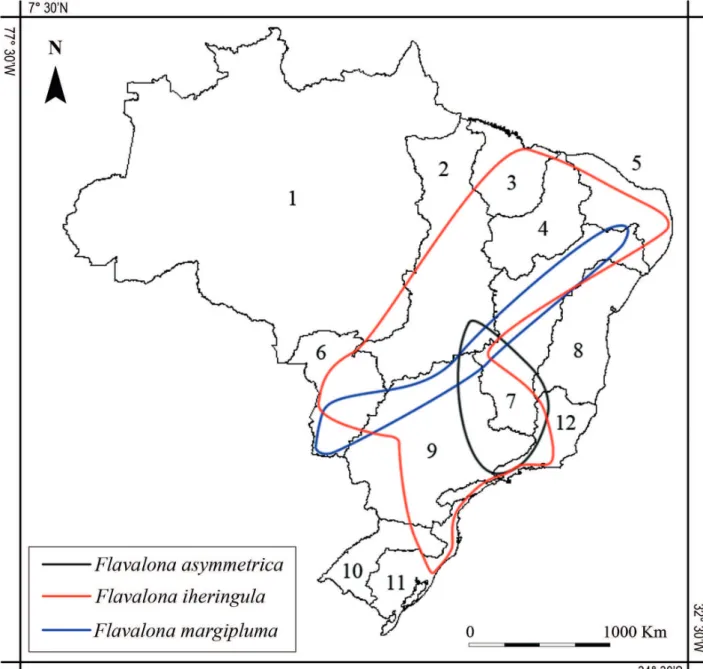
Distribution.So far, Flavalona asymmetrica sp. nov. was observed from Southeast to Central Brazil (Distrito Federal, Goiás, Minas Gerais and São Paulo). A wider distribution in Neotropics is expected. To distribution on the hydrographic regions, see Fig. 5.
DISCUSSION
When revising the costata-group of
Hexalona-branch, Sinev and Dumont (2016) separated Flavalona
Figure 5. Approximated geographical range of Flavalona species in Brazil. The map presents the delimitation of Hydrographic Regions according to Resolution 32 from Conselho Nacional de Recursos Hídricos. 1 - Amazônica; 2 - Tocantins/Araguaia; 3 - Atlântico Nordeste Ocidental; - 4 Parnaíba; 5 - Nordeste Oriental; 6 - Paraguai; 7 - São Francisco; 8 - Atlântico Leste; 9 - Paraná; 10 - Uruguai; 11 - Atlântico Sul; 12 - Atlântico Sudeste.
morphology of lateral head pores and postabdomen
of both females and males. Flavalona asymmetrica
sp. nov. shares many important morphological traits with the costata-clade: (i) valves with pronounced linear sculpture, (ii) very elongated lateral head pores with length over 0.5 IP, (iii) distalmost setulae of each fascicle of the postabdomen thicker than others, (iv) genital process of the postabdomen male is short. The costata-clade is also composed of F. costata, F. cheni, F. natalensis, F. margipluma, and F. weltneri which
are easily differentiated from F. asymmetrica sp. nov.
in the morphology of main head pores. Flavalona
asymmetrica sp. nov. has two main head pores while the aforementioned species have three (see Sinev and Dumont, 2016).
Within the costata-clade, the presence of two main head pores is only shared by F. asymmetrica sp. nov. and
Smirnov, 1971 genus by Smirnov and Tims (1983). Currently, it is a consensus that Biapertura correspond to an artificial assemblage with many different lineages (see Frey, 1987; Sinev, 1999a; Van Damme et al., 2011b; Sinev and Dumont, 2016; Sousa et al., 2015b; Sousa et al., 2016a). Flavalona asymmetrica sp. nov. and F. setigera
are distributed along trans-Pacific areas, with F. setigera
occurring in Australia, Indonesia, Tasmania, New Zealand, and some Pacific oceanic islands (Smirnov and Tims, 1983; Sinev, 1999a; Van Damme and Sinev, 2013; Sinev and Dumont, 2016). Flavalona asymmetrica
sp. nov. is endemic from the Neotropics. Trans-Pacific distribution is not common in Cladocera, however, a similar pattern known as Amphi-Pacific disjunction was mentioned as a strong hypothesis of divergence between species of Leydigiopsis Sars, 1901 (Van Damme and Sinev, 2013), brandorffi-clade of Anthalona Van Damme, Sinev & Dumont, 2011 (Tiang-nga et al., 2016), and Magnospina Sousa, Elmoor-Loureiro &
Santos, 2016 (Sousa et al., 2016b; Van Damme and
Sinev, 2013).
The antiquity of Cladocera taxa of different ranks (Frey, 1987; Kotov and Taylor, 2011; Van Damme and Kotov, 2016) suggest that important morphological differences are expected between groups with divergence related to large-scale biogeographical pattern, for instance, Neotropical Magnospina dentifera
(Sars, 1901) versus South-East Asian Magnospina
siamensis (Sinev & Sanoamuang, 2007) (Sinev et al., 2004; Sinev and Sanoamuang, 2007; Sousa et al., 2016b). In the case of F. asymmetrica sp. nov. and F. setigera, morphological differences are observed in
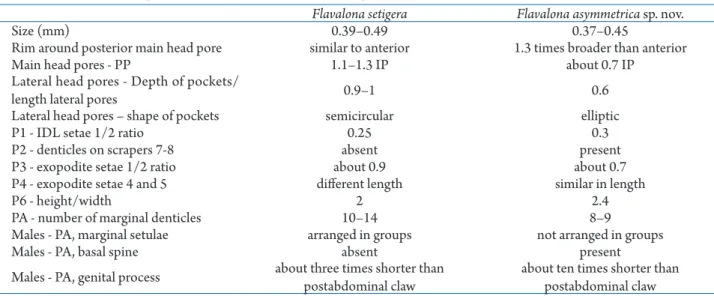
many structures and might be in part explained by biogeographical divergence. The rim of posterior main head pore about 1.3 times broader than anterior, PP about 0.7 IP, deep and elliptic sacs about 0.6 of length of the lateral pores (Fig. 1G, H). In F. setigera the main head pores has similar morphology, PP about 1.1– 1.3 IP, semicircular sacs with length similar to lateral pores (Sinev and Dumont, 2016). The most important differences in the limbs of F. setigera and F. asymmetrica
sp. nov. are related to length of seta 1 of IDL on the first limb, armature of scraper 3, 7–8 on the second limb, and ratio between first and second setae of third limb exopodite (Tab. 1). The main difference observed in the postabdomen of F. asymmetrica sp. nov. is the presence of eight to nine marginal denticles, while F. setigera has 10–14 marginal denticles (Sinev, 1999a; Sinev and Dumont, 2016).
Some studies have confirmed the potential of male morphology to distinguish species, and it is considered very important to the systematics of Chydoridae (Sinev, 1999b; 2013; 2015; Sinev and Sanoamuang, 2011; Sinev and Shiel, 2012; Kotov and Fuentes-Reines, 2015; Sousa et al. 2016b; 2016c). Males of F. asymmetrica sp. nov. have important differences from F. setigera males, for example: (i) they differ in length (0.37–0.46 in F. asymmetrica sp. nov. and 0.55–0.58 in F. setigera); (ii) setae 2–3 of IDL in F. asymmetrica sp. nov. are about 1.5 times shorter than females while in F. setigera this proportion is about 2; (iii) in F. asymmetrica sp. nov. the seta of the copulatory brushis markedly shorter than setae 2–3 of IDL, while in F. setigera this seta has similar length to IDL setae (Sinev, 1999a; Sinev and
Table 1. Main morphological differences between Flavalona setigera (Brehm, 1931) and Flavalona asymmetrica sp. nov.
Flavalona setigera Flavalona asymmetrica sp. nov.
Size (mm) 0.39–0.49 0.37–0.45
Rim around posterior main head pore similar to anterior 1.3 times broader than anterior Main head pores - PP 1.1–1.3 IP about 0.7 IP
Lateral head pores - Depth of pockets/
length lateral pores 0.9–1 0.6
Lateral head pores – shape of pockets semicircular elliptic
P1 - IDL setae 1/2 ratio 0.25 0.3
P2 - denticles on scrapers 7-8 absent present P3 - exopodite setae 1/2 ratio about 0.9 about 0.7 P4 - exopodite setae 4 and 5 different length similar in length
P6 - height/width 2 2.4
PA - number of marginal denticles 10–14 8–9
Males - PA, marginal setulae arranged in groups not arranged in groups Males - PA, basal spine absent present Males - PA, genital process about three times shorter than
postabdominal claw
Dumont, 2016). The postabdomen of F. asymmetrica
sp. nov. differs from F. setigera because it has setulae on the distal and anal margins not separated in groups and genital process about ten times shorter than length of postabdominal claw (Fig. 3J).
Even though a wide distribution in the Neotropics is expected, until now, F. asymmetrica sp. nov. has only been observed in Brazil (Fig. 5). This species can be found together with F. margipluma and F. iheringula
(Santos-Wisniewski et al., 2002; Sousa and
Elmoor-Loureiro, 2012; 2013; Sousa et al., 2013; 2014).
Flavalona margipluma is part of the costata-clade but is easily differentiated from F. asymmetrica sp. nov. because it has three main head pores and postabdomen with 11–13 marginal denticles (Fig. 4G, J). Flavalona iheringula belongs to another clade, named as rustica -clade by Sinev and Dumont (2016). Differently from
F. asymmetrica sp. nov., individualsof F. iheringula
sometimes retain valves from the previous molts, presents three main head pores, lateral head pores relatively short with shallow circular sacs underneath them, postabdomen with distal angle rounded and
markedly prominent (Fig. 4C–F).
In conclusion, populations from the Neotropics previously identified as F. setigera belong to a new species described here. The important morphological
differences and speciation process involving F.
asymmetrica sp. nov. and F. setigera can be associated with the Amphi-Pacific disjunction. Currently, this small group from the costata-clade has a trans-Pacific geographical distribution pattern. Flavalona asymmetrica sp. nov. can be found together with F. iheringula and F. margipluma, however, it is easily differentiated by external morphological traits. The effort to increase knowledge about cladoceran taxonomy in the Neotropics, especially in South America, is in progress, and our results represent just a small part of the necessary advance when taking account of the wide geographical extension of subcontinent.
ACKNOWLEDGEMENTS
This study was partially supported by Federal District Research Foundation (FAP-DF) and Rede ComCerrado through SISBIOTA Project. The authors thank to anonymous reviewers for the valuable suggestions.
REFERENCES
Brehm, V. 1931. Cladoceren aus Neuseeland. Archiv für Hydrobiologie,23: 491–501.
Frey, D.G. 1982. Questions concerning cosmopolitanism in Cladocera. Archiv für Hydrobiologia, 93: 484–502.
Frey, D.G. 1987. The taxonomy and biogeography of the Cladocera.
Hydrobiologia, 145: 5–17.
Keilhack, L. 1905. Zur Cladocerenfauna des Madüsees in Pommern. Beitrage zur Fauna des Madüsees. Archiv für Naturgeschichte, 71: 138–162.
Kotov, A.A. 2000a. Analysis of Kozhowia Vasiljeva & Smirnov, 1969 (Chydoridae, Anomopoda, Branchiopoda), and a description of Parakozhowia gen. n. Hydrobiologia, 437: 17–56.
Kotov, A.A. 2000b. Redescription and assignment of the chydorid Indialona ganapati Petkovski, 1966 (Branchiopoda: Anomopoda: Aloninae) to Indialonini, new tribus.
Hydrobiologia, 439: 161–178.
Kotov, A.A. and Fuentes-Reines, J.M. 2015. A new species of Leberis Smirnov, 1989 (Cladocera: Chydoridae) from Colombia. Zootaxa, 3975: 553–556.
Kotov, A.A. and Sinev, A.Y. 2004. Notes on Aloninae Dybowski & Grochowski, 1894 emend. Frey, 1967 (Cladocera: Anomopoda: Chydoridae): 3. Alona iheringula nom. nov. instead of A. iheringi Sars, 1901, with comments on this taxon.
Arthropoda Selecta,13: 95–98.
Kotov, A.A., Sinev, A.Y. and Berrios, V.L. 2010. The Cladocera (Crustacea: Branchiopoda) of six high altitude water bodies in the North Chilean Andes, with discussion of Andean endemism. Zootaxa, 2430: 1–66.
Kotov, A.A. and Taylor, D.J. 2011. Mesozoic fossils (>145 Mya) suggest the antiquity of the subgenera of Daphnia and their coevolution with chaoborid predators. BMC Evolutionary Biology, 11: 129.
Rocha, O., Santos-Wisniewski, M.J. and Matsumura-Tundisi, T.
2011. Checklist de Cladocera de água doce do Estado de São Paulo. Biota Neotropica, 11: 1–22.
Santos-Wisniewsky, M.J., Rocha O., Güntzel, A.M. and Matsumura-Tundisi, T. 2002. Cladocera Chydoridae of high altitude water bodies (Serra da Mantiqueira), in Brazil. Brazilian Journal of Biology, 62: 681–687.
Santos-Wisniewsky, M.J., Rocha O. and Matsumura-Tundisi, T. 2001. First record of Alona setigera Brehm (Cladocera, Chydoridae) in the Neotropical region. Brazilian Journal of Biology,61: 701–702.
Sars, G.O. 1862. Hr. studios. Medic. G.O. Sars fortsatte sit Foredrag over de af ham I Omegnen af Christiania iagttagne Crustacea cladocera. Forhandlinger i Videnskabs–Selskabet i Christiania, 1861: 250–302.
Sars, G.O. 1901. Contributions to the knowledge of the fresh-water Entomostraca of South America, as shown by artificial hatching from dried material. 1. Cladocera. Archiv for Mathematik og Naturvidenskab Christiana, 23: 1–102.
Sinev, A.Y. 1999b. Alona werestschagini sp. n., new species of genus Alona Baird, 1843, related to A. guttata Sars, 1862 (Anomopoda, Chydoridae). Arthropoda Selecta, 8: 23–30.
Sinev, A.Y. 2001. Redescription of Alona iheringi Sars, 1901 (Chydoridae, Anomopoda, Branchiopoda), a South American species related to A. rustica Scott, 1895. Hydrobiologia,464: 113–119.
Sinev, A.Y. 2008. A new species related to Alona costata Sars, 1862 (Cladocera: Anomopoda: Chydoridae) from South Africa.
Zootaxa,1707: 23–36.
Sinev, A.Y. 2009. Notes on morphology and taxonomic status of some North American species of the genus Alona Baird, 1843 (Cladocera: Anomopoda: Chydoridae). Fundamental and Applied Limnology – Archiv fur Hydrobiologie,175: 59–77.
Sinev, A.Y. 2013. Cladocerans of Alona affinis group (Cladocera: Anomopoda: Chydoridae) from North America. Zootaxa, 3693: 329–343.
Sinev, A.Y. 2015. Revision of the puchella-group of Alona s. lato leads to its translocation to Ovalona Van Damme et Dumont, 2008 (Branchiopoda: Anomopoda: Chydoridae). Zootaxa, 4044: 451–492.
Sinev, A.Y. and Dumont, H.J. 2016. Revision of the costata-group of
Alona s. lato (Cladocera: Anomopoda: Chydoridae) confirms its generic status. European Journal of Taxonomy, 223: 1–38.
Sinev, A.Y., Kotov, A.A. and Van Damme, K. 2004. Morphology of a Neotropical cladoceran Alona dentifera (Sars, 1901), and its position within the Chydoridae Stebbing, 1902 (Branchiopoda: Anomoda). Arthropoda Selecta, 13: 99–107.
Sinev, A.Y. and Sanoamuang, L. 2007. Alona siamensis sp. n., a new species of Cladocera from South- East Asia, related to
Alona dentifera (Sars, 1901) (Anomopoda: Chydoridae).
Arthropoda Selecta, 16: 143–150.
Sinev, A.Y. and Sanoamuang, L. 2011. Hormonal induction of males as a method for studying tropical cladocerans: description of males of four chydorid species (Cladocera: Anomopoda: Chydoridae). Zootaxa, 2826: 45–56.
Sinev, A.Y. and Shiel, R.J. 2012. Extremalona timmsi gen. nov., sp. nov., a new cladoceran (Cladocera: Anomopoda: Chydoridae) from an acid saline lake in southwest Western Australia. Journal of Natural History, 46: 2845–2864.
Smirnov, N.N. 1971. Chydoridae fauny mira. Fauna USSR, Rakoobraznie, 531 p. [in English]
Smirnov N.N. and Timms, B. 1983. A revision of the Australian Cladocera. Records of the Australian Museum, Supplement 1, 1-131.
Sousa, F.D.R., Debastiani-Júnior, J.R., Mugnai, R. and Senna, A.
2015b. New records of Anthalona acuta Van Damme, Sinev & Dumont 2011 and Anthalona brandorffi (Sinev & Hollwedel, 2002) in Brazil, with description of a new species of the
simplex-branch (Crustacea: Cladocera: Chydoridae). Zootaxa, 4044: 224–240.
Sousa, F.D.R. and Elmoor-Loureiro L.M.A. 2012. How many species of cladocerans (Crustacea, Branchiopoda) are found in Brazilian Federal District? Acta Limnologica Brasiliensia, 24: 351–362.
Sousa, F.D.R. and Elmoor-Loureiro, L.M.A. 2013. Cladocerans (Crustacea: Anomopoda and Ctenopoda) of the Sempre Vivas National Park, Espinhaço Range, Minas Gerais, Brazil.
Checklist,9: 4–8.
Sousa, F.D.R., Elmoor-Loureiro, L.M.A. and Mendonça-Galvão, L.
2013. Cladocerans (Crustacea, Anomopoda and Ctenopoda) from Cerrado of Central Brazil: Inventory of phytophilous community in natural wetlands. Biota Neotropica, 13: 222–229.
Sousa, F.D.R., Elmoor-Loureiro, L.M.A., Mendonça-Galvão, L. and Pujol-Luz, J.R. 2014. Evaluation of a new sampling method for assessing Cladocera richness (Crustacea, Branchiopoda) in macrophyte-rich wetlands. International Journal of Limnology, 50: 143–153.
Sousa, F.D.F., Elmoor-Loureiro, L.M.A., Menéndez, R.M., Horta, J. and Maia-Barbosa, P. 2016c. Description of the male of
Coronatella paulinae (Crustacea, Branchiopoda, Chydoridae) with an identification key for the genus based on the male morphology. Nauplius, 24: e201618.
Sousa, F.D.R., Elmoor-Loureiro, L.M.A. and Santos, S. 2016a. New findings of Hexalona-branch representatives in Brazil, with a description of Prenda gen. nov. (Crustacea: Anomopoda: Aloninae). Journal of Natural History, 50: 2727–2768.
Sousa, F.D.R, Elmoor-Loureiro, L.M.A. and Santos, S. 2016b. Position of the dentifera-group in the Coronatella-branch and its relocation to a new genus: Magnospina gen. n. (Crustacea, Chydoridae, Aloninae). ZooKeys, 586: 95–119.
Sousa, F.D.R., Santos, S., Güntzel, A.M., Diniz, L.P., de Melo Junior, M. and Elmoor-Loureiro L.M.A. 2015a. Description of a new species of the costata-group (Cladocera, Chydoridae, Aloninae) from Brazil. Zootaxa,4040: 445–457.
Tiang-nga, S., Sinev, A.Y. and Sanoamuang, L. 2016. A new species of the genus Anthalona Van Damme, Sinev & Dumont, 2011 (Cladocera: Anomopoda: Chydoridae) from North-East Thailand. Zootaxa, 4150: 93–100.
Van Damme, K. 2016. Endemism and long distance dispersal in the waterfleas of Easter Island. Zootaxa, 4139: 221–232.
Van Damme, K. and Eggermont, H. 2011. The Afromontane Cladocera (Crustacea: Branchiopoda) of the Rwenzori (Uganda–D. R. Congo): taxonomy, ecology and biogeography.
Hydrobiologia,675: 57–100.
Van Damme, K., Elias-Gutierrez, M. and Dumont, H.J. 2011a. Three rare European “Alona” taxa (Branchiopoda: Cladocera: Chydoridae), with notes on distribution and taxonomy.
International Journal of Limnology, 47: 45–63.
Van Damme, K. and Kotov, A.A. 2016. The fossil record of the Cladocera (Crustacea: Branchiopoda): Evidence and hypotheses. Earth-Science Reviews, 163: 162–189.
Van Damme, K. and Sinev, A.Y. 2013. Tropical Amphi-Pacific disjunctions in Cladocera (Crustacea: Branchiopoda). Journal of Limnology, 72: 209–244.