F
OURNEWN
EOTROPICAL SPECIESOFT
RIGONOMETOPUSM
ACQUART, 1835
(D
IPTERA, L
AUXANIIDAE)
Â
NGELAM
ARIAA
LVESDEL
IMA1V
ERAC
RISTINAS
ILVA2ABSTRACT
The genus Trigonometopus Macquart (1835) currently includes 13 species, found in most biogeographic regions, being absent from the Afrotropical and Australian Regions. The genus included six known Neotropical species and four new species are herein added to the genus:
T. assisensis sp. nov., T. boraceiensis sp. nov., T. lourdesae sp. nov., and T. mariae sp. nov., the first two from the State of São Paulo, the other two respectively from the states of Mato Grosso do Sul and Santa Catarina. A key for the exclusively Neotropical species of the genus is provided.
Key-Words: Description; New taxa; Neotropical region; Systematics.
(2013), are: T. eborifacies Shatalkin, 1997 (from Rus-sia); T. frontalis Meigen, 1830 (from a French locality not stated by Meigen, maybe Bordeaux according to Papp, 1984); T. vittatus Loew, 1869 (from Georgia, USA); T. canus Meijere, 1916 (from Indonesia, Java, considered a questionable species by Papp, 2007);
T. fuscipennis Hendel, 1912 (from Samoa); T. ishi-dae Matsumura, 1918 (from Japan; S.D. Gaimari,
person. comm.); and T. semibrunneus Malloch, 1929 (from Niue, American Samoa).
Knab (1914a) reviewed the species from the New World, described two new species and presented a key. His characterization of the genus, however-a long hehowever-ad with however-a trihowever-angulhowever-ar profile, its horizonthowever-al frons, face strongly receding, and antenna inserted at frontal apex-is broad and vague, as pointed by Stuck-enberg (1971). Malloch (1923) described one new INTRODUCTION
The genus Trigonometopus was described by Macquart (1835) to include Tetanocera frontalis Mei-gen, 1830, at that time known from France. The ge-nus now includes 13 species found in the Palearctic, Nearctic, Oriental and Neotropical regions-the genus is noticeably absent in the Afrotropical and Austra-lian regions. There are six species known from the Neotropical region: T. albifrons Knab, 1914a; T. albo-costatus Hendel, 1912; T. angustipennis Knab, 1914a;
T. immaculipennis Malloch, 1923; T. punctipennis
Coquillett, 1898, and T. rotundicornis Williston, 1896. T. punctipennis was originally described from the Nearctic region, but was registered for Mexico and Costa Rica (Gaimari & Silva, 2010b). The valid non-Neotropical species, according to Pape & Thompson
http://dx.doi.org/10.1590/0031-1049.2015.55.09
1. UFPR – Universidade Federal do Paraná. Programa de Pós-Graduação em Entomologia, Setor de Ciências Biológicas, Departamento de Zoologia. Caixa Postal 19.020; CEP 81531-980, Curitiba, PR, Brasil. E-mail: [email protected]
species from Cuba and presented a key for the identi-fication of the species he had seen-the key most used for the genus in the region so far.
The taxon as a family group based on Trigonome-topus has been studied mainly by Knab (1914b), Mal-loch (1929), Wheeler (1956), Stuckenberg (1971), Shatalkin (1997, 2000), Sasakawa (1998, 2002, 2005) and Papp (2007), besides many others who have just described new species. A suprageneric taxon has been proposed to gather Trigonometopus and some other genera, ranked as subfamily by Becker (1905), but considered as tribe by Papp (2007). It would in-clude, according to Papp (2007), the following Old World genera: Diplochasma Knab; Kerteszomyia Mal-loch; Luzonomyza Malloch; Maquilingia Malloch;
Neotrigonometopus Malloch; Protrigonometopus Hen-del; Shatalkinella Papp; Trigonometopsis Malloch;
Trigonometopus Macquart; and Tetroxyrhina Hendel. Papp (2007) reviewed the Trigonometopini providing a better characterisation of its Old World genera. The tribe can be characterized by a number of features: an elongated head, in most genera longer than high; a broad, setose fronto-orbital plate (an ob-vious synapomorphy of the clade); the thorax more or less elongated; abdomen never strongly flattened; tergite 7 fused to the epandrium, at least medially (an-other synapomorphy of the tribe); male genitalia with no surstylus nor surstylar lobe on epandrium; phallus wholly membranous; and three spermathecae.
Shatalkin (1997) considered Tetroxyrhina a subgenus of Trigonometopus, but pointed many dif-ferences between the two taxa. He indicated as Pa-laearctic species of Trigonometopus s. str. just T. fronta-lis (Meigen, 1830) and T. eborifacies Shatalkin, 1997, refering as diagnostic features for this taxon the first flagellomere pointed apically, fore fronto-orbital setae situated on level of anterior margin of eye, two ster-nopleural setae, yellow halteres, epandrium forming a ring structure as a result of the ventral expansion of its lateral sectors. Papp (2007) elevated Tetroxyrhina to the generic level, and it seems to be the most speciose genus of the tribe.
Gaimari & Silva (2010b) presented a key to the Neotropical Lauxaniidae genera that includes Trigo-nometopus. Diagnostic features for the genus in the Neotropical region would be the head sharply pointed anteriorly; fronto-facial angle less than 90°; eye at least slightly longer than high; postsutural intra-alar seta absent; wing hyaline or marked; crossvein dm-cu be-yond middle of wing; cell dm with rounded apex.
This paper is a contribution to the knowledge of the Neotropical Lauxaniidae, a large acalyptrate family still poorly known in the Neotropics, with the
description and illustration of four new species of
Trigonometopus from Brazil. The paper discusses in-teresting genitalic features of males and females that may be particularly useful in a worldwide revision of the genus.
MATERIALS AND METHODS
This study utilized material collected by the au-thors and specimens borrowed from the “Coleção Pa-dre Jesus Santiago Moure”, Universidade Federal do Paraná, Curitiba, Brazil (DZUP), and from the Mu-seu de Zoologia da Universidade de São Paulo, São Paulo, Brazil (MZUSP).
Specimens of one of the new species were col-lected by the first author in Assis in the State of São Paulo. The type specimens were deposited at the col-lections of DZUP and MZUSP. The study also in-cludes material collected in the “SISBIOTA Diptera CNPq/FAPESP” project in the State of Mato Grosso do Sul, housed at the MZUSP.
For the study of the morphology of male and female terminalia, the post-abdomen was removed from a dry specimen and placed in a cold 10% KOH solution for 24-48 hours to soften the tissues, and then rinsed in distilled water and dehydrated in an increasing ethanol series (30%, 50%, 70% and 95%). It was then bleached with lactophenol and stored in a vial with glycerin, which was fixed to the insect pin. Illustrations were made using a Leica DM 2500 mi-croscope and Leica MZ 12,5 stereomimi-croscope, both equipped with a camera lucida.
The morphological terminology follows Gaimari & Silva (2010b) and Cumming & Wood (2009).
RESULTS
Taxonomy
Trigonometopus Macquart, 1835
Trigonometopus Macquart, 1835: 419. Type species,
Tetanocera frontalis Meigen, 1830: 45. Ref.: Hendel, 1908: 60; Melander, 1913: 77; Knab, 1914a: 123, 1914b: 132; Malloch, 1923: 48, 1929: 33; Wheeler, 1956: 313; Stuckenberg, 1971: 515; Shatalkin, 1997: 163, 2000: 39; Papp, 2007: 166; Gaimari & Silva, 2010b: 993.
protrud-Key for the Neotropical species of Trigonometopus
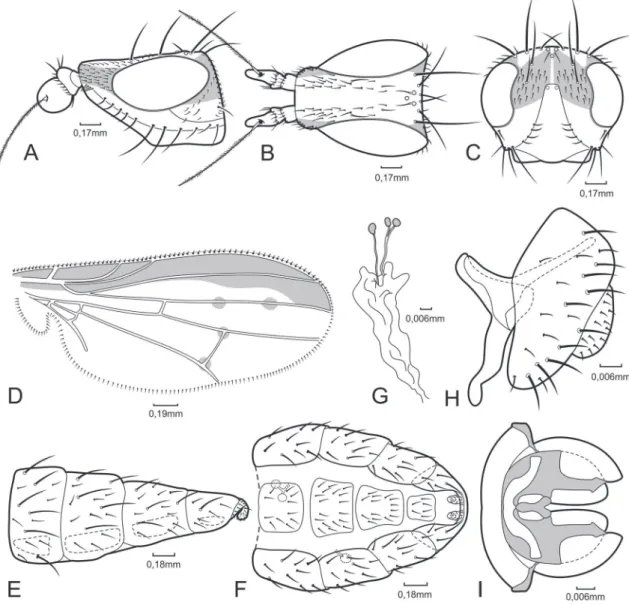
1. Body grey; wing with brown bands (Fig. 1D); ocellar setae longer than posterior fronto-orbital seta (Fig. 1A) ...T. assisensis Lima & Silva, sp. nov. — Body brownish or yellowish; wing unspotted or with stripes; ocellar setae no longer than posterior fronto-orbital seta or absent ...2 2. Wing membrane with milky costal margin extending to apex of vein R4+5 ...T. albocostatus Hendel
— Wing membrane without milky costal margin ...3 3. Presutural dorsocentral seta present ...4 — Presutural dorsocentral seta absent ...7 4. Wing hyaline; pleural region dark; prescutellar acrostichal setae tiny; dorsocentral setae 1+2 ... ...T. immaculipennis Malloch — Wing infuscated, sometimes spotted; pleural region pale; prescutellar acrostichal setae well developed; dor-socentral setae variable ...5 5. Wing membrane with two dark spots along the apical section of vein R4+5; dark spots at both ends of dm-cu
crossvein (Fig. 4D) ...6 — Wing without spots ...T. rotundicornis Williston 6. Wing infuscated at costal and anterior margins ...T. mariae Lima & Silva, sp. nov. — Anterior margin of wing not infuscated ...T. punctipennis Coquillett 7. Ocellar seta present ...8 — Ocellar seta absent ...9 8. Wing hyaline; pleura yellow; apical scutellar setae with setigerous spot ...T. albifrons Knab — Wing infuscated (Fig. 3D); pleura brownish; apical scutellar setae without setigerous spot ... ...T. lourdesae Lima & Silva, sp. nov. 9. Genal margin with dark stripe; postocellar setae convergent; apex of first flagellomere almost triangular ... ...T. angustipennis Knab — Genal margin not darkened (Fig. 2A); postocellar setae cruciate (Figs. 2B‒C); apex of first flagellomere
rounded ...T. boraceiensis Lima & Silva, sp. nov.
Trigonometopus assisensis sp. nov. (Figs. 1A‑I)
Diagnosis: Grey integument. Ocellar setae long, lon-ger than posterior fronto-orbital seta; proclinate setu-lae covering anterior third of frons to base of anterior fronto-orbital seta; scape shorter than pedicel; first flagellomere long, oval, with recurved apex. Scutum, abdomen and femora covered by setigerous spots; dorsocentral setae arranged 0+2; proepisternal and anepisternal setae absent. Anterior two third of the wing totally covered by brown bands. Female termi-nalia telescopic, hypoproct and epiproct present, well developed; sternite 8 narrow; 4 spermathecae. Male terminalia: sternite 6 reduced; sternites 7 and 8 al-most fused; hypandrium reduced to a stripe; phallus pear-shaped.
Description:Male:Head (Figs. 1A, 1B, 1C): Rounded vertex, grey; posterior edge of vertex slightly concave from dorsal view; ocellar triangle placed slightly ante-rior of vertex, slightly raised. Frons rectangular, short, longer than wide; flat in profile, a shallow dark grey groove running longitudinally from base of ocellar triangle through middle of frons to anterior margin; proclinate setulae from anterior margin to almost half way to vertex, including base of anterior fronto-orbit-al seta; anterior margin, in dorsfronto-orbit-al view, concave; lu-nule exposed. Face grey, almost flat; lower facial mar-gin narrow. Parafacial grey, narrow. Gena grey with setigerous spots. Eye oval, longer than high, brownish red. Antenna brown, inserted in a facial depression: scape shorter than pedicel; first flagellomere long, oval, with recurved apex, pruinose; arista pubescent. Chaetotaxy: outer vertical seta divergent, ⅔ length of ing; eye longer than high; fronto-facial angle slightly
higher than 45°; fronto-orbital setae situated on level of anterior margin of eye; proclinate setulae on the anterior part of frons; anepimeron bare; postsutural
intra-alar seta absent; ctenidium absent; wing sapro-myziform; wing hyaline or marked; crossvein dm-cu beyond middle of wing; base of R4+5 bare; cell dm
inner vertical seta, convergent; ocellar seta ⅔ lenght of postocellar setae, proclinate, divergent; postocellar setae strong, cruciate; anterior fronto-orbital seta and posterior fronto-orbital seta both reclinate, anterior seta ⅔ length of posterior seta; 2 genal setae. Thorax:
Scutum flat; grey, with setigerous spots; pleural region grey; scutellum triangular, grey. Chaetotaxy: dorso-central setae 0+2 (anterior seta away from suture); 1
postpronotal seta; 2 notopleural setae; 1 prescutellar acrostichal seta; 4 rows of acrostichal hairs; intra-alar seta absent; 1 pre- and 1 postsutural supra-alar setae; 2 postalar setae; 1 katepisternal seta; many katepi-sternal hairs; anepikatepi-sternal seta absent; proepikatepi-sternal seta absent; 2 pairs scutellar setae, apical pair parallel.
Legs: Coxae and femora brown with grey pruinosity; apex of femora dark yellow; tibiae and tarsi brownish
yellow; apical segments of tarsi dark brown. Chaeto-taxy: fore coxa with preapical seta; fore femur with posterodorsal and posteroventral rows of setae; mid coxa with 2 basal setae; mid femur with 2 strong api-cal setae; mid tibia with 1 strong apiapi-cal anterior seta; hind coxa with 1 apical seta; hind femur with anterior and anteroventral rows of setae; hind tibia with strong 1 posteroventral and 1 anteroventral setae. Wing (Fig. 1D): Hyaline; anterior two thirds with brown bands, spotted at crossveins; costa sapromyziform; R bare; crossvein r-m located before midpoint of discal medial cell; crossvein dm-cu before midpoint of cell r4+5; longitudinal veins parallel; vein A1 short. Halter
whitish yellow. Abdomen: Grey, with setigerous spots; dorsally with black spots; in males, sternite 6 reduced to a small plate, tergites 7 and 8 almost fused. Termi-nalia (Figs. 1H, 1I): Epandrium almost rectangular. Surstylus not well developed, fused to epandrium. Hy-pandrium as an almost complete ring around phallus base, narrow; with median projection, forked. Phallus pear-shaped; phallapodeme U-shaped laterally and forked in ventral view, strongly sclerotized; ejaculato-ry apodeme small and bell-shaped, in ventral view. Fe‑ male: As male, except for abdominal apical segments, telescopic, membranous areas widely folded; sternite 8 narrow (Figs. 1E, 1F). Terminalia: With hypoproct and epiproct present. Cercus long. Spermathecae with configuration 2+2; pair of spermathecae united with no differenciation of a commom duct; very short duct linking paired spermathecae (Fig. 1G).
Etymology: The specific epithet assisensis was used as a homage to the type-locality, the city of Assis, where a large number of the type specimens were collected. To be treated as a noun in apposition.
Type material: Holotype: male; Brazil: São Paulo. As-sis, 06.iv.2001, A.M.A. Lima col. (DZUP). Paratypes:
Brazil: São Paulo. Assis, Horto Florestal, 05.ix.1992, S.M.D. Mello col., 1 male (MZUSP); Assis, 10.v.1995, V.C. Silva col., 2 males, 1 female (MZUSP); As-sis, 27.iv.1999, A.M.A. Lima col., 3 males, 2 females (MZUSP); Assis, 06.iv.2001, A.M.A. Lima col., 2 males, 9 females (DZUP); Santa Catarina. [Seara], Nova Teutônia, ix.1967, F. Plaumann col., 1 male (MZUSP).
Comments: Some specimens of this new species were collected on grass fields. It should be noted that, be-sides the adaptation to life to an open vegetation-as noticed by Collin (1948: 227) and Stuckenberg (1971: 516) but queried by Shewell (1977) and Da-vies et al. (2012) the specimens were collected close to water source, preferably just before sunset.
Trigonometopus boraceiensis sp. nov. (Figs. 2A‑I)
Diagnosis: Brownish yellow integument. Ocellar seta absent; postocellar setae cruciate. Antennal scape as long as pedicel. Thorax dark brown, with yel-low stripes. Wing infuscated slightly brownish with dark brown median stripe. Female abdomen without modified sternites; 3 rounded spermathecae; epiproct present as a slender belt. Male terminalia: epandrium rectangular; surstylus rounded, articulated with epan-drium.
mid femur with 1 short and strong posterior seta; mid tibia with 2 apical setae: 1 anterodorsal and 1 ventral; hind coxa with 1 apical seta; hind femur with 1 an-terodorsal seta; hind tibia with 1 apical anteroventral spine. Wing (Fig. 2D): Infuscated slightly brownish with dark brown median stripe; anterior margin with-ish till apex of R2+3 and with brown stripe from R4+5
till CuA2+A1; Sc and R1 paler than the other veins;
costa sapromyziform; crossvein r-m located before midpoint of discal medial cell; crossvein dm-cu lo-cated at midpoint of cell r4+5; longitudinal veins
par-allel; vein A1 short, ending halfway to wing margin.
Halter brownish yellow. Abdomen: Dark brown, lat-eral and central regions yellowish. Terminalia:
Epan-drium (Figs. 2H, 2I) rectangular. Surstylus articulated with epandrium; rounded. Hypandrium as an almost complete ring around phallus base; with long medial projection; phallapodeme as a long tube; phallus not seen. Female (Figs. 2E, 2F): As males, except for the following features: sternites not modified. Epiproct present as a slender belt. Cercus long. Terminalia:
With 1+2 spermathecae configuration, rounded, with short ducts (Fig. 2G).
Etymology: The specific epithet boraceiensis is a hom-age to the type-locality, “Estação Biológica de Bora-céia”, where the holotype was collected. To be treated as a noun in apposition.
Type material: Holotype: male; Brazil: São Paulo. Salesópolis, 14.viii.1947, E. Rabello & Trav. F. & J. Lane col. (MZUSP). Paratype: 1 female, Brazil: Santa Catarina. Seara, Nova Teutônia, ix.1967, F. Plaumann col. (MZUSP).
Comments: The abdomen of both types was dissected and stored in vials in glycerin, pinned with the speci-mens.
Trigonometopus lourdesae sp. nov. (Fig. 3)
Diagnosis: Brownish yellow body. Postocellar setae cruciate; 1 genal seta; arista inserted pre-basally; an-tennal scape longer than pedicel. Dorsocentral setae arranjed 0+3. Wing infuscated, with paler anterior margin. Female sternite 8 reduced; hypoproct and epiproct present; 3 spermathecae; cercus well devel-oped.
Description:Male:Head (Figs. 3A, 3B, 3C): Rounded vertex, brown; posterior edge of vertex distinctly con-cave from dorsal view; ocellar triangle placed slightly anterior of vertex, well raised, brown. Frons rectan-gular, longer than wide; brown, with an anterior me-dian yellow stripe; flat in profile; proclinate setulae from anterior margin to mid way between anterior and posterior fronto-orbital setae; anterior margin, in dorsal view, straight. Face yellow, with brown, me-dian, narrow, stripe, and a thin brown ocular margin till the lower supravibrissal setae (more evident in female paratype); in profile, almost flat; bare; lower facial margin wider; facial length approximately 3 times its upper width. Eye oval, longer than wide, brown. Parafacial yellow, narrow. Gena brownish. Occiput brownish. Antenna yellowish brown, insert-ed in a facial depression: scape longer than pinsert-edicel; first flagellomere triangular to oval, with rounded apex; arista pubescent, inserted submedially. Chae-totaxy: outer vertical seta divergent, ½ length of in-ner vertical seta, reclined; ocellar setae proclinate, ⅓ length of postocellar setae; postocellar setae cruci-ate; both anterior fronto-orbital seta and posterior fronto-orbital seta reclinate, anterior seta ¾ length posterior seta; 1 genal seta; supravibrissal setae long, reaching base of face; occipital setae in two rows.
Thorax: Scutum flat; brown, with paler longitudinal stripes; pleural region brown, postponotal lobe yel-lowish and continuing to wing base; scutellum tri-angular, flat, brown. Chaetotaxy: dorsocentral setae 0+3 (anterior seta close to suture); 1 postpronotal
seta; 2 notopleural setae; prescutellar acrostichal seta absent; 2 rows of acrostichal hairs; intra-alar seta ab-sent; presutural supra-alar setae abab-sent; 1 postsutural supra-alar setae; 1 postalar seta; 1 anepisternal seta; 1 katepisternal seta; 1 proepisternal seta; 2 scutellar se-tae, apical pair paralel. Legs: Yellowish brown. Chae-totaxy: fore coxa with 2 anterior apical setae; fore fe-mur with one posterodorsal, one posteroventral and one posterior rows of setae; fore tibia with 2 apical setae: 1 dorsal and 1 ventral; mid coxa with 1 row of apical setae; mid tibia with 2 apical setae: 1 dorsal and 1 ventral; hind coxa with 1 apical seta; hind fe-mur with 1 strong anterodorsal seta; hind tibia with 2 small apical ventral spine. Wing (Fig. 3D): Infus-cated, with paler anterior margin; Sc, R1 and R2+3
light brown; costa sapromyziform; crossvein r-m lo-cated before midpoint of discal medial cell; crossvein dm-cu located in midpoint of cell r4+5; longitudinal
veins parallel; vein A1 short, ending halfway to wing
margin. Halter yellow. Abdomen: Brown. Terminalia:
Epandrium (Fig. 3H) almost oval. Surstylus fused to epandrium. Hypandrium (Fig. 3I) as an almost com-plete ring around phallus base; well sclerotized; with median projections with lateral expansions, arrow shaped. Phallus (Fig. 3I) reduced, pear shaped; phal-lapodeme hourglass shaped. Cercus wide, rounded. Female (Figs. 3E, 3F): As males, except for termi-nalia not telescoped; sternite 8 reduced. Hypoproct and epiproct present. Cercus long. Terminalia: Sper-mathecae with configuration 1+2, tubular, common duct very short (Fig. 3G).
Etymology: This species is named after Maria de Lourdes Alves de Lima, sister of the first author, who has greatly incentived her to complete her scientific research training.
Type material: Holotype: male; Brazil: Mato Grosso [do Sul]. Nioaque, ii.1937 (MZUSP). Paratype:
Brazil: Mato Grosso [do Sul]. Nioaque, ii.1937, 1 female (MZUSP). Corumbá, BEP [Base de Estudos do Pantanal, Universidade Federal do Mato Grosso do Sul] – transição Ciliar/Paratudal, 19°34’20,09”S, 57°00’57,09”W, Malaise 2, 14-29.ix.2012, Lamas, Nihei & eq. col., 1 male (MZUSP).
Trigonometopus mariae sp. nov. (Fig. 4)
Diagnosis: Yellowish brown species, darker at the dor-sal side. Anterior margin of frons almost straight, in dorsal view. Postocellar setae cruciate. Antennal scape as long as pedicel. Dorsocentral setae arranged 1+3; presutural supra-alar seta present. Wing hyaline, infuscated at costal margin, spotted at both end of crossvein dm-cu, two spots along R4+5 near its apex.
Female sternite 8 reduced to a small plate; epiproct present; 3 spermathecae; cercus papilate.
of posterior fronto-orbital seta; anterior margin, in dorsal view, almost straight. Face yellowish brown, bare; in profile, straight; lower facial margin narrow. Lunule exposed. Eye oval, longer than high, ish. Parafacial brownish yellow, narrow. Gena brown-ish yellow, with short setulae. Occiput brown. An-tenna brownish yellow, inserted in a facial depression: scape as long as pedicel; first flagellomere oval; arista pubescent, inserted dorsomedially. Chaetotaxy: outer vertical seta divergent, ⅔ length of inner vertical seta, reclined; ocellar seta proclinate; postocellar setae cru-ciate, ocellar setae ⅔ lengh postocellar setae; anterior and posterior fronto-orbital setae reclinate, anterior seta ⅔ length posterior seta; no genal seta; supravi-brissal setae very long, reaching base of face;
occipi-tal setae in two rows. Thorax: Scutum flat; brownish yellow, and darker at lateral margins; pleural region brownish yellow; scutellum triangular, rounded apex, flat, brown with yellow central stripe. Chaetotaxy: dorsocentral setae 1+3 (anterior seta close to suture); 1 postpronotal seta; 2 notopleural setae; 2 prescutellar acrostichal setae; 4 rows of acrostichal hairs; intra-alar seta absent; 1 presutural and 1 postsutural supra-alar setae; 1 postalar seta; 1 anepisternal seta; 1 proepister-nal seta; 2 katepisterproepister-nal setae; 2 scutellar setae. Legs:
yellow, fore apical tarsomeres darker. Chaetotaxy: fore coxa with 3 apical setae; fore femur with one pos-terodorsal, one posteroventral and one dorsal rows of setae; fore tibia with 2 apical setae: 1 anterodorsal and 1 ventral; mid coxa with 2 basal setae and 1 apical
setae; mid femur with 1 anterior row of setae, 1 apical posterodorsal seta, 1 apical posterior seta; mid tibia with 2 apical setae: 1 anterodorsal and 1 anteroventral; hind coxa with 2 apical setae: 1 anterior and 1 lateral; hind femur thickened, with 1 strong anterodorsal seta; hind tibia with 1 apical anterodorsal spine, 1 ventral spine. Wing (Fig. 4D): Hyaline, infuscated at costal margin, spotted at both end of crossvein dm-cu, two spots along R4+5 near its apex; costa sapromyziform;
crossvein r-m located in the midpoint of discal me-dial cell; crossvein dm-cu located before midpoint of cell r4+5; longitudinal veins parallel; vein A1 short, not
reaching wing margin. Halter brownish yellow. Abdo-men: Brown, with yellow stripes at the anterior mar-gin of the tergites that become paler in each segment toward abdominal apex, which is yellow. Terminalia (Figs. 4H, 4I): Epandrium trapezoid, with rounded margins; surstylus rounded, fused to epandrium; hy-pandrium as an almost complete ring, strongly sclero-tized, with paired median sharp projections; phal-lapodeme Y-shaped, strongly sclerotized; phallus not seen; cercus big, papilate. Female: As males, except for sternite 8 reduced to a small plate. Terminalia not telescopic (Figs. 4E, 4F, 4G): Hypoproct and epiproct present; genital chamber as a long tube, posterior apex forming a large bag; dorsal wall with the opening of the spermathecal ducts. Spermathecae with configu-ration 1+2; ducts of paired spermathecae short until commom duct (Fig. 4G). Cercus small, papilate.
Distribution: Brazil.
Etymology: This species is named after Maria Alves de Lima, mother of the first author, for her continuous support to AMAL.
Type material: Holotype: female: Brazil: Santa Cata-rina. Seara, Nova Teutônia, ix.1962, F. Plaumann col. (MZUSP). Paratype: Brazil: Pará. Belém, 25.iv.1965, F. Pirelli & H.S. Lopes col., 1 male (MZUSP).
Comments: Abdomens dissected and stored in vials with glycerin and pinned with the specimens. This spe-cies is similar to T. punctipennis, differing by the frons being longer (1,5 times longer than wide in T. punc-tipennis), brown (brown with yellow central stripe in
T. punctipennis), first flagellomere oval (pointed api-cally in T. punctipennis), scutum brownish yellow, darker at lateral margins (brownish yellow with central gray dorsocentral vittae through entire length and dark brown laterally in T. punctipennis), wing infuscated at costal margin (infuscated at cell bm and base of basal radial cell and r-m spotted in T. punctipennis).
DISCUSSION
This genus has considerably wide distribution in the world, but it is still poorly known in the Neotropi-cal region. This paper almost doubles the number of previously known species for the Neotropics, suggest-ing that there is the need for collectsuggest-ing effort in more diverse habitats in different parts of the region. The actual number of Neotropical species of Trigonometo-pus is likely much higher.
Among the new species, only T. assisensis
sp. nov. has four spermathecae, a feature considered by Gaimari & Silva (2010a) to be an apomorphy for the Eurychoromiinae and as well a feature sporadi-cally found in other lauxaniid genera. It has been also observed in the Neotropical lauxaniine genera Ceph-alella Malloch (Silva, 1999) and Neogriphoneura Mal-loch (Mello & Silva, 2008), and in the Australian species Australinina geniseta (Malloch), Homoneura
(Homoneura) angustigena Kim and H. (H.) eurymelon
Kim (Kim, 1994). This feature is still insufficiently known in many species and genera of the family and a more extensive comparative analysis would better show the evolution of the number of spermathecae in the Lauxaniidae.
Shatalkin (1997) and Papp (2007) considered that the following features define Trigonometopus: first flagellomere pointed apically, anterior fronto-orbital seta situated on level of anterior margin of eye and structure of the epandrium forming a ring as a result of the ventral expansion of its lateral sectors. These features are quite variable, however, among the Neo-tropical species or are even absent in some species (or the information is not available). The apex of the flag-ellomere is pointed only in T. assisensis and T. punc-tipennis, although not forming a small beak, as in
T. frontalis. The position of the anterior fronto-orbital setae is more variable among the Neotropical species, but five of the species share the state in T. frontalis,
while there is no information about T. albocostatus
for this character. The shape of the epandrium is not known in six of the Neotropical species, but in five of the species the abdomen certainly does not form a ring.
Other characters always mentioned for the genus are the number and position of dorsocentral setae and the number of katepisternal setae: the dorsocentral se-tae are variable, but in the Nearctic species T. vittatus
ac-tually apply to only part of Trigonometopus, not being shared by part or all of the Neotropical diversity of the genus. The set of Neotropical species diverge from the rest of the genus to a certain degree. A detailed study of the relationships within Trigonometopus is necessary to put the Neotropical species into proper context within the genus.
RESUMO
O gênero Trigonometopus Macquart (1835) atual-mente inclui 13 espécies e é encontrado em quase todas as regiões biogeográficas, estando ausente nas Regiões Afrotropical e Australiana. Na Região Neotropical, está composto por seis espécies. Neste trabalho, são descritas quatro novas espécies de Trigonometopus da região Ne-otropical: T. assisensis sp. nov., T. boraceiensis sp. nov.,
T. lourdesae sp. nov.; e T. mariae sp. nov., as duas pri-meiras do Estado de São Paulo e as outras duas respecti-vamente dos Estados do Mato Grosso do Sul e de Santa Catarina. Uma chave para as espécies exclusivamente neotropicais do gênero é fornecida.
Palavras-Chave: Descrição; Novos táxons; Região Neotropical; Sistemática.
ACKNOWLEDgMENTS
The authors are very grateful to the curators of the institutions listed for the loan of the material. This paper is produced as a result of the Master The-sis of AMAL and we thank the “Programa de Pós-Graduação em Entomologia, UFPR, Curitiba, Bra-zil” for the support. We would like to thank Cláudio J.B. de Carvalho for his advices during AMAL the-sis. We are grateful to “Conselho Nacional de De-senvolvimento Científico e Tecnológico” (CNPq) for a research grant awarded to A.M.A. Lima and to V.C. Silva (Proc. 56 3236/2010-9) and to FAPESP for Research Grants (procs. Zoologia 94/2031-8; 95/4805-0; 1997/3894-5; 2010/54314-0) awarded to V.C. Silva. Thanks also to the CNPq (Proc. No. 563256/2010-9) and “Fundação de Amparo a Pes-quisa do Estado de São Paulo” (FAPESP) (Proc. No. 2010/52314-0) for the support to the SISBIOTA Brasil Program. Stephen D. Gaimari, Ramon L. Mello and Dalton S. Amorim made important sug-gestions and we are very gratefull to them. Also, S.D. Gaimari provided copies of papers and pictures of the type of T. punctipennis; we are in debt for that.
REFERENCES
Becker, T. 1905. Cyclorrhapha Schizometopa: Holometopa. In:
Becker, T.; Bezzi, M.; Kertész, K. & Stein, P. (Eds.). Katalog der paläarktischen Dipteren. Budapest. v. 4, p. 1-273. Collin, J.E. 1948. A short synopsis of the British Sapromyzidae
(Diptera). Transactions of the Entomological Society of London,
99(5): 225-242.
Cumming, J.M. & Wood, D.M. 2009. Adult Morphology and Terminology. In: Brown, B.V.; Borkent, A.; Cumming, J.M.; Wood, D.M.; Woodley, N.E. & Zumbado, M. (Eds.). Manual of Central American Diptera. Ottawa, NRC Research Press. v. 1, p. 9-50.
Davies, G.B.P.; Miller, R.M. & Muller, B.S. 2012. A new genus of lauxaniid fly from South Africa (Diptera: Acalyptratae: Lauxaniidae), associated with proteas (Proteaceae). African Invertebrates, 53(2): 615-636.
Gaimari, S.D. & Silva, V.C. 2010a. Revision of the Neotropical subfamily Eurychoromyiinae (Diptera: Lauxaniidae). Zootaxa,
2342: 1-64.
Gaimari, S.D. & Silva, V.C. 2010b. Lauxaniidae (Lauxaniid flies). In: Brown, B.V.; Borkent, A.; Cumming, J.M.; Wood, D.M.; Woodley, N.E. & Zumbado, M. (Eds.). Manual of Central American Diptera. NRC Research Press, Ottawa, v. 2, p. 971-995.
Hendel, F. 1908. Diptera. Fam. Muscaridae, Subfam. Lauxaniinae. Wytsman, P.A.G. (Ed.). Genera Insectorum. Bruxelles. pt. 68, p. 1-66.
Kim, S.P. 1994. Australian Lauxaniid flies: revision of the Australian species of Homoneura van der Wulp, Trypetisoma Malloch, and allied genera (Diptera: Lauxaniidae). Melbourne, Csiro. v. 1. Knab, F. 1914a. A review of our species of Trigonometopus (Diptera,
Lauxaniidae). Psyche, Cambridge, 21: 123-126.
Knab, F. 1914b. The Oriental trigonometopine flies (Diptera, Lauxaniidae). Insecutor Inscitiae Menstruus, 2: 131-133. Macquart, J. 1835. Histoire naturelle des insectes. Diptères. Paris,
N.E. Roret. v. 2.
Malloch, J.R. 1923. Some new genera and species of Lonchaeidae and Sapromyzidae (Diptera). Proceedings of the Entomological Society of Washington, 25(2): 45-53.
Malloch, J.R. 1929. Notes on some oriental Sapromyzid flies (Diptera), with particular reference to the Philippine species.
Proceedings of the Entomological Society of Washington, 74(6): 1-97.
Melander, A.L. 1913. A synopsis of the Sapromyzidae. Psyche,
20(2): 57-82.
Mello, R.L. & Silva, V.C. 2008. Revision of the genus Physoclypeus
Hendel, 1907 (Diptera, Lauxaniidae), with description of seven new species. Papéis Avulsos de Zoologia, São Paulo, 48(26): 289-315.
Pape, T. & Thompson, F.C. (Eds.). 2013. Trigonometopus
Macquart. Systema Dipterorum, Version 1.5. 45 work records (not peer-reviewed material). www.diptera.org, accessed on 22 July 2014.
Papp, L. 1984. Lauxaniidae. In: Soós, Á. & Papp, L. (Eds.).
Catalogue of Palaearctic Diptera. Akadémiai Kiadó, Budapest, v. 9, p. 193-217.
Papp, L. 2007. A review of the Old World Trigonometopini Becker (Diptera: Lauxaniidae). Annales Historico-Naturales Musei Nationalis Hungarici, 99: 129-169.
Sasakawa, M. 1998. Oriental Lauxaniidae (Diptera). Part 1.
Scientific reports of Kyoto Prefectural University, Human Environment & Agriculture, 50: 49-74.
Silva, V.C. 1999. Systematic review of Neotropical Lauxaniidae genera: Cephalella Malloch, 1926 (Diptera, Schizophora).
Revista Brasileira de Zoologia, 16(1): 133-137.
Stuckenberg, B.R. 1971. A review of the Old World genera of Lauxaniidae (Diptera). Annals of the Natal Museum, 20: 499-610.
Wheeler, M.R. 1956. Latheticomyia, a new genus of acalyptrate flies of uncertain family position. Proceedings of the United States National Museum, 106: 305-314.
Aceito em: 20/03/2015 Impresso em: 30/06/2015
Reports of Kyoto Prefectural University, Human Environment & Agriculture, 54: 33-61.
Sasakawa, M. 2005. Fungus Gnats, Lauxaniid and Agromyzid Flies (Diptera) of the Imperial Palace, the Akasaka Imperial Gardens and the Tokiwamatsu Imperial Villa, Tokyo. Memoirs of the National Science Museum Tokyo, 39: 273-312.
Shatalkin, A.I. 1997. East-Asian species of Lauxaniidae (Diptera). Genera Trigonometopus Mcq., Protrigonometopus Hendel.
International Journal of Dipterological Research, 8(3): 163-168. Shatalkin, A.I. 2000. Keys to the Palearctic flies of family
Lauxaniidae (Diptera). Zoologicheskie issledovania, 5: 1-101. Shewell, G.E. 1977. Family Lauxaniidae. In: Delfinado, M.D. &