Proficiency test for radioactivity measurements
in nuclear medicine*
Teste de proficiência para medições de radioatividade na medicina nuclear
Akira Iwahara1, Luiz Tauhata1, Antonio Eduardo de Oliveira2, Ieda Gomes Nícoli1, Frederico Gil Alabarse3, Ana Maria Xavier1
OBJECTIVE: To assess the performance of radionuclide calibrators in 55 Brazilian nuclear medicine services in the measurement of 99Tcm radiopharmaceutical activity. Proficiency tests were applied to data sets with 63 results originated from the comparison program developed by Laboratório Nacional de Metrologia das Radiações Ionizantes of Instituto de Radioproteção e Dosimetria. MATERIALS AND METHODS: The calibrators’ performance was evaluated in compliance with the acceptance criterion of ±10% accuracy required by the Brazilian standards and also the criteria established by the ISO/IEC Guide 43-1, and classified as either “acceptable” or “non-acceptable”. The samples of 99
Tcm
utilized in the comparison were supplied by some of the participants and calibrated at Laboratório Nacional de Metrologia das Radiações Ionizantes for determining the activity reference value. RESULTS: The present study utilizing 99
Tcm
has shown that 82.5% of the calibrators were considered as acceptable according to the Brazilian standards, while by the criteria established by ISO/IEC 43-1, 81.0% were considered as acceptable. On the other hand, radionuclide calibrators with Geiger-Müller detectors presented unsatisfactory performance when compared with calibrators with ionization chambers. CONCLUSION: The performance evaluation based on the ISO/IEC 43-1 criteria, which are applied to analytical laboratories, in spite of being more restrictive, has demonstrated to be quite consistent with the accuracy criterion established by the Brazilian standard.
Keywords: Proficiency test; Radionuclide calibrator; Nuclear medicine; 99
Tcm
.
OBJETIVO: Avaliar o desempenho dos calibradores de radionuclídeos de 55 serviços de medicina nuclear brasileiros em medição de atividade de radiofármaco contendo 99Tcm. Testes de proficiência foram aplicados em 63 resultados originados do programa de comparação promovido pelo Laboratório Nacional de Metrolo-gia das Radiações Ionizantes do Instituto de Radioproteção e Dosimetria. MATERIAIS E MÉTODOS: O de-sempenho foi avaliado em relação ao critério de aceitação de ±10% de exatidão exigido pela norma brasi-leira e também aos critérios estabelecidos pela ISO/IEC Guide 43-1, e classificado como “aceitável” ou “não aceitável”. Amostras de 99
Tcm
usadas nas comparações foram fornecidas por alguns dos participantes e calibradas no Laboratório Nacional de Metrologia das Radiações Ionizantes para determinar o valor de refe-rência da atividade. RESULTADOS: Esta comparação com o 99
Tcm
mostrou que o desempenho aceitável atendendo à exigência da norma regulatória foi de 82,5%, enquanto pelos critérios estabelecidos pela norma ISO/IEC 43-1 foi de 81,0%. Por outro lado, calibradores de radionuclídeos com detector Geiger-Müller apre-sentaram desempenho inferior quando comparados com os dotados com câmara de ionização. CONCLU-SÃO: Nesta comparação, a avaliação do desempenho baseada nos critérios da ISO/IEC 43-1, os quais são aplicados a laboratórios analíticos, apesar de serem mais restritivas, foi bastante consistente com o critério de exatidão exigido pela norma nacional.
Unitermos: Teste de proficiência; Calibrador de radionuclídeo; Medicina nuclear; 99
Tcm
. Abstract
Resumo
* Study developed at Instituto de Radioproteção e Dosimetria/ Comissão Nacional de Energia Nuclear (IRD/CNEN), Rio de Ja-neiro, RJ, Brazil.
1. PhDs, Researchers at Instituto de Radioproteção e Dosi-metria/Comissão Nacional de Energia Nuclear (IRD/CNEN), Rio de Janeiro, RJ, Brazil.
2. Master, Researcher at Instituto de Radioproteção e Dosi-metria/Comissão Nacional de Energia Nuclear (IRD/CNEN), Rio de Janeiro, RJ, Brazil.
3. Graduate Student of Physics, Universidade Federal de Rio Grande do Sul (UFRGS), Porto Alegre, RS, Brazil.
Mailing address: Dr. Akira Iwahara. Avenida Salvador Allende, s/nº, Recreio dos Bandeirantes. Rio de Janeiro, RJ, Brazil, 22780-160. E-mail: [email protected]
Received March 13, 2009. Accepted after revision May 29, 2009.
calibrate instruments and evaluating the performance of activity measurements al-lows the establishment of quality assurance programs in the use of radiopharmaceu-ticals. In nuclear medicine centers (NMCs) many types of radioactive substances are utilized in the diagnosis and therapy rou-tines. The instrument utilized for measur-ing these radiopharmaceuticals activity is the radionuclide calibrator also known as curimeter or dose calibrator. This
instru-Iwahara A, Tauhata L, Oliveira AE, Nícoli IG, Alabarse FG, Xavier AM. Proficiency test for radioactivity measurements in nuclear medicine. Radiol Bras. 2009;42(4):255–259.
INTRODUCTION
The field of radionuclide metrology plays an important role in the life sciences activities. Due to the recognition of the quality assurance programs implementa-tion to assure accuracy, repeatability and measurements consistency, it is easy to understand its applicability in nuclear medicine practices(1-4). The availability of
ment comprises an ionization chamber or Geiger-Müller detector coupled with an electrometer with a display whose reading is the activity measured in MBq or Ci sub-multiples.
The International Atomic Energy Agency(5) and the European
Pharmaco-poeia(6) recommend a maximum deviation
of ± 5% when referring to accuracy of ac-tivity measurements with radionuclide cali-brators. In Brazil, the accuracy for diagnos-tic studies is established by the NN.3.05 Standard of the Comissão Nacional de Energia Nuclear (CNEN)(7), which
estab-lishes a maximum deviation of ± 10%. The activity delivered to patients must be the closest possible to that prescribed by the physician. If this activity is underestimated, the patient will probably need an additional dose in order to achieve the desired clini-cal outcome (a good image for diagnosis, for example), resulting in an undesirable dose. If overestimated, the patient will re-ceive an unnecessary dose, and in both cases one of the fundamental principles of radioprotection, that of optimization will be broken.
With the purpose of analyzing the per-formance of routine activity measurements at the Brazilian NMCs, the Laboratório Nacional de Metrologia das Radiações Ionizantes do Instituto de Radioproteção e Dosimetria/Comissão Nacional de Energia Nuclear (LNMRI-IRD/CNEN) coordinates and organizes programs for comparison of activity measurements of pharmaceutical products utilized in nuclear medicine prac-tices(8). The participation in such programs
occurs on a voluntary basis and is open to all nuclear medicine centers of clinics and hospitals in Brazil. According to the Gen-eral Coordination of Medicine and Indus-try of CNEN, there are approximately 300 NMCs in Brazil, 60% of which are in the Southeast region. In the comparison for 99Tcm this year, 55 NMCs participated, 34
in the state of Rio de Janeiro, 11 in the city of Porto Alegre, and 10 in Brasília.
In the present study, the criteria of the ISO/IEC 43-1(9) standard were applied,
with the objective of homogenizing the procedures for evaluating the performance of the participants in the comparison. The performance evaluation was also carried out by using the R rate value of the
partici-pating NMC and the result obtained by the LNMRI was adopted as a reference value. Then, the R rate is compared with the nor-mative requirements established by the Brazilian regulatory authority(7).
The two evaluation procedures focus mainly on the accuracy and repeatability of measurements and both include the total combined uncertainty associated with mea-surements from participants, as well the reference value determined by LNMRI. Besides that, two other statistical param-eters, the Zscore, and the relative deviation were calculated to complement the re-quired information for the performance analysis. According to ISO/IEC 43-1 crite-ria, for a participant’s performance to be considered as “acceptable” all the indi-vidual criteria (with the exception of R) must be “acceptable”.
MATERIALS AND METHODS
The proficiency test for performance evaluation was applied to the results of activity measured by the 55 NMCs partici-pating in the comparison. The reference value and associated uncertainty were de-termined by LNMRI utilizing a Centronic IG12 secondary standard ionization cham-ber calibrated with a standard 99Tcm source, which is the standard in primary measure-ment systems installed at LNMRI.
The final result of the performance evaluation was defined by the combined results of accuracy, repeatability, relative deviation and Zscore
(9). Using this approach,
the evaluation was applied to the 63 results provided by the participants in the compari-son. A code was attributed to each partici-pant, in order to protect their confidential-ity.
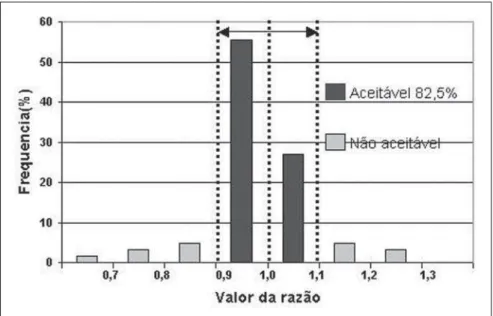
The value of the R rate (valueNMC/ valueLNMRI) was also determined with the objective of comparing the performance with the acceptance criterion established by the Brazilian standard. In this case the ac-ceptance criterion (or compliance) is 0.90 ≤R≤ 1.10.
The evaluation and compliance criteria established by ISO/IEC 43-1 are shown in Table 1, where: valueLNMRI = reference value determined by LNMRI; valueNMC= value determined by the NMC; uLNMRI = standard uncertainty of the reference value; uNMC= standard uncertainty of the NMC value; k = statistical coverage factor (in this study k = 3 was used, for a confidence level of 99.7%; the CNEN NN-3.05 standard requires a 90% confidence level).
RESULTS
Table 2 presents the types and numbers of radionuclide calibrators participating in the comparison, in which one notices a prevalence of the model manufactured by Capintec, followed by the model from Victoreen. The results distribution by re-gion and radionuclide calibrator type (ion-ization chamber or Geiger-Müller detector) utilized by the participants is presented on Table 3. In percentages, Rio de Janeiro has a larger presence of calibrators with
Gei-Table 1 Statistical criteria adopted for performance evaluation according with ISO/IEC 43-1 standard.
Criterion
Accuracy (Uscore)
Repeatability (P)
Relative deviation (RD)
Zscore
Calculated value Compliance criterion
Uscore =
valueLNMRI – valueSMN
k. u
√
LNMRI2 + uSMN2uLNMRI
valueLNMRI
uSMN
valueSMN
√
P = ( ) + ( ) × 100%2 2
valueSMN – valueLMNRI
valueLNMRI
RD = × 100%
valueSMN – valueLMNRI σ Zscore =
σ = 0.05 × valueLNMRI
Uscore < 1
P ≤ ± 5%
RD ≤ ± 10%
Table 3 Distribution of the results by region and type of radionuclide calibrator (ionization chamber or Geiger-Müller).
Calibrator type
Region
Rio de Janeiro Brasília Porto Alegre Total
Quantity
41 11 11 63
Ionization chamber
25 10 9 44
Geiger-Müller detector
16 1 2 19
Table 2 Types of radionuclide calibrators utilized by the nuclear medicine centers in the comparison.
Model
CGR Actividigit Alfanuclear Vexcal Atomlab Victoreen Capintec Total
Quantity
2 4 7 9 14 27 63
Participation (%)
3.2% 6.3% 11.1% 14.3% 22.2% 42.9% 100%
Table 4 Nuclear medicine centers performance according with criteria of standards ISO/IEC 43-1 and CNEN NN-3.05.
Evaluation criterion
Accuracy (k = 3) Repeatability Relative deviation
Zscore
Performance according with ISO/IEC 43-1 Performance according with NN-3.05
Acceptable performance (%)
79.4 100 82.5 92.1
81.0
82.5
ger-Müller detectors (16 in 41, or 39%), while both Brasilia and Porto Alegre have only two in 11 (18%). These figures may explain the inferior performance from par-ticipants in Rio de Janeiro (33 acceptable results in 41, or 80%) compared with 10 in 11, or 91% in Brasília, and 100% in Porto Alegre.
Table 4 presents the results of perfor-mance evaluations based on ISO/IEC 43-1 criteria and the R rate according to the CNEN standard criterion. The performance according to ISO/IEC 43-1 criteria achieved 81% while 82.5% were consid-ered “acceptable” or “compliant”, accord-ing to the Brazilian standard.
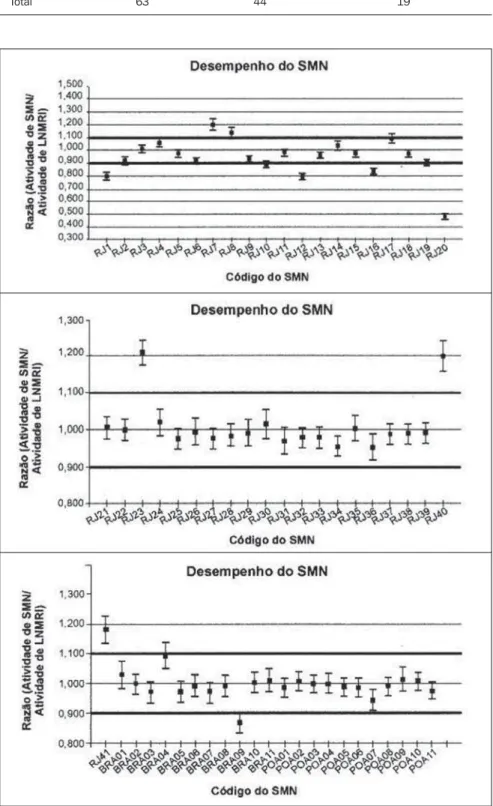
The participants’ performances in terms of R rate, complying with the accuracy cri-terion established by the CNEN NN-3.05 standard, are shown on Figure 1. Accord-ing to this criterion, deviations greater than ± 10%, that is, 0.90 ≤R≤ 1.10, indicate that the value of the activity determined by a NMC was “non-acceptable” or “noncom-pliant” according with this standard re-quirement. The frequency of R rate values distribution is shown on Figure 2.
configuration of the Geiger-Müller detec-tor in the construction of the calibradetec-tor, in which the geometrical dependency is very high.
Finally, the combined use of these four statistical criteria for the proficiency test based on the ISO/IEC 43-1 indicates that the 63 results of the measurements of 99Tcm activity obtained in the comparison with the participation of 55 NMCs reached a result of 81% with the “acceptable” clas-sification. This result is quite consistent with the 82.5% obtained for the R rate val-ues, complying with the accuracy criteria established by the Brazilian regulatory standard.
CONCLUSIONS
The number of participants in this com-parison, 55, corresponding to 18% of the total number of NMCs existing in Brazil (300), is not statistically significant to sup-port a more consistent conclusion. This fact implies the need for greater motivation to encourage NMCs to participate in this type of comparisons. However, it may be con-cluded that the performance of the radio-nuclide calibrators utilized by the partici-pants, with 82.5% complying with the re-quirements of the regulatory standard, was satisfactory. Additionally, a lower perfor-mance was expected when the statistical criteria of the ISO/IEC 43-1 were adopted, remembering that such criteria are appli-cable to analytical laboratories. However, if the coverage factor k = 3 were utilized instead of k = 1.96 in the calculation of the
Uscore values, the performance changes from 71.4% to 81.0%, which is very close to the requirement of the regulatory stan-dard.. This demonstrates that at least in this comparison with 99Tcm, the quality of the participants’ measurements is reasonably satisfactory.
Another conclusion is related to the ra-dionuclide calibrators with Geiger-Müller detectors, which presented lesser “accept-able” performances than those equipped with ionization chambers: 70% and 88% respectively. Such results may support the regulatory authorities in recommending a progressive replacement of the calibrators using Geiger-Müller detectors by calibra-tors with ionization chambers in order to Figure 2. Distribution frequency of the R rate values.
DISCUSSION
As some NMCs have more than one ra-dionuclide calibrator, the number of results (63) is larger than the number of partici-pants (55). On Table 3, the fact that Rio de Janeiro, on a percentage basis, has a higher number of calibrators with Geiger-Müller detectors than Brasília and Porto Alegre is evidenced. On Figure 1, one observes that the participant RJ20 presents the largest deviation, with R = 0.483, that is, the read-ing of the activity is underestimated by al-most 50%. This fact was known by the participant before the comparison, and the LNMRI was informed that all activity read-ings for 99Tcm were multiplied by 2 in the working routine of this service.
The accuracy evaluated by the Uscore val-ues, calculated with k = 3 for this compari-son, indicates that 81% of the results are “acceptable” and it is consistent with the 82.5% of the values considered as “accept-able” for relative deviation. Normally a more strict coverage factor k = 1.96 is uti-lized for the evaluation of analytical labo-ratories. As the NMCs are not in this cat-egory, k = 3 was utilized in this compari-son. If k = 1.96 were utilized, the evalua-tion under this criterion would be reduced to 71.4%. The relative deviation values are equivalent to the R rate values that classify the performance according with the crite-rion set by the Brazilian standard. The
evaluation for the repeatability criterion demonstrated that 100% of the results pre-sented values lower than ± 5%, indicating a good repeatability of the measurements performed by the NMCs. In what concerns the Zscore criterion 92.1% of the results were considered as “acceptable”. The mean value for R, excluding the RJ20 participant, was evaluated at 0.993 ± 0.079 (8.0%), indicating a slight tendency towards under-estimation of activity readings by the par-ticipants.
improve the overall quality of measure-ments of radiopharmaceuticals activity at the NMCs. This comparison exercise also establishes traceability in the measure-ments of radiopharmaceuticals activity and can be utilized to implement corrective and preventive measures in order to improve the quality of services provided to patients.
REFERENCES
1. Debertin K, Schrader H. Intercomparisons for quality assurance of activity measurements with radionuclide calibrators. Nucl Instrum Methods Phys Res A. 1992;312:241–5.
2. Iwahara A, de Oliveira AE, Tauhata L, et al. Intercomparison of 131I and 99mTc activity
mea-surements in Brazilian nuclear medicine services. Appl Radiat Isot. 2001;54:489–96.
3. Joseph L, Anuradha R, Nathuram R, et al. Na-tional intercomparisons of 131I radioactivity
mea-surements in nuclear medicine centres in India. Appl Radiat Isot. 2003;59:359–62.
4. Oropesa P, Hernández AT, Serra R, et al. Compari-son of activity measurements with radionuclide calibrators. Appl Radiat Isot. 2003;59:383–7. 5. International Atomic Energy Agency. Quality
as-surance for radioactivity measurement in nuclear medicine. Technical Reports Series no. 454. Vienna: IAEA; 2006.
6. European Pharmacopoeia, European Directorate
for the Quality of Medicines. 4th ed. Strasbourg: EDQM; 2001.
7. Comissão Nacional de Energia Nuclear. CNEN NN-3.05: Requisitos de radioproteção e segu-rança para serviços de medicina nuclear. Rio de Janeiro: CNEN; 1996.
8. dos Santos JA, Iwahara A, Nícoli IG, et al. Imple-mentation of a national metrology network of radionuclides used in nuclear medicine. Appl Radiat Isot. 2006;64:1114–8.