Dengue in Java, Indonesia: Relevance of
Mosquito Indices as Risk Predictors
Siwi P. M. Wijayanti1,2, Sunaryo Sunaryo3, Suprihatin Suprihatin4, Melanie McFarlane1, Stephanie M. Rainey1, Isabelle Dietrich1, Esther Schnettler1, Roman Biek1,5, Alain Kohl1*
1MRC-University of Glasgow Centre for Virus Research, Glasgow, Scotland, United Kingdom,2Public Health Department, Faculty of Health Sciences, University of Jenderal Soedirman, Purwokerto, Indonesia,
3Vector Borne Disease Research and Development Unit, Banjarnegara, Indonesia,4Parasitology Department, University of Gadjah Mada, Yogyakarta, Indonesia,5Boyd Orr Centre for Population and Ecosystem Health, Institute of Biodiversity, Animal Health and Comparative Medicine, College of Medical Veterinary and Life Sciences, University of Glasgow, Glasgow, United Kingdom
Abstract
Background
No vaccine is currently available for dengue virus (DENV), therefore control programmes usually focus on managing mosquito vector populations. Entomological surveys provide the most common means of characterising vector populations and predicting the risk of local dengue virus transmission. Despite Indonesia being a country strongly affected by DENV, only limited information is available on the local factors affecting DENV transmission and the suitability of available survey methods for assessing risk.
Methodology/principal findings
We conducted entomological surveys in the Banyumas Regency (Central Java) where den-gue cases occur on an annual basis. Four villages were sampled during the dry and rainy seasons: two villages where dengue was endemic, one where dengue cases occurred spo-radically and one which was dengue-free. In addition to data for conventional larvae indices, we collected data on pupae indices, and collected adult mosquitoes for species identifica-tion in order to determine mosquito species composiidentifica-tion and populaidentifica-tion density. Tradiidentifica-tion- Tradition-ally used larval indices (House indices, Container indices and Breteau indices) were found to be inadequate as indicators for DENV transmission risk. In contrast, species composition of adult mosquitoes revealed that competent vector species were dominant in dengue endemic and sporadic villages.
Conclusions/significance
Our data suggested that the utility of traditional larvae indices, which continue to be used in many dengue endemic countries, should be re-evaluated locally. The results highlight the need for validation of risk indicators and control strategies across DENV affected areas here and perhaps elsewhere in SE Asia.
OPEN ACCESS
Citation:Wijayanti SPM, Sunaryo S, Suprihatin S, McFarlane M, Rainey SM, Dietrich I, et al. (2016) Dengue in Java, Indonesia: Relevance of Mosquito Indices as Risk Predictors. PLoS Negl Trop Dis 10(3): e0004500. doi:10.1371/journal.pntd.0004500
Editor:Michael J Turell, United States Army Medical Research Institute of Infectious Diseases, UNITED STATES
Received:June 3, 2015
Accepted:February 9, 2016
Published:March 11, 2016
Copyright:© 2016 Wijayanti et al. This is an open access article distributed under the terms of the Creative Commons Attribution License, which permits unrestricted use, distribution, and reproduction in any medium, provided the original author and source are credited.
Data Availability Statement:All relevant data are within the paper.
Author Summary
Geographically and economically, Indonesia is one of the most prominent countries in SE Asia, yet many of its endemic infectious diseases are poorly managed, controlled and understood. This includes dengue virus (DENV), which can result in serious human dis-ease and is transmitted by mosquitoes. Dengue risk assessment is a key factor in managing the impact of infection on public health, and this often relies on assessing the presence and nature of mosquitoes through a number of indices associated with the occurrence of larvae and the location/availability of breeding containers. Here we assessed traditionally used indices in combination with other indicators including pupae indices, and the presence of adult mosquitoes in areas with different dengue status: endemic, sporadic or free. Our data suggested that traditional indices were poor indicators of reported local DENV transmis-sion. This has important consequences for design and focus of risk management strategies and efforts to control DENV locally as well as elsewhere in the region.
Introduction
Dengue virus (DENV) is considered to be the most important arbovirus world wide, with a heavy disease burden in humans [1]. It is transmitted mainly byAedes aegyptimosquitoes, but Ae.albopictuscan also act as a vector [2–5]. Dengue is endemic in many countries around the world, especially in the tropics; moreover the number of endemic areas is increasing [6]. DENV belongs to the genusFlavivirusin the familyFlaviviridaeand consists of four antigeni-cally distinct and mediantigeni-cally relevant serotypes, with a possible fifth recently described
(DENV1, 2, 3, 4 and 5)[1,6–9]. The clinical spectrum of DENV infection can vary from asymp-tomatic to more severe forms such as dengue hemorrhagic fever (DHF) and dengue shock syn-drome (DSS) [8]. DENV is transmitted to humans following mosquito bite (horizontal transmission), and mosquitoes can become infected by ingestion of a DENV-containing blood meal [2]. However, DENV can also be maintained via vertical transmission i.e. passed into eggs and subsequently into the next generation of mosquitoes, thereby maintaining outbreaks in human populations. This has already been documented in bothAe.aegyptiandAe.albopictus in different countries including in SE Asia [10–13].
Since it was first identified in 1968 in the cities of Jakarta (capital of Indonesia) and Sura-baya (East Java), dengue disease has been recognised as an important public health problem in Indonesia. Periodic outbreaks have occurred in Indonesia with an increasing number of cases and severity [14]. DENV incidence in Indonesia has been shown to peak during the rainy sea-son (between the months of October and April) [15]. From 2004 onwards, Indonesia reported the highest number of DENV cases in the region. All four serotypes of DENV have been found to be circulating since and DENV3 infections associated with the most severe disease [16,17]. Despite dengue being a major concern remarkably little is known or done to control this virus in Indonesia, in spite of its size (in surface and population, as the world’s largest island nation but with high levels of poverty) and important economical position in SE Asia and the world [18].
As there are no vaccines or drugs available for DENV, control programmes for DENV transmission are often focused on managing mosquito populations. To determine the nature of mosquito populations, entomological surveys are usually conducted within routine control programmes [19]. For many years, the standard protocol has relied on traditional sampling (Stegomyiaindices) which is based solely on the presence of larvae [20]. Indicators of DENV vector abundance (mainlyAe.aegypti) were based on larval surveys of container habitats and collection and analysis, decision to publish, or
preparation of the manuscript.
the calculation of various indices, namely House Index (HI: percentage of houses infested with larvae or pupae), Breteau Index (BI: number of larvae or pupae positive containers per 100 houses examined) and Container Index (CI: percentage of water-holding containers found to be infested with larvae or pupae) [20]. These indices can facilitate understanding of vector ecol-ogy in a given control area, but also serve as useful measures to determine the success of inter-vention strategies. However, these traditional sampling methods have shortcomings by measuring only the abundance of larvae and not determining species, which therefore may be poor predictors of the abundance of adult vector mosquitoes that are responsible for transmis-sion [20]. Following consideration of these issues, Focks (2003) suggested that pupal/demo-graphic survey methods were developed to replace the more traditional larval indices [20]. The pupae index is based on counting the number of pupae per container and identifying which container types are responsible for the largest number of adult mosquitoes. It assumes the abil-ity to predict the potential of DENV epidemics more accurately than the traditional HI, which does not necessarily correlate with DENV transmission [21,22].
Despite the limitation of traditional sampling methods, many studies have continued to focus on indices from larval stages of the mosquito, e.g. [23–28]. However, the importance of developing improved and locally appropriate entomological surveys in DENV endemic areas is increasingly recognised [20]. In Indonesia, variations in dengue disease reporting make it important to further understand the entomological differences between areas with different DENV risk i.e., in endemic areas (defined here as an area that has regularly reported DENV cases in the three years preceding this study, 2009–2011), sporadic areas (defined here as an area which has had an irregular number of DENV cases reported in the three years preceding this study, 2009–2011) and compare these to dengue free areas (defined here as an area with no reports of dengue disease in the three years preceding this study, 2009–2011). Comparisons of mosquito populations and local habits in these different areas are more likely to indicate the key entomological differences that can inform potential points of intervention, and the validity of the various indices and survey methods.
In this study we applied traditional larvae indices, the pupae index as well as adult mosquito collections and species identification to compare and enhance the validity of entomological survey results in villages with different dengue endemicity in the Banyumas Regency of Java. By comparing these traditional indices to newer indicators with respect to their ability to pre-dict dengue risk, we aimed to better understand the local dengue transmission processes. Over-all our data help to fill important gaps in our knowledge of dengue transmission and associated ecology/human behaviour in this area of SE Asia and inform local prevention strategies. Our observations may be relevant beyond the study area by informing entomological surveys else-where. By determining the most representative factors to predict/analyse mosquito populations and transmission risk, entomology surveys can be done in an effective and more efficient manner.
Methods
Description of the study area
precipitation averages at 1755 mm (69.1 inches) and there are 2975 hours of sunshine on aver-age per year.
Household studies and seasonal analysis
In order to determine the differences in mosquito population density between seasons, ento-mological surveys were carried out twice, once in the dry and once in the rainy season. During the dry season three independent villages were selected on the basis of differing endemicity sta-tus and their spread across the region (Fig 1): DENV endemic: Tanjung village, South Purwo-kerto Community Health Centre and Sokanegara, East PurwoPurwo-kerto Community Health Centre; DENV sporadic: Panusupan village, Cilongok I Community Health Centre; DENV free: Gunung Lurah village, Cilongok II Community Health Centre.
The endemicity status criteria are based on“The Technical Manual Eradication of Dengue Mosquito-borne Diseases, Indonesian Ministry of Health”(1992) [29]. The determination of DENV status was made before the survey began, based on reported dengue cases from the Banyumas Regency Health Office. All suspected DENV cases are reported to the health office, however not all cases are confirmed. It is important to note that all reported cases are severe and require hospitalisation. Therefore it is likely there is under reporting of actual cases across the regency. The dry season survey was conducted from May-June 2012, while the rainy season survey was conducted from January-February 2013. One additional village, Sokanegara village (DENV endemic) was added to the survey in the rainy season. In each village, 100 houses were chosen by simple random sampling for the entomological surveys, resulting in a total of 300 Fig 1. Location of the entomology survey areas in the Banyumas regency.Black areas indicate the locations of the entomology survey: Tanjung, Sokanegara, Panusupan and Gunung Lurah. This map also shows the contours of the area (in meters). Lower right, map of Java with Banyumas regency (in white) and also whole map of Indonesia.
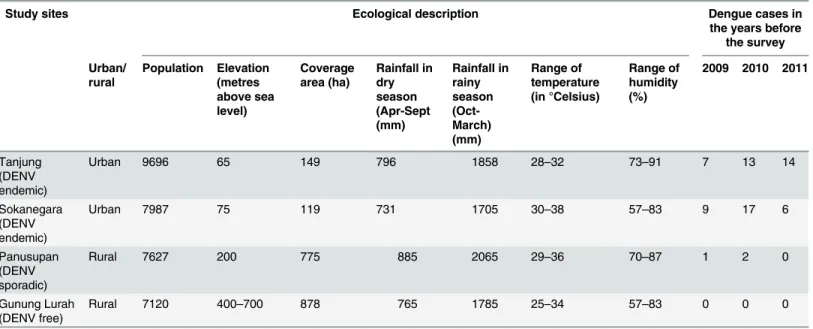
houses being analysed in the dry season and 400 houses in the rainy season. The individual locations of the entomological surveys are shown inFig 1. An overview of environmental con-ditions and characteristics of the four villages is shown inTable 1.
Larval/pupae surveys and adult mosquito collections
Larvae collection was carried out in every container both inside and outside the participating houses. To measure the entomological parameters the House Index (HI: percentage of houses infested with larvae and/or pupae), Container Index (CI: percentage of water-holding contain-ers infested with larvae or pupae), Breteau Index (BI: number of positive containcontain-ers per 100 houses inspected), Pupae Index (PI: number of pupae per 100 houses inspected) and Free Lar-vae Index (FLI: the percentage of houses without larLar-vae) were determined [20]. 100 houses is the sample size recommended by the Indonesian Ministry of Health, in“The Technical Manual Eradication of Dengue Mosquito-borne Diseases, Indonesian Ministry of Health”(1992) [29]. The interpretation of transmission risk levels of each village was made based on the larvae index, as described in the WHO document“A review of entomological sampling methods and indicators for dengue vectors”[20]. The survey also included a description of all containers, both artificial and natural in each participant’s house. Identification of the recovered larvae was based on the key identification criteria as described by Stojanovich and Scott, 1965 [30].
Insect collections were carried out using back-pack aspirators to capture adult mosquitoes in resting and flying positions. Areas inside the house where mosquitoes normally rest were focused on. For example,Ae.aegyptimosquitoes prefer to rest in dark, shielded, humid areas on hanging objects such as clothes and curtains and on walls. Adult mosquito capture was car-ried out between 8–11 AM for around 20 minutes per house (100 houses per village). Identifi-cation of adult mosquitoes was conducted by using key identifiIdentifi-cation criteria as described earlier [30]. Sample sizes of 100 houses were used as recommended.
Statistical tests
Confidence intervals (C.I.) 95%, t test, chi square test were calculated by using IBM SPSS Statis-tic 21.
Table 1. Description of the study sites in Banyumas Regency, Java.Details of the ecology and population of the four study sites are provided.
Study sites Ecological description Dengue cases in
the years before the survey
Urban/ rural
Population Elevation (metres above sea level)
Coverage area (ha)
Rainfall in dry season (Apr-Sept (mm)
Rainfall in rainy season (Oct-March) (mm)
Range of temperature (in °Celsius)
Range of humidity (%)
2009 2010 2011
Tanjung (DENV endemic)
Urban 9696 65 149 796 1858 28–32 73–91 7 13 14
Sokanegara (DENV endemic)
Urban 7987 75 119 731 1705 30–38 57–83 9 17 6
Panusupan (DENV sporadic)
Rural 7627 200 775 885 2065 29–36 70–87 1 2 0
Gunung Lurah (DENV free)
Rural 7120 400–700 878 765 1785 25–34 57–83 0 0 0
Ethical statement
Studies conducted here (data collection of mosquito breeding sites, mosquito egg collections) were carried out with ethical approval from the University of Glasgow (Project Number: 2012082) and the Ministry of National Education, Faculty of Medicine Gadjah Mada Univer-sity, Medical and Health Research Ethics Committee (KE/FK/323/FC). No data involving human participants were collected in this study.
Results
Larvae and pupae: survey results inside and outside houses
Following the field surveys conducted during the dry and rainy seasons, the HI and BI indices in the rainy season were found to be higher than in the dry season: the average HI and BI in all villages in the rainy season were 24 and 31, respectively, higher than in the dry season (15 and 18, respectively). On the other hand, the CI was lower in the rainy season (Table 2) probably because more containers were found in the rainy seasons in all villages. Thus compared to the dry season, more mosquito larvae were found during the rainy season. Panusupan (DENV spo-radic) showed the lowest free larvae indices (FLI), and was classed as a high risk level of DENV transmission compared to other villages using this index.
To determine whether larvae density correlated with number of DENV cases occurring after the survey, updated information on the number of dengue cases from the Banyumas Regency Health Office was obtained (Table 3).
Based on the report, Tanjung and Sokanegara (DENV endemic) which were classified as medium risk level according to the indices above, continued to have more dengue cases in 2012 Table 2. Risk level of dengue transmission based on larvae indices in the 4 study areas in the dry and rainy seasons.The following table summa-rizes House index (HI), Breteau Index (BI), Container Index (CI) and Free Larvae Index (FLI). Risk level determination according to AHA Brown [20]; C.I.: con-fidence interval.
Village DENV
status
Larvae index, dry season Larvae Index, rainy season
HI (95% C.I.) BI (95% C.I.) CI (95% C.I.) FLI (95% C.I.) Risk Level HI (95% C.I.) BI (95% C.I.) CI (95% C.I.) FLI (95% C.I.) Risk Level
Tanjung Endemic 16 (8–23) 16 (8–23) 10 (5–14) 84 (76–
91)
Medium 18 (10–
26)
18 (10–
26)
4 (2–5) 82(74–90) Medium
Sokanegara Endemic - - - 18 (10–
26)
18 (10–
26)
5 (2–6) 82 (74–
90)
Medium
Panusupan Sporadic 25 (16–
33)
35 (25–
44)
22 (15–
28)
75 (66–
83)
Medium 44 (34–
53)
71 (62–
79)
13 (9–15) 56 (46–
65)
High
Gunung Lurah
free 3 (0–6) 3 (0–6) 3 (0–5) 97 (93–
100)
Low 16 (8–
23)
19 (11–
26)
3 (1–4) 84 (76–
91)
Medium
Average 15 18 11 85 24 31 6 76
doi:10.1371/journal.pntd.0004500.t002
Table 3. Mosquito larvae density in dry and rainy seasons, and the number of dengue cases in 2012 and 2013.Dengue case numbers following the surveys were obtained from Banyumas Health Officer’s Report.
Village Endemicity status
Mosquito larvae density, dry season (May-June 2012)
Mosquito larvae density, rainy season (Jan-Feb 2013)
Dengue cases, 2012 (July-December)
Dengue cases, 2013 (March-December)
Tanjung Endemic Medium Medium 2 15
Sokanegara Endemic - Medium 13 9
Panusupan Sporadic Medium High 0 0
Gunung Lurah
Free area* Low Medium 0 1
*Despite one case, classed as free based on years preceding these surveys (seeTable 1). Larval densities were measured in accordance to Focks et al. [20].
and 2013 compared to the sporadic and free area. Meanwhile, Panusupan (DENV sporadic, but classed as high risk) reported no dengue cases in 2012 and 2013 and Gunung Lurah (reported as DENV free before 2012 and with a low or medium risk depending on index used) reported one dengue case in 2013. In addition to calculating the various indices as outlined above, species identification of the collected larvae was performed (Fig 2).
Numbers of larvae in all villages were higher in the rainy season than in the dry season.Ae. aegyptiandAe.albopictuswere the dominant species in Tanjung, Sokanegara (DENV endemic) and Panusupan (DENV sporadic).Culex sp. were identified in low numbers only in Panusupan (DENV sporadic) and Gunung Lurah (DENV free). Next pupae were assessed in each village and the Pupae Indices (PI) used in order to improve the entomology survey. Details of PI (house and container pupae indices) are indicated inTable 4.
The DENV endemic and sporadic areas had higher CPI and HPI than the DENV free area (Gunung Lurah) (X2= 6.60, df = 1, p-value = 0.01). This indicated that in the endemic/sporadic areas, mosquitoes tend to have a more conducive environment to survive from eggs to become
Fig 2. Number of mosquito species within the larvae identified in each of the four villages in dry and rainy season.Each bar represents the mosquito species as indicated in the legend.
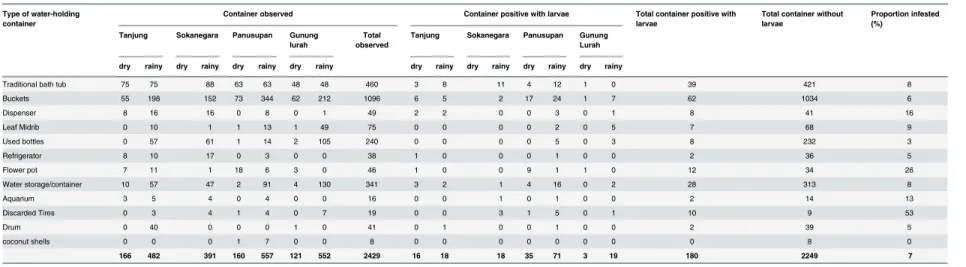
pupae, and environments with greater survival of mosquitoes to the pupal stage correlated to a higher number of reported dengue cases in endemic areas (Table 3) compared to sporadic and free areas; the high CPI and HPI did not however, correlate with the zero reported cases in Panusupan in the months after the survey. According to Focks (2003) the threshold of dengue transmission is when the pupae/person index (Table 4) ranged between 0.5–1.5 with an opti-mum air temperature 28°C [20]. Containers found in each house were recorded in order to determine what the dominant mosquito breeding containers were in the various study areas. The main finding of the container survey was that more artificial containers were found in the four villages surveyed compared to natural containers (paired t-test, mean 195, SD 310, p = 0.003) (summarized inTable 5). We found more natural containers in sporadic and free areas (Panusupan and Gunung Lurah) compared to endemic areas (Sokanegara and Tanjung), although there was no significant difference (p = 0.5) (Table 5). Endemic areas (Tanjung and Sokanegara) are more urbanised (less vegetation, and more densely populated), as described in
Table 1. Buckets, water storage containers and traditional bath-tubs were found to be the domi-nant breeding containers observed in all four villages. In fact, discarded tyres were the contain-ers which had the highest proportion of infestation (53%), this finding is also consistent with other studies [31,32]. Moreover, other artificial containers such as aquariums, water dispensers and flower pots also showed high infestation rates.
Adult mosquito field collections: larval indices did not always correspond
to abundance of adult vectors
Measuring adult mosquito numbers is considered to be the most representative quantitative estimate to obtain information about mosquito abundance, as immature stages need to go through several developmental stages to become adult mosquitoes before they can transmit DENV [20]. After identification of the mosquito species in the dry and rainy seasons, the num-bers of each species in each area are shown inFig 3.
The dominant adult mosquito species captured (both seasons combined) during the survey in Tanjung (whereCulex sp. were dominant only in the rainy season) and Sokanegara (DENV endemic) wereAe.aegypti; in Panusupan (DENV sporadic), non dengue transmittingCulex sp. were identified as the dominant species (12 in the dry season and 144 in the rainy season); although comparable numbers (to endemic areas) ofAe.aegyptiwere identified. Moreover the combined numbers ofAe.aegyptiandAe.albopictuswere higher in Panusupan than in the dengue endemic areas. However, because of its feeding preference, the role ofAe.albopictus has been called into question [3]. This adult collection result is in contrast with the larvae iden-tification, whereAe.albopictuswas found to be the dominant species in Panusupan and this is likely due to breeding behavior, asAe.albopictus(andAe.aegypti) species frequently breed in Table 4. Pupae indices for the four villages included in this study.
Name of Villages status CPI (%)(95% C.I.) HPI (%)(95% C.I.) Pupae/person Pupae/house Pupae/ container
dry rainy dry rainy dry rainy dry rainy dry rainy
Tanjung endemic 4 (0–8) 4 (0–8) 5 (0.7–9) 9(3–15) 0.02 0.061 0.09 0.26 0.05 0.05
Sokanegara endemic - 5 (1–9) - 11 (5–17) - 0.04 - 0.21 - 0.05
Panusupan sporadic 6 (1–11) 1 (0–3) 7 (2–12) 5 (1–9) 0.03 0.02 0.11 0.11 0.07 0.01 Gunung Lurah free 3 (0–6) 1 (0–3) 2 (0–5) 2 (0–5) 0.01 0.007 0.04 0.03 0.03 0.005
*CPI: Container Pupae Index; HPI: House Pupae Index; C.I.: confidence interval.
Table 5. Proportion of water-holding containers infested with larvae and/or pupae in the four villages of the study area.Both rainy and dry seasons are taken into account. Containers are described by type, as indicated.
Type of water-holding container
Container observed Container positive with larvae Total container positive with larvae
Total container without larvae
Proportion infested (%)
Tanjung Sokanegara Panusupan Gunung lurah
Total observed
Tanjung Sokanegara Panusupan Gunung Lurah
dry rainy dry rainy dry rainy dry rainy dry rainy dry rainy dry rainy dry rainy
Traditional bath tub 75 75 88 63 63 48 48 460 3 8 11 4 12 1 0 39 421 8
Buckets 55 198 152 73 344 62 212 1096 6 5 2 17 24 1 7 62 1034 6
Dispenser 8 16 16 0 8 0 1 49 2 2 0 0 3 0 1 8 41 16
Leaf Midrib 0 10 1 1 13 1 49 75 0 0 0 0 2 0 5 7 68 9
Used bottles 0 57 61 1 14 2 105 240 0 0 0 0 5 0 3 8 232 3
Refrigerator 8 10 17 0 3 0 0 38 1 0 0 0 1 0 0 2 36 5
Flower pot 7 11 1 18 6 3 0 46 1 0 0 9 1 1 0 12 34 26
Water storage/container 10 57 47 2 91 4 130 341 3 2 1 4 16 0 2 28 313 8
Aquarium 3 5 4 0 4 0 0 16 0 0 1 0 1 0 0 2 14 13
Discarded Tires 0 3 4 1 4 0 7 19 0 0 3 1 5 0 1 10 9 53
Drum 0 40 0 0 0 1 0 41 0 1 0 0 1 0 0 2 39 5
coconut shells 0 0 0 1 7 0 0 8 0 0 0 0 0 0 0 0 8 0
166 482 391 160 557 121 552 2429 16 18 18 35 71 3 19 180 2249 7
doi:10.1371/journal.pntd.0004500.t005
Mosquito
es
and
Dengu
e
Risk
in
Tropical
Diseas
es
|DOI:10.13
71/journa
l.pntd.000450
0
March
11,
containers around housing while culicine mosquitoes use different types of habitats. In Gunung Lurah (DENV free), we captured very few adult mosquitoes, andAe.albopictuswas the dominant species collected whileAe.aegyptiwas completely absent.
Discussion
Many DENV-endemic countries such as Indonesia, Malaysia and Thailand use entomological surveys as a routine method recommended by WHO to record mosquito populations [19]. Information on mosquito density can then be used in mosquito control efforts and in preven-tion of DENV transmission [33,34]. Areas with high mosquito populations have usually been treated with larvicides such as organophosphates or temephos in an attempt to prevent out-breaks of DENV. In Indonesia, a Ministry of Health programme encourages community par-ticipation in carrying out routine entomology surveys in their homes [35]. Some villages in Indonesia also have trained village health volunteers (VHV) who regularly conduct entomolog-ical surveys. Traditional sampling methods i.e. larvae indices were routinely applied over many years to determine mosquito densities in defined areas and the subsequent risk of DENV Fig 3. Number of adult mosquito species collected in each of the villages studied in the dry and rainy seasons.Each bar represents the mosquito species indicated as in the legend. Dengue endemicity status is also indicated.
transmission. However there can be limitations associated with traditional indices [20–22,36]. To assess the validity and usefulness of these methods, and improve the characterisation of vec-tor populations in our study area, we combined the traditional larvae indices together with the pupae index, species identification and adult mosquito collections.
Our results suggest that traditional larvae indices might not always be an appropriate way of quantifying mosquito populations and dengue transmission risk, as has been previously reported [36]. From the adult mosquito collections (and subsequent species identification), the high larvae indices in Gunung Lurah village (DENV free area; one recent case likely to have been imported from an area where transmission occured) did not support the transmission of DENV as very few adult mosquitoes were captured in this village. Nonetheless it is important to point out that bothAe.albopictusandAe.aegyptiwere present in DENV-sporadic Panusu-pan and perhaps differences in vectorial capacity come into play locally. Clearly, our data indi-cated that larvae density was not always in accordance with the number of DENV cases reported in villages. The pupae survey in this study (Table 4), would suggest that the area of study has a low risk for dengue transmission according to factors previously defined by Focks (2003). The high presence ofAe.albopictuslarvae in the dengue free area also suggests that presence of vectors alone may not predict transmission;Ae.albopictusin this area may have reduced capacity due to their feeding behaviour etc. or possibly reduced competence for DENV. That very few adult mosquitoes were found in 100 houses in Gunung Lurah might be due to a generally unfavourable environment for mosquitoes. These results suggested that high levels of adultAe.aegyptiin endemic (and sporadic) areas were a potential indicator of DENV transmission risk. These findings were in agreement with the real numbers of DENV cases which occured in Gunung Lurah; one reported case in 2013. Adult mosquito numbers (and species identification) may be a useful estimate to obtain information on dengue disease risk, at least in this part of Indonesia as immature stages need to go through several developmental stages in order to become adult mosquitoes able to transmit DENV [20,36]. However, these methods require specialist skills [37] and are not easily transferable to local surveillance pro-grammes. Moreover, while our observations suggest that the usefulness of several indices should be questioned at local level, we stress that underreporting of dengue cases needs to be taken into consideration in the discussion of our results. Improved patient data collection and dengue diagnostics need to be developed, implemented and combined with future mosquito surveillance work in the Regency to support entomological surveillance studies whose accuracy relies on such data. Our findings may encourage such efforts and lead to a more in depth re-evaluation of the observations reported here.
Based on the results of this study, mosquito populations in the regency are higher in the rainy season than in the dry season, for example more mosquito larvae and also adult mosqui-toes in three villages were found during the rainy season compared to the dry season. This sug-gests that health officers and the community should focus their efforts on the beginning of the rainy season. Not surprisingly we also found more potential breeding containers in the rainy season with buckets and water storage containers as predominant water sources in all four vil-lages surveyed. Our findings indicate that villagers can minimize the potential breeding sites for mosquitoes by reducing the presence of artificial containers such as traditional bath-tubs and buckets.
natural containers were found more frequently in rural areas (Panusupan and Gunung Lurah) andAe.albopictusis more prevalent thanAe.aegypti. These findings are in accordance with previous reviews on the differences in distribution and ecology betweenAe.aegyptiandAe. albopictuswhich stated thatAe.albopictusprefers natural containers [38].
Species identification is important but rarely applied in the field, and often only for research purposes.Culexsp. mosquitoes were identified as the dominant adult mosquito type in Panu-supan village; this is of interest since this species has not been shown to be a vector of DENV. Vazeille and colleagues stated thatAe.aegyptiis the most effective vector for dengue viruses and is highly receptive to oral infection; they also demonstrated thatCx.quinquefasciatuscan be infected by the parenteral route with DENV type 2 but the virus replicated to very low levels, therefore the authors concluded thatCx.quinquefasciatusshould not be considered a biological vector of DENV [39].
A recent study carried out in Taiwan suggested that various vector indices alone were poor DENV outbreak indicators and each country should evaluate its own situation [40]. We agree with this statement, although we emphasize that better diagnostics needs to be implemented as part of any future studies on this subject in Java. The transmission risk by adult mosquitoes can be influenced by a number of factors that affect the extrinsic incubation period (EIP) and arbovirus/ vector interactions. Indeed, virus and vector genetics, but also gut microbiota and host responses are important factors in DENV-vector interactions [41–53]. Moreover, climatic factors such as temperature and humidity come into play. The influence of temperature on EIPs associated with DENV for example, has been analysed, and was shown to be important for EIP duration [54–56]. These, and other risk factors may vary locally, and could also change over time highlighting the importance of local assessments. At least in the case of Banyumas Regency, our findings also suggest that more prevention efforts should be carried out in the beginning of the rainy season to reduce dengue virus transmission, for example by clearing artificial containers. In summary the observations of this study can form the basis of a better understanding of dengue vector ecology in this part of Indonesia.
Acknowledgments
We gratefully acknowledge the people in Tanjung, Sokanegara, Panusupan and Gunung Lurah villages for cooperating during the entomological surveys in and around their homes. We would also like to thank the staff of the Vector Borne Disease Research and Development Unit Banjarnegara for field research support, as well as the students of the Public Health Depart-ment, University of Jenderal Soedirman who participated in the field work. We also thank Tri-wibowo AG of the Vector Borne Disease Research and Development Unit Salatiga for his advice.
Author Contributions
Conceived and designed the experiments: SPMW MM SMR ES RB AK. Performed the experi-ments: SPMW SSun SSup. Analyzed the data: SPMW MM SMR ID ES RB AK. Wrote the paper: SPMW MM SMR ES RB AK.
References
1. Bhatt S, Gething PW, Brady OJ, Messina JP, Farlow AW, et al. (2013) The global distribution and bur-den of bur-dengue. Nature 496: 504–507. doi:10.1038/nature12060PMID:23563266
3. Lambrechts L, Scott TW, Gubler DJ (2010) Consequences of the expanding global distribution of Aedes albopictus for dengue virus transmission. PLoS Negl Trop Dis 4: e646. doi:10.1371/journal. pntd.0000646PMID:20520794
4. Weaver SC, Reisen WK (2010) Present and future arboviral threats. Antiviral Res 85: 328–345. doi: 10.1016/j.antiviral.2009.10.008PMID:19857523
5. Guzman MG, Halstead SB, Artsob H, Buchy P, Farrar J, et al. (2010) Dengue: a continuing global threat. Nat Rev Microbiol 8: S7–16. doi:10.1038/nrmicro2460PMID:21079655
6. Kyle JL, Harris E (2008) Global spread and persistence of dengue. Annu Rev Microbiol 62: 71–92. doi: 10.1146/annurev.micro.62.081307.163005PMID:18429680
7. Gubler DJ (2010) The Global Threat of Emergent/Re-emergent Vector-Borne Diseases. Vector Biol-ogy, Ecology and Control,. Washington DC: National Academy of Sciences, Courtesy of the National Academies Press. pp. 39–62.
8. Guzman MG, Harris E (2015) Dengue. Lancet 385: 453–465. doi:10.1016/S0140-6736(14)60572-9 PMID:25230594
9. Mustafa MS, Rasotgi V, Jain S, Gupta V (2015) Discovery of fifth serotype of dengue virus (DENV-5): A new public health dilemma in dengue control. Med J Armed Forces India 71: 67–70. doi:10.1016/j. mjafi.2014.09.011PMID:25609867
10. Rohani A, Aidil Azahary AR, Malinda M, Zurainee MN, Rozilawati H, et al. (2014) Eco-virological survey of Aedes mosquito larvae in selected dengue outbreak areas in Malaysia. J Vector Borne Dis 51: 327–
332. PMID:25540966
11. Thavara U, Siriyasatien P, Tawatsin A, Asavadachanukorn P, Anantapreecha S, et al. (2006) Double infection of heteroserotypes of dengue viruses in field populations of Aedes aegypti and Aedes albopic-tus (Diptera: Culicidae) and serological features of dengue viruses found in patients in southern Thai-land. Southeast Asian J Trop Med Public Health 37: 468–476. PMID:17120966
12. Thongrungkiat S, Maneekan P, Wasinpiyamongkol L, Prummongkol S (2011) Prospective field study of transovarial dengue-virus transmission by two different forms of Aedes aegypti in an urban area of Bangkok, Thailand. J Vector Ecol 36: 147–152. doi:10.1111/j.1948-7134.2011.00151.xPMID: 21635652
13. Khin MM, Than KA (1983) Transovarial transmission of dengue 2 virus by Aedes aegypti in nature. Am J Trop Med Hyg 32: 590–594. PMID:6859404
14. Karyanti MR, Uiterwaal CS, Kusriastuti R, Hadinegoro SR, Rovers MM, et al. (2014) The changing inci-dence of dengue haemorrhagic fever in Indonesia: a 45-year registry-based analysis. BMC Infect Dis 14: 412. doi:10.1186/1471-2334-14-412PMID:25064368
15. Setiati ET, F. P. Wagenaar J, D. de Kruif M, T.A Mairuhu A, C.M van Grop E, et al. (2006) Changing Epi-demiology of Dengue Haemorrhagic Fever in Indonesia. Dengue Bulletin 2006 1–4.
16. Suwandono A, Kosasih H, Nurhayati, Kusriastuti R, Harun S, et al. (2006) Four dengue virus serotypes found circulating during an outbreak of dengue fever and dengue haemorrhagic fever in Jakarta, Indo-nesia, during 2004. Trans R Soc Trop Med Hyg 100: 855–862. PMID:16507313
17. Ong SH, Yip JT, Chen YL, Liu W, Harun S, et al. (2008) Periodic re-emergence of endemic strains with strong epidemic potential-a proposed explanation for the 2004 Indonesian dengue epidemic. Infect Genet Evol 8: 191–204. doi:10.1016/j.meegid.2007.12.005PMID:18243816
18. Tan M, Kusriastuti R, Savioli L, Hotez PJ (2014) Indonesia: an emerging market economy beset by neglected tropical diseases (NTDs). PLoS Negl Trop Dis 8: e2449. doi:10.1371/journal.pntd.0002449 PMID:24587452
19. WHO (2009) Dengue: Guidelines for Diagnosis, Treatment, Prevention and Control. Geneva, Switzer-land: WHO. pp. 1–160.
20. Focks DA (2003) A Review of Entomological Sampling Methods and Indicators for Dengue Vectors. Florida, USA: World Health Organization on behalf of the Special Programme for Research and Train-ing in Tropical Diseases.
21. Barbazan P, Tuntaprasart W, Souris M, Demoraes F, Nitatpattana N, et al. (2008) Assessment of a new strategy, based on Aedes aegypti (L.) pupal productivity, for the surveillance and control of dengue transmission in Thailand. Ann Trop Med Parasitol 102: 161–171. doi:10.1179/136485908X252296 PMID:18318938
22. Focks D, Alexander N (2006) Multicountry study of Aedes aegypti pupal productivity survey methodol-ogy: findings and recommendations. Geneva: World Health Organization on behalf of the Special Pro-gramme for Research and Training in Tropical Diseases.
24. Sanchez L VV, Alfonso L, Marquetti MC, Guzman MG, Bisset J, et al (2006) Aedes aegypti larval indi-ces and risk for dengue epidemics. Emerg Infect Dis 12: 800–806. PMID:16704841
25. Gurtler RE, Garelli FM, Coto HD (2009) Effects of a five-year citywide intervention program to control Aedes aegypti and prevent dengue outbreaks in northern Argentina. PLoS Negl Trop Dis 3: e427. doi: 10.1371/journal.pntd.0000427PMID:19399168
26. Chadee DD, Williams FL, Kitron UD (2005) Impact of vector control on a dengue fever outbreak in Trini-dad, West Indies, in 1998. Trop Med Int Health 10: 748–754. PMID:16045461
27. Sulaiman S, Pawanchee ZA, Arifin Z, Wahab A (1996) Relationship between Breteau and House indi-ces and cases of dengue/dengue hemorrhagic fever in Kuala Lumpur, Malaysia. J Am Mosq Control Assoc 12: 494–496. PMID:8887232
28. Correa PR, Franca E, Bogutchi TF (2005) Aedes aegypti infestation and occurrence of dengue in the city of Belo Horizonte, Brazil. Rev Saude Publica 39: 33–40. PMID:15654458
29. Indonesia MoH (1992) Technical manual eradication of dengue mosquito-borne diseases. Jakarta: Indonesian Ministry of Health.
30. Stojanovich CHS, H.G (1965) Illustrated Key to Mosquitoes of Vietnam. Atlanta: U.S. Department of Health, Education and Welfare, Public Health Service, CDC Atlanta.
31. Williams CR, Johnson PH, Ball TS, Ritchie SA (2013) Productivity and population density estimates of the dengue vector mosquito Aedes aegypti (Stegomyia aegypti) in Australia. Med Vet Entomol 27: 313–322. doi:10.1111/j.1365-2915.2012.01051.xPMID:23205694
32. Nyamah MA, Sulaiman S, Omar B (2010) Categorization of potential breeding sites of dengue vectors in Johor, Malaysia. Trop Biomed 27: 33–40. PMID:20562811
33. Ooi E- E, Goh K- T, Gubler DJ (2006) Dengue Prevention and 35 Years of Vector Control in Singapore. Emerging Infectious Diseases 12: 887–893. PMID:16707042
34. Scott TW, Morrison AC (2010) Vector dynamics and transmission of dengue virus: implications for den-gue surveillance and prevention strategies: vector dynamics and denden-gue prevention. Curr Top Micro-biol Immunol 338: 115–128. doi:10.1007/978-3-642-02215-9_9PMID:19802582
35. Ministry of Health I (2011) Module of Dengue Fever Control. In: Handoko DP, E.B; Hartoyo S, editor. Jakarta: Ministry of Health, Indonesia. pp. 120.
36. Bowman LR, Runge-Ranzinger S, McCall PJ (2014) Assessing the relationship between vector indices and dengue transmission: a systematic review of the evidence. PLoS Negl Trop Dis 8: e2848. doi:10. 1371/journal.pntd.0002848PMID:24810901
37. Sivagnaname N, Gunasekaran K (2012) Need for an efficient adult trap for the surveillance of dengue vectors. Indian J Med Res 136: 739–749. PMID:23287120
38. Higa Y (2011) Dengue Vectors and their spatial distribution. Tropical Medicine and Health 39: 17–27.
39. Vazeille M RL, Mousson L, Failloux AB (2003) Low oral receptivity for dengue type 2 viruses of Aedes albopictus from Southeast Asia compared with that of Aedes aegypti. Am J Trop Med Hyg 68: 203–
208. PMID:12641412
40. Chang F-S, Tseng Y-T, Hsu P-S, Chen C-D, Lian I-B, et al. (2015) Re-assess Vector Indices Threshold as an Early Warning Tool for Predicting Dengue Epidemic in a Dengue Non-endemic Country. PLoS Negl Trop Dis 9: e0004043. doi:10.1371/journal.pntd.0004043PMID:26366874
41. Fansiri T, Fontaine A, Diancourt L, Caro V, Thaisomboonsuk B, et al. (2013) Genetic mapping of spe-cific interactions between Aedes aegypti mosquitoes and dengue viruses. PLoS Genet 9: e1003621. doi:10.1371/journal.pgen.1003621PMID:23935524
42. Pongsiri A, Ponlawat A, Thaisomboonsuk B, Jarman RG, Scott TW, et al. (2014) Differential suscepti-bility of two field aedes aegypti populations to a low infectious dose of dengue virus. PLoS One 9: e92971. doi:10.1371/journal.pone.0092971PMID:24664142
43. Bennett KE, Flick D, Fleming KH, Jochim R, Beaty BJ, et al. (2005) Quantitative trait loci that control dengue-2 virus dissemination in the mosquito Aedes aegypti. Genetics 170: 185–194. PMID: 15781707
44. Bosio CF, Fulton RE, Salasek ML, Beaty BJ, Black WCt (2000) Quantitative trait loci that control vector competence for dengue-2 virus in the mosquito Aedes aegypti. Genetics 156: 687–698. PMID: 11014816
45. Gomez-Machorro C, Bennett KE, del Lourdes Munoz M, Black WCt (2004) Quantitative trait loci affect-ing dengue midgut infection barriers in an advanced intercross line of Aedes aegypti. Insect Mol Biol 13: 637–648. PMID:15606812
47. Charan SS, Pawar KD, Severson DW, Patole MS, Shouche YS (2013) Comparative analysis of midgut bacterial communities of Aedes aegypti mosquito strains varying in vector competence to dengue virus. Parasitol Res 112: 2627–2637. doi:10.1007/s00436-013-3428-xPMID:23636307
48. Chauhan C, Behura SK, Debruyn B, Lovin DD, Harker BW, et al. (2012) Comparative expression pro-files of midgut genes in dengue virus refractory and susceptible Aedes aegypti across critical period for virus infection. PLoS One 7: e47350. doi:10.1371/journal.pone.0047350PMID:23077596
49. Behura SK, Gomez-Machorro C, Harker BW, deBruyn B, Lovin DD, et al. (2011) Global cross-talk of genes of the mosquito Aedes aegypti in response to dengue virus infection. PLoS Negl Trop Dis 5: e1385. doi:10.1371/journal.pntd.0001385PMID:22102922
50. Xi Z, Ramirez JL, Dimopoulos G (2008) The Aedes aegypti toll pathway controls dengue virus infection. PLoS Pathog 4: e1000098. doi:10.1371/journal.ppat.1000098PMID:18604274
51. Souza-Neto JA, Sim S, Dimopoulos G (2009) An evolutionary conserved function of the JAK-STAT pathway in anti-dengue defense. Proc Natl Acad Sci U S A 106: 17841–17846. doi:10.1073/pnas. 0905006106PMID:19805194
52. Sanchez-Vargas I, Scott JC, Poole-Smith BK, Franz AW, Barbosa-Solomieu V, et al. (2009) Dengue virus type 2 infections of Aedes aegypti are modulated by the mosquito's RNA interference pathway. PLoS Pathog 5: e1000299. doi:10.1371/journal.ppat.1000299PMID:19214215
53. Ramirez JL, Souza-Neto J, Torres Cosme R, Rovira J, Ortiz A, et al. (2012) Reciprocal tripartite interac-tions between the Aedes aegypti midgut microbiota, innate immune system and dengue virus influ-ences vector competence. PLoS Negl Trop Dis 6: e1561. doi:10.1371/journal.pntd.0001561PMID: 22413032
54. Carrington LB, Armijos MV, Lambrechts L, Scott TW (2013) Fluctuations at a low mean temperature accelerate dengue virus transmission by Aedes aegypti. PLoS Negl Trop Dis 7: e2190. doi:10.1371/ journal.pntd.0002190PMID:23638208
55. Chan M, Johansson MA (2012) The incubation periods of Dengue viruses. PLoS One 7: e50972. doi: 10.1371/journal.pone.0050972PMID:23226436