ISSN 0104-6632 Printed in Brazil
www.abeq.org.br/bjche
Vol. 25, No. 03, pp. 453 - 459, July - September, 2008
Brazilian Journal
of Chemical
Engineering
DECOLORIZATION AND REMOVAL OF COD
AND BOD FROM RAW AND BIOTREATED
TEXTILE DYE BATH EFFLUENT THROUGH
ADVANCED OXIDATION PROCESSES (AOPS)
A. Muhammad
*, A. Shafeeq, M. A. Butt, Z. H. Rizvi, M. A. Chughtai and S. Rehman
Institute of Chemical Engineering & Technology, University of the Punjab, Phone: +( 92) 42923126, Fax: +(92) 429231159, Lahore (54590), Pakistan.
E-mail: [email protected]
(Received: October 3, 2006 ; Accepted: March 10, 2008)
Abstract - In this paper, a comparative study of the treatment of raw and biotreated (upflow anaerobic sludge blanket, UASB) textile dye bath effluent using advanced oxidation processes (AOPs) is presented. The AOPs applied on raw and biotreated textile dye bath effluent, after characterization in terms of COD, colour, BOD and pH, were ozone, UV, UV/H2O2 and photo-Fenton. The decolorization of raw dye bath effluent was 58%
in the case of ozonation. However it was 98% in the case of biotreated dye bath effluent when exposed to UV/H2O2. It is, therefore, suggested that a combination of biotreatment and AOPs be adopted to decolorize
dye bath effluent in order to make the process more viable and effective. Biodegradability was also improved by applying AOPs after biotreatment of dye bath effluent.
Keywords: Biodegradation; Dyes; Ozonation; Pollutant; AOPs.
INTRODUCTION
The textile, paper, food processing and tanning industries have experienced significant economic development during the past two decades, accompanied by extremely high consumption of water. The textile industry produces large quantities of highly colored effluents, which are generally toxic and resistant to destruction by biological treatment methods. Most of the dyes used are of complex structured polymers. Particularly reactive azo dyes cause special environmental concern due to their degradation products, such as aromatic amines which are highly carcinogenic (APHA, AWWA and WEF Standard Methods for the Examination of Water and Wastewater, 1995; Arslan and Seremet, 2004). The use of a variety of dyes and auxiliary chemicals results in the discharge of toxic waste into natural water bodies. These industries are thus facing problems in maintaining a profitable level of
production while reducing the intake of fresh water. Another problem is the disposal of large volumes of effluents which abides by environmental standards. These are generally not amenable to conventional biological, physical and chemical treatment processes due to their recalcitrant and complex nature (Arslan et al., 1999; Azbar et al., 2004).
Advanced oxidation is a potential alternate method to decolorize and reduce recalcitrant wastewater loads from textile dyeing and finishing effluents (Balcioglu and Arslan, 1999). Chemical oxidation using ultraviolet radiation (UV) in the presence of hydrogen peroxide (H2O2) is a very
promising technique. The most common technique is the use of UV wavelengths (200-300) nm at 254 nm to disassociate H2O2 progressively. The UV/H2O2
454 A. Muhammad, A. Shafeeq, M. A. Butt, Z. H. Rizvi, M. A. Chughtai and S. Rehman
can be further oxidized (Baxendale et al., 1957; Bolton et al., 1996; Camel and Bermond, 1998; Catalkaya et al., 2003). Almost 700,000 tons of approximately 10,000 types of dyes and pigments are produced annually worldwide, of which about 20% are assumed to be discharged as industrial effluent during the textile dyeing processes. Aerobic biological degradation is not always effective for the purpose of color removal from textile dye-contaminated effluent. Since biodegradation products can be of a toxic nature, success with treatment by biodegradation can be limited and specifically the treatment of synthetic dyestuff cannot depend on biodegradation. Up to 50% for reactive dyes, 8-20% for disperse dyes and 1% for pigments may be lost directly into effluent, resulting in a colored effluent, due to the inefficient dyeing process and the nature of the dyes, which after hydrolyzation do not react with the fiber (Azbar et al., 2004). Commonly applied treatment methods for color removal from dye contaminated effluents consist of integrated processes involving various combinations of biological, physical and chemical decolorization methods. Advanced oxidation processes (O3, O3/H2O2, O3/UV, UV/H2O2,
O3/UV/H2O2 and Fe 2+
/H2O2) for the degradation of
nonbiodegradable organic contaminants in industrial effluents are attractive alternatives to conventional treatment methods. AOPs based on the generation of very reactive and oxidizing free radicals have been used with increasing interest due to their high oxidant power. Also many studies have demonstrated that AOPs are effectively removing color and partially removing the organic content of dyestuffs (Chen et al., 1997; Galindo et al., 2001; Glaze et al., 1987; Gulyas et al., 1995; Thobanoglous et al., 2003).
EXPERIMENTAL SETUP FOR ADVANCED OXIDATION PROCESSES
Advanced oxidation of raw and biotreated (UASB) textile dye bath effluent (Real, obtained from local textile industry) was carried out by applying ozonation, UV, UV/H2O2 and photo-Fenton
processes at ambient temperature and pressure. The upflow anaerobic sludge blanket (UASB) uses an anaerobic process while forming a blanket of granular sludge suspended in the tank. Wastewater flows upwards through the blanket and is processed by the anaerobic microorganisms. All the experiments were carried out for the effluent sample of 0.5L in batch mode at a constant pH of 6.2 and adjusted by adding 1N NaOH to raise the pH to 10.2 or 1N HCl to lower the pH to 3.5 upon decolorization. The highest decolorization rate was observed at pH 6.2 without adjustment with NaOH or HCl and was selected for the decolorization
condition of dye bath effluent in all the experiments. One of the major factors which may affect the efficiency of color and COD removal is pH, particularly in the cases of the ozonation and photo-Fenton processes (Sigge et al., 2002). A bubble column type reactor consisting of a graduated Pyrex glass vessel (internal diameter 5 cm and height 30 cm) and a magnetic stirrer was utilized.
Ozonation Process
A JQ-6M PURETECH model ozone generator with the capacity to produce ozone at a concentration of 5% was employed. High purity oxygen at a concentration of 99.5% was introduced at a rate of 3.5 l/min. into the ozone generator. However, the real doses of ozone applied into the reactor through a fine bubbling stone, were estimated at 1.5 l/min. of oxygen. Ozonation time was varied from (5 to 30) min. for both raw and biotreated effluent. Ozone-treated effluent was sampled at regular time intervals for determination of COD and color removal efficiencies.
UV Photo-Reactor
A UV lamp model PENRAY 3SC9 (Upland, USA) with a radiation intensity of 5 mW/cm2 and wavelength of 254 nm was positioned within the center of reactor. As the most biologically disruptive frequencies are the shortest wavelengths within ultraviolet (UV) light, known as the UV-C spectrum ranging from (200 to 300) nm, the UV emission spectrum at 254 nm was utilized.
Hydrogen Peroxide Setup
The hydrogen peroxide (H2O2) used in this study
was of analytical grade (35%) and was obtained from Merck (Germany). The dosage of H2O2 used for all
the tests performed was first optimized at a constant pH of 6.2 for the samples in each study by varying the dosage from (50-200) mg/l.The optimized dose of H2O2 above which the decolorization effect was
weakened was found to be in the range of (150-200)
mg/l for raw and (100-150) mg/l for biotreated
effluent.
Analytical Methods
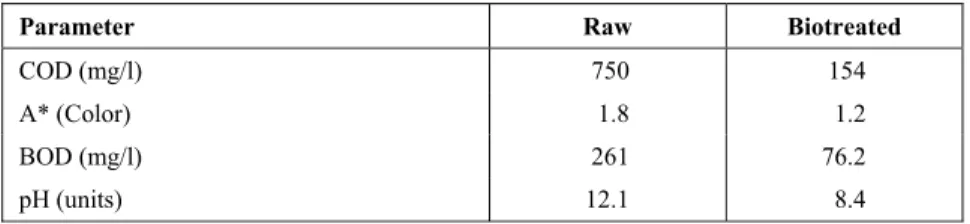
Table 1: Characterization of Raw and Biotreated Textile Dye Bath Effluent
Parameter Raw Biotreated
COD (mg/l) 750 154
A* (Color) 1.8 1.2
BOD (mg/l) 261 76.2
pH (units) 12.1 8.4
*Absorbance of color at 465nm
ADVANCED OXIDATION OF RAW TEXTILE EFFLUENT
Ozonation
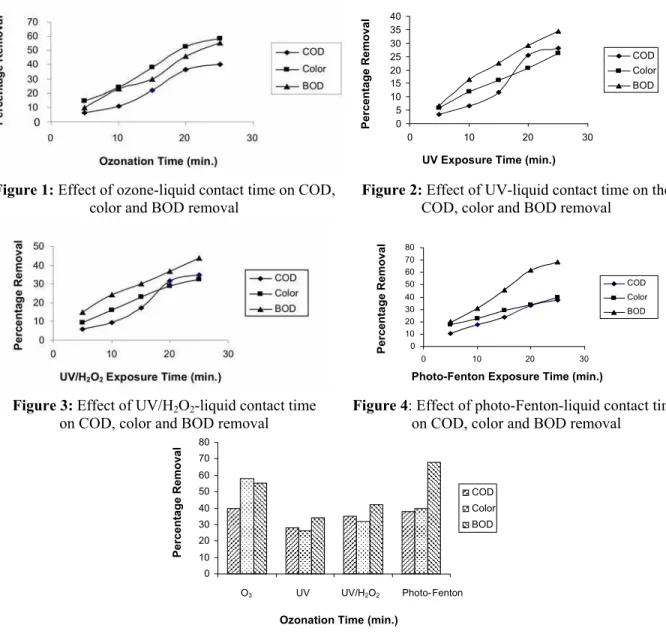
In this study the effect of ozonation time on removal of COD, color and BOD was investigated with oxygen at a purity of 99.5% fed into the ozone generator. The removal of COD, color and BOD initially increased with ozonation exposure time up to 25 min. and did not change appreciably thereafter. This can probably be explained by the fact that some organic compounds are more susceptible to oxidation than others, while some are only partially oxidized (Camel and Bermond, 1998). Although, Ozone itself is a highly oxidizing agent, even then various pH values have a large effect on COD removal, which increases at higher pH values (Azbar et al., 2004). The results shown in Figure 1 imply that dye bath effluent can be decolorized efficiently at a constant pH of 6.2 by ozonation, i.e., 58% at a 25 min. exposure time.
Irradiation
Raw textile effluent was exposed to UV irradiation alone and the removal of COD, color and BOD was found to be highest at a 25 min. exposure time, i.e., 28%, 26% and 34%, respectively, as shown in Figure 2, and seemed to decrease thereafter. Percentage removal was not appreciable due to the fact that the UV supported process is generally applied to the aqueous wastes of low color intensity, while in this study the textile effluent color was of high intensity. This high color intensity might have prevented the uniform penetration of UV light throughout the sample
UV/H2O2
It is obvious from Figure 3 that 35%, 32% and 44% of COD, color and BOD, respectively, were removed. Percentage removal was not appreciable, due to the fact that hydroxyl radical production in the presence of UV may require a specific pH. However, a decolorization efficiency may be enhanced by applying UV/H2O2/O3 or increasing the concentration
of H2O2 to ensure the availability of hydroxyl
radicals.
Photo-Fenton Process
Figure 4 illustrates that the best results for the removal of color, COD and BOD were obtained at a 25 min. exposure time to UV irradiation, 40%, 38% and 68% respectively and after 25 min., removal remained constant.
Comparison of AOPs
It is obvious from Figure 5 that decolorization and COD and BOD removal are higher in case of ozonation of raw textile dye bath effluent than with all other AOPs applied, with the exception that percentage removal of BOD was found to be highest in the case of exposure to photo-Fenton. Thus ozone was shown to be effective as a strong oxidizing agent, specially with respect to COD and color removal. As UV/H2O2 requires acidic conditions for
reasonable removal efficiency (Shu and Chang, 2005), its probable failure to be the most effective in our study may have been due to the pH used, i.e., 6.4. However, in the presence of UV or H2O2, along
456 A. Muhammad, A. Shafeeq, M. A. Butt, Z. H. Rizvi, M. A. Chughtai and S. Rehman
0 5 10 15 20 25 30 35 40
0 10 20 30
UV Exposure Time (min.)
Pe
rc
e
n
ta
g
e
R
e
m
o
v
a
l
COD Color BOD
Figure 1: Effect of ozone-liquid contact time on COD, color and BOD removal
Figure 2: Effect of UV-liquid contact time on the COD, color and BOD removal
0 10 20 30 40 50 60 70 80
0 10 20 30
Photo-Fenton Exposure Time (min.)
COD Color
BOD
Pe
rc
e
n
ta
g
e
R
e
m
o
v
a
l
Figure 3: Effect of UV/H2O2-liquid contact time
on COD, color and BOD removal
Figure 4: Effect of photo-Fenton-liquid contact time on COD, color and BOD removal
0 10 20 30 40 50 60 70 80
O3 UV UV/H2O2 Photo- Fenton
Ozonation Time (min.)
COD Color BOD
Pe
rc
e
n
ta
g
e
R
e
m
o
v
a
l
Figure 5: Comparison of AOPs in terms of COD, color and BOD removal
STUDY OF BIODEGRADABILITY ENHANCEMENT OF RAW TEXTILE EFFLUENT
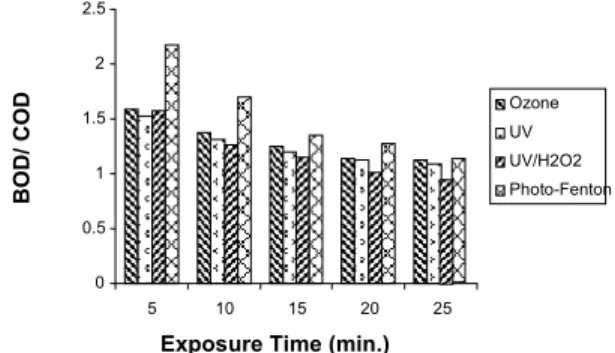
The improvement in biodegradability in all the experiments was followed by measuring the change in BOD/COD ratio. Adoption of the two-step sequence, i.e., biological treatment along with oxidation of effluents, is thus suggested to obtain the greatest advantage with application of AOPs. The goal of advanced oxidation processes is not to mineralize the compounds (i.e., convert to CO2 and
H2O), but rather to convert biorecalcitrant
compounds into intermediates which are readily biodegradable in conventional biological treatment processes. Biodegradability of the raw textile
effluents showed a sudden improvement from 0.35 to >1 up to an exposure time of 15 min., which could be due to high BOD and then continuously decreased with the increase in exposure time in all the oxidation processes, as shown in Figure 6. This may be due to the fact that initially all AOPs were able to destroy recalcitrant components of the effluent or that no appreciable amount of recalcitrant material was present in the initial stages. Mineralization of organic matter into CO2 and water takes place in
highly oxidative environments, yet its existence cannot be ignored here either. The effect of H2O2
0 0.5 1 1.5 2 2.5
5 10 15 20 25
Exposure Time (min.)
Ozone UV
UV/H2O2 Photo-Fenton
B
O
D
/
C
O
D
Figure 6: Biodegradability improvement of raw textile effluent
ADVANCED OXIDATION OF BIOTREATED (UASB) TEXTILE EFFLUENT
A 2.5L laboratory-scale up flow anaerobic sludge blanket (UASB) bioreactor was used and operated at 35°C. The volume of the biogas was determined using a barometric unit equipped with an electronically controlled counter and a gas-tight valve and the volumes were adjusted to standard temperature and pressure. The substrate was fed semicontinuously into the bioreactor by means of a peristaltic pump (Watson-Marlow 302S) controlled by an electronic timer. The bioreactor was run at a hydraulic retention time (HRT) of 36 h. The bioreactor effluent was characterized in terms of COD, color, BOD and pH, as shown in Table 1.
Ozonation
The ozonation experiments of UASB-treated effluent were performed at a constant pH of 6.2 and ozone (5% conc.) dosage at a pure oxygen supply of 1.5 l/min. with quite promising results (Figure 7), i.e., percentage removal values of 75% COD, 95% color and 85% BOD at a 25 min. exposure time. The degree of color removal initially increased with dose of ozone administered, but showed no appreciable decolorization thereafter, which may be due to the fact that biotreatment had already lowered the intensity of the dye bath effluent.
UV Irradiation
Decolorization and COD removal by applying UV irradiation were 79% and 80%, respectively, as shown in Figure 8. Decolorization was quite appreciable because the color of UASB-treated effluent was already less intense. However, the color removal efficiency was further improved due to
uniform distribution of UV light throughout the sample.
UV/H2O2
It is clear from Figure 9 that the increase in color and COD reduction with time is not linear, i.e., it is initially rapid up to a 20 min. exposure time and then decreases with time, which indicates that UASB-treated effluents may contain considerable amounts of compounds that require a stronger oxidizing system.
Photo-Fenton Process
The photo-Fenton process is an important emerging technology in the field of oxidation processes. All the tests were performed using concentration of FeSO4 (10 mg/l) for 30 min. of UV
exposure time. Disruption of the biological substances occurred mostly between UV spectrum of (200-300) nm, so the used wavelength is considered to be appropriate for this process. In Figure 10 it can be observed that percentage removal after a 25 min. exposure time was 61%, 86% and 69% COD, color and BOD, respectively; thereafter no appreciable removal efficiency was observed
Comparison of AOPs
Decolorization of biotreated textile dye bath effluent was most efficient, and reached up to 95% in the cases of both ozone and UV/H2O2.COD removal
in all AOPs was found to occur in the following descending order UV/H2O2, UV, O3 and photo-
Fenton. Thus, in Figure 11, it can be observed that UV/H2O2 was the most efficient in terms of both
COD and color removal. It can also be presumed that the simultaneous application of UV and H2O2 to
458 A. Muhammad, A. Shafeeq, M. A. Butt, Z. H. Rizvi, M. A. Chughtai and S. Rehman 0 20 40 60 80 100
0 10 20 30
Ozonation Time (min.)
Pe rc e n ta g e R e m o v a l COD Color BOD 0 20 40 60 80 100
0 10 20 30
UV Exposure Time (min.)
Pe rc e n ta g e R e m o v a l COD Color BOD
Figure 7: Effect of Ozone -liquid contact time on COD, color and BOD removal
Figure 8: Effect of UV-liquid contact time on COD, color and BOD removal
0 20 40 60 80 100 120
0 10 20 30
UV/H2O2 Exposure Time (min.)
Pe rc e n ta g e R e m o v a l COD Color BOD 0 10 20 30 40 50 60 70 80 90 100
0 10 20 30
Photo-Fenton Exposure Time (min.)
Pe rc e n ta g e R e m o v a l COD Color BOD
Figure 9: Effect of UV/H2O2-liquid contact time on
COD, color and BOD removal
Figure 10: Effect of photo-Fenton-liquid contact time on the removal of COD, BOD and color
0 20 40 60 80 100 120
O3 UV UV/H2O2 Photo-Fenton
Exposure Time (min.)
COD Color BOD P e rc e n ta g e R e m o v a l 0 0.5 1 1.5 2 2.5
5 10 15 20 25
Exposure Time (min.)
B O D / C O D Ozone UV UV/H2O2
Photo-Fenton
Figure 11: Comparison of AOPs in terms of percentage removal of COD, color and BOD.
Figure 12: Biodegradability improvement of biotreated textile effluent
BIODEGRADABILITY IMPROVEMENT OF TREATED TEXTILE EFFLUENT
The biodegradability of the biotreated textile effluents also initially increased suddenly from 0.5 to >1 and then decreased continuously during application of all the AOPs, which is obvious in Figure 12, as the biodegradable components had already been removed during biotreatment and only biorecalcitrant matter was left in the effluent to either be converted in to biodegradable matter or turned in to highly recalcitrant or inert matter.
CONCLUSIONS
allows better achievement of decolorization efficiency, but also contributes towards reducing treatment costs. Thus application of AOPs to biotreated textile effluent is more effective than their use with raw effluent. Ozonation of raw textile effluent is probably better for decolorization than the AOPs applied. However, in the case of biotreated textile effluent, the efficiency of decolorization was higher with UV/H2O2 than with the other AOPs applied.
REFERENCES
APHA, AWWA and WPCF, Standard Methods for the Examination of Water and Wastewater, 19th ed., American Public Health Association, Washington, D.C., 1995.
Arslan, I. and Seremet, O., Advanced Treatment of Biotreated Textile Industry Wastewater with Ozone, Virgin/Ozonated Granular Activated Carbon and Their Combination, Toxic/Hazardous Substances & Environmental Engineering, 39(7): 1687-1700 (2004).
Arslan, I., Balcioglu, I. A. and Tuhkanen, T., Advanced Oxidation of Synthetic Dyehouse Effluent by O3,
H2O2/O3 and H2O2/UV Processes, Env. Tech., 20:
921-931 (1999).
Azbar, N., Yonar, T. and Kestioglu, K., Comparison of Various Advanced Oxidation Processes and Chemical Treatment Methods for COD and Color Removal from a Polyester and Acetate Fiber Dyeing Effluent,Chemosphere, 55: 35-43 (2004). Balcioglu, I. and Arslan, I., Treatment of Textile
Industry Wastewater by Enhanced Photo Catalytic Oxidation Reaction, J. Adv. Oxid. Tech., 4 (2): 189-195 (1999).
Baxendale, J. H. and Wilson, J. S., The Photolysis of Hydrogen Peroxide at High Light Intensities, Trans. Faraday Soc., 53: 344-356 (1957).
Bolton, J. R., Bircher, K. G., Tumas, C. A. and Tolman, C. A., Figures of Merit for the Technical
Development and Application of Advanced Oxidation Processes, J. Adv. Oxid. Tech., 1 (1): 13-17 (1996).
Camel, V. and Bermond, A., The Use of Ozone and Associated Oxidation Processes in Drinking Water Treatment, Water Research, 32, 3208-3222 (1998).
Catalkaya, E., Bali, U. and Sengul, F., Photochemical Degradation and Mineralization of 4-chlorophenol, Env. Sci. Pollut. Res., 10 (2): 113-118 (2003).
Chen, J., Rulkens, W. H. and Bruning, H., Photochemical Elimination of Phenols and COD in Industrial Wastewaters, Wat. Sci. Tech., 35 (4): 231-238 (1997).
Galindo, C., Jacques, P. and Kalt, A., Photochemical and Photocatalytic Degradation of an Indigoid Dye: a Case Study of Acid Blue 74 (AB74), J. Photochem. Photobiol. A., 141 (1): 47-56 (2001). Glaze, W. H., Kang, J. W. and Chapin, D. H., The
Chemistry of Water Treatment Processes Involving Ozone, Hydrogen Peroxide and Ultraviolet Radiation, Ozone Sci. Eng., 9: 335-352 (1987).
Gulyas, H., Von Bismarck, R. and Hemmerling, L., Treatment of Industrial Wastewaters with Ozone/Hydrogen Peroxide, Wat. Sci. Tech., 32(7): 127-134 (1995).
Shu, H. Y. and Chang, M. C., Pre-Ozonation Coupled with UV/H2O2 Process for the Decolorization and
Mineralization of Cotton Dyeing Effluent and Synthesized C.I. Direct Black 22 wastewater, J. of Hazardous Materials B121, 127-133 (2005). Sigge G. O., Britz T. J., Fourie P. C., Barnardt, C. A.
and Strydom R., Combining UASB Technology and Advanced Oxidation Processes (AOPs) to Treat Food Processing Wastewaters, Water Sci. Tech., vol. 45, no. 10, pp. 329-334 (2002).