*e-mail: [email protected]
Analysis of the Performance of Superabrasive and Alumina
Grinding Wheels with Different Bonds and Machining Conditions
Eduardo Carlos Bianchia, Paulo Roberto de Aguiarb, Rodrigo Daun Monicic, Luiz Daré Neto*, Leonardo Roberto da Silvad
a
Department of Mechanical Engineering - State University of Sao Paulo - UNESP/Bauru C.P. 473 - 17033-360 Bauru - SP, Brazil
b
Department of Electrical Engineering - State University of Sao Paulo - UNESP/Bauru
c
Graduating in Mechanical Engineering - State University of Sao Paulo - UNESP/Bauru
d
Department of Mechanical Federal Center of Technological Education of Minas Gerais -CEFET-MG
Received: August 26, 2002; Revised: February 1, 2003
This paper presents a review of researches on CBN (cubic boron nitride) grinding wheels with the purpose of identifying the state of art in abrasive machining and serving as the basis for future researches and laboratory tests. The scientific studies investigated here report on interesting re-sults involving grinding, published by Brazilian and foreign authors. The methods and the rere-sults are presented and discussed. In addition, a grinding setup is presented which provides more reli-able experimental results about the surface integrity of fragile materials. This setup was obtained for grinding tests in several grinding conditions during the wheel service life, using alumina and vitrified and resin bond CBN grinding wheels. Results of cutting force, surface roughness and G ratio are also presented and discussed. They confirm the excellent machining capacity of the CBN wheel, with stable behavior in cutting force and roughness results during the tests. The G ratio values are in agreement with the results found by other researchers.
Keywords: machining, grinding wheels, tangential cutting force, bonds
1. Introduction
The requisites of quality and functionality of industri-ally manufactured components, which have become increas-ingly stringent in recent years, have led to the manufacture of better quality components produced more rapidly, off-setting material and machining process costs. The produc-tion cost of machined parts is substantially higher for parts with a complex geometry13.
Foreign competition is forcing the national industry to meet international standards of product quality and perform-ance. This, in turn, implies detailed knowledge of basic as-pects ranging from the design to the manufacture of ma-chines and equipment.
The manufacture of precision machines and equipment involves the use of parts with controlled tolerances (dimen-sion and shape) and extremely slight surface roughness.
Such parts are usually produced in a precision machining operation, which must combine minimum cost with maxi-mum production output1,2. The performance of the machin-ing operation is strongly dependent on the operator’s skill and sensitivity, as well as on the machining and dressing conditions of the grinding wheel (sharpness). This machin-ing operation cannot be optimized simply by changmachin-ing a process input parameter. The operator is usually responsi-ble for deciding, based on trial and error, about the proce-dures to which the parts are to be subjected. Knowing the behavior of the machining process enables him to make a better interpretation of the operation that is carried out on a part and to make any modifications of the process that will allow him to reach the desired results.
means through which it enables manufacturers of mass pro-duction and of medium-sized and flexible propro-duction lots to make significant advances in productivity. Today, the superabrasive grains of Cubic Boron Nitride (CBN) are used in a broad range of industrial applications and, although their use in machining processes doesn’t have yet the im-pact of integrated and computer-aided processes such as CAD, CAM and CNC, among others, this impact lies in the very near future. Currently, while most technical schools and even manufacturing companies possess CAD laborato-ries and offer computer and CNC programming courses as well as many other facilities, very few teach their students about uses and applications of superabrasives in machin-ing. There is a clear gap between the real capacity of superabrasives and the industrial skills in their practical use. New tooling machines and materials for cutting tools have been developed as the result of continuous efforts to improve the quality of products and manufacturing methods4,10. Some types of composite materials are provenly very difficult or even impossible to subject to the machining process using superabrasive grinding wheels, even though the cutting ca-pacity of this type of grinding wheel is superior to that of the alumina ones, depending on the applicability of each tool. However, superabrasives have proved to be exceptional in the machining of hard ferrous metals, cast iron and nickel and cobalt super-alloys. It is also a fact that superabrasive grinding wheels have high efficiency, cutting capacity and can produce a larger variety of high precision parts using the same physical effort expended on alumina grinding wheels at lower cost and, hence, with higher productivity.
In typical manufacturing operations, the grinding wheel is the interface between the machine and the part. For the grinding wheel to transfer the energy available in the ma-chine to the machining operation it must, among other things, be harder than the part and, therefore, more resistant to wear. The abrasive crystal grains of CBN are appropriate and even exceed this requirement and, for that reason, they are used in the manufacture of grinding wheels for high efficiency machining of difficult to grind (DTG) materials.
Alumina and silicon carbide grinding wheels quickly lose their cutting capacity when machining DTG materials, resulting in high cutting forces and temperature (generated by friction), and low material removal rates, which affect the geometrical and dimensional precision of machined parts. In contrast, CBN grinding wheels prolong the ma-chine’s cutting capacity and the high thermal conductivity helps reduce the uncontrolled increase of heat, thus reduc-ing the possibility of metallurgical damage to the part.
According to Metzger11, the fast growth and advances in high performance production, allied to the progressive substitution of skilled workers by computerized or microprocessed controls, make it increasingly important to determine, with precision and reliability, the real
perform-ance of high technology tools used for working with ever more complex and superior materials.
The need for precise and continuous control of cutting tool performance is understandable when one considers that management focuses on greater productivity with resulting economic improvements. However, this also implies the urgent need for greater efforts on the part of members of the technical and management staff of manufacturers. Daily experience has demonstrated that, in a company’s manu-facturing area, every machining process, including turning, is subject to some degree of dispersion, which may trans-form a reliable pertrans-formance measure into a Utopian value that is difficult to achieve, doubtful and often frustrating.
The purpose of this study is to make a comparative analy-sis of CBN grinding wheels produced with three different types of bond and a alumina wheel. To this end, resin bonds, high performance resins and vitrified resins were used on abrasive grinding wheels. This comparative analysis was based on tangential cutting force, surface roughness of the part and the G ratio.
2. Machining of Surfaces with CBN
Grinding Wheel
CBN grinding wheels are more cost efficient for the machining of a variety of metals that are usually considered difficult to grind. This category includes any carbon steel or alloy hardened to 50 HRc or more, extremely hard and abrasion-resistant cast irons and abrasion-resistant steel al-loys, nickel or cobalt superalloys with a hardness of or above 35 HRc, and special metals such as Stellite.
The benefits of surface machining with CBN grinding wheels are: more consistent precision of the components, better surface quality, greater productivity and lower ma-chining costs. The cost-benefit ratio of CBN grinding wheels is based on surface machining operations on hardened steel components. Although the cost of machining per part may be higher when machining with the CBN grinding wheel than with the aluminum oxide one, the work costs and overall expenses per tool may be lower due to the shorter machin-ing time required, fewer tool changes, less conditionmachin-ing of the grinding wheel, less tool changes and machine adjust-ments to compensate for the wear of the grinding wheel, and faster finishing cycles. The total cost of machining per tool may be 40% lower, which makes the CBN grinding wheel an excellent investment4,6.
3. Types of Bonds
The machining of a large number of parts requires the use of a variety of bond systems to fix the abrasive grains on the surface of the grinding wheel’s core. The four most commonly employed bonds materials currently used by superabrasive grinding wheel manufacturers are: resin, vit-rified, metallic and electroplated types. It is important to understand how each type of grinding wheel is manufac-tured and the effect that the manufacturing process exerts on the grinding wheel’s properties. These properties deter-mine the procedures of recovery and sharpening, which are possibly the most important determining factors for grind-ing wheel effectiveness.
Grinding wheels with resin bond are manufactured by mixing measured amounts of phenolic resin or polyamide and fillers with the proper weight and size of the CBN abra-sive with a metallic layer. The mixture is then used to fill the mold of the cavity and form the section of the machin-ing end around the core of the grindmachin-ing wheel. After the cavity is filled, the resin and abrasive mixture is subjected to pressures and temperatures of up to 400 °C, which fixes the abrasive to the core of the grinding wheel. After the grinding wheel is removed from the mold, a second heat treatment polymerizes and reinforces the resin bond6.
Grinding wheels with resin bond remove material rap-idly but have limited characteristics of aggregation and shape. The main characteristics of grinding wheels with resin bond are the following6:
• They can be used for a large variety of applications; • They are available in a great many shapes and sizes; • They can be used for both refrigerated and dry
ma-chining;
• They possess good cutting qualities.
Electroplated CBN grinding wheels have a single layer of abrasive grains that are bonded to a metallic core by means of an electrodeposited nickel bath. The electrodeposited nickel matrix provides excellent retention for the abrasive. The manufacturing process of grinding wheels with vit-rified bond consists of the following steps6:
1. The appropriate amount of powdered vitrified mate-rial, known as “FRIT”, is mixed with the desired type, weight and grain size of CBN;
2. The mixture is carefully placed in a mold around the core of the grinding wheel, which is made of ceramic which can withstand temperatures of up to 1000 °C;
3. The “green grinding wheel” is also carefully removed and placed in a furnace with controlled temperature and atmosphere, with the time factor also carefully controlled; 4. While the grinding wheel is inside the furnace, a chemi-cal reaction causes the bond to transform into hard vitrified bond that fixes the CBN abrasive to the grinding wheel’s core; 5. Vitrified grinding wheels with greater width can be
made of small radial segments that are carefully placed and cemented around the periphery of the grinding wheel’s core. These grinding wheels display a good cutting capacity, producing good surface finishing, have good wear resist-ance and maintain the geometrical profile of the grinding wheel. The porosity or open structure of vitrified grinding wheels can be controlled to provide chip output, allow for the flow of cooling fluids, and prevent clogging of the grind-ing wheel’s pores. The main characteristics of superabrasive grinding wheels with vitrified bond are6:
• Good abrasion resistance;
• Good capacity to maintain their geometrical shape; • Long service life;
• They are usually easier to recover and sharpen than other bonds;
• They produce better surface finishing - concentrations of 150 to 200 can produce the best results;
• They display lower resistance to inappropriate use.
3.1 High performance surface machining - The bond’s influence on the abrasive process
According to Brinksmeier & Minke3, much attention in recent years has been focused on the development of high performance machining to gain a better understanding of the process and to apply this technology in industrial appli-cations. Today, specially designed CBN machines and tools are available and basic knowledge about machining and dressing processes has been gained. However, there are a number of problems relating to this process, which will re-quire redoubled efforts to be overcome in the future. The application of this method to difficult to grind materials such as high-speed steels, tungsten carbide, nickel alloys, tita-nium, ceramics and glass, will open up a vast new field. In practical research, several issues will require a closer inves-tigation, namely, the machining forces and the power re-quired by the process, the temperature, the damages caused to the subsurface and the quality of workmanship. The ef-fects and possibilities of replacing the mineral oil commonly used so far with soluble oil or alternative fluids will also have to be looked into.
3.2 Abrasive strength
The strength of CBN crystal particles affect the self-sharpening properties and may exert a significant effect on CBN grinding wheel performance in certain machining operations. Although CBN crystals are highly wear resist-ant, their sharp edges may lose their sharpness if the abra-sive, the bond or the machining conditions are incompat-ible. Ideally, the crystal should fracture in a controlled man-ner to expose new, sharp cutting edges.
other hand, if the crystal is not sufficiently strong for a given application, it may fracture prematurely, wasting abrasive, shortening the service life of the grinding wheel, and pro-ducing a rougher surface finishing.
Medium-strength crystals should be used for most op-erations while higher strength crystals are recommended for operations in which the machining forces are greater. Microcrystalline CBN types are recommended for excep-tionally severe machining conditions4,6.
3.3 Superabrasive properties
Superabrasives, diamonds and CBN have properties that conventional abrasives such as aluminum oxide and silicium carbide do not possess. The hardness, abrasive strength, compression strength and thermal conductivity of superabrasives render them the logical choice for many dif-ficult machining operations10.
3.4 Development of cubic boron nitride (CBN)
In the periodic table of the elements, boron lies adjacent to the diamond (carbon) on its left while nitrogen lies on its right. If these elements were combined into a bonding struc-ture as dense as that of the diamond, its crystals would al-most as hard or even harder than those of carbon. The quest for a new hard material has led to the development of a new superabrasive not found in nature - cubic boron nitride, which has been called Borazon (CBN)6.
Before CBN was synthesized at GE’s research and devel-opment laboratory, the shape of boron nitride (known as hex-agonal boron nitride) was very similar to that of graphite, which was commercially available. The atoms of hexagonal boron nitride are arranged similarly to those of graphite, with alternate boron and nitrogen instead of only carbon. This sug-gests that such an arrangement, like that of the diamond with alternate boron and nitrogen, should also exist.
3.5 Types of cubic boron nitride
According to GE’s catalogue6, like diamond, CBN is transformed into a variety of products for different applica-tions. Unlike diamond, however, all the CBN products are used in the metallurgical industry. There are currently seven different types of CBN abrasives commercially available, each manufactured specifically according to one or both of the primary criteria, i.e., type of bond and machining mode or material removal rate.
Type I - This is a monocrystal CBN abrasive designed for use in vitrified, metallic or electroplated grinding wheels. Type II - The surfaces of the Type I crystal are too smooth to hold resin bond properly; hence, they must be located in a heavy layer of nickel metal so that they can be used in systems with resin bond. The Type II crystal is the Type I crystal with a nickel layer of 60% in weight covering its surface. This layer allows the Type II abrasive to be utilized
only in systems with resin bond. Because grinding wheels with resin bond are the CBN grinding wheels most com-monly used today, Type II is the CBN abrasive most widely employed. Both crystals (Types I and II) wear through the controlled division of the grains, leaving sharp cutting points. Type 500 - This is a high resistance monocrystalline CBN abrasive especially designed for applications involving vit-rified and electroplated bond systems.
Type 510 - This abrasive grain is produced by the appli-cation of a thin layer of titanium on the crystal.
CBN Borazon Types I, II, 500 and 510 consist of monocrystals with a large number of indentations where fracturing occurs. This macrofracturing (large break) is es-sential for the grains to resharpen when they lose their cut-ting capacity (loss of shine). This macrofracturing, which may occur several times during the crystal’s service life, keeps it sharp for effective removal of steel.
Type 550 - This high strength microcrystalline abrasive is designed for almost every application requiring vitrified or metallic bonds. Because the thermal stability of the Type 550 abrasive is greater than that of the other CBN abrasives, it offers unique advantages in the manufacture and use of grinding wheels with metallic and vitrified bond.
Type 560 - This CBN abrasive is manufactured by the application of a 60% weight layer of nickel on the Type 550 crystal, rendering the Type 560 applicable only for use in grinding wheels with resin bond.
Type 570 - Is a CBN abrasive produced by applying a special treatment on the surface of the Type 550 crystal, rendering it useful only for electroplated grinding wheels.
The Types 550, 560 and 570 Borazon are microcrystal-line CBN superabrasives that resharpen more through microfracturing (very small breaks) than by macrofracturing. Each particle consists of thousands of microparticles of CBN regions strongly bonded to each other to form a 100% dense particle. When the sharp edges of individual abrasive parti-cles begin to lose their shine, machining forces produce an indentation the size of a sub-micron in the crystalline re-gion of the CBN. This microfracture continually resharpens each superabrasive particle as it loses its shine, resulting in a consistent and efficient cutting action with a minimum of heating by friction.
4. Methodology
A system, consisting of a torque gauge to calibrate the system and measure the tangential cutting force, was built to perform the tests. This system is discussed later herein, as are the measurements of the surface roughness and radial wear.
4.1 Dynamic gauging of the test bench
The grinding wheel, fixed to the grinder’s main spindle, was replaced by a crown wheel with a d1 diameter. This crown wheel was coupled to another one with a d2 diam-eter by means of a chain. The d2 diameter crown wheel was then coupled to the torque gauge exit shaft, which had a shoe brake connected to its entry shaft. The torque gauge to be used allowed readings from 0 to 20 N.m, whose correla-tion equacorrela-tion of the exit tension values as a funccorrela-tion of the applied torque had already been determined experimentally. There was also a signal conditioning circuit to transform the signals from the torque gauge into values compatible to those of the data acquisition program.
The shoe brake was activated according to a frequency selected on the converter, which corresponded to a given rotation of the grinding wheel’s starter motor, reducing the rotation of crown wheel d2 and, thus, that of crown wheel d1. The value of the instantaneous torque on the shaft of crown wheel 2 was then read by the data acquisition soft-ware program (Labview 5.0.1) as a function of the voltage transmitted by the torque gauge to the microcomputer. Ac-cording to the d1 and d2 diameters of the crown wheels and the transmission ratio between them, it was possible to de-termine the instantaneous value of the tangential cutting force on the d1 crown wheel (Ftc torq). Concomitantly, the instantaneous voltage and electric current values from the grinding wheel’s starter motor were measured as a function of the torque contrary to the movement of the shaft applied by the brake. Based on these voltage and current values, the conditioning circuit multiplied these signals, calculated the electric power consumed, sending a voltage value propor-tional to that power to the microcomputer. This enabled us to determine, based on the voltage value sent, which was proportional to the power consumed and the above described procedures, the tangential cutting force value (Ftc pot) in crown wheel 1, as a function of its d1 diameter and rotation, using the data acquisition software program.
The above-described dynamic gauging of the tangential cutting force data acquisition system was carried out by mounting the system shown in Fig. 1, which was then turned on and the shoe brake gradually activated, allowing for sev-eral Ftc torq values (through Ttorq) and for the corresponding Ftc pot to be found (through Tpot). The graph shown in Fig. 2 was drawn up based on these values.
An analysis of the dynamic gauging of the tangential force data acquisition system resulted in the following cor-relation equation of the torques supplied by the system:
Ttorq = - 0.88866 + 1.96883Tpot (1)
This will therefore be the correlation equation employed to correct the tangential cutting force values.
5. Results and Discussion
The results of the tests on CBN grinding wheels with resin, vitrified, and high performance resin bonds and on the alumina grinding wheel are shown in the form of graphs of tangential cutting force. The results of the radial wear and surface roughness as a function of the machining con-ditions are presented in Table 1.
5.1 Tangential cutting force values obtained for the CBN grinding wheels with vitrified, resin and high perform-ance resin bonds and for the alumina grinding wheel
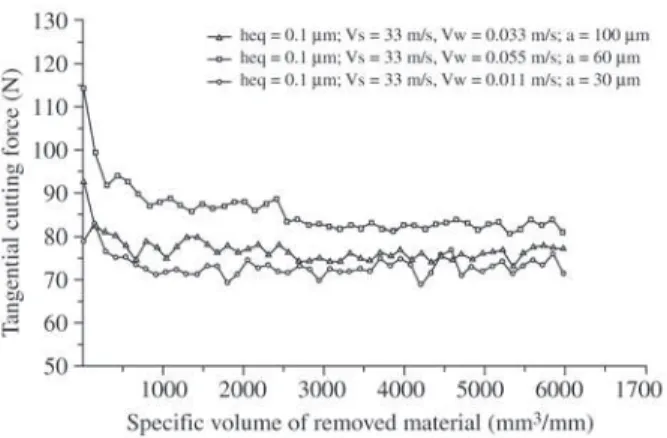
Figures 3, 4, 5, and 6 show the experimental values of tangential cutting force as a function of the specific volume of removed material in the machining conditions as indi-cated in the legends.
Figure 1. Diagram of the calibrating procedure.
An analysis of the performance of the alumina grinding wheel showed a bond hardness classified as soft, which is appropriate for the machining of DTG materials with alumina grinding wheels. grinding wheels used for hard materials should be soft while those used for soft materials should be hard12. When a material with a high degree of hardness is cut, the wear of the grain is more intense, which makes self-sharpening desirable (so that the part does not burn). Moreover, the wear on the bond caused by the chips is not as evident, since hard materials normally produce short, brittle chips. In contrast, when a material with low hardness is cut, the wear on the abrasive grains is slower and, therefore, there is less need for new layers of grains. Added to this is the possibility of new cutting edges appear-ing as a result of grain fracturappear-ing (dependappear-ing on the grain’s friability), and the fact that the chips produced in the cut-ting of soft materials are usually long and ductile, accut-ting with greater intensity on the bond (friction).
The choice of a soft grinding wheel allows the ing forces and roughness to remain stable during machin-ing through the constant release and renewal of abrasive grains, since it increases in the cutting force resulting from the wear of the abrasive grains lead to their release, owing to the low hardness and retention capacity of the grinding wheel’s bond. However, this constant release of abrasive grains results in a diametral loss of the grinding wheel and, hence, a drop in the G ratio. Otherwise, if a grinding wheel with a bond classified as hard is used, the excessive increase in tangential cutting force caused by the wear of the abra-sive grains and by the greater retention capacity of the worn grains may lead to an increase in the machining energy re-quired, an increase in cutting region temperature, probable thermal damage, greater surface roughness and higher lev-els of vibration, etc.
Figure 3. Tangential cutting force values obtained using the grind-ing wheel with vitrified bond.
Figure 4. Tangential cutting force values obtained using the grind-ing wheel with resin bond.
Figure 5. Tangential cutting force values obtained using the grind-ing wheel with the high performance resin bond.
Due to these factors, the use of a alumina grinding wheel classified as soft (hardness of the soft bond) allowed the tan-gential cutting force values, which were close to those ob-tained with the superabrasive CBN grinding wheels, to re-main stable throughout the tests. After the initial period of reduced tangential cutting force, which originates from the profiling operation itself, all the tests showed a tendency for the tangential cutting forces to stabilize due to the greater wear resistance of the cutting edges of the superabrasive CBN grains. These new cutting edges showed greater wear resist-ance owing to the better mechanical properties of the superabrasive CBN grain compared to those of aluminum oxide5. Thus, the cutting tool remained active (with a high cutting capacity) for a longer period of time, for the CBN grain has a slow micro-wear. A characteristic of these tools is the combined effect of slow micro-wear coupled with the generation of new cutting edges produced by microfracturing. These phenomena can be identified as responsible for the tool’s low radial wear during the tests, as shown in Table 1, and subsequently confirmed by the values found for the G ratio.
The results of these tests indicate that, for the same value of heq, the increase in the penetration of the grinding wheel into the part did not significantly alter the latter’s surface roughness values, Ra. Significant modifications in roughness, when the penetration into the part is altered while
maintain-ing the heq value, are more marked in deep machining opera-tions than in machining operaopera-tions of the pendular type9.
With an heq = 0.1 µm, a reasonably severe machining
condition, there is a slight difference between the rough-ness, Ra, value of 0.86 µm for the grinding wheel with
vit-rified bond and that of the 0.71 µm for the resin bond,
0.50 µm for the high performance resin bond and 0.69 µm
for the alumina grinding wheel.
As shown in Table 1, the reduction in the grinding wheel’s penetration into the part, coupled with the rise in the latter’s speed, resulted in an increase of the tool’s radial wear due to the greater number of shocks caused by the increase of Vw, thus producing a reduction in the G ratio. This occurred for the same volume of removed material (Qw = 30,000 mm3), which remained constant in all the tests, while the greater radial wear led to an increased rate of tool wear (Qs). Because the G ratio is defined as the ratio be-tween Qw (stock removal rate) and Qs, an increase of Qs with a constant Qw will lead to a reduction in the G ratio. In other words, the tool presents a greater volumetric wear for the removal of the same volume of material.
Under the same machining conditions, the grinding wheel with vitrified bond showed trend of less volumetric wear, presenting a higher G ratio. This was due to the greater in-duced porosity of the vitrified grinding wheel, which allows Table 1. Radial wear and roughness of CBN grinding wheels with vitrified, resin, and high performance resin bonds and of the alumina grinding wheel.
Vitrified bond heq = 0.1 µm
Test Radial wear (µm) Ra (µm) a (µm) Vs (m/s) Vw (m/s)
1 34.2 0.91 100 33 0.033
6 35.3 0.89 60 33 0.055
10 36.3 0.79 30 33 0.11
Resin bond heq = 0.1 µm
Test Radial wear (µm) Ra (µm) a (µm) Vs (m/s) Vw (m/s)
4 39.7 0.73 100 33 0.033
2 42.5 0.71 60 33 0.055
12 46.4 0.70 30 33 0.11
High performance resin bond heq = 0.1 µm
Test Radial wear (µm) Ra (µm) a (µm) Vs (m/s) Vw (m/s)
9 10.0 0.46 100 33 0.033
7 50.0 0.50 60 33 0.055
3 80.0 0.52 30 33 0.11
Alumina grinding wheel heq = 0.1 µm
Test Radial wear (µm) Ra (µm) a (µm) Vs (m/s) Vw (m/s)
5 300.0 0.74 100 33 0.033
8 550.0 0.72 60 33 0.055
for a better fit of the torn away chips. In addition, the vitrified bond is less susceptible to the erosive wear caused by the action of the chips on the bond, providing greater bond re-tention strength on the abrasive grain and, thus, reducing the radial loss of the grinding wheel7. In the case of grinding wheels with resin bond, the torn away chips cause greater wear of the bond owing to the grinding wheel’s lower poros-ity and the greater difficulty of fitting the torn away chips, leading the chips to produce greater friction on the bond and thereby degrading it. However, the maximum radial wear of the tool was found to be 46.4 µm for the tool with
conven-tional resin bond, among the several penetration conditions under which the tool was tested. Nevertheless, based on the order of magnitude of the values observed, the tool’s radial wear was attributed to the combined effect of the phenomena of microfracturing and slow micro-wear. Thus, the amount of diametral loss of abrasive grains was low. However, the lower radial wear observed in the grinding wheels with vitri-fied bond, coupled with the higher tangential cutting force, was attributed to the fact that the renewal operation, which is commonly done on tools with resin bond that are more ex-posed to abrasive grains because of bond wear, was not car-ried out. On the other hand, this reduces the anchoring strength exerted by the bond on the grain and may even cause loosen-ing of poorly anchored grains. The greater abrasive grain re-tention capacity of the vitrified bond owing to its better me-chanical properties and resistance to the heat generated by machining was not very significant because of the apparent underuse of the tools tested here, which resulted from the low volume of material removal proposed in this study. This underuse was evidenced by the stability of the values of forces and roughness and the low cutting temperatures measured during the tests compared to the temperatures measured for the CBN grinding wheels8.
The most significant differences were found in the analy-sis of the values of the G ratio, which confirmed that CBN grinding wheel performance is many times superior to that of the alumina grinding wheel, i.e., CBN grinding wheels allow for the removal of the same amount of material as the alumina grinding wheel, but their wear is many times infe-rior to that of the alumina tool.
6. Conclusions
The analysis of the radial wear values indicated the su-perior performance of vitrified CBN grinding wheel when compared to the resin bond one. In terms of roughness and G ratio, more pronounced differences in favor of the vitri-fied one would be observed if it had been produced with a concentration of 150 to 200. Therefore, this wheel is the most suitable one to grinding this steel (VC 131).
The most strongly marked differences were found in the analysis of the G ratio values, which demonstrated that the
performance of the CBN grinding wheel with high perform-ance resin bond was many times superior to that of the alumina tool (up to 30 times better). In other words, the CBN grinding wheel tested here allows for the removal of the same amount of material as the alumina grinding wheel, but the wear on the tool is many times inferior to that of the alumina tool. As for our findings on surface roughness, the CBN grinding wheel showed better values under the same machining conditions.
References
1. Bianchi, E.C.; Fernandes, O.C.; Mogami, O.; Silva Júnior, C.E.; Aguiar, P.R. Análise do Comportamento de Rebolos Convencionais na Retificação de Aços Frágeis.
Congresso Norte Nordeste de Engenharia Mecânica, IV. Recife/PE, 17 a 20 de junho, p. 335-340, 1996a. 2. Bianchi, E.C.; Fernandes, O.C.; Mogami, O.; Silva Júnior,
C.E.; Aguiar, P.R. Avaliação do Comportamento de Rebolos Convencionais na Retificação de Aços Dúcteis.
Congresso Norte Nordeste de Engenharia Mecânica, IV. Recife/PE, 17 a 20 de junho, p. 387-392, 1996b. 3. Brinksmeier, E.; Minke, E. High-Performance Surface
Grinding - The Influence of Coolant on the Abrasive Process, Annals of the CIRP, v. 42, n. 1, p. 367-370, 1993. 4. English, W.R. Hidden Aspects of Superabrasive
Econom-ics, 1991.
5. Felipe Júnior, J. Estudo Fenomenológico do Processo de Retificação Creep-Feed, São Carlos, EESC-USP, Dissertação (Mestre em Engenharia Mecânica), EESC-USP, 190p., 1992.
6. GE Superabrasives., Man-Made Diamante y Borazon CBN para Aplicaciones Industriales de Retificado. 7. King, R.I.; Hann, R.S. Handbook of Modern Grinding
Technology, 3 ed., cap.6, p. 119-167, 1992.
8. Kohli, S.P.; Guo, C.; Malkin, S. Energy Partition for Grinding with Aluminum Oxide and CBN Abrasive Wheels, ASME Journal of Engineering for industry, v. 117, p. 160 168, 1995.
9. König, W. Fertigungverfahren Bände 2, Echleifen, Hohnen, Lappen, VDI Verlag GMBH Rudeldorf, 1972. 10. Krar, S.F.; Ratterman, E. Superabrasives: Grinding and
Machining with CBN and Diamond, McGraw-Hill, Inc., USA, 196 p., 1990.
11. Metzger, J.L. Scatter in Grinding Tests-Curse or Bless-ing?, Industrial Diamond Review, n. 6, p. 270-277, 1988. 12. Vieira Junior, M. Avaliação da Dureza de Rebolos em Trabalho Através do Uso da Emissão Acústica na Dressagem, São Carlos, Tese (Doutorado), Escola de Engenharia de São Carlos, Universidade de São Paulo, 130 p., 1996.