DO:
D 10.1590/S1516-14392011005000078
Microstructural Analysis of Carbon Nanomaterials Produced from
Pyrolysis/Combustion of Styrene-Butadiene-Rubber (SBR)
Joner Oliveira Alvesa,b*, Chuanwei Zhuoa, Yiannis Angelo Levendisa, Jorge Alberto Soares Tenórioc
a
Department of Mechanical and Industrial Engineering, College of Engineering,
Northeastern University, 360 Huntington Av., Boston, MA, 02115, USA
b
Research Centre, Aperam South America, 09, Praça 1º de Maio, Centro,
CEP 35180-018, Timóteo, MG, Brazil
c
Department of Metallurgical and Materials Engineering, Polytechnic School,
University of Sao Paulo – USP, 2463, Prof. Mello Moraes Av.,
CEP 05508-030, São Paulo, SP, Brazil
Received: March 10, 2011; Revised: August 15, 2011
Styrene-Butadiene-Rubber (SBR) is a synthetic rubber copolymer used to fabricate several products. This
study aims to demonstrate the use of SBR as feedstock for carbon nanomaterials (nanoibers and nanotubes)
growth, and therefore to establish a novel process for destination of waste products containing SBR. A three stage
electrically heated low reactor was used. Small pellets of rubber were pyrolyzed at a temperature of 1000 °C. The pyrolyzates were mixed with oxygen-containing gases and were burned. The products of combustion were used to synthesize the carbon nanomaterials (CNMs) at the presence of a catalyst. CNMs have a wide range of potential applications due to their extraordinary mechanical, thermal and electrical properties. Produced materials were characterized by SEM and TEM, whereas combustion products were assessed using GC. Results showed that CNMs with outer diameters of 30-100 nm and lengths of about 30 µm were formed. Therefore, it was demonstrated that waste products containing SBR can be used to generate CNMs which are value-added
products of intense technological interest.
Keywords: nanomaterials, SBR, catalysis, combustion
*e-mail: [email protected]
1. Introduction
Styrene-Butadiene-Rubber (SBR) is a synthetic rubber copolymer consisting of styrene and butadiene. This material is used in a number of different applications around the world, such as shoe heels and
soles, children’s toys, caulking compounds, sponges, and loor
tiles, however the SBR is most massively used in the production of automobile tires1,2. According to the Onternational Rubber
Study Group, the world production of synthetic rubbers was about
12 million tons in 20093.
On this work, SBR was chosen as carbon feedstock for growing nanomaterials because of the high volume of wastes materials
containing this rubber. Therefore, the study of SBR can be expanded
for tires or other materials that use this copolymer as predominant raw material. The waste rubber materials are thermoset polymers, which cannot be reprocessed like thermoplastic polymers, therefore recycling of these materials requires special techniques that demands high investments4. A solution to the disposal of waste rubber products is provided by the pyrolysis or combustion processes. The pyrolysis is a process wherein the material is decomposed using means of
temperature with the absence of an oxidized gas, and the combustion is characterized by the addition of the oxidized gases during the process. Past research in the Combustion and Air Pollution Laboratory of Northeastern University showed that SBR products are attractive potential fuels due to their high heating values (29-37 MJ.kg–1)5-7,
which exceed those of lignite (10-20 MJ.kg–1) and bituminous coals
(30 MJ.kg–1)8. This study proposes a novel technique to co-generate
carbon nanomaterials (CNM) during the combustion of SBR, or materials produced from SBR. The reason that SBR is irst pyrolyzed
and then burned is to be able to generate premixed combustion, upon mixing with oxygen containing gases at the venturi, and thus minimize
the production of condensed products of combustion, such as soot7. Such products would contaminate the catalyst substrates, which are placed downstream.
Nanotechnology products were responsible for a consumer market of about US$ 11 trillions in 2010, wherein US$ 340 billion
correspond just to nanomaterials9. Nanomaterials consist of structures with at least one dimension in the order of nanometers (1 × 10⁻⁹ m). These materials have a wide range of potential applications due to
their extraordinary mechanical, thermal and electrical properties10,11. To generate carbon nanomaterials carbon bearing gases are needed at an elevated temperature environment. Such gases can be generated by high temperature pyrolysis and/or combustion of hydrocarbon-based feedstocks12. On prior work, it was found that carbon bearing gases can be provided from other types of solid waste fuels, such as plastics13 and biomass14. Ot will be shown herein that SBR-based products can be used as feedstock to generated nanomaterials.
2. Materials and Methods
2.1. Materials
Alves et al.
were analyzed in a low-magniied TEM (model JEOL 1010, with an accelerating voltage of 70 kV).
The evaluation of generated efluent gases is important in order to identify the precursors of the CNTs growth. Light hydrocarbon gases (LHCs) generated during the experiments were monitored off-line at the exit of the synthesis furnace. Gases were withdrawn at a rate of 0.5 mL/min, using syringes mounted on a dual syringe pump. Analysis was performed by gas chromatography (GC), with a HP 6890-series instrument equipped with two parallel columns, one coupled to a lame ionization detector, the other to a thermal conductivity detectors (GC-FID and TCD).
3. Results and Discussion
3.1. Effluents of the pyrolysis/combustion of the SBR
feedstock
The pyrolysis/combustion process of SBR pellets generated
several gases, (hydrocarbons, H2, CO and CO2). The most prominent light hydrocarbon species detected in this work were: methane
(CH4), acetylene (C2H2), benzene (C6H6), ethylene (C2H4) and
toluene (C7H8). Traces of other compounds were also detected,
including 1,3-butadiene, propylene, propyne, ethylacetylene and ethylbenzene17. Mole fractions of the most prominent LHCs detected
in the experiments are shown in Figure 2; data was collected with
2.2. Samples preparation
The laboratory furnace consists of a three-section quartz laminar-low, electrically heated, mufle furnace. The irst section (37 mm ID × 870 mm) is the feedstock pyrolyzer, the second section (37 mm ID × 260 mm long) is connected to a mixing venturi (8 mm ID), and the third section is the nanomaterials synthesis furnace (37 mm ID × 380 mm long), the efluent of which is connected to the gases analyzers. A design of the furnace can be seen in the Figure 1.
The ceramic boat with the samples was inserted into the furnace
with nitrogen serving as carrying gas at the lowrate of 5 L/min ensuring the absence of oxygen; therefore, pyrolytic conditions prevailed in the irst stage of the furnace. Several temperatures (in the range of 600-1000 °C) were tested in the irst section of the furnace
in order to decide on the pyrolysis conditions that are most suitable
for CNM growth; a temperature of 1000 °C was selected because
it presented the best relation of burned material. On the venturi, the pyrolysis gases come in intimate contact with jets of a preheated
2 L/min low of an oxygen-nitrogen mixture (oxygen mole fractions of 17 and 19% were tested). As a result of the blending of the pyrolyzates with the preheated oxidizing gases, ignition occurred and a premixed lame was established at the exit of the venturi. The combustion gases
were channeled into the third stage of the apparatus where a catalyst
mesh was placed perpendicularly to the low with a predetermined CNM synthesis temperature of 1000 °C. In order to prevent any combustion-generated particulate matter (as the premixed lames were transient in nature in these batch combustion experiments)
from entering the synthesis chamber and contaminate the catalyst,
a barrier ilter was placed in the division of the two sections of the apparatus. This ilter consists of a honeycomb structure made out of silicon carbide (SiC), and performs with a high iltration eficiency resulting in 97% retention for submicron particles15.
The method for the nanomaterials synthesis used in this work
was the catalytic chemical vapor deposition (CCVD). The catalyst substrates consisted of circular pieces (10 mm ID) of a mesh made of stainless steel AISI 304 with chemical composition according to ASTM E2016 speciication: Cr (18-20.0%), Ni (8-10.5%), Mn (≤2.0%), Si (≤1.0%), N (≤0.1%), C (≤0.08%), P (≤0.05%), S (≤0.03%), and Fe (balance)16.
The duration of each experiment was about 42-50 seconds; as
determined by the time elapsed between the onset and the termination
of the evolution of CO and CO2 in the pyrolysis/combustion efluents.
These gases were monitored in real-time with an on-line dual infrared
analyzer (California Analytical Instrument, Model 200).
2.3. Sample characterization
Upon completion of each experiment, the apparatus was cooled down to 200 °C under nitrogen before the removing the stainless
steel meshes. Morphological analyses of the collected materials
were performed using Scanning Electronic Microscopy (SEM) and Transmission Electron Microscopy (TEM). Random sections of the mesh were removed and placed directly on the SEM imaging stage. SEM analysis was conducted on a Hitachi 4800, using a 3 kV voltage, and a working distance of 8.2 mm. For TEM samples, the meshes were sonicated in a 100% ethanol solution and the products
Table 1. Physical properties and chemical composition of SBR used in the work.
Particle size (µm) Fixed carbon (%) Volatiles (%) Ash (%) C (%) H2 (%) S (%) N2 (%) O2 (%) Heating value (MJ.kg–1)
180-212 21.7 52.3 26.0 60.9 5.3 2.5 0.3 7.1 29
Figure 1. Experimental apparatus consisting of two horizontal furnaces (feedstock pyrolyzer on the left and CNM synthesizer on the right), separated by a mixing venturi where a lame was established.
Figure 2. Emissions of the most prominent LHCs (in ppm) detected in the experiments.
and without the catalyst system (the values are listed in parts per million - ppm).
Several prior works have shown that the hydrocarbons can be
used as important carbon donors in the production of CNMs using the catalytic CVD method18-24. The CCVD process used in this work basically consisted of thermal dehydrogenation reactions whereby a transition metal catalyst was used to “crack” the hydrocarbon
gases into carbon and hydrogen12. Baker et al.25,26 studied the growth
of carbon ibers; they describe that the catalytic decomposition of
hydrocarbon sources start on the active transition metal surface,
Alves et al.
growth, it was found that major detected pyrolyzates include methane,
ethane, ethylene, propane, propylene, acetylene, butane, butadiene,
ethylacetylene, benzene and hydrogen13, among which ethylene was the predominant. When biomass were used as carbon feedstock,
methane (CH4), ethylene (C2H4), acetylene (C2H2) and benzene (C6H6) were found to be the highest yield LHCs in the pyrolyzates14.
Therefore, also as established for the LHCs generated by controlled
burned of unserviceable tires27, the pyrolysis/combustion of SBR products can be considered an important sources of carbon for
growth of CNMs.
3.2. Microstructural analysis of catalyzed materials
Scanning Electron Microscopy (SEM) was used to assess the
catalyst system success, i.e., to ascertain whether if nanomaterials
were formed on the stainless steel meshes. Figure 3 shows SEM images of synthesized materials from SBR; wherein the images
the mesh weight. Weight increments of the mesh, ∆Wmesh, were in the
range of 45-50 mg. Assuming that CNM synthesis times are equal or shorter than pyrolysis/combustion times, average CNM growth rates
were calculated to be about 1.0 mg/s.
The presence of the catalyst did not have consistent effects on the
CO and CO2 emissions; in some cases a mild increase was observed whereas in some other cases a mild decrease was recorded, typically
within experimental error.
A noteworthy trend emerging from the results of Figure 2 is
that all detected light hydrocarbon species were partially depleted at the presence of catalytic meshes. This indicates that they are instrumental in the formation process of carbon nanomaterials.
Several previous investigations showed that LHCs generated in this work (benzene21,22, ethylene23,24, methane18, and acetylene20) can be
used as carbon feedstock in the production of nanomaterials. For example, when polyethylene was used as carbon feedstock for CNM
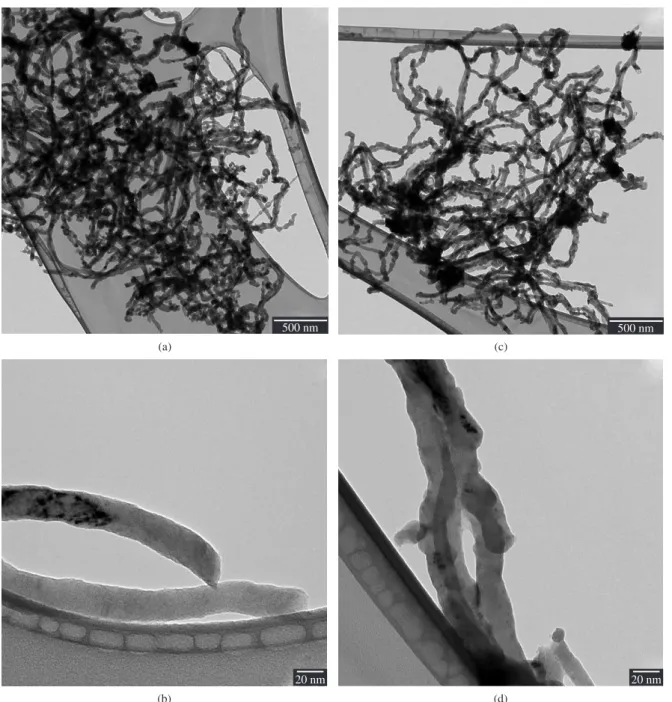
Figure 4. TEM images of catalyzed materials using SBR using: 17% of O2 (a and b) and 19% of O2 (c and d).
5. Levendis YA, Atal A, Carlson J, Dunayevskiy Y and Vouros P. Comparative Study on the Combustion and Emissions of Waste Tire Crumb and Pulverized Coal. Environmental Science & Technology. 1996; 30(9):2742-2754. http://dx.doi.org/10.1021/es950910u
6. Caponero J, Tenorio JAS, Levendis YA and Carlson J. Emissions from batch combustion of waste tire chips: The afterburner effect. Energy & Fuels. 2003; 17:225-239. http://dx.doi.org/10.1021/ef0201331 7. Caponero J, Tenorio JAS, Levendis YA and Carlson J. Emissions
from batch combustion of waste tire chips: The pyrolysis effect.
Combustion science and technology. 2005; 177(2):347-381. http://dx.doi. org/10.1080/00102200590900516
8. Wang L, Hanna MA, Weller CL and Jones DD. Technical and economical analyses of combined heat and power generation from distillers grains
and corn stover in ethanol plants. Energ Convers Manage. 2009;
50(7):1704-13. http://dx.doi.org/10.1016/j.enconman.2009.03.025 9. Pitkethly MJ. Nanoparticles as building blocks. Nano Today. 2003;
36:36-42.
10. Tessonnier JP, Rosenthal D, Hansen TW, Hess C, Schuster ME, Blume R et al. Analysis of the structure and chemical properties of
some commercial carbon nanostructures. Carbon. 2009; 47:1779-98.
http://dx.doi.org/10.1016/j.carbon.2009.02.032
11. Ávila AF and Lacerda GSR. Molecular Mechanics Applied to Single-Walled Carbon Nanotubes. Materials Research. 2008; 11(3):325-333.
http://dx.doi.org/10.1590/S1516-14392008000300016
12. See CH and Harris AT. A review of carbon nanotube synthesis via luidized-bed chemical vapor deposition. Industrial & Engineering Chemistry Research. 2007; 46(4):997-1012. http://dx.doi.org/10.1021/
ie060955b
13. Zhuo C, Hall B, Richter H and Levendis YA. Synthesis of carbon nanotubes
by the sequential pyrolysis and combustion of polyethylene. Carbon.
2010; 48(14):4024-34. http://dx.doi.org/10.1016/j.carbon.2010.07.007 14. Alves JO, Zhuo C, Levendis YA and Tenório JAS. Catalytic conversion
of wastes from the bioethanol production into carbon nanomaterials.
Applied Catalysis B: Environmental. 2011; 106(3-4):433-44. http://dx.doi.
org/10.1016/j.apcatb.2011.06.001
15. Larsen CA, Levendis YA and Shimato K. Filtration assessment and thermal effects on aerodynamic regeneration in silicon carbide and cordierite particulate ilters. SAE; 1999. SAE Technical Paper Series Report no. 1999-01-0466.
16. American Society for Testing and Materials - ASTM. ASTM E2016
- 06: Standard speciication for industrial woven wire cloth. West Conshohocken: ASTM International; 2006.
17. Alves JO, Zhuo C, Levendis YA and Tenório JAS. Analysis of light hydrocarbon gases in the pyrolysis and combustion processes of waste tires. On: Proceedings of the 139th TMS Annual Meeting & Exhibition; 2010; Seattle, USA. Warrendale: EPD Congress; 2010. p. 703-9. 18. Kong J, Cassell AM and Dai H. Chemical vapor deposition of methane
for single-walled carbon nanotubes. Chemical Physics Letters. 1998;
292:567-574. http://dx.doi.org/10.1016/S0009-2614(98)00745-3 19. Zhao N, He C, Jiang Z, Li J and Li Y. Fabrication and growth
mechanism of carbon nanotubes by catalytic chemical vapor deposition. Materials Letters. 2006; 60(2):159-63. http://dx.doi.org/10.1016/j. matlet.2005.08.009
20. Zhong G, Hofmann S, Yan F, Telg H, Warner JH, Eder D et al. Acetylene: a key growth precursor for single-walled carbon nanotube forests. Journal of Physical Chemistry C. 2009; 113:17321-5. http://dx.doi.org/10.1021/
jp905134b
21. Benito AM, Maniette Y, Munoz E and Martinez MT. Carbon nanotubes production by catalytic pyrolysis of benzene. Carbon. 1998; 36(5):681-3.
http://dx.doi.org/10.1016/S0008-6223(98)00039-6
22. Lyu SC, Liu CB, Lee JC, Kang HK, Yang CW and Park CY. High-quality double-walled carbon nanotubes produced by catalytic decomposition of benzene. Chemistry of Materials. 2003; 15:3951-4. http://dx.doi.
org/10.1021/cm030309s
a, b and c were obtained with 17% of O2 (83% N2) and images
d, e and f with 19% of O2 (81% N2).
SEM images show entangled nanomaterials which cover (not
uniformly) the catalyst mesh under all conditions. The images
exhibit the catalyst meshes in the background and ramiications of nanomaterials impregnated in the surface. Produced materials showed long iber forms with lengths of about 30 µm.
Transmission Electron Microscopy (TEM) was used for additional analysis of the CNM dimensions and, also, to check the structures of the products. TEM images are showed in Figure 4 (a and b - 17% of O2, and c and d - 19% of O2).
As expected, TEM images showed that the produced cylindrical
carbonaceous materials have appear to be either solid or tubular,
and may be characterized as nanoibers (CNFs) or carbon nanotubes (CNTs). CNTs were discovered by Iijima28 in 1991, and consist
of coaxial tubular graphene sheets, with lengths in the order of
micrometers and diameters in the order of nanometers. On past years,
a variety of synthesis techniques for CNTs have been developed: arc discharge, laser ablation, lame synthesis, and CVD29. However, the high cost to produce such materials limits their usage. To reduce the
cost of CNTs, it is instrumental to reduce the expenses associated
with the procurement of raw-materials and to reduce the production
expenses. By using waste rubber products as feedstock for CNT growth, the cost of raw-material can be minimized.
Figure 4 shows the formation of long ibers and some impurities in the background. Outer diameters of the formed materials were in the range of 30-100 nm. Produced materials showed tiny black
points, which are metallic particles that were incorporated into the
nanotubes during the catalyst process, which was conirmed by EDX measurements. Some impurities are expected in materials produced by catalytic synthesis, thus puriication processes are generally used
to reduce the presence of undesired components30.
4. Conclusion
This study demonstrated that a high density of entangled
nanomaterials, with outer diameters of 30-100 nm and lengths of about 30 µm, could be generated from the pyrolysis/premixed-combustion products of SBR on the catalyst meshes. Produced carbon
nanomaterials were of cylindrical forms some of which were tubular.
They were characterized as nanoibers/nanotubes. Therefore, the use of SBR as feedstock for CNM growth was satisfactory and it may be considered to be an interesting ield for future investments due to the
high volume of wastes produced from SBR.
Acknowledgements
The authors would like to thank the CNPQ-Brazil for inancing the period of the D.Sc. Joner Alves at Northeastern University (USA). The support provided by CAPES (Grant: 04/CII-2008 - Rede Nanobiotec-Brasil) is also greatly appreciated.
References
1. Massarotto M, Crespo JS, Zattera AJ and Zeni M. Characterization of Ground SBR Scraps from Shoe Industry. Materials Research. 2008; 11(1):81-84. http://dx.doi.org/10.1590/S1516-14392008000100015 2. Trezza MA and Scian AN. Scrap Tire Ashes in Portland Cement
Production. Materials Research. 2009; 12(4):489-494. http://dx.doi. org/10.1590/S1516-14392009000400019
3. Internacional Rubber Study Group. Available from: <www.rubberstudy. com>. Access in: 06/23/2010.
4. Murugan S, Ramaswamy MC and Nagarajan G. The use of tyre pyrolysis
oil in diesel engines. Waste Management. 2008; 28(12):2743-2749.
Alves et al.
27. Alves JO, Zhuo C, Levendis YA and Tenório JAS. Microstructural analysis of nanomaterials synthesized from unserviceable tires. In:
Proceedings of the 140th TMS Annual Meeting & Exhibition; 2011; San Diego, USA. Warrendale: EPD Congress; 2011. p. 253-60.
28. Iijima S. Helical microtubules of graphitic carbon. Nature. 1991; 354:56-8. http://dx.doi.org/10.1038/354056a0
29. Grobert N. Carbon nanotubes - becoming clean. Materials Today. 2007; 10(1-2):28-35. http://dx.doi.org/10.1016/S1369-7021(06)71789-8 30. Lobach AS, Spitsina NG, Terekhov SV and Obraztsova ED. Comparative
analysis of various methods of puriication of single-walled carbon
nanotubes. Physics of the Solid State. 2002; 44(3):475-7. http://dx.doi.
org/10.1134/1.1462677 23. Khavrus VA, Lemesh NV, Gordeichuk SV, Tripol’skii AI, Ivashchenko
TS and Strizhak PE. Catalytic synthesis of carbon nanotubes from ethylene in the presence of water vapor. Theoretical and Experimental Chemistry. 2006; 42(4):234-8. http://dx.doi.org/10.1007/s11237-006-0045-0
24. Liao H and Hafner JH. Low-temperature single-wall carbon nanotube
synthesis by thermal chemical vapor deposition. Journal of Physical
Chemistry B. 2004; 108(22):6941-3. http://dx.doi.org/10.1021/jp048566n
25. Baker RTK, Harris PS, Thomas RB and Waite RJ. Formation of filamentous carbon from iron, cobalt and chromium catalyzed
decomposition of acetylene. Journal of Catalysis. 1973; 30(1):86-95.
http://dx.doi.org/10.1016/0021-9517(73)90055-9
26. Baker RTK. Catalytic growth of carbon filaments. Carbon. 1989; 27(3):315-23. http://dx.doi.org/10.1016/0008-6223(89)90062-6