(will be inserted by the editor)
Search for Supersymmetry in Events with Large Missing
Transverse Momentum, Jets, and at Least One Tau Lepton in
7 TeV Proton-Proton Collision Data with the ATLAS Detector
The ATLAS Collaboration1
1CERN, 1211 Geneva 23, Switzerland e-mail: [email protected]
Received: date / Accepted: date
Abstract A search for supersymmetry (SUSY) in events with large missing transverse momentum, jets, and at least one hadronically decaying τ lepton, with zero or one additional light lepton (e/µ), has been performed using 4.7 fb−1 of proton-proton collision data at√s = 7 TeV recorded with the ATLAS detector at the Large Hadron Collider. No excess above the Standard Model background expectation is observed and a 95 % con-fidence level visible cross-section upper limit for new phenomena is set. In the framework of gauge-mediated SUSY-breaking models, lower limits on the mass scale Λ are set at 54 TeV in the regions where the ˜τ1 is the next-to-lightest SUSY particle (tan β > 20). These lim-its provide the most stringent tests to date of GMSB models in a large part of the parameter space consid-ered.
Keywords ATLAS · SUSY · taus · GMSB
1 Introduction
This paper reports on the search for supersymmetry (SUSY) [1–9] in events with large missing transverse momentum, jets and at least one hadronically decaying τ lepton. Four different topologies with a τ in the final state have been studied: one τ lepton, at least two τ leptons, one τ lepton and precisely one additional muon and one τ lepton and precisely one additional electron. The minimal gauge-mediated supersymmetry-breaking (GMSB) model [10–15] is considered as benchmark to evaluate the reach of this analysis.
SUSY introduces a symmetry between fermions and bosons, resulting in a SUSY partner (sparticle) for each Standard Model (SM) particle with identical mass and quantum numbers except a difference by half a unit
of spin. Assuming R-parity conservation [16–20], spar-ticles are produced in pairs. These would then decay through cascades involving other sparticles until the lightest SUSY particle (LSP), which is stable, is pro-duced. Since equal mass SUSY partners are excluded, SUSY must be a broken symmetry. Minimal GMSB models can be described by six parameters: the SUSY-breaking mass scale in the low-energy sector (Λ), the messenger mass (Mmess), the number of SU(5) messen-ger fields (N5), the ratio of the vacuum expectation val-ues of the two Higgs doublets (tan β), the Higgs-sector mixing parameter (µ) and the scale factor for the grav-itino mass (Cgrav). For the analysis presented in this pa-per, Λ and tan β are treated as free parameters, and the other parameters are fixed to the values already used in Refs. [21, 22]: Mmess = 250 TeV, N5= 3, µ > 0 and Cgrav= 1. The Cgravparameter determines the lifetime of next-to-lightest SUSY particle (NLSP); for Cgrav= 1 the NLSP decays promptly (cτNLSP < 0.1 mm). With this choice of parameters, at moderate Λ the production of gluino and/or squark pairs is expected to dominate at the LHC; these sparticles will decay into the next-to-lightest SUSY particle (NLSP), which subsequently de-cays to the LSP. In GMSB models, the LSP is the very light gravitino ( ˜G). The NLSP is the dominant sparti-cle decaying to the LSP and this leads to experimental signatures which are largely determined by the nature of the NLSP. This can be either the lightest stau (˜τ1), a right-handed slepton (˜`R), the lightest neutralino ( ˜χ01), or a sneutrino (˜ν), dominantly leading to final states containing τ leptons, light leptons (` = e, µ), photons, b-jets, or neutrinos. At large values of tan β, the ˜τ1 is the NLSP for most of the parameter space, which leads to final states containing at least two τ leptons. In the so-called CoNLSP region, where the mass difference be-tween the ˜τ1 and the ˜`R is smaller than the sum of the
τ and light-lepton masses, both the ˜τ1and the ˜`Rdecay directly into the LSP and are therefore NLSPs.
Previous searches for ˜τ1 pair production, with the subsequent decay ˜τ1→ τ ˜G in the minimal GMSB model, have been reported by the LEP Collaborations ALEPH [23], DELPHI [24] and OPAL [25]. The analysis re-ported in this paper extends the searches in 2 fb−1 of data presented in Refs. [21, 22]. It comprises the full 2011 dataset, corresponding to an integrated luminosity of (4.7 ± 0.1) fb−1 [26, 27] after applying beam, detec-tor and data-quality requirements. A complementary search interpreted in GMSB, requiring two light lep-tons, has also been performed using the same dataset by the ATLAS collaboration [28]. The CMS Collaboration has searched for new phenomena in samesign τ -pair events [29] and multi-lepton events including two τ leptons in the final state [30] using 35 pb−1 of data, where the minimal GMSB model was not considered.
2 ATLAS detector
The ATLAS experiment [31] is a multi-purpose detec-tor with a forward-backward symmetric cylindrical ge-ometry and nearly 4π solid angle coverage. The inner tracking detector (ID) consists of a silicon pixel detec-tor, a silicon microstrip detector and a transition radi-ation tracker. The ID is surrounded by a thin super-conducting solenoid providing a 2 T magnetic field and by fine-granularity lead/liquid-argon (LAr) electromag-netic calorimeters. An iron/scintillator-tile calorimeter provides hadronic coverage in the central pseudorapid-ity1range. The endcap and forward regions are instru-mented with liquid-argon calorimeters for both elec-tromagnetic and hadronic measurements. An extensive muon spectrometer system that incorporates large su-perconducting toroidal magnets surrounds the calorime-ters.
3 Simulated samples
The Monte Carlo (MC) simulations used to evaluate the expected backgrounds and selection efficiencies for the SUSY models considered are very similar to the ones used in Refs. [21, 22]. A suite of generators is
1ATLAS uses a right-handed coordinate system with its
ori-gin at the nominal interaction point (IP) in the centre of the detector and the z-axis along the beam pipe. The x-axis points from the IP to the centre of the LHC ring and the y-axis points upward. Cylindrical coordinates (r, φ) are used in the transverse plane, φ being the azimuthal angle around the beam pipe. The pseudorapidity is defined in terms of the polar angle θ as η = − ln tan(θ/2).
used to aid in the estimate of SM background contri-butions. The ALPGEN generator [32] is used to simulate samples of W and Z/γ∗ events with up to five (for Z events) or six (for W events) accompanying jets, where CTEQ6L1 [33] is used for the parton distribution func-tions (PDFs). Z/γ∗ events with m``< 40 GeV are re-ferred to in this paper as “Drell-Yan”. Top quark pair production, single top production and diboson (W W and W Z) pair production are simulated with MC@NLO [34–36] and the next-to-leading-order (NLO) PDF set CT10 [37]. Fragmentation and hadronization are per-formed with Herwig [38], using JIMMY [39] for the un-derlying event simulation. The decay of τ leptons and radiation of photons are simulated using TAUOLA [40, 41] and PHOTOS [42], respectively. The production of multi-jet events is simulated with PYTHIA 6.4.25 [43] using the AUET2B tune [44] and MRST2007 LO∗ [45] PDFs. The SUSY mass spectra are calculated using ISAJET 7.80 [46]. The MC signal samples are produced using Herwig++ 2.4.2 [47] with MRST2007 LO∗ PDFs. Signal cross-sections are calculated to next-to-leading order in the strong coupling constant, adding the resummation of soft gluon emission at next-to-leading-logarithmic ac-curacy (NLO+NLL) [48–52]. The nominal SUSY pro-duction cross-sections and their uncertainties are taken from an envelope of cross-section predictions using dif-ferent PDF sets and factorisation and renormalization scales, as described in Ref. [53]. The GMSB signal sam-ples are generated on a grid ranging from Λ = 10 TeV to Λ = 80 TeV and from tan β = 2 to tan β = 67, with the cross-section dropping from 100 pb for Λ = 15 TeV to 5.0 fb for Λ = 80 TeV.
All samples are processed through the Geant4-based simulation [54] of the ATLAS detector [55]. The full simulation also includes a realistic treatment of the variation of the number of pp interactions per bunch crossing (pile-up) in the data, with an average of nine interactions per crossing.
4 Object reconstruction
Jets are reconstructed using the anti-kt jet clustering algorithm [56] with radius parameter R = 0.4. Jet en-ergies are calibrated to correct for upstream material, calorimeter non-compensation, pile-up, and other ef-fects [57]. Jets are required to have transverse momenta (pT) greater than 25 GeV and |η| < 2.8, except in the computation of the missing transverse momentum, where |η| < 4.5 and pTgreater than 20 GeV is required.
Muon candidates are identified as tracks in the ID matched to track segments in the muon spectrometer [58]. They are required to have pT> 10 GeV and |η| < 2.4. Electron candidates are constructed by matching
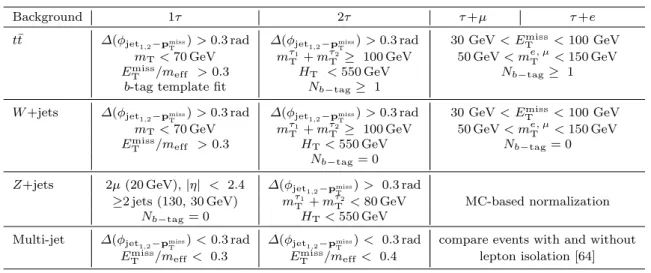
Table 1 Event selection for the four final states presented in this paper. Numbers in parentheses are the minimum transverse momenta required for the objects. Pairs of numbers separated by a slash denote different selection criteria imposed in different data-taking periods.
– 1τ 2τ τ +µ τ +e
Trigger jetMET jetMET muon/muon+jet electron
pjetT > 75 GeV pjetT > 75 GeV pµT> 18 GeV pe
T> 20/22 GeV
Emiss
T > 45/55 GeV EmissT > 45/55 GeV p jet
T > 10 GeV
Jet req. ≥2 jets (130, 30 GeV) ≥2 jets (130, 30 GeV) ≥1 jet (50 GeV) — Emiss
T req. EmissT > 130/150 GeV EmissT > 130/150 GeV — —
Ne,µ 0 0 1 µ (20 GeV) 1 e (25 GeV)
Nτ =1 medium (20 GeV), ≥2 loose (20 GeV) ≥1 medium (20 GeV) ≥1 medium (20 GeV)
=0 loose
Kinematic ∆(φjet1,2−pmissT ) > 0.3; ∆(φjet1,2−pmissT ) > 0.3 m
e, µ T > 100 GeV m e, µ T > 100 GeV criteria Emiss T /meff > 0.3, mτT1+ m τ2
T > 100 GeV meff > 1000 GeV meff > 1000 GeV
mT > 110 GeV; HT > 650 GeV
HT > 775 GeV
electromagnetic clusters with tracks in the ID. They are then required to satisfy pT > 20 GeV, |η| < 2.47 and to pass the “tight” identification criteria described in Ref. [59], re-optimized for 2011 conditions.
Electrons or muons are required to be isolated, i.e. the scalar sum of the transverse momenta of tracks within a cone of ∆R =p(∆φ)2+ (∆η)2 < 0.2 around the lepton candidate, excluding the lepton candidate track itself, must be less than 10% of the lepton’s trans-verse energy for electrons and less than 1.8 GeV for muons. Tracks selected for the electron and muon isola-tion requirement defined above have pT > 1 GeV and are associated to the primary vertex of the event.
The missing transverse momentum vector pmissT (and its magnitude Emiss
T ) is measured from the transverse momenta of identified jets, electrons, muons and all calorimeter clusters with |η| < 4.5 not associated to such objects [60]. For the purpose of the measurement of Emiss
T , τ leptons are not distinguished from jets. Jets originating from decays of b-quarks are iden-tified and used to separate the W and t¯t background contributions. They are identified by a neural-network-based algorithm, which combines information from the track impact parameters with a search for decay ver-tices along the jet axis [61]. A working point corre-sponding to 60 % tagging efficiency for b-jets and < 1 % mis-identification of light-flavour or gluon jets is chosen [62].
The τ leptons considered in this search are structed through their hadronic decays. The τ recon-struction is seeded from anti-kt jets (R = 0.4) with pT> 10 GeV. An η- and pT-dependent energy calibra-tion to the hadronic τ energy scale is applied. Discrimi-nating variables based on track information and
observ-ables sensitive to the transverse and longitudinal shape of the energy deposits of τ candidates in the calorimeter are used. These quantities are combined in a boosted decision tree (BDT) discriminator [63] to optimize their impact. Calorimeter information and measurements of transition radiation are used to veto electrons mis-iden-tified as τ leptons. Suitable τ lepton candidates must satisfy pT> 20 GeV, |η| < 2.5, and have one or three associated tracks of pT > 1 GeV with a charge sum of ±1. A sample of Z → τ τ events is used to measure the efficiency of the BDT τ identification. The “loose” and “medium” working points in Ref. [63] are used herein and correspond to efficiencies of about 60 % and 40 % respectively, independent of pT, with a rejection factor of 20–50 against τ candidates built from hadronic jets (“fake” τ leptons).
5 Event Selection
Four mutually exclusive final states are considered for this search: events with only one “medium” τ , no addi-tional “loose” τ candidates and no muons or electrons, referred to as ‘1τ ’; events with two or more “loose” τ candidates and no muons or electrons, referred to as ‘2τ ’; events with at least one “medium” τ and exactly one muon (‘τ +µ’) or electron (‘τ +e’).
In the 1τ and 2τ final states, candidate events are triggered by requiring a jet with high transverse mo-mentum and high Emiss
T (‘jetMET’) [65], both measured at the electromagnetic scale2. In the τ +µ final state,
2The electromagnetic scale is the basic calorimeter signal
scale for the ATLAS calorimeters. It has been established using test-beam measurements for electrons and muons to
Table 2 Definition of the background control regions (CRs) used to estimate the normalization of background samples in the four final states: 1τ , 2τ , τ +µ and τ +e.
Background 1τ 2τ τ +µ τ +e
t¯t ∆(φjet1,2−pmissT ) > 0.3 rad ∆(φjet1,2−pmissT ) > 0.3 rad 30 GeV < E
miss T < 100 GeV mT< 70 GeV mτT1+ m τ2 T ≥ 100 GeV 50 GeV < m e, µ T < 150 GeV Emiss
T /meff > 0.3 HT < 550 GeV Nb−tag≥ 1
b-tag template fit Nb−tag≥ 1
W +jets ∆(φjet1,2−pmissT ) > 0.3 rad ∆(φjet1,2−pmissT ) > 0.3 rad 30 GeV < E
miss
T < 100 GeV
mT< 70 GeV mτT1+ mτT2≥ 100 GeV 50 GeV < me, µT < 150 GeV
Emiss
T /meff > 0.3 HT< 550 GeV Nb−tag= 0
Nb−tag= 0
Z+jets 2µ (20 GeV), |η| < 2.4 ∆(φjet1,2−pmissT ) > 0.3 rad
≥2 jets (130, 30 GeV) mτ1
T + m
τ2
T < 80 GeV MC-based normalization
Nb−tag= 0 HT< 550 GeV
Multi-jet ∆(φjet1,2−pmissT ) < 0.3 rad ∆(φjet1,2−pmissT ) < 0.3 rad compare events with and without
Emiss
T /meff< 0.3 ETmiss/meff < 0.4 lepton isolation [64]
events are selected by a muon trigger and a muon-plus-jet trigger (‘muon+muon-plus-jet’), while in the τ +e final state, a single-electron trigger requirement is imposed [65]. The trigger requirements have been optimized to ensure a uniform trigger efficiency for all data-taking periods, which exceeds 98 % with respect to the offline selection for all final states considered.
Pre-selected events are required to have a recon-structed primary vertex with at least five tracks (with pT> 0.4 GeV). To suppress soft multi-jet events in the 1τ and 2τ final states, a second jet with pT> 30 GeV is required. Remaining multi-jet events, where highly en-ergetic jets are mis-measured, are suppressed by requir-ing the azimuthal angle between the missrequir-ing transverse momentum vector and either of the two leading jets to be greater than 0.3 rad. Three quantities characterising the kinematic properties of the event are used to fur-ther suppress the main background processes (W +jets, Z+jets and t¯t events) in all four final states:
– the transverse mass mτ,`T formed by ETmissand either the pTof the τ lepton in the 1τ and 2τ channels, or of the light lepton (e/µ) in the τ +µ and τ +e ones: mτ,`T = q 2pτ,`T Emiss T (1 − cos(∆φ(τ /`, E miss T ))) ; – the scalar sum HT of the transverse momenta of τ
lepton candidates and the two highest momentum jets in the events: HT=P pτT+
P i=1,2p
jeti
T ; – the effective mass meff = HT+ ETmiss.
give the correct response for the energy deposited in electro-magnetic showers, although it does not correct for the lower response of the calorimeter to hadrons.
For each of the four final states, specific criteria are ap-plied to the above quantities in order to define a signal region (SR), as summarized in Table 1.
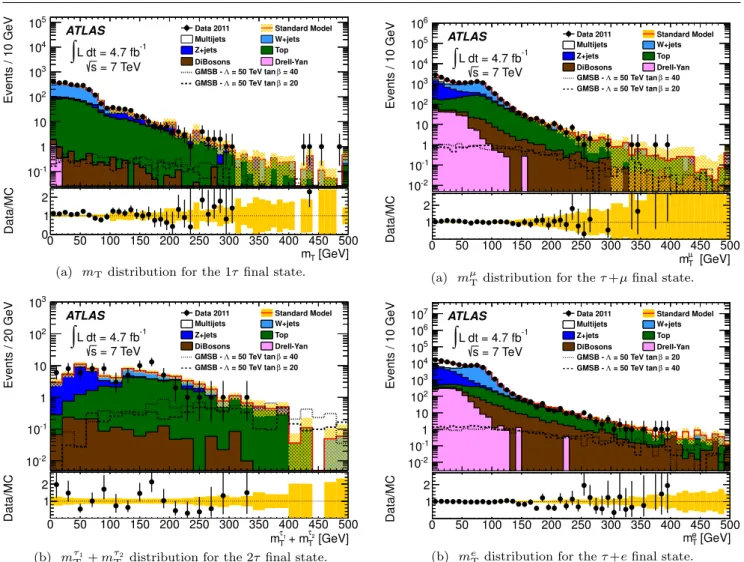
Figure 1 shows the mTand mτT1+ m τ2
T distributions for the 1τ and 2τ channels after all the requirements of the analysis except the final requirement on HT. Sim-ilarly, Figure 2 shows the me, µT distributions for the τ +µ and τ +e channels after all the requirements of the analysis except the final meff requirement.
Figure 3 and 4 show the HT distributions in the 1τ and 2τ channels, and meff distributions in the τ +µ and τ +e channels, respectively, after all other selection criteria have been imposed.
6 Background estimation
The SM background expectation predicted by simula-tion in the SR is corrected by means of control regions (CRs), which are chosen such that a specific background process is enriched while any overlap with the SR is avoided. Data/MC comparison in the CRs show that MC overestimates the number of events compared to data, mainly due to mis-modelling of τ mis-identifica-tion probabilities and kinematics. Scaling factors are therefore obtained from the ratio of the number of ob-served events to the number of simulated background events in the control region where a given background contribution is enriched. Studies comparing data with MC simulations show that the τ mis-identification prob-ability is, to a good approximation, independent of the kinematic variables used to separate the SR from the CRs, so that the measured ratio of the data to MC event yields in the CR can be used to compute scaling
0 50 100 150 200 250 300 350 400 450 500 Events / 10 GeV -1 10 1 10 2 10 3 10 4 10 5 10 ATLAS -1 L dt = 4.7 fb
∫
= 7 TeV sData 2011 Standard Model Multijets W+jets Z+jets Top DiBosons Drell-Yan = 40 β = 50 TeV tan Λ GMSB - = 20 β = 50 TeV tan Λ GMSB - [GeV] T m 0 50 100 150 200 250 300 350 400 450 500 Data/MC 0 1 2
(a) mTdistribution for the 1τ final state.
0 50 100 150 200 250 300 350 400 450 500 Events / 20 GeV -2 10 -1 10 1 10 2 10 3 10 ATLAS -1 L dt = 4.7 fb
∫
= 7 TeV sData 2011 Standard Model Multijets W+jets Z+jets Top DiBosons Drell-Yan = 40 β = 50 TeV tan Λ GMSB - = 20 β = 50 TeV tan Λ GMSB - [GeV] 2 τ T + m 1 τ T m 0 50 100 150 200 250 300 350 400 450 500 Data/MC 1 2 (b) mτ1 T + m τ2
T distribution for the 2τ final state.
Fig. 1 Distribution of (a) mT and (b) mτT1+ m τ2
T for the
1τ and 2τ final states, respectively, after all analysis require-ments but the final requirement on HT. Data are represented
by the points, with statistical uncertainty only. The SM pre-diction includes the data-driven corrections discussed in the text. The band centred around the total SM background in-dicates the uncertainty due to finite MC sample sizes on the background expectation. Also shown is the expected signal from two typical GMSB samples (Λ = 50 TeV, tan β = 40, Λ = 50 TeV, tan β = 20).
factors to correct the MC background prediction in the SR.
The dominant background contributions in the SR arise from top quark pair and single top events (here-after generically indicated as ‘top’), W +jets, Z+jets and multi-jet events. The latter background does not contribute significantly to the τ +µ final state. The CR definitions used to estimate these background contribu-tions in the various channels are summarized in Table 2. 0 50 100 150 200 250 300 350 400 450 500 Events / 10 GeV -2 10 -1 10 1 10 2 10 3 10 4 10 5 10 6 10 ATLAS -1 L dt = 4.7 fb
∫
= 7 TeV sData 2011 Standard Model Multijets W+jets Z+jets Top DiBosons Drell-Yan = 40 β = 50 TeV tan Λ GMSB - = 20 β = 50 TeV tan Λ GMSB - [GeV] µ T m 0 50 100 150 200 250 300 350 400 450 500 Data/MC 1 2
(a) mµTdistribution for the τ +µ final state.
0 50 100 150 200 250 300 350 400 450 500 Events / 10 GeV -2 10 -1 10 1 10 2 10 3 10 4 10 5 10 6 10 7 10 ATLAS -1 L dt = 4.7 fb
∫
s = 7 TeVData 2011 Standard Model Multijets W+jets Z+jets Top DiBosons Drell-Yan = 20 β = 50 TeV tan Λ GMSB - = 40 β = 50 TeV tan Λ GMSB - [GeV] e T m 0 50 100 150 200 250 300 350 400 450 500 Data/MC 1 2 (b) me
Tdistribution for the τ +e final state.
Fig. 2 Distribution of me, µT for the (a) τ +µ and (b) τ +e fi-nal states after all afi-nalysis requirements but the fifi-nal require-ment on meff. Data are represented by the points, with
statis-tical uncertainty only. The SM prediction includes the data-driven corrections discussed in the text. The band centred around the total SM background indicates the uncertainty due to finite MC sample sizes on the background expectation. Also shown is the expected signal from two typical GMSB samples (Λ = 50 TeV, tan β = 40, Λ = 50 TeV, tan β = 20).
6.1 Background estimation in the 2τ channel
The W and top background contributions are domi-nated by events in which one τ candidate is a true τ and the others are mis-reconstructed from hadronic activity in the final state. The background from Z+jets events is dominated by final states with Z → τ τ decays. The CRs defined for the estimation of these background contri-butions have a very small contamination from multi-jet events due to the requirement on ∆(φjet1,2−pmiss
T ) and
the presence of two or more τ leptons. The signal contri-bution in these CRs is expected to be at less than 0.1 % for the models considered. Correlations between
differ-0 200 400 600 800 1000 1200 Events / 40 GeV -1 10 1 10 2 10 3 10 ATLAS -1 L dt = 4.7 fb
∫
= 7 TeV sData 2011 Standard Model Multijets W+jets Z+jets Top DiBosons Drell-Yan = 40 β = 50 TeV tan Λ GMSB - = 20 β = 50 TeV tan Λ GMSB - [GeV] T H 0 200 400 600 800 1000 1200 Data/MC 0 1 2
(a) HTdistribution for the 1τ final state.
0 200 400 600 800 1000 1200 Events / 40 GeV -1 10 1 10 2 10 ATLAS -1 L dt = 4.7 fb
∫
= 7 TeV sData 2011 Standard Model Multijets W+jets Z+jets Top DiBosons Drell-Yan = 40 β = 50 TeV tan Λ GMSB - = 20 β = 50 TeV tan Λ GMSB - [GeV] T H 0 200 400 600 800 1000 1200 Data/MC 1 2
(b) HTdistribution for the 2τ final state.
Fig. 3 Distribution of HT for the (a) 1τ and (b) 2τ final
states after all analysis requirements. Data are represented by the points, with statistical uncertainty only. The SM pre-diction includes the data-driven corrections discussed in the text. The band centred around the total SM background in-dicates the uncertainty due to finite MC sample sizes on the background expectation. Also shown is the expected signal from two typical GMSB samples (Λ = 50 TeV, tan β = 40, Λ = 50 TeV, tan β = 20).
ent samples in the various CRs are taken into account by considering the matrix equation Ndata = A ω, where Ndata is the observed number of data events in each of the CRs defined in Table 2, after subtracting the expected number of multi-jet events and any remaining sub-dominant background contribution, obtained from MC simulation. The matrix A is obtained from the MC expectation for the number of events originating from each of the background contributions (top, W and Z). The vector ω of scaling factors is then computed by inverting the matrix A. To obtain the uncertainties for the scaling factors, all contributing parameters are var-ied according to their uncertainties, the procedure is
re-0 200 400 600 800 1000 Events / 50 GeV -1 10 1 10 2 10 3 10 4 10 ATLAS -1 L dt = 4.7 fb
∫
= 7 TeV sData 2011 Standard Model Multijets W+jets Z+jets Top DiBosons Drell-Yan = 40 β = 50 TeV tan Λ GMSB - = 20 β = 50 TeV tan Λ GMSB - [GeV] eff m 0 200 400 600 800 1000 Data/MC 1 2 > (a) meff distribution for the τ +µ final state.
0 200 400 600 800 1000 1200 Events / 50 GeV -3 10 -2 10 -1 10 1 10 2 10 3 10 4 10 5 10 6 10 ATLAS -1 L dt = 4.7 fb
∫
= 7 TeV sData 2011 Standard Model Multijets W+jets Z+jets Top DiBosons Drell-Yan = 20 β = 50 TeV tan Λ GMSB - = 40 β = 50 TeV tan Λ GMSB - [GeV] eff m 0 200 400 600 800 1000 1200 Data/MC 1 2
(b) meff distribution for the τ +e final state.
Fig. 4 Distribution of mefffor the (a) τ +µ and (b) τ +e final
states after all analysis requirements. Data are represented by the points, with statistical uncertainty only. The SM pre-diction includes the data-driven corrections discussed in the text. The band centred around the total SM background in-dicates the uncertainty due to finite MC sample sizes on the background expectation. Also shown is the expected signal from two typical GMSB samples (Λ = 50 TeV, tan β = 40, Λ = 50 TeV, tan β = 20). In the top figure, the event in data surviving all the analysis requirements is shown in the over-flow bin.
peated and new scaling factors are obtained. The width of the distribution of each resulting scaling factor is used as its uncertainty. The typical scaling factors ob-tained with this procedure are between 0.75 and 1 , with uncertainty of order 40 %. The multi-jet background ex-pectation is computed in a multi-jet-dominated CR de-fined by inverting the ∆(φjet
1,2−pmissT ) requirement and
not applying the mτ1
T + m τ2
T and HT selection. In addi-tion, an upper limit is imposed on the ratio Emiss
T /meff to increase the purity of this CR sample.
6.2 Background estimation in the 1τ channel
The number of events from W +jets and W Z processes in the SR is estimated by scaling the number of cor-responding MC events with the ratio of data to MC events in the W +jets CR. The corresponding scaling factors are computed separately for the cases in which the τ candidates from W /top decays are true τ lep-tons and for those in which they are mis-reconstructed from hadronic activity in the final state. It has been checked that the same scaling factors can be applied to both W +jets and W Z processes. In the case of W +jets background events with true τ candidates, the charge asymmetry method [66, 67] is used. To estimate the background from top events with true τ candidates, a scaling-factor-based-technique is also used, where the number of b-tagged events in data in the top CR is fit-ted to a template from MC simulation (‘template fit’). For background events in both W /top processes due to fake τ candidates, the matrix method already dis-cussed for the 2τ background estimation is employed, where the parameters in the vector ω of scaling factors are ωfake
W , ωtrueW , ωfaketop and ωtoptrue. The region dominated by fake τ candidates is defined by mT> 110 GeV and HT < 600 GeV, while the one dominated by true τ candidates is defined by requiring mT < 70 GeV. The values of ωtruetop obtained from this method and from the template fit are in very good agreement. The fac-tor ωtrue
W obtained with the charge asymmetry method agrees within 2σ with the one obtained with the ma-trix inversion method. The difference between the two ωtrue
W values is then assigned as a systematic uncertainty on the W +jets background estimation procedure. The background from Z+jets events is due to events where the Z decays to a pair of neutrinos, and contributes fully to the observed ETmiss. The background contribu-tion in the SR is estimated from data by measuring the data/MC ratio from Z → `+`− decays in the Z+jets CR defined in Table 2. Typical scaling factors are be-tween 0.75 and 1.2 , with uncertainty of order 20 %. The multi-jet background expectation is computed in the same way as in the 2τ channel.
6.3 Background estimation in the τ +µ and τ +e channels
The top background contribution consists of events where the muon (electron) candidate is a true muon (elec-tron), and the τ candidate can either be a true τ or a hadronic jet mis-identified as a τ . On the other hand, the W +jets background consists mainly of events where the τ candidate is mis-reconstructed from hadronic ac-tivity in the final state. For this reason, the top CR
is divided into two subregions: one dominated by true τ candidates, defined by 100 GeV < me, µT < 150 GeV, and one dominated by fake ones (50 GeV < me, µT < 100 GeV). The same matrix approach already described is then used to estimate the true/fake top and W +jets background contributions to the SR. The scaling factors obtained are about 0.6–0.8 , with typical uncertainty of 15 %. The Z+jets background is much smaller than the W +jets one, and it is estimated using MC simulated events. The multi-jet background arises from mis-iden-tified prompt leptons. By comparing the rates of events with and without the lepton isolation requirement, a data-driven estimate is obtained following the method described in Ref. [64].
The contribution from other sources of background considered (Drell-Yan and diboson events) is estimated in all analyses using directly the MC normalizations, without applying any further scaling factor.
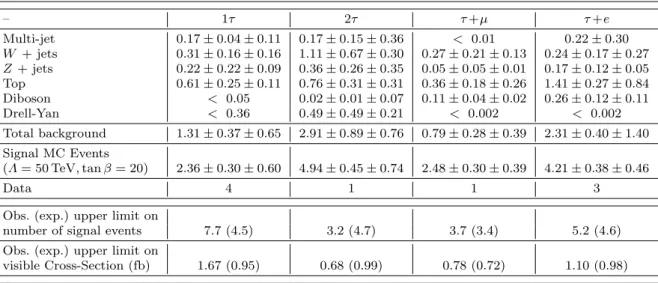
Table 3 summarizes the estimated numbers of back-ground events in the SR for each channel.
7 Systematic uncertainties on the background Various systematic uncertainties were studied and the effect on the number of expected background events in each channel presented was evaluated, following the approach of Refs. [21, 22]. The dominant systematic uncertainties in the different channels are summarized in Table 4.
The theoretical uncertainty on the MC-based cor-rected extrapolation of the W +jets and top backgrounds from the CR into the SR is estimated using alternative MC samples. These MC samples were obtained by vary-ing the renormalization and factorisation scales, the functional form of the factorisation scale and the match-ing threshold in the parton shower process in the gen-erators used for the simulation of the events described in section 3.
Systematic uncertainties on the jet energy scale (JES) and jet energy resolution (JER) [57] are applied in MC events to the selected jets and propagated throughout the analysis. The difference in the number of expected background events obtained with the nominal MC sim-ulation after applying these changes is taken as the sys-tematic uncertainty.
The effect of the τ energy scale (TES) uncertainty on the expected background is estimated in a similar way. The uncertainties from the jet and τ energy scale are treated as fully correlated.
The uncertainties on the background estimation due to the τ identification efficiency depend on the τ identi-fication algorithm (“loose” or “medium”), the
kinemat-Table 3 Number of expected background events and data yields in the four final states discussed. Where possible, the uncertainties are separated into statistical and systematic parts. The SM prediction is computed taking into account correlations between the different uncertainties. Also shown are the number of expected signal MC events for one GMSB point (Λ=50 TeV, tan β=20), the 95 % confidence level (CL) upper limit on the number of observed (expected) signal events and corresponding cross-section from any new physics scenario that can be set for each of the four final states, taking into account the observed events in the data and the background expectations.
– 1τ 2τ τ +µ τ +e Multi-jet 0.17 ± 0.04 ± 0.11 0.17 ± 0.15 ± 0.36 < 0.01 0.22 ± 0.30 W + jets 0.31 ± 0.16 ± 0.16 1.11 ± 0.67 ± 0.30 0.27 ± 0.21 ± 0.13 0.24 ± 0.17 ± 0.27 Z + jets 0.22 ± 0.22 ± 0.09 0.36 ± 0.26 ± 0.35 0.05 ± 0.05 ± 0.01 0.17 ± 0.12 ± 0.05 Top 0.61 ± 0.25 ± 0.11 0.76 ± 0.31 ± 0.31 0.36 ± 0.18 ± 0.26 1.41 ± 0.27 ± 0.84 Diboson < 0.05 0.02 ± 0.01 ± 0.07 0.11 ± 0.04 ± 0.02 0.26 ± 0.12 ± 0.11 Drell-Yan < 0.36 0.49 ± 0.49 ± 0.21 < 0.002 < 0.002 Total background 1.31 ± 0.37 ± 0.65 2.91 ± 0.89 ± 0.76 0.79 ± 0.28 ± 0.39 2.31 ± 0.40 ± 1.40 Signal MC Events (Λ = 50 TeV, tan β = 20) 2.36 ± 0.30 ± 0.60 4.94 ± 0.45 ± 0.74 2.48 ± 0.30 ± 0.39 4.21 ± 0.38 ± 0.46 Data 4 1 1 3
Obs. (exp.) upper limit on
number of signal events 7.7 (4.5) 3.2 (4.7) 3.7 (3.4) 5.2 (4.6) Obs. (exp.) upper limit on
visible Cross-Section (fb) 1.67 (0.95) 0.68 (0.99) 0.78 (0.72) 1.10 (0.98)
ics of the τ sample and the number of associated tracks. In the different channels, they vary between 2–5 %.
A systematic uncertainty associated with the sim-ulation of pile-up in the MC events is also taken into account, with uncertainties varying between 5–20 %.
The effect of the 1.8 % uncertainty on the luminos-ity measurement [26, 27] is also considered on the nor-malization of the background contributions for which scale factors derived from CR regions were not applied (Drell-Yan and diboson in all channels, and Z+jets in the τ +µ and τ +e channels).
The total systematic uncertainties obtained in the 1τ , 2τ , τ +µ and τ +e channels are 52 %, 26 %, 49 % and 60 %, respectively. The limited size of the MC samples used for background estimation gives rise to a statistical error ranging from 21 % in the 1τ channel to 46 % in the τ +e channel.
8 Signal efficiencies and systematic uncertainties
The GMSB signal samples are described in Section 3. The total cross-section drops from 100 pb for Λ = 15 TeV to 5.0 fb for Λ = 80 TeV. The cross-section for strong production, for which this analysis has the largest effi-ciency, decreases faster than the cross-sections for slep-ton and gaugino production, such that for large val-ues of Λ the selection efficiency with respect to the to-tal SUSY production decreases. For the different final
states, in the ˜τ1NLSP region the efficiency is about 3 % for the 2τ channel, 1 % for the τ +µ and τ +e channels, and 0.5 % for the 1τ channel. In the non-˜τ1 NLSP re-gions and for high Λ values it drops to 0.1–0.2 % for all final states. The total systematic uncertainty on the signal selection from the various sources discussed in Section 7 ranges between 10–15 % for the 1τ channel, 15–18 % for the 2τ channel, 8–16 % for the τ +µ chan-nel and 11–17 % for the τ +e chanchan-nel over the GMSB signal grid.
Theoretical uncertainties related to the GMSB cross-section predictions are obtained using the same proce-dure as detailed in Ref. [22]. These uncertainties are cal-culated for individual SUSY production processes and for each model point in the GMSB grid, leading to over-all theoretical cross-section uncertainties between 5 % and 25 %.
9 Results
Table 3 summarizes the number of observed data events and the number of expected background events in the four channels, with separate statistical and systematic uncertainties. No significant excess is observed in any of the four signal regions. From the numbers of ob-served data events and expected background events, up-per limits at 95 % confidence level (CL) of 7.7, 3.2, 3.7 and 5.2 signal events from any scenario of physics be-yond the SM are calculated in the 1τ , 2τ , τ +µ and τ +e
Table 4 Overview of the major systematic uncertainties and the MC statistical uncertainty for the background estimates in the four channels presented in this paper.
Source of Uncertainty 1τ 2τ τ +µ τ +e CR to SR Extrapolation 27 % 12 % 26 % 29 % Jet Energy Resolution 21 % 6.5 % 5.4 % 13 % Jet Energy Scale 20 % 4.8 % 11 % 8.5 % τ Energy Scale 10 % 8.5 % 0.3 % 4.3 % Pile-up modelling 5.1 % 14 % 20 % 3.5 %
MC statistics 21 % 32 % 39 % 46 %
channels, respectively. Using only the background pre-dictions, expected limits of 4.5, 4.7, 3.4 and 4.6 events are obtained for the four channels (1τ , 2τ , τ +µ and τ +e). The limits on the number of signal events are computed using the profile likelihood method [68] and the CLscriterion [69]. Uncertainties on the background and signal expectations are treated as Gaussian-dis-tributed nuisance parameters in the likelihood fit. The signal-event upper limits translate into a 95 % CL ob-served (expected) upper limit on the visible cross-sec-tion for new phenomena for each of the four final states, defined by the product of cross-section, branching frac-tion, acceptance and efficiency for the selections defined in Section 5. The results are summarized in Table 3 for all channels. In order to produce the strongest possi-ble 95 % CL limit on the GMSB model parameters Λ and tan β, a statistical combination of the four chan-nels is performed. The likelihood function representing the outcome of the combination includes the statisti-cal independence of the four final states considered. The resulting observed and expected lower limits for the combination of the four final states are shown in Figure 5. These limits are calculated including all ex-perimental and theoretical uncertainties on the back-ground and signal expectations. Excluding the theoret-ical uncertainties on the signal cross-section from the limit calculation has a negligible effect on the limits obtained. Figure 5 also includes the limits from OPAL [25] for comparison. The best exclusion from the com-bination of all final states is obtained for Λ = 58 TeV for values of tan β between 45 and 55 . The results ex-tend previous limits and values of Λ < 54 TeV are now excluded at 95 % CL, in the regions where the ˜τ1is the next-to-lightest SUSY particle (tan β > 20).
10 Conclusions
A search for SUSY in final states with jets, ETmiss, light leptons (e/µ) and hadronically decaying τ leptons is performed using 4.7 fb−1 of √s = 7 TeV pp collision data recorded with the ATLAS detector at the LHC.
[TeV] Λ 10 20 30 40 50 60 70 80 90 100 β tan 10 20 30 40 50 60 =1 grav >0, C µ =3, 5 =250 TeV, N mess GMSB: M 1 0 χ∼ 1 τ∼ CoNLSP R l ~ Theory excl. (2000 GeV) g~ (1800 GeV) g~ (1600 GeV) g~ (1400 GeV) g~ (1200 GeV) g~ (1000 GeV) g~ (800 GeV) g~ (600 GeV) g~ (400 GeV) g~ 1 0 χ∼ lR ~ Theory excl. (600 GeV) g~ (400 GeV) g~ (600 GeV) g~ (400 GeV) g~ 1 0 χ∼ Theory excl. ATLAS =7 TeV s , -1 L dt = 4.7 fb ∫ ) theory SUSY σ 1 ± Observed 95% CL limit ( ) exp σ 1 ± Expected 95% CL limit ( ATLAS 95% CL limit τ 2 -1 2.05fb ) 1 τ∼ OPAL 95% CL ( ) R µ∼ OPAL 95% CL ( OPAL 95% CL
Fig. 5 Expected and observed 95 % CL lower limits on the minimal GMSB model parameters Λ and tan β. The dark grey area indicates the region which is theoretically excluded due to unphysical sparticle mass values. The different NLSP regions are indicated. In the CoNLSP region the ˜τ1and the
˜
`R are the NLSPs. Additional model parameters are Mmess
= 250 TeV, N5= 3, µ > 0 and Cgrav= 1. The limits from the
OPAL experiment [25] are shown for comparison. The recent ATLAS limit [22] obtained on a subset (2 fb−1) of the 2011
data in the 2τ final state is also shown.
In the four final states studied, no significant excess is found above the expected SM backgrounds. The re-sults are used to set model-independent 95 % CL upper limits on the number of signal events from new phe-nomena and corresponding upper limits on the visible cross-section for the four different final states. Limits on the model parameters are set for a minimal GMSB model. A lower limit on the SUSY breaking scale Λ of 54 TeV is determined in the regions where the ˜τ1 is the next-to-lightest SUSY particle (tan β > 20) by statistically combining the result of the four analyses described in this paper. The limit on Λ increases to 58 TeV for tan β between 45 and 55 . These results
pro-vide the most stringent test to date of GMSB SUSY breaking models in a large part of the parameter space considered.
Acknowledgements
We thank CERN for the very successful operation of the LHC, as well as the support staff from our institutions without whom ATLAS could not be operated efficiently. We acknowledge the support of ANPCyT, Argentina; YerPhI, Armenia; ARC, Australia; BMWF and FWF, Austria; ANAS, Azerbaijan; SSTC, Belarus; CNPq and FAPESP, Brazil; NSERC, NRC and CFI, Canada; CERN; CONICYT, Chile; CAS, MOST and NSFC, China; COL-CIENCIAS, Colombia; MSMT CR, MPO CR and VSC CR, Czech Republic; DNRF, DNSRC and Lundbeck Foundation, Denmark; EPLANET and ERC, European Union; IN2P3-CNRS, CEA-DSM/IRFU, France; GNSF, Georgia; BMBF, DFG, HGF, MPG and AvH Founda-tion, Germany; GSRT, Greece; ISF, MINERVA, GIF, DIP and Benoziyo Center, Israel; INFN, Italy; MEXT and JSPS, Japan; CNRST, Morocco; FOM and NWO, Netherlands; BRF and RCN, Norway; MNiSW, Poland; GRICES and FCT, Portugal; MERYS (MECTS), Ro-mania; MES of Russia and ROSATOM, Russian Fed-eration; JINR; MSTD, Serbia; MSSR, Slovakia; ARRS and MVZT, Slovenia; DST/NRF, South Africa; MICINN, Spain; SRC and Wallenberg Foundation, Sweden; SER, SNSF and Cantons of Bern and Geneva, Switzerland; NSC, Taiwan; TAEK, Turkey; STFC, the Royal Soci-ety and Leverhulme Trust, United Kingdom; DOE and NSF, United States of America.
The crucial computing support from all WLCG part-ners is acknowledged gratefully, in particular from CERN and the ATLAS Tier-1 facilities at TRIUMF (Canada), NDGF (Denmark, Norway, Sweden), CC-IN2P3 (France), KIT/GridKA (Germany), INFN-CNAF (Italy), NL-T1 (Netherlands), PIC (Spain), ASGC (Taiwan), RAL (UK) and BNL (USA) and in the Tier-2 facilities worldwide.
References
1. H. Miyazawa, Prog. Theor. Phys. 36 (6) (1966) 1266–1276.
2. P. Ramond, Phys. Rev. D3 (1971) 2415–2418. 3. Y. A. Golfand and E. P. Likhtman, JETP Lett. 13
(1971) 323.
4. A. Neveu and J. H. Schwarz, Nucl. Phys. B31 (1971) 86.
5. A. Neveu and J. H. Schwarz, Phys. Rev. D4 (1971) 1109.
6. J. Gervais and B. Sakita, Nucl. Phys. B34 (1971) 632–639.
7. D. V. Volkov and V. P. Akulov, Phys. Lett. B46 (1973) 109.
8. J. Wess and B. Zumino, Phys. Lett. B49 (1974) 52. 9. J. Wess and B. Zumino, Nucl. Phys. B70 (1974)
39.
10. M. Dine and W. Fischler, Phys. Lett. B110 (1982) 227.
11. L. Alvarez-Gaume, M. Claudson, and M. Wise, Nucl. Phys. B207 (1982) 96.
12. C. R. Nappi and B. A. Ovrut, Phys. Lett. B113 (1982) 175.
13. M. Dine and A. E. Nelson, Phys. Rev. D48 (1993) 1277, arXiv:hep-ph/9303230.
14. M. Dine, A. E. Nelson, and Y. Shirman, Phys. Rev. D51 (1995) 1362, arXiv:hep-ph/9408384. 15. M. Dine, A. E. Nelson, Y. Nir, and Y. Shirman, Phys. Rev. D53 (1996) 2658, hep-ph/9507378. 16. P. Fayet, Phys. Lett. B64 (1976) 159.
17. P. Fayet, Phys. Lett. B69 (1977) 489.
18. G. R. Farrar and P. Fayet, Phys. Lett. B76 (1978) 575.
19. P. Fayet, Phys. Lett. B84 (1979) 416.
20. S. Dimopoulos and H. Georgi, Nucl. Phys. B193 (1981) 150.
21. ATLAS Collaboration, Phys. Lett. B 714 (2012) 197, arXiv:1204.3852 [hep-ex].
22. ATLAS Collaboration, Phys. Lett. B 714 (2012) 180, arXiv:1203.6580 [hep-ex].
23. ALEPH Collaboration, A. Heister et al., Eur. Phys. J. C25 (2002) 339, arXiv:hep-ex/0203024. 24. DELPHI Collaboration, J. Abdallah et al., Eur.
Phys. J. C27 (2003) 153, arXiv:hep-ex/0303025. 25. OPAL Collaboration, G. Abbiendi et al., Eur.
Phys. J. C46 (2006) 307, arXiv:hep-ex/0507048. 26. ATLAS Collaboration, Updated Luminosity
Determination in pp Collisions at √s = 7 TeV using the ATLAS Detector ,
ATLAS-CONF-2012-080, 2012.
https://cdsweb.cern.ch/record/1460392. 27. ATLAS Collaboration, Eur. Phys. J. C71 (2011)
1630, arXiv:1101.2185 [hep-ex]. 28. ATLAS Collaboration, Further search for
supersymmetry at √s = 7 TeV in final states with jets, missing transverse momentum and isolated leptons with the ATLAS detector ,
arXiv:1208.4688 [hep-ex].
29. CMS Collaboration, J. High Energy Phys. 1106 (2011) 077, arXiv:1104.3168 [hep-ex].
30. CMS Collaboration, Phys. Lett. B704 (2011) 411, arXiv:1106.0933 [hep-ex].
31. ATLAS Collaboration, J. Instrum. 3 (2008) S08003.
32. M. L. Mangano et al., J. High Energy Phys. 0307 (2003) 001, arXiv:hep-ph/0206293 [hep-ph]. 33. J. Pumplin et al., J. High Energy Phys. 0207
(2002) 012, arXiv:hep-ph/0201195 [hep-ph]. 34. S. Frixione and B. R. Webber, J. High Energy
Phys. 0206 (2002) 029, arXiv:hep-ph/0204244 [hep-ph].
35. S. Frixione, P. Nason, and B. R. Webber, J. High Energy Phys. 0308 (2003) 007,
arXiv:hep-ph/0305252 [hep-ph].
36. S. Frixione, E. Laenen, P. Motylinski, and B. R. Webber, J. High Energy Phys. 0603 (2006) 092, arXiv:hep-ph/0512250 [hep-ph].
37. H. L. Lai, Phys. Rev. D82 (2010) 074024. 38. G. Corcella et al., J. High Energy Phys. 0101
(2001) 010, arXiv:hep-ph/0011363 [hep-ph]. 39. J. Butterworth, J. R. Forshaw, and M. Seymour,
Z. Phys. C72 (1996) 637, arXiv:hep-ph/9601371 [hep-ph].
40. S. Jadach, Z. Was, R. Decker, and J. H. Kuhn, Comput. Phys. Commun. 76 (1993) 361. 41. P. Golonka et al., Comput. Phys. Commun. 174
(2006) 818.
42. E. Barberio and Z. Was, Comput. Phys. Commun. 79 (1994) 291.
43. T. Sjostrand, S. Mrenna, and P. Skands, J. High Energy Phys. 0605 (2006) 026,
arXiv:hep-ph/0603175 [hep-ph]. 44. ATLAS Collaboration, ATLAS Tunes for
PYTHIA6 and PYTHIA8 for MC11 , ATLAS-PHYS-PUB-2011-009, July, 2011. https://cdsweb.cern.ch/record/1363300. 45. A. Sherstnev and R. S. Thorne, Eur. Phys. J. C55
(2008) 553, arXiv:0711.2473 [hep-ph]. 46. F. E. Paige, S. D. Protopopescu, H. Baer, and
X. Tata, ISAJET 7.69: A Monte Carlo Event Generator for pp, ¯pp, and e+e− Reactions, arXiv:hep-ph/0312045.
47. M. Bahr et al., Eur. Phys. J. C58 (2008) 639–707, arXiv:0803.0883v3 [hep-ph].
48. W. Beenakker, R. Hopker, M. Spira, and P. Zerwas, Nucl. Phys. B492 (1997) 51, arXiv:hep-ph/9610490 [hep-ph].
49. A. Kulesza and L. Motyka, Phys. Rev. Lett. 102 (2009) 111802, arXiv:0807.2405 [hep-ph]. 50. A. Kulesza and L. Motyka, Phys. Rev. D80 (2009)
095004, arXiv:0905.4749 [hep-ph].
51. W. Beenakker et al., J. High Energy Phys. 0912 (2009) 041, arXiv:0909.4418 [hep-ph]. 52. W. Beenakker et al., Int. J. Mod. Phys. A26
(2011) 2637–2664, arXiv:1105.1110 [hep-ph].
53. M. Kr¨amer et al., Supersymmetry production cross sections in pp collisions at√s = 7 TeV ,
arXiv:1206.2892 [hep-ph].
54. Geant4 Collaboration, S. Agostinelli et al., Nucl. Instrum. Meth. A506 (2003) 250.
55. ATLAS Collaboration, Eur. Phys. J. C70 (2010) 823, arXiv:1005.4568 [physics.ins-det]. 56. M. Cacciari, G. P. Salam, and G. Soyez, J. High
Energy Phys. 0804 (2008) 063, arXiv:0802.1189 [hep-ph].
57. ATLAS Collaboration, Jet Energy Measurement with the ATLAS Detector in pp Collisions at √
s = 7 TeV, 2011. arXiv:1112.6426 [hep-ex]. Submitted to Eur. Phys. J. C.
58. ATLAS Collaboration, J. High Energy Phys. 1012 (2010) 060, arXiv:1010.2130 [hep-ex].
59. ATLAS Collaboration, Eur. Phys. J. C 72 (2012) 1909, arXiv:1110.3174 [hep-ex].
60. ATLAS Collaboration, Eur. Phys. J. C72 (2012) 1844, arXiv:1108.5602 [hep-ex].
61. ATLAS Collaboration, Commissioning of the ATLAS high-performance b-tagging algorithms in the 7 TeV collision data,
ATLAS-CONF-2011-102, Jul, 2011.
http://cdsweb.cern.ch/record/1369219. 62. ATLAS Collaboration, Measurement of the b-tag
Efficiency in a Sample of Jets Containing Muons with 5 fb−1 of Data from the ATLAS Detector , ATLAS-CONF-2012-043, Mar, 2012.
http://cdsweb.cern.ch/record/1435197. 63. ATLAS Collaboration, Performance of the
Reconstruction and Identification of Hadronic Tau Decays with ATLAS , ATLAS-CONF-2011-152, Nov, 2011.
http://cdsweb.cern.ch/record/1398195. 64. ATLAS Collaboration, Eur. Phys. J. C 71 (2011)
1577, arXiv:1012.1792 [hep-ex].
65. ATLAS Collaboration, Eur. Phys. J. C 72 (2012) 1849, arXiv:1110.1530 [hep-ex].
66. ATLAS Collaboration, Phys. Rev. D 85 (2012) 072004, arXiv:1109.5141 [hep-ex].
67. ATLAS Collaboration, Eur. Phys. J. C 72 (2012) 2039, arXiv:1203.4211 [hep-ex].
68. G. Cowan, K. Cranmer, E. Gross, and O. Vitells, Eur. Phys. J. C 71 (2011) 1554, arXiv:1007.1727 [physics.data-an].
The ATLAS Collaboration
G. Aad48, T. Abajyan21, B. Abbott111, J. Abdallah12, S. Abdel Khalek115, A.A. Abdelalim49, O. Abdinov11, R. Aben105, B. Abi112, M. Abolins88, O.S. AbouZeid158, H. Abramowicz153, H. Abreu136, B.S. Acharya164a,164b, L. Adamczyk38, D.L. Adams25, T.N. Addy56, J. Adelman176, S. Adomeit98, P. Adragna75, T. Adye129,
S. Aefsky23, J.A. Aguilar-Saavedra124b,a, M. Agustoni17, M. Aharrouche81, S.P. Ahlen22, F. Ahles48,
A. Ahmad148, M. Ahsan41, G. Aielli133a,133b, T. Akdogan19a, T.P.A. ˚Akesson79, G. Akimoto155, A.V. Akimov94, M.S. Alam2, M.A. Alam76, J. Albert169, S. Albrand55, M. Aleksa30, I.N. Aleksandrov64, F. Alessandria89a, C. Alexa26a, G. Alexander153, G. Alexandre49, T. Alexopoulos10, M. Alhroob164a,164c, M. Aliev16, G. Alimonti89a, J. Alison120, B.M.M. Allbrooke18, P.P. Allport73, S.E. Allwood-Spiers53, J. Almond82, A. Aloisio102a,102b, R. Alon172, A. Alonso79, F. Alonso70, A. Altheimer35, B. Alvarez Gonzalez88, M.G. Alviggi102a,102b, K. Amako65, C. Amelung23, V.V. Ammosov128,∗, S.P. Amor Dos Santos124a, A. Amorim124a,b, N. Amram153,
C. Anastopoulos30, L.S. Ancu17, N. Andari115, T. Andeen35, C.F. Anders58b, G. Anders58a, K.J. Anderson31, A. Andreazza89a,89b, V. Andrei58a, M-L. Andrieux55, X.S. Anduaga70, S. Angelidakis9, P. Anger44,
A. Angerami35, F. Anghinolfi30, A. Anisenkov107, N. Anjos124a, A. Annovi47, A. Antonaki9, M. Antonelli47, A. Antonov96, J. Antos144b, F. Anulli132a, M. Aoki101, S. Aoun83, L. Aperio Bella5, R. Apolle118,c,
G. Arabidze88, I. Aracena143, Y. Arai65, A.T.H. Arce45, S. Arfaoui148, J-F. Arguin93, E. Arik19a,∗, M. Arik19a, A.J. Armbruster87, O. Arnaez81, V. Arnal80, C. Arnault115, A. Artamonov95, G. Artoni132a,132b, D. Arutinov21, S. Asai155, S. Ask28, B. ˚Asman146a,146b, L. Asquith6, K. Assamagan25, A. Astbury169, M. Atkinson165,
B. Aubert5, E. Auge115, K. Augsten127, M. Aurousseau145a, G. Avolio30, R. Avramidou10, D. Axen168,
G. Azuelos93,d, Y. Azuma155, M.A. Baak30, G. Baccaglioni89a, C. Bacci134a,134b, A.M. Bach15, H. Bachacou136, K. Bachas30, M. Backes49, M. Backhaus21, J. Backus Mayes143, E. Badescu26a, P. Bagnaia132a,132b,
S. Bahinipati3, Y. Bai33a, D.C. Bailey158, T. Bain158, J.T. Baines129, O.K. Baker176, M.D. Baker25, S. Baker77, P. Balek126, E. Banas39, P. Banerjee93, Sw. Banerjee173, D. Banfi30, A. Bangert150, V. Bansal169, H.S. Bansil18, L. Barak172, S.P. Baranov94, A. Barbaro Galtieri15, T. Barber48, E.L. Barberio86, D. Barberis50a,50b,
M. Barbero21, D.Y. Bardin64, T. Barillari99, M. Barisonzi175, T. Barklow143, N. Barlow28, B.M. Barnett129, R.M. Barnett15, A. Baroncelli134a, G. Barone49, A.J. Barr118, F. Barreiro80, J. Barreiro Guimar˜aes da Costa57, P. Barrillon115, R. Bartoldus143, A.E. Barton71, V. Bartsch149, A. Basye165, R.L. Bates53, L. Batkova144a, J.R. Batley28, A. Battaglia17, M. Battistin30, F. Bauer136, H.S. Bawa143,e, S. Beale98, T. Beau78,
P.H. Beauchemin161, R. Beccherle50a, P. Bechtle21, H.P. Beck17, A.K. Becker175, S. Becker98, M. Beckingham138, K.H. Becks175, A.J. Beddall19c, A. Beddall19c, S. Bedikian176, V.A. Bednyakov64, C.P. Bee83, L.J. Beemster105, M. Begel25, S. Behar Harpaz152, P.K. Behera62, M. Beimforde99, C. Belanger-Champagne85, P.J. Bell49, W.H. Bell49, G. Bella153, L. Bellagamba20a, M. Bellomo30, A. Belloni57, O. Beloborodova107,f, K. Belotskiy96, O. Beltramello30, O. Benary153, D. Benchekroun135a, K. Bendtz146a,146b, N. Benekos165, Y. Benhammou153, E. Benhar Noccioli49, J.A. Benitez Garcia159b, D.P. Benjamin45, M. Benoit115, J.R. Bensinger23, K. Benslama130, S. Bentvelsen105, D. Berge30, E. Bergeaas Kuutmann42, N. Berger5, F. Berghaus169, E. Berglund105,
J. Beringer15, P. Bernat77, R. Bernhard48, C. Bernius25, T. Berry76, C. Bertella83, A. Bertin20a,20b, F. Bertolucci122a,122b, M.I. Besana89a,89b, G.J. Besjes104, N. Besson136, S. Bethke99, W. Bhimji46,
R.M. Bianchi30, L. Bianchini23, M. Bianco72a,72b, O. Biebel98, S.P. Bieniek77, K. Bierwagen54, J. Biesiada15, M. Biglietti134a, H. Bilokon47, M. Bindi20a,20b, S. Binet115, A. Bingul19c, C. Bini132a,132b, C. Biscarat178, B. Bittner99, K.M. Black22, R.E. Blair6, J.-B. Blanchard136, G. Blanchot30, T. Blazek144a, I. Bloch42,
C. Blocker23, J. Blocki39, A. Blondel49, W. Blum81, U. Blumenschein54, G.J. Bobbink105, V.B. Bobrovnikov107, S.S. Bocchetta79, A. Bocci45, C.R. Boddy118, M. Boehler48, J. Boek175, N. Boelaert36, J.A. Bogaerts30,
A. Bogdanchikov107, A. Bogouch90,∗, C. Bohm146a, J. Bohm125, V. Boisvert76, T. Bold38, V. Boldea26a, N.M. Bolnet136, M. Bomben78, M. Bona75, M. Boonekamp136, S. Bordoni78, C. Borer17, A. Borisov128, G. Borissov71, I. Borjanovic13a, M. Borri82, S. Borroni87, J. Bortfeldt98, V. Bortolotto134a,134b, K. Bos105, D. Boscherini20a, M. Bosman12, H. Boterenbrood105, J. Bouchami93, J. Boudreau123, E.V. Bouhova-Thacker71, D. Boumediene34, C. Bourdarios115, N. Bousson83, A. Boveia31, J. Boyd30, I.R. Boyko64, I. Bozovic-Jelisavcic13b, J. Bracinik18, P. Branchini134a, A. Brandt8, G. Brandt118, O. Brandt54, U. Bratzler156, B. Brau84, J.E. Brau114, H.M. Braun175,∗, S.F. Brazzale164a,164c, B. Brelier158, J. Bremer30, K. Brendlinger120, R. Brenner166,
S. Bressler172, D. Britton53, F.M. Brochu28, I. Brock21, R. Brock88, F. Broggi89a, C. Bromberg88, J. Bronner99, G. Brooijmans35, T. Brooks76, W.K. Brooks32b, G. Brown82, H. Brown8, P.A. Bruckman de Renstrom39, D. Bruncko144b, R. Bruneliere48, S. Brunet60, A. Bruni20a, G. Bruni20a, M. Bruschi20a, T. Buanes14, Q. Buat55,
F. Bucci49, J. Buchanan118, P. Buchholz141, R.M. Buckingham118, A.G. Buckley46, S.I. Buda26a, I.A. Budagov64, B. Budick108, V. B¨uscher81, L. Bugge117, O. Bulekov96, A.C. Bundock73, M. Bunse43, T. Buran117,
H. Burckhart30, S. Burdin73, T. Burgess14, S. Burke129, E. Busato34, P. Bussey53, C.P. Buszello166, B. Butler143, J.M. Butler22, C.M. Buttar53, J.M. Butterworth77, W. Buttinger28, S. Cabrera Urb´an167, D. Caforio20a,20b, O. Cakir4a, P. Calafiura15, G. Calderini78, P. Calfayan98, R. Calkins106, L.P. Caloba24a, R. Caloi132a,132b, D. Calvet34, S. Calvet34, R. Camacho Toro34, P. Camarri133a,133b, D. Cameron117, L.M. Caminada15, R. Caminal Armadans12, S. Campana30, M. Campanelli77, V. Canale102a,102b, F. Canelli31,g, A. Canepa159a, J. Cantero80, R. Cantrill76, L. Capasso102a,102b, M.D.M. Capeans Garrido30, I. Caprini26a, M. Caprini26a, D. Capriotti99, M. Capua37a,37b, R. Caputo81, R. Cardarelli133a, T. Carli30, G. Carlino102a, L. Carminati89a,89b, B. Caron85, S. Caron104, E. Carquin32b, G.D. Carrillo-Montoya173, A.A. Carter75, J.R. Carter28,
J. Carvalho124a,h, D. Casadei108, M.P. Casado12, M. Cascella122a,122b, C. Caso50a,50b,∗,
A.M. Castaneda Hernandez173,i, E. Castaneda-Miranda173, V. Castillo Gimenez167, N.F. Castro124a,
G. Cataldi72a, P. Catastini57, A. Catinaccio30, J.R. Catmore30, A. Cattai30, G. Cattani133a,133b, S. Caughron88, V. Cavaliere165, P. Cavalleri78, D. Cavalli89a, M. Cavalli-Sforza12, V. Cavasinni122a,122b, F. Ceradini134a,134b, A.S. Cerqueira24b, A. Cerri30, L. Cerrito75, F. Cerutti47, S.A. Cetin19b, A. Chafaq135a, D. Chakraborty106, I. Chalupkova126, K. Chan3, P. Chang165, B. Chapleau85, J.D. Chapman28, J.W. Chapman87, E. Chareyre78, D.G. Charlton18, V. Chavda82, C.A. Chavez Barajas30, S. Cheatham85, S. Chekanov6, S.V. Chekulaev159a, G.A. Chelkov64, M.A. Chelstowska104, C. Chen63, H. Chen25, S. Chen33c, X. Chen173, Y. Chen35, Y. Cheng31, A. Cheplakov64, R. Cherkaoui El Moursli135e, V. Chernyatin25, E. Cheu7, S.L. Cheung158, L. Chevalier136, G. Chiefari102a,102b, L. Chikovani51a,∗, J.T. Childers30, A. Chilingarov71, G. Chiodini72a, A.S. Chisholm18, R.T. Chislett77, A. Chitan26a, M.V. Chizhov64, G. Choudalakis31, S. Chouridou137, I.A. Christidi77, A. Christov48, D. Chromek-Burckhart30, M.L. Chu151, J. Chudoba125, G. Ciapetti132a,132b, A.K. Ciftci4a, R. Ciftci4a, D. Cinca34, V. Cindro74, C. Ciocca20a,20b, A. Ciocio15, M. Cirilli87, P. Cirkovic13b, Z.H. Citron172, M. Citterio89a, M. Ciubancan26a, A. Clark49, P.J. Clark46, R.N. Clarke15, W. Cleland123, J.C. Clemens83, B. Clement55, C. Clement146a,146b, Y. Coadou83, M. Cobal164a,164c, A. Coccaro138, J. Cochran63, L. Coffey23, J.G. Cogan143, J. Coggeshall165, E. Cogneras178, J. Colas5, S. Cole106, A.P. Colijn105, N.J. Collins18,
C. Collins-Tooth53, J. Collot55, T. Colombo119a,119b, G. Colon84, G. Compostella99, P. Conde Mui˜no124a, E. Coniavitis166, M.C. Conidi12, S.M. Consonni89a,89b, V. Consorti48, S. Constantinescu26a, C. Conta119a,119b, G. Conti57, F. Conventi102a,j, M. Cooke15, B.D. Cooper77, A.M. Cooper-Sarkar118, K. Copic15,
T. Cornelissen175, M. Corradi20a, F. Corriveau85,k, A. Cortes-Gonzalez165, G. Cortiana99, G. Costa89a, M.J. Costa167, D. Costanzo139, D. Cˆot´e30, L. Courneyea169, G. Cowan76, C. Cowden28, B.E. Cox82,
K. Cranmer108, F. Crescioli122a,122b, M. Cristinziani21, G. Crosetti37a,37b, S. Cr´ep´e-Renaudin55, C.-M. Cuciuc26a, C. Cuenca Almenar176, T. Cuhadar Donszelmann139, M. Curatolo47, C.J. Curtis18, C. Cuthbert150,
P. Cwetanski60, H. Czirr141, P. Czodrowski44, Z. Czyczula176, S. D’Auria53, M. D’Onofrio73, A. D’Orazio132a,132b, M.J. Da Cunha Sargedas De Sousa124a, C. Da Via82, W. Dabrowski38, A. Dafinca118, T. Dai87, C. Dallapiccola84, M. Dam36, M. Dameri50a,50b, D.S. Damiani137, H.O. Danielsson30, V. Dao49, G. Darbo50a, G.L. Darlea26b, J.A. Dassoulas42, W. Davey21, T. Davidek126, N. Davidson86, R. Davidson71, E. Davies118,c, M. Davies93, O. Davignon78, A.R. Davison77, Y. Davygora58a, E. Dawe142, I. Dawson139, R.K. Daya-Ishmukhametova23, K. De8, R. de Asmundis102a, S. De Castro20a,20b, S. De Cecco78, J. de Graat98, N. De Groot104, P. de Jong105, C. De La Taille115, H. De la Torre80, F. De Lorenzi63, L. de Mora71, L. De Nooij105, D. De Pedis132a,
A. De Salvo132a, U. De Sanctis164a,164c, A. De Santo149, J.B. De Vivie De Regie115, G. De Zorzi132a,132b, W.J. Dearnaley71, R. Debbe25, C. Debenedetti46, B. Dechenaux55, D.V. Dedovich64, J. Degenhardt120, J. Del Peso80, T. Del Prete122a,122b, T. Delemontex55, M. Deliyergiyev74, A. Dell’Acqua30, L. Dell’Asta22, M. Della Pietra102a,j, D. della Volpe102a,102b, M. Delmastro5, P.A. Delsart55, C. Deluca105, S. Demers176, M. Demichev64, B. Demirkoz12,l, J. Deng163, S.P. Denisov128, D. Derendarz39, J.E. Derkaoui135d, F. Derue78, P. Dervan73, K. Desch21, E. Devetak148, P.O. Deviveiros105, A. Dewhurst129, B. DeWilde148, S. Dhaliwal158, R. Dhullipudi25,m, A. Di Ciaccio133a,133b, L. Di Ciaccio5, C. Di Donato102a,102b, A. Di Girolamo30,
B. Di Girolamo30, S. Di Luise134a,134b, A. Di Mattia173, B. Di Micco30, R. Di Nardo47, A. Di Simone133a,133b, R. Di Sipio20a,20b, M.A. Diaz32a, E.B. Diehl87, J. Dietrich42, T.A. Dietzsch58a, S. Diglio86, K. Dindar Yagci40, J. Dingfelder21, F. Dinut26a, C. Dionisi132a,132b, P. Dita26a, S. Dita26a, F. Dittus30, F. Djama83, T. Djobava51b, M.A.B. do Vale24c, A. Do Valle Wemans124a,n, T.K.O. Doan5, M. Dobbs85, D. Dobos30, E. Dobson30,o,
J. Dodd35, C. Doglioni49, T. Doherty53, Y. Doi65,∗, J. Dolejsi126, I. Dolenc74, Z. Dolezal126, B.A. Dolgoshein96,∗, T. Dohmae155, M. Donadelli24d, J. Donini34, J. Dopke30, A. Doria102a, A. Dos Anjos173, A. Dotti122a,122b,
M.T. Dova70, A.D. Doxiadis105, A.T. Doyle53, N. Dressnandt120, M. Dris10, J. Dubbert99, S. Dube15, E. Duchovni172, G. Duckeck98, D. Duda175, A. Dudarev30, F. Dudziak63, M. D¨uhrssen30, I.P. Duerdoth82, L. Duflot115, M-A. Dufour85, L. Duguid76, M. Dunford58a, H. Duran Yildiz4a, R. Duxfield139, M. Dwuznik38, F. Dydak30, M. D¨uren52, W.L. Ebenstein45, J. Ebke98, S. Eckweiler81, K. Edmonds81, W. Edson2,
C.A. Edwards76, N.C. Edwards53, W. Ehrenfeld42, T. Eifert143, G. Eigen14, K. Einsweiler15, E. Eisenhandler75, T. Ekelof166, M. El Kacimi135c, M. Ellert166, S. Elles5, F. Ellinghaus81, K. Ellis75, N. Ellis30, J. Elmsheuser98, M. Elsing30, D. Emeliyanov129, R. Engelmann148, A. Engl98, B. Epp61, J. Erdmann54, A. Ereditato17,
D. Eriksson146a, J. Ernst2, M. Ernst25, J. Ernwein136, D. Errede165, S. Errede165, E. Ertel81, M. Escalier115, H. Esch43, C. Escobar123, X. Espinal Curull12, B. Esposito47, F. Etienne83, A.I. Etienvre136, E. Etzion153, D. Evangelakou54, H. Evans60, L. Fabbri20a,20b, C. Fabre30, R.M. Fakhrutdinov128, S. Falciano132a, Y. Fang173, M. Fanti89a,89b, A. Farbin8, A. Farilla134a, J. Farley148, T. Farooque158, S. Farrell163, S.M. Farrington170, P. Farthouat30, F. Fassi167, P. Fassnacht30, D. Fassouliotis9, B. Fatholahzadeh158, A. Favareto89a,89b,
L. Fayard115, S. Fazio37a,37b, R. Febbraro34, P. Federic144a, O.L. Fedin121, W. Fedorko88, M. Fehling-Kaschek48, L. Feligioni83, D. Fellmann6, C. Feng33d, E.J. Feng6, A.B. Fenyuk128, J. Ferencei144b, W. Fernando6, S. Ferrag53, J. Ferrando53, V. Ferrara42, A. Ferrari166, P. Ferrari105, R. Ferrari119a, D.E. Ferreira de Lima53, A. Ferrer167, D. Ferrere49, C. Ferretti87, A. Ferretto Parodi50a,50b, M. Fiascaris31, F. Fiedler81, A. Filipˇciˇc74, F. Filthaut104, M. Fincke-Keeler169, M.C.N. Fiolhais124a,h, L. Fiorini167, A. Firan40, G. Fischer42, M.J. Fisher109, M. Flechl48, I. Fleck141, J. Fleckner81, P. Fleischmann174, S. Fleischmann175, T. Flick175, A. Floderus79,
L.R. Flores Castillo173, M.J. Flowerdew99, T. Fonseca Martin17, A. Formica136, A. Forti82, D. Fortin159a, D. Fournier115, A.J. Fowler45, H. Fox71, P. Francavilla12, M. Franchini20a,20b, S. Franchino119a,119b, D. Francis30, T. Frank172, M. Franklin57, S. Franz30, M. Fraternali119a,119b, S. Fratina120, S.T. French28, C. Friedrich42, F. Friedrich44, R. Froeschl30, D. Froidevaux30, J.A. Frost28, C. Fukunaga156, E. Fullana Torregrosa30,
B.G. Fulsom143, J. Fuster167, C. Gabaldon30, O. Gabizon172, T. Gadfort25, S. Gadomski49, G. Gagliardi50a,50b, P. Gagnon60, C. Galea98, B. Galhardo124a, E.J. Gallas118, V. Gallo17, B.J. Gallop129, P. Gallus125, K.K. Gan109, Y.S. Gao143,e, A. Gaponenko15, F. Garberson176, M. Garcia-Sciveres15, C. Garc´ıa167, J.E. Garc´ıa Navarro167, R.W. Gardner31, N. Garelli30, H. Garitaonandia105, V. Garonne30, C. Gatti47, G. Gaudio119a, B. Gaur141, L. Gauthier136, P. Gauzzi132a,132b, I.L. Gavrilenko94, C. Gay168, G. Gaycken21, E.N. Gazis10, P. Ge33d, Z. Gecse168, C.N.P. Gee129, D.A.A. Geerts105, Ch. Geich-Gimbel21, K. Gellerstedt146a,146b, C. Gemme50a, A. Gemmell53, M.H. Genest55, S. Gentile132a,132b, M. George54, S. George76, P. Gerlach175, A. Gershon153, C. Geweniger58a, H. Ghazlane135b, N. Ghodbane34, B. Giacobbe20a, S. Giagu132a,132b, V. Giakoumopoulou9, V. Giangiobbe12, F. Gianotti30, B. Gibbard25, A. Gibson158, S.M. Gibson30, M. Gilchriese15, D. Gillberg29, A.R. Gillman129, D.M. Gingrich3,d, J. Ginzburg153, N. Giokaris9, M.P. Giordani164c, R. Giordano102a,102b, F.M. Giorgi16, P. Giovannini99, P.F. Giraud136, D. Giugni89a, M. Giunta93, P. Giusti20a, B.K. Gjelsten117, L.K. Gladilin97, C. Glasman80, J. Glatzer21, A. Glazov42, K.W. Glitza175, G.L. Glonti64, J.R. Goddard75, J. Godfrey142, J. Godlewski30, M. Goebel42, T. G¨opfert44, C. Goeringer81, C. G¨ossling43, S. Goldfarb87, T. Golling176, A. Gomes124a,b, L.S. Gomez Fajardo42, R. Gon¸calo76, J. Goncalves Pinto Firmino Da Costa42, L. Gonella21, S. Gonz´alez de la Hoz167, G. Gonzalez Parra12, M.L. Gonzalez Silva27, S. Gonzalez-Sevilla49, J.J. Goodson148, L. Goossens30, P.A. Gorbounov95, H.A. Gordon25, I. Gorelov103, G. Gorfine175, B. Gorini30, E. Gorini72a,72b, A. Goriˇsek74, E. Gornicki39, B. Gosdzik42, A.T. Goshaw6, M. Gosselink105, M.I. Gostkin64, I. Gough Eschrich163, M. Gouighri135a, D. Goujdami135c, M.P. Goulette49, A.G. Goussiou138, C. Goy5, S. Gozpinar23, I. Grabowska-Bold38, P. Grafstr¨om20a,20b, K-J. Grahn42, E. Gramstad117, F. Grancagnolo72a, S. Grancagnolo16, V. Grassi148, V. Gratchev121, N. Grau35, H.M. Gray30, J.A. Gray148, E. Graziani134a, O.G. Grebenyuk121, T. Greenshaw73, Z.D. Greenwood25,m, K. Gregersen36, I.M. Gregor42, P. Grenier143, J. Griffiths8, N. Grigalashvili64, A.A. Grillo137, S. Grinstein12, Ph. Gris34, Y.V. Grishkevich97, J.-F. Grivaz115, E. Gross172, J. Grosse-Knetter54, J. Groth-Jensen172, K. Grybel141, D. Guest176, C. Guicheney34, S. Guindon54, U. Gul53, J. Gunther125, B. Guo158, J. Guo35, P. Gutierrez111, N. Guttman153, O. Gutzwiller173, C. Guyot136, C. Gwenlan118, C.B. Gwilliam73, A. Haas108, S. Haas30, C. Haber15, H.K. Hadavand8, D.R. Hadley18,
P. Haefner21, F. Hahn30, S. Haider30, Z. Hajduk39, H. Hakobyan177, D. Hall118, K. Hamacher175, P. Hamal113, K. Hamano86, M. Hamer54, A. Hamilton145b,p, S. Hamilton161, L. Han33b, K. Hanagaki116, K. Hanawa160, M. Hance15, C. Handel81, P. Hanke58a, J.R. Hansen36, J.B. Hansen36, J.D. Hansen36, P.H. Hansen36, P. Hansson143, K. Hara160, G.A. Hare137, T. Harenberg175, S. Harkusha90, D. Harper87, R.D. Harrington46, O.M. Harris138, J. Hartert48, F. Hartjes105, T. Haruyama65, A. Harvey56, S. Hasegawa101, Y. Hasegawa140, S. Hassani136, S. Haug17, M. Hauschild30, R. Hauser88, M. Havranek21, C.M. Hawkes18, R.J. Hawkings30,