Óscar Narciso
Mortágua Pereira
DACA: Arquitetura para Implementação de
Mecanismos Dinâmicos de Controlo
de Acesso em Camadas de Negócio
DACA: Architecture to Implement Dynamic
Access Control Mechanisms
on Business Tier Components
Programa de Doutoramento em Informática das Universidades do Minho, Aveiro e Porto
Óscar Narciso
Mortágua Pereira
DACA:
Arquitetura
para
Implementação
de
Mecanismos Dinâmicos de Controlo de Acesso em
Camadas de Negócio.
Tese apresentada à Universidade de Aveiro para cumprimento dos requisitos necessários à obtenção do grau de Doutor em Ciências da Computação (MAP-i), realizada sob a orientação científica do Prof. Doutor Rui L. Aguiar, Professor Associado com Agregação, do Departamento de Eletrónica, Telecomunicações e Informática da Universidade de Aveiro em co-orientação com a Prof. Doutora Maribel Yasmina Santos, Professora Associada com Agregação, do Departamento de Sistemas de Informação da Universidade do Minho.
Dedico este trabalho:
ao meu pai, à minha mãe
o júri
presidente
Prof. Doutor Carlos Alberto Diogo Soares BorregoProfessor Catedrático da Universidade de Aveiro Prof. Doutor Arnaldo Carvalho Martins Professor Catedrático da Universidade de Aveiro
Prof. Doutor Marco Paulo Amorim Vieira
Professor Auxiliar da Faculdade de Ciências e Tecnologia da Universidade de Coimbra
Prof. Doutor João Costa Seco
Professor Auxiliar da Faculdade de Ciências e Tecnologia da Universidade de Lisboa
Prof. Doutor Rui Luís Andrade Aguiar (orientador)
Professor Associado com Agregação da Universidade de Aveiro
Prof. Doutora Maribel Yasmina Campos Alves Santos (co-orientadora) Professora Associada com Agregação da Escola de Engenharia da Universidade do Minho.
agradecimentos O modo como se desenvolveu e se concluiu este trabalho deve muito ao apoio científico prestado e também às condições criadas e proporcionadas pelo Prof. Doutor Rui Luís Aguiar. Sem a sua colaboração e compreensão, o resultado seria inevitavelmente diferente. A ele o meu sincero obrigado.
Realço a disponibilidade total, constante e pronta da Prof. Doutora Maribel Yasmina Santos na colaboração científica que prestou. A ela o meu sincero obrigado.
Finalmente, realço a contribuição de todos os elementos do grupo ATNoG que de alguma forma também colaboraram para o sucesso deste meu trabalho. Não posso deixar de destacar o Prof. Doutor. Diogo Gomes, o Prof. Doutor João Paulo Barraca e o técnico André Rainho. A todos também o meu sincero obrigado.
palavras-chave
Controlo de acesso, componentes, arquitecturas de
software, sistemas adaptativos, base de dados
relacionais, camadas de negócio.
resumo Controlo de acesso é um desafio para a engenharia de software nas
aplicações de bases de dados. Atualmente, não há uma solução satisfatória para a implementação dinâmica de mecanismos finos e evolutivos de controlo de acesso (FGACM) ao nível das camadas de negócio de aplicações de bases de dados relacionais. Para solucionar esta lacuna, propomos uma arquitetura, aqui referida como Arquitetura Dinâmica de Controlo de Acesso (DACA). DACA permite que FGACM sejam dinamicamente construídos e atualizados em tempo de execução de acordo com as políticas finas de controlo de acesso (FGACP) estabelecidas. DACA explora e utiliza as características das Call Level Interfaces (CLI) para implementar FGACM ao nível das camadas de negócio. De entre as características das CLI, destacamos o seu desempenho e os diversos modos para acesso a dados armazenados em bases de dados relacionais. Na DACA, os diversos modos de acesso das CLI são envolvidos por objetos tipados derivados de FGACM, que são construídos e atualizados em tempo de execução. Os programadores prescindem dos modos tradicionais de acesso das CLI e passam a utilizar os dinamicamente construídos e atualizados. DACA compreende três componentes principais: Policy Server (repositório de meta-data dos FGACM), Dynamic Access Control Component (componente da camada de negócio que é responsável pela implementação dos FGACM) e Policy Manager (broker entre DACC e Policy Server). Ao contrário das soluções atuais, DACA não é dependente de qualquer modelo de controlo de acesso ou de qualquer política de controlo de acesso, promovendo assim a sua aplicabilidade a muitas e diversificadas situações. Com o intuito de validar DACA, foi concebida e desenvolvida uma solução baseada em Java, Java Database Connectivity (JDBC) e SQL Server. Foram efetuadas duas avaliações. A primeira avalia DACA quanto à sua capacidade para dinamicamente, em tempo de execução, implementar e atualizar FGACM e, a segunda, avalia o desempenho de DACA contra uma solução sem FGACM que utiliza o JDBC normalizado. Os resultados recolhidos mostram que DACA é uma solução válida para implementar FGACM evolutivos em camadas de negócio baseadas em CLI.
keywords
Access control, business tiers, software architecture,
components, adaptive systems, relational databases,
business tiers.
abstract Access control is a software engineering challenge in database applications.
Currently, there is no satisfactory solution to dynamically implement evolving fine-grained access control mechanisms (FGACM) on business tiers of relational database applications. To tackle this access control gap, we propose an architecture, herein referred to as Dynamic Access Control Architecture (DACA). DACA allows FGACM to be dynamically built and updated at runtime in accordance with the established fine-grained access control policies (FGACP). DACA explores and makes use of Call Level Interfaces (CLI) features to implement FGACM on business tiers. Among the features, we emphasize their performance and their multiple access modes to data residing on relational databases. The different access modes of CLI are wrapped by typed objects driven by FGACM, which are built and updated at runtime. Programmers prescind of traditional access modes of CLI and start using the ones dynamically implemented and updated. DACA comprises three main components: Policy Server (repository of metadata for FGACM), Dynamic Access Control Component (DACC) (business tier component responsible for implementing FGACM) and Policy Manager (broker between DACC and Policy Server). Unlike current approaches, DACA is not dependent on any particular access control model or on any access control policy, this way promoting its applicability to a wide range of different situations. In order to validate DACA, a solution based on Java, Java Database Connectivity (JDBC) and SQL Server was devised and implemented. Two evaluations were carried out. The first one evaluates DACA capability to implement and update FGACM dynamically, at runtime, and, the second one assesses DACA performance against a standard use of JDBC without any FGACM. The collected results show that DACA is an effective approach for implementing evolving FGACM on business tiers based on Call Level Interfaces, in this case JDBC.
T
ABLE OFC
ONTENTS 1 Introduction ... 1 1.1 Problem Definition ... 1 1.2 Solution Proposal ... 4 1.3 Research questions ... 5 1.4 Contributions ... 61.5 Computational Tools and Infrastructure ... 8
1.6 Thesis Organization ... 8
2 Background and State of the Art ... 9
2.1 Basic Access Control Concepts ... 9
2.1.1 Access Control Strategies ... 10
2.1.2 Architectures for Access Control Mechanisms ... 12
2.1.3 Dimensions of Access Control Mechanisms ... 16
2.2 Current tools for Building Business Tiers ... 19
2.2.1 O/RM tools and ADO.NET ... 19
2.2.2 Call Level Interfaces ... 21
2.2.3 Other proposals ... 27
2.3 JDBC ... 29
2.3.1 JDBC Overview ... 29
2.3.2 JDBC Approach to Call Level Interfaces Functionalities ... 30
2.3.3 JDBC Class Diagram ... 33
2.4 Current Approaches to Implement Access Control ... 36
2.4.1 Current Techniques ... 36
2.4.2 Related Work ... 41
2.5 Summary ... 52
3 From Call Level Interfaces Towards the DACA ... 53
3.1 Concepts ... 53
3.1.1 CRUD Schema ... 53
3.1.2 Business Schema ... 57
3.1.3 Business Entity ... 58
3.2 Modelization of Call Level Interfaces ... 59
3.2.1 Motivation ... 59
3.2.2 Proposed Approach for the Modelization of CLI ... 62
3.3 Componentization of CLI ... 66
3.3.1 Components... 66
3.3.2 Adaptation Process ... 67
3.4 Access Control... 72
3.5 Summary ... 72
4 DACA: Dynamic Access Control Architecture ... 75
4.1 Fine-grained Access Control Mechanisms ... 75
4.2 General Architecture... 76
4.2.1 Phases of the DACA ... 76
4.2.2 General Operation of the DACA ... 79
4.3 The DACA Components ... 80
4.3.1 The DACC ... 80
4.3.2 Policy Server ... 88
4.3.3 Policy Manager ... 89
4.4 Summary ... 90
5 Proof of Concept ... 91
5.1 The DACA Platform ... 91
5.1.1 Scenario ... 92
5.1.2 Awareness of FGACM ... 94
5.1.3 Security Configurator ... 96
5.1.5 DbProof ... 99
5.2 Performance Assessment ... 100
5.2.1 Methodology ... 101
5.2.2 Collected Results ... 105
5.3 Results Evaluation ... 109
5.3.1 Dynamic FGACM on business tiers ... 109
5.3.2 Security ... 110
5.3.3 FGACM awareness ... 110
5.3.4 Preservation of CLI Advantages ... 110
5.4 Summary ... 111 6 Conclusion ... 113 6.1 Overview ... 113 6.2 Contributions ... 114 6.3 Discussion ... 114 6.4 Future Work... 117
6.4.1 Extending DACC to Support Additional Access Modes ... 117
6.4.2 Fine-grained Access Control Policies for the DACA ... 117
6.4.3 Concurrent Approach of Call Level Interfaces... 117
6.4.4 Multi-function Components ... 118
6.4.5 Extending FGACP to the Runtime Values of CRUD expressions ... 118
6.4.6 Orchestration of Business Entities ... 119
6.4.7 The DACA Based on LINQ ... 119
References ... 121
Annex A – Logical model for metadata of FGACM ... 131
Annex B - Concurrency on CLI ... 135
B.1 CTSA- The Wrapper Approach ... 135
B.1.1 CTSA Presentation ... 135
B.1.3 Proof of Concept ... 138
B.1.4 CTSA Performance Assessment ... 140
B.1.5 Conclusion ... 146 B.2 Embedded Approach ... 146 B.2.1 Presentation ... 146 B.2.2 Architecture ... 147 B.2.2.1 Individual Cache ... 147 B.2.2.2 Shared Cache ... 147 B.2.3 Performance Assessment ... 148 B.3 Conclusion ... 148
Annex C – ABTC: Multi-purpose Adaptable Business Tier Components ... 149
C.1 Introduction ... 149 C.2 ABTC ... 149 C.2.1 Adaptation Process ... 149 C.2.2 Architecture Presentation ... 151 C.3 Proof of Concept ... 153 C.4 Discussion ... 154 C.5 Conclusion ... 155
T
ABLE OFF
IGURES Figure 1. Typical usage of CLI (JDBC). ... 2Figure 3. Centralized access control mechanism. ... 13
Figure 4. Mixed architecture.based on PEP and PDP. ... 16
Figure 5. Example based on ADO.NET. ... 20
Figure 6. Example based on JPA. ... 20
Figure 7. Example based on LINQ... 20
Figure 8. LMS with 5 tuples (rows) and 6 attributes (a till f). ... 24
Figure 9. CLI and DACA access mechanisms. ... 26
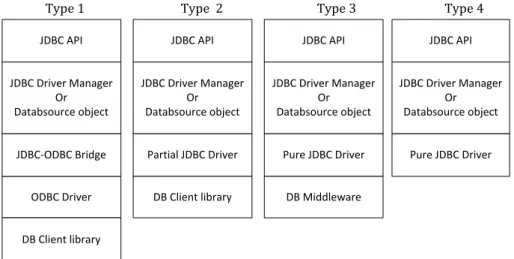
Figure 10. Types of JDBC drivers and their dependency on other components. ... 29
Figure 11. Declaration of variables. ... 30
Figure 12. Use of forward-only and read-only statement. ... 31
Figure 13. Use of forward-only and read-only prepared statement. ... 31
Figure 14. Use of scrollable and updatable statement. ... 31
Figure 15. Insert a row using a prepared statement. ... 32
Figure 16. Examples of transaction with JDBC. ... 32
Figure 17. Methods to scroll on LMS. ... 32
Figure 18. JDBC class diagram. ... 33
Figure 19. Connection interface. ... 33
Figure 20. Statement interface. ... 34
Figure 21. PrepareStatement interface. ... 34
Figure 22. ResultSet interface. ... 35
Figure 23. Enforcement of RBAC in Java EE... 51
Figure 24. Enforcement of RBAC in ORBAC. ... 51
Figure 25. Three CRUD expressions with different combinations of CRUD Schemas. ... 55
Figure 26. Two sibling CRUD expressions. ... 55
Figure 27. Partial example of how to implement the permissions of Table 3 on LMS. ... 58
Figure 28. Typical JDBC/CLI drawbacks. ... 61
Figure 29. Business Schema for the modelization of CLI: CRUD-Model. ... 63
Figure 30. Block diagram for the modelization process of CLI. ... 64
Figure 31. Partial view of a Business Entity based on the CRUD-Model. ... 64
Figure 32. Example shown in Figure 28 but based on the CRUD-Model. ... 65
Figure 33. Block diagram for the static approach: a) service composition and b) service allocation. ... 69
Figure 34. Block diagram for the dynamic service composition. ... 69
Figure 35. Attributes shared by all CRUD expressions. ... 71
Figure 36. Example of one Multiple Business Schema implementation. ... 71
Figure 37. General architecture of the DACA. ... 77
Figure 38. Concept of permission in the DACA. ... 78
Figure 39. Simplified block diagram of DACC. ... 80
Figure 40. Class diagram of DACC. ... 81
Figure 41. Business Entity class diagram. ... 86
Figure 42. ILMS class diagram for LMS. ... 86
Figure 43. Access control Meta-model. ... 89
Figure 44. Block diagram for the proof of concept. ... 92
Figure 45. Hierarchy of roles. ... 93
Figure 46. Role_B2 definition... 96
Figure 47. Programmers awareness about FGACM for Role_B2. ... 96
Figure 48. Application definition. ... 97
Figure 49. Role_B2 definition... 97
Figure 51. IRead definition. ... 97
Figure 52. Definition of all CRUD expressions. ... 98
Figure 53. Security keeper. ... 98
Figure 54. DbProof. ... 99
Figure 55. Business Schemas implemented for user User_A. ... 99
Figure 56. LMS interfaces for Cat_s Business Schema. ... 100
Figure 57. Graphics for scenario SSr. ... 106
Figure 58. Graphics for scenarios SSi, SSu and SSd. ... 107
Figure 59. Graphic for scenarios SI, SU and SD... 108
Figure 60. Wrapping approach to provide the getMet ... 111
Figure 61. DbProof implemented inADO.NET. ... 116
Figure 62. Logical model for the proof of concept. ... 131
Figure 63. CTSA main protocols. ... 137
Figure 64. CTSA class diagram. ... 138
Figure 65. CTSA constructor. ... 138
Figure 66. Partial view of IRead protocol. ... 139
Figure 67. Partial view of IScroll protocol. ... 139
Figure 68. Set and store the execution context. ... 140
Figure 69.CTSA from users’s perspective. ... 140
Figure 70. Std_Student schema. ... 141
Figure 71. E(c-jdbc,p,s) / E(c-ctsa,p,s) chart. ... 144
Figure 72. E(c-jdbc,p,s) / E(c-ctsa,p,s) details. ... 144
Figure 73. E(c-jdbc,p,u) / E(c-ctsa,p,u) chart. ... 145
Figure 74. E(c-jdbc,p,i) /E(c-ctsa,p,i) chart. ... 145
Figure 75. Implemented and tested scenarios. ... 150
Figure 76. Class diagram of ABTC. ... 152
T
ABLE OFT
ABLES Table 1. Access matrix to a table with attributes a, b, c and d. ... 10Table 2. Main protocols of LMS. ... 26
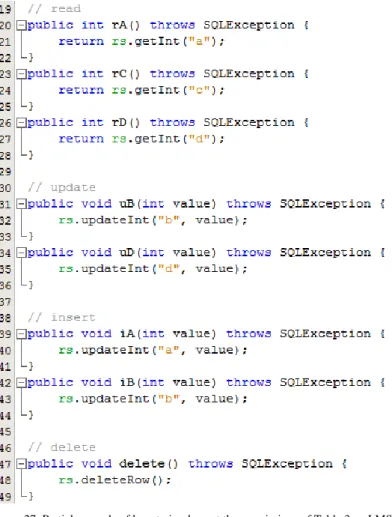
Table 3. Example of a table of permissions in a LMS (Indirect Access Mode). ... 58
Table 4. Roles and the correspondent permissions for the implemented scenario. ... 94
Table 5. Strategy to collect and compute measurements. ... 101
Table 6. Collected measurements for a) TBS, TBW and for b) RAM in ns. ... 102
Table 7. Scenarios for the Select expression: algorithms and typical component usage. ... 103
Table 8. Scenarios for the Insert, Update and Delete expressions: algorithms and typical component usage. ... 104
Table 9. Exclusive access mode approaches. ... 136
Table 10. Algorithm for E(c-jdbc,p,γ) assessment. ... 142
Table 11. Algorithm for E(c-jdbc,p,γ) assessment ... 143
Table 12. CRUD expressions and Business Schemas for the implemented scenarios. ... 154
Listing 1. Definition of table user in Ur/Web. ... 47
Listing 2. Policy definition in Ur/Web. ... 47
Listing 3. Policy definition in λDB. ... 48
Listing 4. Query rewritten in T-SQL. ... 49
Listing 5. Four examples of CRUD expressions. ... 57
A
CRONYMSABAC Attribute-Based Access Control
ABTC Adaptable Business Tier Component
ABTC_Dynamic Adaptable Business Tier Component - Dynamic
ABTC_Static Adaptable Business Tier Component - Static
ACP Access Control Policy
API Application Programming Interface
BE Business Entity
BS Business Schema
BW Business Worker
CBAC Credential Based Access Control
CLI Call Level Interfaces
CRUD Create Read Update Delete
CRUD-Model CRUD-Model
CTSA Concurrent Tuple Set Architecture
C-CTSA Component – Concurrent Tuple Set Architecture
C-JDBC Concurrent – Java Database Connectivity
DAC Discretionary Access Control
DACA Dynamic Access Control Architecture
DACC Dynamic Access Control Component
DAM Direct Access Mode
DCA Denial Category Assignment
DDL Data Definition Language
DFMAC Dynamic Fine-grained Meta-level Access Control
DRBAC Dynamic Role Based Access Control
FGAC Fine-grained Access Control
FGACM Fine-grained Access Control Mechanism
FGACP Fine-grained Access Control Policy
JDBC Java Database Connectivity
GUI Guided User Interface
IAM Indirect Access Mode
IDE Integrated Development Environment
IIS Internet Information Server
JIF Java + Information Flow
LMS Local Memory Structure
MAC Mandatory Access Control
ODBC Open Database Connectivity
O/RM Object-o-Relational Model
PAP Policy Administration Point
PCA Permission Category Assignment
PDP Policy Decision Point
PEP Policy Enforcement Point
PEP-PDP PEP PDP
PIP Policy Information Point
RBAC Role Based Access Control
RDBAC Reflective Database Access Control
RDBMS Relational Database Management System
SAC Semantic Access Control
SQL Structured Query Language
TAi Time to execute a method with 10 arguments and returning void
TBS Time to instantiate a Business Session
TBW Time to instantiate a Business Worker
TRi Time to execute a method with no arguments
1 Introduction
Fine-grained access control (FGAC) is a critical security issue in many software systems, mainly when policies evolve over time. Software systems are increasingly involved in all dimensions of our existence as humans. When operating in critical organizations, such as airports, hospitals, banks and power plants, they need to be available 24 hours a day and always operating under a high level of security. They manage data from which all day decisions are taken, many of them critical. To prevent any security violation, several security measures are taken such as user authentication, data encryption and secure connections. Another relevant security concern is access control [Samarati, '01b; Vimercati, '08], which “is concerned with limiting the activity of legitimate users.” [Sandhu, '94]. Basically, access control is a process to supervise every request to access a protected resource, in our case data residing inside relational database management systems (RDBMS), by determining whether the permission should be granted or denied. While access control is enforced at the table level, fine-grained access control (FGAC) is enforced at the column and row level. Currently, there isn´t any known solution to automatically build and keep updated, at runtime, fine-grained access control mechanisms (FGACM) on business tiers of relational database applications and in accordance with the established fine-grained access control policies (FGACP).
This chapter is organized as follows. Section 1.1 describes the problem being addressed. Section 1.2 briefly presents a solution to overcome the identified problem. Section 1.3 states the research questions to be addressed in this thesis. Section 1.4 enumerates and describes the contributions of this thesis. Section 1.5 presents the tools and infra-structured used during the thesis development process and, finally, section 1.6 presents the thesis organization.
1.1 Problem Definition
Critical data are mostly kept and managed by database management systems. Among the several paradigms, the relational paradigm continues to be one of the most successful to manage data and, therefore, to build database applications. To be useful, data need to be stored, updated and retrieved from databases. To this end, software architects use software tools to ease the development process of business tiers. Two groups of software tools are widely accepted in commercial and academic forums: O/RM tools (Java Persistent API [Yang, '10], LINQ [Erik, '06], Hibernate [Christian, '04] and Ruby on Rails [Vohra, '07]) and Call Level Interfaces (CLI) [ISO, '03] (JDBC [Parsian, '05], ODBC [Microsoft, '92], ADO.NET [Mead, '11]). Unfortunately, none of these tools addresses access control, much less when the policies evolve over time. These tools were mainly devised and designed to tackle the impedance mismatch issue [David, '90].
We now leverage the importance of CLI as the perfect choice for building business tiers whenever performance is considered a key requirement [Cook, '05] in detriment of other requirements such as productivity, usability and maintainability. Some of the features that contribute positively for a high performance of CLI are:
Fine tune control
CLI are low level API (Application Programming Interface) that provide programmers with a fine tune control to manage and optimize the environment in which Create, Read, Update and Delete (CRUD) expressions are executed.
Use of the native SQL language
Native SQL statements are encoded inside strings, this way keeping the performance and the full expressiveness of the SQL language.
Multi-access mode to data
CLI support several modes to access to data residing on relational databases. In each situation programmers are free to choose the access mode that better addresses their needs. Among the several access modes the use of the native SQL language is the most well-known. Chapter 2 thoroughly describes the access modes used by the DACA.
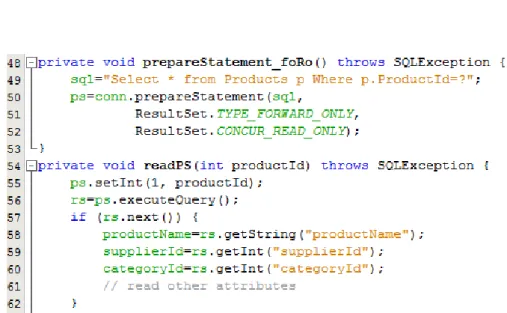
In spite of these key advantages, CLI (as other software tools) do not address access control. Figure 1 presents a typical usage of CLI in this case based on JDBC. From this example we see that there is no sign of any FGACP or any FGACM. Programmers are free to write any CRUD expression encoded inside strings (Figure 1: line 46) and execute them (Figure 1: line 47-50). The presented CRUD expression is a Select expression and, therefore, it returns a relation. CLI provide protocols from which programmers read the retrieved data (Figure 1: line 54-55), update the returned data (Figure 1: line 58-60), insert new data (Figure 1: line 63-66) and delete returned data
(Figure 1: line 69). There is no possibility to prevent programmers from writing this type of source-code and therefore there is no possibility to guide programmers to write source code in accordance with any established FGACP.
To overcome this lack of access control of current software tools, several approaches are proposed by the commercial and the academic communities. Security experts, instead of exploiting the advantages of CLI to implement FGACM, build additional security layers specially crafted to control the access to protected data. These security layers are responsible for evaluating authorization to perform actions on database objects and also to execute them if permission is granted. These security layers convey several drawbacks, among them four are emphasized:
Awareness gap about the policies and about the mechanisms
Programmers of business tiers and application tiers are expected to master the established access control policies at development time. This mastering process is very difficult to be sustained when the complexity of access control policies increases. Programmers do only get aware of any security violation after having written the source code. Awareness of any violation may take place at compile time but in most of the cases it is only obtained at runtime. Before compiling the source or running the database application, there is no possibility to statically validate the authorized actions during the development process of business tiers.
Security gap
The SQL language is characterized by its endless expressiveness capacity and programmers of business tiers and application tiers are not restricted to write any CRUD expression. This freedom opens the possibility for the existence of security gaps. Current techniques can hardly guarantee safety for all CRUD expressions [Shi, '09; Wang, '07]. Even if safety is guaranteed, programmers are always before additional techniques with increased complexity to express the policies to be enforced [Caires, '11; Chaudhuri, '07; Chlipala, '10; Corcoran, '09; Fischer, '09; Gary, '07; Hicks, '10; LeFevre, '04; Rizvi, '04; Wang, '07; Yang, '12]. Additional techniques and, above all, increased complexity frequently leads to the possibility of opening unwanted security gaps.
Wastage of CLI features
Architecture of current security layers is not based on architecture of CLI, this way preventing the use of their advantages by business and application tiers.
Maintenance activities
Currently, any modification in the policies implying modifications in the access control mechanisms forces a maintenance activity on the security layers and/or on the business logic to be carried out in advance. Currently, there is no way to translate access control policies automatically into access control mechanisms and/or into the business logic. Maintenance is
very often a critical activity when modifications are necessary at the client-side of database applications with a great amount and distant equipment.
1.2 Solution Proposal
To tackle the aforementioned drawbacks of current security layers, we propose a new architecture herein referred to as Dynamic Access Control Architecture (DACA). Security layers relying on the DACA are dynamically built at their instantiation time on the client-side of database applications and are continuously updated to enforce any modification in the established access control policies. The dynamic adaptation of business tiers may leverage security systems based on [email protected] [Blair, '09] to continuously keep security layers aligned with the policies they must enforce. To take advantage of CLI features, the implemented access control mechanisms are closely aligned with the architecture of CLI and with the services they provide. Among the services provided by CLI, the DACA makes use of two access modes as it will be described in chapter 4. To overcome possible security gaps of current solutions, users are restricted to use only the permissions provided by the FGACM. Among the restrictions, users can only use CRUD expressions made available by the implemented FGACM. Finally, the DACA provides programmers of business tiers with a complete awareness about the implemented FGACM this way relieving them from mastering FGACM while writing source code.
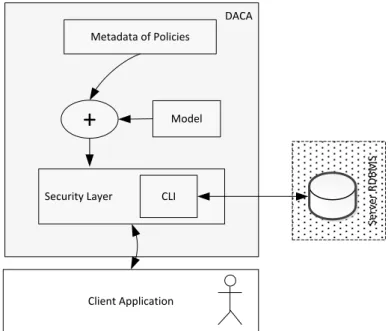
To unveil the proposed architecture, Figure 2 presents a simplified block diagram, though incomplete, of the DACA. The overall operation is as follows:
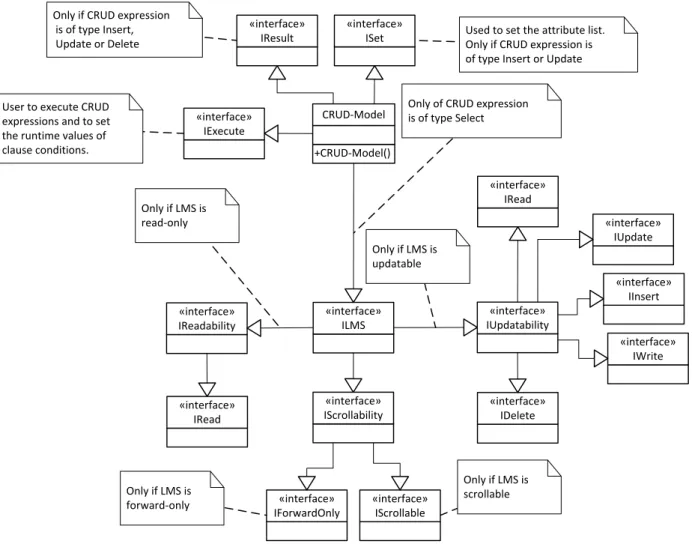
A security layer (business tier relying on CLI – it is a client-side layer) is dynamically built and kept updated (from an architectural model based on CLI and from the policies kept in a server) to implement access control mechanisms in accordance with the established policies. The security layer is composed by typed objects driven by FGACM;
Client applications access database objects through the security layer;
Security layer uses standard CLI to interact with database objects.
Se rv er R D B M S DACA Client Application Metadata of Policies Security Layer
+
Model CLIThere is no reference to FGACP. The DACA is focused on FGACM only. The DACA uses metadata derived from FGACP relying on any security model. This issue will be thoroughly addressed in chapter 4.
In order to validate the DACA, a solution based on Java, Java Database Connectivity (JDBC) and SQL Server was devised, designed and implemented. Two evaluations were carried out. The first one evaluates the DACA capability to address the announced drawbacks of current solutions, including the capacity to implement evolving FGACM dynamically, at runtime. The second evaluation is aimed at assessing its performance against a standard use of JDBC where no policies are enforced. The collected results show that the DACA is an effective solution to implement evolving FGACM on business tiers, of relational database applications, based on CLI, in this case JDBC.
1.3 Research questions
This thesis aims at answering several research questions related to the implementation of dynamic FGACM on business tiers of relational database applications. The research questions are derived from the issues described and emphasized in the previous sections.
The main question to be answered by this thesis is: is it possible to implement FGACM on business tiers dynamically, at runtime, and keep them updated when the policies evolve over time? If yes, the second level questions are:
Security
Current approaches allow users to write their own CRUD expressions freely. In an unsupervised context this opens possibilities to security violations. Is there any possibility to supervise the use of CRUD expressions effectively when protected data is being accessed?
Mastering of FGACP
Current security layers do not give any guidance on the established FGACP neither on the implemented FGACM. Is it possible to overcome this difficulty by providing programmers with a complete awareness about the established FGACM?
Use of CLI
The use of CLI to build business tiers presents several advantages. Is it possible to keep those advantages on the proposed solution to implement FGACM?
To answer these research questions, several steps need to be taken. In a first step, an architectural model is necessary aimed at addressing the main question of this thesis: the dynamic implementation of FGACM at runtime. In a second step, the use of CLI needs to be analyzed in order to implement FGACM. In a third step, a solution is necessary to convey a complete awareness to programmers about the implemented FGACM. Finally, in a fourth step, the proposed solution is evaluated to check its compliance with the research questions.
1.4 Contributions
The Dynamic Access Control Architecture is the main contribution of this thesis, exploiting CLI as the main standard API to be used. CLI are fundamental for the development process of business tiers whenever both a fine-tune control on the interactions with RDBMS and performance are considered key requirements. However, CLI do not provide any support for several software engineering challenges, such as how to implement dynamic FGACM on business tiers.
CLI are low level API and, as such, they convey some additional drawbacks when used for the building process of business tiers. Two of the most relevant drawbacks are:
CLI are agnostic regarding schemas of database objects
CLI do not incorporate or provide any guidance about schemas of database objects. Programmers need to completely master schemas of database objects to be able to use CLI. This drawback deeply affects productivity of programmers during the development process and during the maintenance process of database applications. This drawback also hampers the enforcement of access control policies.
CLI do not promote the reuse of software
Inefficiency of CLI to build reusable software is complete. Every business need impels programmers to write similar source-code to manage each CRUD expression. This drawback also hampers the development of reusable software for security layers.
Thus, these drawbacks have also a negative impact if security layers based on CLI are needed to enforce FGACP. FGACM control the access to database objects (formalized by schemas) and the DACA seeks to provide FGACM continuously updated and aligned with evolving FGACP. To address both drawbacks of CLI, some research was carried out. In a first step, the research was focused on defining a model to integrate schemas of relational databases with object-oriented applications using CLI. In a second step, the research was focused on defining an architecture for reusing adaptable business tier components relying on CLI. The dynamic implementation of FGACM was only addressed after the conclusion of these two lines of work. As such, in spite of not being considered as main contributions, the modelization process of business tiers and the componentization process of business tiers based on CLI are two cornerstones of the main contribution of this thesis.
Modelization of business tiers
This research was focused on defining a model to integrate schemas of relational database objects with object-oriented applications when CLI are used to build business tiers [Pereira, '10b; Pereira, '11b]. The model defines typed objects aimed at managing the execution of CRUD expressions. A tool was also presented to ease the development process of typed objects from native CRUD expressions. Source-code of typed objects is automatically generated to be used on business tiers. In [Gomes, '11; Pereira, '10a] some research has also been carried out to evaluate the possibility of devising a high-performance version of the model, based on a thread-safe implementation.
Modelization of business tiers was the continuation of an earlier research focused on easing the development process of business tiers based on CLI but using stored procedures instead of
CRUD expressions [Óscar Mortágua Pereira, '05; Pereira, '06; Pereira, '07a; Óscar Narciso Mortágua Pereira, '05a; Óscar Narciso Mortágua Pereira, '05b].
Componentization of business tiers
Componentization addressed a key issue of defining an architecture for developing reusable and adaptable business tier components based on CLI. Several techniques were devised to address reusability and adaptation of business tier components. Among them, a technique was devised to deploy CRUD expressions at runtime which is one of the techniques used by the DACA to address evolving access control policies. The combination between the several techniques, next presented, led to the possibility of adopting several approaches for the building process of business tier components.
In [Pereira, '12d; Pereira, '11c; Pereira, '13f] a proposal based on a wide typed object is presented to support one specific business area at a time. Basically, a component is statically customized to support a business area, such as accountability, relying on a unique wide typed object. Then CRUD expressions are deployed at runtime in accordance with users’ needs (eventually by access control policies). The typed object is said to be wide because it supports a schema for:
All foreseen attributes to be returned from the database;
All runtime values for column lists of all Update and Insert expressions;
All runtime values for clause conditions of all CRUD expressions.
In [Pereira, '11a; Pereira, '13a] a component is also statically customized to support a business area but now relying on several typed objects. Each typed object addresses a specific business need such as implementing the reading process of attributes of a database object. CRUD expressions are also deployed at runtime in accordance with users’ needs (eventually by access control policies). Each typed object supports all CRUD expressions whose schemas are in accordance with its own schema.
In [Pereira, '12b] a new customization process of business tiers is proposed. Here, customization is dynamically implemented at runtime, unlike the two previous approaches. Typed objects are dynamically created at runtime, following any of the two previous approaches. CRUD expressions are also deployed at runtime.
In [Pereira, '13b] an integrated perspective is given for multi-propose components based on CLI.
Access control
The security perspective is centered on access control and it is closely linked to the previous researches. In reality, the process to support evolving access control policies also includes the reusability and adaptability perspectives of business tiers components, which, by their side, include models.
[Pereira, '12d] presents an approach to address static implementation of FGACM based on CLI. In [Pereira, '12c] the previous approach was improved to address runtime adaptation of business tiers to implement FGACM. In [Pereira, '12a; Pereira, '13d] a complete and final perspective is given for an architecture to implement and keep FGACM updated on business tiers based on CLI. Additionally, to evaluate the impact of the enforcement mechanisms at the client side, a performance assessment was carried out. A scenario was defined and implemented to validate the approach. It is available through the Windows “Remote Desktop
Connection” at: url: ned.av.it.pt, username: DACA; password: guest (only one user at a time is allowed to login).
1.5 Computational Tools and Infrastructure
Several computational tools and infrastructures were used since the first research on using stored procedures and CLI. Publications involving stored procedures, between 2005 and 2007, were based on the .NET framework and the following tools/technologies were used: Visual Studio 2005 (C#, ADO.NET, ASP.NET, Web Services), IIS (Internet Information Server) and SQL Server 2005. Publications since 2010 were based on the NetBeans (Java SE, Java EE, JPA, JDBC), Visual Studio 2010 (C#, ADO.NET, LINQ) and SQL Server 2008. Microsoft Northwind database was used in several works including the proof of concept of the DACA.
1.6 Thesis Organization
The remainder of this thesis is organized as follows.
Chapter 2 is divided in four main sections. The first, second and third sections provide the necessary background for a complete understanding of the technical aspects herein addressed. The fourth section is focused on the state of the art and presents some of the current approaches, commercial and academic, used to support access control.
Chapter 3 describes the evolution from CLI till the final DACA. It presents the modelization and the componentization approaches for CLI as key steps towards the DACA. Access control is also superficially addressed and a very concise presentation is made for the approach that has been followed.
Chapter 4 is dedicated to the DACA. It presents the methodology followed in this thesis to devise and design the DACA. It thoroughly presents and describes how the research was conducted. Beyond the information to convey the believability of the obtained results, this chapter provides the necessary information to allow other researchers replicate and design accurately solutions based on the DACA.
In Chapter 5, a scenario based on the DACA is defined and implemented to evaluate the DACA against the announced research questions. This chapter is divided in three sections. The first section is aimed at implementing a scenario based on the DACA. The second section is aimed at assessing the DACA performance against a standard use of CLI but without any FGACM. The third section is aimed at analyzing the collected results to evaluate if the DACA answers the research questions of this thesis positively.
Chapter 6, the final chapter, is organized in four sections. The first section is focused on presenting an overview of this work. The second section is focused on presenting the contributions of this work. The third section concisely discusses some important issues closely related to this thesis but out of its scope. Finally, the fourth section presents the future work to be conducted to continue the work here presented.
2 Background and State of the Art
This chapter is focused on presenting the necessary background and the state of the art in the area of access control to promote a good understanding on this thesis contents and to make it a self-contained document for most of the readers. It comprises five sections each one addressing a particular subject: section 1 presents the basic access control concepts; section 2 presents current tools for building relational business tiers; section 3 presents JDBC; section 4 presents current approaches to access control, general techniques and related work and, final, section 5 summarizes to contents of this chapter.
This chapter is organized as follows. Section 2.1 presents the basic access control concepts. Section 2.2 presents the current tools that are used for building business tiers. Section 2.3 introduces the JDBC which is the a key API of the DACA. Section 2.4 presents the state of the art and, finally, section 2.5 summarizes the content of this chapter.
2.1 Basic Access Control Concepts
This section provides the required background to completely understand the fundamental concepts and techniques of access control and also the one used on the DACA.
Access control is a concept used in several applications and several contexts. It is focused on preventing unauthorized accesses to protected resources. Access control is enforced by security layers, which mediates every attempt to access to protected resources. Access control has been used on several situations, such as to control the access to: XML documents [Bertino, '00; Damiani, '02; Fundulaki, '04; Iwaihara, '05; Luo, '04], Web Services [Bhatti, '05; Koshutanski, '03; Mecella, '06; Paci, '11; Sharifi, '09; Wonohoesodo, '04], publish/subscribe systems [Belokosztolszki, '03], social networks [Anwar, '12; Carminati, '09a; Carminati, '06; Carminati, '09b], pervasive computing systems [José, '09; Kim, '09; Kulkarni, '08; Vagts, '11; Zhang, '03], content shared in the web [Tootoonchian, '08], collaborative environments [He, '09; Hildmann, '99; Raje, '12; Tolone, '05], grid computing system [Oo, '07; Wang, '06; Zhang, '03], cloud computing systems [Zhu, '12], sensor networks [Garcia-Morchon, '10; Hur, '11; Liu, '10; Vuran, '06; Ye, '04] and mobile communications [Lawson, '12]. In this thesis we are focused on protecting data residing inside and managed by RDBMS. In this context, access control is aimed at limiting the activities of legitimate users (legitimate at the database level) to access sensitive data residing in RDBMS. Authentication and access control concepts must not be confused. The authentication process is responsible for identifying database users while access control assumes that a previous authentication of users has been accomplished before enforcing any security policy. Access control has a specialized branch dedicated to privacy protection [Shi, '09; Wang, '07], which is generally known as fine-grained access control (FGAC). Unlike general access control, which is concerned on providing protection to
data at the table and view level, FGAC is concerned with providing ways to control the access to protected data at the row and even at the cell level.
2.1.1 Access Control Strategies
Security policies define rules through which access control is governed. Three of the main strategies for regulating access control policies are [Samarati, '01a; Vimercati, '08]: discretionary access control (DAC) [Sandhu, '94], mandatory access control (MAC) and Role-based access control (RBAC) [Ferraiolo, '01; Sandhu, '00]. There are other strategies for regulating access control, such as attribute-based access control (ABAC) [Kuhn, '10], credential-based access control (CBAC) [Li, '05; Yu, '03], content driven [Moffett, '91; Staddon, '08], location driven [Decker, '08], public key driven [Wang, '11] and certificate driven [Samarati, '01b]. Each one addresses specific security needs for the system under protection. Next follows a description for the three main policies: DAC, MAC and RBAC.
2.1.1.1 Discretionary Access Control Policies
DAC [Vimercati, '08] is based on the identity of users and on the access rules stating what users are and are not allowed to do when they request access to a protected resource. DAC is based on a set of rules, known as authorizations, which state which user can perform which action on which resource. In the most basic form, an authorization is a triple (s, a, r), stating that subject (user) s can execute action a on a resource r. The first discretionary access control model proposed in the literature is the access matrix model [Graham, '72; Harrison, '76; Lampson, '74]. Table 1 shows an adaptation of the standard access matrix concept assigning an access matrix to two users to access a database table. This access matrix defines granted and denied permissions for two users (A and B) to execute actions (Read, Update, Insert and Delete) on a database table with attributes a, b, c and d. This access matrix defines, for each table attribute (resource) and for each user, which actions (read, update and insert) each user is authorized and is denied to perform. Delete action is authorized in a tuple basis and, therefore, it is executed as an atomic action on all attributes as shown in Table 1.
User Action a b c d
A
Read yes no yes yes Update no yes no yes Insert yes yes no no
Delete yes
B
Read no no yes yes Update yes yes no yes Insert yes yes no no
Delete no
Table 1. Access matrix to a table with attributes a, b, c and d.
DAC presents several security vulnerabilities. DAC does not separate the concept of User from the concept of Subject. When using DAC policies, Users are actors authorized to run a system and to whom permissions are granted. To run any system, processes (subjects) are created on behalf of
users. As DAC policies do not consider the distinction between Users and Subjects, DAC policies evaluate permissions of subjects according to permissions of their users. This security gap is used by malicious programs to exploit the legitimate permissions of users, as it happens with Trojan Horses [Samarati, '01b].
2.1.1.2 Mandatory Access Control Policies
MAC [Samarati, '01b; Vimercati, '08] enforces access control on the basis of regulations mandated by a central authority. The access to protected resources is governed on the basis of classification of subjects and resources on the system where each one has an assigned security level. The security level assigned to a resource measures its sensitivity. The security level assigned to a user, called clearance, measures its reliability to access protected resources. The most common form of mandatory policy is the multilevel security policy. Unlike DAC, MAC policies distinguish users from subjects and the access control is enforced on processes operating on behalf of users. Each subject and resource is associated with an access class, usually composed of a security level and a set of categories. Security levels in the system are characterized by a total order relation, while categories form an unordered set. As a consequence, the set of access classes is characterized by a partial order relation, denoted ≥ and called dominance. Given two access classes c1 and c2, class c1 dominates class c2, denoted c1 ≥ c2, if and only if the security level of class c1 is greater than or equal to the security level of class c2 and the set of categories of class c1 includes the set of categories of class c2. Access classes together with their partial order dominance relationship form a lattice [Sandhu, '93].
2.1.1.3 Role-Based Access Control Policies
RBAC is the most popular access control policy to protect data residing in relational databases. As such, RBAC is described in more detail than DAC and MAC.
RBAC [Ferraiolo, '92; Sandhu, '96] decisions are based on the roles that individual users play on an organization such as hospital administrator, doctor and nurse. RBAC is attracting increasing interest particularly of vendors of database management systems, and a standardization was proposed by NIST (National Institute of Standards and Technology) [Sandhu, '00]. A role is defined as a set of permissions associated with the subjects (users) playing that role. When accessing the system, each subject has to specify the role he/she wishes to play and, if he/she is granted to play that role, he/she can exploit the corresponding permissions. A permission is an authorization to execute an operation in a protected resource. Thus, permissions are assigned to roles and roles are assigned to subjects. The access control policy is then defined through two different steps: firstly, the administrator defines roles and the permissions related to each of them; secondly, each subject is assigned with the set of roles he/she can play. Roles can be hierarchically organized to exploit the propagation of access control privileges along the hierarchy. This approach is a natural means for organizing roles to reflect lines of responsibilities in organizations. Each user may be allowed to play more than one role simultaneously and more users may play the same role simultaneously, even if restrictions on their number may be imposed by the security administrator. It is important to note that roles and groups of users are two different concepts. A group is a named collection of users and possibly other groups. A role is both a named collection of users on one side and collection of permissions on the other side. Roles serve as linking entities to bring permissions and
users together. Furthermore, while roles can be activated and deactivated directly by users at their discretion, the membership in a group cannot be deactivated. The main advantage of RBAC, regarding to DAC and MAC, is that it better suits commercial environments. In fact, in a company, the identity of a person is not important for his/her access to the system, but his/her responsibilities are. Also, the role-based policy tries to organize privileges mapping the organization’s structure on the roles hierarchy used for access control.
RBAC is commonly ruled by three security principles: least privilege, separation of duties and data abstraction. Next follows a description for each security principle.
Least Privilege
The least privilege principle requires that a subject be given no more privilege than necessary.
Least privilege is used to ensure that only those permissions required to accomplish a task carried out by subjects of a role are effectively assigned to that role.
Separation of Duties
The separation of duties principle requires that mutually exclusive roles must not be granted to the same subjects to complete sensitive tasks. For example, the authorization to complete a task should not be given by who is requesting the authorization to complete the requested task. Separation of duties is accomplished statically or dynamically. Static separation of duties is enforced through constraints on the assignment of users to roles. Dynamic separation of duties is enforced by placing constraints on the roles that can be activated within a user’s session. Data Abstraction
The data abstraction principle is supported by means of abstract permissions such as credit and debit for an account rather than the usual low level permissions such as read and write permissions.
In spite of its importance, RBAC does not solve all access control issues. In situations where access control is required to deal with sequences of operations, additional access control mechanisms are often required. For example a purchase requisition may require several intermediate steps before being a purchase order.
Some of the vendors offering RBAC security environments on their products are: Microsoft, Cisco Systems, IBM, Siemens, Symantec, Sybase and Oracle.
2.1.2 Architectures for Access Control Mechanisms
Access control is usually implemented in a three phase approach [Samarati, '01b]: security policy definition, security model to be followed and security enforcement mechanisms. This thesis is focused on access control mechanisms and, therefore, an overview of the architectures for their implementation is presented and described in this sub-section.
Access control mechanisms implement the security policy formalized by the security model. In this thesis we are focused on providing access control to data residing in RDBMS and specially FGAC. Several architectural approaches are available to implement FGACM to protect data in RDBMS. Some are provided by the vendors of RDBMS and others have been proposed by the
research community. Very often, access control mechanisms comprise a runtime procedure, known as decision evaluation, to evaluate if permissions are granted or denied. Basically there are three main architectural approaches:
Centralized approach
In the centralized approach decisions about granting or denying access, and access control mechanisms are both managed by centralized entities. This is the approach used by vendors of RDBMS.
Distributed approach
In the distributed approach decisions about granting or denying access, and access control mechanisms are both locally managed on the client-side applications. The DACA is based on this approach.
Mixed approach
In the mixed approach decisions about granting or denying access are managed by a centralized entity but the access control mechanisms are managed on the client-side applications. The most well-known example is the eXtensible Access Control MarkUp Language (XACML) [OASIS, '12] where policies are enforced in the client-side by Policy Enforcement Points (PEP) of database applications but the decision whether to grant or deny access is taken by centralized Policy Decision Points (PDP).
The following sub-sections present a more detailed description for each architectural approach just described.
2.1.2.1 Centralized Approach
The centralized approach is based on a security layer developed by security experts and usually using RDBMS tools and based on RBAC policies. Access control policies vary from RDBMS to RDBMS but comprise several entities, such as users, roles, database schemas and permissions. They are directly managed by RDBMS and are completely transparent for software applications. Their presence is only noticed if some unauthorized access is detected by the security layer. Figure 3 presents a simplified block diagram for the centralized approach. Basically, SQL statements are sent to the RDBMS (Figure 3: 1) and before being executed they are evaluated by a security layer to check their compliance with the established access control policies. If any violation is detected, SQL statements are rejected and an exception is raised, otherwise they are executed (Figure 3: 2).
Business Logic RDBMS … executeCRUD ... Security Layer 1 2
The centralized approach presents advantages and disadvantages. Among the advantages, the following are emphasized:
Maintenance
Whenever a maintenance activity is necessary, it is restricted to the entity responsible for the decisions and the mechanisms. The centralized approach clearly avoids the need to carry out maintenance activities in several equipment.
Reliable security
If security is correctly defined and implemented, any attempt to violate the system security is always evaluated against the enforced access control policies.
Among the disadvantages [Lopez, '02b; Valle, '02], the following are emphasized: Scalability
Access control always conveys an additional processing overhead and, in case of complex decisions and mechanisms, there may be scalability problems.
Increased latency
Requests to access to data, and the decisions and mechanisms to control those accesses reside in different computer devices leading to an increased latency when the access is not granted. On the distributed architectures, decisions and mechanisms are local and, therefore, the latency is minimized.
Single point of failure
As any centralized architecture the single point of failure may lead to undesirable security failures. In this unwanted security failure, every request to access protected data may exploit the security gap.
2.1.2.2 Distributed Architecture
A distributed approach can be characterized by the distributed character of the decisions making and also on the distributed character of the enforcement mechanisms. Decisions and mechanisms are implemented and placed in each running client-side application. Not only the mechanisms are distributed but also the decisions are locally taken. Such distributed architecture approach conveys some advantages and some disadvantages. Among them, the following advantages are to be emphasized:
Scalability
The rational to decide upon granting or denying access and the mechanisms are deployed in each client-side application. This approach clearly delegates in each client the total responsibility to ensure and to comply with the established access control policies. When the number of client-side applications increase, there is no effect on the performance and on the responsiveness of the extended system. If complexity of the decisions and/or mechanisms increases, the additional power computation that is needed is not cumulative in any centralized equipment but distributed in each client-side equipment. Therefore, each client-side equipment
has the responsibility to provide the eventual necessary additional computational power to avoid any security violation. This issue has an increased relevancy because very often database servers are bottlenecks in intensive database applications. If beyond the access to data they are also required to provide access control, then very probably the bottleneck will be more noticeable. The distributed architecture clearly relieves database servers from the responsibility of providing access control.
Minimum latency
In the distributed architecture decisions and mechanism are deployed in each client application and, therefore, the latency for any request to access protected data is minimized. In non-distributed architectures, latency may be significant when requests to access to data are denied. While in distributed architectures the decision is made locally, in non-distributed architectures there is the unavoidable latency for the communication process between client applications and the centralized security equipment.
Among the disadvantages the following are next emphasized: Maintainability
Whenever a maintenance activity is carried out on the access control policies, it is potentially necessary to extend the maintenance activities to all equipment running client-side applications. If the maintenance activity is not automated then it may convey a huge effort in systems comprising many and faraway client equipment. However, this potential disadvantage is not applicable to the DACA as it has already been mentioned. The DACA has an automated process to keep FGACM updated in all client-side equipment.
Security gap
If policies are not coordinated from a central point, the probability of deploying security gaps is increased. This potential disadvantage is not applicable to the DACA because the DACA comprises central systems responsible for ensuring that the implementation of FGACM in all client-side equipment is in accordance with the established FGACP.
2.1.2.3 Mixed Architecture
A mixed approach splits the responsibilities for the access control between a centralized server and client-side equipment. The best well-known standard is the XACML. XACML is an access control language based on XML and defined by the Organization for the Advancement of Structured Information Standards (OASIS). The basic design of an XACML system has four main components: PAP (Policy Administration Point), PEP (Policy Enforcement Point), PIP (Policy Information Point) and PDP (Policy Decision Point). We will be mainly focused on the PEP and PDP components but PAP and PIP will also be described.
The XACML approach consists in a security software layer with two main functionalities: the PDP and the PEP, as defined in XACML [OASIS, '12] and used in [Corcoran, '09], see Figure 4. The PEP are locally inserted in-line with the client-side source code to intercept users requests for accessing a resource protected by an access control policy (Figure 4: 1) and enforces the decision to be evaluated by a remote PDP on this access authorization. PDP evaluates requests to access a resource against the access control policies to decide whether to grant or to deny the access
(Figure 4: 2). If authorization is granted, PEP uses business logic to perform the authorized action (Figure 4: 3) and, if no other restriction exists, the action is executed by the RDBMS (Figure 4: 4). PEP are intentionally inserted in key points of the source code to enforce PDP decisions. PEP-PDP approach is a mixed approach involving the centralized approach and the distributed approach. Beyond PEP and PDP components, the basic design of an XACML system has two more main components: PAP and PIP. PAP is where administration of policies is carried out. PIP is where information is collected for the PDP to make up decisions. The advantages and disadvantages of the mixed architecture emanates from the advantages and disadvantages of the centralized and distributed architectures. Anyway, latency deserves a closer attention. In the centralized approach, when compared with the distributed approach, the latency is only noticeable if permission to access the protected resource is not granted. In the mixed approach, the latency is permanent and independent from the decision process. This means that every request to a protected resource entails a latency to evaluate if permission is or is not granted.
... accessGranted = If (accessGranted) { ... PEP PDP 1 2 3 Business Logic RDBMS Optional RDBMS Security Layer 4
Figure 4. Mixed architecture.based on PEP and PDP.
2.1.3 Dimensions of Access Control Mechanisms
In this sub-section a survey is made about the main dimensions that may influence the implementation of access control mechanisms.
The enforcement of access control policies comprises five orthogonal dimensions: architecture, granularity, awareability, contextuality and adaptability. The architectural dimension, because of its visibility and notoriety, has been already presented separately in sub-section 2.1.2. The remaining four dimensions are now jointly presented and described in this sub-section. Granularity is focused on characterizing the granularity of the data to be disclosed and also the authorized actions on it. Awareability is focused on evaluating if access control mechanisms are or are not made available to programmers while they write source code for client-side applications. Contextuality is focused on evaluating if access control uses runtime context to decide upon the data to be made available and the authorized actions. Adaptability is focused on evaluating if access control mechanisms are or are not automatically updated when access control policies evolve over time. Next follows a detailed description for each dimension.
2.1.3.1 Granularity
Currently, most of the RDBMS provide access control mechanisms driven by fixed relations between users, operations and tables leading to a maximum protection of resources at the column-level [Caires, '11]. This column-level of protection may be satisfactory in many situations but in many others it is far from being satisfactory. In situations where the access to data is not controlled at the column level but is also controlled at the row level, it is considered as being a FGACP. Some RDBMS vendors support FGACP using different approaches, such as query rewriting in INGRES, Virtual Private Database [Oracle] in Oracle and label-based in DB2 [Bond, '07]. Very often these features of RDBMS are not enough and there is the need to provide an increased level of protection. This need for an increased level of protection has been the motivation for the researches that have been conducted and also one of the key motivations of this thesis.
2.1.3.2 Awarability
Programmers of client applications can hardly master established access control policies in database applications with many and complex policies. As such, it is convenient to follow an approach where the policies are statically checked at development time or at compile time of applications tiers. This awarability relieves programmers from mastering FGACP and, additionally, conveys a swift feedback about any policy violation. This approach conveys two important advantages:
Productivity
The obligation to evaluate the correctness of source-code at runtime induces and additional overhead at the development process, this way leading to a decrease in productivity. Therefore, productivity is improved if programmers are relieved from running applications to become aware of any disconformity with the established access control policies;
Security
Due to the endless SQL expressiveness, difficulties arise to ensure a complete secure access control. To overcome this fragility, a possible approach is by implementing a fine control on the set of CRUD expressions that are allowed to be executed to improve the overall security. Ultimately, CRUD expressions are provided by database administrators and are statically made available to programmers, this way avoiding the free writing process of CRUD expressions by programmers of business tiers and application tiers.
The awareness of access control policies follows two approaches, the typed approach and the untyped approach:
Typed approach
The typed approach is based on typed objects to enforce access control policies so that programmers become aware of their existence at development time. The awareness at development time is the approach that improves productivity more. Programmers become aware of any disconformity while writing the source code, this way avoiding the waste of time for writing erroneous source code and the waste of time for compiling and re-writing the source code.