The European Journal of Spatial Development is published by Nordregio, Nordic Centre for Spatial Development and Delft University of Technology, Faculty of Architecture and Built Environment.
ISSN 1650-9544
Publication details, including instructions for authors: www.nordregio.se/EJSD Indexed in Scopus and DOAJ
Territorial Cohesion:
An EU concept
Eduardo Medeiros
Abstract
This article addresses the concept of Territorial Cohesion, which has been gaining increasing interest within academia and the EU policy circles. In particular, this article examines its relevance and main dimensions, and also suggests a comprehensive definition based on those dimensions. Ad-ditionally, this paper proposes a methodology which can be used to meas-ure Territorial Cohesion in a given territory. Furthermore, the article also highlights the importance of the territorial dimension as a key topic in the EU political agenda and, at the same time, gives a contribution to answer several questions for debate expressed in the Green Paper on Territorial Cohesion.
Keywords: socioeconomic cohesion, territorial cohesion, territorial cooperation,territorial governance, territorial sustainability
AUTHOR INFORMATION
Eduardo Medeiros
Universidade de Lisboa, Insti-tute of Geography and Spatial Planning (IGOT), Lisboa, Portugal, e-mail: emedeiros@ campus.ul.pt
To cite this article:Medeiros, E. (2016). Territorial Cohesion: An EU concept, European Journal of Spatial Development, 60. Available from: http://www.nordregio.se/Global/EJSD/Refereed articles/refereed60.pdf
Online publication date: April 2016
Refereed article No. 60
1. Introduction
The European concept of territorial cohesion is a relatively recent devel-opment, yet it is complex, elusive, and ambiguous. In the bigger picture, according to Faludi (2009, 2010a, 2010b, 2011), this concept has French roots, as it was first discussed by the Assembly of European Regions, under the vice president Robert Savy (chairman of the French Comité interministériel de l’aménagement du territoire), and afterwards popu-larized in the European Commission (EC) by the French Commissioner for Regional Policy Michel Barnier, who “ ensured that territorial co-hesion received a mention in relation to general services of economic interest in the Treaty of Amsterdam coming into force in 1997” (Faludi, 2009: 2). In essence, this reflected a will to counteract the prevailing tendency of market forces to favour the most competitive and populated regions, thus following the French vision of promoting more cohesive and balanced development by the end of the 20th century. Since then, a chain of events has prompted a range of debates and discussions around this concept, with two highlights: the launch of the Green Paper on Ter-ritorial Cohesion (EC, 2008), and its inclusion in the Lisbon Treaty, in 2009, as one of the three main pillars of the EU (European Union) Co-hesion Policy.
In the meantime, the recent fascination with this emerging ‘EU con-ceptual novelty’, along with the need to bring new insights and to clarify the concept of territorial cohesion (thus enriching the knowledge base surrounding this crucial and comprehensive concept), has begun to permeate academic discourse (see Böhme et al., 2008, 2011; Camagni, 2008; ESPON 3.2, 2006; ESPON INTERCO, 2011; Schön, 2009; Faludi, 2004, 2006, 2007, 2010, 1013a, 2013b; Davoudi, 2005; Van Well, 2012). Yet, so far, few studies have attempted to identify its main dimensions or to offer a rich vein of theoretical reasoning that could prove instructive towards the elaboration of a methodology which effectively measures the territorial cohesion of a given territory. Here, some ESPON reports provide interesting attempts to operationalize and measure this vague concept (ESPON 3.2, 2006; ESPON INTERCO, 2011).
In this context, this article aims to provide an updated overview of the concept of territorial cohesion, and its relevance to the EU objective of a more balanced and harmonious territory, by offering a state of the art review of the existing literature on this concept. Furthermore, this text reflects on the need to appreciate not only the concept’s histori-cal background and related mainstream politihistori-cal discourses, but also to move beyond the persistent EU (mis)understanding of ‘territory’ as the simplified sum of economy, society and environment.
In order to gather a more comprehensive and holistic perspective of the concept of territorial cohesion, this paper is divided into four main sections. Each one of them attempts to answer a concrete question. The first reflects on the relevance of the territorial dimension of cohesion policies in an increasingly globalized world. In the end, a fundamental question needs to be answered: in what way can this holistic notion of territorial cohesion improve policies for reducing inequalities? The
fol-lowing section is dedicated to shedding some light on the meaning of the territorial cohesion concept. Unlike traditional approaches, my analysis proposes a clear-cut definition of territorial cohesion. This definition is further explored in the third section, where the main dimensions of ter-ritorial cohesion are identified and explained. Finally, the last section is dedicated to explaining how to measure the territorial cohesion in a given territory, by constructing and applying an aggregated territorial cohesion index in an EU Member-State.
2. Why territorial cohesion?
Why is the notion of territorial cohesion so important? As one of the first studies which discussed the territorial cohesion concept argues, economic cohesion does not evolve in a similar way in all territories and individuals (COR, 2003:8). Indeed, as the Fifth Cohesion Report (EC, 2010a: 11) recognizes, the regional disparities in GDP per head remain pronounced in the EU, although, overall, between 1996 and 2007 the coefficient of variation fell from 42.7 to 39.1. However, according to the same document, regional disparities have increased in several Member States during this period of time, which reflects the intense concentra-tion of growth in their metropolitan areas.
Also, a cursory glance at a more worldwide analysis makes it difficult to dispute that economic activity is increasingly concentrated within countries, which have likely been contributing to spatial disparities in living standards and welfare. This underlines the common assumption that the “concentration of the economic activity is inevitable and usu-ally desirable for economic growth, but the resulted spatial disparities in welfare are not” (WB, 2009: 2). Indeed, such territorial trends are widely believed to be a result of political interests and market forces, which privilege the highly productive regions, normally located in large metropolitan areas. These productive regions normally experience high levels of resource efficiency and innovative capacity (EC, 2014), along-side the availability of socioeconomic infrastructure, larger markets, qualified labour force, and access to capital.
From the onset, the (presently known) EU recognized, in their early treaties, the need to correct existing social and economic imbalances. For instance, Article 130a of the Single European Act clearly stated that “in order to promote its overall harmonious development, the Commu-nity shall develop and pursue its actions leading to the strengthening of its economic and social cohesion. In particular the Community shall aim at reducing disparities between the various regions and the backward-ness of the least-favoured regions” (EC, 1987: 337). Although the notion of territorial cohesion is not explicitly used in the text, it is implicit via references made to the ‘European Regions’. However, a probable reason not to include the notion of territorial cohesion at this stage of EU poli-tics is the fact that territorial cohesion policy is a sensitive issue for the sovereignty of states.
Driven by the need to better understand the causes behind these creasing territorial disparities at all scales (supra-national, national, in-fra-national), most scholars draw on a fertile tradition of focusing their
analysis on the social and economic aspects of cohesion (see Amin and Tomaney, 1995a; Hannequart, 1992; Danson, 1999; Leonardi, 2005, 2006; Wishlade, 2008; Florio, 2006; Mairate, 2006; Giannias et al., 1999; Guersent, 2001), while others base their analysis in the standalone economic dimension by turning to econometric models, like the input-output analysis (Martin and Tyler, 2006; Batterbury, 2006; Bachtler and Wren, 2006; Badinger et al., 2004; Crescenzi, 2009). Here, cohe-sion and inequalities are discussed without mentioning the territorial dimension specifically, as the concept of cohesion is essentially associ-ated with the goal of reducing socioeconomic disparities in Europe (see Mayes, 1995).
Running parallel to this longstanding prevalence of socioeconomic cohesion analysis in available literature is an inability from the main-stream geographical analysis to impose a more complete and holistic vision of the cohesion concept. There have been, moreover, statistical constraints in getting comparable indicators in non-socioeconomic territorial components. In marked contrast, socioeconomic cohesion analysis can be more easily created. For instance, economic cohesion analysis can be based on the use of GDP, employment/unemployment rates, and productivity changes in a given place. For its part, the socio-cohesion analysis uses, all too often, data related to education, health, social exclusion, and social protection related indicators (Molle, 2007; EC, 2010a). This is to say that to produce a socioeconomic analysis of cohesion is not as complex as producing a territorial cohesion analysis.
Even so, some early studies on cohesion did not fully neglect the existence of territorial imbalances in Europe in, for instance, produc-tivity, unemployment, and GDP (Amin and Tomaney, 1995b; Amin et al., 1992), while others brought to the discussion the environmental di-mension of cohesion (Bachtler and Michie, 1994) at a very early stage. Notwithstanding, the release of the European Spatial Development Per-spective (ESDP – EC, 1999) marks the decisive milestone in putting the ‘territory’ as a ‘new dimension of the European Policy’. Curiously, this document only used the term ‘territorial cohesion’ once in its text, as a complement to social cohesion. And soon after its publishing, the Com-mission ceased its support of intergovernmental spatial planning (Fa-ludi, 2009).
The revival of the territorial cohesion notion within the EU agenda was only instilled several years later, with the publication of the Green Paper on Territorial Cohesion (EC, 2008), which “has succeeded in ex-tending the territorial cohesion debate to a broader coalition of groups that compete for influence over policy development” (Adams et al., 2014: 729) and ended up putting the definition of territorial cohesion up for debate (Faludi, 2009). Despite these efforts, the inclusion of the territo-rial cohesion as a main goal of EU policy, alongside social and economic cohesion related ones, in the Lisbon Treaty (2009), did not provide a clear and official definition of this concept. Nevertheless, it endorsed a message that “territory is relevant to promoting competitiveness and to addressing regional and social inequities” (Faludi and Peyrony, 2011:4).
In spite of this recognition, the adoption of the Europe 2020 strategy by the EU, follows a ‘growth’ rather than a ‘development’ narrative, in-cluding the notion of territorial cohesion within the ‘inclusive growth’ priority: “fostering a high-employment economy delivering social and territorial cohesion” (EC, 2010b:3). This might indicate a lack of focus and political will to better understand the notion of territorial cohesion within EU political circles.
More recently, the current status of EU Cohesion Policy (2014-2020), in times of financial constraints, generally follows the guidelines of the Europe 2020 strategy in supporting its main priorities (smart, sustain-able, and inclusive growth) and the eleven related specific thematic ob-jectives. Even so, the main mission and goals expressed in its regulation continue to state that “the Funds shall contribute to developing and pur-suing the actions of the Union leading to strengthening of its economic, social, and territorial cohesion in accordance with Article 174 TFEU” (EC, 2013, 63). Moreover, two new instruments have been introduced in order to achieve the territorial cohesion objective in this programming period: (i) the Community-Led Local Development (CLLD), and (ii) the Integrated Territorial Investments (ITI). The first follows from the pre-vious experiences of the LEADER Community Initiative in developing rural areas, and the second is sold as a flexible mechanism to formulate integrated responses to diverse territorial needs.
Be that as it may, the undergoing EU political agenda does not place territorial cohesion policy as a main topic of political discussion, while the existing UE documents which shed some light on the territorial co-hesion notion, like the latter Coco-hesion Report, bring few convincing ar-guments to this debate (see EC, 2014: 202). Indeed, based on findings of the ESDP, Faludi (2006, 2007) remembers that territorial cohesion also relates to sustainability, good governance, the need to strengthen a more balanced and polycentric urban system, and to encourage ritorial cooperation and networking. However, the vagueness of the ter-ritorial cohesion concept (Faludi, 2013a), associated with its different interpretations within each one of the EU Member States (Luukkonen, 2010), and the lack of a widely accepted methodology to analyse and measure the territorial cohesion in a particular territory, deters many scholars from pursuing this type of analysis.
However, the real challenge is to translate the territorial cohesion concept into an easily understood and easily measured type of concept, as the economic and social ones are. Nonetheless, there should be an attempt to avoid redundant and excessive components and dimensions, which would make it difficult to draw useful conclusions on the evolu-tion of territorial cohesion in a given territory. In this regard, there are positive signs towards the elaboration of methodologies which can pro-vide a solid ground to analyse territorial cohesion, namely within the ESPON Programme (ESPON INTERCO, 2011; ESPON KITCASP, 2012). Regarding this Programme, it was launched in 2002 by the EC, with the expectation to support applied research and studies on territorial devel-opment and spatial planning, in support of policy develdevel-opment, namely by: (i) diagnosing the principal territorial trends, potentials and
imbal-ances within the European territory; (ii) assessing he main impacts of EU policies; (iii) elaborating spatial scenarios and development oppor-tunities; and (iv) building policy evaluation tools, techniques, method-ologies, indicators and databases.
Indeed, the need for measuring territorial cohesion is twofold. For one, a widely accepted method of measuring territorial cohesion would help to reduce its scientific misunderstanding, and to engage the aca-demic community in producing useful studies, which could be of vital importance to better understand and correct territorial imbalances. Sec-ondly, at the political level, the territorial cohesion concept could be dis-cussed in a more concrete and focused way. In both cases, the need for the elaboration of aggregated territorial cohesion indicators is of crucial importance, as this would allow for the design of a concrete indicator. Such an indicator could measure the territorial cohesion in a certain pe-riod of time, thus permitting the measurement of territorial cohesion trends in general and in all their main dimensions. This is especially use-ful in assessing the impact of cohesion and development policies, such as EU Cohesion Policy. The goal is to provide an additional contribu-tion to this debate in the following seccontribu-tions. Notwithstanding, I am fully aware that good research does not necessarily lead to a more informed policy. But, in my view, leaving the fate of knowledge regarding territo-rial cohesion to non-measurable and uninformed academic discussions would only contribute to maintain the present, elusive status quo of this notion ad eternum.
3. What is territorial cohesion?
One way of solving a conceptual riddle is by exploring the exact mean-ing of the words which compose the concept. In this case, the first word (territorial) is related with the key geographical notion of ‘territory’. No need to say that ‘territory’ is, by itself, a complex (Davoudi et al., 2008) and dynamic (Elden, 2013) concept. Also, there is a need for a multi-disciplinary approach to understand all the elements present in human sociospatial organizations. Indeed, if one regards ‘territory’ as an area over which rights of ownership are exercised (Haggett, 2001), or an ex-pression of the fusion of power and social space (Delaney, 2009), sev-eral interrelated components and dimensions become implicit in this discussion, such as governance, economy, sovereignty, and citizenship.
As Delaney (2009: 196) puts it: ”territory and territoriality are among the most basic and significant terms in human geography (…). Here, territory delimits the spatial scope and limits of sovereignty, jurisdic-tion, administrajurisdic-tion, and citizenship”. In turn, “the term ‘territoriality’ is used in a number of senses”. More specifically, territoriality is related with: (i) the feeling of ownership of a space by its occupants (place at-tachment) (Warwick, 2009: 202; Wastl-Walter, 2009: 332); (ii) any form of behaviour displayed by individuals and groups seeking to es-tablish, control, maintain, and exercise power over space (Gold, 2009: 282; Penrose, 2009: 223; Fyfe, 2009: 212; Storey, 2009: 245; Coleman, 2009: 255); and (iii) the involvement of territorial ensembles with other social phenomena such as power or identity (Delaney, 2009: 197). In
sum, territorial analysis is complex as it involves the interplay of several interrelated elements.
When contemplating the second word of this concept (cohesion), the Shorter Oxford English Dictionary defines it as “the action or condition of cohering” (OXFORD, 1970). Unsurprisingly, no answers are evident concerning the meaning of territorial cohesion. By implication, and in view of the above, a simple connection of both the ‘territorial’ and the ‘cohesion’ meanings opens up a window to a variety of possible abstract definitions such as: ‘a way of cohering an area over which rights of own-ership are exercised’.
Alternatively, in an attempt to respond to the challenge posed by the Green Paper on Territorial Cohesion, and to propose a widely ac-cepted definition of the territorial cohesion concept (EC, 2008: 12), one probably has to be keen to stretch their thinking in a different direction. More concretely, this challenge could principally be focused in detecting its main dimensions and components. In this sense, some invoke the multi-dimensional character of the Territorial Concept, and its dynamic characteristics, making it prone to different interpretations (ESPON, 2011; Grasland and Hamez, 2005).
This line of reasoning leads me to concentrate the analysis in iden-tifying the main dimensions and components of this concept, which will be discussed later on, rather than finding a ‘neat dictionary type of definition’ of territorial cohesion. In the end, a proposed definition will depend on this identification. Notwithstanding, in the course of the last decade, several attempts were made to clarify and define this concept. Some of these have an ‘institutional and normative purpose’, and the remaining entail a more scientific interpretation (see Table 1). In a wide sense, the former embrace some of the EU Treaties’ general policy goals of promoting a more balanced, sustainable, and socially accessible EU territory. Conversely, the latter mostly contemplate and identify more concrete elements of this concept.
Even though a direct reference to the territorial dimension of the co-hesion goal is not present in the Maastricht Treaty, it is implicit, since it shows concern for the EU regional disparities. The same recognition was put forward soon after by a “Commission’s 1993 White Paper”, which invoked the competitiveness improvement of the EU weaker re-gions (EC, 1996: 11). A few years later, in 1997, the Amsterdam Treaty used the term territorial cohesion (Mirwaldt et al., 2009) (Article 16) alongside with the need to promote social cohesion in the Union. Yet, the territorial dimension was only officially added as the third pillar of the cohesion in the Lisbon Treaty (article 3 - 2009), together with the ‘old EU’ goals of social and economic cohesion. This explicit recognition to include territorial cohesion as a main EU political concern was also accompanied with a new definition of subsidiarity, providing the op-portunity to strengthen the role of regional and local actors (Samecki, 2009).
In the meantime (between the Amsterdam Treaty and the Lisbon Treaty), the importance of the territorial dimension in several ‘territo-rial planning/development/cohesion’ flagship reports was consistently
Table 1. Proposed definitions of Territorial Cohesion
Source Definition
INSTITUTIONAL DEFINITIONS
Green Paper on Territorial Cohesion - To ensure a balanced and sustainable territorial development of the EU as a whole, strengthening its economic competitiveness and capacity for growth while respecting the need to preserve its natural assets and ensuring social cohesion
- It builds bridges between economic effectiveness, social cohesion and eco-logical balance, putting sustainable development at the heart of policy design Third Cohesion Report - A policy seeking to ensure that people should not be disadvantaged by
wher-ever they happen to live or work in the Union
Fifth Cohesion Report - Territorial Cohesion reinforces the importance of access to services, sustain-able development, ‘functional geographies’ and territorial analysis
Territorial Agenda background document - To achieve a more balanced development by reducing existing disparities, avoiding territorial imbalances and by making both sectorial policies which have a spatial impact and regional policy more coherent
Sixth Progress Report on Cohesion - To promote an harmonious and sustainable development of all territories by building on their characteristics and resources
Kiruna Conference on Territorial Cohesion - Territorial Cohesion is about ensuring a balanced development of all these places and about making sure that our citizens are able to make the most of inherent features of their territory
Conference of Peripheral Maritime - To offer fair access to services of general interest and to ensure optimal com-petitiveness conditions for all territories
Regions
Rotherham Declaration - Territorial Cohesion translates the goal of sustainable and balanced develop-ment assigned to the Union into territorial terms
SCIENTIFIC INTERPRETATIONS
Roberto Camagni - Territorial Cohesion may be seen as the territorial dimension of sustainability -beyond the technological, the behavioural and the diplomatic dimensions Andreas Faludi - To reduce the dominance of a central urban area not only economically but
also in terms of access to decision making
- Territorial cohesion is thought of in terms of how well activities within and also between the stacked containers harmonise with each other
Willen Molle - Territorial Cohesion can be seen as a situation whereby people and firms are not unduly handicapped by spatial differences in access to basic services, basic infrastructure and knowledge
ESPON 2.2.1 - Territorial Cohesion is seen to address the potential, the position and the rela-tive situation of a given geographical entity. It can be analysed and opera-tionalized at various geographical levels or scales, i.e. at the micro, meso or macro levels
ESPON INTERCO - Smart growth in a competitive and polycentric Europe - Inclusive, balanced development and fair access to services - Local development conditions and geographical specificities - Environmental dimension and sustainable development - Governance and coordination of policies and territorial impacts
Sources: (EC, 2008; EC, 2004a; EC, 2010a; EC, 2005a; EC, 2005b; ESPON, 2005;
ESPON INTERCO, 2011; EC, 2009a; EC, 2009b; ESPON, 2010; Camagni, 2008; Faludi, 2004, 2013a; Molle, 2007) - Author compilation
solidified, with particular emphasis to the ESDP (EC, 1999), the Territo-rial Agendas (TerritoTerrito-rial Agenda, 2007; TerritoTerrito-rial Agenda, 2011) the Green Paper on Territorial Cohesion (EC, 2008), and finally the ESPON Programme.
Curiously, and according to Faludi (2004: 1349), the initial focus of the territorial cohesion idea has been on regional economic develop-ment. The same author claims that the roots of this concept are to be found in the French expression ‘Aménagement des Territoires’, and that there is a decisive French political influence in including this dimen-sion of cohedimen-sion into the EU political agenda, to support the European Model of Society, in opposition to the liberal Anglo-Saxon model of de-velopment (Faludi, 2004: 1350). In this regard, the former EU Com-missioner, Michel Barnier, had a crucial role in including the territorial dimension of cohesion in the EU Second Cohesion Report (EC, 2001), which was absent in the First Cohesion Report (EC, 1996). Here, the no-tion of territorial cohesion associated with the idea of promoting a more balanced and harmonious development was invoked by following the principles expressed in the ESDP, released two years earlier (EC, 1999). Certainly, the main dichotomy appearing in the existing interpreta-tions of the notion and the EU goal of territorial cohesion is that it is either referred to as a new EU general goal, which goes beyond the social and economic cohesion goals, or it can be understood as an enlargement of the previous goals, by encompassing and including them in a broader EU goal. Here, both the Lisbon Treaty and the fifth EU Cohesion Report follow the former interpretation. However, the territorial cohesion goal should not be understood as a new separate goal (often associated with the environmental sustainability component – see EC, 2010a) detached from the social and economic components of cohesion, simply because the Territorial Cohesion goal cannot be achieved without ‘touching’ sev-eral dimensions and components associated with territorial develop-ment, which includes social and economic ones.
Again, as Davoudi (2004) puts it, a myriad of visions and definitions of territorial cohesion were offered by various publications. Yet, the one that discussed this concept in a more detailed manner was the EU Third Cohesion Report (EC, 2004a: 27) by stating that “people should not be in disadvantage by wherever they happen to live or work in the Union”. The same author highlights the importance of the territorial cohesion concept in bringing a new dimension to (or spatializing) the debate on the European social model: “within the context of the European social model, territorial cohesion not only brings its embedded political ten-sions to the fore, it also gives them a spatial dimension” (Davoudi, 2005: 436).
Analogous and dissonant ideas emerge in this constant flux of aca-demic enlightenment over the territorial cohesion notion. Nevertheless, in a broad sense, there is a tendency to associate cohesion with ‘con-vergence’. For instance, according to Molle (2007: 7) “convergence of wealth is the main objective of cohesion policy and hence it is important to measure its development and capture the factors that contribute to either a positive or a negative development”. Yet, the same author
rec-ognizes that territorial cohesion is much more difficult to translate into concrete indicators than economic and social cohesion.
More precisely, territorial cohesion can be understood as a ‘territorial convergence process’, which is expected to take place within a certain period of time, in a given territory, in a wide set of territorial develop-ment indicators, related with several components and dimensions. Most fundamentally, if the majority of these indicators follow a convergence path, within a given territory, in a certain period of time, then we can be faced with a ‘process of territorial cohesion’ vis-à-vis a ‘territorial exclu-sion process’. Such an exercise can be, however, virtually impossible if non-comparable adequate indicators are encountered for the selected time interval.
Amid this ongoing debate, it would appear reasonable to surmise that territorial cohesion is a complex, holistic and comprehensive concept, and it can only be assessed properly if one takes in account a myriad of territorial development components, which include and go beyond the economic and social cohesion related analytic elements. Under this light, I propose the following definition of territorial cohesion, based on the main dimensions of this concept, which will be discussed in the next section: Territorial Cohesion is the process of promoting a more cohesive and balanced territory, by: (i) supporting the reduction of so-cioeconomic territorial imbalances; (ii) promoting environmental sus-tainability; (iii) reinforcing and improving the territorial cooperation/ governance processes; and (iv) reinforcing and establishing a more polycentric urban system.
4. What are the dimensions of territorial
cohe-sion?
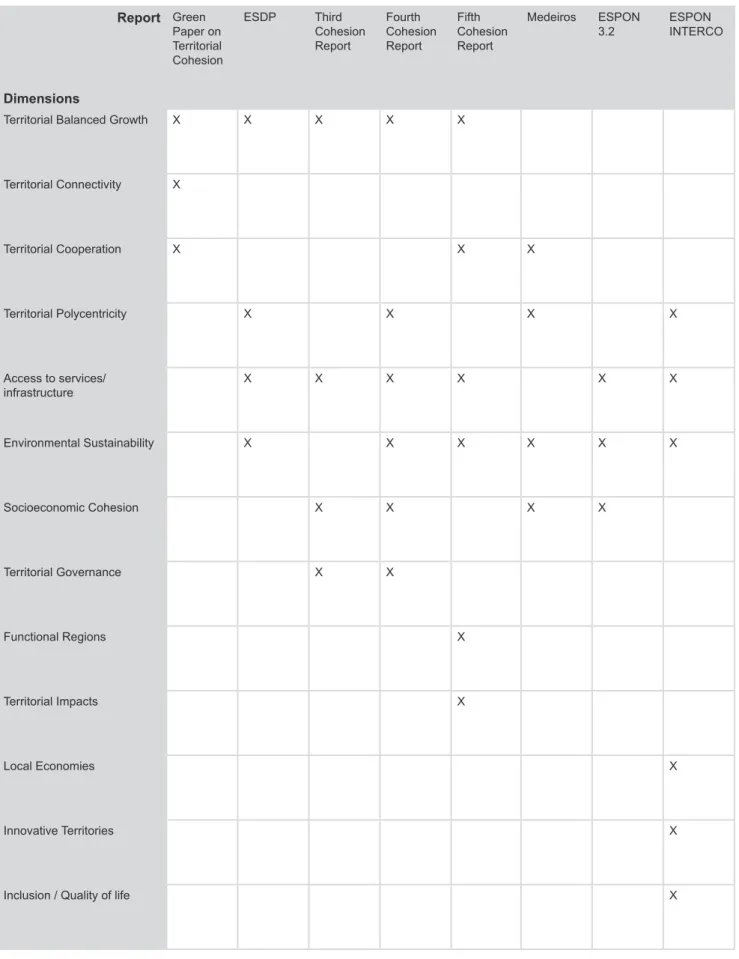
As noted in the previous section, the conceptual approach used in this paper considers the territorial cohesion concept divided into four main dimensions (Fig. 1). The identification of these dimensions is crucial, not only because it makes it easier to clarify the meaning and the defini-tion of this concept, but also because it makes it possible to associate the right components and indicators, in order to measure territorial co-hesion accordingly. Likewise, the Green Paper on Territorial Coco-hesion and each one of the EU Cohesion Reports suggest, in a direct or indirect way, some key-dimensions/components of territorial cohesion. As al-ready noted, this report clearly relates this notion to a more balanced and harmonious territorial development by counteracting the excessive concentration of people and activities. Furthermore, it calls for a coher-ent effort to improve territorial connectivity and territorial cooperation (EC, 2008: 6-9). Beyond these three ‘main intervention dimensions’ of territorial cohesion (Table 2), which are clearly in line with the rationale behind the ESDP, this report also outlines the need to address specific political actions to the EU regions with specific geographical features (mountain regions, island regions and sparsely populated areas) as con-crete examples of ‘excluded territories’.
More recently, the ESPON INTERCO (2011) report proposed the development of a list of key indicators to measure territorial cohesion,
from the local to a global level (Van Well, 2012: 1555). Each one of these indicators is associated with one of the six dimensions (or territorial objectives) of territorial cohesion identified in this study (Table 3). In a broad assessment, the economic (competitiveness, innovation), the social (access to services, inclusion), the environmental (ecologic val-ues), and the polycentric dimensions are all included in the ESPON IN-TERCO proposal. Also, the proposal includes indicators which measure the territorial cooperation process in the ‘Integrated Polycentric Terri-torial Development’ dimension. Most notably, this conceptual approach displays larger appreciation for the need to include the ‘polycentric ter-ritorial development’ element into the terter-ritorial cohesion debate (see Baudelle and Castagnède, 2002).
However, the ESPON INTERCO proposal does not use any indicator directly related to territorial governance. Moreover, the indicators in-cluded in the territorial objective related to ‘polycentric territorial devel-opment’ do not embrace the territorial connectivity component (includ-ed instead in the ‘fair access to services’ dimension), which is difficult to understand. This distinction permits us to better explore the link-ages between the four proposed dimensions of my conceptual vision for territorial cohesion and its related components and possible indicators (Fig 2). Here, the clear association between the social and the economic
Figure 1 The star of the
Territorial Cohesion. Source: Authors own elaboration
Report Dimensions Green Paper on Territorial Cohesion ESDP Third Cohesion Report Fourth Cohesion Report Fifth Cohesion Report Medeiros ESPON 3.2 ESPONINTERCO
Territorial Balanced Growth X X X X X
Territorial Connectivity X Territorial Cooperation X X X Territorial Polycentricity X X X X Access to services/ infrastructure X X X X X X Environmental Sustainability X X X X X X Socioeconomic Cohesion X X X X Territorial Governance X X Functional Regions X Territorial Impacts X Local Economies X Innovative Territories X
Inclusion / Quality of life X
Table 2. Territorial Cohesion Dimensions/Components from several studies
Source: (EC, 1999; EC, 2004a; EC, 2007a; EC, 2010a; Medeiros, 2005; ESPON 3.2, 2006;
fundamental dimensions of cohesion behoves us to subject such a con-troversial decision to critical analysis. In my defence, admittedly some socioeconomic indicators (e.g. income, unemployment/employment, basic infrastructure) touch both the social and economic dimensions. Despite that division, each of these two dimensions has a clear-cut rep-resentation in my proposed model, as seen in Figure 2. Subsequently, in order to instil some coherence to this proposal, in the following lines we will look, in a brief way, and more closely, to each one of the four dimen-sions and their main components, which should be viewed as the main pillars of the territorial cohesion concept.
Socioeconomic Cohesion dimension:
Territorial analysis often involves an overlapping of superimposed mo-saics of social and economic practices and achievements, amongst other elements. In the end, citizens aim to achieve socioeconomic prosperity, wherever they are located. By implication, the correction of persistent socioeconomic imbalances (the socioeconomic cohesion goal) in a giv-en territory should be viewed as one of the most fundamgiv-ental pillars to achieve territorial cohesion. Put differently, the territorial cohesion con-cept embraces the concon-cept of socioeconomic cohesion because the goal of cohesion in a given territory requires a convergence of both social and economic related indicators over time.
Indeed, it is commonly agreed that EU Cohesion policy is essentially aimed at addressing economic and social inequalities (Bache, 2008). This clear-cut association between socioeconomic cohesion elements and the goal of strengthening territorial cohesion is also recognized in the latter Territorial Agenda (Territorial Agenda, 2011), in particular in the priority of ‘ensuring global competitiveness of the regions based on strong local economies’. Another matter of concern is the problematic reconciliation between economic cohesion and territorial cohesion, as EU liberalization policies have had a growing impact on public service delivery in EU Member-States (Dühr et al., 2010: 260). Consequently, more actions are needed to counteract the negative side-effects of the Single European Market, by ensuring fair access to infrastructure and services (Böhme et al., 2008).
Concretely, social and economic dimensions need to be regarded as key aspects to ensuring territorial cohesion, namely by strengthening economic competitiveness and by ensuring social integration. The later dimension (social), however, is not always easy to capture. More spe-cifically, Molle (2007) proposes a series of indicators to measure social cohesion (quality of employment, integration of immigrants, quality of the social security system, social exclusion, and level of education), and economic cohesion (production structure, production environment - qualifications, infrastructures, innovation, transports, knowledge in-frastructure, dynamics of entrepreneurship, knowledge economy, and foreign direct investment).
At any given time, social cohesion and the economic cohesion are crucial processes (but not the only ones) in achieving the territorial co-hesion goal. While the former requires a spatial convergence in several
Table 3. ESPON INTERCO Territorial Objectives and IndicatorsSource: (ESPON INTERCO, 2011:17) – adapted by the author
social components such as education, health, culture, social inclusion, and security, the later can be achieved through the spatial convergence of components such as productivity, income, employment, innovation, and entrepreneurship. As some express, territorial cohesion extends be-yond the notions of social and economic cohesion (EC, 2007a), and it adds to these concepts ”by translating the fundamental EU goal of bal-anced and sustainable development into a territorial setting” (ESPON, 2006: 1). By and large, the latter remark expresses the need to move beyond the elementary understanding of ‘territory’ as a three vertices triangle, in which the corners are: society, economy and environment, which has been far and long spurred amid mainstream EU reports on territorial analysis, such as the ESDP. Here, a more holistic approach is required, which can include such elements as: territorial governance and territorial polycentricity, which we will analyse further on.
Territorial Objectives Indicators
Strong local economies ensuring global competitiveness
- Labour productivity - GDP per capita in PPP - Overall unemployment rate - Old age dependency ratio
Innovative territories - Pop. aged 25-64 with tertiary education - Intramural expenditures on R&D - Employment rate 20-64 Fair access to services,
market and jobs - Access to compulsory school- Access to hospitals - Accessibility of grocery services - Access to university
- Accessibility potential by rail - Accessibility potential by air Inclusion and quality of life - Disposable household income
- Life expectancy at birth
- Proportion of early school leavers - Gender imbalances
- Different female-male unemployment rate - Ageing index
Attractive regions of high ecological values and strong territorial capital
- Potential vulnerability to climate change - Air pollution: PM10
- Air pollution: Ozone concentrations - Soil sealing per capita
- Mortality, hazards and risks - Biodiversity
- Renewable energy potential Integrated polycentric
territorial development - Population potential within 50 k- Net migration rate - Cooperation intensity
- Cooperation degree
Environmental Sustainability dimension:
Originally, EU Cohesion Policy was primarily focused on achieving eco-nomic and social cohesion. As time went by, the environmental pres-ervation and sustainability goals began to gradually shape the EU pol-icy agenda. More recently, the Europe 2020 Strategy set out a vision to achieve a sustainable future by promoting a more resource-efficient, greener, and more competitive economy (EC, 2010b). In addition, the revised Territorial Agenda recognized that “territorial cohesion is a set of principles for harmonious, balanced, efficient, sustainable territorial development” (Territorial Agenda, 2011: 4).
The fundamental goal of promoting environmental sustainability goes hand in hand with both the EU cohesion and territorial develop-ment visions. In this regard, and right from the onset, the ESDP placed the goal of promoting ‘sustainable development, prudent management and protection of nature and cultural heritage’ as one of the three main pillars to achieve a more balanced and harmonious EU territory. Even
Figure 2. The analytic model
of the Territorial Cohesion concept
so, much of the initial discussion on the territorial cohesion notion “has focused on economic and social aspects rather than the environmen-tal dimension”. To change this picture, and “to ensure that sustainable development is pursued throughout Europe, the concept of territorial cohesion needs to incorporate the idea of sustainable development - in-cluding the environmental dimension” (EEA, 2010: 7).
Indeed, agreement on the importance of the notion of sustainable development as a crucial mechanism through which the cohesion goal can be achieved can be found across a wide political spectrum (Hjerp et al., 2011). More particularly, environmental sustainability is seen as a fundamental ingredient to promote integrated territorial development (Territorial Agenda, 2011: 4), regional economic growth, quality of life and regional attractiveness (EC, 2010a: 238).
For all these reasons, the previously discussed ESPON methods to as-sess Territorial Cohesion (TEQUILA, INTERCO) included the environ-mental component as a key element in analysing territorial cohesion. Furthermore, the Green Paper on Territorial Cohesion maintains that a more sustainable development is implicit in the notion of territorial co-hesion (EC, 2008: 5). Moreover, the Europe 2020 strategy invokes the need to promote a more resource efficient, greener and more competi-tive economy (sustainable growth) (EC, 2010b: 8). In addition, the up-dated Territorial Agenda defines as one of its main priorities the need to manage and connect ecological, landscape and cultural values of regions (Territorial Agenda, 2011: 8). In sum, the environmental dimension is gaining more and more relevance in the EU political agenda, and this dimension cannot be set apart from the central goal of achieving a more cohesive EU territory.
Territorial polycentricity dimension (morphology):
The reduction of territorial disparities is one of the main goals of Euro-pean Spatial Policy (ESPON atlas, 2006: 14). Accordingly, the territo-rial cohesion goal should not only be concerned with the convergence of economic, social and environmental indicators, but also with changes in the urban network, which should counteract monocentric tendencies. In this regard, the Third ESPON Synthesis Report is clear when it predicts that “in the long-term, the enlargement or dispersion of the Pentagon, and strong urban agglomerations in more remote locations, might con-tribute to increased territorial cohesion” (ESPON, 2006: 15). Equally, the ESDP emphasizes that “the concept of polycentric development has to be pursued to ensure regionally balanced development” and to avoid excessive economic and demographic concentration in the core area of the EU (EC, 1999: 20).
Moreover, according to the Leipzig Charter, one of the three main strategic principles for the EU development policy with a view to achieve territorial cohesion is related to the establishment of a balanced territo-rial organization, based on a polycentric urban structure, to make better use of available resources in European regions (LC, 2007: 1; Territorial Agenda, 2007: 3). As it stands, the active encouragement of polycen-tricity is an increasingly significant policy goal in a European Context
(Hall and Pain, 2006). Crucially, the ESDP stood out as an important milestone in this trend, as it underlined that the promotion of a more polycentric spatial arrangement of the EU territory is an essential pre-requisite for more balanced and sustainable development, and con-sequently a more cohesive territory (EC, 1999: 20-21). Of course, the analysis of polycentrism largely depends on the studied territorial scale. For this reason, the concept of polycentric development can be regarded as a ‘rather fuzzy’ one, since it means different things to different actors and on different scales, and also because “the concepts of territorial co-hesion and polycentric development still need to crystallize out on the European scale” (Meijers et al., 2007: 3).
Nonetheless, one can argue that there is a strong case for placing ur-ban polycentricity as one of the main pillars of the territorial cohesion concept, as it provides a means to counteract excessive urban concen-tration, urban diffusion, and urban integration inequalities (Baudelle and Castagnède, 2002). Again, various ESPON policy scenario reports underline this relation between the goal of territorial cohesion and the goal of promoting a more polycentric and balanced urban system at the national level (ESPON, 2004). This can be done, for instance, by pro-moting polycentric accessibility in the European regions, because “even in the information society, transport systems and their physical infra-structure remain vital if urban networks are to flourish and territorial cohesion is to be achieved” (ESPON ATLAS, 2006: 36). What is more, “depending on the territorial context, larger urban agglomerations, small and medium sized towns as well as rural areas can provide good development opportunities for enterprises and attractive living condi-tions for citizens. Indeed, regional strategies that focus on functional specialisation and supporting entrepreneurship and SME development can reinforce trends towards increasing territorial cohesion” (ESPON, 2006:20).
The use of this dimension, however, requires particular attention to the fact that polycentricity has two complementary aspects: one relates with the morphology (number of cities, connectivity, distribution and hierarchy) and the other with the relations between urban settlements (flows, networks, cooperation, functional complementarity) (ESPON, 2004: 3). As such, and since the next discussed territorial cohesion di-mension covers, in large measure, the latter one (relations), the indica-tors selected to measure this dimension are mostly related to the mor-phologic aspects of polycentricity (see Fig. 2).
In simple terms, it is expected that terrestrial cohesion cannot only be achieved through the convergence of social, economic, and ecological components, but also by the promotion of a more balanced urban net-work, which: (i) favours the position of small and medium sized towns within the urban system hierarchy/ranking; (ii) improves the urban net-work connectivity; and (iii) promotes a more compact growth of cities. The revised Territorial Agenda follows the same line of thought by stat-ing that “polycentric and balanced territorial development of the EU is key element of achieving territorial cohesion”, with the argument that a more polycentric urban pattern contributes to better territorial
develop-ment and fosters the territorial competitiveness of the territories out-side the larger metropolitan areas (Territorial Agenda, 2011: 7).
Likewise, the ESPON INTERCO (2011) defined the goal of promoting an ‘integrated polycentric territorial development’ as one crucial dimen-sion of territorial cohedimen-sion, although it focuses more on the relational el-ements of the polycentrism concept. Also, the TEQUILA model (ESPON 3.2, 2006), includes polycentrism within a myriad of elements which are important to achieving territorial cohesion, despite not including it as a main pillar of this notion. Notwithstanding, it would be difficult to con-ceive an understanding and measurement of the process of territorial cohesion in a given territory if one neglects the territorial arrangements, and more concretely the urban network organization and its territorial connectivity.
Territorial cooperation/governance dimension:
The last dimension is not directly related to any main objective of the ESDP. Yet, this document supports the idea that an integrated spatial development requires new ways of horizontal and vertical cooperation, with a view to reinforce urban and regional networks and partnerships. It is also important to notice that the notion of ‘Territorial Governance’ - which is regarded “as a process of the organization and co-ordination of actors to develop territorial capital in a non-destructive way in order to improve territorial cohesion at different levels” (ESPON 2.3.2, 2006: 13) - is very much related with the notion of ‘Territorial Cooperation’. For this reason, I decided to join both designations in this fourth and last pillar of the territorial cohesion concept.
Clearly, it is possible to uncover a complement in the ‘barrier break-ing effect/bridgbreak-ing territories’ aim of the territorial cooperation objec-tive and its crucial contribution to achieving the ESDP goals (ESPON, 2007: 3). The territorial governance objective can be a “conditio sine qua non to guarantee more balanced development across Europe and to achieve territorial cohesion” (ESPON 2006 2.3.2: 12), because it of-fers an alternative to a typical ‘hierarchical type of government’ (Schout and Jordan, 2007: 838). This can allow more active public intervention and collective action to take place at different territorial levels through a more integrated territorial development policy.
From this territorial governance perspective, which views ‘territory’ as a rich, complex system of public and private actors (Faludi, 2004: 1353), territorial cooperation brings an additional contribution to the territorial cohesion by enhancing a more integrated territorial approach through the development of multi-level spatial development strategies. Equally, Gualini (2008) also suggests that the territorial cohesion “can only gain effective meaning through its appropriation and enactment by local-regional governance actors”.
In the bigger picture, as Janin Rivolin (2005: 93) notes, “the pursuit of territorial cohesion requires coordination of national planning sys-tems and subsidiarity”, and that the EU “Constitution should at least encourage planners to discuss principles of good EU territorial govern-ance by addressing the performgovern-ance of statutory planning systems in
the common areas of territorial cohesion”. More recently, the same au-thor advocates that “the recent establishment of territorial cohesion as a shared competence between the EU and the Member States, as well as the simultaneous acceptance of the ‘good governance’ notion, may be seen as promising inputs towards new institutional developments for EU territorial governance” (Janin Rivolin, 2010: 19). In both arguments, there is a quite interesting connection between the need to establish a sound territorial governance system within the EU, and its importance to the pursuit of the territorial cohesion goal.
Here, the EU principle of subsidiarity arises as the key vehicle for im-proving the territorial governance process within the EU, by reinforcing relations between all levels of government, and consequently by helping to implement a sound multi-level governance process within the EU ter-ritory. Indeed, as Faludi (2013b: 1595) concludes, “subsidiarity is about relations between levels of government, each responsible for the terri-tory over which it has jurisdiction. In other words, subsidiarity relates to what in the EU context is being discussed as multilevel governance”. The same author also reminds us that territorial cohesion relates to the formulation of coherent policy packages, and that “this understanding brings territorial cohesion close to spatial planning” (Faludi, 2013b: 1596).
Furthermore, the territorial cooperation process has a key role to play in promoting territorial cohesion, namely through the enhance-ment of the territorial developenhance-ment potential associated with city net-working, based on functional complementarities (ESPON, 2006: 20). Territorial cohesion also has a role in bridging territories by reducing the barrier effect in all its dimensions (see Medeiros, 2010). Ultimately, the territorial cooperation process adds to a more cohesive territory if it is able to establish and increase the levels of horizontal (within the same administrative level) and vertical (involving different administra-tive levels) cooperation in a given territory.
5. How to measure territorial cohesion?
When it comes to measuring the territorial cohesion trends in a selected territory, two things have to be considered. Firstly, this concept is a rela-tive one, as it suggests a path towards the reduction of disparities within the analysed territory (either at the regional, national or continental lev-el). This requires a comparable analysis of two different periods of time. Secondly, these disparities should not only cover the economic and so-cial dimensions of cohesion, but should also cover components associ-ated with the environmental sustainability, the territorial governance/ cooperation, and the morphologic polycentricity, as explained in the previous section. Such circumstances make the process of measuring territorial cohesion a challenging task. Despite these constrains, and as The Green Paper on Territorial Cohesion recognizes, there is a need to use quantitative/qualitative indicators to improve understanding and to closely monitor the trends in territorial cohesion (EC, 2008: 12). Here, Table 4 provides some guidance to the selection of the most adequate indicators for each one of the territorial cohesion dimensions and
com-ponents, which should preferably be used in a balanced matter, i.e., not choosing too many statistical indicators in one or two dimensions and neglecting the remaining ones. Finally, attention must be brought to the fact that, in most cases, these indicators should be chosen according to the studied territorial scale, and should not be used in absolute values, in order to enable regional comparisons.
Not surprisingly, so far, such attempts to quantify or measure territo-rial cohesion trends are scarce, as they can be of exceptional difficulty. Not many attempts have been made to embark in a similar endeavour. However, the available literature (Medeiros, 2005; ESPON INTERCO, 2011) provided some guidance and established a rationale, on the aca-demic level, for the possibility of measuring territorial cohesion. Also, a French study proposed the use of an aggregated statistical index to measure territorial cohesion in Europe (Grasland and Hamez 2005). However, the indicators used in this particular study (GDP – as an indi-cator of economic competitiveness; unemployment rate – as an indica-tor of social cohesion, and (iii) percentage of young - as an indicaindica-tor of sustainable development), are somewhat negotiable and incomplete, as they only cover some elements of the socioeconomic cohesion dimen-sion.
As it stands, it is not the purpose of this paper to explore all the possi-ble methods which can be used to measure the territorial cohesion con-cept. Nevertheless, despite the fact that some might argue that several multivariate data technics (like the factor analysis) can be used to get an aggregated indicator of the territorial cohesion in a specific territory, one specific study showed that the methodology used in the United Na-tions Human Development Reports, to create the Human Development Index, is the most appropriate one to paint a clear picture of territorial imbalances at distinct territorial levels (DPP, 2009).
In this light, more recently, the use of this technique (use of an ‘ag-gregated territorial cohesion index) was applied to the Iberian and Scan-dinavian (Medeiros, 2014) peninsulas, both at the NUTS 2 and NUTS 3 levels, in order to detect the territorial cohesion trends over the last few decades (1990-2010). In the following, the results obtained for the Por-tuguese NUTS3 regions are presented as a practical example. Regarding the select indicators for this specific case-study, for all the analysed di-mensions, they appear in bold in Figure 2. Here, it is expected that the NUTS3 with the ’lower performance’ in all these indicators, at an initial period of time (1990), would have a better performance in the latter pe-riod of analysis (2010).
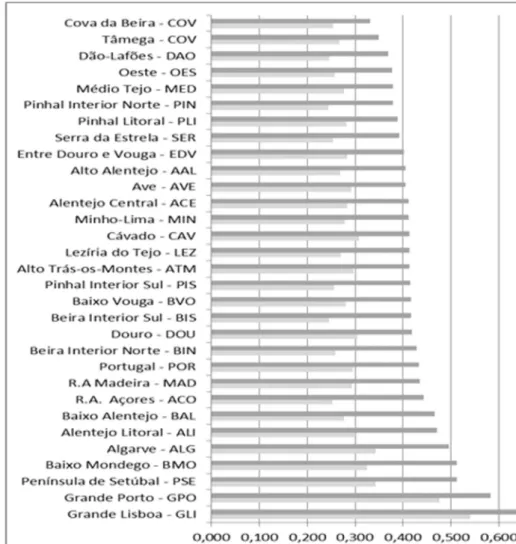
Such an exercise produced four aggregated indexes (socioeconomic cohesion index, environmental sustainability index, territorial govern-ance/cooperation index, and the polycentricity index). In the following, their arithmetic average revealed two Territorial Cohesion Indexes, one for 1990 and the other for 2010, for each NUTS3 region. The end result, that is, the final ‘Territorial Cohesion Index’ resulted from subtracting the 2010 values with the 1990 ones. Based on the use of the selected in-dicators, the results show a troubling picture of marked unbalanced ter-ritorial trends in the Portuguese territory over the last several decades,
Table 4. Territorial Cohesion Dimensions/Components suggested indicators
Indicator - Socioeconomic (distribution) Dimension Componen Source
EU Human Development Index GDP
Competitiveness Index
Net adjusted disposal income of private households Tertiary education
Access to the information society Research Centres Productivity Employment Rate Patents granted Libraries Physicians Poverty Rate Criminality Rate
Access to public transports Schools Transversal Income Income Income Knowledge Knowledge Entrepreneurship Productivity Employment Innovation Culture Health Exclusion/Inclusion Security Basic Infrastruc. Public Services (EC, 2010a) Several (EC, 2010a) (EC, 2010a) Several (EC, 2007a) Several Several Several (Medeiros, 2010) Several Several (Medeiros, 2010) (Medeiros, 2010) Several Several
Indicator – Cooperation/Governance Dimension Component Source
Cooperation Projects Intensity (same territorial level) Twin Cities
Inter-Municipal Cooperation
Cooperation Projects Intensity (different territorial level) Regional and Local Cooperation Associations E-government use/availability Administrative Decentralisation Participation in Elections H. Cooperation H. Cooperation H. Cooperation V. Cooperation V. Cooperation T. Governance T. Governance T. Governance (ESPON atlas, 2006) (Medeiros, 2005) (ESPON, 2004) (ESPON atlas, 2006) (Medeiros, 2005) Eurostat (EC, 2004b) (EC, 2004b) Cooperation Projects Intensity (same territorial level)
Twin Cities
Inter-Municipal Cooperation
Cooperation Projects Intensity (different territorial level) Regional and Local Cooperation Associations E-government use/availability Administrative Decentralisation Participation in Elections H. Cooperation H. Cooperation H. Cooperation V. Cooperation V. Cooperation T. Governance T. Governance T. Governance (ESPON atlas, 2006) (Medeiros, 2005) (ESPON, 2004) (ESPON atlas, 2006) (Medeiros, 2005) Eurostat (EC, 2004b) (EC, 2004b)
Indicator – Environmental/Sustainability Dimension Component Source Renewable Energy Production
Energy Efficiency Eco-Efficiency Waste Treatment Protected areas
Environmental Risk Reduction
Energy Energy Energy Envir. – Health Biodiversity Environment (Medeiros, 2005) (DPP, 2009) (DPP, 2009) (EC, 2010a) (Medeiros, 2010) (ESPON 3.2, 2006) Polycentric Index City Rankings Specialized Functions Population Density Compact City Form Road Density Transports Accessibilities Accessibility to Infrastructures Telecommunications Infrastructures Transversal Hierarchy Hierarchy Density Density Density Connectivity Connectivity Connectivity (ESPON, 2004) (ESPON, 2004) (Medeiros, 2005) (Medeiros, 2005) (ESPON 3.2, 2006) (Medeiros, 2005) (Medeiros, 2005) (ESPON 3.2, 2006) (Medeiros, 2005)
Indicator – Polycentricity (Morphology) Dimension Component Source
Polycentric Index City Rankings Specialized Functions Population Density Compact City Form Road Density Transports Accessibilities Accessibility to Infrastructures Telecommunications Infrastructures Transversal Hierarchy Hierarchy Density Density Density Connectivity Connectivity Connectivity (ESPON, 2004) (ESPON, 2004) (Medeiros, 2005) (Medeiros, 2005) (ESPON 3.2, 2006) (Medeiros, 2005) (Medeiros, 2005) (ESPON 3.2, 2006) (Medeiros, 2005) Note: The source indicates the report where this indicator is suggested/used. The indicators
despite large financial support from EU Cohesion Policy (more than 80 billion euros executed from 1990 to 2013 – Medeiros 2013a) (Fig. 3).
In all, the most dynamic and developed NUTS3 region (Grande Lis-boa - GLI) ended up having the best performance in the evolution of both indexes. By contrast, some less developed and peripheral NUTS3 regions, like Cova da Beira (COV) and Tâmega (TAM) had negligible positive changes over the same period of time. This is a clear sign that the EU and its national territorial development policies have not made Portuguese territory significantly more cohesive over the last few dec-ades. These outcomes are even clearer if one compares the results of the 1990 and the 2010 Territorial Cohesion Indexes closely (Fig.4), since one will find that many of the NUTS3 regions which registered lower Territorial Cohesion Indexes in 1990 were not the ones which experi-enced improved results in the 2010 Territorial Cohesion Index.
6. Conclusions
The 2013 Human Development Report entitled ‘The rise of the South’, in its foremost conclusions, argues that over the last decade, a large number of developing countries have had a notable convergence in the values associated with Human Development Indicators globally. How-ever, this report also recognizes that progress was uneven within and between regions (UN, 2013). At the European level, my own analysis of the territorial impacts of EU Cohesion Policy, which made use of a host of territorial development indicators (Medeiros. 2013b, 2014b, 2014c), concluded that Cohesion Policy was pivotal in promoting territorial de-velopment in the Iberian Peninsula, yet was insufficient to achieve ter-ritorial cohesion.
Indeed, it is evident that persistent territorial asymmetries between the European regions paved the way for the inclusion of territorial cohe-sion as a fundamental goal of the European Union in the 2009 Lisbon Treaty. However, the use of this term in EU political circles, which goes quite far back in time (at least in the last couple of decades), is still used in a fuzzy, ambiguous, and uncomprehensive way, both by political and technical EU institutions. This can be seen in the two latest (Fifth and Sixth) Cohesion Reports. Here, I do not necessarily agree with Begg (2010: 78) when he claims that more recently, considerable attention has been paid to this ‘territorial’ dimension of cohesion within the EU, at least in a qualitative, sound and fruitful manner.
On the contrary, in my perspective, the discussion launched in the Sec-ond Cohesion Report (EC, 2001), where the notion of territorial cohe-sion was connected with the goal of achieving a ‘more balanced territori-al development’, following the rationterritori-ale for the formulation of the ESDP (EC, 1999), was not properly explored both scientifically and politically around the release of the Green Paper on Territorial Cohesion, in 2008. Nevertheless, as seen throughout the paper, a vast array of existing liter-ature puts an emphasis on the need to include several territorial analysis elements to shed light on the territorial cohesion trends which go be-yond the common socioeconomic cohesion indicators (i.e environmen-tal sustainability, territorial governance, and spatial planning) in a given region, country or continents.
Over the past decades, multiple attempts have been made to pro-pose a clear and accepted definition of territorial cohesion, even without identifying the concept’s main dimensions. In this regard, Faludi (2009: 24) reminds us that defining territorial cohesion should not be a prior-ity because, in the end, these definitions depend on who gives them, when, and with which purpose. Conversely, one can argue that the lack of a proper definition will only contribute to the persistent fuzziness as-sociated with the concept of territorial cohesion, gradually reducing its political and scientific importance.
In the end, a globally accepted definition of territorial cohesion is unlikely to exist in the near future. Despite this pessimistic note, the
Figure 3. Territorial Cohesion
Index evolution in Portu-gal - NUTS III (1990-2010). Source: Data (several). Author Cartography
role of academia is to continue to provide concrete discussions on the operational meaning of territorial cohesion. More concretely, scholars can articulate the concept’s main dimensions and components, which can then be linked to related statistical indicators, making it possible to measure territorial cohesion trends in a given territory. This was es-sentially the main goal of this paper, which began by identifying and dis-cussing the relevance of the main dimensions of the territorial cohesion concept, since, ultimately, its definition should be built around these di-mensions. Consequently, it suggests a definition of territorial cohesion as ‘the process of promoting a more cohesive and balanced territory, by: (i) supporting the reduction of socioeconomic territorial imbalances; (ii) promoting environmental sustainability; (iii) reinforcing and improving the territorial cooperation/governance processes; and (iv) reinforcing and establishing a more polycentric urban system’.
Following from the above definition, the next step would be to struc-ture the previous conceptual vision into an operational package (con-struction of a Territorial Cohesion Index), which can be both useful and comprehensible for policy-makers and regional/local stakeholders. These actors could then identify, for instance, the major territorial im-pacts of the EU Cohesion Policy funds in achieving the goal of territorial cohesion at the regional, national and European levels. In this regard,
Figure 4. Territorial
Cohe-sion Index comparison in the Portuguese NUTS III (1990-2010)
this paper suggests several statistical indicators for each dimension of territorial cohesion, despite the fact that relevant and comparable data at the EU regional level is scarce in many specific domains (especially regarding the 20th Century). Specifically, my proposed method for as-sessing territorial cohesion is conceptually different from the existing ones, because: (i) it does not rest exclusively in the use of socioeconomic indicators (like the Grasland model); (ii) it highlights the importance of the urban polycentrism as a key dimension of the territorial cohesion concept (unlike the TEQUILA model); and (iii) it also brings some terri-torial governance elements to this debate (unlike the ESPON INTERCO proposal).
Moreover, it deserves notice that the ‘territorial cohesion’ notion is still very much viewed as a political concept, subject to multiple in-terpretations. Hence, an attempt to produce a ‘conceptual analysis’ re-lated to this notion is unlikely to be consensual. However, the growing need for policies with a territorial focus, following the EU Territorial Agenda’s proposals, is prompting the EU Member-States to seek more insights into implementing territorial development strategies and poli-cies. Amongst those proposals are many of the key ingredients (like the promotion of a polycentric territorial development) which can lead to the creation of a more cohesive territory (see Territorial Agenda, 2011). In turn, the operationalization of these proposals requires the use of concrete evaluation techniques and models which measure the impacts of their implementation and their contribution to achieving a more co-hesive territory. Put differently, I advocate that the scope of territorial cohesion analysis should not be restrained by historical narratives, but should be focused in more practical issues.
Finally, I would like to stress that I look forward to seeing a global fo-cus and disfo-cussion on the need for territorial cohesion, which is still very much regarded as a European construction. This is even more relevant in the context of increasing economic globalization, which often have profoundly negative territorial development effects in lagging regions. In this regard, this article intends to make an additional contribution to this worldwide political and academic debate. As such, I hope that the territorial cohesion objective is gradually brought to the centre of the political agenda throughout the world, in a practical manner, with a view towards improving the impacts of programmes and policies for re-ducing territorial exclusion and consequently promoting more balanced and harmonious territories.
Acknowledgements
The author would like to thank the journal editor and the anonymous reviewers of the manuscript for their helpful comments and suggestions, and Graça Rønning for the English review.
References
Adams, N., Cotella. G., Nunes, R. (2014) The Engagement of Territorial Knowledge Communities with European Spatial Planning and the Territorial Cohesion, Euro-pean Planning Studies, 22 (4):712-734.
Amin, A., Charles, D. R., Howells, J. (1992) Corporate Restructuring and Cohesion in the New Europe, Regional Studies, 26 (4): 319-331.
Amin, A., Tomaney, J. (eds.) (1995a) Behind the Myth of the European Union, Rout-ledge, London.
Amin A, Tomaney J (1995b) The Challenge of Cohesion, in: Behind the Myth of the Eu-ropean Union, London: Routledge: 10–47.
Bache, I. (ed.) (2008) Europeanization and multilevel governance. Cohesion Policy in the European Union and Britain, Rowman & Littlefield Publishers, INC. Plymouth. Bachtler. J., Michie, R. (1994) Strengthening Economic and Social Cohesion? The
Revi-sion of the Structural Funds, Regional Studies, 28 (8): 789-796.
Bachtler, J., Wren, C. (2006) Evaluation of European Union Cohesion Policy: Research Questions and Policy Challenges, Regional Studies, 40 (2): 143-153.
Badinger, H., Müler, W., Tondl, G. (2004) Regional Convergence in the European Un-ion, 1985–1999: A Spatial Dynamic Panel Analysis, Regional Studies, 38 (3): 241-253. Baudelle, G., Castagnède, B. (2002) Le Polycentrisme en Europe, Bibliothèque des
ter-ritoires, éditions de l’aube, Datar, Paris.
Beeg, I. (2010) Cohesion or Confusion: A Policy Searching for Objectives, Journal of European Integration, 32(1): 77-96.
Böhme, K., Eser, T., Gaskell, F. (2008) The Territorial Cohesion Principles. Position paper to the EU Green Paper on Territorial Cohesion. Position Paper from the ARL Nº78, Academic for Spatial and Planning, Hanover.
Böhme, K., Doucet, P., Komorniki, T., Zaucha, J., Swiatek, D. (eds.) (2011) How to strengthen the territorial dimension of ‘Europe 2020’ and the EU Cohesion policy. Ministry of Regional Development, Warsaw.
Camagni, R. (2008) Regional Competitiveness: towards a concept of territorial capi-tal, in: Cappello, R., Camagni R., Chizzolini, B., Fratesi, U. (eds), Modeling Scenarios for the Enlarged Europe, Springer, Berlin: 33-48.
Coleman, M. (2009) Sovereignty, International Encyclopedia of Human Geography, El-savier, Conventry, Vol. 10: 255-261.
COR (2003) Territorial Cohesion in Europe. Committee of the Regions. Brussels. Crescenzi, R. (2009) Undermining the Principle of Concentration? European Union
Re-gional Policy and the Socio-economic Disadvantage of European Regions, ReRe-gional Studies, 43 (1): 111-133.
Davoudi, S. (2004) Territorial cohesion: An agenda that is gaining momentum, Town and Country Planning, 73(7/8): 224-227.
Davoudi, S. (2005) Understanding territorial cohesion. Planning Practice & Research, 20(4): 433-441.
Davoudi, S., Evans, N., Governa, F., Santangelo, M. (2008) Territorial Governance in the Making. Approaches, Methodologies, Practices, Boletín de la A.G.E, 46: 32-52. Danson, M. (1999) Debates and Reviews, Regional Studies, 33 (3): 259-268.
DPP (2009) Índice Sintético de Desenvolvimento Regional. (eds) Instituto Nacional de Estatística e Departamento de Prospectiva e Planeamento e Relações Internacionais, Lisbon.
Delaney, D. (2009) Territory and Territoriality, International Encyclopedia of Human Geography, Elsavier, Conventry, Vol. 11, 196-208.
Dühr, S., Colomb, C., Nadin, V. (eds.) (2010) European Spatial Planning and Territo-rial Cooperation, Routledge, London.
EEA (2010) The territorial dimension of environmental sustainability. Potential ter-ritorial indicators to support the environmental dimension of terter-ritorial cohesion. European Environment Agency. EEA Technical Report nº 92010, Copenhagen. EC (1987) Single European Act, Treaties establishing European Communities, Office for
Official Publications of the European Communities, Luxembourg.
EC (1996) First report on economic and social cohesion, European Commission, Lux-embourg.
EC (1999) ESDP. European Spatial Development Perspective. Towards Balanced and Sustainable Development of the Territory of the European Union, European Com-munities, Luxembourg.