UNIVERSIDADE DE LISBOA
FACULDADE DE CIÊNCIAS
DEPARTAMENTO DE BIOLOGIA VEGETAL
The role of fitness frequency-dependent in the evolution of
antibiotic resistance
Diana Ribeiro Alves
Mestrado em Microbiologia Aplicada
2010
FACULDADE DE CIÊNCIAS
DEPARTAMENTO DE BIOLOGIA VEGETAL
The role of fitness frequency-dependent in the evolution of
antibiotic resistance
Diana Ribeiro Alves
Dissertação orientada por
Prof. Doutor Francisco Dionísio Doutora Ana Rita Ponce
Mestrado em Microbiologia Aplicada
2010
i
A
CKNOWLEDGMENTSI want to express my sincere gratitude to all the people that contributed to the success of this work, especially to:
- Francisco Dionísio, for giving me the opportunity to develop my Master´s Thesis in his research group, for being a great supervisor and for being always extremely supportive.
- Ana Rita Ponce, for her constant motivation, suggestions and advice that improved this project.
- Professor Ana Reis, for her kind support and encouragement and especially for her outstanding help in finding a research group for the Leonardo da Vinci fellowship.
- Silvia Mendonça and Rui Silva, for being always ready to help and support me and, most importantly, for being excellent friends. A special thanks to Silvia for her critical proofreading of this thesis.
- Evolutionary Ecology of Microorganisms group members, for their share of knowledge, support and contribution to a good working environment.
ii
Antibiotic resistance is, usually, associated with fitness costs for the bacteria. Therefore, it is expected that if one competes a resistant bacterial strain with an otherwise isogenic susceptible strain in an antibiotic free environment, resistant bacteria will be eliminated. Here, I report the occurrence of stabilizing frequency-dependent selection in 43% of a set of antibiotic resistant strains. Stabilizing frequency-dependent selection may promote the maintenance of a stable polymorphism between resistant and susceptible bacteria. If resistant bacteria are rare, their fitness is higher than that of the susceptible strain. If resistant bacteria are the majority in the competition assay, their fitness is smaller than that of the susceptible strain. This enables a stable coexistence between sensitive and resistant strains. Genetic and ecological causes of frequency-dependent selection were investigated. The demonstration of frequency-dependent selection involving drug resistance strains implies that antibiotic resistant bacteria will not be easily eliminated or reversed upon reduction of antibiotic use. This reveals a worrying scenario for the eradication of antibiotic resistance.
Keywords: Antibiotic Resistance, Fitness Cost of Resistance, Bacteria, Competition, Frequency-Dependent Selection, Coexistence.
iii
Durante muito tempo foi admitido que as populações bacterianas seriam mantidas num estado monomórfico devido a dois fenómenos: competição exclusiva e selecção periódica. O principio da exclusão competitiva refere que duas ou mais espécies que competem pelos mesmos recursos não podem coexistir, uma vez que a espécie mais eficiente irá eliminar gradualmente todas as outras (Hardin, 1960). O processo de selecção periódica, em que a evolução de populações bacterianas num recurso limitante consiste numa série temporal de substituições por genótipos cada vez com maior sucesso reprodutivo ou fitness, é responsável por eliminar toda a variabilidade genética (Atwood, et al., 1951, Levin, 1981). A existência de polimorfismos seria, então, apenas uma etapa transitória no processo evolutivo.
Contudo, o processo de competição entre espécies é muito mais complexo. O ambiente dos organismos, biótico e físico, é heterogéneo espacial e temporalmente. Portanto, as frequências dos diferentes genótipos numa população estão continuamente a sofrer alterações. Ao mesmo tempo, existem mecanismos responsáveis pela manutenção de polimorfismos nas populações bacterianas. A selecção dependente da frequência é um desses mecanismos.
A selecção dependente da frequência já foi observada em organismos como Drosophila (Ayala, 1971), Escherichia coli (Levin, 1972, Helling, et al., 1987) e em vírus (Elena, et al., 1997, Yuste, et al., 2002). Num sistema biológico, em que a selecção dependente da frequência actua, o sucesso reprodutivo de um organismo está dependente da sua frequência. Este mecanismo pode resultar em dois cenários diferentes. Assim sendo, a selecção pode favorecer o genótipo mais comum, definindo-se como selecção dependente da frequência disruptiva. Por outro lado, se a selecção favorecer o genótipo mais raro, então estamos perante selecção dependente da frequência estabilizante.
A selecção dependente da frequência disruptiva leva à eliminação de polimorfismos na população. Um genótipo, mesmo possuindo uma qualquer vantagem, apenas será seleccionado face a outro genótipo se a sua frequência se encontrar acima de um certo valor (Levin, 1988). Caso contrário, o genótipo é eliminado.
A selecção dependente da frequência estabilizante, sobre a qual nos iremos focar neste trabalho, resulta num ponto de equilíbrio que permite a coexistência estável entre os genótipos. Se a frequência de um dos genótipos está abaixo do equilíbrio estável, o seu
fitness relativamente ao outro genótipo será maior, permitindo-lhe aumentar a sua
frequência. Se a sua frequência estiver acima do ponto de equilíbrio, o seu fitness será menor do que o outro genótipo em competição, e consequentemente irá ocorrer uma
iv
redução do seu número. No ponto de equilíbrio o fitness de ambos os genótipos é idêntico, levando a um polimorfismo estável. Vários estudos demonstram a coexistência de genótipos diferentes mesmo em ambientes simples. Algumas sugestões foram sendo dadas na tentativa de explicar os mecanismos ecológicos que permitem a coexistência:
(i) Trade-off demográfico, em que cada genótipo é especializado num diferente nicho ecológico (Levin, 1972, Helling, et al., 1987, Turner, et al., 1996, Rozen & Lenski, 2000). Por exemplo, um dos genótipos possui um maior fitness quando a glucose no meio é abundante, enquanto o outro genótipo possui um fitness mais elevado quando a glucose é escassa (Turner, et al., 1996);
(ii) Cross-feeding, em que o genótipo com maior sucesso excreta um metabolito resultante do seu metabolismo ou morte celular para o meio. O segundo genótipo é eficiente a utilizar este metabolito (Turner, et al., 1996, Rozen & Lenski, 2000);
(iii) Interacção antagonista, em que durante a fase estacionária um dos genótipos devido a uma mutação ou a um efeito pleiotrópico de uma mutação é capaz de inibir o genótipo mais frequente, interferindo com o seu crescimento máximo (Lemonnier, et al., 2008).
Os mecanismos ecológicos acima descritos não se excluem entre si. Aliás, a ocorrência de um trade-off demográfico está geralmente associado a uma interacção por cross-feeding (Rosenzweig, et al., 1994, Turner, et al., 1996).
No presente estudo demonstro a ocorrência de selecção dependente da frequência em bactérias resistentes a antibióticos.
A resistência aos antibióticos pode resultar de mutações genéticas e/ou aquisição de determinantes de resistência por transferência horizontal de genes (revisto emMartinez, et
al., 2009). As mutações que conferem resistência podem alterar processos fisiológicos da
célula (Andersson & Levin, 1999). De forma similar, quando a resistência está localizada em elementos genéticos móveis (plasmídeos, integrões ou transposões), a replicação e expressão dos seus genes é responsabilidade da bactéria hospedeira. Tal irá interferir no crescimento normal da bactéria (Bjorkman & Andersson, 2000). Assim, um fenótipo resistente acarreta na maioria das vezes, custos para a bactéria, fazendo com que sofra uma diminuição do seu fitness (Andersson, 2006). Neste trabalho, utilizei bactérias resistentes a três antibióticos diferentes: ácido nalidíxico, rifampicina e estreptomicina. Para estes antibióticos a resistência é causada por mutações cromossomais em genes envolvidos na replicação (Marcusson, et al., 2009) , transcrição (Reynolds, 2000) e tradução (Kurland,
et al., 1996), respectivamente.
Estudos anteriores têm demonstrado que, face às alterações fisiológicas inerentes à resistência, bactérias resistentes em competição com bactérias sensíveis e na ausência de antibióticos, possuem uma desvantagem competitiva (Gillespie, 2001, Trindade, et al.,
v
eliminadas. Contudo, o cenário apresenta-se muito mais complexo (Johnsen, et al., 2009). Existem vários processos que permitem manter bactérias resistentes na população ao reduzirem ou eliminarem o custo provocado pelas mesmas: mutações compensatórias (Bjorkman & Andersson, 2000), epistasia entre resistências a antibióticos (Trindade, et al., 2009), mutações sem custo (Ramadhan & Hegedus, 2005, Criswell, et al., 2006) e co-selecção de resistências a antibióticos (Enne, et al., 2004, Andersson & Hughes, 2010). A ocorrência de selecção dependente da frequência aqui apresentada poderá ser um outro fenómeno.
Os resultados aqui apresentados mostram que 13 dos 30 clones espontâneos (43%) resistentes a antibióticos testados apresentam um fenótipo de dependência na frequência quando em competição com um clone sensível. É de notar que, para as mesmas mutações pontuais nos genes envolvidos na resistência ao antibiótico respectivo, os clones resistentes apresentavam um comportamento diferente durante a competição. Isto sugere que o fenótipo para a dependência na frequência seria causado, não pelas mutações para a resistência, mas por outra qualquer mutação a ocorrer no cromossoma. Contudo, tal hipótese não ficou demonstrada.
Relativamente, ao mecanismo ecológico responsável pela dependência na frequência sugeri a ocorrência de um cross-feeding ou uma interacção antagonista. Relativamente, ao
cross-feeding os resultados não foram esclarecedores. No entanto, a hipótese de uma
interacção antagonista, apesar de ainda não testada, aponta-se esclarecedora: os clones resistentes seriam portadores de uma mutação capaz de inibir os clones sensíveis através de um contacto célula a célula.
Os resultados mostram uma incidência elevada de selecção dependente da frequência (43%) nos clones resistentes aos antibióticos. Tal incidência pode ser reflexo do método utilizado para selecção dos clones, o qual poderá estar a favorecer a selecção de clones com estas características. Apesar desta hipótese não estar ainda esclarecida, e portanto, desconhecermos se a selecção dependente da frequência tem uma baixa ou elevada incidência nas populações bacterianas resistentes, este estudo vem reforçar que a simples redução ou mesmo eliminação do uso de antibióticos não é uma medida eficaz no combate às resistências aos antibióticos. A ocorrência de selecção dependente da frequência em bactérias resistentes irá possibilitar a sua manutenção nas populações bacterianas, mesmo em baixas frequências. Assim que se reintroduzir novamente o antibiótico a resistência irá emergir em larga escala (De Gelder, et al., 2004).
A selecção dependente da frequência deve ser um mecanismo considerado no estudo das dinâmicas das populações bacterianas e, em particular, nas populações resistentes aos
vi
antibióticos. Deste modo, torna-se necessário o desenvolvimento de novas terapêuticas alternativas aos antibióticos no combate às infecções bacterianas. Tal necessidade está na base do recente desenvolvimento de terapêuticas profiláticas, tais como a interferência bacteriana, vacinas bacterianas e a terapia fágica.
Palavras-Chave: Resistência a Antibióticos, Custo de Fitness da Resistência, Bactéria, Competição, Selecção Dependente da Frequência, Coexistência.
vii
ACKNOWLEDGMENTS ... i
ABSTRACT ... ii
RESUMO ... iii
I–INTRODUCTION ... 1
1 COMPETITIVE EXCLUSION PRINCIPLE ... 1
2 FREQUENCY-DEPENDENT SELECTION ... 1
2.1 DISRUPTING FREQUENCY-DEPENDENT SELECTION ... 2
2.2 STABILIZING FREQUENCY-DEPENDENT SELECTION ... 3
3 ANTIBIOTIC RESISTANCE... 5
3.1 MECHANISMS RESPONSIBLE FOR ANTIBIOTIC RESISTANCE ... 6
3.2 BIOLOGICAL COSTS OF RESISTANCE ... 6
3.3 COMPENSATORY EVOLUTION ... 7
3.4 EPISTASIC INTERACTIONS BETWEEN ANTIBIOTIC RESISTANCES ... 8
3.5 COST-FREE MUTATIONS ... 8
3.6 CO-SELECTION OF ANTIBIOTIC RESISTANCE ... 9
4 OBJECTIVES ... 9
II–MATERIALS AND METHODS ... 10
1. BACTERIAL STRAINS AND GROWTH CONDITIONS ... 10
2. SELECTION OF SPONTANEOUS ANTIBIOTIC RESISTANT CLONES ... 10
3. COMPETITION ASSAYS ... 12
4. SCREENING FOR MUTATOR PHENOTYPES ... 13
5. BACTERIAL GROWTH IN SUPERNATANT PREPARATIONS ... 13
6. DEVELOPMENT OF AN EXPERIMENTAL PROTOCOL TO UNDERSTAND THE ORIGIN OF CLONES WITH HIGH FITNESS WHEN RARE ... 14
7. ESTIMATION OF FITNESS ... 14
8. STATISTICAL AND MATHEMATICAL ANALYSIS ... 15
III–RESULTS ... 16
1 DEMONSTRATION OF FREQUENCY-DEPENDENCY IN SPONTANEOUS ANTIBIOTIC RESISTANT CLONES ... 16
1.1 COMPETITIONS 1:105 OF RESISTANT TO WILD-TYPE CELLS ... 16
1.2 COMPETITIONS 1:1 OF RESISTANT AND WILD-TYPE CELLS ... 21
viii
1.4 COMPETITIONS 1:102 OF ΔARA TO RESISTANT CELLS ... 22
1.5 FREQUENCY-DEPENDENT FITNESS OF NAL48 CLONE ... 24
1.6 EVIDENCE FOR ANOTHER MUTATION OCCURRING IN THE CHROMOSOME... 25
2 SCREENING FOR MUTATORS ... 26
3 TESTING IF ANOTHER MUTATION IS OCCURRING ELSEWHERE IN THE CHROMOSOME ... 27
4 TESTING THE OCCURRENCE OF CROSS-FEEDING INTERACTION ... 28
5 EVALUATION OF RESISTANT CLONES SELECTION METHOD ... 28
IV–DISCUSSION ... 32
V–CONCLUSION ... 37
1
I
–
I
NTRODUCTION1
C
OMPETITIVE EXCLUSION PRINCIPLECan two or more related species coexist when competing for the same limited resources? The question has been debated for a long time. Gause‟s principle, or principle of competitive exclusion, states that species using the same resource cannot coexist. The reason is that the more efficient species will gradually increase over the competition and displace the less efficient (Hardin, 1960). Given that bacteria reproduce asexually, it is generally assumed that their evolution in a limiting resource will consist of a temporal series of replacements by ever more fit genotypes, via the process of periodic selection, eliminating all genetic variability (Atwood, et al., 1951, Levin, 1981). Therefore, the existence of polymorphisms would be a process, only transitive, for evolution. So, natural populations should be maintained monomorphic via these two phenomena: periodic selection and competitive exclusion.
However, Gause‟s principle ignores the complexities of the competition process. In fact, the environment of organisms, physical and biotic, is heterogeneous both spatially and temporally. So, the frequencies of genotypes in a population are continually changing. At the same time, mechanisms responsible for the maintenance of polymorphisms are acting in bacterial populations. Frequency-dependent selection is one of those mechanisms.
2
F
REQUENCY-
DEPENDENT SELECTIONFrequency-dependent selection phenomena have been demonstrated to occur in very different organisms, such as Drosophila (Wright & Dobzhansky, 1946, Ayala, 1971),
Escherichia coli (Chao, et al., 1977, Helling, et al., 1987), vesicular stomatitis (VSV) and
human immunodeficiency type 1 (HIV-1) viruses (Elena, et al., 1997, Yuste, et al., 2002). It has been hypothesized that frequency-dependent selection occurs in natural populations (Ayala & Campbell, 1974, Hori, 1993). However, model organisms with short generation time, large population size and the possibility to control environmental factors, allow studying more precisely the phenomenon of frequency-dependent selection.
In a biological system where there is frequency-dependent selection, the fitness of a given organism depends on its frequency. If selection favors the most common genotype it is called disrupting frequency-dependent selection. If selection favors the rare genotype over a
2
frequent one it is called stabilizing frequency-dependent selection. The latter will result in the maintenance of genetic variability in a population [containing at least one stable equilibrium]. 2.1 DISRUPTING FREQUENCY-DEPENDENT SELECTION
Disrupting frequency-dependent selection implies that there is no internal stable equilibrium in the population and only the most common genotype will be selected.
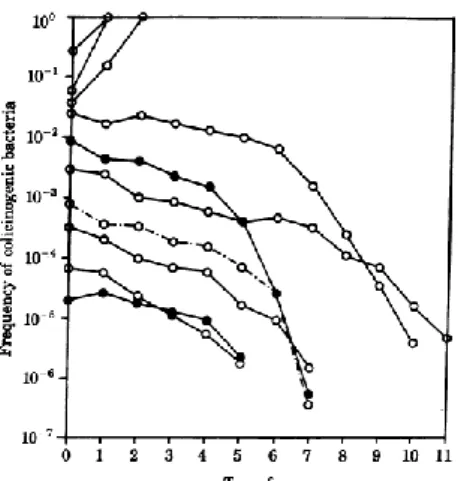
A good example for disrupting frequency-dependent selection in bacterial populations is the competition between bacteria producing allelopathic molecules and a sensitive one. Allelopathic molecules are capable of killing or inhibiting the growth of competing bacteria, including antibiotics, bacteriocins (Reeves, 1972) and temperate bacteriophages (Levin & Lenski, 1983, Stewart & Levin, 1984). Competitions between bacteriocin sensitive and bacteriocin-producing E. coli in liquid media have demonstrated that the latter only invade the population if it is above frequency on the order of 10-2 (Chao & Levin, 1981). In other words, only when bacteriocin-producing bacteria are in a high frequency, they will able to invade [where their quantity is sufficient to produce enough bacteriocin to overcome the growth rate disadvantage of its production]. If not, bacteriocin-producing bacteria will be gradually eliminated due to its growth disadvantage (Figure 1).
Figure 1: Changes in frequency of colicinogenic bacteria competing with sensitive bacteria in liquid
medium cultures (adapted from Chao & Levin, 1981).
Another example for disrupting frequency-dependent selection involves bacterial toxin-antitoxin (TA) gene systems. TA systems code for a stable toxin that kills or inhibits their own cell, and an unstable antitoxin which counteracts the toxin‟s effect. The toxin is always a protein. The antitoxin can be: (i) an antisense small RNA complementary to the toxin mRNA (type I) inhibiting its translation or (ii) a protein capable of neutralizing the toxin through formation of a proteic complex (type II). These systems are widely distributed in Bacteria and
3
2005, Pandey & Gerdes, 2005). The presence of TA systems in plasmids, especially those with low-copy number, contributes to plasmid maintenance in growing bacterial populations. Plasmid-free daughter cells are selectively eliminated by post-segregational killing. This elimination occurs after cell division. The antitoxin is unstable and easily degraded by cytoplasmatic proteases. Without its replacement, because the plasmid is lost, the toxin may act (Jaffe, et al., 1985). Conjugative plasmids with TA loci (TA+) have the ability to invade a bacterial population of the same incompatibility group carrying plasmids without TA loci (TA-). This means that, within-cell plasmid competition between TA+ e TA- will provide an advantage to TA+ plasmids (Figure 2) (Cooper & Heinemann, 2000, Cooper & Heinemann, 2005). In liquid cultures where all resources are distributed to all surviving bacteria, TA plasmids would only have an advantage when their initial frequency is high enough to overcome the costs for the host of carrying it. If not, the TA plasmids are unable to invade and tend to extinction (Cooper & Heinemann, 2005).
Figure 2: Advantage conferred to bacteria carrying a TA plasmid. (A) Vertical transmission.
Prevalence of TA plasmids is increased by post-segregational killing of plasmid-free daughter bacteria. (B) Horizontal transmission. Plasmid-plasmid competition gives an advantage to TA+ plasmid that outcompete TA- plasmid. Bacteria that lose TA+ plasmid are killed. On the contrary, bacteria that lose TA- plasmid suffer no damage. Bacterial dead (grey), TA+ plasmid (purple) and TA- plasmid (black) (adapted from Van Melderen & Saavedra De Bast, 2009).
2.2 STABILIZING FREQUENCY-DEPENDENT SELECTION
Stabilizing frequency-dependent selection occurs when the fitness of a genotype is higher when that genotype is rare relative to other genotype. This selection results in a stable coexistence. The system is stable because the competitive fitness of one genotype relative to the other is smaller when its frequency is above the equilibrium point and greater when its frequency is below the equilibrium. At the equilibrium frequency, the competitive fitness of the two genotypes is identical.
4
In natural bacterial populations, one can find some examples of stabilizing frequency dependence selection. One example refers to bacteria capable of neutralizing compounds that kill or inhibit cell growth and cell division (like antibiotics or heavy metals). These bacteria reduce the concentration of those toxic compounds in the environment. Consequently, susceptible bacteria that have disadvantage due to the presence of the toxin are only capable of invading and maintaining in a population where resistant cells are present. When this happens, both bacteria will eventually reach a stable equilibrium. In that equilibrium, the disadvantage of resistant bacteria owing to costs associated to neutralization of the toxin is overcome by its resistance; and the advantage of susceptible bacteria is counterbalanced by dead due to toxin‟s action. In a theoretical study, Lenski and Hatting showed that E. coli strains carrying a chloramphenicol resistant (Cmr) plasmid and plasmid-free strains: (i) in an environment without chloramphenicol, Cmr plasmid reduced the fitness of the host bacterium relative to plasmid-free bacteria; (ii) in an environment with chloramphenicol, plasmid-free cells were unable to maintain if resistant ones were not present. However, if plasmid-free bacteria were introduced, at low frequencies, into resistant bacteria cultures with chloramphenicol, plasmid-free bacteria were able to invade and maintain a stable equilibrium with the resistant population (Lenski & Hattingh, 1986). In another theoretical model, presence of beta-lactamase producing bacteria in an environment with the antibiotic (ampicillin) allowed sensitive bacteria to survive at low frequencies. Sensitive bacteria were regarded as cheaters, because they do not harbor a cost from beta-lactamase production, taking advantage from the producing-bacteria (Domingues, 2010).
Besides the biological system above there are several experimental works, mostly done with E. coli showing that different genotypes are able to maintain ecologically relevant genetic diversity even in simple environments (Levin, 1972, Helling, et al., 1987, Turner, et
al., 1996, Rozen & Lenski, 2000).
In attempting to explain the observation of coexistence in simple environments, some hypotheses have been suggested:
(i) A demographic trade-off. Each genotype is specialized in a different ecological niche (Levin, 1972, Rosenzweig, et al., 1994, Turner, et al., 1996, Rozen & Lenski, 2000). For example, one genotype is competitively superior when glucose is abundant whereas the other is the better competitor for sparse glucose (Turner, et al., 1996). Therefore each genotype will have a growth benefit at a different stage of the cycle and both can stably coexist. So, even though consuming the same resources the two genotypes are not in a direct competition
(ii) A cross-feeding interaction. One genotype is competitively superior for the limiting resource that is exogenously supplied (for example, glucose) and excretes some metabolite into the environment for which the other genotype is efficient to use. The metabolite could be
5
a result of cell metabolism or a by-product from dead cells. If the amount of the metabolite is proportional to the density of the genotype that is producing it, the rare genotype will benefit. Likewise, the frequent competitor will also benefit when rare because it is more efficient to use the limiting resource, having a higher fitness. Thus, the relative fitnesses of both genotypes will be decreasing functions of their own frequencies, because each has an advantage when rare (Turner, et al., 1996, Rozen & Lenski, 2000);
(iii) An antagonistic interaction. During stationary-phase a genotype carrying a mutation or a pleiotropic effect of a mutation is able to inhibit or kill the other genotype. Such interaction was defined as stationary phase contact-dependent inhibition (SCDI) (Lemonnier,
et al., 2008). The inhibition does not occur until bacteria are at (or close to) stationary phase
and the total cell density being sufficiently high. Hence, rare SCDI-bacteria are able to increase in frequency by directly decreasing frequency of the other competitor. In that study, the SCDI phenomenon was attributed to mutations in glgC, which codes for a regulatory enzyme that catalyzes the first reaction of bacterial glycogen synthesis (Ballicora, et al., 2003).
The above three hypotheses do not exclude each other and stable coexistence could be explained by all of them simultaneously. It is important to emphasize that these stable equilibria will eventually change or disappear. Over generations, environment could change and/or mutations will constantly arise and allow the fixation of beneficial mutations. One genotype will be allowed to win the competition by displacing the other, or both genotypes will coexist in a different stable equilibrium.
In the present study, I attempt to understand if stabilizing frequency-dependent selection is acting in antibiotic resistant bacterial populations.
3
A
NTIBIOTIC RESISTANCEThe widespread use of antibiotics in past decades to treat bacterial infectious diseases has greatly assisted the improvement of modern medicine. However, their extensive usage sometimes without rule was responsible for the considerable selection and spread of antibiotic resistant bacteria in both hospital and community settings (Reichler, et al., 1992, Mulvey & Simon, 2009). This scenario imposes a serious problem for public health. Bacterial pathogens are now widely resistant to common antibiotics and new developing drugs became quickly ineffective (Woodford & Livermore, 2009).
6
3.1 MECHANISMS RESPONSIBLE FOR ANTIBIOTIC RESISTANCE
Antibiotic resistance occurs by genetic mutations and/or acquisition of horizontal gene transfer (HGT) of resistant determinants (for review Martinez, et al., 2009). The rate of formation of resistant bacteria will be determined by the bacteria mutation rate, the biological cost of resistance (Andersson & Levin, 1999) and the rate of antibiotic use (Lipsitch & Levin, 1997). DNA repair systems assure that mutation rate is kept low. However, the mutation rate is greatly determined by the presence of mutator strains. Mutator strains are characterized by increased mutations rates (Oliver, et al., 2000) and recombination frequencies (Matic, et al., 1995) due to a defective methyl-directed mismatch DNA repair (MMR) system (Matic, et al., 1997, Oliver, et al., 2000). The presence of mutators strain in a population will contribute to the emergence of resistant bacteria (Oliver, et al., 2000).
Resistance genes may be found on transferable genetic elements, such as plasmids, transposons or integrons. These elements can spread very fast in bacterial populations, consequently, being fundamental in bacterial genome evolution (Frost, et al., 2005) and in antibiotic resistance dissemination (Whittle, et al., 2002, Bennett, 2008).
The most common mechanisms for antibiotic resistance are the following (Walsh, 2000): (i) alteration of antibiotic target, (ii) enzymatic modification and degradation of the antibiotic or (iii) drug efflux or reduced membrane permeability to prevent antibiotic entry into the cell.
3.2 BIOLOGICAL COSTS OF RESISTANCE
Mutations conferring resistance may disrupt normal physiological processes in the cell. Examples include inhibition of bacterial cell wall synthesis, protein synthesis or nucleic acid replication (Andersson & Levin, 1999). Moreover, if resistance is located in a mobile genetic element, as bacteria are responsible for their replication and gene expression, these elements may interfere with the normal cell growth (Bjorkman & Andersson, 2000). As a consequence, antibiotic resistance is usually associated with fitness costs (Lenski, 1998, Andersson, 2006, Gagneux, et al., 2006, Andersson & Hughes, 2010), which can be reflected in a lower growth rate and virulence.
In the present study, I will focus on chromosomal mutations. Strains harboring resistance mutations in the rpoB, rpsL and gyrA genes were used. Mutations in the rpoB gene, which codes for RNA polymerase β-subunit, confer resistance to rifampicin in E. coli. Those mutations exhibit reduced efficiency of the transcription (Reynolds, 2000). Mutations on rpsL gene, which codes for the S12 ribosomal protein, are responsible for resistance to streptomycin in E. coli. In these resistant bacteria a diminished translational rate is observed
7
(Kurland, et al., 1996). Mutations in gyrA gene, which confer resistance to quinolones, result in alterations in DNA supercoiling. Such alterations give rise to disturbed patterns of transcriptional regulation in E. coli (Marcusson, et al., 2009).
In previous studies it has been demonstrated that, in the absence of antibiotic selective pressure, resistant bacteria have a fitness cost, being in disadvantage compared to their counterpart antibiotic-sensitive bacteria (Lenski, 1998, Gillespie, 2001). For this reason it is not clear why resistant bacteria are not eliminated or reverse to a susceptible phenotype upon antibiotic control strategies, i.e. reduction of antibiotic prescription (Johnsen, et al., 2009).
There are four known processes for stability of resistance caused by chromosomal mutation(s) which reduce/eliminate the cost of resistance and make reversion a less probable event: compensatory mutations, epistasic interaction between antibiotic resistances, cost-free mutations and co-selection.
3.3 COMPENSATORY EVOLUTION
In the absence of antibiotic pressure the growth disadvantage of resistant bacteria could be compensated by second-site mutations elsewhere in the chromosome, resulting in an antibiotic resistant bacterial population as fit as susceptible bacteria (Bjorkman & Andersson, 2000) (Figure 3). Compensatory mutation seems to be a more common event than reversion (Schrag, et al., 1997, Kugelberg, et al., 2005), possibly because there is a larger mutation target (Schrag, et al., 1997). Strikingly, the compensation of an antibiotic resistance fitness cost has been shown to occur both in the presence and absence of the antibiotic (Bouma & Lenski, 1988, Schrag & Perrot, 1996, Schrag, et al., 1997, Dahlberg & Chao, 2003, Dionisio,
et al., 2005).
Figure 3: Stability of antibiotic resistance in bacteria. Antibiotic resistant bacteria (AbR) may be as fit (i) or less fit (ii) than their sensitive variants. Fitness may be restored (iii) by true reversion of the resistance conferring mutation or (iv) by acquisition of compensatory mutations that restore fitness to different extent without causing loss of resistance (AbR*) (Bjorkman & Andersson, 2000).
8
Compensatory mutations can occur by different mechanisms. The most common is the restoration of the structure and function of an altered RNA or protein by intragenic (Hanson,
et al., 1993, Reynolds, 2000, Nagaev, et al., 2001) or extragenic (Bjorkman, et al., 1998,
Maisnier-Patin, et al., 2007) mutations.
3.4 EPISTASIC INTERACTIONS BETWEEN ANTIBIOTIC RESISTANCES
Epistasis occurs when two or more genes interact with each other resulting in a phenotypically different scenario then if they were acting independently. There are epistasic gene interactions between different antibiotic resistance genes. If different antibiotic mutations enhance each other‟s costs it is defined as synergistic. If antibiotic mutations mask each other‟s costs, it is defined antagonistic. In the former case, synergistic interactions will constrain evolution of multiple drug resistance by aggravating its costs. In the latter case antagonistic interactions will promote stability of multidrug-resistant bacteria by reducing its costs. Many studies in this area have found that epistasis tends to be antagonistic (Trindade,
et al., 2009, Ward, et al., 2009) and recently a similar epistasis study between antibiotic
resistance mutations occurring in the chromosome and in a plasmid has revealed the same trend (Silva, 2010). These findings suggest that epistasis interactions between antibiotic resistances have a key role in the evolution and could explain the difficulties to eliminate multidrug resistant bacteria, as in the case of Mycobacterium tuberculosis (Santos, et al., 2010) or methicillin-resistant Staphylococcus aureus (MRSA) (Rodriguez-Noriega, et al., 2010).
3.5 COST-FREE MUTATIONS
Cost-free mutations refer to the occurrence of resistance mutations that confer no fitness costs, therefore reducing the driving force for reversibility. Such mutations have been found for several types of antibiotics and bacterial species (Ramadhan & Hegedus, 2005, Criswell,
et al., 2006). For instance, substitutions in the 30S ribosomal protein S12, which confer
resistance to streptomycin, seems to be a no-cost mutation in E. coli and Salmonella
typhimurium (Kurland, et al., 1996). It should be noted that methods used to measure fitness
costs might not detect the lower ones. So, it could appear that certain mutations do not harbor fitness cost. However, those mutations may reduce growth of bacteria in other environments.
9 3.6 CO-SELECTION OF ANTIBIOTIC RESISTANCE
Co-selection appears mainly in two different scenarios. First, a genetic linkage between a resistance gene and other genetic marker under selection could occur. Therefore, a costly resistance mutation could be maintained in the population (Enne, et al., 2004). Second, resistance to one antibiotic could lead to resistance of antibiotics with a similar structure. If different variants of an antibiotic are used in two different environments [for example, in agriculture and in veterinary] that have different antibiotic control strategies, acquisition of resistance in one environment may develop resistance in the other environment (Andersson & Hughes, 2010).
4
O
BJECTIVESThis study aims to demonstrate the occurrence of frequency-dependent selection in antibiotic resistant bacteria. To measure the cost of resistance, competitions experiments are usually performed between resistant and sensitive bacteria in a 1:1 proportion (for example Bjorkman & Andersson, 2000, Trindade, et al., 2009). Nevertheless, only rarely would resistant and sensitive bacteria would be present in a similar proportion in natural environments. Moreover, their proportions are in constant fluctuation. For example, the migration of antibiotic resistant bacteria to antibiotic-free environments, that will result in a lower frequency of the resistant bacteria. Therefore, I performed competitions in antibiotic free environment between spontaneous antibiotic resistant and sensitive clones at different proportions.
I tried to understand if the genetic cause of the frequency-dependent phenotype is a result of a second chromosomal mutation, besides the antibiotic resistance mutation. Then, I tried to determine if a cross-feeding interaction could be the ecological mechanism underlying frequency-dependent selection.
Finally, I developed an experimental protocol to understand the origin of clones with high fitness when rare.
10
II
–
M
ATERIALS ANDM
ETHODS1. B
ACTERIALS
TRAINS ANDG
ROWTHC
ONDITIONSThe Escherichia coli strains used were K12 MG1655 (wild-type), K12 MG1655 Δara, K12 MG1655 srl::Tn10 mutS- StrR (mutator strain) (Giraud, et al., 2001) and K12 MG1655 srl::Tn10 StrR (non-mutator strain) (Giraud, et al., 2001). Spontaneous resistant clones to nalidixic acid, rifampicin and streptomycin, were derived from the ancestral strain E. coli K12 MG1655. Genes known to be involved in the resistance to the corresponding antibiotics have been sequenced (Dionisio, et al., unpublished data): gyrA, gyrB, parC and parE for resistance to nalidixic acid (NalR) clones; rpoB for resistance to rifampicin (RifR) clones; and
rpsL for resistance to streptomycin (StrR) clones (Tables 1, 2 and 3).
Clones were grown in liquid Luria Bertani (LB) or LB supplemented with agar (LA). In all experiments, the final antibiotic concentrations in the media were: 40 μg/ml of nalidixic acid, 100 μg/ml of rifampicin and 100 μg/ml of streptomycin.
Competitions assays were performed between E. coli K12 MG1655 or E. coli K12 MG1655 Δara and spontaneous antibiotic resistant clones. Δara is due to a deletion in the arabinose operon giving rise to red colonies on the tetrazolium arabinose (TA) indicator agar (Lenski, 1988), being distinguished from antibiotic resistant clones (ara+) that produce white colonies. Competitions were performed over a pre-determined time in 50 ml tubes containing 10 ml of LB medium at 37 ºC with constant shaking (170 rpm).
All serial dilutions were done in MgSO4 10-2 M. All clones were stored in 15% (V/V) glycerol at -80 °C for future experiments.
2. S
ELECTION OFS
PONTANEOUSA
NTIBIOTICR
ESISTANTC
LONESEscherichia coli K12 MG1655 cells were inoculated on several tubes of 10 ml of LB
medium for 24 hours, at 37°C and constant shaking. The stationary phase of each culture was platted on LA supplemented with the appropriate antibiotic, followed by incubation at 37°C over 24 hours. Resistant well individualized colonies from each culture were selected and streaked twice onto other selective plates. Then, each clone was grown overnight in LB with the appropriated antibiotic at 37 °C with constant shaking and stored.
11
Table 1: Sequence of genes involved in resistance to nalidixic acid (Nal; clone number) for wild-type
(wt) and resistant clones (Dionisio, et al., unpublished data).
Clone
Nalidixic acid resistance genes
gyrA gene gyrB gene
parC
gene parE gene wt 87th codon: GAC – translates to Aspartic Acid wt allele wt allele wt allele Nal41 87th codon TAC - translates to Tyrosine wt allele wt allele wt allele Nal43 87th codon GGC - translates to Glycin wt allele wt allele wt allele Nal45 87th codon GGC - translates to Glycin wt allele wt allele wt allele Nal48 87th codon GGC - translates to Glycin wt allele wt allele wt allele Nal50 87th codon GGC - translates to Glycin wt allele wt allele wt allele Nal51 87th codon TAC - translates to Tyrosine wt allele wt allele wt allele Nal54 87th codon TAC - translates to Tyrosine wt allele wt allele wt allele Nal56 87th codon GGC - translates to Glycin wt allele wt allele wt allele Nal58 87th codon GGC - translates to Glycin wt allele wt allele wt allele Nal59 87th codon TAC - translates to Tyrosine wt allele wt allele wt allele
Table 2: Sequence of genes involved in resistance to rifampicin (Rif; clone number) for wild-type (wt)
and resistant clones (Dionisio, et al., unpublished data).
Clone Rifampicin resistance genes
rpoB1 gene rpoB2 gene
wt
511th codon CTG - translates to Leucine 512th codon TCT - translates to Serine 516th codon GAC - translates to Aspartic acid 526th codon CAC - translates to Histidine 529th codon CGT - translates to Arginine 531st codon TCC - translates to Serine
wt allele
Rif1 516th codon AAC - translates to Methionine wt allele Rif3 516th codon TAC - translates to Tyrosine wt allele Rif4 526th codon TAC - translates to Tyrosine wt allele Rif7 526th codon TAC - translates to Tyrosine wt allele Rif8 511th codon CCG - translates to Proline wt allele Rif12 529th codon CAT - translates to Histidine wt allele Rif15 526th codon TAC - translates to Tyrosine wt allele Rif17 512th codon TTT - translates to Phenylalanine wt allele Rif18 526th codon TAC - translates to Tyrosine wt allele Rif19 531st codon TTC - translates to Phenylalanine wt allele
12
Table 3: Sequence of genes involved in resistance to streptomycin (Str; clone number) for wild-type
(wt) and resistant clones (Dionisio, et al., unpublished data).
Clone Streptomyicin resistance genes
rpsL gene wt
43rd codon AAA - translates to Lysine 88th codon CCG - translates to Proline 91st codon CCG - translates to Proline Str20 43rd codon AAC - translates to Asparagine Str21 91st codon CAG - translates to Glutamine Str23 43rd codon AAC - translates to Asparagine Str24 43rd codon AAC - translates to Asparagine Str29 43rd codon ACA - translates to Threonine Str30 88th codon CGG - translates to Arginine Str31 43rd codon AAC - translates to Asparagine Str34 43rd codon ACA - translates to Threonine Str35 43rd codon ACA - translates to Threonine Str36 43rd codon ACA - translates to Threonine
3. C
OMPETITIONA
SSAYSCompetition assays were performed between antibiotic resistant clones and a susceptible clone to determine the ratio of the antibiotic resistant clones [relative to the susceptible clone]. Clones were grown to stationary phase in liquid LB medium. The susceptible clone [wild-type or Δara) were mixed with the antibiotic resistant clones at initial ratios close to: 1:10-5; 1:1 and 1:102, in LB and incubated for 24 hours at 37 °C with constant shaking. The total number of cells at the beginning of the competition was approximately 107 cells/ml, irrespectively of the initial ratio. The number of colony forming units before competition was measured by serial dilutions of each culture, followed by plating on LA and the respective antibiotic (to select for resistant cells) and without antibiotic (for wild-type or Δara cells). Competitions assays were performed over 5 days, unless otherwise noted, through serial competition passages. Every 24 hours, 10 μl of the resulting culture was transferred to 10 ml of fresh LB medium. All experiments were replicated independently three times. The number of antibiotic resistant and wild-type or Δara cells after competition was determined as follows:
(i) Competitions 1:10-5 of wild-type to antibiotic resistant clones. Cultures were serial diluted and plated on LA or on LA with the respective antibiotic followed by overnight incubation at 37 °C.
13
(ii) Competitions 1:1 of wild-type and antibiotic resistant clones. Cultures were serial diluted and plated on LA followed by overnight incubation at 37°C, after which 100 random isolated colonies were picked and plated on both LA and LA with corresponding antibiotic, and incubated overnight at 37 °C.
(iii) Competitions 1:1 and 1:102 of Δara and antibiotic resistant clones. Cultures were serial diluted and plated TA indicator agar. An overnight incubation at 37 °C was followed.
4. S
CREENING FORM
UTATORP
HENOTYPESI followed the method of Leclerc et al (1996). Each clone (resistant and wild-type) was grown, in three independently cultures, until stationary-phase in LB for 48 hours at 37°C, with constant shaking. After incubation, 108 bacteria from each culture were plated, for resistant (R) count, on LA supplemented with rifampicin, with the exception of RifR clones that were plated on LA with nalidixic acid. To count the total number of cells, dilutions were performed and plated on LA. An overnight incubation at 37 ºC was followed for all plates.
As a positive control, I performed the same assay with a mutator strain (E. coli K12 MG1655 srl::Tn10 mutS- StrR (Giraud, et al., 2001)). This strain was used to compare the results of the resistant and wild-type clones mutation frequency.
The mutation frequency for each clone was calculated by the following formula:
ml
cfu
Total
ml
cells
R
frequency
Mutation
5. B
ACTERIALG
ROWTH INS
UPERNATANTP
REPARATIONSBacterial cells were grown to stationary phase in liquid LB medium over one day at 37 °C with constant shaking. Then, cells were removed by centrifugation (10 min at 5000 RPM), followed by decantation. Finally, the supernatant was filtered twice (pore size 0.22 μm). Then, this supernatant was used to grow other bacterial cells over 50 hours at 37 °C with shaking. The number of cells, during incubation, for the first 6 hours was measured hourly, then measurements were done again at 10 hours and 50 hours, by plating in LA or LA with the appropriate antibiotic. After incubation a growth curve was set up.
14
6. D
EVELOPMENT OF AN EXPERIMENTAL PROTOCOL TO UNDERSTAND THE ORIGIN OF CLONES WITH HIGH FITNESS WHEN RAREThe experiments performed in this thesis have shown an unexpected high number of clones with a greater fitness when rare. I tried to understand if the resistant bacteria selection method favored the selection of these clones. The ancestral strain E. coli K12 MG1655 was grown in LB overnight at 37 ºC with constant shaking (170 rpm). A dilution to 10-2 was performed and plated on 24 plates with LA. Plates were divided to carry out two independent experiments during incubation: (A) no mixing and (B) manual mixing with glass beads. For experiment (B), 50 μl of MgSO4 10-2 M was added to the plate before mixing, which happened every one and a half hour, for the first 10 hours. Replica plating (Lederberg & Lederberg, 1952) was performed to LA plates with nalidixic acid. After 48 hours of incubation, one clone of each plate was selected randomly and streaked twice to nalidixic acid plates. All clones were stored. Then I checked for an advantage when rare of each of these 24 clones (12 clones under protocol A and 12 clones under protocol B).
7. E
STIMATION OFF
ITNESSTo measure the fitness of resistant clones relative to the wild-type clones we use the following formula according to Lenski et al. (Lenski, 1991), where the fitness of wild-type is normalized to 1:
t R rRt R 0 2
t wt
rwtt wt 0 2
r
t
R
t
R
Log
R
t
R
R t rR
0
2
0
2
r
t
wt
t
wt
Log
wt
t
wt
wt t rwt
0
2
0
2 Hence:
)
0
(
)
(
)
0
(
)
(
)
0
(
)
(
)
0
(
)
(
/
2 2 2 2wt
t
wt
Log
R
t
R
Log
r
r
wt
t
wt
Log
R
t
R
Log
r
r
R wt R wt ,where R0, Rt, wt0 and wtt stand for colony forming units of antibiotic resistant and wild-type cells in the beginning and in the end of competition assay. This formula assumes that fitness
15
is not frequency-dependent. Nevertheless, I used it to measured fitness in a 24 hour competition where I will fundamentally be measuring differences in the exponential growth (the principal component of the formula) of both competing strains. Besides, in a 24 hour competition there is not a huge difference in the frequency of the frequency-dependent clones.
8. S
TATISTICAL ANDM
ATHEMATICAL ANALYSISTo test if frequency of resistant clones were in equilibrium I performed a linear regression, given as follows: y = mt + b, where y is the log-frequency of the clone, m is the slope, t is time in days, and b is the y-intercept. Then an ANOVA was performed to assess if the slope (m) of the regression line of the last three or four days of competition is statistically significant different from zero.
To assess if fitness values of resistant clones were superior to the fitness of the reference strain I performed a Student’s t-test.
To find differences between mutation rates of clones and those of mutator strains I tested data for homogeneity with Levene‟s test and I performed a one-way analysis of variances (ANOVA) followed by a Tukey‟s HSD test. This was performed in SPSS 17.0.
16
III
–
R
ESULTS1
D
EMONSTRATION OF FREQUENCY-
DEPENDENCY IN SPONTANEOUS ANTIBIOTIC RESISTANT CLONESThe aim of the present study was to understand if populations of antibiotic resistant clones show a frequency-dependent phenotype. I performed competition assays, in the absence of antibiotics, between antibiotic resistant clones and a sensitive clone at different proportions. In these competitions I used thirty clones conferring resistance to commonly used antibiotics belonging to three different classes: 10 clones resistant to the quinolone nalidixic acid (NalR); 10 clones resistant to the rifampicin from rifamicyns class (RifR); and 10 clones resistant to the aminoglycoside streptomycin (StrR). Mutations that confer resistance are located in important genes involved in replication (gyrA), transcription (rpoB) and translation (rpsL), respectively. I measured the ratio of the resistant clones in the population along 5 days (unless otherwise noted) of serial dilutions [serial dilutions of 1/1000, implying about 9.966 generations per day]. Each new culture had an initial inoculum of 107 cells/ml.
1.1 COMPETITIONS 1:105 OF RESISTANT TO WILD-TYPE CELLS
I performed competitions in an approximate proportion of 1:105 of resistant to wild-type clones. Figures 4, 5 and 6 show the resistant clones frequencies over competition, for the three different antibiotics.
As observed in Figures 4, 5 and 6 some clones showed an advantage when rare and were maintained in the population in a certain frequency (without replacement of the wild-type strain). At this point it was necessary to establish a criterion to distinguish advantageous resistant clones from disadvantageous. The criterion was: the equilibrium point is not stable if the slope (m) of the regression line of the last three or four days of competition is not statistically significant different from zero.
17
Figure 4: Frequency of rifampicin resistant clones over time. Competitions were performed with initial
frequencies of resistant clones close to 10-5 over 5 days (about 10 generations per day) against wild-type (wt). The ratio of resistant (R) cells over the wild-wild-type was calculated as follows: ratioR =
log10(R/R+wt). Frequency-dependent (FD) clones are indicated. -9 -8 -7 -6 -5 -4 -3 -2 -1 0 0 1 2 3 4 5 6 lo g r a ti o R if 1 :w t
Serial Dilutions (days)
-9 -8 -7 -6 -5 -4 -3 -2 -1 0 0 1 2 3 4 5 6 lo g r a ti o R if 3 :w t
Serial Dilutions (days)
-9 -8 -7 -6 -5 -4 -3 -2 -1 0 0 1 2 3 4 5 6 lo g r a ti o R if 4 :W w t
Serial Dilutions (days)
-9 -8 -7 -6 -5 -4 -3 -2 -1 0 0 1 2 3 4 5 6 lo g r a ti o R if 7 :w t
Serial Dilutions (days)
-9 -8 -7 -6 -5 -4 -3 -2 -1 0 0 1 2 3 4 5 6 lo g r a ti o R if 8 :w t
Serial Dilutions (days)
-9 -8 -7 -6 -5 -4 -3 -2 -1 0 0 1 2 3 4 5 6 lo g r a ti o R if 1 2 :w t
Serial Dilutions (days)
-9 -8 -7 -6 -5 -4 -3 -2 -1 0 0 1 2 3 4 5 6 lo g r a ti o R if 1 5 :w t
Serial Dilutions (days)
-9 -8 -7 -6 -5 -4 -3 -2 -1 0 0 1 2 3 4 5 6 lo g r a ti o R if 1 7 :w t
Serial Dilutions (days)
-9 -8 -7 -6 -5 -4 -3 -2 -1 0 0 1 2 3 4 5 6 lo g r a ti o R if 1 8 :W w t
Serial Dilutions (days)
-9 -8 -7 -6 -5 -4 -3 -2 -1 0 0 1 2 3 4 5 6 lo g r a ti o R if 1 9 :WT
Serial Dilutions(days)
A B C D E F G H I J FD FD
18
Figure 5: Frequency of nalidixic acid resistant clones over time. Competitions were performed with
initial frequencies of resistant clones close to 10-5 over 5 days (about 10 generations per day) against wild-type (wt). The ratio of resistant (R) cells over the wild-type was calculated as follows: ratioR =
log10(R/R+wt). Frequency-dependent (FD) clones are indicated. -9 -8 -7 -6 -5 -4 -3 -2 -1 0 0 1 2 3 4 5 6 lo g r a ti o N a l4 1 :w t
Serial Dilutions (days)
-9 -8 -7 -6 -5 -4 -3 -2 -1 0 0 1 2 3 4 5 6 lo g r a ti o N a l4 3 :w t
Serial Dilutions (days)
-9 -8 -7 -6 -5 -4 -3 -2 -1 0 0 1 2 3 4 5 6 lo g r a ti o N a l4 5 :w t
Serial Dilutions (days)
-9 -8 -7 -6 -5 -4 -3 -2 -1 0 0 2 4 6 8 10 lo g r a ti o N a l4 8 :w t
Serial Dilutions (days)
-9 -8 -7 -6 -5 -4 -3 -2 -1 0 0 1 2 3 4 5 6 lo g r a ti o N a l5 0 :w t
Serial Dilutions (days)
-9 -8 -7 -6 -5 -4 -3 -2 -1 0 0 1 2 3 4 5 6 lo g r a ti o N a l5 1 :w t
Serial Dilutions (days)
-9 -8 -7 -6 -5 -4 -3 -2 -1 0 0 1 2 3 4 5 6 lo g r a ti o N a l5 4 :w t
Serial Dilutions (days)
-9 -8 -7 -6 -5 -4 -3 -2 -1 0 0 1 2 3 4 5 6 lo g r a ti o N a l5 6 :w t
Serial Dilutions (days)
-9 -8 -7 -6 -5 -4 -3 -2 -1 0 0 1 2 3 4 5 6 lo g r a ti o N a l5 8 :w t
Serial Dilutions (days)
-9 -8 -7 -6 -5 -4 -3 -2 -1 0 0 1 2 3 4 5 6 lo g r a ti o N a l5 9 :w t
Serial Dilutions (days)
A B C D E F G H I J FD FD FD FD FD FD FD FD FD FD
19
Figure 6: Frequency of streptomycin resistant clones over time. Competitions were performed with
initial frequencies of resistant clones close to 10-5 over 5 days (about 10 generations per day) against wild-type. The ratio of resistant (R) cells over the wild-type was calculated as follows: ratioR =
log10(R/R+wt). Frequency-dependent (FD) clones are indicated. -9 -8 -7 -6 -5 -4 -3 -2 -1 0 0 1 2 3 4 5 6 lo g r a ti o S tr 2 0 :w t
Serial Dilutions (days)
-9 -8 -7 -6 -5 -4 -3 -2 -1 0 0 1 2 3 4 5 6 lo g r a ti o S tr 2 1 :w t
Serial Dilutions (days)
-9 -8 -7 -6 -5 -4 -3 -2 -1 0 0 1 2 3 4 5 6 lo g r a ti o S tr 2 3 :w t
Serial Dilutions (days)
-9 -8 -7 -6 -5 -4 -3 -2 -1 0 0 1 2 3 4 5 6 lo g r a ti o S tr 2 4 :w t
Serial Dilutions (days)
-9 -8 -7 -6 -5 -4 -3 -2 -1 0 0 1 2 3 4 5 6 lo g r a ti o S tr 2 9 :w t
Serial Dilutions (days)
-9 -8 -7 -6 -5 -4 -3 -2 -1 0 0 2 4 6 8 lo g r a ti o S tr 3 0 :w t
Serial Dilutions (days)
-9 -8 -7 -6 -5 -4 -3 -2 -1 0 0 1 2 3 4 5 6 lo g r a ti o S tr 3 1 :w t
Serial Dilutions (days)
-9 -8 -7 -6 -5 -4 -3 -2 -1 0 0 1 2 3 4 5 6 lo g r a ti o S tr 3 4 :w t
Serial Dilutions (days)
-9 -8 -7 -6 -5 -4 -3 -2 -1 0 0 1 2 3 4 5 6 lo g r a ti o S tr 3 5 :w t
Serial Dilutions (days) -9
-8 -7 -6 -5 -4 -3 -2 -1 0 0 1 2 3 4 5 6 lo g r a ti o S tr 3 6 :w t
Serial Dilutions (days)
FD A B C D E F G H I J
20
Table 4a: Values of the stable equilibrium of frequency-dependent clones obtained from a linear
regression analysis.
Clone Intersection (b) Slope (m) P (ANOVA) †
Nal41 -4.832 -0.036 0.515 Nal43 -2.962 0.017 0.850 Nal45 -4.881 0.040 0.474 Nal48 -1.184 -0.011 0.785 Nal50 -4.571 0.036 0.269 Nal51 -6.086 -0.043 0.776 Nal54 -4.962 -0.047 0.150 Nal56 -4.058 -0.017 0.932 Nal58 -4.237 -0.226 0,108 Nal59 -2.960 -0.065 0.757 Str36 -4.902 -0.148 0.359 Rif3 -3.985 0.107 0.564 Rif4 -4.202 -0.045 0.923
† Last column refers to ANOVA for regression analysis testing if slope is significantly different from
zero.
Table 4b: Clones without frequency-dependency assessed from a linear regression analysis.
Clone Slope (m) P (ANOVA) †
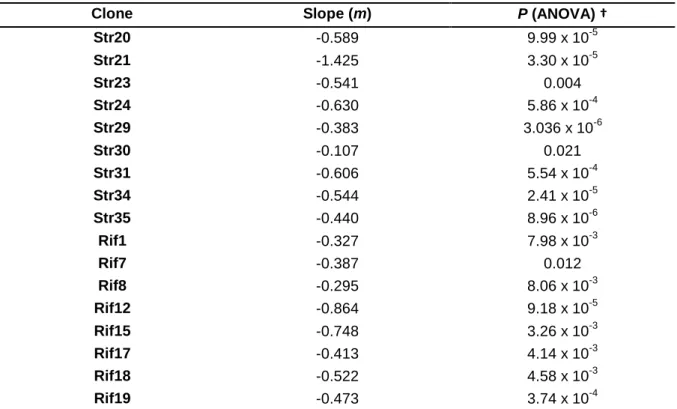
Str20 -0.589 9.99 x 10⁻⁵ Str21 -1.425 3.30 x 10⁻⁵ Str23 -0.541 0.004 Str24 -0.630 5.86 x 10⁻⁴ Str29 -0.383 3.036 x 10⁻⁶ Str30 -0.107 0.021 Str31 -0.606 5.54 x 10⁻⁴ Str34 -0.544 2.41 x 10⁻⁵ Str35 -0.440 8.96 x 10⁻⁶ Rif1 -0.327 7.98 x 10⁻³ Rif7 -0.387 0.012 Rif8 -0.295 8.06 x 10⁻³ Rif12 -0.864 9.18 x 10⁻⁵ Rif15 -0.748 3.26 x 10⁻³ Rif17 -0.413 4.14 x 10⁻³ Rif18 -0.522 4.58 x 10⁻³ Rif19 -0.473 3.74 x 10⁻⁴
† Last column refers to ANOVA for regression analysis testing if slope is significantly different from
21
Thirteen of the thirty (43%) spontaneous resistant clones (Table 4a) have reached a stable equilibrium (P > 0.05): 10 NalR clones, two RifR clones (Rif3 and Rif4) and one StrR clone (Str36). These results suggest that their fitness is high when rare having an ability to maintain in the population by stable coexisting with the wild-type. This coexistence occurs without selective pressure (i.e. presence of antibiotic). These thirteen clones were denoted „frequency-dependent mutants‟. For clone Nal43 I only considered two days for the stable equilibrium, because the frequencies at day 3 showed a large variance (Figure 5B).
For the remaining clones (Table 4b) I did not find a stable equilibrium, because their frequency was gradually decreased over the competition period. In one case - Str21 - the resistant clone was eliminated on day 3 of the competition experiment. The clone has a relative fitness of 0.32 (± 0.078). Therefore, these clones did not present a frequency-dependent phenotype.
Each frequency-dependent clone seems to present a characteristic stable equilibrium at low frequencies (Table 4a) and regardless of its low starting frequency relative to the wild-type, each clone reached its point of balance. For example, the clone Nal48, that showed the largest increase of its frequency over the competition period, when the starting frequency was 10-5 it rose rapidly to 0.1 (b = -1.184). After reaching this frequency Nal48 showed a stable equilibrium with the wild-type; when it started with a frequency close to 10-1 it was observed the stable equilibrium since the first day of competition (Dionisio et al., unpublished results). The clone Nal51 presents a stable equilibrium beneath its starting frequency (b = -6.086). So, its frequency in the first two days decreased until it reaches its equilibrium point. The clone Str36 reached the equilibrium on the first day of competition, because its stable point is very similar to the initial frequency of 10-5 (b = -4.902) and there it keeps along the competition period.
1.2 COMPETITIONS 1:1 OF RESISTANT AND WILD-TYPE CELLS
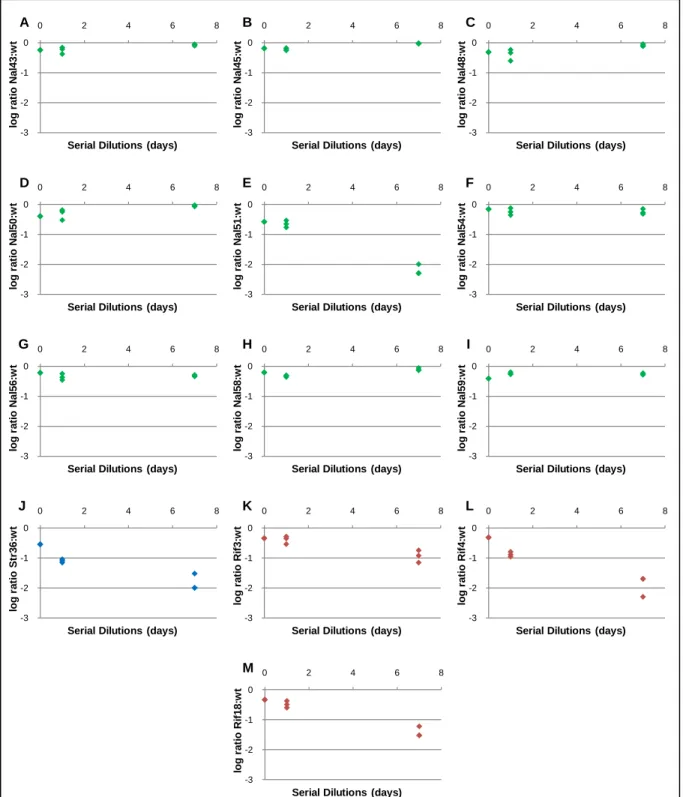
Previous authors have performed competition experiments between sensitive and resistant clones in environments free of antibiotics. With no reasons to do otherwise, most authors have performed 1:1 competitions, not 1:10-5 or any other frequency. Their results show that resistant clones, either have a cost or an equivalent fitness to the wild-type (Tubulekas & Hughes, 1993, Lenski, 1998, Gillespie, 2001). So, I performed 1:1 competitions to test if our clones are not different from common clones tested in previous works. I performed competitions between clones of the Table 4a and the wild-type along 7 days. I measured the resistant clones‟ frequencies in the first and seventh days. Results are shown in Figure 7.
22
I follow the same criterion defined in page 16, section 1.1 to assess for a statistically significant frequency decrease. The clones Nal51, Str36, Rif3 and Rif4 presented a statistically significant disadvantage over the wild-type along the competition (for all P < 0.001). Hence, they present a cost. The remaining 8 NalR frequency-dependent clones did not show a statistically significant disadvantage (P > 0.05), even though neither showed any advantage. These clones did not show a growth cost. I also performed a competition with one clone without a frequency-dependent phenotype (Rif18, see table 4b) which confirmed that these clones still present a disadvantage against the wild-type. This 1:1 competition assay was not performed for clone Nal41.
1.3 COMPETITIONS 1:1 OF RESISTANT AND ΔARA CELLS
I performed competitions 1:1 between Δara and resistant clones to evaluate if using a Δara strain, instead of the wild-type strain would give similar results (Figure 8). I performed competitions for the 8 NalR clones without a statistically significant frequency decrease, for Rif3 and Str36. I observed identical outcomes to the Figure 7. The cost of carrying a Δara marker was measured by performing a competition assay against the wild-type. I observed a cost of 0.6% not statistically different from zero (Student’s t-test, t = -0.509, d.f. = 2, P = 0.661). For that reason I disregard the cost.
1.4 COMPETITIONS 1:102 OF ΔARA TO RESISTANT CELLS
As frequency-dependent clones have an advantage when rare, I attempt to demonstrate that such advantage is somehow compensated by a disadvantage when resistant clones are the majority. When in majority, discrimination between resistant clones and the wild-type it is not possible. Therefore, I performed competitions in a proportion 1:102 of Δara to resistant clones. I used the Δara strain, which showed similar results to the wild-type (Section 1.3), to overcome technical difficulties in discriminating between resistant and sensitive clones. For these competitions I used three frequency-dependent clones and one clone without frequency-dependency. All four clones tested presented a clear disadvantage over the Δara along the competition experiment, here shown by the increase in frequency of Δara cells. Since resistant clones are at a higher proportion in the competition, in Figure 9 I calculated the ratio of Δara to the total number of cells.