FACULDADE DE CIÊNCIAS
DEPARTAMENTO DE ENGENHARIA GEOGRÁFICA, GEOFÍSICA E ENERGIA
OPTIMIZATION OF HYBRID RENEWABLE ENERGY SYSTEMS ON ISOLATED
MICROGRIDS: A SMART GRID APPROACH
Doutoramento em Sistemas Sustentáveis de Energia
D
IANAP
EREIRAN
EVESTese orientada pelos Professores Doutores:
António Manuel Barros Gomes de Vallêra
Carlos Augusto Santos Silva
2015
Acknowledgements
This work would not have been possible without the financial support of the Portuguese Foundation of Science and Technology, through the doctoral grant SFRH/BD/62446/2009, and without the acceptance of the University of Lisbon and the MIT Portugal Program for having me as a PhD candidate.
I am grateful to my supervisor António Vallêra, for having accepted to guide me, in first place, through the PhD odyssey, giving me wise advices, helping me to become a more solid and independent researcher.
I am also very grateful to my supervisor Carlos Santos Silva, for having accepted the challenge to work with me. Carlos was tireless, and I deeply acknowledge his patient, his support and guidance through the development of this work, even when I had more doubts than proposals. Above all, I want to acknowledge his time - the time he dedicated to this work through the last three years - which I learnt that is precious.
To both my supervisors, I wish to thank them for their encouragement to do this PhD, and meanwhile to follow-up my dream to go to the Olympic Games, even when it meant to stop my studies during two years. My sincere gratitude for your understanding.
To Stephen Connors from MIT, André Pina from IST and Miguel Centeno Brito from FCUL, with whom I collaborated on the idealization of some of the papers that are part of this thesis: their inputs and the meetings we had through the way, helped me to define a more wise strategy and added value to my work. Thank you.
I also want to acknowledge the journals’ reviewers for the extensive, and sometimes hard, critics of my work, so that it would be more innovative, structured and better understood by the academic community.
Finally, I wish to thank to all the individuals and professionals which were not named here before and that walked this road with me. They too, are part of this achievement. Thank you.
This work was a pleasant journey, where I learnt to become a better and more critical engineer, always with a researcher passion. Today, I am sure it was the right choice to do a PhD.
Abstract
The energy systems of small isolated communities face great challenges related to their autonomy and resilience, when looking for a sustainable energy future. Hybrid renewable energy systems, composed from different technologies, partially or totally renewable, potentiates a growing security of supply for these isolated micro-communities. Moreover, with a smart grid approach, the possibility to reschedule part of the electricity load is seen as a promising opportunity to delay further investments on the grid’s power capacity, enabling a better grid management, through peak load control, but also to promote a more efficient use of endogenous resources, maximizing renewable penetration.
To identify the micro-communities main energy challenges, a literature review was taken, reporting the design and implementation of isolated hybrid renewable energy systems. Since electricity and heat energy vectors can be, in part, assured by endogenous resources, a methodology to optimize demand response on isolated hybrid renewable energy systems was developed, using the electric backup of solar thermal systems for domestic hot water supply as flexible loads. This approach is intended to increase energy efficiency of the energy system, reducing grid operation costs and associated CO2 emissions.
A model of the electric impact of the implementation of solar thermal systems and heat pumps for domestic hot water supply was developed and tested for the Corvo Island case study, a small and isolated microgrid, located in the mid-Atlantic with around 400 inhabitants and a diesel power plant. An impact of 60% on peak load and 7% on annual electricity demand was found. In order to tackle this significant impact in the grid, a model for optimizing the economic dispatch of the island was developed, testing multiple demand response approaches to the backup loads, from heuristics to genetic algorithms, having this last one performed best to control the peak load and minimize the operation costs. Nonetheless, there was the need to compare and validate the demand response optimization strategies of this developed model with other available modeling tools, which in the end presented similar results.
As the pillar of this thesis is the optimization of hybrid renewable energy systems, the influence of the uncertainties associated to renewables forecast had to be studied, in particular its impact on the demand response scheduling. Wind uncertainties demonstrated to have a greater impact on the grid than the solar ones.
Finally, the methodology developed incrementally along the thesis and validated in Corvo Island, was tested on different scales and types of isolated systems. It demonstrated to be especially suitable for small systems with less than 20 MW power installed and over 25% renewable generation, with mostly residential load profiles.
Keywords
Demand response; Thermal storage; Smart grids; Isolated microgrids; Hybrid renewable energy systems
Resumo
As pequenas comunidades isoladas enfrentam grandes desafios relativamente à autonomia e à resiliência dos seus sistemas de energia. Os sistemas de energia híbridos e renováveis, compostos por várias tecnologias, renováveis parcialmente ou na totalidade, potenciam uma maior segurança de abastecimento e, consequentemente, uma maior sustentabilidade para estas micro-comunidades isoladas. Adicionalmente, a capacidade de, em sistemas isolados, mobilizar parte do consumo de electricidade para outras horas do dia, apresenta-se como uma oportunidade promissora: tanto para a optimização da operação da rede destes sistemas, levando a uma regulação do pico de consumo; mas também produzindo poupança económica para o utilizador final, se este usufruir de tarifas diferenciais. Deste modo, a necessidade de novos investimentos em capacidade do sistema energético é adiada, como também se contribui para o uso mais eficiente dos recursos renováveis endógenos, e, no caso de sistemas com consumo de combustíveis fósseis, a uma redução das emissões de gases com efeito de estufa.
Tendo em conta que os vectores da electricidade e do calor podem ser assegurados em parte por fontes renováveis endógenas, foi desenvolvida uma metodologia de optimização do despacho de cargas flexíveis em sistemas isolados, usando para tal a capacidade de armazenamento térmico dos tanques de água quente dos sistemas solares térmicos. Com esta metodologia, quis-se aumentar a eficiência energética total do sistema energético, reduzir os custos de operação da rede e as emissões de CO2
associadas.
Tendo começado por caracterizar as micro-comunidades isoladas em termos de configuração e implementação de sistemas energéticos híbridos e renováveis, foi identificado que os sistemas híbridos mais utilizados em ilhas são centrais térmicas a diesel, integrados com energia eólica e fotovoltaica, enquanto que nas comunidades remotas, tipicamente mais pequenas e com menos infraestruturas, são compostos por energia solar fotovoltaica, apoiada por geradores unitários a diesel e complementada pelo uso de baterias.
Os sistemas de armazenamento para sistemas isolados de energia de maior escala, como é o caso das ilhas estudadas, ainda apresentam desafios técnicos. A inexistência ou inadequabilidade dos sistemas de armazenamento actuais limita, na maior parte dos casos, uma maior taxa de penetração de energia renovável, que tipicamente não ultrapassa 50% do total de produção de electricidade.
No que respeita ao abastecimento de calor, concluiu-se que este é assegurado na sua maioria por combustíveis fósseis, e na lógica da maximização do consumo de fontes endógenas, a introdução de sistemas renováveis neste vector é essencial.
Usando o caso de estudo da ilha do Corvo, nos Açores, que viu ser implementado para abastecimento doméstico de água quentes sanitárias (AQS), sistemas solares térmicos e bombas de calor, modelou-se
em 60% do pico de consumo, o que para o sistema energético em questão seria incomportável. Para contornar um tal aumento, várias estratégias de optimização dos consumos eléctricos introduzidos pelo apoio dos sistemas de AQS, foram testadas. Considerando flexível o apoio eléctrico destes sistemas e tendo como objectivo optimizar o seu despacho, reduzindo os custos de operação da rede eléctrica, diferentes estratégias de optimização do consumo adaptativo foram modeladas, utilizando modelos heurísticos, programação linear e algoritmos genéticos, utilizando para isso várias formulações em termos de quantidade de energia flexível e em termos de número de sistemas AQS ligados/desligados. A optimização das cargas flexíveis através dos algoritmos genéticos, obteve os melhores resultados de minimização dos custos de operação e energia consumida, obtendo uma redução de 1% para o caso de estudo do Corvo, quando comparado com um cenário de cargas fixas, ou seja, sem estratégias de consumo adaptativo.
No entanto, existindo outras ferramentas de simulação de sistemas híbridos e renováveis, com funcionalidades de modelação de consumos flexíveis e adaptativos, o modelo desenvolvido para o caso de estudo da Ilha do Corvo, foi comparado e validado com outros modelos existentes no mercado (HOMER e EnergyPLAN) na sua estratégia de optimização, apresentando resultados similares.
Sendo o objectivo primordial desta dissertação, estudar a optimização de sistemas energéticos híbridos e renováveis utilizando para isso a integração de funcionalidades atribuídas a redes inteligentes, tal como o armazenamento de energia e o consumo adaptativo, o estudo da integração de renováveis na produção de electricidade e o impacto das incertezadas associadas à previsão meteorológica, era um ponto fulcral a analisar. Embora em termos de produção eléctrica a Ilha do Corvo seja 100% dependente de diesel, já foram executados vários estudos para implementação de energia eólica e a facilidade na obtenção de dados de produção e de recurso solar e eólico, determinou que se recorresse novamente ao caso de estudo do Corvo para modelar a influência das incertezas do recurso na gestão do consumo adaptativo.
É demonstrado que as incertezas no recurso eólico têm maiores repercussões na gestão das cargas flexíveis, uma vez que estas são programadas para maximizar a absorção da produção eólica e têm um impacto directo na rede, diminuindo no entanto o seu impacto para menores cargas flexíveis. Relativamente às incertezas no recurso solar, para o sistema analisado, o seu impacto é menor pois está afecto a sistemas solares térmicos cuja função é o aquecimento de água, funcionando por isso como um amortecedor das incertezas, uma vez que armazena a energia solar, ao contrário do que acontece com a energia eólica que é transmitida directamente à rede. No entanto, para níveis baixos de armazenamento de energia térmica, isto é, de água quente nos tanques, o impacto das incertezas associadas ao recurso solar aumenta pois, pode condicionar a segurança de abastecimento de água quente ao utilizador final. Adicionalmente, uma maior precisão na previsão meteorológica, ou seja, com menores incertezas associadas, potenciará em sistemas renováveis híbridos uma maior penetração de energia renovável o que levará consequentemente a reduzir as emissões de CO2 associadas.
Finalmente, a metodologia de optimização de cargas flexíveis em sistemas energéticos híbridos e renováveis, desenvolvida modularmente ao longo da tese e modelada para o caso de estudo da Ilha do Corvo, foi testada noutras escalas de micro-comunidades isoladas com diferentes características geográficas, perfis de consumo e sistemas energéticos.
A optimização do consumo adaptativo de sistemas energéticos isolados híbridos e renováveis, utilizando como cargas flexíveis o apoio eléctrico de sistemas solares térmicos, apresenta resultados
de consumo maioritariamente residenciais, especialmente quando a penetração de energia renovável é superior a 25% do total de energia produzida. O impacto dos sistemas solares térmicos, quando aplicados a 50% das casas, registou aumentos de 0.1% a 3% do consumo diário de electricidade, conforme se tratasse, respectivamente, de grandes sistemas (capacidade instalada superior a 20 MW) ou de pequenos (capacidade instalada menor que 20 MW). Os impactos positivos mais baixos foram registados em micro-redes, em que o perfil de carga é dominado pelo sector da indústria e/ou serviços, sendo o sector residencial uma percentagem pequena do perfil de carga diária. No entanto, esta metodologia demonstrou funcionalidades no controlo do pico de consumo e na redução das emissões de CO2, que em comparação com outros sistemas de AQS alimentados com combustíveis fósseis, registou
88% menos emissões.
Conclui-se assim que a implementação de sistemas solares térmicos como solução sustentável e potenciadora de redução de emissões, optimização da operação da rede e controlo de pico de consumo, em sistemas energéticos isolados híbridos e renováveis é interessante para micro-redes com capacidade instalada menor que 20 MW, e especialmente em sistemas que tenham uma percentagem de produção renovável acima dos 25%.
Palavras-Chave
Consumo adaptativo; Armazenamento térmico; Redes inteligentes; Micro-redes isoladas; Sistemas energéticos híbridos e renováveis
Contents
Acknowledgements ...iii Abstract ... v Keywords ... vi Resumo ... vii Palavras-Chave ... ixList of Abbreviations and Acronyms... xvii
List of Figures ... xix
List of Tables ... xxiii
Introduction ... - 1 -
1 Motivation... - 1 -
2 Background concepts ... - 5 -
2.1 Integrated and Hybrid renewable energy systems ... - 5 -
2.2 Economic dispatch ... - 5 -
2.3 Smart grids and its capabilities ... - 6 -
3 Research questions ... - 11 -
4 Research strategy ... - 13 -
4.1 Work structure ... - 13 -
4.2 Publications ... - 16 -
4.3 Outline of the thesis... - 17 -
5 Conclusions and future work ... - 17 -
5.1 Isolated hybrid renewable energy systems characterization and benchmarking . ... - 17 -
5.2 Modeling domestic hot water systems ... - 18 -
5.3 Different strategies to optimize the short-term energy operation ... - 19 -
5.4 Demand response optimization strategies in different modeling tools ... - 19 -
5.5 The impact of renewables forecast uncertainties on demand response ... - 20 -
5.6 Assessing DHW systems with demand response capabilities for different scales of isolated microgrids ... - 20 -
6 Future work ... - 21 -
References ... - 23 -
Design and implementation of hybrid renewable energy systems on micro-communities: a review on case studies ... - 25 -
Abstract ... - 25 -
1 Introduction ... - 27 -
2 Review approach ... - 28 -
2.1 Community characterization ... - 29 -
2.2 Hybrid renewable energy system details ... - 29 -
3 Comparative review ... - 30 -
3.1 Islands ... - 30 -
3.2 Remote villages ... - 42 -
3.3 Reporting framework for HRES projects ... - 49 -
4 Conclusions ... - 49 -
Acknowledgements ... - 50 -
References ... - 51 -
Modeling the impact of integrating solar thermal systems and heat pumps for domestic hot water in electric systems – The case study of Corvo Island ... - 57 -
Abstract ... - 57 -
1 Introduction ... - 58 -
2 Corvo energy system ... - 59 -
2.1 Domestic hot water demand ... - 60 -
2.2 Electric load ... - 61 -
2.3 Solar radiation data ... - 62 -
3 Modeling DHW ... - 63 -
3.1 Solar thermal model ... - 64 -
3.2 Heat pumps model ... - 65 -
4 Corvo DHW modeling... - 66 -
4.1 Model parameters for Corvo’s systems ... - 66 -
4.2 Comparison of solar thermal systems and heat pumps... - 68 -
4.3 Integrated models ... - 70 -
4.4 Energy and peak load for different models... - 76 -
References ... - 79 -
Optimal electricity dispatch on isolated mini-grids using a demand response strategy for thermal storage backup with genetic algorithms ... - 81 -
Abstract ... - 81 -
1 Introduction ... - 82 -
2 Problem statement of the case study of Corvo Island ... - 83 -
3 Modeling the optimal dispatch ... - 84 -
3.1 Economic dispatch model ... - 84 -
3.2 Domestic hot water model ... - 86 -
4 Demand response strategies ... - 89 -
4.1 Demand response based on heuristics ... - 89 -
4.2 Demand response with linear programming ... - 89 -
4.3 Demand response with genetic algorithms ... - 91 -
5 Results and discussion... - 94 -
5.1 Demand response heuristics and linear programming ... - 94 -
5.2 Genetic algorithms with economic dispatch ... - 96 -
6 Conclusions ... - 99 -
Acknowledgements ... - 99 -
References ... - 101 -
Demand response modeling: a comparison between tools ... - 103 -
Abstract ... - 103 -
1 Introduction ... - 104 -
2 Modeling microgrids and demand response ... - 105 -
2.1 Software modeling tools ... - 106 -
3 The Corvo Island case study ... - 107 -
3.1 Characterization of electricity system ... - 108 -
3.2 Characterization of domestic hot water system ... - 109 -
4 Scenarios ... - 110 -
5 Results and Discussion ... - 112 -
5.1 Scenario 1 – Modeling base load ... - 112 -
5.2 Scenario 2 – Modeling base load with fixed additional load ... - 114 -
5.3 Scenario 3 – Modeling base load with flexible additional load ... - 115 -
5.4 Discussion ... - 117 -
6 Conclusions ... - 119 -
Acknowledgements ... - 120 -
References ... - 121 -
Impact of solar and wind forecast uncertainties on demand response of isolated microgrids ... - 125 -
Abstract ... - 125 -
1 Introduction ... - 126 -
2 Forecast of renewable resources... - 127 -
2.1 Solar forecast ... - 127 -
2.2 Wind forecast ... - 128 -
2.3 Forecast errors ... - 128 -
3 The Corvo Island case study ... - 129 -
3.1 Energy system ... - 129 -
3.2 Solar data ... - 130 -
3.3 Wind data ... - 132 -
4 Implementing renewables’ forecast on optimal dispatch ... - 134 -
4.1 Solar resource daily forecast ... - 134 -
4.2 Wind power forecast ... - 135 -
4.3 Genetic algorithms to optimize the placement of DHW backup needs ... - 135 -
4.4 Algorithm implementation ... - 138 -
5 Results ... - 139 -
5.1 Day-ahead planning and different wind regimes... - 140 -
5.2 Three-day planning ... - 143 -
5.3 One-week planning ... - 144 -
6 Conclusions ... - 146 -
Acknowledgements ... - 147 -
References ... - 149 -
Assessment of DHW systems’ implementation with demand response capabilities on isolated microgrids, using a smart grid approach ... - 153 -
Abstract ... - 153 -
1 Introduction ... - 155 -
2 Methodology ... - 156 -
3 Case studies’ characterization ... - 161 -
4 Results and discussion... - 165 -
4.1 Scenarios comparison ... - 165 -
4.2 Investment costs for the implementation of ST with DR actions ... - 171 -
4.3 CO2 emissions comparison of different DHW configurations ... - 171 -
5 Conclusions ... - 172 -
Acknowledgements ... - 173 -
List of Abbreviations and Acronyms
CDM Clean Development Mechanisms COP Coefficient of Performance DHW Domestic Hot Water DPP Diesel Power Plant
DR Demand Response
ED model Economic Dispatch model EDA Electricity of Azores company EV Electric Vehicles
GA Genetic Algorithms GDP Gross Domestic Product GHG Greenhouse Gases
HP Heat Pumps
HRES Hybrid Renewable Energy System LGP Liquefied Petroleum Gas
NPC Net Present Cost
OECD Organization for Economic Cooperation and Development PDG Private Diesel Generators
PV Photovoltaics
RES Renewable Energy Sources ST Solar Thermal Systems
List of Figures
Figure I.1 - World Electricity Access by Region, in 2012 [2] ... - 1 - Figure I.2 - Global new investment in renewable power and fuels, in developed and developing countries, from 2004 to 2014 [2] ... - 2 - Figure I.3 - Countries with renewable energy policies and/or targets, in 2015 [2]. - 3 - Figure I.4 - Estimated renewable share of global electricity production, in 2014 [2] .... ... - 3 - Figure I.5 - World total primary energy supply by type, from 1971 to 2012 (Mtoe) [4]
... - 4 - Figure I.6 - Global energy related CO2 emissions by sector and region, from 1990 to
2014 [6] ... - 4 - Figure I.7 - Demand response strategies ... - 8 - Figure I.8 - Energy storage applications, depending on power capacity and discharge duration [13] ... - 9 - Figure I.9 - Ranking of suitability of energy storage technologies (adapted from [16])
... - 10 - Figure I.10 - Maturity of energy storage technologies [13] ... - 10 - Figure I.11 - Thesis outline by topics ... - 13 - Figure II.1 - Electricity Demand versus population (whole range up to 100,000 population and zoomed in to 10,000) ... - 37 - Figure II.2 - Electricity demand per capita according to geographical site and population ... - 38 - Figure II.3 - Distribution of existing supply systems by demand per capita and population bellow 10,000 people ... - 39 - Figure II.4 - Distribution of projects by its application, renewable penetration and population ... - 40 - Figure II.5 - Storage technologies studied ... - 41 - Figure II.6 - Yearly energy demand per household by geographical site ... - 45 - Figure II.7 - Percentage of renewable source on the hybrid renewable systems... - 46 - Figure II.8 - Percentage of use of each type of hybrid system, on the analyzed case studies ... - 46 - Figure III.1 - Corvo electric load for week 43 (October) from Saturday to Friday. - 61 - Figure III.2 - Evolution of electricity demand on residential sector on Azores islands, to the same period (January-May)[11] ... - 62 -
Figure III.3 - Monthly horizontal global radiation on Corvo Island, and ambient and
water inlet temperatures ... - 63 -
Figure III.4 - Daily global Irradiation on 30º inclined plane in Corvo Island ... - 63 -
Figure III.5 - Individual Solar thermal collector scheme ... - 66 -
Figure III.6 - Heat Pump air-water [8] ... - 67 -
Figure III.7 - Comparison of different hourly demand profiles for ST collectors model, on four days of Week 7 (winter) ... - 68 -
Figure III.8 - Comparison of different hourly demand profiles for ST collectors model, on Week 26 (summer) ... - 68 -
Figure III.9 - Comparison of different hourly demand profiles for HP model, on four days of Week 7 (winter) ... - 69 -
Figure III.10 - Comparison of DHW Model and Validation load for winter ... - 71 -
Figure III.11 - Comparison of Model and Validation load for summer ... - 71 -
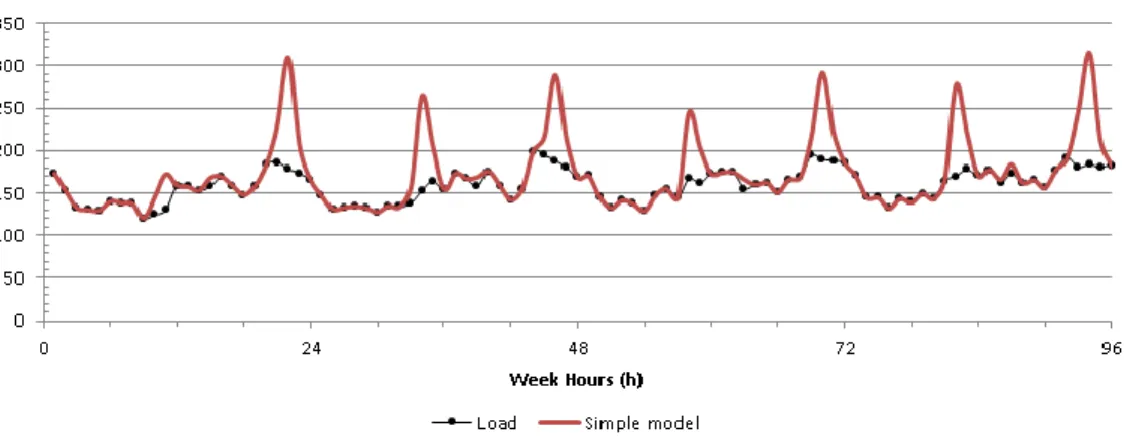
Figure III.12 - Comparison of previous Corvo electric load and simple DHW Model, for Week 10 (winter) ... - 72 -
Figure III.13 - Comparison of DHW Model with and without losses, knowing exterior temperature for Week 10 (winter) ... - 73 -
Figure III.14 - Comparison of DHW Model with and without losses for Week 25 (summer) ... - 73 -
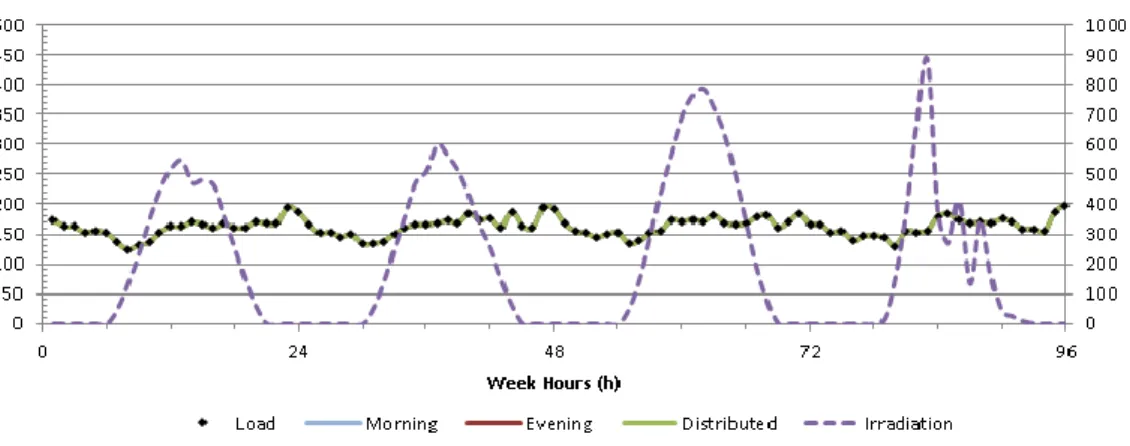
Figure III.15 - Comparison of simple model with free backup and off-peak backup model for Week 10 (winter) ... - 74 -
Figure III.16 - Comparison of simple model with free backup and off-peak backup model for Week 26 (summer)... - 74 -
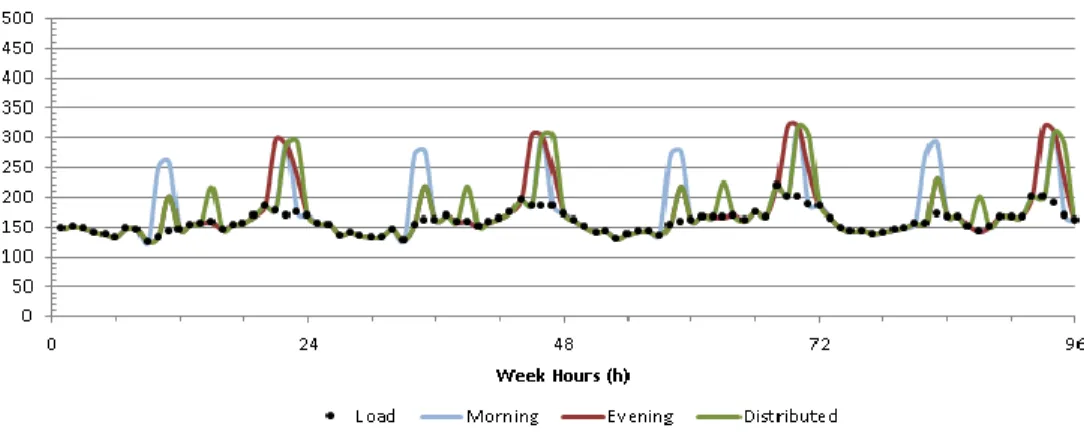
Figure III.17 - Comparison of off-peak backup model with disperse off-peak model for Week 10 (winter) ... - 75 -
Figure III.18 - Comparison of off-peak backup model with and without losses for Week 10 (winter) ... - 76 -
Figure IV.1 - Daily load diagram for Corvo Island: 2012 hourly variability; winter and summer daily variability ... - 83 -
Figure IV.2 - Electric dispatch model ... - 86 -
Figure IV.3 - Daily Irradiation on 30º surface in Corvo Island... - 87 -
Figure IV.4 - DHW model regarding its impact on the grid [9]... - 88 -
Figure IV.5 - Assumed profiles of DHW demand in Corvo Island [9] ... - 88 -
Figure IV.6 - Profile cost for linear programming optimization for placing DHW loads ... - 90 -
Figure IV.7 - Qualitative comparison of best daily models with different formulations ... - 99 -
Figure V.1 - Typical daily load diagram for Corvo Island, still without DHW
electrification loads (2012) ... - 108 -
Figure V.2 - Monthly horizontal global radiation on Corvo Island, and ambient and water inlet temperature, represented by T_ambient and T_ water_inlet, respectively ... - 110 -
Figure V.3 - Scenario 1 comparison of committed generators, for the actual operation and different modeling tools ... - 113 -
Figure V.4 - Scenario 2 comparison of committed generators between different modeling tools ... - 114 -
Figure V.5 - Comparison of Scenario 3 between different modeling tools ... - 116 -
Figure VI.1 - Daily solar horizontal irradiation and average daily ambient temperature for Corvo Island [29] ... - 131 -
Figure VI.2 - Comparison between forecast and measurements for a winter week ... ... - 131 -
Figure VI.3 - Comparison between forecast and measurements for a summer week .... ... - 131 -
Figure VI.4 - Daily average wind speed at 25m ... - 132 -
Figure VI.5 - Corvo's wind speed distribution ... - 133 -
Figure VI.6 - Wind turbine power curve ... - 133 -
Figure VI.7 - Flowchart of the algorithm implemented ... - 139 -
Figure VI.8 - Comparison of different wind regimes ... - 141 -
Figure VI.9 - Wind Power Available vs Wind Power Used and ST loads for DH/FH/FF=24/24/3-6-12 ... - 142 -
Figure VI.10 - Wind Power Available vs Wind Power Used and ST loads for DH/FH/FF=24/72/3-6-12 ... - 144 -
Figure VI.11 - One-week balance of thermal needs, level of storage, solar forecast and demand ... - 146 -
Figure VII.1 - Economic dispatch model algorithm description ... - 158 -
Figure VII.2 - Methodology description ... - 160 -
Figure VII.3 - Load comparison between groups of islands ... - 162 -
Figure VII.4 - Group A load scenario comparison ... - 166 -
Figure VII.5 - Group B load scenario comparison ... - 166 -
Figure VII.6 - Group C load scenario comparison ... - 169 -
List of Tables
Table I.1 - Correspondence between papers and Chapters, referring its application and main topic ... - 17 - Table II.1 - Projections from the Universal Modern Energy Access Case Scenario for 2010-2030 [1]... - 27 - Table II.2 - Characterization of indicators ... - 28 - Table II.3 - Island case studies comparative review ... - 31 - Table II.4 - Number of projects that used each resource... - 40 - Table II.5 - Remote villages’ case studies comparative review ... - 43 - Table II.6 - Comparison of main between Islands and Remote villages ... - 47 - Table III.1 - Costs of operation in current situation ... - 59 - Table III.2 - DHW projected systems for the 144 houses of Corvo Island ... - 60 - Table III.3 - DHW demand in Corvo ... - 60 - Table III.4 - Assumed profiles of DHW in Corvo Island ... - 61 - Table III.5 - Solar system relevant parameters [18] ... - 67 - Table III.6 - Heat Pump relevant parameters [6] ... - 67 - Table III.7 - Comparison between actual and possible scenarios ... - 70 - Table III.8 - Final energy, peak load and cost comparison between different models.... ... - 77 - Table IV.1 - Diesel Generators characteristics and constraints... - 84 - Table IV.2 - Possible combination of committed generators... - 85 - Table IV.3 - DHW systems relevant parameters [9] ... - 88 - Table IV.4 - Description of the different methods to test demand response of DHW loads ... - 89 - Table IV.5 - Problem constraints ... - 91 - Table IV.6 - Comparative results of different strategies of demand response for a representative day, using only optimal economic dispatch ... - 95 - Table IV.7 - Economic dispatch with genetic algorithms for DHW... - 97 - Table IV.8 - Quantitative comparison of best models with different formulations- 98 - Table V.1 - Diesel Generators specification data ... - 109 - Table V.2 - Partial load efficiencies for Generators #1 & #2 and #3 & #4 ... - 109 - Table V.3 - Expected loads for an average day ... - 110 -
Table V.5 - Scenarios taken into account... - 112 - Table V.6 - Percentage of working hours and average capacity during a day, for Scenario 1, or each generator ... - 114 - Table V.7 - Percentage of working hours and average capacity during a day, for Scenario 2, for each generator ... - 115 - Table V.8 - Percentage of working hours and average capacity during a day, for Scenario 3, for each generator ... - 117 - Table V.9 - Comparison of liters of diesel consumed per day for different scenarios and modeling tools ... - 117 - Table V.10 - Comparison of operational costs for different scenarios and modeling tools ... - 117 - Table VI.1 - Diesel Generators characteristics and constraints... - 129 - Table VI.2 - Electric loads in Corvo Island after the installation of the DHW systems.... ... - 130 - Table VI.3 - Solar forecast errors of Corvo, compared to real data ... - 132 - Table VI.4 - Wind power forecast errors compared with real data... - 133 - Table VI.5 - Simulations done with different combinations of indexes ... - 140 - Table VI.6 - Comparison results for DH/FF/FF = 24/24/3-6-12 and different wind regimes ... - 141 - Table VI.7 - Wind absorption for DH/FH/FF=24/24/3-6-12 ... - 142 - Table VI.8 - Comparison results for DH/FF/FF = 24/72/3-6-12 ... - 143 - Table VI.9 - Wind absorption for DH/FH/FF=24/72/3-6-12 ... - 143 - Table VI.10 - Comparison results for DF/FH/FF= 24/168/6 and 24-48-72/168/12 ... ... - 145 - Table VI.11 - Wind absorption for DH/FH/FF=24/168/6 and 24-48-72/168/12 ... ... - 145 - Table VII.1 - DHW modeling description... - 158 - Table VII.2 - Economic Dispatch description ... - 159 - Table VII.3 - Summary of different parameters considered for different case studies... ... - 161 - Table VII.4 - Island parameters description ... - 163 - Table VII.5 - Results comparison ... - 167 - Table VII.6 - Scenarios increase on investment costs ... - 171 - Table VII.7 - CO2 emissions ... - 172 -
Introduction
The three pillars that support a sustainable energy system – energy security, environmental sustainability and economic development - are extremely hard to guarantee in small and isolated systems. The implementation of hybrid renewable energy systems that take advantage of the new smart grid features have the potential to promote self-sufficiency, energy use efficiency while reducing greenhouse gases emissions (GHG), and that is the underlying purpose of this work.
1 Motivation
Nowadays, there is still 15% of global population that lacks access to electricity, mostly in developing areas of the world, and especially in rural areas where the energy access is still sparse and limited, as demonstrated on Figure I.1.
Distributed and hybrid renewable energy systems can help to democratize the access to energy and contribute to the achievement of some of the Millennium Development Goals [1]. In particular, achieving sustainable energy for all - by providing essential and productive energy services in remote areas, such as enabling public lighting and electricity in schools after sunset or providing cooking facilities that do not depend on the collection of biomass (wood) - may help to promote social aspects as universal primary education, and empowerment of women [1] and thus contribute to the achievement of other development goals.
With the variability of fuel costs together with the international efforts to reduce GHG emissions, the investment on renewable capacity has been gathering interest both in developed and developing countries. As exemplified by Figure I.2, while in developed countries, the investment on renewables grew from 2004 to 2014 - with the exception of the years of 2009, 2012 and 2013, mainly associated with periods of economic crisis - in the developing countries it grew until 2014, except for 2013. Multiple factors have contributed to the growth of renewable projects in developed and developing countries:
in developed countries, projects have arose from the necessity to fight climate change, and reduce GHG emissions, meeting international environmental targets, reducing fossil fuels consumption, and increasing in this way the security of supply;
in developing countries, the recognition of the importance of electricity and cooking energy access for remote and isolated communities, where hybrid systems – that integrate renewables and fossil resources – are the most cost effective solutions;
the support of development banks have increased the number of clean and renewable investments in developing countries, since renewables begin to show more technological maturity and equivalent costs;
the implementation of Clean Development Mechanism (CDM), until 2012, introduced by Kyoto Protocol [3], allowed developed countries to balance its GHG emissions investing on renewable projects in developing countries – this can explain the decrease from 2012 to 2013.
Figure I.2 - Global new investment in renewable power and fuels, in developed and developing countries, from 2004 to 2014 [2]
Figure I.3 presents the countries with some kind of policies and/or targets on renewable energy. As it can be observed, most of the developed and developing countries already present targets and policies regarding renewables. Some developing countries scattered in South America, Africa and Asia have either only defined policies but no targets, or only defined targets with no policies; Greenland, few
Figure I.3 - Countries with renewable energy policies and/or targets, in 2015 [2]
Figure I.4 presents the global share of renewable electricity production in the world, at the end of 2014. Despite the growing investments on renewables around the world, fossil fuels and nuclear still assure 77% of the electricity production, while renewables only present a contribution of 23%. Hydropower is the largest renewable source (16.6%), since is a well-mature and lasting technology with more than 100 years of implementation, while wind is a growing technology that represents 3% and bio–power (from biomass, biofuels, etc.) almost 2%. Solar photovoltaics are almost achieving 1% and all other emerging technologies as geothermal, concentrated solar power and ocean energy represent only around 0.4%. Although these values seem encouraging for electricity production, when looking at primary energy consumption is still observed a predominance of fossil fuels, as presented by Figure I.5.
Figure I.5 - World total primary energy supply by type, from 1971 to 2012 (Mtoe) [4]
The consequence is the continuous global rise of CO2 emissions at least until 2013, as seen in Figure I.6.
However, despite the world’s average annual 1.5% increase on energy consumption on recent years, coupled with an average 3% growth in the GDP, CO2 emissions remain unchanged since 2013, which
represents for the first time over the last decades that the economy grew decoupled from CO2 emissions
[5]. This can be explained by the increase of energy efficiency and renewable generation, especially from emerging world economies like China.
In Figure I.6 is still observable that, the main sectors that contribute more for CO2 emissions are the
power generation, industry and transportation sectors. The greatest is the power generation, responsible for more than 40% of the total emissions. In particular, the power generation in developing countries is responsible for almost 30% of the emissions.
Figure I.6 - Global energy related CO2 emissions by sector and region, from 1990 to 2014 [6]
emissions almost triplicated on the power generation sector on Non–OECD countries, in 24 years (Figure I.6). This means that to reduce overall CO2 emissions, one of the focus must be in the energy
access in developing countries, but especially on remote and isolated communities. New systems are emerging or being converted, and there is the real possibility to influence local energy policy making by promoting the implementation of integrated and hybrid renewable energy systems.
2 Background concepts
In the following sections, the background concepts underlined in this thesis are introduced.
2.1 Integrated and Hybrid renewable energy systems
There is no strict definition of what an integrated energy system is. Ideally, an integrated energy system is one that takes advantages of the synergies between energy uses and energy vectors to increase efficiency. For example, a combined heat and power system where the waste heat from a electricity generation unit (from fuel or gas) is used for low-temperature applications, like pre-heating furnaces air, is a good example of an integrated energy system.
A hybrid renewable energy system (HRES) is one that couples, in the generation mix, more than on type of energy source, including renewable resources. It is seen as an opportunity to increase sustainability and security of supply, since it addresses the use of endogenous resources, as a way to improve energy efficiency and decrease external importations of fossil fuels. HRES are also becoming popular for isolated and small communities, although some operation questions arise, not only regarding the design, but also in terms of system’s reliability in case of large renewable penetration.
2.2 Economic dispatch
One of the central issues to determine which units of a certain power system should operate at a certain time in order to meet a certain demand of electricity, is based on the variable operating cost of the different electric power plants [7]. This is called the electricity dispatch problem.
On a system, with multiple power plants, the technologies with lower operating costs are generally dispatched first, followed by the ones with sequentially increasing higher costs, as demand increases. There are other dispatch criteria that must also be followed, apart from the operation costs, such as the maximum capacity committed, the associated environmental emissions and the required reserve needed to guarantee the system’s reliability.
The commitment of different power plants is such that is possible to answer the expected demand with a reserve margin, in order to enable a quick response to unexpected demand events. Normally, the units that assure the base load are typically the units with big inertia as thermal power plants or nuclear energy, while the peak increases are answered by quick response technologies with high power density, such as hydro or natural gas power plants.
On a hybrid renewable energy system, the availability of renewable energy resources is another important factor to take into account, as typically the operating costs of renewables are very low or null. This introduces a logic of full priority on the dispatch of renewables. However, the dispatch patterns are limited by a complex mix of technology time of response, balance between distribution and storage, grid stability, or even reservoir levels in the case of hydro power plants, etc. To keep the right balance between supply and demand, renewables are sometimes curtailed.
As seen, there are multiple criteria that can be considered for the electricity dispatch, however the model adopted in this work was the economic dispatch model with the unit commitment problem. This model is usually used for short-term electricity planning and consists on a minimization of the operation costs, taking into account all the systems constraints, as it is further explained on Chapter IV.
2.3 Smart grids and its capabilities
There are multiple definitions for smart grids: most definitions refer only to electricity grids while others present a more integrated approach of smart energy grids, either heat, gas or electricity.
Looking at different definitions, the International Energy Agency defines smart grids as “networks that monitor and manage the transport of electricity from all generation sources to meet the varying electricity demands of end-users, being deployed at different rates (…) depending on local commercial attractiveness, compatibility with existing technologies, regulatory developments and investment frameworks” [8]. The European Technology Platform for the Electricity Networks of the Future gives a more generic definition, stating that a smart grid is “an electricity network that can intelligently integrate the actions of all users connected to it - generators, consumers and those that do both - in order to efficiently deliver sustainable, economic and secure electricity supplies” [9]. Both definitions consider only the electricity grid.
The Smart Grid Task Force by the European Commission broadens the definition of smart grids to “energy networks that can automatically monitor energy flows and adjust to changes in energy supply and demand accordingly, that, when coupled with smart metering systems, reach consumers and suppliers by providing information on real-time consumption, allowing consumers to adapt – in time and volume - their energy usage to different energy prices throughout the day, having economic benefits by consuming more energy in lower price periods” [10]. The US Department of Energy participates of the same extended vison, adding also the goals that can be achieved through its implementation: “(…) representing an unprecedented opportunity to move the energy industry into a new era of reliability, availability, and efficiency that will contribute to economic and environmental health” [11].
Relying on the concept of using communication’s information for a more efficient and reliable generation and supply, concepts like flexible demand, renewable integration, distributed generation, storage systems, and cross-energy vectors are integrated on the interaction of various agents and systems. Although smart grids are mainly thought for electricity grids, heat and cooling grids can also be smart, being the great challenge the integration of all these energy vectors.
Smart grids are desirable for system efficiency and reliability improvements, variable renewable energy integration and distributed energy resources, which can be driven by advanced metering infrastructures for demand response capabilities, enabling new services products to power costumer’s decision and participation [8]. Thus, nowadays it is fundamental to consider the infrastructure that
For isolated systems, the implementation of smart grid capabilities is also very relevant for the sustainability of the system, in order to:
Increase the use of local resources, as renewables, for energy generation, instead of importing external resources, as fossil fuels;
Use demand and peak control strategies, to make the use of the resources more efficient, such as storage and flexible demand;
Reduce the variability and uncertainty associated to demand, but also to resource availability, through forecast and prevision;
Manage and promote the optimization of generation dispatch, for optimal operation costs and reduction of CO2 emissions – act locally, think globally.
2.3.1 Demand response
The potential to reschedule part of the electricity load on energy systems, but especially on isolated micro-communities, is seen as a promising opportunity to delay further investments on the power capacity of a grid.
The European Network of Transmission System Operators for Electricity defines demand response (DR) as “a voluntary temporary adjustment of power demand taken by the end-user as a response to a price signal (market price or tariffs) or taken by a counter-party based on an agreement with the end-user”. If it is used for short periods (hours) it acts as a system power balance, providing economical optimization of the electricity demand. However if used during a longer period will also affect the energy balance in the power system and may also result in energy savings [12]. In this view, demand response can be driven by price incentives, or act like a contracted resource for power reserve.
Although demand response still presents technical and operability challenges, it can be considered one of the most promising smart grids’ features, with potential on the following areas:
Large scale integration of renewable generation, by shifting the load to hours with renewable penetration;
Use of the thermal capacity of water heating or direct space heating or cooling, to shift the electricity consumption, than can be interrupt for a short period of time without interfering with the end-user comfort;
Some industries with energy intensive processes that can function with market incentives to stop its manufacturing, if the market price of electricity is above a certain limit, and share the savings with the utility;
Grid power balancing mechanisms.
Figure I.7 demonstrates multiple strategies of demand response, comparing a usual profile of consumption with one optimized with demand response. While valley filling can help taking full advantage of committed power plants or increase renewable penetration, peak shaving helps to
decrease the peaks, avoiding the need to commit more generators, and so decreasing the operation costs. Finally load shifting, is a mix of the two previous strategies. These strategies consider the existence of enough systems’ and load flexibility to shift some part of the loads to other periods.
Figure I.7 - Demand response strategies
2.3.2 Energy storage systems
Energy storage is the key element for the growth of hybrid renewable energy systems, meeting different purposes on the planning of an energy system.
Figure I.8 presents multiple applications of storage systems, depending on their capacity, either in terms of power or energy density, and which can be used for power quality or to boost demand response capabilities. According to the purpose, different storage systems can act, in different ways [13]:
for demand shifting and peak reduction purposes, storage can be done with thermal applications with capacities under 1 MW, for short periods (as minutes to one day);
for variable renewable integration, storage can be assured, either by electricity or thermal applications, for capacities between 1 MW and 100 MW, also for short periods;
if seasonal storage is the purpose, this is for longer periods (from days to months) and typically for capacities larger than 100 MW, electricity and thermal applications can be used;
however, for system services, as spinning reserve, voltage support and frequency regulation, typically above 1MW capacity, electricity-only applications should be used.
Figure I.8 - Energy storage applications, depending on power capacity and discharge duration [13]
The role of storage on isolated systems, especially with the presence of renewables, is of particular importance since it adds economic value to renewable generation, helping optimizing the grid’s management and dispatch [14], and softening the impact of renewable availability uncertainties. Ideally, supply would have to match the demand, thus the capability of storing energy to provide a synchronized supply and demand, becomes the management core of an isolated grid, requiring planning ahead capabilities [15].
In this context, there are plenty of energy storage technologies that are currently being studied, that can be grouped by their scale:
Large scale: pumped hydro, compressed air, power-to-gas, etc.;
Small/local scale: chemical, electrochemical, electromagnetic;
Small and large scale: thermal energy and some electrochemical.
Figure I.9 presents the suitability of the different types of technology, according to type of generation – conventional or renewable, and type of system services – transmission, distribution or costumer services. The outer line means that the technology is suitable, the intermediary line possible and the center unsuitable.
As it is possible to see, thermal storage is a solution that is suitable for conventional generation but also possible to renewable integration purposes, and it is suitable for costumer services, and possible for transmission and distribution purposes. This indicates that thermal storage, can be the driver for a systems’ and consumer approach, and can be applied either for small or medium systems.
Figure I.9 - Ranking of suitability of energy storage technologies (adapted from [16])
Nevertheless, thermal storage, through sensible heat, in the form of residential hot water heaters with storage (Figure I.10) appears in the threshold of demonstration to commercialization, as reported in [17], [18] and [19]. However, to the best of my knowledge, there is still a knowledge gap regarding the use of residential thermal storage for commercial purposes that would be fulfilled integrating solar resource and grid dynamics. This is the main focus of this thesis.
3 Research questions
The work presented in this thesis tries to answer which are the great development challenges for small and isolated communities, especially islands, and how they can be overcome through a smart grid approach. This topic maybe unfold in different research questions, as it follows.
1. What are the main socially, economic and energetic characteristics of small and isolated communities? Which factors limit or push their development?
While researching and trying to answer this question, the energy supply and demand of communities with isolated systems was analyzed. As the residential sector is normally the main consumer of these small and isolated communities, a solution had to focus on this type of demand [20]. The energy services are typically divided into four types: electric equipment, lighting, space heating and cooling and water heating. However, the residential sector has limited flexibility to change its loads to another period, usually taking advantage of lower production costs. Further, albeit the trend to hybridize the energy supply taking progressively advantage of a mix of endogenous resources to produce electricity, the supply of heat is still, in most cases, dependent on external resources, such as Liquefied Petroleum Gas (LPG) or diesel. This promotes an external dependency, and the CO2 emissions associated with the heat
supply remain unchanged.
At this stage, the most prompt solution is also to electrify the supply of heat, and integrate it on the islands’ hybrid electric system. Of course, there could be multiple options to supply heat. However, focusing on the domestic hot water (DHW) is an interesting challenge, since the water heating is easily hybridized through the integration of electrified renewable systems, as it is the case of solar assisted heat pumps or solar thermal systems, and it opens the possibility to increase the flexibility of loads that can be shifted, with the thermal storage capacity of the hot water tanks. However, this arises an additional question:
2. Which is the electric impact of the implementation of electrified electric hot water system, as solar thermal systems and heat pumps?
Isolated communities normally struggle with power peak. This problem is especially important in larger communities, due to the existence of a tourism industry, which impacts in the demand with seasonal peak power oscillations. Nonetheless, the energy systems are normally designed to cope with these oscillations, using different power resources, normally thermal plants fueled by diesel that are quickly committed to cover that periods. However the demand growth has to be carefully manage in order to postpone the need for successive power generation capacity increases.
Moreover, if an isolated system opts for the electrification of the DHW supply to decrease the external dependence of fossil fuels, even if in part assured by solar energy, this could cause another problem – the increase of power peak at certain periods, in a scale that the current system might not handle it. A conceivable strategy to cope with this problem is to assume the possibility to implement some kind of demand response on the electric system. Since we are considering small and isolated microgrids, there are no market conditions to establish flexibility on a decentralized way through price incentives, but rather promote demand response centrally managed, by the grid manager.
3. How much of the operation costs of an isolated islands’ energy system can be decreased by implementing thermal storage with demand response capabilities?
To test the best way to decrease the operation costs, multiple optimization hypotheses were assumed: different ways of optimizing the DHW backup loads - from heuristics, linear programing and genetic algorithms - but also different formulations of the optimization problem - in terms of number of systems switched on and off, or in terms of amount of energy.
Having tested and compared different formulations, the genetic algorithms optimization of the DHW systems total amount of energy, resulted on the best minimization of the operation costs, with lowest energy increase. However, for validation purposes, there was the need to compare these results obtained for the self-developed dispatch model with available other models:
4. How good can the current simulation tools model demand response?
Several energy modeling tools already include some feature to model the use of demand response strategies. Thus, another question that arose in the development of the work was how these tools perform compared with a specific model and how they could be improved to integrate demand response strategies.
To use these models for optimization purposes, resorts in general to average values of demand load, DHW daily needs and solar gains, not taking into account how exactly the balance between the hourly pattern of the hot water tanks and the solar radiation may impact the system. This led to question:
5. Which is the percentage of error of modeling demand response with average solar gains and real solar gains values for a particular day?
To analyze this, we need to introduce solar forecast dynamics and compare the two approaches regarding the use of solar gains: average values versus real values. As the intention was also to model hybrid electricity systems, wind energy was added to the energy system configuration of the case study. In this context a new question arose:
6. How much influence has the uncertainty of the renewables forecast, on the demand response dispatch? Does introducing wind power on the energy systems helps on the dispatch of the solar thermal systems’ backup?
As done for the solar forecast before, we modeled the wind forecast taking into account the real case values for this new systems’ configuration.
The case study used to answer all the previous questions was the isolated system of Corvo Island, in Azores, Portugal. So, the final question to be answered is to know the applicability and performance of this methodology outside the context of Corvo Island:
7. Can thermal storage play a central role on the optimization of the dispatch of isolated energy systems of different scales? For which conditions is the proposed approach valid and useful? These are the research hypothesis that guided my research, leading me to answer them with the developed work, further explained in the Section 4.1.
4 Research strategy
The research strategy consisted in developing multiple models to answer the different research questions, from the technological electric impact to systems’ operation optimization and renewables’ integration, validating them, when possible, with real data from the case study of Corvo Island.
The choice of the Corvo Island as the main case study of a small isolated community is justified by the opportunity to engage in a close cooperation with Corvo Island authorities and utility, providing access to technical, statistical and operation data of the island. Moreover, the island is currently suffering an energy system transition towards sustainability and answering the research questions would provide useful information for the authorities to solve the current policy making issues.
In particular, Corvo Island started in 2010 the implementation of Solar Thermal Systems (ST) and Heat Pumps (HP) for domestic hot water (DHW) supply, replacing the LPG bottles supply, as a result of a previous work on the economic analysis of such implementation, developed by the Green Islands team, which I was part of [21].
This context proportionated the opportunity to study and develop a smart grid integrated energy framework for isolated microgrids and validating it with real data from Corvo Island. This result consists of an integrated energy systems’ approach to assess demand response on isolated microgrids, through the use of the thermal storage capacity of DHW systems, in order to optimize the economic dispatch, reducing the operation costs, the peak load and the CO2 emissions. Finally, this methodology was used
to simulate other case studies in order to determine the bounds of applicability of the proposed methodology.
This section presents step-by-step the research strategy followed in this thesis, by presenting the work structure and linking it to the publications produced during the course of the research work.
4.1 Work structure
Figure I.11 presents the work structure by topics, corresponding each to a publication, developed further on the next subsections.
Figure I.11 - Thesis outline by topics
Literature Review on HRES DHW systems technology modeling Modeling optimization strategies of energy planning Modeling strategies comparison Modeling renewable forecast uncertainties on energy planning Modeling integrated energy systems
4.1.1 Literature review
As the first aim was to study small and isolated communities, it was decided to identify the main parameters that characterize these communities, in terms of energy systems, type of economic activities or even of location in the globe, and how these aspects interfere with the habits and economical capacities. The geographical or physical isolation was also approached, when comparing the energy systems’ design of isolated islands and remote communities. In the process of reporting the state of the art of these communities, trying to identify their biggest energy challenges, a literature review of isolated micro-communities with hybrid renewable energy systems was developed [22].
The results report that HRES are increasing in isolated communities, as a way to provide security of supply, and consequently, many different methodologies, tools and feasibility studies have been done over the last decade to approach the design and implementation of hybrid systems on these communities.
4.1.2 Technology modeling
To model the impact of DHW systems on an isolated microgrid, Corvo Island was introduced as the case study. First, the electricity and heat demand of the island was analyzed, based on a local survey [23], and afterwards the supply data of heat and electricity was retrieved from the local utility for the years of 2010 to 2013. From the analysis of this load data, a typical year was found and was further used along the models for Corvo Island case study.
As the impact of the implementation of the new DHW systems was first notice in the grid, in the beginning of 2013, an hourly model to quantify the electric impact on the grid of the implementation of solar thermal and heat pump systems for domestic hot water supply was developed and validated for Corvo Island [24].
The relevant results of this new hourly model is the estimation of the impact on the grid of the implementation of ST and HP systems for DHW. However, in this study, this implementation is analyzed decoupled from the rest of the island’ energy system, leading to the need of a global approach to the island’ load dispatch.
4.1.3 Modeling optimization strategies of energy planning
After validating the model for the electric impact of electrified DHW systems, there was the need to develop a global model of the Corvo Island energy system, in order to evaluate the impact of such implementation on the system dispatch of the island and optimize it. The economic dispatch model based on a unit commitment problem was first introduced by [25]. This model was coupled with the model of the electric impact from the DHW systems implementation described in the previous subsection.
In [25], the ST electric backup was scheduled as a flexible loads to optimize the dispatch and minimize the operation costs by different demand response approaches: heuristics, linear programming and genetic algorithms. The genetic algorithms optimization was found to be the one that bests minimizes
4.1.4 Modeling strategies comparison
Although interesting results were achieved with the economic dispatch model optimization, it is very common to find scientific publications with self-developed models that are only valid for the specific case-studies they were developed to.
Corvo’s utility had the will to implement in practice some kind of demand response actions, and in order to give a more relevant contribution on the optimization field, there was the need to test the performance of the demand response capabilities of our model against other available energy modeling tools usually used for energy systems modeling and optimization. For this purpose, a comparison of the demand response strategies of different modeling tools was done for Corvo Island case study [26]. A full analysis of the demand response strategies of HOMER [27], EnergyPLAN [28] and the previous developed economic dispatch model was taken. The comparison is done for the Corvo Island case study, where it is found that the developed model is the one that best reproduces the real operation dispatch data for Corvo, demonstrating however that tools like HOMER and EnergyPLAN are able to generate similar results, albeit with different DR strategies.
4.1.5 Modeling renewables forecast uncertainties on energy planning
After validating the developed economic dispatch model against other modeling tools, there was the need for the adaptation of the model to include renewable generation, as this is the natural transition for an isolated hybrid microgrid that is giving small steps towards sustainability. As the existent energy system in Corvo is still 100% fuel-based, wind generation was included on the model, taking into account the uncertainties introduced by the wind forecast. The solar forecast was also introduced for DHW generation, when planning the dispatch in one-day-ahead basis [29].
A sensitivity analysis on multiple parameters was made, such as frequency of forecast, forecast horizon and dispatch horizon, based on the comparison of the dispatch costs, wind generation absorption and DHW backup.
Also, with the idea of introducing the real time solar dynamics on the dispatch model, a comparison between two modeling approaches, comparing seasonal needs, was done [30]:
- the dynamic model, which is a modeling approach for smaller time scales (in the order of days to one week), which receives the solar forecast every 24 hours, and determines the hour at which the backup is needed, managing to optimize its dispatch until then, respecting the accumulation in the tanks;
- and the average model, which is a long-term modeling approach that uses seasonal backup averages and optimizes its dispatch without looking into the hour at which the backup is needed.
4.1.6 Modeling integrated energy systems
Until here, multiple models of optimization for demand response strategies and sensitivity analysis for the Corvo Island case study have been developed. However, to have an idea of the feasibility bounds of
case studies with different parameters. To follow that purpose, the methodology of modeling the implementation of electrified DHW systems for optimizing the dispatch of isolated microgrids was tested on other isolated systems, with different characteristics that could influence the results found in Corvo.
With that in mind, the islands characterization parameters found in [22] where used to enumerate different case studies according to community scale, with different social, economic, climatic conditions and also different energy system configurations. As a result, an assessment of DHW systems’ implementation on various types of isolated hybrid microgrids was produced, to know the feasibility boundaries of these methodology [31].
4.2 Publications
The work developed in this thesis resulted in the publication of five papers on international peer-review journals, and sixth one that is currently under review, and an additional Conference Paper, which are presented next, and relate directly to the work structure presented previously:
1. Design and implementation of hybrid renewable energy systems on micro-communities: A review on case studies, , by Diana Neves, Carlos A. Silva and Stephen Connors, published in the journal Renewable and Sustainable Energy Reviews, in 2014, [22];
2. Modeling the impact of integrating solar thermal systems and heat pumps for domestic hot water in electric systems – The case study of Corvo Island, by Diana Neves and Carlos A. Silva, published in the journal Renewable Energy, in 2014, [24];
3. Optimal electricity dispatch on isolated mini-grids using a demand response strategy for thermal storage backup with genetic algorithms, by Diana Neves and Carlos A. Silva, published in the journal Energy, in 2015, [25];
4. Demand response modeling: A comparison between tools, by Diana Neves, André Pina and Carlos A. Silva, published in the journal Applied Energy, in 2015, [26];
5. Impact of solar and wind forecast uncertainties on demand response of isolated microgrids, by Diana Neves, Miguel C. Brito and Carlos A. Silva, published in the journal
Renewable Energy, in 2015, [29];
a. Demand Response on isolated island with solar forecast by Diana Neves, Miguel C. Brito and Carlos A. Silva, presented on the 2nd International Conference on Energy and Environment: bringing together Engineering and Economics, 2015, and invited for publication on the Special Issue of the conference, on the Energy journal, [30];
6. Assessment of DHW systems’ implementation with demand response capabilities on isolated microgrids, using a smart grid approach, by Diana Neves, André Pina and Carlos A. Silva, submitted to the Applied Energy journal, 2015, [31].
4.3 Outline of the thesis
The thesis is organized in seven chapters, as presented in Table I.1.
Table I.1 - Correspondence between papers and Chapters, referring its application and main topic
Chapter Paper Case study Topic
II 1 Isolated islands and
remote communities Literature review III 2 Corvo Island Technology modeling
IV 3 Corvo Island Modeling optimization strategies of energy planning V 4 Corvo Island Modeling strategies comparison
VI 5 Corvo Island Modeling renewables forecast uncertainties on energy planning
VII 6 Several islands Modeling integrated energy systems
Chapter II corresponds to Paper 1, where a literature review on the hybrid renewable energy systems of isolated communities is done. Chapter III presents Paper 2, where a model to quantify the electric impact of DHW systems on isolated microgrids is developed. In Chapter IV, Paper 3 proposes and compares different optimization strategies to use demand response with the DHW backup loads, focusing on the genetic algorithms optimization. In Chapter V, Paper 4 compares the performance of different HRES modeling tools when modeling demand response programs. In Chapter VI, Paper 5 evolves the model to include solar and wind forecast information, quantifying the impact of forecast uncertainties. Finally, in Chapter VII, Paper 6 implements the methodology developed along the thesis for different islands’ in order to determine the conditions where the proposed methodology should be applied.
5 Conclusions and future work
The main contribution of this thesis is the development of a framework for modeling demand response on isolated and hybrid renewable energy systems, through solar thermal systems, which is of particular importance for the optimization of economic dispatch in a smart grid.
An overview of the main highlights of each chapter and future work is here presented.
5.1 Isolated hybrid renewable energy systems characterization and
benchmarking
The reporting of HRES projects has still a long way of standardization, since the information given is disperse, often based only on estimations and differs with the focus of each project (environmental, economic, energetic, etc.).
![Figure I.2 - Global new investment in renewable power and fuels, in developed and developing countries, from 2004 to 2014 [2]](https://thumb-eu.123doks.com/thumbv2/123dok_br/15201373.1018165/26.893.251.664.687.933/figure-global-investment-renewable-power-developed-developing-countries.webp)
![Figure I.3 - Countries with renewable energy policies and/or targets, in 2015 [2]](https://thumb-eu.123doks.com/thumbv2/123dok_br/15201373.1018165/27.893.197.720.169.442/figure-i-countries-renewable-energy-policies-targets.webp)
![Figure I.5 - World total primary energy supply by type, from 1971 to 2012 (Mtoe) [4]](https://thumb-eu.123doks.com/thumbv2/123dok_br/15201373.1018165/28.893.212.677.135.381/figure-world-total-primary-energy-supply-type-mtoe.webp)
![Figure I.8 - Energy storage applications, depending on power capacity and discharge duration [13]](https://thumb-eu.123doks.com/thumbv2/123dok_br/15201373.1018165/33.893.137.753.133.442/figure-energy-storage-applications-depending-capacity-discharge-duration.webp)


![Figure III.2 - Evolution of electricity demand on residential sector on Azores islands, to the same period (January-May)[11]](https://thumb-eu.123doks.com/thumbv2/123dok_br/15201373.1018165/86.893.193.697.316.620/figure-evolution-electricity-demand-residential-azores-islands-january.webp)