
Application of an acoustic wave sensor for copper quantification in the water and particulate matter of the Ria de Aveiro
6
0
0
Texto
(2) 1.. INTRODUCTION. Important and complex metal transport processes take place at estuaries. As estuaries are nurseries of many biological species, contain more living organisms than the ocean [3], and attract people because of the economic activities linked to fishing and harbouring, heavy metal contents are of great concern. Estuarine water receives metal contributions from freshwater but also from fluvial sediment, effluents from industries and urban settlements, waste from ships and ship industry and atmospheric deposition. Estuaries are interfaces between rivers and oceans and metals can be transported along hydrological cycles [3]. Besides natural transportation, high quantities of metals can be also released during dredging operations. Estuaries determine the amount of riverborne trace metals reaching the ocean. This is the usual route of sediment transportation in European estuaries, although there are reports of sediment import from the sea into the estuary [4]. In aquatic systems metals can be found dissolved in the water, on suspended matter, on the sediments and on pore waters. All these metal reservoirs interact with each other. Transport of particulate matter is influenced by waves, tidal movement and typical estuarine circulation commanded by differences in salinity between river and ocean water. During transport, environmental changes affect the distribution over the dissolved and particulate phases, and metals from the sediments can be remobilized. Changes in pH, chlorinity or discharge of complexing agents can markedly change the interaction of metals with particulate matter. Measurement of copper both on dissolved and in particulate matter of Ria de Aveiro, near the Bar entrance, was performed in neap tide and spring tide, in low water, flood, and high water. Due to the dynamic nature of estuarine systems and to gradients in chemical composition of water, the understanding of exchanges between the estuary and the continent or the ocean, and between sediment, water column and particulate matter are difficult and require hard analytical work. The analytical task is difficult as quantitative levels are low. Individual chemical species are often present in nano and picomolar concentration and very sensitive analytical methodologies are required. Besides, devices like the Cu electrode, which could be used to measure free metal activity, show interference in high chloride media [5]. Anodic stripping voltammetry is often used in speciation methods due to its high sensitivity and its ability to distinguish between labile from non-labile metal species. This electroanalytical methodology gains its sensitivity by an electrochemical accumulation of metal onto the electrode. Metals are generally reduced on a hanging mercury drop or mercury film [3,5] which poses environmental problems. Substituting the mercury electrode by a quartz crystal offers other advantages besides being environmental friendly. Recording of the mass uptake during the pre-concentration step, but most important during the striping of the metal, is now possible. The interpretation of the results becomes simplified as oxidations or reductions which are not mass contributors are invisible. A mass sensor based on a piezoelectric quartz crystal is a very sensitive and powerful device and has already been employed to follow the effect of copper on estuarine bacteria [2]. In spite of its sensitivity, the analytical methodology did not allow determination of labile copper, as the levels were bellow the detection limit. Therefore, only total copper, dissolved and the particulate matter was measured.. Α-1654.
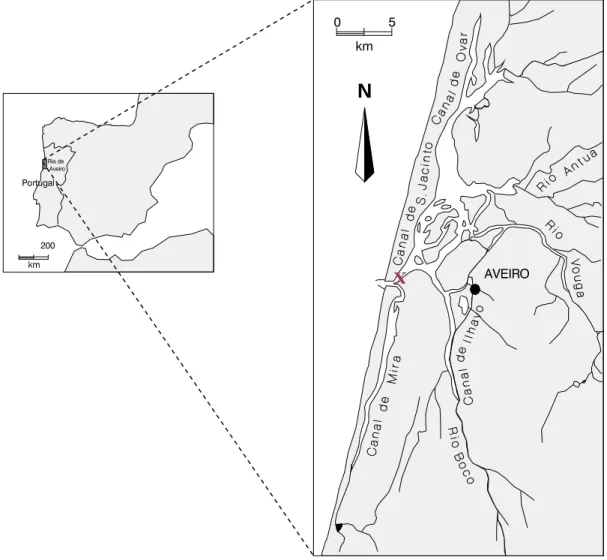
(3) 2.. LOCALIZATION AND PHYSICAL CHARACTERISTICS OF RIA DE AVEIRO. Ria de Aveiro is a shallow coastal lagoon, 47 Km long, located parallel to the Atlantic coast of Portugal, with a maximum water penetration inland of 11 Km. In spring tide covers an area of 83 Km2 at high tide, and 66 km2 at low tide [6]. The lagoon is at the mouth of three rivers, Vouga, Antuã and Boco, and it is connected to the ocean by a single artificial channel. This channel is used for navigation and it is responsible for the exchanges with the ocean through tidal water movements. The contribution of fresh water from the rivers is small compared to the tidal prism at the entrance channel. The present studies were conducted near the bar entrance, at the navigation channel, at a position where it is approximately 260 m wide and the maximum depth is around 23 m. Figure 1 shows the geographical localization. The samples were collected at the centre of the channel (latitude 40o 38’ 43.3 N and longitude 8o 44’ 55.2 W) at the surface and bottom. At surface, besides the centre of the channel, water was also collected at its North edge.. N. X. Figure 1: Localization of The Ria de Aveiro and sampling channel (X). Tidal influence was studied, and samples were collected in the chosen places, during summer, at neap tide and spring tide. Samples were always collected at low tide, flood and high tide. Samples during spring tide were collected on the 26th of June of 2002, at 9:15 h (low tide), 12:30 h (flood) and 15:37 h (high tide). Samples were also collected during neap tide on the 4th of July of 2002, at 8:00 h (flood), 10:23 h (high tide) and 16:23 h (low tide).. Α-1655.
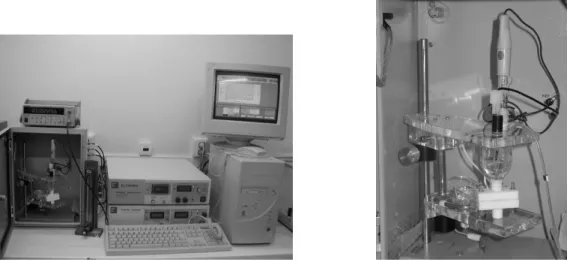
(4) 3.. EXPERIMENTAL. 3.1. INSTRUMENTATION Fig.2 shows the experimental layout. The electrochemical quartz crystal nanobalance (EQCM 700) and the potentiostat / galvanostat (PS-205) were both from Elchema. Quartz crystals were 10 MHz AT-cut HC-6/U with gold electrodes deposited over a chromium layer (ICM-International Crystal Manufacturing Co, Inc) and the Teflon quartz crystal cell and the glass cup were home-made according to a design conceived to allow easy changing of cups and reverse of the crystal face in contact with the solution without dismounting the quartz crystal. The counter electrode was a platinum wire and the reference was an Ag/AgCl (KCl sat) electrode.. Figure 2: Experimental layout (electrochemical quartz crystal microbalance and cell with the three electrodes.. 3.2. PROCEDURE All glassware, as well as the crystal cell and cup, have been soaked in nitric acid, rinsed with Milli-Q water and allowed to dry before the experiments. Samples were collected in polyethylene containers, treated for 3 hours with a synthetic sea water solution, in order to minimize losses of metal by adsorption. Immediately after collection, samples were filtered in Millipore filtration units, through cellulose acetate membranes with 0.45 µm of porosity, previously weighed. The filtrate was collected in polyethylene flasks, acidified till pH<2 and kept at 4oC till the analysis. The membranes containing the particulate fraction were dried at 70oC for 12 hours, after which were kept in a desiccator waiting for digestion. Liquid samples were then treated with a mixture of HNO3 4M and H2O2 30%, and placed into quartz tubes irradiated during 6 hours with an Hg 500 W lamp. Then pH was adjusted to 4.75 with an acetic acid/sodium acetate buffer, prior to the analysis. The membranes with the particulate matter were digested in Teflon vessels with concentrated HCl, HNO3 and HF [7]. After total dissolution, samples were placed in an oven at 80oC for 2 hours. Samples were diluted with MilliQ water and neutralized with HBO3 [7]. Then pH was adjusted to 4.75 with an acetic acid/sodium acetate buffer, prior to the analysis. The analysis used 10.00 mL of the buffered sample. The quartz crystal was at the bottom of the cell, and one of its gold electrodes was in contact with the solution. Reference and counter electrodes were immersed in the solution and nitrogen was bubbled into the. Α-1656.
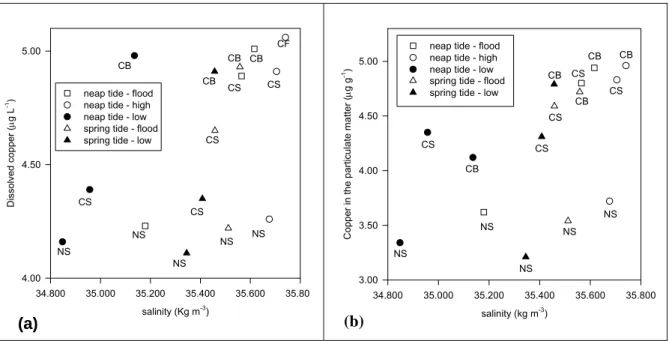
(5) solution for a few minutes, in order to displace oxygen. Mass display was adjusted to zero, and the voltage was then set at -450 mV and held at that value for 3 minutes. A nitrogen flow of 215 mL min-1 was maintained inside the cell, in order to favour convective mass transport, but it was stopped 30 s before the starting of potential scanning towards the positive direction. A nitrogen blanket over the solution was maintained throughout the whole experiment. Potential was swept till +600 mV at a constant rate of 10 mV s-1. Both current and mass were recorded vs. potential.. 4.. RESULTS AND DISCUSSION. Figure 3 shows the copper concentration dissolved (a) and in particulate matter (b) versus salinity.. CF. 5.00. CB CB. -1. Dissolved copper (µg L ). CB neap tide - flood neap tide - high neap tide - low spring tide - flood spring tide - low. Copper in the particulate matter (µg g-1). CB. CS. CS. CS. 4.50. CS. CS NS. NS. NS. NS. CS CS. CB CS. CS. CS CB. 4.00. NS 3.50. NS. NS. NS NS. 4.00. 3.00 35.000. 35.200. 35.400. 35.600. 35.80. 34.800. -3. salinity (Kg m ). (a). CB. CB CB. 4.50. NS 34.800. neap tide - flood neap tide - high neap tide - low spring tide - flood spring tide - low. 5.00. (b). 35.000. 35.200. 35.400. 35.600. 35.800. salinity (kg m-3). Figure 3: Copper concentration in water (a) and particulate matter (b) (NS: North surface, CS: centre surface; CB: centre bottom). Salinity increases from surface to the bottom and so does copper concentration in the water. This increase could be related to lower copper adsorption and release of copper from sediment and particulate matter, and in fact copper content in particulate at the centre of the channel, and in neap tide - low water decreases from the surface to the bottom. However, in flood or high tide or in spring tide, wherever the water is low, high or entering from the ocean, copper concentration, both dissolved or in particulate, always increase with salinity, from the surface to the bottom. This different behaviour is easy to understand, as the turbulence can erode sediments and ressuspend the metal. The effect of ionic strength on metal sorption with the salinities changes in the estuary mixing zone was already described by other authors [3]. It was suggested that calcium and magnesium compete with the metals for adsorption. Another explanation, or a complementary process, is the formation of chlorocomplexes at high salinities, which compete with adsorption [3]. This same explanation can be applied to the increase of dissolved copper with salinity, at the surface, going from North to the centre of the channel. The metal in particulate does not behave as expected by these theories, and does not decrease with salinity, with the exception already discussed of neap tide and low water at the centre of the channel due to the strong turbulence. In fact, it is worth to see that the low metal contents in the particulate were found at the surface of the North. Α-1657.
(6) edge of the channel, where the strength of the water flows is much smaller. Data from maximum velocity of water coming from the mouth and water flows show that minimum values of 0 m s-1 and 0 m3 s-1 were measured in neap tide at low water, with 1.11 m s-1 and 3306 m3 s-1 during flood and 0.43 m s-1 and 797 m3 s-1 at high water. At spring tide values of 0.23 m s-1 and 3 m3 s-1 were found at low water and 1.01 m s-1 and 3481 m3 s-1 during flood and 1.32 m s-1 and 4310 m3 s-1 at high water. The concentrations of copper at the bottom are the highest, both in water as in particulate which is consistent with the presence of an important metal source in the sediments, or with an entrance of copper coming from the ocean, water with high salinity. Although not so common, there are indeed estuaries that import sediments from the sea [4]. The pH and the dissolved oxygen can also play an important role in the transport of metals through the formation of hydroxides, carbonates and other metal precipitates. pH in water varies from 8.57 to 8.68 and dissolved oxygen is higher in low tide, ranging from 5.86 mL L-1 at the bottom, in the centre of the channel, to 5.99 mL L-1 at the surface.. 5.. CONCLUSIONS. The use of a 10 MHz quartz crystal with gold electrodes where copper has been accumulated at -450 mV for 3 minutes, allows the determination of copper in the water as well as in particulate collected from Ria de Aveiro. However, the methodology is not sensitive enough to do metal speciation, and need to be optimized. Changes in cell geometry, stirring rate and in the accumulation period will be tried in the future. Optimization effort is worth as the methodology is intended to be used in the future in adsorption studies, because there is a major advantage in measuring mass besides current. The results obtained so far in the measurement of copper in neap and spring tides, during low and high water tide as well during flood allowed to detect the importance of salinity and oxygen dissolved in copper concentrations in the water column and in particulate. Data suggest that remobilization of copper from the sediments by water turbulence is a major factor that explain the higher copper concentrations in spring tide and in high water or during flooding. The question of how efficient is Ria de Aveiro in trapping particulate and dissolved copper from entering the ocean, and if the ocean can be an input of contaminated sediments is still open and the analysis of other data collected in the navigation channel is under progress. REFERENCES 1. 2. 3. 4. 5. 6. 7.. Gomes, M. T. S. R. (2001) Application of the Piezoelectric Quartz Crystals to the Analysis of Trace Metals in Solution: A Review. IEEE Sensors J., 1, 109-118. Yamasaki, A., Cunha A., Oliveira J.A.B.P, Duarte C.A. and Gomes M.T.S.R (2004) Assessment of Copper Toxicity Using an Acoustic Wave Sensor. Biosens. Bioelectr., 19, 1203-1208. Salomons and Förstner U. (1984) Metals in the HydrocycleSpringer-Verlag Heidelberg. Cancino L. and Neves, R., (1999). Hydrodynamic and sediment suspension modelling in estuarine systems, Part II: Application to the Western Scheldt and Gironde estuaries. J. Mar. Syst., 22, 117-131. Stumm W. (1987) Aquatic Surface Chemistry. John Willey & Sons, New York. Dias J.M., Lopes J.F. and Dekeyser, I., (2000). Tidal Propagation in Ria de Aveiro Lagoon, Portugal. Phys Chem. Earth (B), 25, 369-374. Rantala R.T.T. and Loring D.H., (1975). Multi-element Analysis of silicate Rocks and Marine sediments by atomic absorption Spectrophotometry. At. Absorption Newslett., 14, 117-120.. Acknowledgments: The authors which to thank FCT, POCTI, FEDER and the University of Aveiro for financial support.. Α-1658.
(7)
Imagem
Documentos relacionados
Peça de mão de alta rotação pneumática com sistema Push Button (botão para remoção de broca), podendo apresentar passagem dupla de ar e acoplamento para engate rápido
Uma das explicações para a não utilização dos recursos do Fundo foi devido ao processo de reconstrução dos países europeus, e devido ao grande fluxo de capitais no
Neste trabalho o objetivo central foi a ampliação e adequação do procedimento e programa computacional baseado no programa comercial MSC.PATRAN, para a geração automática de modelos
Ousasse apontar algumas hipóteses para a solução desse problema público a partir do exposto dos autores usados como base para fundamentação teórica, da análise dos dados
financeiras, como ainda por se não ter chegado a concluo entendimento quanto à demolição a Igreja de S. Bento da Ave-Maria, os trabalhos haviam entrado numa fase
Este artigo discute o filme Voar é com os pássaros (1971) do diretor norte-americano Robert Altman fazendo uma reflexão sobre as confluências entre as inovações da geração de
Despercebido: não visto, não notado, não observado, ignorado.. Não me passou despercebido
Muito bom Bom Regular Ruim Muito ruim Não se aplica ou não observado.. A partir dos resultados obtidos, pode-se afirmar que, na opinião dos alunos, o curso possui muitas
