Full Terms & Conditions of access and use can be found at
http://www.tandfonline.com/action/journalInformation?journalCode=tgcl20
Download by: [Universidade Nova de Lisboa] Date: 04 September 2017, At: 10:33
Green Chemistry Letters and Reviews
ISSN: 1751-8253 (Print) 1751-7192 (Online) Journal homepage: http://www.tandfonline.com/loi/tgcl20
Novel biocompatible ionic liquids based on
gluconate anion
Alexandra Costa, Andreia Forte, Karolina Zalewska, Gonçalo Tiago, Zeljko
Petrovski & Luis C. Branco
To cite this article: Alexandra Costa, Andreia Forte, Karolina Zalewska, Gonçalo Tiago, Zeljko Petrovski & Luis C. Branco (2015) Novel biocompatible ionic liquids based on gluconate anion, Green Chemistry Letters and Reviews, 8:1, 8-12, DOI: 10.1080/17518253.2014.951695
To link to this article: http://dx.doi.org/10.1080/17518253.2014.951695
© 2014 The Author(s). Published by Taylor & Francis.
Published online: 06 Nov 2014.
Submit your article to this journal
Article views: 1591
View related articles
View Crossmark data
RESEARCH LETTER
Novel biocompatible ionic liquids based on gluconate anion
Alexandra Costa, Andreia Forte, Karolina Zalewska, Gonçalo Tiago, Zeljko Petrovski and Luis C. Branco*
Departamento de Química, Faculdade de Ciências e Tecnologia, REQUIMTE, Universidade Nova de Lisboa, Caparica, Portugal (Received 20 November 2013; final version received 1 August 2014)
A sustainable organic synthetic methodology for the preparation of novel biocompatible ionic liquids (ILs) based on gluconate anion has been developed. Four functionalized methylimidazolium cations were efficiently combined with gluconic acid by acid-base neutralization reactions. All salts were obtained as RTILs in high yields (92–98%) and in high purity levels. Proton Nuclear Magnetic Resonance (1H NMR) studies had proved the correct cation/ anion proportion (1:1) and their chemical stability. These novel gluconate ILs can be applied for chemistry, material science, and medicine areas.
Keywords: gluconate; biocompatible; ionic liquids
1. Introduction
Ionic liquids (ILs) have emerged as a possible envir-onmentally benign alternative to classic organic sol-vents, mainly due to their almost negligible vapor pressure, high thermal stability and ionic conductivity, large electrochemical window, insolubility in super-critical CO2(scCO2), and dissolution of a large range
of organic molecules and transition metal complexes (1). The physical and structural properties of the ILs are generally dependent on the combination of cation/ anion structures. Applications of ILs (2) include their use as recyclable media for chemical processes, includ-ing bio- and chemical catalysis, CO2capture, biphasic
extraction, gas chromatography, selective transport using supported liquid membranes, pervaporation, dissolution of cellulose, in fuel cells, and their potential use as a matrix for mass spectrometry or as solvent in nuclear electrical power plants, among others.
In the last decade, several synthetic ILs have been produced, characterized from the physical and chem-ical point of view and apply in several research areas (first generation) (3,4).
Their extremely low volatility and high thermal and chemical stability as well as the possibility to incorporate desired functions or properties rendered the denomination of task-specific ILs (second genera-tion) (5,6).
Another recent class of ILs incorporating phar-maceutical drugs had been developed in order to open new platforms for pharmaceutical sciences (third generation) (7,8).
Depending on the cation and anion combination it is possible to develop nontoxic and biodegradable ILs (9).
In this context, different examples of biocompatible organic cations or anions including amino acids, carbo-hydrates, and their derivatives have been used (10).
Our group has worked in all generations of ILs and the discovery of novel biocompatible cation/ anion combinations for several applications (11,12).
Gluconic acid and their derivatives are important for mammalian organisms as intermediates in the carbohydrate metabolism. Gluconate salts are natural substances readily nontoxic and biodegradable both in aerobic and in anaerobic conditions (13). They are listed as permitted food additives, which may be added to all food stuffs as long as no special regulations restrict their use (14).
In recent years, gluconic acid and its salts have been used in the formulation of food, pharmaceutical, and hygienic products (15).
The manufacturing of gluconic acid is based on a fermentation process (16). It is possible to produce gluconic acid from glucose through a dehydrogenation reaction catalyzed by glucose oxidase (17). Oxidation of the aldehyde group on the C-1 of D-glucose to a carboxyl group results in the production of glucono-d-lactone and hydrogen peroxide (18). Production of gluconic acid using the enzyme has the potential advantage that no product purification steps are required if the enzyme is immobilized (19). However, this approach is not yet common in the industry.
*Corresponding author. Email:[email protected]
Vol. 8, No. 1, 8–12, http://dx.doi.org/10.1080/17518253.2014.951695
© 2014 The Author(s). Published by Taylor & Francis.
This is an Open Access article distributed under the terms of the Creative Commons Attribution License (http://creativecommons.org/licenses/by/3.0), which permits unrestricted use, distribution, and reproduction in any medium, provided the original work is properly cited. The moral rights of the named author(s) have been asserted.
Estimation of the worldwide industrial production per year for all the derivatives of gluconate salts is around 100,000 tones.
The properties of sodium gluconate are attractive in particular for this high sequestering power. It is a good chelator at alkaline pH and, in general, better than ethylenediaminetetraacetic acid (EDTA), nitrilo-triacetic acid (NTA), and other commercial available chelators (20). Aqueous solutions of sodium gluconate are resistant to oxidation and reduction at high temperatures. Another relevant characteristic of sodium gluconate is related with this biodegradability and the possibility to use as efficient plasticizer and inhibiting bitterness in foodstuffs (21). It is well suited for removing calcareous deposits from metals and other surfaces, including milk or beer scale on galva-nized iron or stainless steel. Its property of sequester-ing iron over a wide range of pH is exploited in the textile industry (22), where it prevents the deposition of iron and for desizing polyester and polyamide fabrics. It was also used in detergent industry, bottle and dish washing, cleaning of machinery, equipment and transport cages used in food processing, cleaning agent for ceramic surface, among others.
In pharmaceutical field, some gluconate salts showed relevant antiseptic properties as well as potential interest for drug formulation (23).
Herein, we described the sustainable synthesis of novel biocompatible ILs based on gluconate anion combined with different functionalized methylimida-zolium cation as indicated in Figure 1.
2. Materials and methods 2.1. Materials and instruments
All commercial organic solvents were used as supplied from Sigma-Aldrich in analytical purity grade.
Gluconic acid and sodium gluconate (99%, Alfa Aesar), Amberlite IRA-400-OH anionic resin (Sigma-Aldrich), and chloride or bromide functionalized methylimidazolium salts in particular [EMIM][Br], [BMIM][Cl], [C2OHMIM][Cl] and [C3OMIM][Cl]
(Solchemar, >98%) were used as supplied.
Hydrogen-1(1H) and Carbon-13 nuclear magnetic resonance (13C NMR) spectra were recorded on a
Bruker AMX400 spectrometer. Chemical shifts are reported downfield in parts per million using MeOD or D2O as deuterated solvents. Sodium gluconate was
checked by NMR for comparison with gluconate ILs. The removal of the volatile solvent was performed with rotary evaporator equipment (Bruker) accomp-lished under high vacuum.
Differential scanning calorimeter (DSC) analysis was carried out by using a TA Instruments Q-series TM Q200 DSC with a refrigerated cooling system. The sample is continuously purged with 50 mL/min nitrogen gas, and 2–8 mg of salt was crimped into an aluminum standard sample pan with lid. The samples were submitted to an isothermal step (40°C, 10 minutes) and then heated to 250°C (10°C/min). The melting point and the decomposition temperatures were determined in the heating process. The decom-position temperature was determined using the inflec-tion point of the endothermic behavior.
2.2. Synthesis of biocompatible ILs based on gluconate anion
The selected methylimidazolium organic cations in chloride or bromide form ([EMIM][Br]; [BMIM][Cl]; [C2OHMIM][Cl]; [C3OMIM][Cl]; 2.1 mmol) were
dissolved in methanol and passed through an anion-exchange column Amberlite IRA-400-OH (5 eq., flux rate 0.133 mL/mL.min). Then, the prepared hydrox-ide cation solution was slowly added to gluconic acid (2 mmol) dissolved in methanol. The mixture was stirred at room temperature for 1–2 hours after com-plete dissolution. Finally, methanol was evaporated and then the desired pure products were dried in vacuum for 24 h. All the final products were obtained in high yield and purity levels as room temperature ILs (RTILs) (Scheme 1).
1-ethyl-3-methylimidazolium gluconate, [EMIM][glu-conate]: Yellow viscous liquid. Yield: 97% (0.59 g).
1
H NMR (400 MHz, MeOD): 1.48 (3H, t, J = 8 Hz), 3.26 (1H, m), 3.58 (1H, m), 3.75–3.68 (2H, m), 3.89 (3H, s), 3.97 (1H, m), 4.02 (1H, m), 4.23 (2H, t, J = 8 Hz), 7.59 (2H, d, J = 28Hz), 8.94 (1H, s)
Scheme 1. Synthetic methodology for the preparation of novel ionic liquids based on gluconate anion.
Figure 1. Structure of novel gluconate ILs prepared.
Green Chemistry Letters and Reviews 9
13
C NMR (100 MHz, MeOD): 136.91, 123.89, 122.27, 73.74, 72.36, 71.13, 70.87, 62.59, 45.03, 34.05, 14.60.
1-butyl-3-methylimidazolium gluconate, [BMIM][glu-conate]: Pale yellow gel. Yield: 98% (0.65 g).
1 H NMR (400 MHz, MeOD): 1.01 (3H, t, J = 8 Hz), 1.41 (1H, m), 3.89 (2H, m), 3.33 (1H, m), 3.62 (1H, m), 3.83–3.71 (2H, m), 3.95 (3H, s), 4.04 (1H, m), 4.09 (1H, m), 4.24 (2H, t, J = 8 Hz), 7.59 (2H, d, J = 24 Hz), 8.96 (1H, s). 13 C NMR (100 MHz, MeOD): 136.00, 123.30, 122.05, 73.70, 72.06, 71.02, 70.67, 62.19, 48.92, 35.51, 31.30, 18.60, 12.40.
1-ethanol-3-methylimidazolium gluconate, [C2OHMIM]
[gluconate]: Yellow viscous liquid. Yield: 93% (0.60 g).
1 H NMR (400 MHz, MeOD): 3.26 (1H, m), 3.57 (1H, m), 3.76–3.65 (2H, m), 3.83 (2H, t, J = 6 Hz), 3.89 (3H, s), 4.03 (1H, m), 4.26 (2H, t, J = 4 Hz), 7.52 (2H, d, J = 24 Hz), 8.92 (1H, s). 13 C NMR (100 MHz, MeOD): 136.28, 123.31, 122.00, 73.97, 72.06, 71.73, 70.17, 62.09, 59.70, 45.94, 35.61. 1-ethylmethoxy-3-methylimidazolium Gluconate, [C3OMIM][Gluconate]: Yellow gel. Yield: 92%
(0.62 g). 1 H NMR (400 MHz, MeOD): 3.25 (1H, m), 3.55 (1H, m), 3.74–3.61 (2H + 1H, m), 3.87 (3H, s), 3.96 (1H, m), 4.02 (1H, m), 4.33 (2H, t, J =4 Hz), 7.50 (2H, d, J =20 Hz), 8.88 (1H, s). 13 C NMR (100 MHz, MeOD): 138.01, 122.84, 121.90, 72.94, 72.46, 71.83, 71.07, 70.62, 62.59, 58.91, 47.08, 36.24.
Sodium Gluconate, [Na][Gluconate]: White powder.
1H NMR (400 MHz, D2O): 3.58–3.54 (1H, m), 3.67
(1H, m), 3.71 (1H, m), 3.74 (1H, m), 3.94 (1H, m), 4.04 (1H, m).
3. Results and discussion
3.1. Synthesis of biocompatible ILs based on gluconate anion
In this work, a sustainable organic synthetic meth-odology was followed in order to obtain the desired ILs based on gluconate anion in high yields (92–98%) and purity levels (as indicated inScheme 1).
First, four functionalized methylimidazolium cations previously prepared in the chloride or brom-ide form ([EMIM][Br]; [BMIM][Cl]; [C2OHMIM][Cl];
[C3OMIM][Cl]) were efficiently converted into
hydroxide using Amberlite IRA-400-OH anionic resin. This step was optimized through the use of
appropriate quantity of resin and adequate pH con-trol in order to convert completely the initial bromide or chloride salts. Then, hydroxide organic cations were slowly added to gluconic acid in methanol solution. The final gluconate salts were obtained as room temperature ILs (viscous liquids or gels) in high purity after complete drying in vacuum. This sustain-able synthetic strategy avoids the use of metal salts for anion-exchange methods which in general involve several steps of purification and lower reaction yields. The possibility to apply with success a neutraliza-tion acid–base reacneutraliza-tion requires the chemical stability of hydroxide organic cations as well as the use of strong or mild organic or inorganic acids. In this case, methylimidazolium cations are stable in different chemical conditions such as in acidic, basic, oxidative, and reduction media, while gluconic acid is enough strong for effective neutralization reaction.
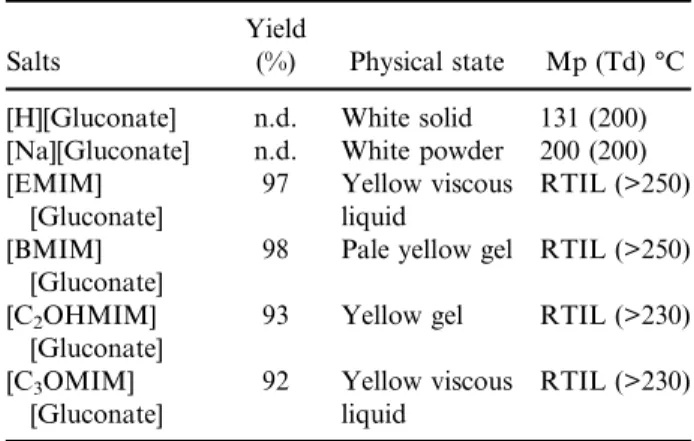
Table 1 summarizes all the prepared gluconate ILs comparing with initial gluconic acid and its sodium salt.
3.2. Characterization of novel gluconate-based ILs All novel biocompatible ILs based on gluconate anion were obtained as viscous liquids or gels comparing with initial solids of gluconic acid (131°C) or its sodium salt (205°C). The exchange of initial inorganic cation to organic bulky cation based on methylimi-dazolium units allowed a significant reduction of their melting point. Additionally, a thermal stability improvement was achieved in the case of gluconate ILs (higher than 230°C) comparing with initial gluconate salts (lower than 200°C).
A detailed1H NMR study was performed in order to check the chemical stability of cation and anion and their correct proportion (1:1 cation/anion) as well as the final purity of the salts (indicative purity level Table 1. Characterization of gluconate salts including prepared ILs.
Salts
Yield
(%) Physical state Mp (Td) °C [H][Gluconate] n.d. White solid 131 (200) [Na][Gluconate] n.d. White powder 200 (200) [EMIM] [Gluconate] 97 Yellow viscous liquid RTIL (>250) [BMIM] [Gluconate]
98 Pale yellow gel RTIL (>250)
[C2OHMIM] [Gluconate]
93 Yellow gel RTIL (>230)
[C3OMIM] [Gluconate]
92 Yellow viscous liquid
RTIL (>230)
according to the presence of protons in NMR spectra). For 1H-NMR spectra of different ILs based on gluconate was selected methanol as deuterated solvent allowing a simplest NMR profile (OH groups from gluconate do not appear in the spectra).
A chemical shift to the left was observed for protons in pendant substituent group of cations and protons close to carboxylate group from gluconate anion in which it is more pronounced in the case of hydrophilic organic cations in particular [C2OHMIM]
and [C3OMIM] examples.
Also, acidic proton (H-2) from the imidazolium ring should interact with gluconate anion by hydrogen bonding. All characteristic carbons from different ILs based on gluconate anions can be identified by analysis of13C NMR spectra.
Depending on the selected organic cation combined with the gluconate anion, it is possible to tune different chemical, physical, and thermal properties. Viscosity, density, water and organic solvent solubilities, polar-ity, and thermal behavior can be modulated through the appropriate selection of functionalized methylimi-dazolium cation.
4. Conclusion
Novel biocompatible chiral ILs based on the efficient combination of functionalized methylimidazolium cation and gluconate anion have been developed.
All high pure gluconate salts have been obtained as RTILs by sustainable organic synthetic methodo-logy based on anionic resin process followed by an acid–base neutralization reaction.
According to the adequate cation/anion combina-tion, it should be possible to tune physical–chemical properties of final gluconate salts. In this context, these novel biocompatible gluconate RTILs can be applied for asymmetric catalysis or chiral recognition processes, taking advantage of gluconate chirality as well as food or pharmaceutical formulations.
A detailed study of physical, chemical, thermal, and biological properties is required in order to elucidate the potential interest of these novel biocom-patible RTILs.
Taking advantage of the peculiar properties of ILs and gluconate salts separately, the combination of these ionic forms can open novel perspectives for future applications in chemistry, medicine, material science, and similar research areas.
Acknowledgments
This work was supported by Fundação para a Ciência e Tecnologia (PEst-C/LA0006/2011, PTDC/CTM/103664/ 2008) and Solchemar Company.
References
(1) Rogers, R.D.; Seddon, K.R. Ionic Liquids as Green Solvents: Progress and Prospects; American Chemical Society: Washington, DC, 2003.
(2) Wasserscheid, P.; Welton, T. Ionic Liquids in Synthesis, 1st ed.; Wiley-VCH: Weinheim, 2002.
(3) Branco, L.C.; Carrera, G.V.S.M.; Aires-de-Sousa, J.; Martin, I.L.; Frade, R.; Afonso, C.A.M. Physico-chemical Properties of Task-specific Ionic Liquid. In Ionic Liquids, Theory and Applications; Kokorin, A., Ed.; Intech: Rijeka, Croatia; 2011; pp 62–94 (Chapter 3). (4) Branco, L.C.; Serbanovic, A.; da Ponte, M.N.; Afonso, C.A.M. Chiral Guanidinium Ionic Liquids for Asymmetric Dihydroxylation of Olefins with Recycling of the Catalytic System by Supercritical CO2. ACS Catal. 2011, 1, 1408.
(5) Branco, L.C.; Pina, F. Intrinsically Photochromic Ionic Liquids. Chem. Commun. (41), 2009, 6204. (6) Branco, A.; Branco, L.C.; Pina, F. Electrochromic and
Magnetic Ionic Liquids. Chem. Commun. 2011, 47, 2300. (7) Hough, W.L.; Smiglak, M.; Rodríguez, H.; Swatloski, R.P.; Spear, S.K.; Daly, D.T.; Pernak, J.; Grisel, J.E.; Carliss, R.D.; Soutullo, M.D.; Davis, Jr., J.H.; Rogers, R.D. The Third Evolution of Ionic Liquids: Active Pharmaceutical Ingredients. New J. Chem. 2007, 31, 1429.
(8) Ferraz, R.; Branco, L.C.; Prudêncio, C.; Noronha, J. P.; Petrovski, Z. Ionic Liquids as Active Pharmaceut-ical Ingredients. Chem. Med. Chem. 2011, 6 (6), 975. (9) Frade, R.F.M.; Rosatella, A.A.; Marques, C.S.;
Branco, L.C.; Kulkarni, P.S.; Mateus, N.M.M.; Afonso, C.A.M.; Duarte, C.M.M. Toxicological Evalu-ation on Human Colon Carcinoma Cell Line (CaCo-2) of Ionic Liquids based on Imidazolium, Guanidinium, Ammonium, Phosphonium, Pyridinium and Pyrrolidi-nium Cations. Green Chem. 2009, 11 (10), 1660. (10) Branco, L.C.; Gois, P.M.P.; Lourenco, N.M.T.;
Kur-teva, V.B.; Afonso, C.A.M. Simple Transformation of Crystalline Chiral Natural Anions to Liquid Medium and Their Use to Induce Chirality. Chem. Commun. (22), 2006, 2371.
(11) Ferraz, R.; Branco, L.C.; Marrucho, I.; Araújo, J.; da Ponte, M.N.; Prudêncio, C.; Noronha, J.P.; Petrovski, Z. Development of Novel Ionic Liquids-APIs based on Ampicillin Derivatives. Med. Chem. Commun. 2012, 3, 494.
(12) Carrera, G.V.S.M.; Frade, R.F.M.; Aires-de-Sousa, J.; Afonso, C.A.M.; Branco, L.C. Synthesis and Proper-ties of New Functionalized Guanidinium based Ionic Liquids as Non-toxic Versatile Organic Materials. Tetrahedron 2010, 66 (45), 8785.
(13) Moyer, A.J. Process for the Gluconic acid production. US patent, No. 2351500, 1940.
(14) Gluconic acid and Gluconate Salts is available in
http://www.jungbunzlauer.com/productsapplications/ products/gluconates.html, 2005.
(15) Moksia, J.; Larroche, C.; Gros, J.B. Gluconate Pro-duction by Spores of Aspergillus niger. Biotechnol. Lett. 1996, 18, 1025.
Green Chemistry Letters and Reviews 11
(16) Röhr, M.; Kubicek, C.P.; Kominek, J. Gluconic Acid. In Biotechnology; Rehm, H.J.; Reed, G., Eds.; Verlag Chemie: Weinheim, Germany, 3, 1983; pp 455–465. (17) Pazur, J.H.; Kleppe, K. The Oxidation of Glucose and
Related Compounds by Glucose Oxidase from Asper-gillus niger. Biochemistry 1964, 3, 578.
(18) de Wilt, H.G.J. Oxidation of Glucose to Gluconic Acid. Survey of Techniques. Ind. Eng. Prod. Res. 1972, 11, 370.
(19) Godjevargova, T.; Dayal, R.; Turmanova, S. Gluconic Acid Production in Bioreactor with Immobilized Glucose Oxidase Plus Catalase on Polymer Membrane Adjacent to Anion-exchange Membrane. Macromol. Biosci. 2004, 4, 950.
(20) Gluconate Application Uses is available inhttp://www. pmpinc.com/Application-Uses (from FMP Fermenta-tion InformaFermenta-tion and related links).
(21) Breslin, P.A.S.; Beauchamp, G.K. Suppression of Bitterness by Sodium: Variation among Bitter Taste Stimuli. Chem. Senses 1995, 20, 609.
(22) Kaewprasit, C.; Hequet, E.; Abidi, N.; Gourlot, J.P. Application of Methylene Blue Adsorption to Cotton Fiber Specific Surface Area Measurement: Part I. Methodology. J. Cotton Sci. 1998, 2, 164.
(23) Senel, S.; Ikinci, G.; Kaş, S.; Yousefi-Rad, A.; Sargon, M.F.; Hincal, A.A. Chitosan Films and Hydrogels of Chlorhexidine Gluconate for Oral Mucosal Delivery. Int. J. Pharm. 2000, 193 (2), 1.