
Mestre em Química
Development of Novel Active Pharmaceutical
Ionic Liquids and Salts Based on Antibiotics
and Anti
-
fungal Drugs
Dissertação para obtenção do Grau de Doutor em Química Sustentável
Orientador: Maria Cristina Prudêncio Pereira Soares, Professor Coordenador com Agregação, ESTSP-IPP
Co-orientador: João Paulo da Costa de Noronha, Professor Auxiliar, FCT-UNL
Co-orientador: Željko Petrovski, Investigador Solchemar
Júri:
Presidente: Doutor Luís Manuel Camarinha de Matos, Professor Catedrático da Faculdade de Ciências e Tecnologia da Universidade Nova de Lisboa
Arguentes: Doutora Maria Paula Pinto Amador, Professora Adjunta da Escola Superior Agrária de Coimbra do Instituto Politécnico de Coimbra
Doutor Carlos Alberto Mateus Afonso, Professor Catedrático da Faculdade de Farmácia da Universidade de Lisboa;
Vogais: Doutor Rúben Miguel Pereira Fernandes, Professor Adjunto da Escola Superior de Tecnologia da Saúde do Instituto Politécnico do Porto
Doutor Nuno Miguel Torres Lourenço, Investigador de Pós-Doutoramento do Instituto Superior Técnico da Universidade de Lisboa; Doutor Luís Alexandre Almeida Fernandes Cobra Branco, Investigador da Faculdade de Ciências e Tecnologia da Universidade Nova de Lisboa
III
Copyright © 2013 Ricardo João Vieira Ferraz. All the Rights Reserved.
V
Acknowledgments
First, I want to acknowledge my supervisors Prof. Cristina Prudêncio, Prof. João Paulo
Noronha and Doctor Željko Petrovski for their support, encouragement and guidance
throughout this work. Their scientific knowledge and teaching expertise as well as their enthusiasm for science contributed to both my professional and personal evolution. Thank you all for trusting in me and in my work.
I would like to thank in particular to Professor Cristina Prudêncio for giving me the opportunity to work with her in Escola Superior de Tecnologia da Saúde do Porto (ESTSP) as a teacher and academic. Thank you also for all the discussions about microorganism and cells growth as well as their biomolecular structures.
Thank to Professor João Paulo Noronha for everything, for giving me the best accommodation in Lisbon, for welcoming in Faculdade de Ciências e Tecnologia da Universidade Nova de Lisboa (FCT-UNL), and for giving me all the analytical knowledge.
To Doctor Željko Petrovski, also a particular acknowledgment. Without him this PhD
would have been much harder to finish. I thank to him for introducing to the Ionic Liquids and for guiding me throughout the reactions mechanisms, purification methods and spectroscopy analysis.
Special thanks to Doctor Luís Branco for his guidance and support during this research on Ionic Liquids and also to Solchemar for providing some of the reagents used in this work. Likewise my acknowledge to Doctor Isabel Marrucho for allowed me to collaborate with her.
To all my colleagues in ESTSP, in particulary to Rúben Fernandes and Mónica Vieira for helping and supporting me in everything, but also to Joana Almeida and Pedro Coelho. A special thanks to my colleagues in Comissão de Horários e Exames for all the support. Also special thanks to all my laboratory colleagues from FCT-UNL in particular Ricardo Salgado, Ricardo Marques, Isabel Pinto and Alexandra Costa for all the encouragement, work and discussion of ideas for PhDs.
To Professor Maria Helena Fernandes for receiving me in her group Laboratory for Bone Metabolism and Regeneration; also to Doctor João Costa-Rodrigues for the hospitality and all the knowledge shared in a new area of knowledge.
VI
I like to acknowledge Marta Rodrigues from Cell Physiology and NMR group Instituto de Tecnologia Química e Biológica Universidade Nova de Lisboa and Pedro Lamosa from CERMAX-Centro de Ressonância Magnética António Xavier both from group Instituto de Tecnologia Química e Biológica Universidade Nova de Lisboa for the help to interpret spectra analysis.
I thank Gabriel Feio from CENIMAT-FCT/UNL for obtaining the CP-MAS 13C spectra.
I also would like to thank Rita Melo from Centro de Ciências e Tecnologias Nucleares for helping me in the ESI mass spectrum characterization.
I would like to thank to Escola Superior de Tecnologia da Saúde do Instituto Politécnico do Porto for its support in everything I required and for financial support (SFRH/PROTEC/49233/2008).
I would also like to thank to Alexandrina Vila Franca for reviewing this thesis.
VII
Resumo
Os Líquidos Iónicos (LIs) são uma classe de compostos que se popularizaram em meados da década de 90 do século XX. Apesar de os LIs serem definidos por uma propriedade física (ponto de fusão), muitas das suas aplicações actuais baseiam-se nas suas propriedades biológicas. Com efeito, o uso de um fármaco na forma líquida é susceptível de evitar alguns dos problemas inerentes ao polimorfismo, responsável por influenciar a solubilidade da droga e a sua dosagem. Adicionalmente, o arranjo de um catião ou anião com um fármaco pode: a) alterar a classificação biofarmacêutica do fármaco; b) influenciar o processo de formulação do fármaco; e c) alterar as propriedades biológicas do Ingrediente Farmacêutico Activo (IFA).
A presente Tese tem como objectivo a síntese e o estudo das propriedades físico-químicas e biológicas de LIs como IFAs a partir de antibióticos beta-lactâmicos (ampicillina, penicilina G e amoxicilina) e a partir do anti-fúngico anfotericina B. Os IFAs usados foram combinados, através de métodos de neutralização tamponados, com adequados catiões hidróxidos. Os catiões hidróxido foram obtidos a partir de halogenetos através troca iónica na resina de Amberlite (na forma OH). Os estudos das propriedades biológicas destes novos compostos foram feitos usando os métodos colorimétricos e de microdiluição.
No total, foram sintetizados 19 LIs (6 LIs baseados na ampicilina, 4 LIs baseados na amoxicilina, 6 LIs baseados na penicilina G, e 4 LIs baseados na anfotericina B) caracterizados por métodos espectroscópicos e analíticos para confirmar a sua estrutura e pureza. O estudo das propriedades biológicas dos LIs sintetizados demonstrou que estes possuem actividade antimicrobiana em bactérias e fungos, inclusive em bactérias resistentes. Este trabalho permitiu, ainda, verificar que os LIs baseados na ampicilina poderiam funcionar como agentes anti-tumorais. Estes resultados confirmam que a escolha do contra-ião pode provocar alterações nas propriedades físico-químicas e biológicas dos IFA-LIs com grande impacto, tendo em conta as suas aplicações.
Palavras-chave: Ingrediente Farmacêutico Activo, Líquidos Iónicos; Agentes
IX
Abstract
Ionic Liquids (ILs) are class of compounds, which have become popular since the mid-1990s. Despite the fact that ILs are defined by one physical property (melting point), many of the potential applications are now related to their biological properties. The use of a drug as a liquid can avoid some problems related to polymorphism which can influence a drug´s solubility and thus its dosages. Also, the arrangement of the anion or cation with a specific drug might be relevant in order to: a) change the correspondent biopharmaceutical drug classification system; b) for the drug formulation process and c) the change the Active Pharmaceutical Ingredients’ (APIs). The main goal of this Thesis is the synthesis and study of physicochemical and biological properties of ILs as APIs from beta-lactam antibiotics (ampicillin, penicillin G and amoxicillin) and from the anti-fungal Amphotericin B. All the APIs used here were neutralized in a buffer appropriate hydroxide cations. The cation hydroxide was obtained on Amberlite resin (in the OH form) in order to exchange halides. The biological studies of these new compounds were made using techniques like the micro dilution and colorimetric methods.
Overall a total of 19 new ILs were synthesised (6 ILs based on ampicillin, 4 ILs, based on amoxicillin, 6 ILs based on penicillin G and 4 ILs based on amphotericin B) and characterized by spectroscopic and analytical methods in order to confirm their structure and purity. The study of the biological properties of the synthesised ILs showed that some have antimicrobial activity against bacteria and yeast cells, even in resistant bacteria. Also this work allowed to show that ILs based on ampicillin could be used as anti-tumour agents. This proves that with a careful selection of the organic cation, it is possible to provoke important physico-chemical and biological alteration in the properties of ILs-APIs with great impact, having in mind their applications.
Keywords: Active pharmaceutical ingredients, Ionic Liquids; Antimicrobial agents,
XI
List of Contents
Acknowledgments ... V Resumo ... VII Abstract ... IX List of Contents ... XI List of Figures ... XVII List of Schemes ... XXIII List of Tables ... XXV List of Abbreviations ... XXVII
Chapter 1. Objectives and General Plan ... 1
1.1 Study Approach ... 3
1.2 Objectives ... 7
1.3 General Plan ... 8
Chapter 2. General Introduction ... 9
2.1 Active Pharmaceutical Ingredients ... 11
2.2 Antimicrobials Agents ... 11
2.2.1 Beta-lactam Antibiotics ... 11
2.2.2 Anti-fungal Agents ... 12
2.2.3 Mechanisms of Anti-Microbial Action and Resistance ... 14
2.3 Anti-cancer Agents ... 16
2.4 APIs Issues in the Pharmaceutical Industry ... 17
2.5 Methods of Preparing Ionic Liquids ... 18
2.6 Ionic Liquids as Active Pharmaceutical Ingredients ... 21
2.6.1 Abstract ... 21
2.6.2 Introduction ... 22
2.6.2.1 Historical Perspective ... 23
XII
2.6.3.1 Ionic Pharmaceuticals and the Polymorphism Problem ... 26
2.6.3.2 Pharmaceutical Activity ... 29
2.6.3.3 Biopharmaceutics Drug Classification System (BCS) ... 38
2.6.3.4 Some Examples of Ionic APIs ... 39
2.6.4 Conclusions and Future Perspectives ... 43
2.7 Recent applications of ILs-APIs... 44
Chapter 3. Material and Methods ... 45
3.1 Synthesis ... 47
3.1.1 Synthesis of Ampicillin ILs ... 48
3.1.1.1 Preparation of Tetraethylammonium (2S,5R,6R)-6-((R)-2-amino-2- phenylacetamido)-3,3-dimethyl-7-oxo-4-thia-1-azabicyclo[3.2.0]heptane-2-carboxylate [TEA][Amp] ... 48
3.1.1.2 Preparation of Trihexyltetradecylphosphonium (2S,5R,6R)-6-((R)-2- amino-2-phenylacetamido)-3,3-dimethyl-7-oxo-4-thia-1-azabicyclo[3.2.0]heptane-2-carboxylate [P6,6,6,14][Amp] ... 50
3.1.1.3 Preparation of 1-Hexadecylpyridin-1-ium (2S,5R,6R)-6-((R)-2-amino-2- phenylacetamido)-3,3-dimethyl-7-oxo-4-thia-1-azabicyclo[3.2.0]heptane-2-carboxylate [C16Pyr][Amp] ... 53
3.1.1.4 Preparation of (2-Hydroxyethyl)trimethylammonium (2S,5R,6R)-6-((R)-2- amino-2-phenylacetamido)-3,3-dimethyl-7-oxo-4-thia-1-azabicyclo[3.2.0]heptane-2-carboxylate [Cholin][Amp] ... 55
3.1.1.5 Preparation of 1-Ethyl-3-methyl-1H-imidazol-3-ium (2S,5R,6R)-6-((R)-2- amino-2-phenylacetamido)-3,3-dimethyl-7-oxo-4-thia-1-azabicyclo[3.2.0]heptane-2-carboxylate [EMIM][Amp] ... 57
3.1.1.6 Preparation of 3-(2-Hydroxyethyl)-1-methyl-1H-imidazol-3-ium (2S,5R,6R)-6-((R)-2-amino-2-phenylacetamido)-3,3-dimethyl-7-oxo-4-thia-1-azabicyclo[3.2.0]heptane-2-carboxylate [C2OHMIM][Amp] ... 60
3.1.2 Synthesis of Penicillin ILs ... 62 3.1.2.1 Preparation of Ammonium
(2S,5R,6R)-3,3-dimethyl-7-oxo-6-(2-phenylacetamido)-4-thia-1-azabicyclo[3.2.0]heptane-2-carboxylate [NH4][Pen] 62
XIII
3.1.2.3 Preparation of Trihexyl(tetradecyl)phosphonium 3 (2S,5R,6R)-3,3- dimethyl-7-oxo-6-(2-phenylacetamido)-4-thia-1-azabicyclo[3.2.0]heptane-2-carboxylate [P6,6,6,14][Pen] ... 65
3.1.2.4 Preparation of 1-Hexadecylpyridin-1-ium (2S,5R,6R)-3,3-dimethyl-7-oxo-6-(2-phenylacetamido)-4-thia-1-azabicyclo[3.2.0]heptane-2-carboxylate
[C16Pyr][Pen] ... 68
3.1.2.5 Preparation of (2-Hydroxyethyl)-Trimethylammonium (2S,5R,6R)-3,3- dimethyl-7-oxo-6-(2-phenylacetamido)-4-thia-1-azabicyclo[3.2.0]heptane-2-carboxylate [Cholin][Pen] ... 70 3.1.2.6 Preparation of 1-Ethyl-3-methyl-1H-imidazol-3-ium (2S,5R,6R)-3,3- dimethyl-7-oxo-6-(2-phenylacetamido)-4-thia-1-azabicyclo[3.2.0]heptane-2-carboxylate [EMIM][Pen] ... 72 3.1.2.7 Preparation of 3-(2-Hydroxyethyl)-1-methyl-1H-imidazol-3-ium
(2S,5R,6R)-3,3-dimethyl-7-oxo-6-(2-phenylacetamido)-4-thia-1-azabicyclo[3.2.0]heptane-2-carboxylate [C2OHMIM][Pen] ... 74
3.1.3 Synthesis of Amoxicillin ILs ... 77 3.1.3.1 Preparation of 1-Ethyl-3-methyl-1H-imidazol-3-ium (2S,5R,6R)-6-((R)-2-
amino-2-(4-hydroxyphenyl)acetamido)-3,3-dimethyl-7-oxo-4-thia-1-azabicyclo[3.2.0]heptane-2-carboxylate [EMIM][Amx] ... 77 3.1.3.2 Preparation of Trihexyl(tetradecyl)phosphonium (2S,5R,6R)-6-((R)-2-
amino-2-(4-hydroxyphenyl)acetamido)-3,3-dimethyl-7-oxo-4-thia-1-azabicyclo[3.2.0]heptane-2-carboxylate [P6,6,6,14][Amx] ... 80
3.1.3.3 Preparation of 1-Hexadecylpyridin-1-ium 6 (2S,5R,6R)-6-((R)-2-amino-2-
(4-hydroxyphenyl)acetamido)-3,3-dimethyl-7-oxo-4-thia-1-azabicyclo[3.2.0]heptane-2-carboxylate [C16Pyr][Amx] ... 82
3.1.3.4 Preparation of 3-(2-Hydroxyethyl)-1-methyl-1H-imidazol-3- (2S,5R,6R)-6- ((R)-2-amino-2-(4-hydroxyphenyl)acetamido)-3,3-dimethyl-7-oxo-4-thia-1-azabicyclo[3.2.0]heptane-2-carboxylate [C2OHMIM][Amx] ... 84
3.1.4 Synthesis of Amphotericin B ILs ... 86 3.1.4.1 Preparation of 1-Hexadecylpyridin-1-ium
XIV
3.1.4.2 Preparation of (2-Hydroxyethyl)-trimethylammonium
(1R,3S,5R,6R,9R,11R,15S,16R,17R,18S,19E,21E,23E,25E,27E,29E,31E,33R,35S,36R, 37S)-33-(((2R,3S,4S,5S,6R)-4-amino-3,5-dihydroxy-6-methyltetrahydro-2H - pyran-2-yl)oxy)-1,3,5,6,9,11,17,37-octahydroxy-15,16,18-trimethyl-13-oxo-14,39-dioxabicyclo[33.3.1]nonatriaconta-19,21,23,25,27,29,31-heptaene-36-carboxylate
[Cholin][AmphB] ... 89
3.1.4.3 Preparation of (3-(2-Hydroxyethyl)-1-methyl-1H-imidazol-3-ium (1R,3S,5R,6R,9R,11R,15S,16R,17R,18S,19E,21E,23E,25E,27E,29E,31E,33R,35S,36R, 37S)-33-(((2R,3S,4S,5S,6R)-4-amino-3,5-dihydroxy-6-methyltetrahydro-2H - pyran-2-yl)oxy)-1,3,5,6,9,11,17,37-octahydroxy-15,16,18-trimethyl-13-oxo-14,39-dioxabicyclo[33.3.1]nonatriaconta-19,21,23,25,27,29,31-heptaene-36-carboxylate [C2OHMIM][AmphB] ... 91
3.1.4.4 Preparation of (3-(2-Methoxyethyl)-1-methyl-1H-imidazol-3-ium (1R,3S,5R,6R,9R,11R,15S,16R,17R,18S,19E,21E,23E,25E,27E,29E,31E,33R,35S,36R, 37S)-33-(((2R,3S,4S,5S,6R)-4-amino-3,5-dihydroxy-6-methyltetrahydro-2H - pyran-2-yl)oxy)-1,3,5,6,9,11,17,37-octahydroxy-15,16,18-trimethyl-13-oxo-14,39-dioxabicyclo[33.3.1]nonatriaconta-19,21,23,25,27,29,31-heptaene-36-carboxylate [C3OMIM][AmphB] ... 93
3.2 Antimicrobial Activity Studies ... 95
3.2.1 Microorganisms and Growth Conditions ... 95
3.2.2 Culture Medium ... 96
3.2.3 Minimum Inhibitory Concentration (MIC) ... 97
3.2.4 Minimum Bactericidal Concentration (MBC) ... 98
3.2.5 Relative Decrease of Inhibitory Concentration (RDIC) ... 98
3.2.6 Growth Rate Studies ... 98
3.3 Cell Line Culture Studies ... 99
3.4 Statistical Analysis ... 100
Chapter 4. Development of Novel Ionic Liquids Based on Ampicillin ... 101
4.1 Abstract ... 103
4.2 Introduction ... 103
4.3 Results and Discussion ... 104
4.3.1 Physical Properties ... 107
XV
4.3.3 NMR Studies ... 109
4.4 Conclusions ... 110
Chapter 5. Antibacterial Activity of Ionic Liquids Based on Ampicillin Against Resistant Bacteria... 111
5.1 Abstract ... 113
5.2 Introduction ... 113
5.3 Results and Discussion ... 115
5.4 Conclusion ... 123
5.5 Experimental Section ... 124
5.5.1 Reagents and Materials ... 124
5.5.2 Bacterial Strain ... 124
5.5.3 Minimum Inhibitory Concentration (MIC) and Minimum Bactericidal Concentration (MBC) ... 124
5.5.4 Growth Rate Studies ... 126
Chapter 6. Anti-tumoral Activity of Ampicillin Ionic Liquids and Their Salts ... 127
6.1 Abstract ... 129
6.2 Introduction ... 129
6.3 Experimental section ... 131
6.3.1 Biological studies ... 131
6.3.1.1 Cell viability/proliferation ... 131
6.4 Results and discussion ... 132
6.5 Conclusions ... 135
Chapter 7. Synthesis of ILs based on Penicillin G, Amoxicillin and Amphotericin B .. 137
7.1 Introduction ... 139
7.1.1 Amoxicillin and Penicilin ... 140
7.1.2 Amphotericin B ... 141
7.2 Material and Methods... 142
7.2.1 General remarks ... 142
7.3 Results and discussion ... 142
XVI
7.3.2 Isolation of the Products ... 144
7.3.3 Biological Activity ... 147
7.4 Conclusions ... 149
Chapter 8. Discussion and Conclusion... 151
8.1 Discussion ... 153
8.1.1 Synthesis ... 153
8.1.2 Biological Studies ... 156
8.2 Conclusion ... 158
8.3 Future Work ... 161
XVII
List of Figures
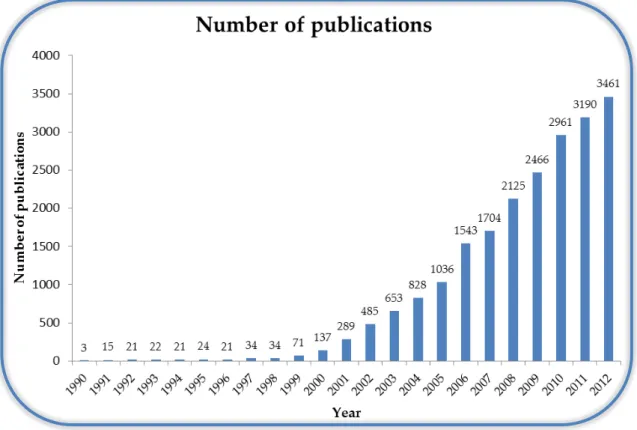
Figure 1.1 Publication frequency of the term “Ionic Liquids” obtained from Web of
Science® database. ... 3
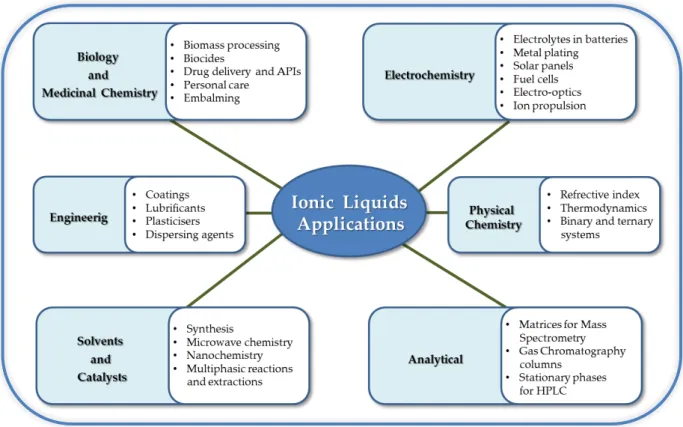
Figure 1.2 Examples of some applications of ILs (adapted from Plechkova Seddon13). .. 4
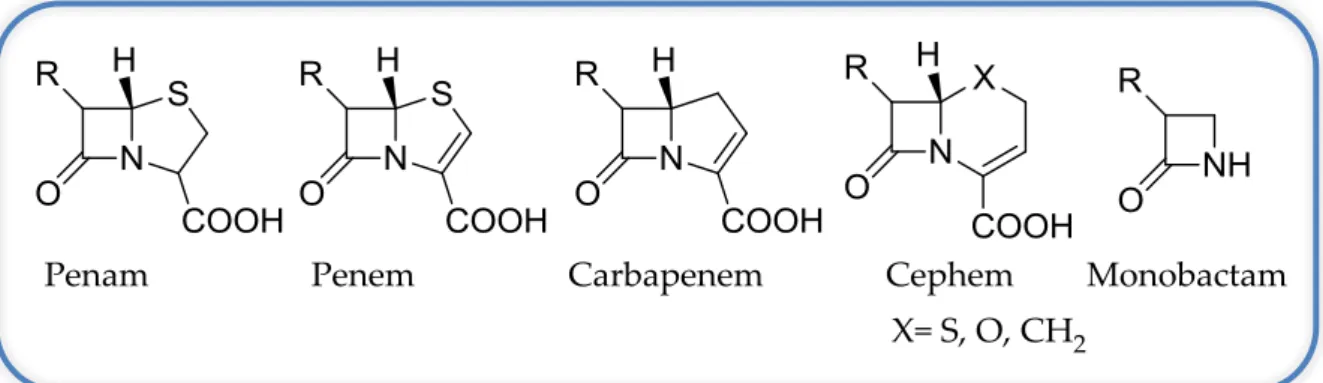
Figure 2.1 General strutures for the five relevant ring strutures of beta-lactams. ... 12
Figure 2.2 Struture of Amphotericin B. ... 12
Figure 2.3 Mechanisms of antimicrobial action and resistance in Gram-negative
organisms. This picture represents a Gram-negative bacteria cell. Black boxes represent mechanisms of drug action and white boxes represent mechanisms of resistance. Below or on the side of each box there are several examples of drugs presenting those types of mechanisms. The main mechanisms of antimicrobial action can be divided into five major classes: (A) those which act in the cell wall synthesis; (B) those which act in the protein translation; (C) those which act in metabolic precursor biosynthesis; (D) those which act in the molecular genetics processes (replication, transcription); and (E) those which disrupt membrane function and permeability. Some of the resistance mechanisms are represented here by numbers: (1) enzymatic inactivation of the drug by the presence of beta-lactamases (1.1); (2) presence of an enhanced efflux pump, whether it is by an active transport system involving ATPases (2.1) or rather if it is driven by proton motive force (2.2), (2.3); (3) porin mutation obstructing the drug entrance; and (4) target modification of the drug, such as the mutation in the penicillin binding proteins (PBPs) (Authorized reproduction)... 15 Figure 2.4 The scientific evolution of ILs, from unique physical properties (Generation
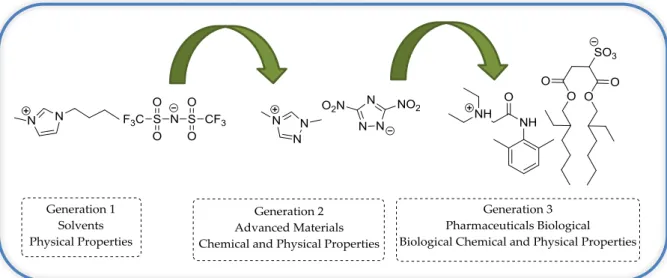
1) through the combination of chemical and physical properties (Generation 2), to the more recent studies of their biological and pharmaceutical activities (Generation 3) [adapted from Hough et al.]8 . ... 23
Figure 2.5 The structure proposed for the heptachlorodialuminate salt (1), intermediate
XVIII
Figure 2.6 Mixture of AlCl3 and 1-ethylpyridinium bromide (5). ... 24
Figure 2.7 1-Butylpyridinium chloride (6) and aluminum chloride mixture (BPC– AlCl3). ... 25
Figure 2.8 Tetrafluoroborate (7), hexafluorophosphate (8), nitrate (9), acetate salts (10), and sulfate (11) as anions combined with 1-ethyl-2-methylimidazolium cation ILs. .... 25
Figure 2.9 Examples of the types of crystal forms of pharmaceutical compounds that can have problems with polymorphism. ... 28
Figure 2.10 Some examples of ILs and their application. ... 30
Figure 2.11 Examples of antibacterial agents. ... 30
Figure 2.12 Examples of potential anticancer agents31. ... 32
Figure 2.13 Examples of anti-biofilm agents135. ... 34
Figure 2.14 Examples of ILs with targeted biological properties combined with adequate selected physical and chemical properties8. ... 37
Figure 2.15 Examples of an antibiotic (37), nonsteroidal anti-inflammatory agent/analgesic (38), and an antiepileptic agent (39) as ILs8,10,145. ... 37
Figure 3.1 Struture of [TEA][Amp]. ... 48
Figure 3.2. [TEA][Amp] 1H-NMR spectrum in CD3OD. ... 49
Figure 3.3. [TEA][Amp] 13C-NMR spectrum in (CD3)2SO. ... 49
Figure 3.4. [TEA][Amp] IR spectrum in KBr. ... 50
Figure 3.5 Struture of [P6,6,6,14][Amp]. ... 50
Figure 3.6. [P6,6,6,14][Amp] 1H-NMR spectrum in CD3OD. ... 51
Figure 3.7. [P6,6,6,14][Amp] 13C-NMR spectrum in CD3OD. ... 52
Figure 3.8. [P6,6,6,14][Amp] IR spectrum in KBr. ... 52
Figure 3.9 Struture of [C16Pyr][Amp]. ... 53
Figure 3.10. [C16Pyr][Amp] 1H-NMR spectrum in CD3OD. ... 54
Figure 3.11. [C16Pyr][Amp] 13C-NMR spectrum in CD3OD. ... 54
Figure 3.12. [C16Pyr][Amp] IR spectrum in KBr. ... 55
Figure 3.13 Struture of [Cholin][Amp]. ... 55
XIX
Figure 3.15. [choline][Amp] 13C-NMR spectrum in CD3OD. ... 56
Figure 3.16. [choline][Amp] IR spectrum in KBr. ... 57
Figure 3.17 Struture of [EMIM][Amp]. ... 57
Figure 3.18. [EMIM][Amp] 1H-NMR spectrum in CD3OD. ... 58
Figure 3.19. [EMIM][Amp] 13C-NMR spectrum in CD3OD. ... 59
Figure 3.20. [EMIM][Amp] IR spectrum in KBr. ... 59
Figure 3.21 Struture of [C2OHMIM][Amp]. ... 60
Figure 3.22. [C2OHMIM][Amp] 1H-NMR spectrum in CD3OD. ... 61
Figure 3.23. [C2OHMIM][Amp] 13C-NMR spectrum in CD3OD. ... 61
Figure 3.24. [C2OHMIM][Amp] IR spectrum in KBr. ... 62
Figure 3.25 Struture of [NH4][Pen]. ... 62
Figure 3.26. [NH4+][Pen] 1H-NMR spectrum in D2O. ... 63
Figure 3.27 Struture of [TEA][Pen]. ... 63
Figure 3.28. [TEA][Pen] 1H-NMR spectrum in CD3OD. ... 64
Figure 3.29. [TEA][Pen] 13C-NMR spectrum in CD3OD. ... 64
Figure 3.30. [TEA][Pen] IR spectrum in KBr. ... 65
Figure 3.31 Struture of [P6,6,6,14][Pen]. ... 65
Figure 3.32. [P6,6,6,14][Pen] 1H-NMR spectrum in CD3OD. ... 66
Figure 3.33. [P6,6,6,14][Pen] 13C-NMR spectrum in CD3OD. ... 67
Figure 3.34. [P6,6,6,14][Pen] IR spectrum in KBr. ... 67
Figure 3.35 Struture of [C16Pyr][Pen]. ... 68
Figure 3.36. [C16Pyr][Pen] 1H-NMR spectrum in CD3OD. ... 69
Figure 3.37. [C16Pyr][Pen] 13C-NMR spectrum in CD3OD. ... 69
Figure 3.38. [C16Pyr][Pen] IR spectrum in KBr. ... 70
Figure 3.39 Struture of [Cholin][Pen]. ... 70
Figure 3.40. [Choline][Pen] 1H-NMR spectrum in CD3OD. ... 71
Figure 3.41. [Choline][Pen] 13C-NMR spectrum in CD3OD. ... 71
Figure 3.42. [Choline][Pen] IR spectrum in KBr ... 72
XX
Figure 3.44. [EMIM][Pen] 1H-NMR spectrum in CD3OD. ... 73
Figure 3.45. [EMIM][Pen] 13C-NMR spectrum in CD3OD. ... 73
Figure 3.46. [EMIM][Pen] IR spectrum in KBr. ... 74
Figure 3.47 Struture of [C2OHMIM][Pen]. ... 74
Figure 3.48. [C2OHMIM][Pen] 1H-NMR spectrum in CD3OD. ... 75
Figure 3.49. [C2OHMIM][Pen] 13C-NMR spectrum in CD3OD. ... 76
Figure 3.50. [C2OHMIM][Pen] IR spectrum in KBr. ... 76
Figure 3.51. a) Sulphoxide Penicillin 1H-NMR spectrum in CD3OD. b) Potassium Penicillin 1H-NMR spectrum in CD3OD. ... 77
Figure 3.52 Struture of [EMIM][Amx]. ... 77
Figure 3.53. [EMIM][Amx] 1H-NMR spectrum in CD3OD. ... 78
Figure 3.54. [EMIM][Amx] 13C-NMR spectrum in CD3OD. ... 79
Figure 3.55. [EMIM][Amx] IR spectrum in KBr. ... 79
Figure 3.56 Struture of [P6,6,6,14][Amx]. ... 80
Figure 3.57. [P6,6,6,14] [Amx] 1H-NMR spectrum in CD3OD. ... 81
Figure 3.58. [P6,6,6,14] [Amx] 13C-NMR spectrum in CD3OD. ... 81
Figure 3.59. [P6,6,6,14][Amx] IR spectrum in KBr. ... 81
Figure 3.60 Struture of [C16Pyr][Amx]. ... 82
Figure 3.61. [C16Pyr][Amx] 1H-NMR spectrum in CD3OD. ... 83
Figure 3.62. [C16Pyr][Amx] 13C-NMR spectrum in CD3OD. ... 83
Figure 3.63. [C16Pyr][Amx] IR spectrum in KBr. ... 84
Figure 3.64 Struture of [C2OHMIM][Amx]. ... 84
Figure 3.65. [C2OHMIM][Amx] 1H-NMR spectrum in CD3OD. ... 85
Figure 3.66. [C2OHMIM][Amx] 13C-NMR spectrum in CD3OD. ... 86
Figure 3.67. [C2OHMIM][Amx] IR spectrum in KBr. ... 86
Figure 3.68 Struture of [C16Pyr][AmphB]. ... 87
Figure 3.69. [C16Pyr][AmphB] 1H-NMR spectrum in (CD3)2SO. ... 88
Figure 3.70. [C16Pyr][AmphB] 13C-NMR spectrum in (CD3)2SO. ... 88
XXI
Figure 3.72 Struture of [Cholin][AmphB]. ... 89
Figure 3.73. [Cholin][AmphB] 1H-NMR spectrum in (CD3)2SO. ... 90
Figure 3.74. [Cholin][AmphB] IR spectrum in KBr. ... 91
Figure 3.75 Struture of [C2OHMIM][AmphB]... 91
Figure 3.76. [C2OHMIM][AmphB] 1H-NMR spectrum in (CD3)2SO. ... 92
Figure 3.77. [C2OHMIM][AmphB] IR spectrum in KBr. ... 93
Figure 3.78 Struture of [C3OMIM][AmphB]. ... 93
Figure 3.79. [C3OMIM][AmphB] 1H-NMR spectrum in (CD3)2SO. ... 94
Figure 3.80. [C3OMIM][AmphB] IR spectrum in KBr. ... 95
Figure 3.81. 13CP-MAS NMR spectrum: a) TMS, b) [C16Pyr][AmphB], c) [C3OMIM][AmphB], d) [C2OHMIM][AmphB]. ... 95
Figure 4.1 Structure of cations used. ... 106
Figure 4.2 Comparative 1H-NMR study of [Cholin][Amp] for four temperatures (25, 45, 65 and 85 oC) and two NMR regions (1 to 2 ppm and 6.5 to 8.8 ppm) in DMSO. ... 110
Figure 5.1 Representation of the prepared API-ILs based on ampicillin anion. ... 116
Figure 5.2 Representation of growth curves (Log(optical density) vs Time) from resistant Gram-negative strains bacteria E. coli AmpC Mox2 (a); E. coli TEM CTX M9 (b); E. coli CTX M2 (c) in the case of API-IL [C16Pyr][Amp] for different concentrations. For comparison no compound addition experiments were performed. ... 122
Figure 6.1 Structure of compounds prepared based on ampicillin. ... 130
Figure 6.2. Struture of [C2OHMIM] cation. The circles is show the possible point of interactions with ampicillin. ... 134
Figure 7.1. Struture of Ampicillin [Amp], Amoxicillin [Amx] and Penicillin [Pen]. .... 140
Figure 7.2 Ionic Liquids based on amphotericin B. ... 142
XXIII
List of Schemes
Scheme 2.1 General procedure for the metathesis reaction and acid base neutralization.
... 18 Scheme 2.2 Examples of the preparation of imidazolium halides using classic methods
from Lévêque et. al88. ... 19
Scheme 2.3 General procedure for the synthesis of ILs using imidazole carbenes. ... 20
Scheme 4.1 Schematic synthetic procedure for the preparation of ampicillin-based ILs.
... 106 Scheme 7.1 Grob fragmentation of a general 1,3-diheterosubstituted substrate (from
Prantz et al.158)... 145
XXV
List of Tables
Table 2.1 Solubility of AmphB in different solvents from Lemke et al.44 ... 13
Table 2.2 Minimum inhibitory concentrations (MIC) for various ILs and starting salts
... 31 Table 2.3 The minimum bactericidal or fungicidal (MBC) concentrations for various ILs
and starting salts. ... 31
Table 2.4 Antitumor activity (GI50 [mm][a] and LC50 [mm][b] data) of compounds 26–30
(Figure 2.12) from five dose studies with the NCI 60-cell-line[c] screen from Kumar and
Malhotra31. ... 33
Table 2.5 MIC and minimum biofilm eradication concentration (MBEC)[a] in mM of
1-alkyl-3-methylimidazolium chlorides ([Cnmim]Cl) (33) from Carson et al135. ... 35
Table 2.6 BCS[a] classification of drugs and in vitro/in vivo correlation (IV/IVC)
expectations for immediate release products based on the biopharmaceutics class, from Löbenberg et al146. ... 39
Table 2.7 Examples of drugs (or their APIs) that could be used in ILs as listed in the
2009 Top-200 generic drugs by retail dollars147. ... 40
Table 2.8 Some examples of ionic liquid salt pairs having both cation and anion as
active component from Kumar et al.142 ... 42
Table 4.1 Physical Properties of ILs-APIs based on ampicillin. ... 107
Table 4.2 Thermal Properties (Tm, Tg and Tdec) of ILs-APIs based on ampicillin. ... 109
Table 5.1 Minimum inhibitory concentrations (mM) on the ampicillin sensitive
bacterial strains tested. ... 117 Table 5.2 Minimum inhibitory concentrations (mM) on the ampicillin resistant
bacterial strains tested. ... 118 Table 5.3 Relative Decrease of Inhibitory Concentration (RDIC) of ampicillin anion in
XXVI
Table 5.4 Relative Decrease of Inhibitory Concentration (RDIC)a) of ampicillin anion in
[Cat][AMP] comparing with Sodium Ampicillin for ampicillin resistant bacteriaa. ... 120
Table 5.5 Growing rates for the different organisms in the presence and absence of
[P6,6,6,14][Amp]. ... 121
Table 6.1 IC50 and LD50 in µMof the ILs based on ampicillin against primary human
cell lines. ... 132 Table 6.2 IC50 and LD50 in µM of the ILs based on ampicillin against cancer cell lines.
... 133 Table 7.1 Yield for the synthesis of ILs based on APIs. ... 143
Table 7.2 Minimum inhibitory concentrations (mM) of the new compounds produced
List of Abbreviations
Ace Acesulfamate
Amp Ampicillin
AmphB Amphotericin B
Amx Amoxicillin
API-ILs Active Pharmaceutical Ingredients – Ionic Liquids
APIs Active Pharmaceutical Ingredients
ATTC American Type Culture Collection
BA Benzalkonium
BCS Biopharmaceutics Drug Classification System
BF4 Tetrafluoroborate
BV Bed Volumes
Cat Cation
DDA Didecyldimethylammonium
DSC Differential Scanning Calorimetry
EMIM 1-Ethyl-3-methylimidazolium
ESI-MS Electrospray Ionization Mass Spectrometry
FDA Food and Drug Administration
GF Gingival Fibroblasts
HAIs Health Care-Associated Infections
HDPC Hexadecylphosphocholine
HepG2 Liver Cancer Cell Lines
IC50 Half Maximal Inhibitory Concentration
XXVIII
LB Lysogeny Broth
LD50 Median Lethal Dose
m.p. Melting Point
MBC Minimal Bactericidal Concentration
MG63 Osteosarcoma Cancer Cell Lines
MIC Minimal Inhibitory Concentration
MTT 3-(4,5-Dimethylthiazol-2-yl)-2,5-diphenyltetrazolium Bromide
NMR Nuclear Magnetic Resonance
PBPs Penicillin-Binding Proteins
PC3 Prostate Cancer Cell Lines
Pen Penicillin
PYCC Portuguese Yeast Culture Collection
RDIC Relative Decrease of Inhibitory Concentration
RKO Colon Cancer Cell Lines
RTILs Room Temperature Ionic Liquids
Sac Saccharinate
SF Skin Fibroblasts
T47D Breast Cancer Cell Lines
Tdec Decomposition Temperature
TEA Tetraethylammonium
Tg Glass Transition Temperature
Tm Melting Temperature
WHO World Health Organization
XTT 2,3-bis[2-Methoxy-4-nitro-5-sulfophenyl]-2H-tetrazolium-5-carboxyanilide
inner Salt
XXXI
“Organic chemistry nowadays almost drives me
mad. To me it appears like a primeval tropical
forest, full of the most remarkable things, a
dreadful endless jungle into which one does not
dare enter for there seems to be no way out”
Chapter 1.
1
Objectives and General Plan
1.1 Study Approach
Ionic Liquids (ILs) are a new type of compounds, which have become a hot topic since the mid-1990s1. A literature search in Web of Science® database has revealed that the
term “Ionic Liquids” in 1990 only had 3 results, in 2002, it had 485 results and in 2012,
it had 3461 results (Figure 1.1). ILs have been attracting a great interest in the last decade. At the same time, there has been a growing awareness of the range of properties that ionic liquids can possess2.
Figure 1.1 Publication frequency of the term “Ionic Liquids” obtained from Web of Science®
The definition of ILs, although ambiguous, is generally defined as salts with melting points below 100 oC (many are liquid at room temperature), and composed only by
discrete cations and anions3.ILs are not new compounds, they have been known for
over a century,but just quite recently they have become under intense worldwide scrutiny, not only due to the implications of their use as solvents3,4, but mainly because
of the biological applications of ILs. Biologically active ions have been used to make new ILs. However, the primary driver for these materials has been the use of ions of known low toxicity to obtain the IL physical property set5. They have been used as
potential alternatives to the classical volatile organic solvents2,6-9.
Recently, the attention for ILs came from other areas like biology and medicine. Despite the fact that ILs today are defined by one physical property (melting point), many of the potential applications are now using combinations of chemical or biological properties, such as in the study of energetic materials or pharmaceutical ILs 9-11. ILs are indeed tuneable, multipurpose materials for a variety of applications, rather
than just solvents12 (Figure 1.2).
As described below, the present work was designed in order to develop new methods of producing ILs based on Active Pharmaceutical Ingredients (API) and the study of their biological applications. This approach could be particularly useful for the pharmaceutical industry because ILs can offer new and distinctive properties compared to the solid pharmaceutical forms.
The selected pharmaceutical drugs were divided in two classes: 1) beta-lactam antibiotics 2) anti-fungal (Amphotericin B). For all the cases, the drugs were used as anion combined with organic cations based on imidazolium, ammonium, phosphonium and pyridinium structures.
The organic cations such as cetylpyridinium, choline and imidazolium structures were selected based on their biocompatibility and recent applications in the pharmacy field9.
Cetylpyridinium is a cation and is used as an antiseptic, present in most toothpastes 14-16. Choline is an available metabolite of phosphatidylcholine and has an important
contribution in both proliferative growth and programmed cell death17. Imidazolium
cations are one of the most common cations in ILs field and they are being applied as antibacterial18-21, antifungal22 and anti-tumour23. There are also some studies about the
toxicological effect of these cations24,25.
A more sustainable synthetic strategy was explored for all the Active Pharmaceutical Ingredients – Ionic Liquids (API-ILs) according with the final interest and the API stability. The most conventional synthetic method for the preparation of ILs involves a metathesis reaction step by the anion exchange of halide salts with adequate metal salts. The pure IL can be obtained by the elimination of undesired inorganic salts (mainly sodium, potassium or lithium chloride or bromide) using a precipitation followed by filtration or other efficient separation processes such as ultra or nanofiltration methods. This work further explores ion exchange resin methods recently developed by Fukumoto et al26.
antibacterial activity against sensitive Gram-negative bacteria Escherichia coli ATCC 25922 and Klebsiella pneumonia (clinically isolated), as well as Gram-positive Staphylococcus aureus ATCC 25923, Staphylococcus epidermidis and Enterococcus faecalis. The arising resistance developed by bacteria to antibiotics is a serious public health threat and needs new and urgent actions such as the development of new drugs that show an efficient antimicrobial activity. In this context, we also intended to study the antibacterial activity of these new compounds against a panel of resistant bacteria (clinically isolated strains): E. coli CTX M9, E. coli TEM CTX M9, E. coli TEM1, E. coli CTX M2, E. coli AmpC Mox227-29.To better understand the behaviour of these drugs in
human cell line and to explore the dual activity (antibacterial and anti-tumour) of the ILs with ampicillin anion [Amp]23,30,31, we also studied anti-proliferative activity against
five different human cancer cell lines, in particular T47D (breast), PC3 (prostate), HepG2 (liver), MG63 (osteosarcoma) and RKO (colon) and two primary human cell types, namely, skin fibroblasts (SF)and gingival fibroblasts (GF). On the one hand, the right conjugation of the cation and the anion can be relevant on modifying the correspondent biopharmaceutic drug classification system (BCS)9,32, as well as their
drug formulation process. On the other hand it increases the activity of the drug or gives the drug a new function.
This work also pretends to show the applications of the neutralization method using exchange resin in pharmaceutical industry. The applications of this method are described on the synthesis of Amphotericin B (AmphB) conjugated with different cations. AmphB is a polyene antibiotic and one of the most frequently used against fungal infections33. Due to the fact that AmphB is insoluble in water there are two ways
of administering AmphB. One is through the addition of sodium desoxycholate to form a mixture, which provides a colloidal dispersion for intravenous infusion, following reconstitution (Fungizone)33,34. But this approach has some inconvenient
side effects such as nephrotoxicity33,35. The other form of administration is by single
bilayer liposomal drug delivery system (Ambisome®)33,36. This allows large dose
1.2 Objectives
The general objectives of the present work were:
a) the synthesis of ILs based on antibiotics (ampicillin, penicillin G and amoxicillin) and Amphotericin B
b) the study of the physical and chemical properties of the compounds newly synthetized;
c) the study of the biological properties of the new compounds obtained.
c1) the study of antimicrobial activity on bacteria and yeast cells
c2) the study of cellular viability and the cytotoxicity of the new compounds obtained on human cell lines
The particular objectives of each chapter are described as follows:
Chapter 4 – the objectives were to develop a method to synthesize ILs
based on ampicillin and to analyze the physical and chemical properties of these new ILs.
Chapter 5 – in this chapter the aims were to study the antibacterial
activity of ILs based on ampicillin against Gram-positive and Gram-negative and against resistant strains and to compare the results with sodium ampicillin.
Chapter 6 – the goal was to study the anti-proliferative activity against
five different human cancer cell lines, in particular T47D (breast), PC3 (prostate), HepG2 (liver), MG63 (osteosarcoma) and RKO (colon) of the Ampicillin-ILs. Besides that, evaluate the toxicity on two human cell lines.
Chapter 7 – Here, the intention was to synthetize several ILs based on
1.3 General Plan
The present work is composed of 9 chapters, including the current chapter describing the objectives and the general plan of the work developed (Chapter 1). In Chapter 2 the state of the art of the work in ILs and the importance that ILs have on the development of APIs is described. A mini review in ILs as APIs was included in this chapter (the content of this subchapter was published in Chemmedchem, 2011, 6, 975-9859). Chapter 3
describes all the material and methods used during this work. Chapter 4, Chapter 5, 6, and 7 describe the work developed according to specific objectives. These Chapters present the results obtained, and are reproductions of the papers that have already been published, accepted or submitted.
In Chapter 4 – Development of Novel Ionic Liquids Based on Ampicillin, which was published in Medchemcomm, 2012, 3, 494-497, describes a new methodology of the synthesis of ampicillin ILs and the relevant physical properties of these novel ionic liquids based on ampicillin.
In Chapter 5 – Antibacterial Activity of Ionic Liquids Based on Ampicillin Against
Resistant Bacteria - the antibacterial activity of new ionic liquids (ILs) containing
ampicillin anion was described in comparison to sodium salt of ampicillin on resistant bacteria. This chapter was submitted to RSC Advances and is a reproduction of the paper.
On the other hand, Chapter 6 – Anti-tumoral Activity of Ampicillin Ionic Liquids and Their Salts, describes anti-proliferative effects against different tumour cell lines
using innovative APIs. The content of this chapter is a reproduction of a manuscript ready to submit.
Chapter 8 – Discussion and Conclusion, gives a general discussion of all the work,
summarizing the main conclusions. In this chapter the future perspectives are also presented.
Chapter 2.
General Introduction
This chapter contains parts of a published review article: Ionic Liquids as Active Pharmaceutical Ingredients
Ricardo Ferraz, Luís C. Branco, Cristina Prudêncio, João Paulo Noronha and
Željko Petrovski.
Chemmedchem, 2011, 6, 975-985.
2
General Introduction
2.1 Active Pharmaceutical Ingredients
The World Health Organization (WHO) defines APIs as “a substance used in a finished
pharmaceutical product (FPP), intended to furnish pharmacological activity or to otherwise have direct effect in the diagnosis, cure, mitigation, treatment or prevention of a disease, or to have direct effect in restoring, correcting or modifying physiological
functions in human beings”37. Therefore, the API is the active compound present in a
drug while the inactive substances are the excipients. For the pharmaceutical industry, the differences between APIs and drugs are of extreme importance. Understanding these differences is fundamental for manufacturers to specialize in, for regulators to focus on resources; and for pharmacists to produce equivalents to brand name products.
2.2 Antimicrobials Agents
2.2.1 Beta-lactam Antibiotics
A compound responsible for killing or inhibiting the growth of a microorganism is called an antimicrobial agent38. An antibiotic compound indicates that it came from a
natural source.38
There are many classes of antibiotics. One of the most important, due to its extensive use are the beta-lactamic antibiotics. This class is characterized by the presence of a beta-lactam ring, a highly strained and reactive cycle amide38. Attending to the type of
Figure 2.1 General strutures for the five relevant ring strutures of beta-lactams.
The largest group of beta-lactam antibiotics are penams. This group includes penicillin, ampicillin and amoxicillin. Penams are composed of an enclosed dipeptide formed by the condensation of L-Cysteine and D-Valine resulting in the beta-lactam ring and in the thiazolidinic ring producing the 6-aminopenicillanic acid38,39.
Beta-lactamic antibiotics are specific for bacteria. Bacteria are prokaryotic cells, so they have many structural and metabolic pathways that are different from eukaryotic cells38.
2.2.2 Anti-fungal Agents
Amphotericin B (AmphB) entered in clinics in 1958 (Figure 2.2) and for nearly 30 years it was almost the only drug available for controlling some severe fungal infections40,41.
There are other types of anti-fungals; especially heterocyclic compounds like imidazole or triazole40,42.
At the present time, the most common antifungal therapies are limited because of
drug’s toxicity42. Nevertheless, AmphB, such a well-known nephrotoxic drug continues
to be the drug of choice against life-threatening systemic infections with fungi, such as Candida albicans or Aspergillus fumigatus42 and also against visceral and cutaneous
leishmaniasis. To avoid and decrease the toxicity of AmphB new formulations have been made since 199043.
AmphB is a low-soluble polyene antifungal which is able to self-aggregate43 and is the
most important member of the mycosamine family, which includes nystatin, candidin and rimodicin. AmphB at an industrial scale is extracted from Streptomyces nodosus43,44.
In 1988 the total synthesis of AmphB was described by Nicolaou et al.45 but the
biotechnological production was much cheaper and more efficient44. There have been
some innovations in synthetic procedures, but the focus is in the synthesis of new analogues with improved antifungal activity and/or water solubility44. AmphB is a
yellow product and has a polar and apolar side of the lactone ring giving the molecule its amphiphilic behaviour. Besides, AmphB has an ionisable carboxyl and amine group (Figure 2.2), which gives amphoteric properties to this drug42-44. These
physico-chemical properties are the reason why AmphB is poorly soluble in all aqueous solvents and in many organic solvents43. As shown in Table 2.1, the solubility of
AmphB in water is less than 1 mgL-1 at physiological pH, at pH below 2 or above 11 is
soluble but is not stable under these conditions43.
Table 2.1 Solubility of AmphB in different solvents from Lemke et al.44
Solvent Solubility (mgL-1)
Water <1 (at pH 6–7)
Methanol 2000
Ethanol 500
Chloroform 100
Petrol ether 10
Dimethyl formamide 2
Propylene glycol 1
Due to AmphB´s toxicity problems (nephrotoxicity) and to its poor oral absorption, it was necessary to adapt some formulations of the drug: liposomes or colloidal dispersions33,43. AmphB form of Fungizone® is a surfactant-stabilised formulation that
helps in the oral solubility and is currently and exclusively administered parenterally33,34. However, this has been associated to some adverse side effects33,35.
Liposomal preparations, like Ambisome®, allow the application of higher dose tolerance of dissolved AmphB33,43 without inducing the adverse side effects. This formulation
could be the most popular choice in the future43.
2.2.3 Mechanisms of Anti-Microbial Action and Resistance
One of the biggest problems of ampicillin, amoxicillin, penicillin and the other penams is the reactivity of the highly strained ring that causes the degradation process of these compounds. At room temperature, the nitrogen of the beta-lactam ring is easily protonated by acids, and is followed by nucleophilic attack of the remaining lateral chain carbonyl38,39. Therefore, the oxazoline formed will produce a new imidazole and
finally penicillic acid.
Another problem, besides chemical degradation, is that of a group of enzymes that specifically destroy and inactivate beta-lactams. Many bacteria produce these enzymes called penicillinases and the beta-lactamase is the most prevalent type of these enzymes38,46.
Normally, antibiotics can be divided in 5 categories, according to the mechanism of action38: a) inhibition of cell wall synthesis; b) impairment cytoplasmic membrane; c)
Figure 2.3 Mechanisms of antimicrobial action and resistance in Gram-negative organisms. This
picture represents a Gram-negative bacteria cell. Black boxes represent mechanisms of drug action and white boxes represent mechanisms of resistance. Below or on the side of each box there are several examples of drugs presenting those types of mechanisms. The main mechanisms of antimicrobial action can be divided into five major classes: (A)those which act in the cell wall synthesis; (B) those which act in the
protein translation; (C) those which act in metabolic precursor biosynthesis; (D)
those which act in the molecular genetics processes (replication, transcription); and (E)those which disrupt membrane function and permeability. Some of the resistance
mechanisms are represented here by numbers:(1)enzymatic inactivation of the drug
by the presence of beta-lactamases (1.1);(2) presence of an enhanced efflux pump,
whether it is by an active transport system involving ATPases(2.1)or rather if it is
driven by proton motive force (2.2),(2.3); (3) porin mutation obstructing the drug
entrance; and (4) target modification of the drug, such as the mutation in the
penicillin binding proteins (PBPs) (Authorized reproduction).
Until approximately 1960, scientists produced and developed more than 20 new classes of antibiotics. Since then, only two new classes of antibiotics have appeared47. The
problem of resistance presented by bacteria has been well known for approximately 20
This figure was kindly offered by the author from “beta-Lactams: chemical structure, mode of action and mechanisms of resistance”, Reviews in Medical Microbiology, R. Fernandes, P. Amador
years or more but the pharmaceutical industry does not invest in the development of new antibiotics47. This may be due to the fact that the period necessary for bacteria to
develop resistance is becoming shorter48, which consequently increases the challenges
that pharmaceutical industry faces9. Instead of developing new antimicrobial agents
that have proved to be more expensive and unsuccessful48 ,the scientific community
seems now to be opting for another approach – the modification of existing antimicrobial agents48,49.
Nowadays, bacterial resistance to different antibiotics is a major public health problem27,30,50,51. Recent outbreaks that evidence this problem27-29,52 are cases such as the
one found in Germany for E. coli O10453,54 as well as the emergence of
multi-drug-resistant organisms, as in the of Gram-negative Enterobacteriaceae associated to the
New Delhi metallo β-lactamase55-57. In fact, bacterial resistance, not only has public
health implications, but is also a global safety threat, specifically at an economic and social level58,59. The latest studies have also reported the significant financial burden on
health care-associated infections (HAIs) in the USA60,61. In the UK, approximately 9% of
hospitalized patients acquire an infection after post-admission to hospital, which increases the costs in the health care system60,62.
In this context, it is important to know and study the resistance mechanisms, and also to study non-antibiotic compounds as antimicrobial agents to find new therapeutic strategies to reduce the spread of resistant bacteria and their evolution.
2.3 Anti-cancer Agents
Anti-cancer agents are drugs used to inhibit cell cancer growth. Nowadays, cancer is one of the most important causes of morbidity and mortality worldwide63. In most
cases, effective cancer care requires the linkage of early diagnosis to the appropriate use of therapy63. The research for new anti-cancer agents is focused on avoiding
tumour resistance and decreasing the toxicity associated with chemotherapies23. In
entity has some pharmaceutical relevance, its bioavailability also becomes a challenge31,64,65. Because of that, the research for new strategies to solubilize these types
of substances is essential64,66,67. One way to overcome the solubility and stability
problems of APIs is salt formation23,31. There are many examples where pharmaceutical
active cations and anions have been combined together. The resulting salt exhibits therapeutic effects of both its components31 and many of these salts have some
characteristics of ILs. So it is possible to prepare ILs (using their tuneable properties) as anti-cancer agents31,68.
2.4 APIs Issues in the Pharmaceutical Industry
“The pharmaceutical industries are undoubtedly experiencing a series of challenges”69.
This industry has always faced difficult challenges in the innovation of drugs, but normally, these difficulties can be overcome with an increase of the final product prices70. One of the difficulties is the amount of regulation that authorities demand to
approve a new drug (particularly in the case of the US Food and Drug Administration (FDA))70. The complications are due to the solid form of many drugs, like low
solubility, polymorphism and low bioavailability. Adding to these, there are related problems, like low solubility media of the drug molecule or the starting material for synthesis of drugs in aqueous systems and in most of the pharmaceutical acceptable organic solvents69.
These issues like polymorphism could be solved using ILs form of the API because ILs can be specially made with pre-selected characteristics by varying the cations and anions of which they are comprised.71
As referred before, there is another big problem that the pharmaceutical industry is facing, drug resistance. This is a problem of the pharmaceutical industry but it also affects public health. In general, antimicrobial resistance is the capacity that any microorganism, like bacteria, fungi and parasites has to neutralize or to deteriorate the drugs which become ineffective38,75-77. This is of major concern because drug resistance
is deadly, can spread to other microorganisms, and carry out costs to individuals and society75-82. Many of the drug treatment breakthroughs of the last century could be lost
through the spread of antimicrobial resistance. As a result, many infectious diseases may one day become uncontrollable and could rapidly spread throughout the world82.
In terms of bacteria resistance, this problem is currently and directly responsible for 15 times as many deaths as AIDS every year in Europe75.
2.5 Methods of Preparing Ionic Liquids
ILs are usually prepared from ammonium, phosphonium or sulphonates ions83. There
are 2 main methods of preparing ILs: metathesis and acid base neutralization (Erro! A origem da referência não foi encontrada.). In the case of imidazolium cations we could
consider another method, that developed by Earl and Seddon: the reaction of imidazole carbenes as strong bases84.
Scheme 2.1 General procedure for the metathesis reaction and acid base neutralization.
is necessary, when an organic halide salt is formed through the alkylation of a base by a haloalkane85. This method can also be used to prepare pyridinium and imidazolium
halides (Scheme 2.2). Currently, the use of non-conventional methods like microwave24,86 and ultrasound techniques 24,87 is being applied in the quaternization
reaction with better results24,88.
Scheme 2.2 Examples of the preparation of imidazolium halides using classic methods from
Lévêque et. al88.
The metathesis reaction is used to prepare ILs halide free like [EMIM][BF4] from the
halide salt ([EMIM]I) and from silver or a group 1 metal (Ag[BF4])85. Other ILs have
been prepared using metathesis reaction like thiocyanate, nonafluorobutanesulfonate, bis((trifluoromethyl)sulfonyl)imide, tris(trifluoromethyl)sulfonyl, methide, trifluoro-acetate, and heptafluorobutanoate. This reaction is quite simple and easy to prepare. Nevertheless, this reaction has some inconvenients, like the contamination with a small amount of halide ions, which may react with solute materials and the presence of water or silver24,85. Recently Srour et al.24 have shown a silver and water free metathesis
reaction. Another problem considering metathesis reactions is the limited variety of commercially available metal salts and also the coordination transition metal with bioactive compounds like aminoacids26,89.
The acid base neutralization method avoids the contamination problem90. This
procedure is also quite simple and through the use of equimolar mixing, it is possible to obtain the salts without the formation of by products90. This method results very
to use hydroxide quaternary cations30. Recently ion exchange resin methods have been
developed by Ohno and co-workers26,91-93.
The use of imidazole carbenes as a strong base84 (Scheme 2.3) also has the advantage of
non-contaminated ILs with halide ions or metal ions, but the main advantage is the possibility of preparing ILs or salts from alcohols like methanol and propanol, from carbonic acid, acetic acid and alkyl sulphonic acid. The disadvantage is that it only works to prepare imidazolium ILs.
2.6 Ionic Liquids as Active Pharmaceutical Ingredients*
2.6.1 Abstract
Ionic liquids (ILs) are ionic compounds that possess a melting temperature below 100
oC. Their physical and chemical properties are attractive for various applications.
Several organic materials that are now classified as ionic liquids were described as far back as the mid-19th century. The search for new and different ILs has led to the progressive development and application of three generations of ILs:
1) The focus of the first generation was mainly on their unique intrinsic physical and chemical properties, such as density, viscosity, conductivity, solubility, and high thermal and chemical stability.
2) The second generation of ILs offered the potential to tune some of these physical and
chemical properties, allowing the formation of “task-specific ionic liquids” which can
be used as lubricants, energetic materials (in the case of selective separation and extraction processes), and as more environmentally friendly (greener) reaction solvents, among others.
3) The third and most recent generation of ILs involves active pharmaceutical ingredients (API), which are being used to produce ILs with biological activity.
Herein, we summarize recent developments in the area of the third-generation ionic liquids that are being used as APIs, with a particular focus on the efforts to overcome current hurdles encountered by APIs. We also offer some innovative solutions in new medical treatment and delivery options.
2.6.2 Introduction
Ionic liquids (ILs) have been a topic of great interest since the mid-1990s1.They have
attracted particularly high attention in recent years; approximately 1800 papers were published in the area of ILs in 2008 alone,94 documenting a variety of new IL
applications. The range of IL uses has broadened, and there has been a significant increase in the scope of both physical and chemical IL properties over the years2,95.
ILs are generally defined as organic salts with melting points below 100 oC (some of
them are liquid at room temperature) and composed entirely of ions94-97. Despite the
fact that ILs were first reported in the mid-1800s, widespread interest in this compound class has occurred only recently. ILs have come under worldwide scrutiny mainly through their use as solvents2-4,94. In particular, the room temperature ionic liquids
(RTILs), also known as “designer solvents” (because it is possible to create an IL with a
given required property), have served as greener alternatives to conventional toxic organic solvents3,94,98. RTILs have been used for several other applications, and their
development continues at a considerable rate owing to their peculiar physical and chemical properties such as high thermal and chemical stability, lack of inflammability, low volatility, and tunable solubility with several organic compounds. By taking advantage of their unique properties,94,99 several IL applications have been described,
including reaction media for many organic transformations,94,100 in separations and
extractions,94,101,102 as electrolytes for electrochemistry,94,103,104 in nanotechnology,94,105,106
in biotechnology,94,107 and in engineering processes,94,108,109 among others.
ILs can be grouped into three generations according to their properties and characteristics8. The first generation includes ILs for which the accessible physical
properties such as decreased vapor pressure and high thermal stability110 are often
unique (Figure 2.4, 1st Generation). The second-generation ILs have potential use as functional materials, such as energetic materials, lubricants, and metal ion complexing agents, (Figure 2.4, 2nd Generation). By taking advantage of their tunable physical and
and designed to enable the production of new useful materials while maintaining the main properties of an IL. Some RTILs have been used as reaction media to produce or improve the preparation of various pharmaceuticals3,111,112. Recently, the third
generation of ILs8 (Figure 2.4, 3rd Generation) has been described using active
pharmaceutical ingredients (APIs) to produce ILs with biological activity.
Figure 2.4 The scientific evolution of ILs, from unique physical properties (Generation 1)
through the combination of chemical and physical properties (Generation 2), to the more recent studies of their biological and pharmaceutical activities (Generation 3) [adapted from Hough et al.]8 .
While a tremendous amount of research has focused on the physical and chemical properties of ILs, more recently, the toxicity and biological behavior of ILs have been included as two of the most highly debated topics in this field. Biologically, active ions have been used to develop novel ILs; however, the primary drive behind the research into these materials has been focused on the use of well-known low-toxicity ions to obtain ILs with the desired set of properties5,8,113.
2.6.2.1 Historical Perspective
The first ionic liquid was described as “red oil” and was produced in the course of
Friedel-Crafts reactions carried out in the mid-19th century. However, the composition of this red oil was only lately identified as a salt. For AlCl3-catalyzed reactions, the
Figure 2.5 The structure proposed for the heptachlorodialuminate salt (1), intermediate in the
Friedel-Crafts reactions. An example of alkylammonium nitrates: ethylammonium nitrate (2).
Modern ILs are quite different from those of the beginning of the 20th century, such as the alkylammonium nitrates 2, shown in Figure 2.5114. The most common ILs
containing quaternary heterocyclic cations (such as alkylpyridinium or dialkylimidazolium) and inorganic anions have an ancestry traceable to traditional high-temperature molten salts114. The inorganic chloroaluminates are considered
examples of salts between the truly high-temperature molten salts (such as cryolite or LiCl–KCl) and the current ionic liquids.
The history behind the alkali chloroaluminate molten salts is a good example of fundamental research emerging rather quickly into practical application. In an example case, researchers at the United States Air Force Academy (Colorado Springs, CO, USA) picked up on the work carried out by Frank Hurley and Thomas Wier115,116 about
electrodeposition of aluminum using AlCl3 – based molten salts. This led to the
development of electrolytes for thermal batteries based on mixtures of AlCl3 and
1-ethylpyridinium halides, mainly bromide (Figure 2.6).
Figure 2.6 Mixture of AlCl3 and 1-ethylpyridinium bromide (5).
One of most important breakthroughs in the history of ILs is related to the discovery of the 1-butylpyridinium chloride–aluminum chloride mixture (BPC–AlCl3, Figure 2.7)117.
bromide–chloride ionic liquids117, but had some disadvantages, which lead to new
research and developments that brought forth the water-stable ionic liquids114,118,119.
Figure 2.7 1-Butylpyridinium chloride (6) and aluminum chloride mixture (BPC–AlCl3).
The research for novel water-soluble ILs was described by Fuller et al.120,121 using a
series of ILs from the traditional dialkylimidazolium cations combined with different anions (tetrafluoroborate, hexafluorophosphate, nitrate, acetate, and sulfate) along with the additional series of mostly larger anions (Figure 2.8). Over the years, new classes of cations and anions have been reported94. Because ILs are intrinsically safer
than highly volatile and flammable organic solvents, their use as solvents improves the safety margins and the environmental performance in solution chemistry95. Nowadays,
the interest from disciplines outside chemistry and engineering is growing. Recent IL applications include the use in sensors, solar cells, solid-state photocells and batteries, as well as thermal fluids, lubricants, hydraulic fluids, and ionogels. ILs are indeed tunable, multipurpose materials for a variety of applications12.
Figure 2.8 Tetrafluoroborate (7), hexafluorophosphate (8), nitrate (9), acetate salts (10), and


![Table 2.5 MIC and minimum biofilm eradication concentration (MBEC) [a] in mM of 1-alkyl-3- 1-alkyl-3-methylimidazolium chlorides ([C n mim]Cl) (33) from Carson et al 135](https://thumb-eu.123doks.com/thumbv2/123dok_br/16489707.733106/67.892.122.773.361.824/table-minimum-biofilm-eradication-concentration-methylimidazolium-chlorides-carson.webp)
