multiplatform listening
DOI: 10.1590/1809-5844201737
María del Pilar Martínez-Costa
(Universidad de Navarra, Facultad de Comunicación, Departamento de Proyectos Periodísticos. Pamplona, Espanha)
Nair Prata
(Universidade Federal de Ouro Preto, Departamento de Ciências Sociais, Jornalismo e Serviço Social, Programa de Pós-Graduação em Comunicação Ouro Preto – MG, Brasil)
Abstract
Radio is a mass medium conditioned by technological changes. From its beginnings, it has also been a public communication space that fosters complicity, closeness and personal interaction with
its audience, which is now ampliied with the possibilities offered by the digital environment. This
paper describes a selection of radio initiatives that show the permanent effort of the radio to seek
the audience in the old and new communication scenarios. The purpose of this description is to
characterize the new radio listening and consumption model. Keywords: Radio. Audience. Experiments. Listening. New models.
Introduction
The radio is a medium which has never been kept apart from technological changes. The evolution of the ways of production, distribution and reception has been projected through the coniguration of the contents and the forms of interaction with the audience
since the centenary origins of the medium.
With the emergence of digital technology, and the extension of internet networks in
the early 1990s, the radio was again forced to redeine its processes, including its model of
listening. As Orihuela points out, “media change when the culture of the audience changes, and although the change is induced by technology, its nature is deeper: it has to do with the new ways by which information is produced, distributed and consumed” (2015, p.22 – Our translation).
the public which are constituted by communities of relationships within digital environment
(garcÍa avilÉs, marTÍneZ-cosTa, 2016, p.268).
The radio has an advantage when playing in this new scenario, since it remains
a privileged space of complicity, proximity, and personal interaction with its audience. Before, it was emphasized that the key to the success of the radio was to invest on the contents, but now, this key has changed, since it invests on the search of the audience at the physical and virtual settings in which the audience is. Reaching the audiences, talking to them, establishing a dialogue, narrowing the complicity is the path sought and found by radio which has worked in order to extend to new formulas of conversation, without abandoning its traditional design.
In this context, this article presents a compilation of sound products and/or services that show a permanent effort of the radio to seek the audience in both old and new scenarios,
as well as in platforms of communication. The purpose of this description is to characterize
a new model of listening and consumption of the radio.
The description is presented in eight topics: 1. investments on alternative and
non-conventional media (Radio for reading; Radio for walking; Radio for carrying); 2.
Transmedia content; 3. visualization of information; 4. social initiatives; 5. new social platforms of transmission; 6. Brand radio; 7. reconiguration of contents through new businesses (diversiication of products in radio business; opening to other businesses
unrelated to radio); 8. Expansion of podcast.
We have applied qualitative methodology, of a descriptive type. We took samples intentionally, according to their intensity, that is, “the components of the sample have been selected deliberately according to the characteristics required for observation, perception and analysis of the main motivations of the research” (FRAGOSO; RECUERO; AMARAL, 2011, p.67 – Our translation).
Ultimately, we propose a table, which synthesizes the characteristics of the traditional
model of radio communication, and the convergent, digital model. The new model of
listening and radio consumption is characterized by the strategic combination of traditional models with new possibilities of digital convergence.
Investments on alternative and non-conventional media
Radio listening from a traditional computer is not always the solution found when it
is desired to talk to audiences, at where they are. There are several experiments, even some unconventional ones, which conirm this. it is a new scenario in charge of boosting the
radio for greater interactivity with the listeners, and promoting a change in the radio model,
Radio for reading
one of the irst internet radio experiments in Brazil took place in the state of ceará,
with Rádio Rui - Uirapuru de Itapipoca - known as a “mute” internet radio, because it transmitted no sound, only text. In 1992/1993, Brazilian researchers used a list on the web
to develop a series of text messages, such as radio programming. The creator of the “radio
station” was the researcher and professor of Electrical Engineering Antonio Mauro Barbosa
de oliveira. however, without the possibility of transmitting audio, since the network did
not have multimedia tools, he anticipated some ideas that were used some time later on the
internet. The slogan of the station was “Rádio Rui Uirapuru de Itapipoca, The new leader of the world” (Bufarah, 2005).
The messages began to be sent every friday in the afternoon, between January 1992 and January 1993. There were 55 “broadcasts”, and each new written program was
enhanced by more followers. Although he was neither a professional nor a researcher in Communication, Antonio Mauro created characters/presenters to facilitate the appreciation/ recognition of users/readers towards/with the program. At the opening of one of the “programs” of the station, the “announcer” said: “Rádio Rui is the only radio that does not speak ... but it is heard”.
Figure 1 – A part of the programming of Rádio Rui
Source: https://amauroboliveira.wordpress.com.
Radio for walking
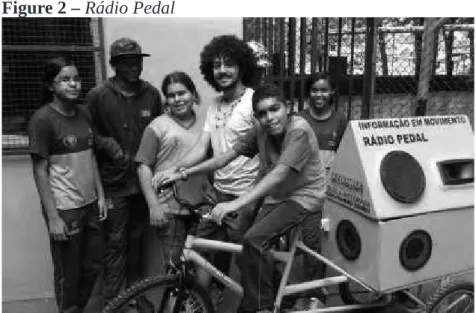
The Brazilian Rádio Pedal – “Information in Motion” was established in June 2011,
in the city of Belo horizonte, state of minas gerais. it is a three-wheeled vehicle equipped
and residents. during the class intervals, the radio is also broadcast. The school develops a project called radioschool workshop, which created the Rádio Pedal. The structure of the studio is complete: a table with four channels, computer, ampliier, three microphones, ive
portable recorders (LEMOS, 2015).
Figure 2 –Rádio Pedal
Source: Lemos (2015).
Radio for carrying
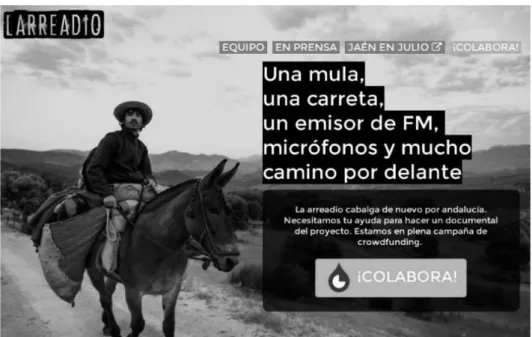
With the slogan “A mule, a cart, an FM transmitter, microphones, and a lot of road ahead”, the Spanish experimentation Larreadio started with an expedition which went
from may to June of 2013. The radio station was itinerant, and crossed the mountains of andalusia on a mule to tell the stories of the town. alejandro Pérez, born in the province of Jaén, studied Journalism and economics in madrid, and decided to do a series of programs
and reports with people who did not have access to media.
during the trips, alejandro used to stay in each town for two or three days, identiied
the people to interview and elaborated his reports. Later, he would set up his technical equipment – the portable studio, the transmitter, the antenna, etc. – and with a megaphone, he would walk around the town to announce what time the program began and at what
frequency, as it was different in each town. The programs were broadcast live in each locality, with a 6w station and a dipole antenna. The produced material is currently
available on the web. A year later, he planned a more ambitious trip in Andalusia, from
Jaén to cadiz, with the andalusian ilmmaker José manuel alguacil, who documented the journalist’s adventure. in order to achieve that, they proposed a collective inancing through
Figure 3 –Homepage of Larreadio
Source: http://larreadio.com.
Transmedia content
The term transmedia can be understood as a narrative technique that consists of
telling a story through multiple platforms and formats, using the resources of each medium to develop and expand the story, and including the participation and contribution of users
(marTÍneZ- cosTa, 2015). vicente, rojas and vicente (2015-2016, p.13) emphasize
that the narrative convergences are the renewal of radio content.
An example is the popular TV Globo’s soap opera called “Êta mundo bom!”, whose story takes place between 1940-1950, known also as the golden years of radio. In the plot, the characters listened to a radio soap opera called “Herança de Ódio”. As a transmedia strategy, TV Globo decided to produce and broadcast the radio soap opera for a real audience, through Rádio Globo. Since then, and three times a week, the Brazilian population would follow on the radio the plot of “Herança de Ódio” which fascinated the characters of “Êta Mundo Bom!”. The radio station was also available on the group’s website, both in audio and video formats. it should be noted that each of the three platforms (Tv, radio and internet)
Figure 4 – Herança de Ódio broadcasting page
Source: http://gshow.globo.com/webseries/radionovela-heranca-de-odio/playlists/0/radionovela-heranca-de-odio.html.
another similar example of television iction which has been transformed into sound
product is the online radio program Morning Glory, which emerged in Spain, in 2013 season, as a spin-off or program derived from the television series called “Ciega a Citas”, broadcast through channel Cuatro. Its protagonist works in a radio station, and attends to a
sentimental ofice. This is detonating for the radio version of an hour daily program, which
has been constructed as an independent magazine, with its own contents and professionals. It has been on the web for two seasons and, although its contents are a promotional window
of the iction content of mediaset group, it is a transmedia experience that gives results, is
spread in social networks, and aspires to compete with the morning shows of specialized stations.
Figure 5 –Morning Glory in channel Cuatro
Information visualization
The radio also makes efforts to use other media languages, and to offer added content
for new audiences on new platforms. For instance and as Jarvis points out, the complementary
use of data, which is “a new and crucial opportunity for the media” that ind in them the
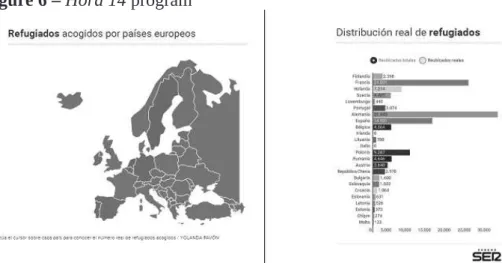
opportunity to collect, analyze and present the context of current information (2015, p.80-81). For example, considering the refugee crisis in Europe, the Spanish program Hora 14 of
Cadena SER offered data coverage after 5 months of the agreements signed by the European Union to address that situation. What the antenna could only expose in a synthetic and very
simpliied way, the interactive charts and maps completed the information with original
developments. On other occasions, the resulting charts and tables were also accompanied
by the compilation of sounds of available iles from the stations.
Figure 6 – Hora 14 program
source: http://cadenaser.com/programa/hora_14.
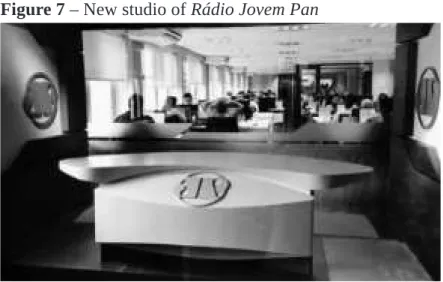
Another example is one of the largest Brazilian radio networks, Rede Jovem Pan,
which is now experimenting in the visual ield. The station broadcasts the news program Jornal da Manhã, from Monday to Saturday, from 5 a.m. to 10 a.m., and the innovation lays
on adding visual content to audio news. The format of the news is the same, but the listener can access the images through mobile devices, tablets, computers etc. The station works
with the concept of “radio with image”, and also plans to add videos and visual interaction with audiences. In addition to Jornal da Manhã, the radio plans to bring images to all
Figure 7 – New studio of Rádio Jovem Pan
source: http://tudoradio.com/noticias/ver/14620-exclusivo-apos-reformas-nos-estudios-fm-e-news-jovem-pan-modiica --estrutura-para-videos-on-line.
Social initiatives
The radio has been present in emergencies situations specially when bringing
affected communities into contact. It is one of the vocations of radio, the provision of
services with the aim of supporting the populations in their daily life (ZuculoTo, 2012).
In Chile, for instance, a country that concentrates 30% of the world seismic energy, the
radio plays a fundamental role when other media cannot reach the population. Thus, the national emergency ofice of chile (onemi – acronym in spanish) manufactured a solar radio receiver that is part of an emergency kit of chilean families. The radio is a cardboard
whose receiver catches FM transmissions, and can be stored, easily distributed among the population, and with energy guaranteed by a solar paper with which it is manufactured.
Figure 8 – Cardboard box radio for emergencies in Chile
New broadcast social platforms
In addition to traditional radio-listening equipment, broadcasts on the internet, and applications on smartphones, the radio has found new transmission platforms in spaces
originally intended for interpersonal communication or social networks. as Peñaiel-saiz (2002, p.30 – our translation) points out, there are more transcendent changes in the ield
of technologies, such as “the extraordinary mutation of languages”.
In Brazil, the reporter Marcos Wor has created a radio that only exists within a WhatsApp group, the Rádio Voice. When each participant in the group requests the execution
of a song, marcos makes comments on the request, and sends the music to everyone. Thus, the “listeners” download and listen to the music. To warn that the program is going to start,
the announcer changes the status of the radio group to “on air”, and when it changes, it returns to the “off” position. Currently, the Rádio Voice has three programs: Manhã Notícia,
Tarde Sertaneja and Flash Back. To participate in the program, anyone can send a message to + 55-17-99121-8387.
Figure 9 – Proile of Rádio Voice on Facebook
Source: https://www.facebook.com/radiovoicewhatsapp/timeline.
Journalism students from Faculdade Cearense in Brazil have also created a radio broadcast in WhatsApp, called “Rádio Zap”. There was a traditional radio at the college
that transmitted during the intervals of the classes. however, due to a reformation, and the boxes of sound have been moved. The students decided to create short radio programs, up to two minutes, for intervals of classes, broadcast through whatsapp. The proposal was to
combine humor to a more informal language, besides being a space of experimentation for
Figure 10 – Pictures of Rádio Zap
Source: http://www.somosvos.com.br/programa-intervalo-e-radio-zap-a-radio-que-e-transmitida-pelo-whatsapp.
Facebook has also become a platform for radio broadcast. A radio on that social
network made for female audience was the idea of the Brazilian businessman vladimir
Batalha, who created in 2012 Rádio Ella FM to offer company to women. The content is entirely dedicated to women, with nine programs about many different topics, such as
technology, games, inancial life, investments, and personal inances. The programming does not have a ixed airtime, but works throughout podcasts. The facebook page warns its
followers every time a new program is ready.
Figure 11 – Facebook page of Rádio Ella FM
Source: http://exame.abril.com.br/tecnologia/noticias/radio-feminina-ella-fm-estreia-no-facebook.
Facebook has also been the path found by Relevant Radio, a broadcaster of the
american catholic church, aimed at reaching young people. in addition to the proile with
content on the social network, the radio uses Facebook to broadcast mass, a rather unusual
strategy. during an interview to rome reports portal, the station’s director, father francis hoffman, said: “where do we ind young listeners? on social networks, that’s where we
come to them. If we go out on the streets, we can see what they have on their hands; a
mobile phone. we are already there”. The social networks of the station have between 12
Figure 12 – Facebook page of Relevant Radio
Source: https://www.facebook.com/Relevantradionetwork.
Brand radio
it is possible to point out the coniguration of a new radio environment in the corporate sphere, such as stations designed for speciic companies, constituting what is known as brand radio. The brand radio – or corporate radio – “can be understood as a
tailor-made station for a particular company, following the precepts of its organizational culture”
(PraTa; marTins, 2017, p.2 – our translation).
A Brazilian example is Luiza Radio, a station of Magazine Luiza Company, one of the largest of its type in Brazil, with almost 740 stores and eight distribution centers among 16 states, selling furniture, home appliances, electronics, gifts, toys, computers, etc.
in 2005, the company created speciic communication channels: Rádio Luiza, TV Luiza
and Portal Luiza. The radio works 24 hours a day, through software developed by Shasta
Company, according to the speciic characteristics of Magazine Luiza. The public of the
radio are the employees of the company, and the programming has been done to provide not only entertainment, but also news and institutional information. Still, the programming is not the same for the whole country, as they vary from one region to another. In total, the radio sends programming to almost 800 points, reaching about 30.000 people, with
Figure 13 – Table of Rádio Luiza transmission
source: Table provided by the production staff.
Another example is a Brazilian radio station which transmits content to the users/ drivers/passengers of a highway. CCR FM, also known as CCR NovaDutra FM, or FM NovaDutra, is a station which operates exclusively on the Presidente Dutra highway,
connecting the states of rio de Janeiro and são Paulo, in a 402-kilometer journey. The radio
is run by NovaDutra highway concessionaire, which won the bidding to operate the radio when it took administrative control of Dutra. The radio operates on the fm 107.5 mhz frequency on the entire length of the road, and its programming is specialized in guiding
drivers in transit (KischinhevsKY, 2014). The advertising campaign is structured around the concept “The only road that talks to you”.
Figure 14 – Release banner of Rádio CCR FM
Reconiguration of content through new business
The issue of business models on the radio has been a recent discussion. oroino (2011) explains that the term business model was irst used in 1975, and has gained
prominence since the 1990s, as a result of dot com companies, e-commerce and knowledge economy. Due to the expansion of the internet and the migration of advertising, “radio has experimented new modes of production and business models in digital environments”
(Pessoa; PraTa; avelar, 2017, p.161 – our translation). Thus, new business models have been boosting radio, and the diversiication of products seems to be the path found
by many broadcasters to have sustainability when facing uncertainty. We can point to at
least two ways of product diversiication: within the business itself, and the opening to
possibilities unrelated to the radio.
Diversiication of products in the radio business
Rádio Pelo Mundo began as a small proposal, in August 2004, when three professionals
from the city of Belo horizonte decided to join forces and create Webradio Pelo Mundo (PraTa; marTins, 2011). The station was a great success. however, in order to ensure
its sustainability, the company became an agency of digital content production, which has already operated in six segments: 1. Production and transmission of Rádio Pelo Mundo;
2. creation and production of corporative Tvs; 3. creation and production of corporative
radios; 4. Planning, creation, production and development in digital environments, focusing on the internet and alternative digital media; 5. Creation and production of content for mobile phones; 6. Production of digital content.
The opening to other businesses unrelated to the radio
Considering its audience, the strength of one of the most important and powerful stations in Brazil, Rádio Itatiaia, lays on the programs of sports, and more speciically, soccer. In 2014, the station created Itatiaia Rádio Bar, a bar with its brand, which accommodates 250 people, aiming at gathering soccer lovers. From their tables, the public can reach part of the historical collection of Itatiaia, remember the most important goals of their football
team and listen to interviews and relevant news. The bar offers events such as concerts,
stand-ups, conferences, round tables on various topics, programs for female audience and courses, among other activities. At the bar, the audience can also watch the soccer matches
on the city’s largest led display. Itatiaia Rádio Bar is always crowded, and it is interesting how a triangulation among the broadcasters, the bar and the public is done, having soccer as the central element of the content.
Figure 16 – Pictures of Itatiaia Rádio Bar
Source: http://www.itatiaiaradiobar.com.br.
Podcast expansion
Podcasts have been clearly pointed out as one of the trends regarding the development of new digital radio content. Several authors consider the year 2016 as the year of the podcast,
as consumption has increased at international level. after the success of the irst season of Serial in the United States, communication groups such as The New York Times have decided to invest in the development of podcasts, following examples from other newspapers, such as The Guardian and The Wall Street Journal, focused on attracting income and listeners.
Similarly in Spain, traditional broadcasters have begun to be interested in developing podcasts. In 2016, Prisa Radio oficially presented Podium podcast, a lively and lexible network with à la carte sound offer which adapts to the needs of each listener, providing content of Prisa Radio’s own production from stations in colombia, mexico, chile,
argentina and spain. Those products have been designed exclusively for the internet, with
new radio sound narratives which invest on quality. Grouped according to four thematic lines – Fiction, Journalism, Entertainment and Essentials – it includes an offer of almost
twenty sound proposals. The developments of those initiatives are welcome, since they
allow us to learn about new models of listening and audio consumption, considering the diversity of platforms.
Figure 17 –Podium podcast
Source: http://www.podiumpodcast.com.
Conclusion
As it was already pointed out, “the goal of any communication process is to reach the receiver, since otherwise, it would be a sterile effort of transmission and a waste of
Ortiz-Sobrino (2017, p.3 – Our translation) mentions a new scenario of radio programming, which takes into account “both the consumption from the traditional audience of generalist radio, as well as that from digital natives, millennials and adults with skills and
digital literacy, which demands another form of listening and speciic content”. Thus, it is
possible to point out that this new scenario is complex and multifaceted, but it is focused on new ways of listening and consumption, that is, audiences are the central axis of the
coniguration of radio as a medium.
As a conclusion, we also point out that this resulting new model of radio listening and consumption is characterized by the combination of traditional models with the new possibilities of digital convergence. Each model is assorted by keywords, which indicate its characteristics and the demarcation of its spaces of action, as it is possible to systematize in the following table:
Tabla 1 – Models of radio communication
Tradicional model of radio communication Convergent and digital model of radio communication
Public Community
Massive Personalized
Passive Active
Receiver Distributor ⁄ Producer
Vertical Horizontal
Linear / Synchronous Nonlinear / Diachronic
Continuity Fragmentation
Proximity Engagement
Synthetic Expanded
Only audio Multimedia
Closed Open
Standardized Experimental
Source: Own production – 2016.
We have, therefore, a radio whose characteristics were centered on passive audio receivers of standardized and vertical programming, which becomes a convergent and digital model formed by an audience who is committed to an open, multimedia and
experimental programming which produces and distributes information actively. They are
the new audiences of a new radio.
The success of radio, as Bertolt Brecht pointed out in his prophetic radio Theory
(1932), continues to focus on the communication and complicity which it establishes with
References
¿QuÉ es ‘morninglory’? un programa de radio en la icción que hemos hecho real. 04 mar. 2014. available at: <http://www.cuatro.com/ciegaacitas/morning-glory-programa-icticio-hecho_0_1758225537.html>.
Accessed on: Jun. 22, 2016.
Bufarah, a. RUI a “rádio” na Internet muda. In: XXviii congresso Brasileiro de ciÊncias DA COMUNICAÇÃO. Rio de Janeiro, 4 set. 2005. Anales... Available at: <http://www.intercom.org.br/
papers/nacionais/2005/resumos/r0612-1.pdf>. accessed on: Jun. 12, 2016.
ceBriÁn herreros, m. Modelos de radio, desarrollos e innovaciones. Del diálogo y participación a la interactividad. Madrid: Editorial Fragua, 2007.
eXclusivo: após reformas nos estúdios “fm” e “news”, Jovem Pan modiica estrutura para vídeos on-line.
15 en. 2016. Available at:
<http://tudoradio.com/noticias/ver/14620-exclusivo-apos-reformas-nos-estudios-fm-e-news-jovem-pan-modiica-estrutura-para-videos-on-line>. accessed on: Jun. 19, 2016.
fernÁndeZ, J. l. introducción. in: fernÁndeZ, J. l. La construcción de lo radiofónico. Buenos Aires:
crujia, 2008.
FRAGOSO, S.; RECUERO, R.; AMARAL, A. Métodos de pesquisa para internet. Porto Alegre: Sulina, 2011.
garcÍa avilÉs, J. a.; marTÍneZ-cosTa, m. P.; sÁdaBa, c. luces y sombras sobre la innovación en los medios españoles. in: sÁdaBa, c., garcÍa avilÉs, J. a.; marTÍneZ-cosTa, m. P. Innovación y desarrollo de los cibermedios en España. Pamplona: Eunsa, 2016.
gshow e rádio globo lançam radionovela de ‘Êta mundo Bom!’. 18 ene. 2016. disponible en <http://
gshow.globo.com/Bastidores/noticia/2016/01/gshow-e-radio-globo-lancam-radionovela-de-eta-mundo-bom.
html>. accessed on: feb. 01, 2016.
hora 14. disponible en <http://cadenaser.com/programa/hora_14>. accessed on: feb. 06, 2016. iTaTiaia radio Bar. disponible en <http://www.itatiaiaradiobar.com.br>. accessed on: mar. 25, 2016. Jarvis, J. El in de los medios de comunicación de masas. Barcelona: Planeta, 2015.
KischinhevsKY, m. Rádios corporativas e customizadas – novos atores no mercado da radiodifusão sonora. In:Xii congreso de la asociaciÓn laTinoamericana de invesTigadores de LA COMUNICACIÓN (ALAIC). Lima, 6 ago 2014. Anales... Available at: <http://congreso.pucp.edu.pe/
alaic2014/wp-content/uploads/2013/09/gT6-marcelo-Kischinhevsky.pdf>. accessed on: may 10, 2016. la estrategia de una radio católica estadounidense para llegar a jóvenes. 21 may. 2016. disponible en
<http://www.romereports.com/2016/05/21/la-estrategia-de-una-radio-catolica-estadounidense-para-llegar-a-jovenes>. accessed on: may 22, 2016.
LA increíble radio de cartón para emergencias diseñada por ONEMI (Chile). 20 may. 2016. <https://
lagalenadelsur.wordpress.com/2016/05/20/la-increible-radio-de-carton-para-emergencias-disenada-por-onemi-chile>. accessed on: may 22, 2016.
larreadio. disponible en <http://larreadio.com>. accessed on: mar. 29, 2016.
marTÍneZ-cosTa, m. P.; unZueTa, J. r. d. Lenguaje, Géneros y Programas de Radio – Introducción a la narrativa radiofónica. Pamplona: Eunsa, 2005.
orihuela, J. l. Los medios después de internet. Barcelona: Editorial UOC, 2015.
OROFINO, M. A. R. Técnicas de criação do conhecimento no desenvolvimento de modelos de negócio. [Disertación de Maestría]. Universidade Federal de Santa Catarina, Programa de Posgrado en Engeñaría e Gestión del Conocimiento, 2011.
orTiZ soBrino, m. a. de la post-radio convergente a la radio híbrida. Revista de la Asociación Española de Investigación de la Comunicación, [S.l.], v.4, n.7, p.1-5, mar. 2017. ISSN 2341-2690. Available at: <http://
www.revistaeic.eu/index.php/raeic/article/view/104>. accessed on: sep. 30, 2017
Pediu…Tocou! dá-lhe samanta marte !!! 20 sep. 2011. disponible en <https://amauroboliveira.wordpress. com/2011/09/20/9h30-pediu-tocou-da-lhe-samanta-marte>. accessed on: feb. 25, 2016.
Pelo mundo. disponible en <http://www.pelomundo.com.br>. accessed on: feb. 27, 2016.
PeÑafiel-saiZ, c. la información en la radio. in: marTineZ-cosTa, m. P. (coordinadora). Información radiofónica – Como contar noticias en la radio hoy. Barcelona: Ariel, 2002.
Pessoa, s. c.; PraTa, n.; avelar, K. rádio em ambientes digitais: experiências de segmentação em
aplicativos para dispositivos móveis. Revista LOGOS. rádio nas bordas – cartograias da radiodifusão
comunitária, livre e alternativa vol.24, n.1, jan-abr 2017. available at: <http://www.e-publicacoes.uerj.br/ index.php/logos/index>. accessed on: sep. 30, 2017.
Podium Podcast. disponible en <http://www.podiumpodcast.com>. accessed on: Jun. 10, 2016.
PraTa, n.; marTins, h. c. webradio como business. Revista Comunicação & Sociedade. Universidade
do minho, Braga. vol.20, 2011, p.129-140.
______. c. Brand radio: la segmentación personalizada como modelo de negocio. Revista de la Asociación Española de Investigación de la Comunicación, [S.l.], v.4, n.7, p.77-85, mar. 2017. ISSN 2341-2690.
available at: <http://www.revistaeic.eu/index.php/raeic/article/view/88>. accessed on: oct. 01, 2017. Programa hora 14. disponible en <http://cadenaser.com/programa/hora_14>. accessed on: may 20, 2016. Programa intervalo e rádio Zap, a rádio que é transmitida pelo whatsapp. 29 feb. 2016. disponible en <http://www.somosvos.com.br/programa-intervalo-e-radio-zap-a-radio-que-e-transmitida-pelo-whatsapp>.
Accessed on: Mar. 31, 2016.
RÁDIO feminina Ella estreia no Facebook. Exame. 04 sep. 2012. Available at: <http://exame.abril.com.br/
tecnologia/noticias/radio-feminina-ella-fm-estreia-no-facebook>. accessed on: aug. 10, 2015.
radio voice. disponible en <https://www.facebook.com/radiovoicewhatsapp/timeline>. accessed on: may
15, 2016.
radionovela herança de Ódio. disponible en < http://gshow.globo.com/webseries/radionovela-heranca-de-odio/playlists/0/radionovela-heranca-de-odio.html>. accessed on: may 13, 2016.
relevanT radio. disponible en <https://www.facebook.com/relevantradionetwork>. accessed on: may
25, 2016.
rui, a radio uirapuru de itapipoca… na internet! disponible en <https://amauroboliveira.wordpress.com>. Accessed on: May 26, 2016.
vicenTe, B. r.; roJas, m. m. h.; vicenTe, e. J. r. convergencias narrativas de la radio en cuba.
Revista Electrónica Razón y Palabra. Cuba, n.92, dic. 2015 – mar. 2016. Available at: <http://www.
revistarazonypalabra.org/index.php/ryp/issue/view/2>. accessed on: Jun. 02, 2016.
Maria del Pilar Martínez-Costa
Ph.D. in Public Communication at the Universidad de Navarra, Pamplona (spain). Titular Professor of Journalism, she works at the Communication Department of the Universidad de Navarra, where she gives lectures on Genre and radio programs, and Radio communication. She is currently Director
of the department of Journalistic Projects at the same university. The development of her career has
focused on the study of the interrelation between radio as a means of communication, radio genres
and diffusion technology, while the latter modiies the models of production, diffusion, listening and
traditional marketing of the medium. Email: [email protected].
Nair Prata
Journalist, Ph.D. in Applied Linguistics (Universidade Federal de Minas Gerais – UFMG), and
Professor of the master’s Program in communication at the Universidade Federal de Ouro Preto –
UFOP (Brazil). she is th vice President of the Associação Brasileira de Pesquisadores de História
da Mídia, and scientiic director of Intercom. Email: [email protected].