SuperStar case)
DOI: 10.1590/1809-5844201738
Carlos Eduardo Marquioni
(Universidade Tuiuti do Paraná, Pró-Reitoria de Pós-Graduação, Pesquisa e Extensão, Programa de Mestrado e Doutorado em Comunicação e Linguagens, Curitiba, Brasil)
Abstract
The second screen experience has reconigured the way audiences watches TV (considering both social TV and the search for additional contents related to the aired one). The use of gadgetswhile the viewers watch TV can promote a distraction of the audience, but also potentially expands the reach of TV sponsors – to this expansion effectively occurs, it is necessary the ads synchronization between the multiple screens accessed. Such synchronization can be interesting to the advertising-supported business model in commercial TV, and is applicable especially when the broadcaster supplies the apps in order to the audience materialize their adapted televisual experience. This paper presents a case of ads’ synchronization between screens observed with the usage by the audience of an app (supplied by Brazilian Globo Network TV) during the airing of the third season of the SuperStar
reality show.
Keywords: Television. Commercial TV. Second screen experience. TV business model. TV
advertisers/sponsors.
Introduction
Television’s audiences are making – all over the world – use of mobile devices to access the Internet while watching TV1. To conceptually analyze this update in the way of
-watching television is complex – even due to the variation in the used terms: depending on the kind of action executed by the TV viewers while using the technological devices, it varies the term used to nominate the action. Sometimes it is entitled as (i) social TV, sometimes as (ii) second screen.
The expression (i) social TV is used to refer the “metamorphosis of television” (COLLETTI; MATERIA, 2012, p.12 – Our translation) noticed when the usage of the gadget connected to the Internet covers the posting of comments (by the audience) in digital social networks (like Facebook or Twitter), related to the TV show they watch on the TV set. This mode of usage has associated the establishing of belonging via backchannel
(PROULX; SHEPATIN, 2012, p.03): it is a “real-time chat […] [that is happening] within social media channels during the time that episode [or TV show] is broadcast” (PROULX;
SHEPATIN, 2012, p.11 – Emphasis from the original text). The chats regarding the TV
show in the social networks enable the “feeling of being connected and part of something
bigger when watching television” (PROULX; SHEPATIN, 2012, p.14 - Our emphasis). Thus, even considering the statement that “the time when a nation felt uniied because everyone was watching the same program simultaneously is over (except for major events like sports, signiicant news and very few shows)” (DOUGLAS, 2015, p.19), the way of watching social TV seems to indicate that there is indeed a tendency in constituting kind of a living room that expands the domestic boundaries2.
The term (ii) second screen (or the variation multiple screens) has been used to refer the search by the audience of additional content on the Internet related to the content aired on TV. In the case of entertainment televisual productions, it is possible to consider, for example, the supply of additional contents to the viewers that can be accessed using a proprietary app (a software product developed by the broadcaster); such app typically runs in a mobile device while the TV show is being aired on TV3. In the case of news’ TV programs, the proprietary app can supply contents that complement the broadcasted news4.
Despite the variations in the nomination regarding the ways of usage, it is considered in this paper that, as an experience (thus, while constituting a general format), the actions executed are related to the existence of a “a parallel and synchronized layer of interactive content associated to the TV experience” (PROULX; SHEPATIN, 2012, p.84). Once associated with the TV experience, it is suggested (and adopted in this paper from here) the
ciated with the usage of smartphone and tablet devices. The update of data in future reports will potentially allow the further development of the analysis.
2 While in the past the chats associated with the aired content (that occurred during TV shows’ broadcast) were typically restricted to the living room (the room of the residences where it was typically installed the TV set), the Internet and the digital social networks in some sense has expanded the reach of such conversations.
expression second screen experience to cover the various used nominations5, particularly considering that such experience is associated with the usage of gadgets connected to the Internet while watching TV6.
It is worth noting that, additionally to considering the experience of second screen as associated to the “TV experience” (PROULX; SHEPATIN, 2012, p.84), in this paper it is considered also that it occurs an effective cultural reconiguration in the televisual experience that was previously observed (that would be understood as constituting the basic televisual experience). The basic televisual experience would be the result of two main aspects (MARQUIONI; OLIVEIRA, 2016, p.211-213): the planned “low” (WILLIAMS, 2005, p.89-90) and the live characteristic of television7. When the second screen experience is materialized, the “low” is potentially subject to variations due to the existence of additional and optional contents considering that one aired on TV (such additional and optional contents, once made available on the software, can impact the narrative of the TV show). Complementally, even a TV show that was previously recorded gets almost-‘live’
with the audience’s chatting posts in the backchannel – it potentially impacts even the live
characteristic of the basic televisual experience.
To justify the statement that the second screen experience constitutes a redeinition in the TV experience, it is worth noting that the way of watching TV considering the second screen experience can be resumed procedurally as: while the viewer watches a content aired on TV (the irst screen), he/she also uses a gadget connected to the Internet – a computer, a notebook, a tablet, a smartphone or a combination of these devices – to execute actions related to the televisual content. Strictly speaking, the technological device is used by the audience “as an extension of his television set” (PROULX; SHEPATIN, 2012, p.84), reaching an experience that is enhanced in comparison with the one that he/she would have if using a single screen. Finally, it is necessary to notice that despite the simplicity suggested by this general process presentation, the second screen experience affects directly the complex relations of mutual inluences (GRAY; LOTZ, 2012) established regarding the three key social actors of the TV system: the audiences, the broadcasters/producers and the advertisers/sponsors. Thus, despite the second screen experience being obviously materialized due to the actions executed by the audience, an analysis of the usage of gadgets connected to the Internet concomitantly to watching TV in a complex perspective should consider the need of procedural adaptations regarding the broadcasters (the ones that produce and/or air the TV shows) and the advertisers (the ones that sponsor such shows). Indeed, the “evolution of the traditional TV [...] [into another, that is] connected to the
5 In this paper, it is adopted the statement presented by James Blake that “‘Second screen’ is best understood not as an object or a media
device, but as an experience” (2017, p.1; emphasis in the original text).
6 According to James Blake it is considered here that the “concept of ‘second screen’ is the story of a marriage of convenience between two [...] platforms [...]: television and mobile devices” (2017, p.1); more speciically devices connected to the Internet.
Internet affects not only the TV viewers habits, but the whole media industry in all its levels” (COLLETTI; MATERIA, 2012, p.7 – Our translation).
To analyze this complex scenario of experiential reconiguration observed in the TV context, the author of this paper has conducted since January 2016 a research project that investigates the impacts motivated by the second screen in the televisual ecosystem. An especially relevant theme addressed in that investigation is the synch of ads between devices when the audiences are using multiple gadgets while watching TV. Is has been analyzed, for example, how the audience’s reconiguration in the televisual experience potentially impacts not only the way of watching, but also the production’s processes and the sponsoring of terrestrial commercial television.
Organizing a part of the investigation at hand, in this paper it is presented how the ads were synchronized between screens in the case of an app supplied by Brazilian Globo Network TV. Such app was supplied to enable the audience interacting while SuperStar
reality show is broadcast (forward in this paper there is a general explanation related to the selection of both the broadcaster and the TV show); from this presentation, there are analyzes and relections regarding the supplied app. This paper has three sections besides the introduction and inal remarks: in On the audience sell and the various televisions it is briely presented the business model adopted by Brazilian terrestrial commercial television, and it is pointed that the term television has been used to refer to distinct items (and the
usage of the same word to reference distinct items potentially promotes confusions – that can culminate even with the idea that television would be living its last days); to analyze the second screen experience it seems necessary to minimize the risk of such confusions. In the section Synchronizing ads between screens it is addressed the relevance in ads sync
as an alternative to minimize the risk of reducing sponsoring of TV production due to the
distraction of the audiences (motivated by the concomitant usage of gadgets). Finally, in the
section The SuperStar app: a case of ads sync between screens it is presented the example of ads sync observed in the proprietary app to be used by the audience of the reality show
Superstar, broadcast by Globo Network.
On the audience sell and the various televisions
Such inluences are directly related to the ad-supported business model (based in audience sell) in the case of terrestrial commercial TV8. In that business model it is established an obvious conceptual circuit: the audiences watch the TV shows aired by the
broadcasters; these broadcasters sell the audience of their TV programs to the advertisers9; such selling is what sponsors the production of the TV shows that the audiences watch. Indeed, the audience sell and the related sponsoring have as a premise the fact that the audience will not watch only the TV show itself, but also the commercials aired during the break as a part of the planned “low”; once the audience materialize the consumption of the services or products presented, the advertisers are motivated to continue with the sponsoring of the TV show (that will be produced, aired and watched). Thus, audiences watching the ads are undoubtedly a key factor in this business model.
It is also worth noting that despite the mentioned relation of mutual inluences is valid to the cases of broadcasters that use the audience sell business model (generally those TV channels classiied as commercial, open, free or linear), those mutual inluences occur independently of the “technology of distribution [...] [, or of the] platform on which [the content] is listened to and/or watched” (GRIPSRUD, 2010, p.9). The analyses presented in this paper are thus valid to broadcasters that use the ad-supported business model considering the terrestrial TV, the cable TV, the satellite TV (or any other technology of distribution); additionally, the mutual inluences can be observed in the case of contents watched on a cathode ray tube, on a digital TV, on a mobile cell phone, on a tablet (or on any other technological platform). This statement is relevant (and not so obvious as it seems), especially when observed the confusion that typically “mixes up ‘TV’ as a business model with ‘TV’ as a distribution channel. TV the business model derives revenue from content pushed [via the aired TV shows] through a distribution network also called ‘TV’” (WOLFF, 2015, p.28). Complementarily to the confusion regarding the (i) business model (mainly that associated to audience sell) and to the (ii) technology of distribution, it is worth noting that the word television is also used to refer the (iii) technological device (the platform, the
TV set – that has been switched: other gadgets have been used to watch televisual content) – and the (iv) experience (the latter, as mentioned, has been reconigured with the usage of an additional gadget while watching TV).
It is reasonable to suppose that referencing these four items using the same term (TV) creates a potential confusion – eventually such confusion may be one of the origins for the assertion that television would be living its last days: indeed, if television is considered as
8 “Sometimes it is hard to say what on TV is not advertising. [...] The ordinary TV viewer tends to consider the commercials as a neces
-sary evil – at least it is what he/she says. Fifteen minutes of ‘ads’ each hour is a tolerable bothering, since such ads make it possible to he/ she watches his/her favorite TV shows. However, he/she does not notice that the opposite would be quite truer: all television programming is produced due to advertising” (PIGNATARI, 1984, p.29 – Our translation). See also Williams (2005, p.24).
the (iii) technological device, it is possible to notice that some kind of TV sets are facing an effective extinction process (as is the case of the cathode ray tube); however, of “all the
bets to make, perhaps the least safe [...] is that people will stop watching TV, even if they stop watching the TV” (WOLFF, 2015, p.28; italics in the original text) – or, in other terms,
televisual content tends to be watched, despite the used monitor – or the screen. It is also possible to use as a last comment a phrase by the executive Aaron De Bevoise said in an interview he granted to Pamela Douglas. De Bevoise, the former Executive Vice President of Programming at Machinima mentioned to Douglas that the “statement ‘I watched [the series] The Walking Dead on television’ is going to be absurd ten years from now. Why are
you telling me the place [the (iii) dispositive] you watched it on? You’re just going to say ‘I watched The Walking Dead’” (DOUGLAS, 2015, p.14).
Indeed, considering the (iii) technological device, it is reasonable to infer that such confusion started
[a]lmost as soon as [Marc] Andreessen’s Netscape [browser] turned the Web into a widely available and easy-to-manipulate visual medium after its release in 1994,[:] the comparison [of the Internet] with television became a common-place. The Web was potential mass media. But, with a little imagination, [it could be even] better [than TV] [...], offering a more individualized and participatory experience than television. (WOLFF, 2015, p.39).
It should be also noticed that eventually the mentioned confusion may have to do with the fact that “analysts have been astonished by the fact that the Internet challenged all major media such as music, newspapers and books, but has faced dificulty competing with TV” (SCHLITTLER, 2011, p.44 – Our translation). Additionally – considering the metaphor presented by Wolff – it does not seem reasonable to consider the end of the (ii) technology of distribution to be a safe bet. In the complex contemporary television ecosystem, it seems
possible the coexistence of various content distributions’ forms – including linear TV channels selling the televisual contents they produce to cable TV stations or OTT (Over The Top).
watching the videos posted on youtube.com with watching TV (particularly in the case of videos related to contents produced and/or aired previously on TV); it also seems not so dificult to understand the announcement of the death of TV due to the existence of a website that allows watching videos. These seem to characterize conceptual simpliications, especially because such simpliications are
a language issue. Everybody believe that behind a sign there is a ‘meaning’, but in fact, when you try to ind a meaning, you just ind other signs. Thus, when we want to know the meaning of an unknown word we use a dictionary […] [that presents] other words to explain the ‘meaning’ we are looking for. (PIGNATARI, 1984, p.11-12 – Our translation).
In the case of the videos available on the Internet, when somebody try to understand their meaning, he/she potentially ind the items (i), (ii) and (iii), that are related to the television. And this is because despite the (iii) device and (ii) technology of distribution have changed, a known TV’s (i) business model can be observed – particularly the ads – and the content is typically a video (in many cases a video related to a program that was produced and aired previously on TV, or a video that uses resources of TV production).
Indeed, if abstracted the (iv) experience, it is possible to infer a context in which a new medium (the Internet)10 replaces a previous one (the TV). This is the reason why in this paper it is considered that the (iv) TV experience constitutes a key factor to conduct the analysis and relections regarding the reconiguration context observed in the contemporary televisual ecosystem. It is the adaptation in televisual experience that – when considered – enables relections encompassing the alternatives of adaptation to the (i) business model, despite the (ii) technology of distribution or the (iii) technological device.
Additionally to the context of mutual inluences previously mentioned regarding the three social actors addressed, the audience (in the reconigured way of watching TV) besides watching the aired content also materializes the second screen experience using an additional technological device (the second screen device); and such usage can promote a “distraction” (PROULX; SHEPATIN, 2012, p.106) that potentially impacts the previously presented conceptual circuit. To understand the assertion, it is necessary a brief presentation of the redeinition context observed in the televisual system addressing culturally the second screen experience (and considering the adaptations in the ways of watching TV in the duration). Also, it is necessary to observe that the viewer can have, in some cases, a
10 It is worth noting that in this paper the Internet is considered more as an information system than as a medium: “An information system
is not always a medium […] [and] there are no medium without an a priori representation of an audience. This fundamental characteristic
relative autonomy while he/she synchronizes the content between the irst and the second screens during the materialization of his/her updated televisual experience.
It is necessary to observe that the second screen experience encompasses both the hardware and the software. Indeed, the distraction is effectively initiated by the gadget
– the place to where the TV viewer looks at (the hardware); this scenario allows even an
analogy with the context of a period observed previously to the Internet:
Advertisers have long accused media of servicing distracted audiences (bathroom and fridge breaks, inattentive leaing through a magazine), but compared with digital, traditional media was something of a theater with a speciic mind-set and focus. [...] Digital media thrived on distraction [...] instead of limiting it. [...] And then came mobile [...] – with its smaller screens, greater distractions (users were, literally, in the street). (WOLFF, 2015, p.74).
However, besides the technological device itself, it is necessary to consider the software used to execute the action – the potential “distraction” of the audience occurs also
due to what the TV viewer looks at (the software accessed during the experience). Thus it
is necessary to notice that despite the broadcaster relevance to the materialization of the experience (once the actions executed tend to be motivated by the content aired on the irst
screen), not only the chats conducted in the backchannel, but also the search for additional contents can occur: in a way (a) controlled by the broadcaster or (b) independently from
the broadcaster. In this last case, the TV viewer would have more autonomy during his/her second screen experience materialization.
Considering the examples presented previously in this paper (mentioned in the footnotes related to the second screen experience in the Introduction of the article, when it was presented the variations in the terms used), typically there was a proprietary app (supplied by the TV channel). Indeed, if such software product is effectively available, it is characterized a second screen experience (a) controlled by the broadcaster, since with the
apps ‘developed by itself’ controls its complete value chain” (COLLETTI; MATERIA, 2012, p.166 – Our translation). In other words, the broadcaster can have more control regarding the experience if the TV channel develops its second screen apps.
In the case when the TV viewer materializes his/her experience without using the proprietary software – thus, (b) independently from the broadcaster – the TV viewer deines
by himself/herself the moment when he/she will materialize the second screen experience. To enable the chats in the backchannel it can be used the site of a digital social network (with the usage of a hashtag to index the chat); to search additional contents, it can be used a search engine (like Google). But it is possible to mention another scenario that also can be materialized (b) independently from the broadcaster: the TV viewer can use an app supplied
by another enterprise (for example, an app can be supplied by a TV cable provider). But in all these cases, the broadcasters have no guarantee in monitoring the audience interactions (it would be possible, for example, only monitoring the usage of some hashtags while the program is running on TV).
The previously mentioned control of the complete value chain involves directly the audience sell business model (as well as the established circuit briely described in this
section). To understand the assertion, it is possible to consider, for example, that with an experience (a) controlled by the broadcaster, even regarding the content presented in the
second screen, one of the aspects that can be addressed is the articulation/sync of the ads of the TV show’s sponsors between screens (CARNEIRO, 2012). Considering that the ads are presented in various screens, it tends to be minimized the advertisers’ concern regarding the audiences’ distraction – that could limit the visualization of the ads. This theme is
addressed in the next section.
Synchronizing ads between screens
Undoubtedly the context of reconiguration in the televisual scenario due to the second screen experience is complex: TV “is changing” (GRIPSRUD, 2010, p.16, emphasis
in the original text) and the usage of technological prostheses (both hardware and software ones) is a key element in that in process update. But it is necessary to notice that changes
motivated using technological prostheses are not exactly new in the context of the terrestrial commercial television that adopts the ad-supported business model (related to audience sell). The relation of mutual inluences between the social actors of the televisual ecosystem had a quite similar previous impact due to the zapping experience. This way of watching
TV (observed in the past with the use of the remote control) allows a key analogy with the second screen experience.
related to the fact that their ads could not be watched during the breaks (even considering that the distractions previously mentioned did not occur). That scenario motivated the
broadcasters to reassess the appropriated moment to air the commercials. When the second screen experience is materialized by the audience (b) independently from the broadcaster,
it is possible to consider the occurrence of a kind of zappingexperience’s complexiication: in the context of second screen experience, watching the sponsors’ ads can be compromised again (and this is critical to the ad-supported business model). While in the past the zapping experience promoted a mosaic between channels, the materialization of second screen experience potentially establishes a mosaic between contents watched on different devices (or watched on different screens) culminating with the previously mentioned “distraction” (PROULX; SHEPATIN, 2012, p.106).
From the audience perspective, the reconigured way of watching television can then be analyzed as the result of a cultural preparation (MARQUIONI, 2016, p.86-99) that involved the use of the remote. However, in the case of broadcasters and advertisers, it is necessary to evaluate alternatives that equate the complex context: there is an additional complexity factor when comparing the second screen experience distraction with the zapping experience. Such additional complexity factor can be observed especially because in the second screen experience materialized (b) independently from the broadcaster, the
percentage of viewers that watch the TV show weakened. To understand the assertion, it can be pointed that even in the case when there is no variation in audience ratings, there is the risk of the viewers be tuned on the TV channel, but with their attention oriented to the content presented on the technological device used to materialize their independent second screen experience. Thus, differently from zapping with the remote control (when it was possible to broadcasters having at least a general indication of the audiences’ migration between channels due to the changes in ratings of each broadcaster in relation to the other TV
channels11), when second screen experience is materialized without the use of a proprietary app provided by the broadcaster, it is likely that if the viewer has his/her attention oriented to the content presented in the second screen device (and not necessarily in the irst screen), he/she will probably watch both the TV show and the sponsors’ ads with less attention. Additionally, the broadcasters tend to have lack of such information12. Strictly speaking, it seems to be possible to state that it is no longer enough for the audience to be tuned on the
11 It seems possible to infer the existence of a general indication considering that the variation in audience ratings’ percentage makes it is possible to observe the switch between channels.
12 It is important to notice that even in the case when the viewer uses the app he/she may not watch the ads. This is something that can
be observed also from the beginnings of Internet advertising – which also led to the need to re-evaluate the way ads are measured on the Internet: “If people weren’t paying attention to ads, if they could avoid them, if they were clicking away from them in microseconds, if there were no structural way to make people pay attention, then their value would go down” (WOLFF, 2015, p.49). However, it is consi
TV channel (since the viewer may be distracted from the content of the irst screen, while he/she is materializing his/her second screen experience independently). In fact, it seems that it would be preferable for the audience to be connected on the TV channel.
In this paper, it is considered that with the audiences using the app provided by the broadcaster it would be more likely the occurrence of that viewer connection with the TV
channel: while the app tends to enhance the consumption of television content, it should also align the interests of the sponsors of the programs, broadcasters and audience. Also, the sponsors – with the two (or more) screens to present their ads – potentially have a greater reach for their products or services (despite the attention sharing, since the ads could be displayed simultaneously on the multiple screens). In such scenario, the broadcasters would potentially maintain the sponsoring for their productions, and the audience would materialize their second screen experience while watching TV.
However, considering the broadcasters’ point of view, the app’s supply has as a prerequisite the development and the maintenance of software products, what makes it more complex the process of television production due to the addition of technical activities (related to systems analysis and construction of software programs) to that tasks typically performed during the TV shows’ production. Additionally, once developed the app, during broadcast a complex context is established, associated to the maintenance of software layers synchronized with the content aired on TV. The apps in such context can be understood analogously as the “overlays” (GAWLINSKI, 2003, p.17) of the interactive digital TV13. Thus, it is necessary to consider the TV vertical schedule (the aired program during the day) to evaluate the interactivity alternatives (that would be enabled via app). This is necessary because there are different reading contracts14 related to different TV shows (and the interactions are potentially affected by such reading contracts).
In the complex scenario, it is necessary to rethink the way of producing TV to address the mutual inluences between the social actors of the televisual system. Although referring only to the emission period, Colletti and Materia already indicated the relevance of
[e]xtending the entertainment experience [, what] obliges broadcasters to deine an unprecedented assembly line [that should be] parallel in relation
13 The Brazilian digital television did not enable (as promised) effective interactivity directly via TV set. Nor it did enable interactivity
considering the TV experience as adopted in this article: although there was the case presented in the book Brasil 4D in the year 2013 (quo
-ted in the references of this paper) – and despite the social relevance of such initiative –, the interactivity addressed in Brasil 4D involved
transforming the TV set into a computer (that was, strictly speaking, the use of interactive digital TV in a computer experience – or in an
Internet experience – but not in a TV experience). The interactivity actions performed during second screen experience seem to equate
this kind of experiential anomaly (or even these actions regarding second screen experience provide a kind of interactivity not effectively
offered) in Brazilian interactive digital TV (in the sense that it becomes possible to the audiences to interact with the television content – in a TV experience – while watching TV, although it gets necessary to use another screen, a different one in relation to the digital television itself in order to materialize the interactive action).
14 In this paper, it is considered that the reading contracts are the result of the articulation between the “cultural form” (WILLIAMS,
to that of the main program of linear TV: to develop pre- and post-program
content for the active online audience; Thus maintain the interest [of the
audience] beyond the canonical 60-120 minutes of broadcasting; Selling advertising in the new space created; Increase proits, or compensate for
lower TV revenue. (2012, p.29-30 – Our translation, italics in the original text, our emphasis added in bold).
In this paper it is considered that, in addition to this extension regarding broadcasting, it would also be necessary to consider the integrated and synchronized development of programs (both the TV and the software programs) concomitantly with the TV show production, so that the audiences get able to materialize their second screen experience.
It is precisely to conceptually analyze the process complexiication and the potential impacts to the three actors affected by the second screen experience that the author of this paper has conducted (as mentioned in the Introduction of this text) a research project to investigate the TV production process using an interdisciplinary approach, considering the integration and synchronization of the three project life cycles15: the TV production life cycle, the Software Engineering life cycle and the Project Management/Ongoing Operations life cycle. There are two main knowledge areas considered in the research project: Communication (covering both television studies and production studies) and Software Engineering (regarding software development processes), as well as management aspects (project management and ongoing operation16). However, it should be noted that despite
the several life cycles, knowledge areas and theoretical notions adopted, Communication is the research’s central reference, since all the articulations proposed occur from the TV production process. But addressing the integration potentialities is not the objective of this paper (nor the dificulties observed): other papers wrote by the author regarding the ongoing project are available in conferences proceedings (where it is presented the synchronization between TV production lifecycles and software development, as well as the orchestration of such integration and sync using project management processes)17.
In this paper, the option was to present, considering a praxis occurrence, how the ads sync between screens has been addressed (or, in other words, how broadcasters have addressed the sponsors’ interest and the supply of apps to audiences materialization of their second screen experience – considering the three main social actors of the audience sell business model). In addition to the general presentation, an analysis is also conducted
15 A project life cycle is “the series of phases that a project passes through from its initiation to its closure. The phases are generally se
-quential, and their names and numbers are determined by the management and control needs of the organization or organizations involved in the project, the nature of the project itself, and its area of application” (PMBOK, 2013, p.38).
16 The processes considered in the research regarding these themes were deined by the PMI – Project Management Institute (PMBOK, 2013).
17 It is possible to ind papers in the proceedings of Intercom Nacional (in the years of 2016 and 2017); also in the proceedings of 14th
considering the proprietary app (supplied by Globo Network) that was used by the audience of the SuperStar TV show18. Such analysis result from the monitoring of the program (in a participant observation format) during that reality show’s third season in Brazil (in 2016).
It is necessary a brief justiication regarding the option in using Globo Network in the research: this broadcaster was selected due to the fact that it is possible to notice in Brazil what can be considered as a tacit pattern deined by Globo (and adopted by the
other terrestrial commercial broadcasters). Additionally, it is possible to notice what can be considered as a cultural preparation to audiences’ interactivity conducted by Globo
Network19. Also, the author of this paper has investigated the alternatives of interactivity presented by this broadcaster since the development of his doctoral thesis, presented in 2012.
Regarding SuperStar, the TV show franchise was selected because the app used in
this reality show constitute an example of second screen experience materialization (a)
controlled by the broadcaster; also, the app is fundamental to the TV show narrative. It
characterizes a case of app that not only enables the second screen experience, but must be supplied together with televisual content (establishing a maximum need of sync between life
cycles, since the TV program and the software program must debut and be available to the TV viewers simultaneously). Additionally, there is a constant sync between the app content and the televisual content during broadcast (in each aired episode of the TV show there are various vote sections that are started to allow the audiences to decide the contestants that
should continue participating in the reality show – such vote sections sync the content aired on TV with that presented on the gadget used to second screen experience materialization). The SuperStar app also enables audience connection with their digital social networks: the
votes can be posted directly from the proprietary app in the viewers’ social network. Finally, the option in considering SuperStar can be justiied because differently from the perspective
that the “next thing they’re going to go after is television’s share of advertising [considering the content also sponsored in the Internet]” (WOLFF, 2015, p.25), or even considering the possibility of synchronizing “contents of mobile devices with the linear programming of the broadcaster” (CARNEIRO, 2012, p.152 – Our translation), in fact the app allows observing that the potential of ads sync between devices has been used in a limited way by the broadcaster. When watching the TV show using the app it is possible to notice a basic sync between contents – thus, considering only part of the effective sponsors of the program, with no advertisements to targeted audiences in the social networks (WOLFF, 2015, p.36-37), or even the sale of speciic ads according to the preferences of the public (or previous accesses made in their devices).
18 SuperStar is the name attributed in Brazil to the reality show franchise Rising Star , whose format was deined and is commercialized
by KeshetTV (RISING STAR, 2015), from Israel.
19 It is possible to mention invitations to audience sending letters (since 1980s in Globo’s TV shows); also voting options in programs
In the next section, it is presented the sync of advertisers between screens that could be observed during the third Brazilian season (aired in the irst half of 2016) of the franchise.
The SuperStar app: a case of ads sync between screens
In order to understand the SuperStar’s proprietary app it is necessary to notice that
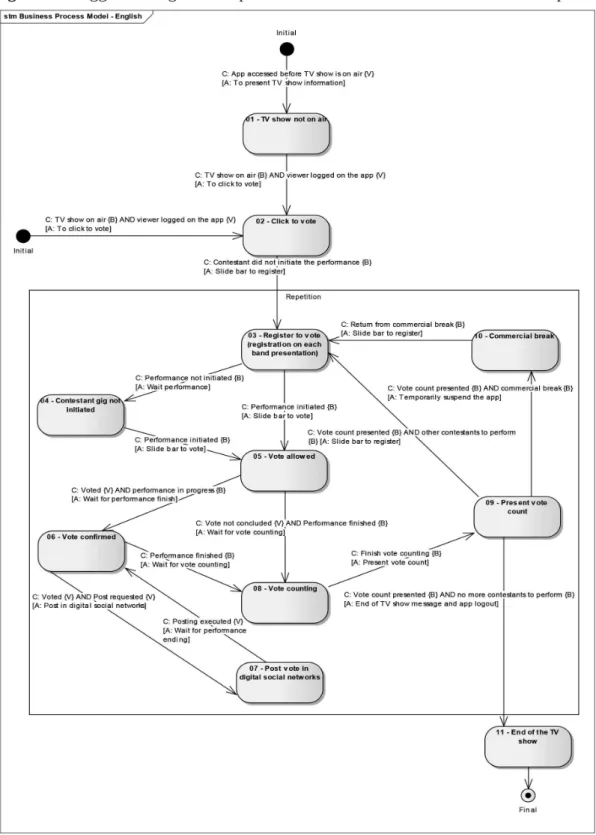
the app interface gets various states20during the period the TV show is aired on the irst screen (on TV). To understand the sophistication associated to the usage of the app, Figure 1 presents a diagram on which it is possible to observe the transitions between the states of that app21 – this diagram was elaborated by the author of this paper from the use of the app during the participant observation; it was elaborated according to the rules of the UML – Uniied Modeling Language (BEZERRA, 2007, p.15-19) –, a technical notation that is used by global software community.
To read the presented diagram (Figure 1), it is necessary to start from the points
indicated as Initial, and advance following the direction of the arrows between the states
(the boxes presented in the diagram). Notice that each state has a numbering associated in
its title to facilitate the references throughout the analyzes below.
Also, each arrow associated with the transition between states has two markers. The irst one corresponds to the condition (C) that must occur in the environment of the app so that its states advance (to advance from one state to another): this is an event initiated sometimes by the viewers, sometimes by the broadcaster. In the Figure 1, the events initiated by the viewers are indicated with the {V} notation, while events initiated by the broadcaster are indicated with the {B} notation. The second marker presented is the corresponding action (A) executed in the app that promotes the effective transition between states. The reading of the diagram then occurs between states, following the direction of the arrows, until reaching the point indicated as Final. It is also worth noting that the ‘Repetition’ box in Figure 1
indicates the group of states that is repeated throughout the program’s irst screen broadcast
(this group is repeated in the app to audience vote in relation to each contestant of the reality show that performs their gigs). Thus, the states between 03 and 10 (including these two) occur several times while the program is broadcasted. On the other hand, the states 01 and 02 typically occur only once (the only possibility to states 01 and 02 occur more than once during the same SuperStar episode is in the case of the viewer logs out the app, and accesses
it again later while the TV show is airing). Also, the state 11 occurs only once, when the TV channel ends the program’s broadcast on TV (and at the same time terminates the run of the app that enables materializing the audiences’ second screen experience).
20 In technical terms (for a software product), a “state is a moment in the life of an object when such object satisies some condition or
performs some activity” (BEZERRA, 2007, p.288 – Our translation).
Figure 1 – Suggested diagram to represent the state transitions observed in the Superstar app
A quantitative analysis of the markers on the arrows that indicate the transition between states shows that the usage of the app is effectively (a) controlled by the broadcaster: in most cases (in seventeen occurrences), events are associated with an action
originated by the broadcaster (these are actions executed in the app’s backstage, and that justify developing future analysis in a speciic article). On the other hand, in only eight transitions between states the events have associated a direct action executed by the viewer. However, it is important to note that although the viewer does not generate events in the app regarding most events that motivate the state transitions (as presented in Figure 1), in all the eleven states presented (in all the eleven boxes that represent the states in Figure 1) there is a speciic software interface. Such interface is presented in the app (in the technological device used to materialize the second screen experience) – thus, it is with that interface that audiences establish visual contact (also, in eight cases, the audiences can effectively interact using such interface). The very identiication of the states by the author of this article (that enabled the elaboration of the diagram presented in Figure 1) was only possible because such interfaces vary in each state transition presented.
Since the viewer needs to look at the app during the TV show’s broadcasting (to identify the moments in which he/she can interact), it is possible to analyze the advertisers’ articulation/synchronization between the irst and the second screens. Especially because the “second screen is a great opportunity for advertisers who look at their television media buy as an integrated [...] experience where each component (or screen) works together – thus making the advertising much more impactful” (PROULX; SHEPATIN, 2012, p.103). To enable this analysis, the Figures 2, 3, 4 and 5 present the interfaces related to four of the states indicated in Figure 1 (states 01, 02, 03 and 10).
Figures 2, 3, 4 and 5 – Content presented in the app during the states 01, 02, 03 e 1022 (according to Figure 1), respectively
Source: Images obtained on the Internet23.
It should also be noted that although the images related to only four of the eleven states presented in Figure 1 are provided in Figures 2, 3, 4 and 5, this content is considered here as suficient for the analyzes suggested in this article. To understand the assertion, it is necessary to notice that, curiously, the sponsors of SuperStar are presented as footnotes in the
app interface only in a context that does not involve the attention sharing (or in moments when his/her attention is supposed to be more oriented to the second screen gadget). Explaining: only in Figures 2 and 3 it is possible to observe on the app’ footnote screen the banner image of one of the three TV show’s sponsors24 (the Tic-Tacdrops). However, even such banner is not presented in any other interface of the app during the entire broadcast (or in any other state of the app). Even when accessing the app from other devices (the author of this paper accessed the app using three gadgets: a smartphone, a tablet, and a notebook); thus, despite the device used to access the app, only one of the three advertisers was presented. The other sponsors (as well as the drops presented in the gadget) are only mentioned in merchandising actions while the TV show is broadcasted (and on commercial breaks).
22 It should be noticed that thestate 10, referring to Figure 05, is also started when the program is suspended temporarily not only due
to commercial breaks (in the case of the episode from which the images presented in this paper were captured, there were various inter -ruptions during the SuperStar broadcast – since the TV show is aired live – requested by Globo Network Department of Journalism due to
president Dilma Rousseff impeachment process coverage).
23 Available at: <http://api.rtp.scrnz.com/front/mt-webview/?#/>. Accessed on April 17th, 2016.
24 In the third season of the Brazilian edition of the franchise, there were three main sponsors: the Tic-Tac drops, the Carrefour hyper
Another aspect that needs to be pointed involves the fact that only while the broadcaster did not start airing the TV show (state 01), or when the program is already on air, but the viewer has not reached his/her voter status, the sponsor has its ads presented (the viewer reaches the voter status, a key role in the context of this reality show starting from the app’sstate 03). Even if it is argued that this option in omitting advertisers during the key stages of the app usage is motivated to not confuse the audiences at important moments, it should be noticed that, paradoxically, when the TV show gets its commercial break on the irst screen, and the app gets on speciic state (state 10, Figure 5), there is no indication of the program sponsors on the app screen.
This analysis allows inferring that in the case of the proprietary app on which audiences materialize their second screen experience in SuperStar reality show in Brazil,
despite most of the interactive actions allowed in the app are controlled by broadcaster, the sync of ads between screens has occurred in a limited way. Thus, the use of the potential to present advertisers to the viewer synchronously between screens cannot be effectively observed in the SuperStar’s proprietary app. Strictly speaking, in the moment that can be
considered that one of maximum interest and participation of the public in relation to the TV program (when it is held a vote that deines the contestant’s permanence in the TV show) – an interface presented repeatedly, and to which the viewers need to look at to vote – there is no mention to the program sponsors.
Final considerations
It is planned to conduct another participant observation to analyze the sync of ads between screens in the case of an eventual new season of the TV show in Brazil. With the participant observation conducted in 2016, it was possible to infer that the articulation of advertisers between the screens during the TV show broadcast occurred in a relatively limited way, although the broadcaster control of actions while the app runs. In other words, considering the ad-supported business model, it seems that the second screen experience had a limitedly expanded in the case of the analyzed app. Such limited use seems to reinforce the potential issue of audience “distraction”, although in the case analyzed in this article the interactivity occurs through a proprietary app supplied by the broadcaster. Paradoxically, even though the app control is in most time with the broadcaster, the SuperStar app did not present the sponsors at key moments of the software usage.
Regardless the success of such contacts with broadcasters, it is expected that, in the light of the analyses presented in this article, it will be conceptually possible to address how the commercial breaks and the ads on the app (and even the ads presented in multiple screens) could be articulated to meet the three key social actors affected by the ongoing (and
unavoidable) reconigurations in the complex Brazilian televisual cultural system. After all, this articulation seems fundamental to the TV audience migration from a TV viewer tuned
on the TV channels to an effectively connected one.
References
BEZERRA, Eduardo. Princípios de Análise e Projeto de Sistemas com UML. Rio de Janeiro: Elsevier, 2007.
BLAKE, James. Television and the second screen: Interactive TV in the age of social participation. London
and New York: Routledge Taylor & Francis Group, 2017.
BRASIL 4D. Estudo de impacto socioeconômico sobre a TV digital pública interativa. Brasília: s/e, 2013.
Available at: <http://www.ebc.com.br/sites/default/iles/brasil_4d.pdf>. Accessed on: Set. 16, 2013.
CARNEIRO, Rafael Gonçalez. Publicidade na TV digital: um mercado em transformação. São Paulo: Aleph,
2012.
CASEY, Neil et al. Television studies: the key concepts. London and New York: Routledge Taylor & Francis
Group, 2002.
COLLETTI, Giampaolo; MATERIA, Andrea. Social TV: guida ala nuova TV nell’era di Facebook e Twitter.
Milano: Gruppo24ore, 2012.
DOUGLAS, Pamela. The future of television: your guide to creating TV in the new world. Studio City:
Michael Wiese Productions, 2015.
GAWLINSKI, Mark. Interactive television production. Oxford: Focal Press, 2003.
GRAY, Jonathan; LOTZ, Amanda D. Television studies. Cambridge: Polity Press, 2012.
GRIPSRUD, Jostein. Television in the digital public sphere. In: ______ (ed). Relocating television: television
in the digital context. London and New York: Routledge, 2010. p.3-26.
MACHADO FILHO, Francisco. Segunda tela: tendências, oportunidades e modelo de negócio concomitante à TV digital aberta no Brasil. In: Intercom Congresso Brasileiro de Ciências da Comunicação, XXXVI Intercom,
2013, Manaus. Anais... Manaus: UFAM, 2013.
MARQUIONI, Carlos Eduardo; OLIVEIRA, Caroline Cavalcanti. Sobre novas formas de manipulação do tempo na televisão (ou Redeinindo a noção de TV ‘ao vivo’ via redes sociais). Revista Comunicação e Sociedade, v.38, n.2, p.209-229, maio/agosto 2016.
______. Programas jornalísticos na TV aberta brasileira: entre atualizações da experiência televisual e a
manutenção de antigos contratos de leitura. Jundiaí: Paco Editorial, 2016.
NO BRASIL, 43% dos internautas assistem à TV enquanto navegam. Available at: <http://www.ibope.com.br/ pt-br/noticias/Paginas/No-Brasil-43-dos-internautas-assistem-a-TV-enquanto-navegam.aspx>. Accessed on: Aug. 08, 2013.
PIGNATARI, Décio. Signagem da televisão. São Paulo: Brasiliense, 1984.
PMBOK. A guide to the project management body of knowledge (5th ed.). Pennsylvania: Project Management Institute, Inc., 2013.
PNAD. Pesquisa Nacional por Amostra de Domicílios: Acesso à Internet e à Televisão e posse de telefone
móvel celular para uso pessoal 2013. Rio de Janeiro: IBGE, 2015. Available at: <http://biblioteca.ibge.gov.br/ visualizacao/livros/liv93373.pdf>. Accessed on: Apr. 29, 2015.
______. Pesquisa Nacional por Amostra de Domicílios: Síntese de Indicadores 2015. Rio de Janeiro: IBGE,
2016. Available at: <http://biblioteca.ibge.gov.br/visualizacao/livros/liv98887.pdf>. Accessed on: Nov. 26, 2016.
PROULX, Mike; SHEPATIN, Stacey. Social TV: How Marketers Can Reach and Engage Audiences by
Connecting Television to the Web, Social Media, and Mobile. New Jersey: John Wiley & Sons, 2012. RISING STAR. The music talent show that lets the viewer reach for the stars in real time!. Available at: <http:// www.keshetinternational.com/show/entertainment/rising-star/>. Accessed on: Dec. 19, 2015.
SCHLITTLER, João Paulo Amaral. TV digital interativa: convergência das mídias e interfaces do usuário
(design de interação e as novas tecnologias de comunicação). São Paulo: Blucher, 2011.
SUPERSTAR: ainda com falhas em aplicativo, reality é festival de erros. Available at: <http://vejasp.abril.com. br/blogs/pop/2014/04/14/superstar-festival-de-erros-cinco-falhas-e-repercussao-piadas-internet/>. Accessed on: Mar. 22, 2016.
WILLIAMS, Raymond. Television: Technology and Cultural Form. Padstow: Routledge Classics, [1974]
2005.
WOLFF, Michael. Television is the new television: the unexpected triumph of old media in the digital age.
New York: Portfolio/Penguin, 2015.
WOLTON, Dominique. Internet, e depois? Porto Alegre: Editora Sulina, 2003.
Carlos Eduardo Marquioni
PhD and Master in Communication and Languages from the Tuiuti University of Paraná; bachelor in System Analysis from PUC-Campinas, conducts his researches using an interdisciplinary approach that relates Communication and Software Engineering. Associate professor of the Master and PhD program in Communication and Languages of the Tuiuti University of Paraná (PPGCom/UTP) since 2013. Coordinates the research group TECA (Technologies: Experience, Culture and Affects) and is vice coordinator of the research group Television Studies of Intercom. He is the author of the book Programas Jornalísticos na TV aberta brasileira: entre atualizações da experiência televisual e a manutenção de antigos contratos de leitura (Paco Editorial, 2016). E:mail: [email protected].
br.