DOI: 10.1590/1809-5844201733
Renato Essenfelder
(Escola Superior de Propaganda e Marketing de São Paulo, Programa de Pós-Graduação Stricto Sensu, Mestrado Proissional em Produção Jornalística e Mercado. São Paulo – SP, Brasil)
Abstract
The article maps and identiies the presence of typical literary resources in a major journalistic report published by a digital native vehicle – in this case, the Brio website, specialized in longform journalism. The Pragmatic Analysis of the Journalistic Narrative method allowed us to identify the
subjectivation strategies of the text, through which the reporter achieves poetic effects and induces
his readers to different types and degrees of commotion. The paper analyzes a report about the environmental tragedy that occurred in Mariana (in the state of Minas Gerais, Brazil) in 2016 and points out the poetic resources in use to conclude that language, structure of text and characters are the tripod on which constitutes the literary journalism practiced by Brio. This work is the result of a project carried out within the scope of the Content Production Research Group, of the Professional Master’s Program in Journalistic Production and Market of ESPM-SP.
Keywords: Literary journalism. Report. Longform journalism. Narrative. Narratology.
Introduction
Even though the study about narrative is not even remotely new – on the contrary, the origin of this type of study dates back for the philosophers of Ancient Greece -, the application of narratology is far less common and fairly new in Brazil, as Motta (2004) reminds us.
In this article, product of the research led in the Research Group in Content Production, linked to ESPM’s Professional Master’s Program in Journalism Production and Market, we use the method of Pragmatic Analysis of the Journalistic Narrative, created by the author (MOTTA, 2007), to unveil expressive resources in use in the narrative of a great internet report. The goal of this study is to effectively identify which resources of subjectivation, usually applied to ictional literature, are being used in contemporary
journalistic narratives published on the internet, in a dialogue of the new – the journalism that embodies modern technologies of information and communication – with the old: the fundamentals of the poetry art.
scoff, irony, etc.” (p.11 – Our translation). According to the author, the journalistic speech gets to promote “the reader’s identiication with the reporting”, transforming gross facts, as it would be the case in the collapse of a dam in Mariana (in the state of Minas Gerais - MG, Brazil), into “human dramas and tragedies”.
By “subjective interpretations”, we understand the interpretations that are precisely done by the subject, that is, as we follow Benveniste’s (1991) point of view, according to whom the “subjectivity corresponds to the capacity of the speaker to propose himself as subject” (p.286 – Our translation) – they are, thus, one of a kind, product of a complex intertwining between personal experiences and social identities. In the case of the journalistic speech, the excerpts said to be subjectivation would be, therefore, those in which the author places himself as subject and evokes the constitution of another subject in dialogue with him, establishing a Me-you1 relationship.
On the other hand, narrative is understood here in a more elementary sense, attributed by Minchilo and Cabral (1989, p.1) as a “report of a certain sequence of real or ictional events”. In the Aurélio dictionary (FERREIRA, 1986 – Our translation), it is placed only as a synonym of “story”. The deinition, however, is not entirely accurate. A narrative is, indeed, a story. However, there are some characteristics that make the narrative something more particular. In the scholar tradition, says Silveira (1999, p.286 – Our translation):
(...) the classiication of texts includes the narration as one of the basic types of the written composition, along with the description and the dissertation. Today (...) the narrative is, at the same time, a type of text and a type of speech. Beyond being a type of marked text, the narrative is also very lexible, since it can perform different types of speech. Therefore, narrative appears in the narration itself, in the instruction, in the exposition, in the description and in the argument. The reverse, however, is not always true: There is no other type of text that can perform narration, because the narrative discourse has as
intrinsic characteristic the so-called temporal juncture2 that cannot be altered,
under the penalty of having the semantic content of the narrative seriously modiied.
1 Many authors have been currently discussing the concept of subjectivity, seeking to avoid simplistic interpretations that associate it simply to notions of identity and singularity, for example. For a more profound notion about this theme, we suggest Costa e Galli Fonseca (2008) and Miranda (2000).
Approaching the discussion over to the journalistic ield, which can use the narrative to perfect the way of telling stories, we ind the journalist and researcher Cremilda Medina, one of the pioneers of the study of journalism as dialogic and capable of socially producing meaning in Brazil. Medina sees the narrative as the capacity of a man to transform the chaos of life into units of meaning – task that, for a journalist, is key. According to her:
A simple deinition of narrative is the one that understands narration as one of the human responses to chaos. Endowed with the capacity to produce meaning when narrating the world, the sapiens organizes chaos in a cosmos. What it
is said to be reality constitutes another reality, the symbolic one. Without this cultural production – the narrative – the human being does not express himself/ herself, does not afirm himself/herself before the disorganization and the unfeasibility of life. More than a talent for some, the possibility of narrating is a vital necessity. (MEdINA, 2006, p.67 – Our translation).
The narrative organizes, therefore, meaningless events – at a irst glance. It is important to emphasize, in the context of this article, that narrating is not, therefore, a luxury of “creative” people, as it is frequently said in the common sense. The capacity of telling a story that gives meaning to a certain event, the capacity of contextualizing feelings or events in more or less complex narratives, is vital for the human being – and it is common to all of us.
It is expected, thus, that journalists also narrate. Even though this airmation may seem obvious at a irst glance, it is necessary to say it precisely because, according to what numberless researchers already noted (MEDINA, 2006) the ethos of the journalistic ield,
that has truth, objectivity and impartiality as central values, try to reduce the image of journalists to machines, objectifying them, de-subjectifying them, as if that was the only way to inform society with clarity and precision. The journalist would be, therefore, a (re) transmitter of speeches and not an actor-author in the society. It is necessary to restore the notion of authorship and social mediation in journalism. To rescue, thus, the narrative dimension of journalism, because “the journalist does not disclose worlds; he builds them. He is not a machine, but a narrator: an author of the narratives of contemporaneity” (ESSENFELDER, 2016, p.45 – Our translation).
Methodology and
Corpus
Amongst these experiences, it has drawn our attention the vehicles dedicated to longform journalism, which use extensive texts, worked with care, generally divided into chapters, in which are mobilized different expressive resources coming originally from literature in order to seduce the reader, appealing to his/her aesthetic sense, and at the same time, to offer contextualized information.
But what are these resources?
With the objective to identify them, in the text of a contemporary news website – Brio, released in 2014 –, this work uses the method of the Pragmatic Analysis of the Journalistic Narrative, that foresees six steps, which Motta (2007) calls movements. They are: 1) recomposition, in the case of a series of news articles and reports, of the intrigue or journalistic event; 2) identiication of conlicts and the functionality of the episodes; 3) analysis of the construction of the journalistic characters (in a discursive level); 4) analysis of communicative strategies; 5) to point out the communicative relation and the “cognitive contract” between narrator and reader; e, inally, 6) to identify the meanings of moral background or of fable in the history. Motta warns for the fact that:
To study journalistic narratives is to discover the rhetorical devices used by reporters and editors capable to disclose the intentional use of linguistic and extra-linguistic resources in journalistic communication to produce effects (the effect of reality or the effect of poetry). In this sense, we afirm that journalism is an argumentative language and there is not one only journalistic style, but a journalistic rhetoric. (...) The presence of narrative resources in journalism is everywhere. Even the “heaviest” texts in the economy section, for instance, frequently resort to brief narrative interregnums with the purpose of getting the reader closer to the episodes that are being narrated, in order to “humanize” a cold text. Other times, the journalistic texts show all their narrative character, as in many news reports and in the literary journalism. In general, there are many hybridisms in genre. (MOTTA, 2005, p.9 – Our translation).
The journalistic website from where we extracted the corpus of this analysis was
selected from the survey of ESPM’s Media Lab3 with innovative initiatives in digital journalism. Out of the total, we observed the 37 listed Brazilian initiatives that were iltered iltered into the following criteria: 1) geography, because even though they are digital initiatives, we looked for initiatives that were closer to the researcher in São Paulo; 2) format, because, in some cases, the listed initiative did not it into the genre of a news article, but experiences of collaborative journalism, such as collaborative maps, photographs or audiovisual initiatives; 3) independence, because we excluded initiatives linked to the
great groups of media, such as Abril and uOL, in an attempt to better understand how smaller, faster and newer groups, born in the digital world, are currently working with the journalistic narrative.
After this process of selection, we met Brio, specialized in great news articles of recognized quality, published in the free platform Medium. About Brio, deak summarizes:
A platform with more than 20 independent journalists, some of them with Pulitzer and Esso prizes, that bet on the reader as inancing form: they do not accept advertisements; they sell single stories or monthly signatures. Out of each purchase, the website gets 45% and the journalist authors get 55%. Great news articles, from the most incredible places on the planet, are part
of the collection. They also have the watchdog section, with investigative
reports sponsored by foundations and distributed without cost. One of them is about BNDES. With ive months of existence, they won the CNT Bio prize
of journalism for the Internet, in November of 2015. (2016, online – Our translation).
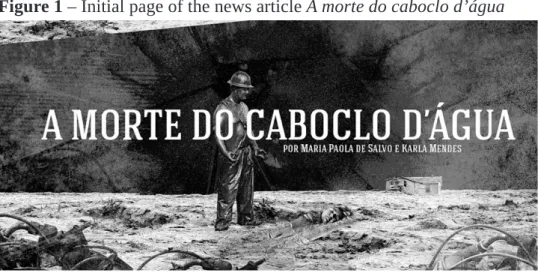
After a irst reading of all the news articles published at Brio until the month of June 2016, we selected the report A morte do caboclo d’água4, by Maria Paola de Salvo and Karla Mendes5 (Figure 1). The text is one of the rare cases of great news article of the
so-called independent media that approaches a hot subject of the national news, the case of the collapse of Samarco’s dam in Mariana (MG) in November 2015, that resulted in the biggest environmental catastrophe of the country’s history. The choice of this news article also enables other researchers to compare the text to narratives of traditional (informative) vehicles published at the time of the tragedy - movement that will not be performed in this study, because it is not our initial scope.
4 Translating to English: The death of the water caboclo. The title uses the death of a mythical creature (o caboclo d’água, the water caboclo) as a metaphor for the environmental catastrophe which took place in the region. The water caboclo is a mythical monster who supposedly would kill people and animals in the neighborhood, a type of boogeyman.
Figure 1 – Initial page of the news article A morte do caboclo d’água
Source:Briowebsite.
Narrativity in
A morte do caboclo d’água
As Motta (2007) suggests, the movements of Pragmatic Analysis in Journalistic Narrative must be adapted according to the context of the work in scope. In the case of the present study, we initially identiied that the irst suggested movement, recomposition, was unnecessary in the context of a holistic great linear report which content was already presented in a complete way at the time of this analysis.
We will start, therefore, by the second movement, that is the identiication of conlicts and functionality of episodes. It is around the conlict that the other plot elements are organized, what creates the status of core of the narrative, according to Motta (2007). The afirmation is also valid not only for literature, but also for journalism, in which narratives are essentially presentations and unfolding of conlicts: crimes, ruptures, disputes, unexpected transformations.
Following that, we proceed with the third movement, analysis of the construction of the journalistic characters, observing the frequency in which they appear and how they are presented. The last analytical movement that is valid for us to apply in the scope of this study is the fourth on Motta’s list: the analysis of communicative strategies. In this stage, the analyst seeks to identify rhetoric devices used to produce deinitive effects of meaning. Motta (2005) suggests a distinction between objectivation strategies and subjectivation strategies in the classiication of these devices. Given the degree of detailing and extension
of this stage, it will only be applied to the irst part of the report A morte do caboclo d’água
to avoid that the study would be too long.
or periods empirically veriiable, reproduction of speeches in the direct speech (as if the journalist wasn’t a part of the story), accurate reproduction of ciphers and varied greatness, use of numbers and statistics in general, document citation, among others.
On the other hand, the subjectivation strategies linked to the poetic effects that the text builds, creating different emotions on the reader. According to Motta:
As effects of reality, the resources of journalistic rhetoric induce readers, listeners and viewers to many types and degrees of commotion. These resources are used in headlines and titles as well as in the texts, either in illustrations and cartoons or in photography and television images. They are in the lexical choices, in the use of prospective verbs, verbs of feeling, negative verbs, verbs of advice, of warning, etc.; in the use of affective adjectives, potential adjectives or possession adjectives; in the use of stigmatized nouns such as terrorists, radicals, thugs, etc. They are in exclamations, questions,
comparisons, emphasis, repetitions and suspension points, more common in the
news than we think. They are in the igures of speech (metaphor, synecdoche, synonym, hyperbole). They are in the irony and parody, that open ields of meaning. They are in implicit content, in adverb implicatures such as “only”, again”, “yet”, common in headlines. They are in the presuppositions and in many others linguistic and extra-linguistic resources that are used in the verbal and audiovisual journalistic language. It is impossible to number or classify them due to their abundance on the news. (2005, p.10-11 – Our translation).
The last two analytical movements conceived by Motta will not be applied on this research (to point out the communicative relation and the “cognitive contract” between narrator and receiver and identifying meanings with a moral or fable-like background in the story) because it is not our research focus. This type of exclusion is authorized beforehand by Motta, to whom the researcher must adjust the method to their necessities in the context of the research.
Although the work of classiication of objectivation strategies had been performed in the context of the study developed by the Research Group in Content Production, we will not deal with these strategies here. We consider that these strategies are already suficiently known and that there is abundant literature about them, therefore, we will concentrate in what is less cited in the literature of the area: the subjectivation strategies in the journalistic text.
Table 1 – Communicative strategies in A morte do caboclo d’água
Categories of subjectivation expressions Reproduction of the excerpt of the report
Detailed description ...
Figures of speech ...
verbs of subjective expression ...
Emphasis/intensity ...
Source: Author’s research.
About the subjectivation strategies we chose, therefore, we have:
1 – detailed description: In this case, the author describes in detail situations or characters through aspects that are not empirically veriiable, because they are subjective, and little did they seem to add to the understanding of the fact as a fact, as a historical occurrence. It is the case, for example, of the passage where a character is described as having “youthful appearance reinforced by the sunglasses worn as a tiara”.
2 – Figures of speech: By deinition, they are igures of expression used by authors to expand the expressive possibilities in the text, used, many times, to describe sensations and perceptions hardly expressed by the denotative function of the language. The most common are metaphor, metonymy, hyperbole, euphemism, irony, ellipsis, pleonasm and onomatopoeia, but there are many other possibilities.
3 – verbs of subjective expression: According to Motta, amongst the numberless resources which the reporters use to express their subjectivity in the journalistic narrative, there is the “use of prospective verbs, verbs of feeling, negative verbs, verbs of advice, verbs of warning, etc.” (2005, p.12 – Our translation). We choose to group these possibilities under the label “verbs of subjective expression”, aware that the journalistic text is illed with expressive possibilities in this ield. The abundant use of reporting verbs in the journalistic
speech also reinforces the importance of a detailed look on this category of analysis. 4 – Emphasis/intensity: In this topic, we list the passages of the corpus where the
author enhances the dramatic appeal in a moment of history through expressions such as adjectives, using punctuation (exclamations, ellipses…) or speciic igures of speech.
Conlicts and characters in
A morte do caboclo d’água
The journalistic narratives, as in all others, are endowed with a conlicting event in its core, an event of atypical and dramatic character. The notion of conlict is expressed in the concept of news itself. In literature, and in dramatical arts in general, the conlict is understood as “basic determinant of dramatical action, which develops due to the opposition and struggle between different forces; dramatical conlict” (FERREIRA, 1986 – Our translation).
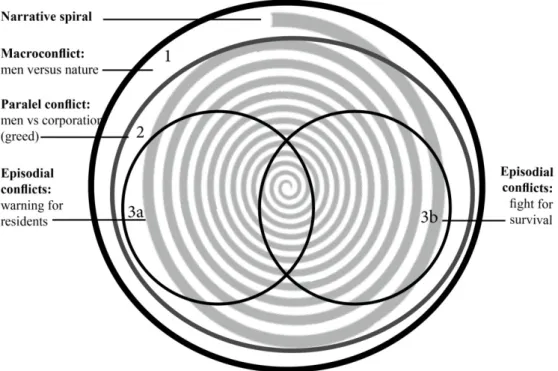
The conlict(s) in A morte do caboclo d’água oppose(s) many forces. In a irst
reading, we identify a central conlict: men versus nature. It is about the story of how simple
caboclos of a small town in the countryside of Minas Gerais react to the nature’s fury: a
looding of water and mud that sweeps entire territories, uncontained and inescapable. A second analysis, however, reveals the concomitant occurrence of a second conlict, that is men versus corporation. As the text advances, we see how the greed of the mining company Samarco not only contributed for the accident but it facilitated it.
Let us think about the news report as a literary genre. If A morte do caboclo
d’água was a novel – understood as short ictional narration –, it would speak about men
ighting against nature and also about men ighting against (or suffering with) the greed of corporations. In the interior of this narrative, however, we would also see many smaller conlicts in progress, which would keep the interest of the reader. The sub conlicts of this report are regarding two situations: 1) the struggle of families to save themselves and their belongings, and 2) the struggle of the residents to warn neighbors and friends about the dam’s collapse.
Figure 2 – Spiral narrative regarding conlicts of A morte do caboclo d’água
Source: Author’s research.
We observe a spiral structure, in which the narrator, of the “selectively omniscient” type, selects some characters to describe not only exterior facts, but also the internal universe of the character, their feelings, sensations etc., goes back and forth into the narrative, coming and going from conlict to conlict, in an unexpected way to the reader.
The experience of the news journalism, on the other hand, is linear: From point A to point B the narrator, omniscient and impartial, proceeds without further ado. In terms of the classic structure of an information pyramid, it is considered that in the case of informative journalism, the structure of the text is given in order of importance of information.
But in A morte do caboclo d’água we cannot speak in pyramid – nor inverted, nor
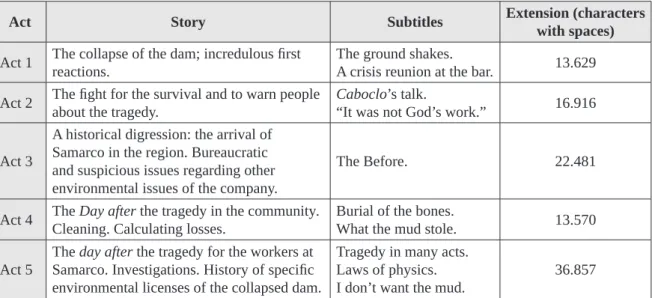
a general balance of the tragedy, the “day after” for Samarco’s employees and the inquiries in progress about the case. The narrative, as we can see, goes back and forth in time and space, avoiding linearity.
In addition, dispersed in Act 2 and Act 5, there is a curious anecdote about a monstrous statue that exists in the region, known as “water caboclo” (a monster who supposedly
would kill people and animals in the neighborhood, a type of boogeyman), that becomes a metaphor, in the text, for what we can understand as Samarco’s greed or as a force of nature that, after being provoked, reacts sweeping the village away, being indifferent to anything. In the following table, we have in detail the stories in each act, including the subtitles used in them and the extension in characters with space in each one of them. In total, the text has impressive 103.453 characters - the equivalent of about 40 pages in Word typed according to the norms of ABNT. Without any doubts, a long-format report – in the literary context, we could categorize the narrative of this extension as a novel.
Table 2 – division of stories per Act in A morte do caboclo d’água
Act Story Subtitles Extension (characters
with spaces)
Act 1 The collapse of the dam; incredulous irst
reactions.
The ground shakes.
A crisis reunion at the bar. 13.629 Act 2 The ight for the survival and to warn people about the tragedy. Caboclo“It was not God’s work.”’s talk. 16.916
Act 3
A historical digression: the arrival of
Samarco in the region. Bureaucratic and suspicious issues regarding other
environmental issues of the company.
The Before. 22.481
Act 4 The Day after the tragedy in the community.
Cleaning. Calculating losses.
Burial of the bones.
What the mud stole. 13.570
Act 5 TheSamarco. Investigations. History of speciic day after the tragedy for the workers at environmental licenses of the collapsed dam.
Tragedy in many acts. Laws of physics.
I don’t want the mud. 36.857
Source: Author’s research.
As we can see, the last Act is the longest of all, which dialogues with the importance it is given to the last act of any artistic work (romances, novels, movies, plays). In the last act, there is a summary of all actions (and omissions) that led to the tragedy and yet a follow-up of all investigations about the case and their probable consequences, either criminal, environmental, economic and social.
the following acts also have their dramatic apogees and none of them are shown in the irst lines of the analyzed segments. Neither we can easily it such morphology in the logic of a normal pyramid, according to which the climax is next to the closing of the text. In fact, the position of the narrative apex is sometimes located in the initial parts, and in other times in the inal excerpts of the text – in full freedom of composition, as it also occurs in literature. In this sense, it is interesting to see that the great report in question ends with a highly poetic ending, evoking to what is similar to a popular poem and recurring to the metaphor of the “water caboclo” statue to wrap an inconclusive ending. As follows:
At the entrance of the city of Barra Longa, the mud competes with the sculpture of the Water Caboclo. While they wait to see who wins the battle for the city, the inhabitants protest to have their Barra Longa back. On the last December 5th, Toninho Papagaio’s mother, Maria Lopes do Carmo, 82 years old, known
as dona Maria Papagaio, although blind and on a wheelchair, protested the way she could, with the following poster on her chest:
I want the Barra of my children I want the Barra of my grandchildren I want the Barra of my great-grandchildren I want my Barra Longa
I want Barra
I don’t want the mud.6
(MENdES; SALvO, 2016 – Our translation, highlights made by the authors)
However, it is not only in the morphology that this great report lirts with literature. Regarding the characters of the story, we have, in a similar way, a clear concern in enriching the introduction of the people narrated, surpassing the strict limits of an informative journalism, that generally describe their characters only by name, last name, occupation, and, sometimes, age.
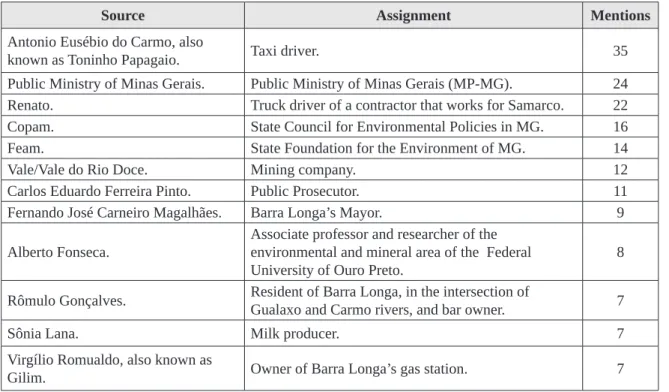
A lengthy survey of the news article indicates the existence of 78 sources of information cited in the text – out of these, ten are unidentiied, attending only by generic assignments such as “Samarco’s representative”, “an employee of the mine”, “Renato’s colleague”.
Among the main characters of this report, however, we see a very diverse treatment. The ten sources that are used more in the news (with three in a tie for the tenth place, in number of citations in the text), considering the sum of their ive acts, are indicated in the table below:
Table 3 – Characters and mentions in A morte do caboclo d’água
Source Assignment Mentions
Antonio Eusébio do Carmo, also
known as Toninho Papagaio. Taxi driver. 35
Public Ministry of Minas Gerais. Public Ministry of Minas Gerais (MP-MG). 24 Renato. Truck driver of a contractor that works for Samarco. 22
Copam. State Council for Environmental Policies in MG. 16
Feam. State Foundation for the Environment of MG. 14
vale/vale do Rio doce. Mining company. 12
Carlos Eduardo Ferreira Pinto. Public Prosecutor. 11
Fernando José Carneiro Magalhães. Barra Longa’s Mayor. 9
Alberto Fonseca. Associate professor and researcher of the environmental and mineral area of the Federal
university of Ouro Preto. 8
Rômulo Gonçalves. Resident of Barra Longa, in the intersection of Gualaxo and Carmo rivers, and bar owner. 7
Sônia Lana. Milk producer. 7
virgílio Romualdo, also known as
Gilim. Owner of Barra Longa’s gas station. 7
Source: Author’s research.
In addition to the cited sources, it is interesting to notice that the “water caboclo”
himself, described as a “monstrous igure, a mixture between a human and a gorilla, that would inhabit the waters of [the river] Carmo” is cited ten times in the report, what would place this inanimate object – or rather, this myth of local folklore – in the eighth position among the cited sources, in case we considered the entity a source. This indicates the strength of this metaphor in the text, present since its title. The resource to the metaphor, in this degree of intensity, is, without a doubt, another approximation of the report to literature.
Another notable characteristic: from the three most cited sources, two are personal (and common people, without status of formal “authorities”) and the other one is a recognized institution, MP-MG. It is given much more importance to the “common” sources, people that probably never talked to a journalist before. It is interesting to notice that, while a public attorney is cited 11 times, a mayor, nine times, and a specialist (professor in the ield of environment and mining at uFOP), eight times, the taxi driver Toninho Papagaio is mentioned nothing less than 35 times in the text – that also quotes his mother and sister as supporting sources.
We consider, therefore, that the treatment given to the characters, from their selection until their presentation and edition in the report, approaches the great report to the classic practices of literature.
Strategies of objectivation and subjectivation
After the reading and analysis of the news report, we selected Act 1 to perform a thorough review categorizing the strategies of objectivation and subjectivation used by the authors, according to the proposition in Table 1, displayed below. The result shows an intricate net of narrative resources in movement, much more complex than what commonly is expected from a journalistic text, characterized, as afirms Lage (2003), by the wish for clarity, rapidity and simplicity.
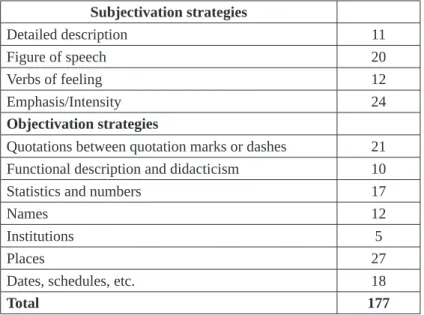
The analysis showed the use of 177 different narrative strategies in the irst Act of the text, being 67 strategies of subjectivation and 110 strategies of objectivation. It is interesting to notice that in the composition of the text, the strategies get intertwined as if they were a complex fabric. It is not about, therefore, observing moments in which the authors employ subjectivity resources in the journalistic text, moments of a certain literary preciousness. The subjectivity resources are ingrained in the structure narrative itself, appearing at the beginning, in the middle and in the end of the news report.
In quantitative terms, the strategies researched appear with the following frequency, according to what Table 4 shows:
Table 4 – Occurrences of objectivation and subjectivation strategies Subjectivation strategies
Detailed description 11
Figure of speech 20
verbs of feeling 12
Emphasis/Intensity 24
Objectivation strategies
Quotations between quotation marks or dashes 21
Functional description and didacticism 10
Statistics and numbers 17
Names 12
Institutions 5
Places 27
Dates, schedules, etc. 18
Total 177
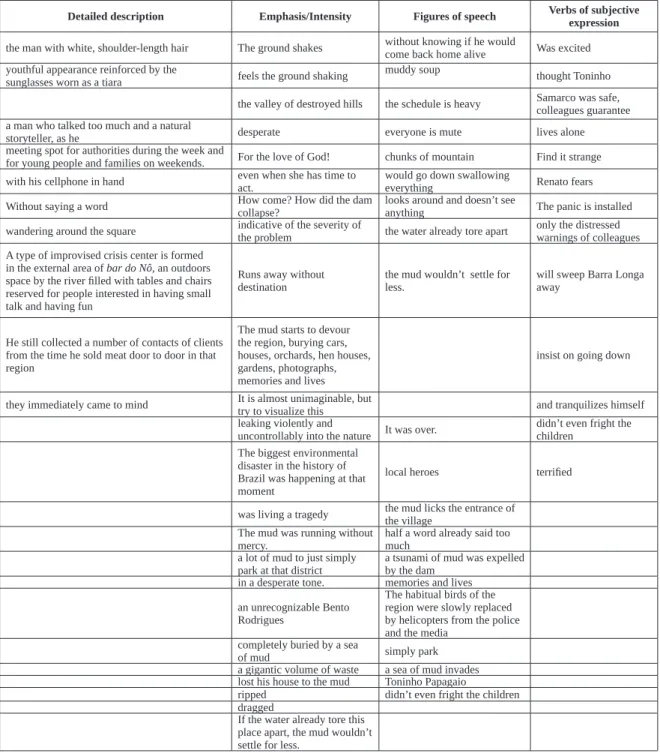
The ways in which these resources are presented are so diverse as the resources itself in the Portuguese language. In the following table, we identify all the occurrences of subjectivation strategies in the report A morte do caboclo d’água.
Table 5 – Segments with subjectivation strategies
Detailed description Emphasis/Intensity Figures of speech Verbs of subjective expression
the man with white, shoulder-length hair The ground shakes without knowing if he would
come back home alive Was excited
youthful appearance reinforced by the
sunglasses worn as a tiara feels the ground shaking muddy soup thought Toninho the valley of destroyed hills the schedule is heavy Samarco was safe,
colleagues guarantee
a man who talked too much and a natural
storyteller, as he desperate everyone is mute lives alone meeting spot for authorities during the week and
for young people and families on weekends. For the love of God! chunks of mountain Find it strange with his cellphone in hand even when she has time to act. would go down swallowing everything Renato fears
Without saying a word How come? How did the dam collapse? looks around and doesn’t see anything The panic is installed
wandering around the square indicative of the severity of
the problem the water already tore apart
only the distressed warnings of colleagues A type of improvised crisis center is formed
in the external area of bar do Nô, an outdoors
space by the river illed with tables and chairs reserved for people interested in having small talk and having fun
Runs away without
destination
the mud wouldn’t settle for
less.
will sweep Barra Longa away
He still collected a number of contacts of clients from the time he sold meat door to door in that
region
The mud starts to devour
the region, burying cars,
houses, orchards, hen houses, gardens, photographs, memories and lives
insist on going down
they immediately came to mind It is almost unimaginable, but try to visualize this and tranquilizes himself leaking violently and
uncontrollably into the nature It was over. didn’t even fright the children The biggest environmental
disaster in the history of Brazil was happening at that
moment
local heroes terriied
was living a tragedy the mud licks the entrance of
the village
The mud was running without
mercy. half a word already said too much
a lot of mud to just simply
park at that district
a tsunami of mud was expelled by the dam
in a desperate tone. memories and lives
an unrecognizable Bento Rodrigues
The habitual birds of the region were slowly replaced by helicopters from the police
and the media
completely buried by a sea
of mud simply park
a gigantic volume of waste a sea of mud invades
lost his house to the mud Toninho Papagaio
ripped didn’t even fright the children
dragged
If the water already tore this place apart, the mud wouldn’t settle for less.
Out of the four categories that we chose to identify and analyze, the most recurrent was the category called “emphasis/intensity”. The second most used strategy was the appeal for igure of speech. Amongst them, metaphors are the most used. They appear in excerpts such as “muddy soup”, “mountain chunks”, the mud that goes down “swallowing everything” or “mud sea”. The metaphor is an important mark of the news article, because it sets the tone of entire text, since the title, that refers to a local myth.
Final considerations
We intend, with this study, to identify and to map some of the main strategies in dialogue with literature, which the contemporary journalism has used – especially in vehicles that are presented as innovative, case of the awarded website Brio, created in 2014.
We could notice, after extensive analysis of the news report A morte do caboclo d’água, that the resources of subjective expression, typically artistic, most used by the authors
in question were igures of speech, specially metaphors, and expressions that enhance the dramatical intensity of the narrated facts, especially adjectives and modal adverbs.
It is interesting to notice that the literary resources are organically disposed in the narrative and not artiicially inserted, as a localized literary preciousness. Said in another way, the journalistic-literary text is performed since the conception stage of the journalistic agenda until the inal edition of the text. It is a project that comprises all the news report, and not a resource for edition or writing added afterwards.
We also noticed that the structure, dismembered in episodes marked by certain elementary conlicts, is not so linear as the news text, but spiraled or elliptical. The narrator goes back and forth in the presentation of conlicts in the history, as a novel, presenting different dramatic centers and then intersecting them in unpredictable ways.
Finally, it is important to notice that the characters are written in a more elaborate manner. Just remember that the most cited person in the text, a taxi driver that the authors refer to as “Toninho Papagaio”, appears no less than 35 times. It is more than the triple of the oficial source most cited nominally, the public attorney Carlos Eduardo Ferreira Pinto. Moreover, added to the citation volume is also a qualitative preoccupation. Toninho is not only “a taxi driver”, but, amongst different mentions, somebody “with white, shoulder-length hair, a youthful appearance reinforced by the sunglasses worn as a tiara” (MENdES; SALvO, 2016 – Our translation). There is an intimacy of the narrators with the character, that in turn creates an intimacy of the reader with Toninho, uncommon fact in a cold and wishfully objective testimony in the daily news.
reading more pleasurable, but also work as resources for authentication, creators of the effect of reality. The descriptions apparently without symbolic function, as the “youthful appearance” of Toninho, are, according to Barthes (1984), powerful expressive instruments to naturalize the reader into the narrative universe. That is they help to carry the reader inside that universe at the same time they make the reader deposit additional trust in the investigation of the reporter, who could not know about the “youthful appearance” if he was not there personally, face to face with the character.
Literature in the journalism, then, seems to fulill an aesthetic function and a function that seems paradoxical at irst sight: to naturalize universes and to legalize speeches, which is of utmost importance for journalism. However, so that such function is performed, it is clear that the composition must be balanced and well made, otherwise the inverse effect will occur: the mushy or forced text, implausible, can generate a distance from the reader, breaking the bond of trust between the audience and the media.
In the meeting between journalism and literature, both in search of an update facing 21st century demands, both systems become more complex, as Soster (2011, 2012)
evidenced in his analysis of journalistic contents in periodicals and magazines. For the author, literature transforms the New Journalism into a more complex genre when it adds
to it more elaborate igures of speech, complete dialogues, an explicit subjectivity from the author, sources of information in the shape of literary characters and frequently a narrator who puts himself as a witness of the narrated events.
References
BARTHES, Roland. O efeito de real. In.: BARTHES, Roland et al. Literatura e realidade: que é realismo?. Tradução de Tereza Coelho. Lisboa: Publicações dom Quixote, 1984. p.87- 97.
BENvENISTE, Émile. da subjetividade na linguagem. In: Problemas de Linguística Geral I. 3. ed. São Paulo: Pontes, 1991. cap.21. p.284-293.
COSTA, Luis; GALLI FONSECA, Tania. da diversidade: uma deinição do conceito de subjetividade. Interamerican Journal of Psychology, v.42, p.513-519, 2008. ISSN 0034-9690. Available at: <http://pepsic. bvsalud.org/scielo.php?script=sci_arttext&pid=S0034-96902008000300011&nrm=iso>. Acessed on: July 10, 2016.
dEAK, André. Conheça 60 casos de narrativas inovadoras do jornalismo. Huffpost Brasil, 2016, online. Available at <http://www.brasilpost.com.br/andre-deak/conheca-60-casos-de-narra_b_8661702.html>. Acessed on: July 10, 2016.
dÜREN, Ricardo. Mais real que a realidade: a obra 1808 e o uso de elementos da narrativa literária pelo
jornalismo. Online, 2013. Available at: <http://repositorio.unisc.br/jspui/handle/11624/501>. Acessed on: June 05, 2016.
ESSENFELdER, Renato. de transmissor a narrador: desconstrução de estereótipos sobre jornalistas. Revista Brasileira de Ensino de Jornalismo, Brasília, v.6, n.18, p.31-47, jan./jun. 2016.
LABOv, William. Some Further Steps in Narrative Analysis. Journal of Narrative and Life History, v.7,
n.1-4, p.395-415, 1997. Available at: <http://www.jbe-platform.com/content/journals/10.1075/jnlh.7.49som>. Acessed on: July 10, 2016.
LAGE, Nilson. Estrutura da notícia. São Paulo: Editora Ática, 2003.
MEdINA, Cremilda. O signo da relação. São Paulo: Paulus, 2006.
MENdES, Karla; SALvO, Maria Paola de. A morte do caboclo d’água. Online, 2016. Available at <https:// medium.com/brio-stories/ato-1-b141fc0ec404#.b87sgomvz>. Acessed on: June 10, 2016.
MINCHILLO, Carlos Alberto; CABRAL, Isabel Cristina. A Narração – Teoria e Prática. São Paulo: Atual,
1989.
MIRANdA, Luciana. Subjetividade: a (des) construção de um conceito. Subjetividade em questão: a infância como crítica da cultura, v.2, p.29-46, 2000.
MOTTA, Luiz Gonzaga. Narratologia: análise da narrativa jornalística. Brasília: Casa das Musas, 2004. ______. A Análise Pragmática da Narrativa Jornalística. In: Congresso Brasileiro de Ciências Da Comunicação, 2005. São Paulo: Intercom, 2005, online. Acessed on: May 20, 2016.
MOTTA, Luiz Gonzaga. Análise pragmática da narrativa jornalística. In.: LAGO, C.; BENETTI, M. (Orgs.). Metodologia de Pesquisa em Jornalismo. Petrópolis: vozes, 2007. p.143-167.
SILvEIRA, Maria Inez Matoso. A Importância da Narrativa Oral no Ensino da Língua Portuguesa na Escola Fundamental. In: MOuRA, d. (Org.). Os múltiplos usos da língua. Alagoas: Edufal, universidade Federal de Alagoas, 1999.
SOSTER, demétrio de Azeredo. A midiatização das narrativas jornalísticas na seção diário da Revista Piauí. In: Encontro Nacional de Pesquisadores em Jornalismo, 9., 2011, Rio de Janeiro. Anais... Rio de Janeiro, SBPJor, 2011. Cd- ROM.
______. Sistemas, complexidades e dialogias: narrativas jornalísticas reconiguradas. In: PICCININ, F.; SOSTER, d. A. (Orgs.). Narrativas comunicacionais complexiicadas. Santa Cruz do Sul: Edunisc, 2012. p.89-110.
Renato Essenfelder
Renato Essenfelder holds a Phd in Communication Sciences from the university of São Paulo (ECA-uSP), a master’s degree in Portuguese by the Pontiical Catholic university of São Paulo (PuC-SP) and a bachelor’s degree in Journalism. Professor of Journalism at the Superior School of Advertising and Marketing of São Paulo (ESPM-SP) since 2011, he has also been a faculty member of the Professional Master’s in Journalism from the same institution since 2016, where he coordinates the Research Group in Content Production. He develops researches in the areas of journalistic narratives, reporting and editing of texts, cyberjournalism, social networks and fake news, and ethics. He is a columnist for Portal Estadão and a guest editor of the journal Cadernos de Cidadania of the
Commerce Social Service of São Paulo (Sesc-SP), since 2010. Email: [email protected].
Received on: 02.13.2017