G o ve rnme nt Co nt e xt ? Empiric al Evide nc e s o n
G o ve rnme nt Co nt e xt ? Empiric al Evide nc e s o n
G o ve rnme nt Co nt e xt ? Empiric al Evide nc e s o n
G o ve rnme nt Co nt e xt ? Empiric al Evide nc e s o n
G o ve rnme nt Co nt e xt ? Empiric al Evide nc e s o n
Enviro nme nt al Influe nc e s in t he De c isio n-M aking
Enviro nme nt al Influe nc e s in t he De c isio n-M aking
Enviro nme nt al Influe nc e s in t he De c isio n-M aking
Enviro nme nt al Influe nc e s in t he De c isio n-M aking
Enviro nme nt al Influe nc e s in t he De c isio n-M aking
Process of English Local A uthorities*
Process of English Local A uthorities*
Process of English Local A uthorities*
Process of English Local A uthorities*
Process of English Local A uthorities*
Ricardo Corrêa Gomes
R RR R
RES U M OES U M OES U M OES U M OES U M O
Este artigo apresenta evidências empíricas sobre a análise de stakeholders no contexto das administrações locais. O trabalho é o resultado de uma pesquisa de campo desenvolvida com administrações locais inglesas no ano de 2001. O artigo esboça a arena na qual as administrações locais tomam decisões apontando os relevantes stakeholders para o processo, assim como o
poder que eles possuem na visão dos chefes executivos(1). A investigação é baseada nas teorias da
dependência e institucionalismo, as quais tem sido utilizadas para explicar o comportamento das organizações quando influenciadas por seus ambientes externos. Como contribuição empírica, o artigo propõe um mapa de stakeholders adequado a qualquer tipo de administração local e que
poderá ajudá-las no processo de definição de estratégias organizacionais.
Palavras-chave: administração pública; administração local; gestão estratégica; análise de
stakeholder.
A AA A
ABS T RA C TBS T RA C TBS T RA C TBS T RA C TBS T RA C T
This article presents empirical evidence of stakeholding in the local government context. It is the result of a survey carried out with English Local Authorities in 2001. It outlines the arena in which local government make decisions by pinpointing the relevant stakeholders in the process as well as the amount of power they are perceived to represent by chief executives. The investigation has its theoretical basis in resource dependence and institutional theories, which are commonly used for explaining an organization’s behaviour and performance as influenced by its environment. As an empirical contribution, the article proposes a stakeholder map for any kind of local government organizations that will help in identifying strategies for managing stakeholders.
Key words: public management; local government; strategic management; stakeholder analysis.
IIIIIN T RO DU C T IO NN T RO DU C T IO NN T RO DU C T IO NN T RO DU C T IO NN T RO DU C T IO N
Despite being in management literature (STONEY; WINSTANLEY, 2001) since Richard E. Freeman published his landmark book “Strategic Management: A Stakeholder Approach” in 1984, stakeholding has yet to be fully explored in the Public Management field, with little empirical evidence in local government studies. The sporadic examples of stakeholding in Public Management are to be found in studies involving public services such as hospitals (FOTTLER et al., 1989), health care (BLAIR; BUESSELER, 1998; KUMAR; SUBRAMANIAN, 1998; MILLER; WILSON, 1998;), and education (ENZ et al., 1993).
As a non-finished theory, stakeholder theory is often related to other theories such as Resource Dependence, Institutionalism, Agency Theory, Resource-Based Theory and even Transaction Cost Analysis. The decision on the adequate theory relies upon the investigation’s aims. In this investigation, resource dependence and institutional theories are used because the main aim is to find out how a specific type of organization (local government) behaves and performs when influenced by external and internal stakeholders.
Donaldson and Preston (1995) have suggested that stakeholder theory has been developed by employing three theoretical bases: normative, descriptive and instrumental. Normative studies are concerned with the nature of the relationships formed between stakeholders and organizations. In some cases, it is a matter of how ethical these relationships are. Descriptive/empirical studies aim “to describe, and sometimes to explain, specific corporate characteristics and behaviors basis” (DONALDSON; PRESTON, 1995, p. 70). Instrumental studies focus on tracking down “connections, if any, between the practice of stakeholder management and the achievement of various corporate performance goals” (DONALDSON; PRESTON, 1995, p. 67).
T TT T
THEO RET ICA LHEO RET ICA LHEO RET ICA LHEO RET ICA LHEO RET ICA L F F F F FRA MEWO RKRA MEWO RKRA MEWO RKRA MEWO RKRA MEWO RK A NDA NDA NDA NDA ND H H H H HYPO T HESESYPO T HESESYPO T HESESYPO T HESESYPO T HESES
Freeman (1984) in one of the most frequently quoted studies in stakeholder theory, defines a stakeholder as “any group or individual who can affect or is affected by the achievement of the organization’s objectives”. Bryson (1995) expanded the definition in the following way: “A stakeholder is defined as any person, group, or organization that can place a claim on an organization’s attention, resources, or output or is affected by that output”.
This investigation employs the stakeholder concept based on the assumption that organizations are neither self-sufficient nor isolated from its external environment (PFEFFER; SALANCIK, 1978). As a main tenet of the Open System Theory (KATZ; KAHN, 1978), organizations engage relationships with their environments in order to get the critical resources for their productive processes (PFEFFER; SALANCIK, 1978), and the required legitimacy for their activities (SELZNICK, 1966).
The following quotation, extracted from the Open System Theory, illustrates the extent to which organizations are shaped by external forces: “The behavior of an organization is contingent upon the social field of forces in which it occurs and must be understood in terms of the organization’s interaction with that environmental field” (KATZ; KAHN, 1978, p. 3).
Scott (1998) argues that environments could be classified as technical and institutional. The technical environment relates to the production of goods and services and the institutional relates to the set of norms, values, rituals and patterns of behavior. Thus, an organization inhabits both technical and institutional-based environments and, in so doing, it is exposed to the influences stemming from them. Technical influences affect the way organizations behave in their productive processes, and institutional influences affect the organization’s
“conformity with social rules and rituals” (ORRÙ et al., 1991, p. 361).
Furthermore, organizations are pretty much shaped by environmental pressures (ORRÙ et al., 1991, p. 361).
such as Mwankwo and Richardson (1996) agree with that assumption, suggesting that organizations survive to the extent that they are able to cope with demands and expectations from the external environment.
Another perspective well connected with the open system’s view is the institutional theory, which explains an organization’s behavior as conforming to norms and patterns of behavior created by institutions. In this vein, Meyer and Rowan (1991) state: “Organizations are driven to incorporate new practices and procedures defined by prevailing rationalized concepts of organizational work and institutionalized in society”.
In other words, the institutional environment which an organization inhabits is regulated by norms, values and patterns of behavior to which the organizations need to conform in order to be accepted. Hannan and Freeman (1977), in their classical ecological perspective, argued that organizations conform in order to avoid being excluded from the environment. Dimaggio and Powell (1991) as well as Meyer and Rowan, 1991 focus on the problems that stem from the organization reproducing institutionalized behaviors, which they label as isomorphism. According to them, organizations start to look alike, losing identity and capacity for innovation. Orrù et al. (1991) warn that isomorphism is a phenomenon common to both
technical and institutional environments. According to them (ORRÙet al., 1991),
the technical environment forces organizations into competitive isomorphism and the institutional environment into institutional isomorphism. The following quotation summarizes the above ideas:
According to both institutional and resource dependence perspectives, organizational choice is limited by a variety of external pressures, environments are collective and interconnected, and organizations must be responsive to external demands and expectations in order to survive (OLIVER, 1991, p. 146).
Agreeing with the argument above, Greening and Gray (1994) suggest that “both institutional and resource dependence theories offer explanations for why firms adopt certain structural modifications”. The combination of these two perspectives should explain the patterns of relationships formed between a local government organization and its stakeholders.
As any organization, local governments need resources in order to be able to carry out their responsibilities and they also need legitimacy for their activities in order to be accepted by society. In the specific case of local government organizations, they have their effectiveness judged upon recognition. Nobody will show up to vote unless they are convinced that the councilors deserve it. Figure 1 indicates the arena in which local government organizations embrace relationships with their stakeholders (environmental influences). It shows a two-way relationship in which stakeholders contribute with some sort of influence and they expect some sort of return.
Figure 1: The Conceptual Links Between an Organization and its Environment
Source: adapted from Oliver (1991) and Greening & Gray (1994).
As part of the stakeholder management process, Mitchell et al. (1997) argue that organizations have to identify and assess their stakeholders as well as their salience (measurement of power and influence) in order to devise proper strategies for dealing with them. Bryson (1995) suggested a six-step process for scanning organizational environment in search of stakeholder identification. The steps are presented below:
1. To identify organization’s main stakeholders;
2. To specify the criteria stakeholders use to assess the organization’s performance;
3. To identify whether the organization is attending stakeholders’ demands;
4. To identify how stakeholder’s influence comes about;
5. To identify what the organization needs from these stakeholders;
Stakeholder Identification Process Stakeholder Identification ProcessStakeholder Identification Process Stakeholder Identification Process Stakeholder Identification Process
For accomplishing the first step, Freeman (1984) suggested a two-dimension grid based on concepts of power and interest (stake). Mitchell et al. (1997) contributed to stakeholder’s identification by proposing a model in which attributes of power, legitimacy, and urgency are combined. Winstanley et al. (1995) proposed a framework for assessing a stakeholder’s salience in public service organizations based on two dimensions of power: criteria power and operational power. The former is a dimension for assessing stakeholder’s power to influence issues about planning such as the definition of objectives and the definition of performance criteria. The latter is a dimension for assessing the stakeholder’s power to influence the service delivery process. This investigation employs this model whose attributes of power are dealt with as follows.
According to Mintzberg (1983), power is the capacity for making someone do what he or she otherwise would not do. He suggests five bases in which power is likely to occur:
. Control of resources;
. Control of a technical skill;
. Control of a body of knowledge;
. Power from legal prerogatives; and
. Access to those who can rely on the previous sources of power.
Etzione (quoted by MITCHELLet al., 1997) suggests that power is likely to
result from three contextual dimensions: normative power, coercive power, and utilitarian power. Normative power results from laws and requirements over which the organization has no control. Coercive power stems from physical means and utilitarian power results from dependence (PFEFFER; SALANCIK, 1978) because the organization sometimes has to go against its own will in order to gain resources.
Power also stems from the decision-making process, and people who have domination over such processes are entitled to coerce others by applying or not “procedures and political routines” (HARDY, 1996, p. S7). The third dimension of power is meaning, which is related to the power to prevent “conflict from emerging in the first place” (HARDY, 1996, p. S8). That is, some people have
control over the status quo and, in doing so, can suppress others of their cognition.
These two bases of power can also be related to the environmental influences upon organizations to the extent that political and professional issues arise from its pressuring the organization to comply with their requirements.
Issues in Stakeholder’ s Salienc e Issues in Stakeholder’ s Salienc eIssues in Stakeholder’ s Salienc e Issues in Stakeholder’ s Salienc e Issues in Stakeholder’ s Salienc e
Aiming to assess stakeholder salience, Savage et al. (1991) propose a matrix that combines the stakeholder’s potential to threaten the organization combined with the stakeholder’s potential to co-operate with the organization. The combination of these two dimensions produces four types of stakeholders: Supportive Stakeholders (low potential to threaten but high potential to co-operate), Marginal Stakeholders (low potential to threaten and low potential to co-operate), Nonsupportive Stakeholders (high potential to threaten but low potential to co-operate), and Mixed Blessing Stakeholders (high potential to threaten as well as to co-operate) (SAVAGE, 1991, p. 65).
From the literature review, it can be seen that organizations inhabit technical and institutional environments. In both instances, the organization is exposed to influences that can alter its form and behavior. The stakeholder theory may offer alternatives to diminish the complexity of such environmental confusion as it makes it possible to pinpoint individual environmental influences. For this reason, the organization needs to identify the stakeholders as well as the opportunity/ threat they represent, in order to devise effective strategies for dealing with them.
R RR R
RES EA RCHES EA RCHES EA RCHES EA RCHES EA RCH M M M M MET HO DSET HO DSET HO DSET HO DSET HO DS
Research Context Research ContextResearch Context Research Context Research Context
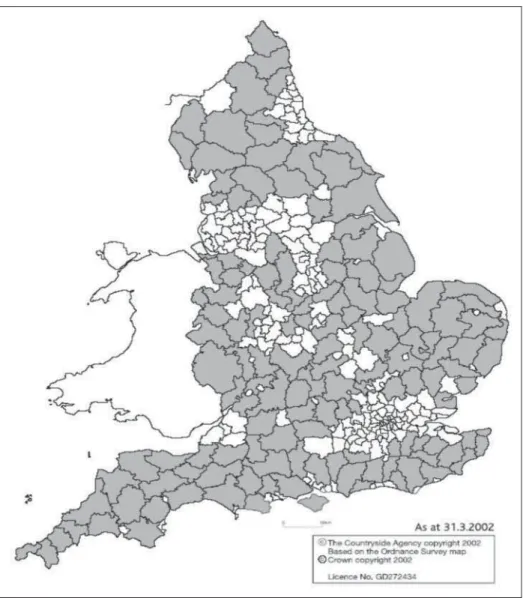
characterized by low population density and primary industry activities. For methodological reasons, the study regards the other areas as non-rural, encompassing urban and suburban areas. The figure below indicates the rural (the gray areas in the map) and non-rural areas.
Figure 2: England’s Map for Differing Rural and Non-Rural Areas
Source: the Countryside Agency (Reproduced with permission) available from www.countryside.gov.uk
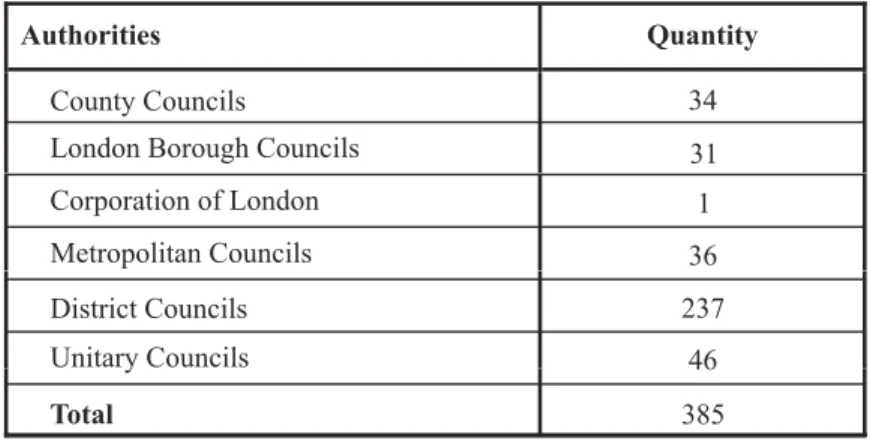
Councils, Metropolitan District Councils, London Borough Councils and Unitary Councils. County Councils are composed of District Councils with which they share the delivery of some specific services. For example, District Councils are responsible for collecting waste while County Councils for its disposal.
The definitive urban areas are the Metropolitan District Councils and the London Borough Councils (which comprise the Great London metropolitan area). These authorities are autonomous and responsible for the delivery of all the public services in their territories. The current English political structure at the time this investigation was carried out is in Table 1.
English local authorities are led by councilors who are periodically elected by democratic elections (MUNICIPAL YEARBOOK, 2000). The dominant political leadership that achieves the majority of the votes has the right to appoint the mayor (Mayor or Lord Mayor). A Chief Executive is a professional appointed to manage the administrative structure. Within the managerial structure, there are departments responsible for delivering public services (MUNICIPAL YEAR BOOK, 2000).
Table 1: The Composition of the English Local Authorities System
Source: Municipal Yearbook, 2000.
Table 2: English Political Parties and their Representation on Controlling Councils
Source: adapted from the Local Government Association world web wide available from http:// www.lga.gov.uk.
Data Collection Data CollectionData Collection Data Collection Data Collection
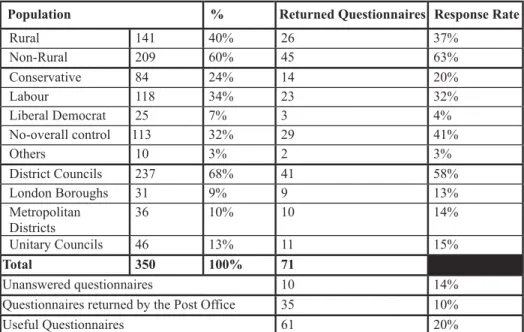
The investigation was undertaken by surveying Chief Executives of English Local Authorities in the period of February to June 2001. The investigation used questionnaires, which were sent to 350 local authorities. The questionnaire was addressed to chief executives due to their position in the administrative structure and also because these people are professionals who remain in authority regardless of the electoral changes in the council. The questionnaire aimed to identify who is likely to be a stakeholder for the whole local authority in the chief executive’s view as well as how much influence these stakeholders are likely to represent in the decision-making process arena.
The questionnaire was structured upon two questions. The first asked the respondent to name who they believe is a stakeholder able to exert influence in the decision-making process. It was an open question aiming to raise as many names as possible. The second question asked the respondents to rate stakeholder’s salience according to seven criteria and based on a one-dimensioned and Lickert scale of five levels (from no influence to strong influence). The criteria were based on concepts of power that are outlined in the literature section and presented as follows.
1. Power to influence decisions concerning objectives;
3. Power to influence criteria about performance appraisal;
4. Power as a result of being a stakeholder whose satisfaction is an aim for the Authority;
5. Power to control critical assets (money and supplies);
6. Power to control technical skills;
7. Power to influence the service delivery process.
Research V ariables Research V ariablesResearch V ariables Research V ariables Research V ariables
The survey’s main aims were to gather data to develop two indexes, namely the stakeholder nomination index (SNI) and the stakeholder salience index (SSI). The SNI was developed to identify the most ‘popular’ stakeholders in chief executives’ view. This index is calculated by comparing the number of nominations a stakeholder received with the total of valid responses. The result is a value situated on a scale of 0 to 1, which is represented by a ratio type variable. The SSI was developed to identify the most influential stakeholders and is calculated by averaging the salience scores achieved by each stakeholder in each criterion, i.e. each stakeholder is associated with a value from the Lickert scale from 0 and 5 and this is his/her SSI in the criterion.
F FF F
FIN DIN G SIN DIN G SIN DIN G SIN DIN G SIN DIN G S
Table 3: Response Rate Explained
Source: data analysis.
Q ue st io n 1 : Who are English Lo c al G o ve rnme nt ’ s Q ue st io n 1 : Who are English Lo c al G o ve rnme nt ’ sQ ue st io n 1 : Who are English Lo c al G o ve rnme nt ’ s Q ue st io n 1 : Who are English Lo c al G o ve rnme nt ’ s Q ue st io n 1 : Who are English Lo c al G o ve rnme nt ’ s St ake ho lde rs?
St ake ho lde rs?St ake ho lde rs? St ake ho lde rs? St ake ho lde rs?
According to chief executives’ responses, a large number of stakeholders are able to influence decision-making. Due to the diversity of stakeholders nominated, a similarity analysis was needed, which resulted in a list of twenty-two different stakeholders, groups of stakeholders and even categories of stakeholders.
Table 4: SNI - Results from the Opinion Survey
Source: data analysis.
According to the findings, central government was the highest nominated stakeholder according to the opinion of 97% of the respondents. And it was nominated by 100% of non-rural authorities, 92% of rural authorities, 100% of Labour authorities, 89% of Conservatives and 96% of no-overall control authorities.
citizens were indicated as a stakeholder by 94% of non-rural authorities, 92% of rural authorities, 100% of Labour authorities, 100% of Conservative authorities and 92% of no-overall control authorities.
The local businesses are another highly nominated stakeholder and they overall SNI was 89%. Particularizing the preferences, 85% of non-rural authorities, 92% of rural authorities, 81% of Labour authorities, 100% of Conservative authorities, and 83% of no-overall control authorities have nominated the local businesses as a stakeholder.
On the other hand, Trade Unions were the lowest nominated stakeholder with an SNI of 28%. Particularizing the preferences, 24% of non-rural authorities, 25% of rural authorities, 24% of Labour authorities, 22% of Conservative authorities, and 25% of no-overall control authorities have nominated Trade Unions as a stakeholder.
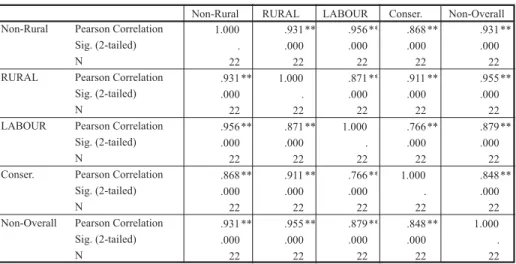
Despite the numerical differences perceived among stakeholder’s nomination, there is strong statistical association when comparing the different categories in pairs. For assessing statistical association, Person’s moment correlation was used to calculate the statistical association between variables. Bryman (2001) suggested that type of statistical calculation as the most appropriate for interval/ratio variables. Table 5 presents the results for this calculation.
Using the SPSS, the smaller result is found in the analysis of Labour and
Conservative authorities preferences whose result is r = 0.766. According to
Miller and Salkind (2002) it represents a strong useful relationship. All the other results are higher than 0.8 and they are considered as a strong correlation. This evidence indicates that geographical and political context are not a determining issue in stakeholder nomination, at least in the chief executives’ view.
Q uestion 2 : How Influential are Stakeholders Perceived to Q uestion 2 : How Influential are Stakeholders Perceived toQ uestion 2 : How Influential are Stakeholders Perceived to Q uestion 2 : How Influential are Stakeholders Perceived to Q uestion 2 : How Influential are Stakeholders Perceived to Be by Chief Executives?
Be by Chief Executives?Be by Chief Executives? Be by Chief Executives? Be by Chief Executives?
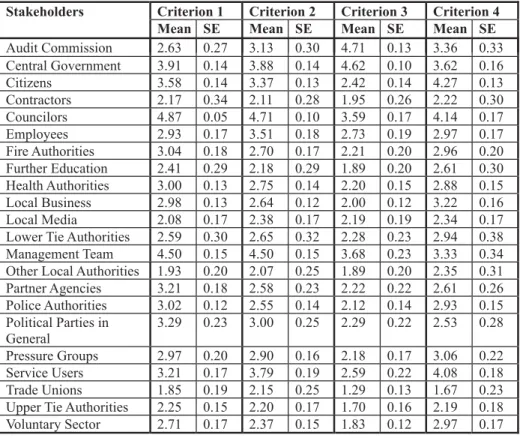
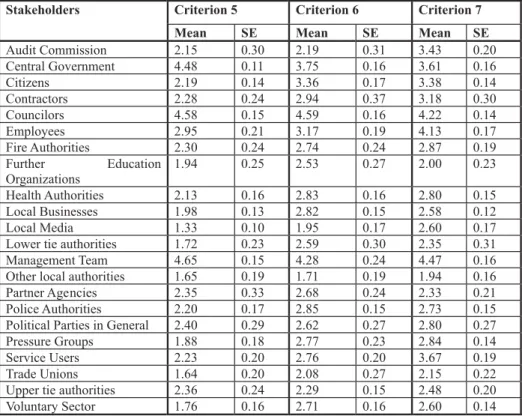
The questionnaire’s second question asked respondents to rate stakeholder’s influences according to seven criteria of assessment. The results of the statistical analysis are presented below, split into two groups. The first comprises criteria one to four, and they relate to the strategy formulation process. The second comprises the criteria five to seven, and they relate to the service delivery process. The results comprise the statistical mean of the rates each stakeholder received by the criterion and the standard error of the mean.
Criterion 1: The Definition of Objectives
In criterion 1, the respondents were asked to indicate how much influence each stakeholder represents in decisions about objectives. According to the respondents, the councilors are regarded as the strongest influential stakeholder with an SSI of 4.87 with a confidence level of 0.05, i.e. councilor’s SSI is likely to vary from 4.82 to 4.92. The management team is also regarded as a strong influential stakeholder (4.50; 0.15).
Criterion 2: The Definition of Priorities On Services
Criterion 3: The Definition of Performance Criteria
The third criterion assesses power to influence the criteria through which performance is to be assessed. At this time, the Audit Commission is regarded as the strongest influential stakeholder (4.71; 0.13) followed by central government (4.62; 0.10). Due to standard error, the averages almost overlap and this fact can be explained by their institutional links.
Criterion 4: The Definition of the Most Important Customers
The fourth criterion is related to stakeholder power a potential customer to be satisfied. At this time, citizens were regarded as the strongest influential stakeholders (4.27; 0.13). Councilors and service users are also regarded as representing strong influence (4.14; 0.17 and 4.08; 0.17 respectively).
Table 6: Stakeholders’ Power to Influence Strategy Formulation
Criterion 5: Power to Control Critical Assets
The fifth criterion assesses stakeholder power as a result of controlling the assets that the local authority employs to carry on its activities. The table below presents the results for this and for the following criteria. The respondent regarded the management team as the strongest influential stakeholder (4.65; 0.15). Councilors and central government are also regarded as representing strong influence (4.58; 0.15 and 4.48; 0.10 respectively).
Criterion 6: Power to Control Technical Skills
The sixth criterion assessed stakeholders’ power for controlling technical skills. In this criterion, the respondents regarded councilors as the strongest influential (4.59; 0.15). The management team is also regarded as representing strong influence (4.28; 0.24). However, the high standard error for the management team’s SSI indicates low agreement around this stakeholder’s influences in this criterion.
Criterion 7: Power to Influence the Service Delivery Process
Table 7: Stakeholders’ power to influence the Service Delivery Process
Source: data analysis.
Reliability A nalysis on Stakeholder Identification Reliability A nalysis on Stakeholder IdentificationReliability A nalysis on Stakeholder Identification Reliability A nalysis on Stakeholder Identification Reliability A nalysis on Stakeholder Identification
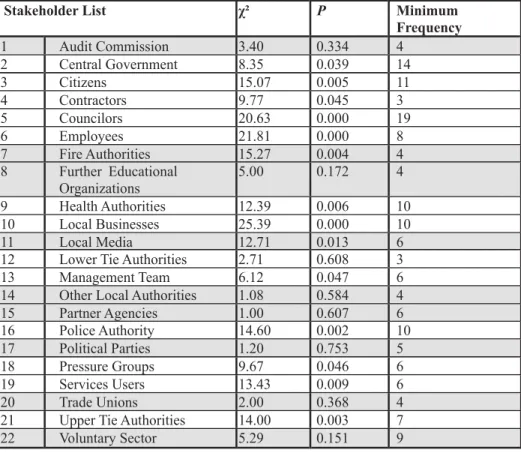
One limitation of this investigation is placed upon the SNI, whose results ranked stakeholders as more or less present in the decision-making process of English Local Authorities. Some stakeholders achieved a low index and this problem could undermine the reliability of the SSI results. In order to improve the reliability of the findings, a goodness of fit analysis is done through the chi-square test.
In this matter, Keppel and Zedeck (1989) defined reliability as “the consistency with which the variable of interest can be assessed”. Sapsford and Jupp (1996) argued that the chi-square test could be used to assess goodness of fit in variables of nonparametric distributions, which is the case of this investigation. Coakes and Steed (1999) suggest that, in order to be acceptable, the results of the chi-square test must comply with the following parameters:
. Confidence level must be 95% at least;
. The variable should be represented in, at least, 5 units of the sample.
Table 8 presents the results for the chi-square calculation. The highlighted stakeholders are those that do not comply with the rules outlined above. This fact means that these stakeholders should have their SSIs disregarded from the investigation and further analysis should be done with them. Therefore, this investigation has no evidence to consider their salience for decision-making.
Table 8: The Chi-Square Test Calculation
D DD D
DIS C U S S IO NIS C U S S IO NIS C U S S IO NIS C U S S IO NIS C U S S IO N
The results of this investigation indicate that English Local Authorities are stakeholder-based organizations with some stakeholder influences being critical to the process. As a key issue in the New Labour agenda since 1997 (DRIVER; MARTELL, 1998), the investigation found empirical evidence to support the assumption that English Local Authorities have to take stakeholders’ opinions and expectations into account when devising their strategies.
First and foremost, the stakeholder concept has to be dealt with. According to Freeman (1984), a stakeholder is any person, group or organization able to influence the organization or to be influenced by the organization’s objectives and operations. According to this broad definition, the people, groups and organizations included in this investigation are very likely to be accepted as stakeholders. However, if we look at more specific definitions of stakeholders, such as that proposed by Mitchell et al. (1997), which expanded Freeman’s concept scope by introducing a third dimension, further considerations need to be made.
According to the criteria of power proposed in this article, a stakeholder is able to influence an organization when possessing control over resources, control over a technical skill, and control over a body of knowledge, power stemming from legal prerogatives, and access to those who can rely on the previous sources of power. Below, some stakeholders have their relationship with local governments analyzed.
. Central government has power because it controls resources, which indicates a dependence relationship between it and local governments. Central government also has legitimacy because its activities are legally supported by acts of Parliament. According to Mitchell et al.’s model, central government can be regarded at least as a dominant stakeholder;
. Councilors have power because they are empowered by legal prerogatives to do so. They also have legitimacy due to legal prerogatives. For this reason, councilors can also be regarded as dominant stakeholders;
. Public partners (health, police, fire authorities, and other local authorities) have legitimacy for influencing decision-making in the scope of their attributions as public service deliverers. Their power and urgency do not seem to be a general issue in the local government affairs and they are to be dealt with case-by-case. For this reason, these stakeholders are labeled as discretionary;
. Citizens, local businesses and service users do not have power. There have to pay taxes and this could lead to a dependence relationship. However, local authorities in England do not rely heavily upon incomes from local taxpayers because around 70% of their budgets are funded by transferences from central government. On the other hand, it is indisputable that these stakeholders have legitimacy as well as urgency in their demands to which local government has a duty to meet.
In terms of stakeholder’s salience, the investigation sheds light on local government stakeholder management theory by pinpointing the powerful stakeholders according to the seven criteria presented above. Starting from this
point, scholars can investigate in detail these stakeholders’ modus operandi in
order to consider better ways for dealing with them.
The evidence presented in this report is supported by the chi-square calculation. In such an analysis, some of the SSIs are not corroborated due to nonconformity with the chi-square parameters and this is in part due to their low SNI. However, the problem does not disqualify the findings. Rather, it indicates that further analysis should be done in this barely explored field. It would be helpful to investigate how different types of local public services perceive stakeholders’ salience. It would be also helpful to compare public and private service delivering processes in order to figure out to what extent they agree about a stakeholder’s identification and salience. For the moment, the list proposed in this investigation would be a helpful starting point for further research.
Figure 3: A Generic Stakeholder’s Map for English Local Authorities
C CC C
CO N C LU S I O NO N C LU S I O NO N C LU S I O NO N C LU S I O NO N C LU S I O N
This paper presents an investigation carried out with the chief executives of English Local Authorities. Its main aim has been to identify who the people, groups and organizations regarded by the authorities as a stakeholder are. To this end, the investigation gathered evidence concerning stakeholder identification and salience based on criteria of power and interest.
A theoretical contribution of the findings is related to the normative basis of the stakeholder theory. Evidence gathered in this investigation corroborates Donaldson and Preston’s (1995) arguments about the normative basis of the stakeholder theory to the extent that it suggests diversity in stakeholder management. From the findings, it can be learned that the relationships with stakeholders are to be managed employing different strategies because all of them assume different roles in decision-making and have different degrees of importance for the process.
As an indication for further investigations, the findings raise the importance of identifying how stakeholder influences come about in local government decision-making. It would be worthwhile to know what part of decision-making influences is exerted as well as the modus operandi of stakeholder influences. This information would shed light on the patterns of relationships between stakeholders and local government’s organizations, e.g., in the accountability process.
Another issue is related to the stakeholder identification framework. This investigation has proved that stakeholder identification is neither based on political, nor geographical contexts. Chief executives have nominated stakeholders in an almost homogeneous manner. However, a stakeholder’s identification might be a service-based issue, and depending on the nature of the service to be delivered different types of stakeholders (perhaps with different amount of power) would arise. Therefore, comparisons between different types of services within the very same authority are welcomed to the field.
Looking at replication, this investigation can be seen as a starting point to introduce the stakeholder concept to other realities despite the nature of the field investigated. The investigation was carried out in a parliamentary and monarchical country. This fact means that the findings need to be looked at carefully to avoid misinterpreting their main contributions to the literature. In Brazil, counties are very likely to adopt stakeholder management because public functions carried here are similar to those carried by local governments in England as demonstrated before. Overall, local decision makers in Brazil are very likely to deal with the same sort of stakeholders as in England.
This investigation concludes that the decision-making of local government organizations have relationships with a myriad of stakeholders, each one able to influence it. In such a process, decision-makers have to acknowledge environmental influences as sources of opportunities to be exploited as well as threats to be avoided. From this point, local government stakeholder management theorists should dedicate their attention to studying in-depth the relationships between local government and the sources of influence raised in this article.
A AA A
AC KN O WLEDG EM EN T SC KN O WLEDG EM EN T SC KN O WLEDG EM EN T SC KN O WLEDG EM EN T SC KN O WLEDG EM EN T S
My sincere gratitude to CAPES - Ministério da Educação - Brazil without whose support anything would have happened.
N NN N NO T EO T EO T EO T EO T E
1 A professional who was hired to manage the administrative machine of local administrations.
R RR R
REFEREN C ESEFEREN C ESEFEREN C ESEFEREN C ESEFEREN C ES
COUNTRYSIDE A.
The State of the Countryside 2001.
Wetherby: Countryside Agency. 2002. Disponível em: <http://www.countryside.gov.uk>.
BLAIR, J. D.; BUESSELER, J. A.
Competitive Forces in the Medical Group Industry: A Stakeholder Perspective. Health Care
Management Review, v. 23, n. 2, p.
7-27. 1998.
BRYMAN, A.
Social Research Methods. Oxford:
Oxford University Press. 2001.
BRYSON, J.
Strategic Planning For Public and
Non-Profit Organization. San
Francisco: Jossey-Bass Publishers. 1995.
COAKES, S. J.; STEED, L. G.
SPSS: Analysis without Anguish.
Brisbane: John Wiley & Sons. 1999.
DIMAGGIO, P. J.; POWELL, W. W.
The iron cage revisited: institutional isomorphism and collective rationality in organizational fields. In: POWELL, W. W.; DIMAGGIO, P. J. (Ed.). The New Institutionalism in
Organizational Analysis. Chicago:
The University of Chicago Press, 1991.
DONALDSON, T.; PRESTON, L. E.
The Stakeholder Theory of the Corporation: concepts, evidences, and implications. Academy of
Management Review, v. 20, n. 1, p.
65-91. 1995.
DRIVER, S.; MARTELL, L.
New Labour, politics after
Thatcherism. Cambridge: Polity
Press. 1998.
ENZ, C. A. et al.
Graduate-Level Education: A Survey of Stakeholders. The Cornell H.R.A
FOTTLER, M. et al.
Assessing Key Stakeholders: Who Matters to Hospitals and Why?
Hospital & Health Services
Administration, v. 34, n. 4, p. 525-546.
1989.
FREEMAN, R. E.
Strategic Management: A Stakeholder
Approach. Massachusetts: Pitman.
1984.
GREENING, D. W.; GRAY, B.
Testing a Model of Organizational Response to Social and Political Issues. Academy of Management
Journal, v. 37, n. 3, p. 467-498. 1994.
HANNAN, M. T.; FREEMAN, J.
The Population Ecology of Organizations. American Journal of
Sociology, v. 82, n. 5, p. 929-964. 1977.
HARDY, C.
Understanding Power: Bringing about Strategic Change. British
Journal of Management, v. 7, Special
Issue, p. S3-S16. mar. 1996.
KATZ, D.; KAHN, R. L.
The Social Psychology of
Organizations: John Wiley & Sons,
Inc. 1978.
KEPPEL, G.; ZEDECK, S.
Data analysis for research designs, analysis of variance and multiple
regression/coorelation approaches.
New York: W. H. Freeman. 1989, A Series of books in psychology.
KUMAR, K.; SUBRAMANIAN. R.
Meeting the Expectations of Key Stakeholders: Stakeholder Management in the Health Care Industry. SAM Advanced
Management Journal, p. 31-40.
spring 1998.
MEYER, J. W.; ROWAN, B.
Institutionalized Organizations: formal structure, myth, and ceremony. In: POWELL, W. S.; DIMAGGIO, P. J. (Ed.). The New Institutionalism in
Organizational Analysis. Chicago:
The University of Chicago Press, 1991. Institutionalized Organizations: formal structure, myth, and ceremony.
MILLER, D. C.; SALKIND, N. J.
Handbook of Research Design &
Social Measurement. Thousand
Oaks: Sage Publications. 2002.
MILLER, S.; WILSON, J.
Perceptions of Stakeholding: The Case of an NHS Trust. Public Money
& Management, p. 51-58. july/sep.
1998.
MINTZBERG, H.
Power in and around Organizations.
New Jersey: Prentice Hall, Inc. 1983.
MITCHELL, R. K. et al.
Toward a theory of stakeholder identification and salience: defining the principle of the who and what really counts. Academy of
Management Review, v. 22, n. 4, p.
MWANKWO, S.; RICHARDSON, B.
Organizational leaders as political strategists: a stakeholder management perspective. Management Decision, v.
34, n. 10, p. 43-49. 1996.
OLIVER, C.
Strategic Responses to Institutional Processes. Academy of Management
Review, v. 16, n. 1, p. 145-179. jan.
1991.
ORRÙ, M. et al.
Organizational Isomorphism in East Asia. In: POWELL, W. S.; DIMAGGIO, P. J. (Ed.). The New Institutionalism in Organizational
Analysis. Chicago: The University of
Chicago Press. Organizational Isomorphism in East Asia, p. 361-389, 1991.
PFEFFER, J.; SALANCIK, G. R.
The External Control of Organizations: A Resource
Dependence Perspective. New York:
Harper and How. 1978.
RAHMAN, S. A.
Comparative Study of TQM practice and organisation performance of SMEs with and without ISO 9000 certification. International Journal of
Quality and Reliability Management,
v. 18, n. 1, p. 35-49. 2001.
SAPSFORD, R.; JUPP, V.
Data Collection and Analysis.
London: Sage Publication. 1996.
SAVAGE, G. T. et al.
Strategies for Assessing and Managing Organizational Stakeholders. Academy
of Management Executive, v. 5, n. 2.
1991.
SELZNICK, P.
TVA and the Grass Roots: a study in the Sociology of Formal
Organization. New York: Harper
Torchbooks. 1966.
STONEY, C.; WINSTANLEY, D.
Stakeholding: Confusion or Utopia? Mapping the Conceptual Terrain.
Journal of Management Studies, v.
38, n. 5, p. 603-626. july 2001.
WINSTANLEY, D. et al.
When the Pieces Don’t Fit: A Stakeholder Power Matrix to Analyse Public Sector Restructuring. Public
Money & Management, p. 19-26. apr/