The role of stakeholders in the formulation of Pronatec
Fabiana Carvalho da Silva Bispo¹ ² Ricardo Corrêa Gomes¹
¹ Universidade de Brasília, Brasília / DF — Brazil ² Instituto Federal de Brasília, Brasília / DF — Brazil
At all stages of the public policy cycle, the importance of various stakeholders can be verified, either by approving, influencing, implementing, monitoring or helping to modify actions and decisions. Considering that the stakeholder analysis aims at determining the relevance of the stakeholders in a project or policy, the objective of this article is to map the stakeholders involved in the formulation process of the National Program for Access to Technical Teaching and Employment (Pronatec) and to understand the performance and their influence on the process. The qualitative research method was used, through content analysis of formal documents and interviews with program managers. From the mapping of the stakeholders, they were classified according to the model of Savage and collaborators (1991), whose result revealed the potential of each stakeholder to threaten or collaborate with the program.
Keywords: stakeholders; public policies; Pronatec.
Os papéis dos stakeholders na formulação do Pronatec
Em todos os estágios do ciclo de políticas públicas pode se verificar a importância de diversos stakeholders, seja aprovando, influenciando, implementando, monitorando ou ajudando a modificar ações e decisões. Considerando que a análise dos stakeholders tem como objetivo determinar a relevância dos mesmos em um projeto ou política, o objetivo deste artigo é mapear os stakeholders envolvidos no processo de formulação do Programa Nacional de Acesso ao Ensino Técnico e Emprego (Pronatec) e compreender a atuação e a influência deles no processo. Foi utilizado o método qualitativo de pesquisa, por meio da análise de conteúdo de documentos formais e entrevistas com gestores do programa. A partir do mapeamento dos stakeholders, os mesmos foram classificados segundo o modelo de Savage e colaboradores (1991), cujo resultado revelou o potencial de cada stakeholder em ameaçar ou colaborar com o programa.
Palavras-chave: stakeholders; políticas públicas; Pronatec.
Los papeles de los stakeholders en la formulación del Pronatec
En todas las etapas del ciclo de políticas públicas puede verificarse la importancia de diversos stakeholders, sea aprobando, influenciando, implementando, monitoreando o ayudando a modificar acciones y decisiones. Consi-derando que el análisis de los stakeholders tiene como objetivo determinar la relevancia de los stakeholders en un proyecto o política, el objetivo de este artículo es mapear a los stakeholders involucrados en el proceso de formu-lación del Programa Nacional de Acceso a la Enseñanza Técnica y Empleo (Pronatec) y comprender la actuación y su influencia en el proceso. Se utilizó el método cualitativo de investigación, a través del análisis de contenido de documentos formales y entrevistas con gestores del programa. A partir del mapeo de los stakeholders, los mismos fueron clasificados según el modelo de Savage y colaboradores (1991), cuyo resultado reveló potencial de cada stakeholder en amenazar o colaborar con el programa.
Palabras clave: stakeholders; políticas públicas; Pronatec.
DOI: http://dx.doi.org/10.1590/0034-761220180095
Article received on March 28, 2018 and accepted on September 25, 2018.
1. INTRODUCTION
From the year 2004, a growth of gross domestic product (GDP) and lower inflation led to an increase in the generation of salaried jobs, contributed to the formalization of labor contracts and increased purchasing power, reducing income differences between the workers.
Due to the resumption of economic growth, new demands from the business community for investments in training and professional qualification of people began to emerge, which generated an expectation of filling new vacancies in all regions of the country. Vocational and technological education began to consolidate as a strategic effort of the Ministry of Education (MEC) aimed at changes in the world of work and several actions were initiated in order to strengthen the role of the State as provider of social policies, especially poverty (Baltar, 2015; Setec/MEC, 2004).
All this context created a “national humor” appropriate to the political project of the federal government. The vocational training courses were considered as a viable alternative and that served both the desires of the business and the unions as well as the population in general. Thus, in early 2011, the National Congress, by President Dilma Rousseff, was sent to Bill No. 1,209, of 2011, which would create the National Program for Access to Technical Education and Employment, Pronatec.
Pronatec created new measures and readjusted a set of previous actions that had been developed for the expansion of the offer of professional education courses in Brazil. Among the new initiatives was the Training Grant, which consisted of the free, large-scale offer of technical courses of initial and continuous training that were funded with resources passed on by the MEC to educational institutions of the various vocational education networks in the country.
As a rule, public policy acquires identity from a set of decisions that define and establish abstract norms and general rules (laws, decrees, agreements, agreements, treaties, etc.) that will determine behaviors and actions of individuals and groups for generation of concrete results aimed at solving problems that gave rise to the need of the policy’s own configuration (Calmon and Costa, 2013; Souza, 2003).
Stakeholders, as called by Freeman (1984), is any individual or group that can affect or be affected in the process of achieving the goals of a given organization. They vary in their meaning and impact on the strategic management process, which is used as a theoretical background to investigate the relationships between a given organization (public or private) and its environment (Gomes and Gomes, 2007; Mitchell, Agle and Wood, 1997; Savage et al., 1991).
Considering that public policies are driven by stakeholders’ interests, whether by approving, influencing, implementing, monitoring or helping to modify actions and decisions and also by organizational interests, the objective of this article is to map the stakeholders involved in the formulation process of the National Access Program to Technical Education in Employment (Pronatec) and to understand their performance and their influence in this process.
2. THEORETICAL BACKGROUND
2.1 FORMULATION OF PUBLIC POLICIES
A policy is an elaborate guideline to address a public problem, a deliberate plan of action to drive decisions and achieve rational outcomes, the term of which can be applied to governments, private sector organizations, and individuals. They are tools used by the State to perform its public functions in meeting social demands and solving problems that affect the community. It concerns the allocation of resources and efforts to address a particular collective problem (Dye, 2002; Howlett, Ramesh and Perl, 2013; Kingdon, 2011; Secchi, 2013; Souza, 2006).
Public policies are driven by stakeholder interests and organizational interests. Interaction among stakeholders reflects on social and political outcomes stemming from three main factors: the distribution of interests, the constraints imposed by rules or norms, and the distribution of power resources. These factors will portray three important elements for action: interests, power resources, and action opportunities that will shape and stimulate stakeholder action in the political system (March and Olsen, 2008).
2.2 PARTICIPATION AND INVOLVEMENT OF STAKEHOLDERS
As presented in the introductory part, the stakeholder in Freeman’s definition (1984) is any individual or group that can affect or be affected in the process of achieving the goals of a given organization. Several authors have proposed models for stakeholder analysis and classification.
In the model of Mitchell, Agle and Wood (1997), the stakeholders must be identified from three attributes: the power of the interested party to influence the organization; the legitimacy of the relationship of the interested party with the organization; the urgency of stakeholder demands on the organization. This criterion of differentiation of groups of stakeholders allows to establish priorities and define which interests will be met. Through the created model the authors propose a different treatment for power and legitimacy, insisting on the difference between them and the fact that, in reality, there may be stakeholders who are perceived with power, but without legitimacy, and stakeholders with legitimacy, but Without power.
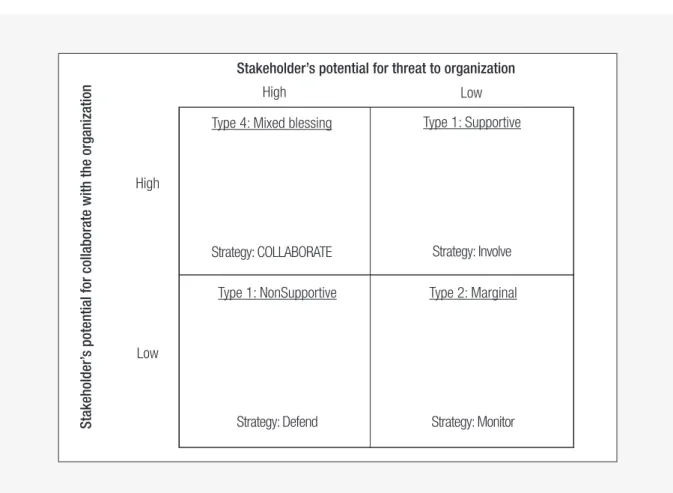
However, stakeholders are not always interested in favoring the organizations with which they share the social, economic or political environment. The potential threat or cooperation of stakeholders vis-à-vis organizations and other stakeholders is the subject of a study presented by Savage and collaborators (1991). According to the authors, for each strategic decision, organizations often face a diverse set of stakeholders with varied and often conflicting interests and objectives. These authors created a matrix by classifying the stakeholders into four groups, where it is possible to identify the degree of influence of each one within the organization and what the best strategy to take before each one.
Stakeholders who are unwilling to cooperate are classified as type 3. These have high potential for threat but low potential for cooperation. Type 4 are ambiguous stakeholders, who have high potential for threat or cooperation. For such classification figure 1, below.
FIGURE 1 STAKEHOLDERS’ DIAGNOSIS BASED ON THE SAVAGE AND COLLABORATORS MODEL (1991)
Stakeholder’s potential for threat to organization
Stak
eholder
’s potential for collabor
ate with the or
ganization
Strategy: COLLABORATE Type 4: Mixed blessing
Strategy: Involve Type 1: Supportive
Strategy: Defend Type 1: NonSupportive
Strategy: Monitor Type 2: Marginal High
Low
High Low
Source: Savage and collaborators (1991:65).
According to Savage and collaborators (1991), the potential for stakeholder co-operation is often ignored because reviews often emphasize the types and magnitude of stakeholder threats. Cooperation between stakeholders is particularly relevant because it can lead organizations to join forces, resulting in better management of activities. In this way, the more dependent the organization’s stakeholder, the greater the willingness to cooperate.
it has observed connections between areas of influence and decision-making, identifying patterns of resource dependency, institutional constraints, and network formation.
3. METHODOLOGY
In accordance with the object analyzed, a qualitative approach was followed for data collection and analysis. The present research used four data sources, namely: 1) scientific articles (secondary data); 2) official documents (secondary data); 3) journalistic documents (secondary data); 4) documents derived from interview transcripts (primary data).
Regarding scientific articles, those that included at least included in the list of key words or in the abstracts, terms such as “stakeholder (s)”, “Pronatec”, “professional education” and “public policy” were searched.
The search for official documents was based on laws, resolutions, ordinances and information notes, as well as the collection of institutional reports obtained at the MAP website — Program Monitoring
and Evaluation —(Setec/MEC).1
As a documentary support, the Audit Reports of the Federal Audit Office (TCU) and the General Controllership Reports of the Union (CGU) were also analyzed, in order to compare the data of these reports with the data obtained in the interviews and to verify the similarities and contradictions. The journalistic documents refer to the articles published in the Senate Portal at the time of the debates on the legislative proposals under analysis.
The interviews took place between May and August of 2017 and were carried out with specialists who were directly involved in the Pronatec formulation process. Representatives from Setec/MEC, as well as from offering and demanding partners of the Pronatec courses, such as S System (Sesc, Senat, Sesi, Sebrae and Senar) and the Federal Institutes of Science and Technology ( Brasília, Rio de Janeiro, Rio Grande do Norte and Espírito Santo). The interviews ended when saturation was reached, when the inclusion of new strata would not add anything new.
In all, 20 interviews were conducted, with a mean duration of 31 minutes each, for those made in person. The interviewees were grouped into three groups of actors: (1) Secretaries and Directors, (2) Coordinators and, and (3) Technicians and Advisors.
After the conclusion of the transcript of each interview, the reports were reviewed, compared to the audio and eventually corrected, for the purpose of retrieving aspects captured at the time of the interview, but were not captured during the transcription. Each report was saved in Word file, with the nomenclature associated with each interviewee. After saving, the files were transferred to Nvivo @ 11 software.
For the operationalization of the codification process in the software, “nodes” were created that corresponded to each identified stakeholder (analysis category). The analysis procedure thus involved the coding of the data according to the category of analysis and was applied equally to the four data sources. Confrontation of the data and an in-depth examination of the material collected allowed the development of data analysis and interpretation.
4. RESULTS AND DISCUSSION
The proposal of the Pronatec bill was sent to the Presidency of the Republic by a commission composed of the following ministers: Fernando Haddad (Minister of Education), Carlos Roberto Lupi (Minister of Labor and Employment), Guido Mantega (Minister of Finance), Miriam Belchior (Minister of Planning, Budget and Management) and Tereza Campello (Minister of Social Development and Fight against Hunger). On April 28, 2011, the President of the Republic sent the proposal to the Chamber of Deputies.
The following day, it was read by the Board of Officers, initiating its processing as a matter of urgency. Receiving number 1,209/2011, three days later, was sent to the Work, Administration and Public Service Committees; Education and Culture; Finance and Taxation; Constitution and Justice and Citizenship.
The proposal went through the Commissions, receiving, officially, 37 amendments. In the commissions, it was recommended to reject nineteen amendments and hold public hearings, which took place in six capitals (Salvador, Brasilia, Belém, Natal, Goiânia and Recife). His replacement, which resulted from the work of the aforementioned standing committees, for having exceeded the 45-day deadline, received an offensive from the mayor to withdraw his urgency.
With the agenda locked and with a delay of 67 days, the proposal of the bill no 1,209/2011 followed
in urgency and finally it was to the plenary session in the deliberative session of August 31, 2011 where it was presented its consolidated substitute by the Commission of Education and Culture, with the contributions of the other committees, and in this session, the final wording signed by Representative Jorginho Mello of PSDB-SC (Cassiolato and Garcia, 2014) was approved.
Thus, on September 6, 2011, the Board of Directors forwarded the bill approved to the Federal Senate, which was approved in the Chamber, and was read in the Senate plenary on September 8, 2011, where it was informed that it would also be processed under a regime urgently. Appreciated by the Committees in which it passed, three days after the approval, the Bureau of the Federal Senate sent an official letter to the Chamber of Deputies communicating the approval, without amendments and revision, of the bill, directing the same to the presidential sanction.
Thus, six months have elapsed since the day the message left the Palácio do Planalto, presenting the Pronatec bill, until the publication of the law in the Official Gazette.
The project submitted by the Executive Branch was the subject of great discussions, both in the Casa’s environment and in external public hearings. Various actors, representing the governmental perspectives of all spheres of action, Secretaries of State for Education and organized civil society related to the theme, were consulted and heard. In the Committees through which it was carried out, it was sought to comply with the requests, as well as the demands of the Deputies and the drafting of a final text that was in agreement with the interests of those involved.
4.1 MAPPING AND CLASSIFICATION OF STAKEHOLDERS
For the classification of the stakeholders identified in the Pronatec formulation process, the model presented by Savage and collaborators (1991) was adopted, since this model considers that, for each strategic decision, organizations usually face a diverse set of stakeholders with interests and varied and often conflicting objectives.
Savage and collaborators (1991) consider that the potential for stakeholder cooperation is often overlooked because the analyzes generally emphasize the types and magnitude of stakeholder threats. According to them, cooperation should also be emphasized as it allows stakeholder management to go beyond merely defensive or offensive strategies.
Savage and collaborators (1991) consider that the potential for stakeholder cooperation is often overlooked because the analyzes generally emphasize the types and magnitude of stakeholder threats. According to them, cooperation should also be emphasized as it allows stakeholder management to go beyond merely defensive or offensive strategies.
The Ministry of Education (MEC), besides being responsible for formulating Pronatec, was the ministry responsible for its implementation and the centralization of resources. In order to fulfill its aims and objectives, Pronatec began to be implemented under a cooperation system between the Union, the States, the Federal District and the Municipalities.
According to Savage and collaborators (1991), the potential for stakeholder cooperation is particularly relevant because it can lead organizations to join forces with other stakeholders, resulting in better management. Often, the more dependent the organization’s stakeholder, the greater its willingness to cooperate. Of course, this arrangement is also influenced by the environment. In other words, the organization and stakeholder may perceive an opportunity to increase interdependence because of a threat from the environment.
Next, stakeholders were analyzed for factors that affect their potential to threaten or cooperate with the program under study, according to Savage and collaborators (1991) model. Box 1 shows the result of the analysis.
BOX 1 CLASSIFICATION OF PRONATEC STAKEHOLDERS ACCORDING TO SAVAGE AND
COLLABORATORS MODEL (1991)
Stakeholder
Analysis Model proposed by Savage and
collaborators (1991)
Action Role Potential to
threat
Potential for
collaborate Classification
MEC/ Setec to coordinate To meet the high demand for skilled labor, to intermediation between ministries and to ensure that the objectives of the Program are met
high high Mixed blessing
FNDE to transfer To ensure that resources are passed on
regularly and that the provision of accounts is timely and appropriate
low low Supportive
Stakeholder
Analysis Model proposed by Savage and
collaborators (1991)
Action Role Potential to
threat
Potential for
collaborate Classification
MDS to demand
To insert workers from its clientele into the Program in order to meet the specific demands of their sector.
high high Mixed blessing
MTE to demand
To insert workers from its clientele into the Program in order to meet the specific demands of their sector.
high high Mixed blessing
System S to offer To qualify workers with a view to the allocation of labor in the labor market.
high high Mixed blessing
Federal Network to offer To qualify workers with a view to the allocation of labor in the labor market.
high high Mixed blessing
MTUR, MDA, MD, MC, MDIC, MJ, MPS, MinC, MPA, MAPA, MD, SMPE, MMA, SEP, SDH/ PR, State Secretariats of Education and DF
to demand To insert workers from its clientele into the Program in order to meet the specific demands of their sector. Being responsible to the SRH Indicate public (people in siutuação of vulnerability, disabled and others) for qualification courses
high high Mixed blessing
TCU to control
To audit the actions of the program and identify operational and compliance weaknesses and risks that could compromise the achievement of the Pronatec objectives
high low NonSupportive
CGU to control
To increase the transparency of Pronatec’s actions, through internal control actions, public audit and correction
high low NonSupportive
Political to influence
Political Articulation, support to the Federal Government project and defense of the interests of those they represented
high high Mixed blessing
Ministry of Finance to control
Administration of public resources
low high Supportive
MPOG to control To plan and to coordinate federal public
administration management policies.
low high Supportive
Councils to articulate To ensure the integrated management of EFA actions, especially in relation to the qualification courses required by the ministries and their state counterparts executing programs and projects of the Union, in order to achieve the achievement of the objectives of priority federal programs.
high high Mixed blessing
Stakeholder
Analysis Model proposed by Savage and
collaborators (1991)
Action Role Potential to
threat
Potential for
collaborate Classification
Forums to articulate To ensure the integrated management of EFA actions, especially in relation to the qualification courses required by the ministries and their state counterparts executing programs and projects of the Union, in order to achieve the achievement of the objectives of priority federal programs.
high high Mixed blessing
Media to influence
To exert an active and continuous role generating public attention, whether they influence positively or negatively in relation to Pronatec
high high Mixed blessing
Trade unions and associations
to defend
Defending the interests of teachers and workers
low low Marginal
Business to profit
To make a profit through training and professional training of people
low low Marginal
Beneficiaries of the Bolsa-Formação
to support
To get professional qualification to work in the job market
low high Supportive
Source: Adapted from Savage and collaborators (1991:65) to the results of the research.
Based on the classification of the Pronatec stakeholders, according to Savage and collaborators (1991) model, figure 2, below, is presented the diagnosis of the same, according to their potential to cooperate and/or threaten the program.
Integrating the group of stakeholders willing to cooperate are the National Education Development Fund (FNDE), the Ministry of Planning, Budget and Management (MPOG) and the Ministry of Finance. Because they support Pronatec’s objectives and actions and present little potential threat but high potential for cooperation, the best strategy, according to the model, would be to involve these stakeholders in relevant issues, maximizing their potential for cooperation. It was up to the managers of the program to be attentive to the suggestions that these stakeholders made and to try to serve them to the maximum, because it would be interesting for the program that they continue in this position in the graph.
FIGURE 2 DIAGNOSIS OF THE PRONATEC STAKEHOLDERS ACCORDING TO THE POTENTIAL TO COOPERATE AND THREATEN BASED ON THE SAVAGE AND COLLABORTORS MODEL (1991)
Stakeholder’s potential for threat to organization
Stak
eholder's potential for collabor
ate with the or
ganization
Strategy: COLLABORATE Type 4: Mixed blessing
Strategy: Involve Type 1: Supportive
Strategy: Defend Type 1: NonSupportive
Strategy: Monitor Type 2: Marginal High
Low
High Low
Setec, National Congress, the Councils, Forums, System S and
the Federal Network
National Education Development Fund (FNDE), the Ministry
of Planning, Budget and Management (MPOG) and the
Ministry of Finance
Federal Audit Office (CGU) and the Federal Audit Office (TCU)
Trade unions, business and associations
Source: Adapted from Savage and collaborators (1991:65) to the results of the research.
In the group of those who are indisposed to cooperate, the Federal Audit Office (CGU) and the Federal Audit Office (TCU), as supervisory bodies, have no interest in joining or supporting the program form. It was necessary to adopt a defense strategy in order to try to reduce the dependency that formed the basis for interest.
5. CONCLUSION
Considering the increasing emphasis on efficiency, effectiveness and effectiveness of government actions, research on the process of formulating and implementing government policies and programs in Brazil, analyzing aspects related to the performance of stakeholders, for example, has some peculiarities that present relevance and relevance to the study.
The mapping of the main stakeholders involved in the Pronatec formulation process made it possible to identify their discussion powers and types of interest during the program formulation process. The results found innovate the findings of the literature due to the wide view about the process, which allowed the observation of aspects related to the analysis of the stakeholders involved. These results confirmed that the dynamics of the social environment in which public policy is situated are constituted of contradictory and structurally articulated relations. In this sense, the Pronatec formulation can be understood as a process where the various subjects involved discuss and negotiate their interests. This knowledge can then be used to develop strategies for stakeholder management, to facilitate the implementation of specific decisions or organizational goals, or to understand the political context and assess the feasibility of future policy orientations.
REFERENCES
BALTAR, Paulo. Crescimento da economia e mercado de trabalho no Brasil. Brasília, DF: Ipea, 2015. (Texto para discussão, n. 2036).
CALMON, Paulo; COSTA, Arthur T. M. Redes e governança das políticas públicas. Revista de Pesquisa em Políticas Públicas, n. 1, p. 1-29, 2013.
CASSIOLATO, Maria Martha M. C.; GARCIA, Ronaldo C. Pronatec: múltiplos arranjos e ações para ampliar o acesso à educação profissional. Brasília, DF: Ipea, 2014. (Texto para discussão, n. 1919).
DYE, Thomas R. Understanding public policy. 10. ed. New Jersey: Prentice Hall, 2002.
FREEMAN, Edward R. Stakeholder theory — the state of the art. Cambridge: Cambridge University Press, 1984.
GOMES, Ricardo C.; GOMES, Luciana de O. M. Proposing a theoretical framework to investigate the relationships between an organization and its environment. Revista de Administração Contemporânea, v. 11, n. 1, p. 75-96, 2007.
GOMES, Ricardo C.; LIDDLE, Joyce; OLIVEIRA, Luciana. A five-sided model of stakeholder influence.
Public Management Review, v. 12, n. 5, p. 701-724, 2010.
HOWLETT, Michael; RAMESH, M.; PERL, Anthony. Política pública: seus ciclos e subciclos. Rio de Janeiro: Elsevier, 2013.
KINGDON, John W. Agendas, alternatives and public
policies. Boston: Longman, 2011.
MARCH, James G.; OLSEN, Johan P. Neo-institucionalismo: fatores organizacionais na vida política. Revista de Sociologia e Política, v. 16, n. 31, p. 121-142, 2008.
MITCHELL, Ronald K.; AGLE, Bradley R.; WOOD, Donna J. Toward a theory of stakeholder identification and salience: defining the principle of who and what really. The Academy of Management Review, v. 22, n. 4, p. 853-886, 1997.
SAVAGE, Grant T. et al. Strategies for assessing and managing organizational stakeholders.
Academy of Management Executive, v. 5, n. 2,
p. 61-75, 1991.
SECCHI, Leonardo. Políticas públicas: conceitos, esquemas de análises, casos práticos. 2. ed. São Paulo: Cengage Learning, 2013.
SETEC/MEC. Proposta em discussão: políticas públicas para a educação profissional e tecnológica. Bras[ilia, DF: MEC, 2004.
SOUZA, Celina. “Estado do campo” da pesquisa em políticas públicas no Brasil. Revista Brasileira de Ciências Sociais, v. 18, n. 51, p. 15-20, 2003.
SOUZA, Celina. Políticas públicas: uma revisão da literatura. Sociologias, a. 8, v. 16, p. 20-45, 2006.
Fabiana Carvalho da Silva Bispo
PhD in Administration of the University of Brasília and professor EBTT of the Federal Institute of Brasília. E-mail: [email protected].
Ricardo Corrêa Gomes