1Universidade Federal do Rio de Janeiro – UFRJ, Rio de Janeiro (RJ), Brazil. E‑mail: [email protected]; [email protected]; [email protected] 2Universidade Federal Rural do Rio de Janeiro – UFRRJ, Seropédica (RJ), Brazil. E‑mail: [email protected]
*Corresponding author.
Manuscript ID: 20160041. Received in: 03/16/2016. Approved in: 02/08/2017.
ABSTRACT: he sedimentary rocks within the Paleozoic Parnaiba basin in NE Brazil were intruded by voluminous tholeiitic diabase sills and covered by coeval basaltic lows. his paper presents lithogeo-chemical data of borehole samples obtained from wells located in the eastern portion of the Parnaiba basin. he diabases are subalkaline tholeiitc rocks comprising three high-TiO2 and three low-TiO2 suites that are unrelated by diferentiation processes. Fractional crystalliza-tion of olivine and augite was the predominantly evolucrystalliza-tionary pro-cesses within individual high- and low-TiO2 suites as depicted by trace element geochemical modelling, exception being made for one low-TiO2 suite that evolved by AFC. Parental compositions for both low- and high-TiO2 suites are related with variably enriched, spi-nel harzburgitic sources likely to represent the heterogeneous sub-continental lithospheric mantle underneath the sedimentary basin. he geochemical provinciality of the Parnaiba tholeiitic magmatism seems unrelated with the Transbrasiliano Lineament but may be due to lithospheric mantle amalgamation and remobilization occurred during previous tectonic events.
KEYWORDS: Transbrasiliano; Parnaiba basin; Diabases.
RESUMO: As rochas sedimentares paleozóicas da Bacia do Parnaíba, no Nordeste do Brasil, foram intrudidas por soleiras volumosas de diabá‑ sio toleítico e cobertas por derrames basálticos. Este artigo apresenta da‑ dos geoquímicos obtidos a partir de amostras de poços da porção leste da bacia sedimentar. Os diabásios são subalcalinos, toleíticos e agrupam‑se em três suites de alto‑TiO2 e três de baixo‑TiO2 não relacionadas por processos de diferenciação. Os processos petrogenéticos foram investi‑ gados com base em modelagem geoquímica e revelaram que as suites toleíticas evoluíram por cristalização fracionada de augita e olivina à exce‑ ção de uma, de baixo‑TiO2, evoluída por AFC em câmaras magmáticas pequenas na crosta superior. As composições parentais de ambas as sui‑ tes, de baixo‑TiO2 e alto‑TiO2, estão relacionadas com fontes mantélicas harzburgíticas variavelmente enriquecidas dentro da zona de estabilidade espinélio representadas pelo manto litosférico subcontinental. Esta fonte mantélica é lateralmente e/ou verticalmente quimicamente heterogênea e a provincialidade geoquímica em escala local parece não ter sido con‑ trolada pelo Lineamento Transbrasiliano, mas sim por remobilização do manto litosférico subcontinental possivelmente amalgamado durante processos orogênicos colisionais ocorridos previamente.
PALAVRAS‑CHAVE: Transbrasiliano; Bacia do Parnaíba; Diabásios.
The petrogenesis of tholeiitic diabases in
eastern Parnaíba Basin: evidence
for geochemical heterogeneities in the
subcontinental lithospheric mantle
in NE Brazil
Petrogênese de diabásios toleíticos na porção oriental da Bacia do
Parnaíba: evidências para heterogeneidade no manto litosférico
subcontinental no NE do Brasil
Adriano Guilherme da Silva1, Cícera Neysi de Almeida1,
Sérgio de Castro Valente2*, Leonardo Fonseca Borghi de Almeida1
INTRODUCTION
holeiitic basalt lows and diabase intrusions (dykes and sills) occur associated with the sedimentary rocks of the Paleozoic Parnaíba basin in northeast Brazil (Aguiar 1969). hese magmatic rocks comprise the Mosquito Formation (199 ± 2,4 Ma; 40Ar/39Ar in plagioclase; Merle et al. 2011)
and the Sardinha Formation (c.a. 129 – 124 Ma; K‑Ar and
40Ar/39Ar, whole‑rock; Bellieni et al. 1990, Fodor et al. 1990).
he former has been associated with the Central Atlantic Magmatic Province (CAMP; Marzoli et al. 1999) and the break‑up of Pangea, prior to the opening of the Central Atlantic Ocean in the Florida‑Guyana‑Liberia area (e.g., Bertrand 1991) whereas the latter has been related with the Paraná‑Etendeka Continental Flood Basalt Province and the fragmentation of Gondwana, previously to the opening of the South Atlantic ocean (Bellieni et al. 1990).
he tholeiitic dykes and sills are interbedded with the Paleozoic sedimentary rocks of the Pimenteiras and Cabeças formations (Devonian), the Poti Formation (Mississipian), and the Piauí Formation (Pensylvanian) of the Parnaíba basin (Vaz et al. 2007). he sedimentary rocks within these formations are related with the petroleum systems identiied in this Paleozoic basin (Abelha 2013). he magmatic rocks of the Sardinha and Mosquito formations played their role in the generation and migration as well as sealing and tra‑ pping of hydrocarbons (e.g. Rodrigues 1995).
Previous works on the tholeiitic magmatism within the Parnaíba basin were done on the basis of petrographic, geo‑ chemical and geochronological data obtained from surface samples (Bellieni et al. 1990, Fodor et al. 1990, Baksi & Archibald 1997, Marzoli et al. 1999, Ernesto et al. 2004, Merle et al. 2011). In this paper we present new petrographic and lithogeochemical data obtained from borehole samples of the Parnaíba tholeiitic rocks and put constraints on the geochemical heterogeneity of the subcontinental lithospheric mantle beneath the Parnaíba sedimentary basin in NE Brazil.
GEOLOGICAL FRAMEWORK
OF THE PARNAÍBA BASIN
he Parnaíba basin is located in northeastern Brazil (Fig. 1). It extends over 6.7 x 10⁵ km2 with approximately
3,500 m of maximum thickness of sediments (Vaz et al.
2007). he sedimentation of immature siliciclasts started in the Late Cambrian and Early Ordovician (Jaibaras Group) and took place onto grabens originated from the separa‑ tion of Laurentia and Baltica (Bond et al. 1984, Oliveira & Mohriak 2003). he stratigraphic record of the Parnaíba basin can be divided into three main sedimentary cycles during
the Silurian, the Devonian and the Permian‑Carboniferous separated by well‑marked unconformities all over the basin (Goes et al. 1990). hese three sedimentary cyles are related with ive sedimentary supersequences from the begining of the Paleozoic to the end of the Cretaceous, including two magmatic episodes represented by the tholeiitic basalts and diabases of the Mosquito Formation (Triassic) and the Sardinha Formation (Cretaceous) (Aguiar 1969).
he main regional structures within the Parnaíba basin are the NE‑trending, Transbrasiliano Lineament and the NW‑trending, Picos‑Santa Inês Lineament (Fig. 1), which controlled the main NE and NW depositional axis from the Early Silurian up to the Early Carboniferous. Later on, the basin acquired the typical oval shape of a syneclise lea‑ ding to the migration of the depocenter to the central parts of the basin (Vaz et al. 2007). Recent small magnitude, shallow depths earthquakes (< 60 km) within the northe‑ ast part of the basin (Lima Neto 2013) might be related to the reactivation of ENE‑WSW‑trending shear zones (Médio Coreaú Domain) extending far below the basin eastwards the Borborema Province.
Gravimetric and seismic data show that the thickness of the continental crust in the area of the Parnaíba basin does not exceed 40 km (Assumpção et al. 2013, Castro et al.
2014) with Moho at shallow to intermediate depths in the northeast and central portions of the basin. he boreholes of the present study are located in this area (Fig. 1).
PREVIOUS WORK ON
THE PARNAÍBA BASALTS
he tholeiitic basalts of the Sardinha Formation pre‑ vail eastwards whereas those of the Mosquito Formation prevail westwards the Parnaíba basin (e.g., Fodor et al.
1990; Ernesto et al. 2004). Some authors proposed that the high‑TiO2 Sardinha and low‑TiO2 Mosquito basalts could be distinguished on the basis of the higher Ti, Ba, La, Ce, Y, Zr, and Sr contents of the former (Bellieni et al.
1990). Nevertheless, low‑TiO2 basalts were later recognised in the Sardinha Formation (Baksi & Archibald 1997) and distinction from their counterparts within the Mosquito Formation are diicult to be made on the basis of petro‑ logical data.
Geochronological K‑Ar data obtained for the Mosquito basalts (Fodor et al. 1990) peaked at ca. 160 Ma and ca.
200 Ma whilst for the Sardinha basalts ages spreaded over
ca. 130 Ma and ca. 115 Ma. Later, 40Ar/39Ar data pointed
& Archibald 1997). More recent 40Ar/39Ar ages on plagio‑
clase separates gave 196 ± 1,0 Ma, 198,0 ± 1,2 Ma and 199,2 ± 1,0 Ma for the high‑TiO2 basalts of the Mosquito Formation, i.e., coeval to the low‑TiO2 ones (Merle et al.
2011). In general, the geochronological data corroborates the association of the high‑ and low‑TiO2 Mosquito basalts with the tectonic events related with the opening of the Atlantic ocean at equatorial latitudes as well as the high‑ and low‑TiO2 Sardinha basalts with the fragmentation of Gondwana prior to the opening of the South Atlantic ocean.
It is now generally accepted by many authors that high‑ and low‑TiO2 basalts, dykes and sills occur both in the Mosquito and Sardinha formations in the Parnaíba basin (Bellieni et al. 1990, Fodor et al. 1990, Baksi & Archibald 1997, Marzoli et al. 1999, Ernesto et al. 2004, Merle et al.
2011). Previously to the publication of geochronological data, petrogenetic studies proposed that the high‑TiO2 Sardinha basalts and the low‑TiO2 Mosquito basalts could not be related to each other by fractional crystallization without or with concomitant assimilation (ie. AFC, DePaolo 1981)
Figure 1. Phanerozoic sedimentary cover and major lineaments of the Parnaíba basin. The boreholes sampled during this study are indicated (eg. 1UN21). As an approximation, the 45°W longitude circle separates the Mosquito Formation, to the west, from the Sardinha Formation, eastwards the Parnaíba basin.
1
1
2
3 2
3
Cenozoic Legend:
Mesozoic
Paleozoic
Mosquito and Sardinha Formations
Transbrasiliano Lineament
Picos Santa Inês Lineament
Tocantins Araguaia Lineament
Well 1UN
Scale:
100 0 100 200
althought the low‑TiO2 Mosquito basalts themselves seemed to be related by AFC at low pressures (Bellieni et al. 1990). hese authors proposed that the compositions of the high‑ ‑TiO2 Sardinha and the low‑TiO2 Mosquito parental magmas could be explained by either 8 and 25% of partial melting of a garnet peridotite source or 10% of partial melting from a garnet and spinel source, respectively. Dynamic models also pointed to generation of the Sardinha and Mosquito basalts by 5 and 20% partial melting of a spinel source with 2% of magma retention in the residue.
More recent petrological work recognized two non‑coge‑ netic high‑TiO2 and three low‑TiO2 suites in the Mosquito basalts in the west part of the Parnaíba basin (Merle et al.
2011). he origin of the high‑TiO2 suites was attributed to partial melting of asthenospheric sources contaminated by interaction with the subcontinental lithospheric mantle. More evolved compositions were related to further AFC processes during ascent to crustal levels. On the other hand, the low‑TiO2 basalts were related to partial melting of the most enriched portions of the subcontinental lithosphe‑ ric mantle whose metassomatization was associated with previous subduction processes. Nevertheless, the partici‑ pation of asthenospheric sources in the generation of the low‑TiO2 Mosquito basalts was not completely refused by those authors. he authors proposed that the high‑ and the low‑TiO2 Mosquito basalts are related to local anomalously hot mantle conditions due to combined efects of edge‑dri‑ ven convection and large‑scale mantle warming beneath the Pangea supercontinent, although a mantle‑plume compo‑ nent with asthenospheric‑like isotopic characteristics was not ruled out neither as a main source nor as a heat supplier.
BOREHOLE SAMPLING
AND ANALYTICAL METHODS
he boreholes are located along an approximately NNE trend subparallel to the Transbrasiliano Lineament (Fig. 1). he farmost boreholes (1UN21 and 1UN26) are located about 400 km apart but boreholes can be displaced from each other by just about 20 km (1UN06 and 1UN32).
hirty‑four samples were collected from the boreholes within the study area. hey were prepared for petrography and a subset with twenty‑two samples was used for lithoge‑ ochemical analysis. Criteria for sample selection for lithoge‑ ochemical analysis were based on the absence of amygdales and veins, alteration products as well as phenocrysts as much as possible. Samples were washed under destiled water, dried, crushed under a cutrock device and furtherly reduced to pow‑ der (~ 10 g) under 200# in a WC mill. Samples powders were sent to ACTLABS in Canada for analyses of major and trace
elements, including the Rare Earth Elements (REE). A 1 g aliquota of each sample powder was fused and then diges‑ ted with aqua regia and diluted to 250 mL volumetrically. Appropriate international reference materials were digested at the same time. he samples and standards were analyzed on a hermo Jarrell Ash ENVIRO II simultaneous and sequential ICP‑AES for SiO2, TiO2, Al2O3, Fe2O3t, MnO, MgO, CaO,
Na2O, K2O, and P2O5. Total iron was analysed as Fe2O3t.
Loss on ignition (LOI) was performed by measuring weight diferences before and after heating another 1 g aliquota of the same sample powder in furnace at 1100⁰C for 30 minu‑ tes. Detection limits were 0.01 wt.% for the analysed oxides and LOI, but 0.001 wt.% for MnO and TiO2. Afterwards, a 0.25 g aliquota of sample powder was digested with four acids beginning with hydroluoric, followed by a mixture of nitric and perchloric acids, heated using precise program‑ mer controlled heating in several ramping and holding cycles which takes the samples to dryness. After dryness was attained, samples were brought back into solution using hydrochloric acid. Selected trace elements (Ni, Cr, Sc, Co, V, Ba, Rb, Sr, Nb, Y, Zr, Hf, U, h, Pb, and the whole set of REE) were measured in samples and standards by Perkin Elmer Sciex ELAN 9000 ICP/MS. hree blanks and ive controls (three before sample group and two after) were analyzed per group of samples. Duplicates were fused and analyzed every 15 sam‑ ples. Instrument was recalibrated every 40 samples. Detection limits for the selected trace elements were as follows: Ni and Cr (20 ppm), Sc and Co (1 ppm), V (5 ppm), Ba (3 ppm), Rb (1 ppm), Sr (2 ppm), Nb (0.2 ppm), Y (0.5 ppm), Zr (1 ppm), Hf (0.1 ppm), U (0.01 ppm), h (0.05 ppm), Pb (5 ppm), and below chondritic values for REE. Accuracy was measured on the basis of international standards W‑2a (oxides and some trace elements), BIR‑1a (Ni, La, Eu, and Gd), and ZW‑C (Nb) whereas precision was measured by duplicating sam‑ ple 1UN06/178,90, according to the method proposed by Jenner (1996) and Jenner et al. (1990). As such, precision values on the basis of percentages of relative standard devia‑ tions (%RSD) varied from 0.00 to 2.56 (average of 0.6) for oxides, 0.00 to 0.75 (average of 0.3) for Ni, Cr, Sc, and Co, 0.00 to 2.22 (average of 1.1) for the other selected trace ele‑ ments, and 0.00 to 4.76 (average of 1.5) for REE. Accuracy values on the basis of percentage of relative diferences (%RD) varied from 0.0 to ± 4.2 (average of ± 1.9) for oxides, 0.00 to
RESULTS
Petrography
he studied samples are basalts and diabases, which were arbitrarily distinguished by their amount of volcanic glass (respectively, > 50 vol.% and < 50 vol.%) since distinction could not be made on ield relationships criteria. Textures and structures were described following MacKenzie et al.
(1982). he rocks vary from aphanitic to phaneritic, the latter being ine (< 1 mm), medium‑ (1 – 3 mm) or coarse‑grai‑ ned (> 3 mm) types. Both hypo‑ to holohyalline rocks were found, the latter being predominantly equigranular and, more rarely, porphyritic. Zoned, partially corroded laths of plagioclase with sieve textures, as well as euhedral to subhe‑ dral augite and olivine pseudomorphs altered to bowlingite and iddingsite occur in the porphyritic rocks. he textures of the plagioclase crystals (Fig. 2) indicate that they were not in equilibrium with the host magma and may represent either antecrysts or xenocrysts. Augite phenocrysts largely predominate over olivine ones. Intersertal and intergranular textures are common, with subordinate ophitic and subophi‑ tic ones. Essential minerals within the groundmass include plagioclase and augite with apatite and Fe‑Ti oxides as acces‑ sory phases. Myrmekite and microgranophyric textures are common, pointing to the relatively evolved compositions of the original basaltic magmas (Fig. 3). Alteration products include bowlingite and iddingsite over olivine, uralite over augite and saussurite over plagioclase. Veins and amygdales
were found in some samples, particularly in those from the central portion of borehole 1UN32.
Lithogeochemistry
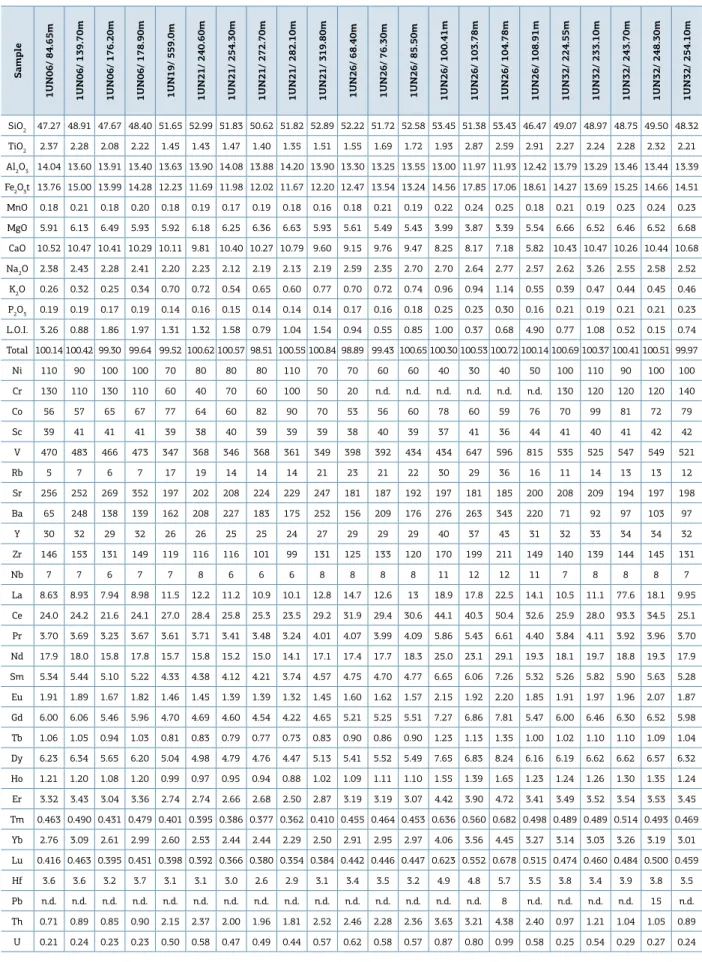
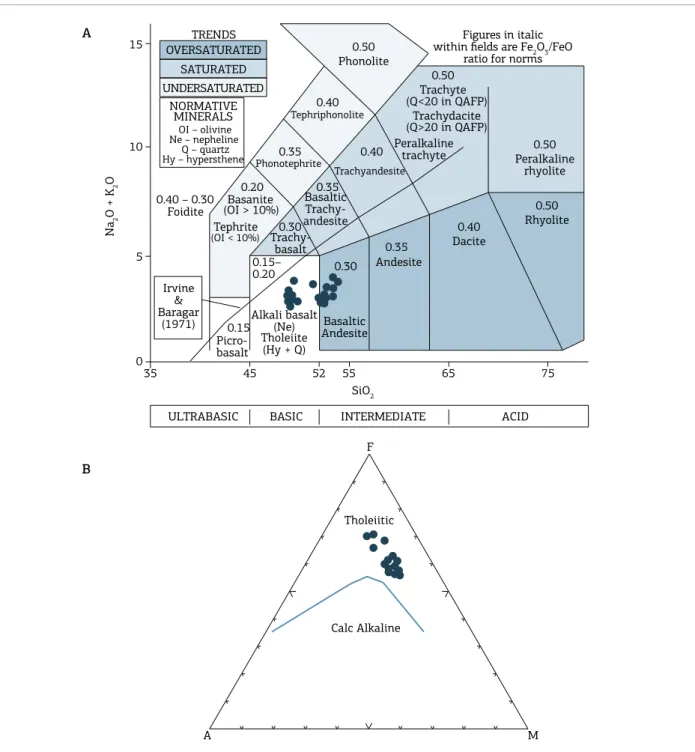
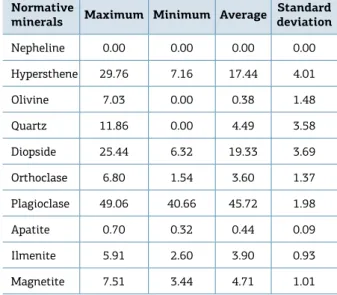
he lithogeochemical data of the studied samples are shown in Table 1. he Parnaíba basalts and diabases sam‑ pled from the ive boreholes comprise a subalkaline, tholeii‑ tic series (Fig. 4). he rocks are classiied as basalts and basal‑ tic andesites in the TAS diagram. CIPW norm calculations (Tab. 2) showed that all samples are hypersthene normative with no nepheline, which corroborates their tholeiitic evolu‑ tionary trend. here are both supersaturated (ie. normative quartz‑bearing) and saturated (ie. normative olivine‑bearing) tholeiites among samples, the former being more abundant than the latter.
he Parnaíba tholeiitic basalts and diabases can be divi‑ ded into low‑TiO2 (L‑Ti) and high‑TiO2 (H‑Ti) suites according to their TiO2 contents to similar evolutionary level (MgO) with a boundary at TiO2 = 2% (Fig. 5) and Ti/Y = 410 (Fig. 6) as with many Continental Flood Basalt Provinces worldwide (Erlank et al. 1984, 1988, Peate 1997).
Neither the L‑Ti nor the H‑Ti studied samples bear primary basaltic compositions (e.g. Ni > 500 ppm; Cr > 1000 ppm; SiO2 < 50wt.%; magnesium number 0.68 – 0.75; Roeder & Emslie 1970, Wilson 1989) (Tab. 3). he two aforementioned suites cannot be related by evolutionary processes since a single parental magma could not give rise to such diferent Ti/Y ratios and TiO2 contents for similar MgO values (Figs. 5 and 6). he small gap shown in both suites (~ 4 wt.% < MgO < 5.5 wt.%) are most likely to be related to the somehow reduced amount of samples available for this study than to magma mixing processes. Even so, the petrogenetic investigations were carried on with great care to prevent possible biased interpretations and were mostly based on geochemical modelling.
GEOCHEMICAL MODELLING
OF EVOLUTIONARY PROCESSES
he Rayleigh equation (Wood & Fraser 1976) was used to test for relationships among basaltic suites in the study area by fractional crystallization. Results were then used in mass balance calculations in order to test for coherence with the degree of evolution based on the MgO content of samples. Additionally, assimilation and fractional crystalli‑ zation (AFC) modelling (DePaolo 1981) was tried whene‑ ver fractional crystallization alone could not explain trace element variations within basaltic suites. As aforementioned, magma mixing or assimilation (without fractional crystalli‑ zation) were not taken as possible diferentiation processes
1.0 mm 1.0 mm
Figure 2. Corroded (A) and zoned (B) plagioclase xenocrysts in diabases from the Parnaíba basin. Crossed polarized light. Samples: 1UN06 and 1UN32.
A B
0.5 mm 0.5 mm
A B
Sample
1UN06/ 84.65m 1UN06/ 139.70m 1UN06/ 176.20m 1UN06/ 178.90m 1UN19/ 559.0m 1UN21/ 240.60m 1UN21/ 254.30m 1UN21/ 272.70m 1UN21/ 282.10m 1UN21/ 319.80m 1UN26/ 68.40m 1UN26/ 76.30m 1UN26/ 85.50m 1UN26/ 100.41m 1UN26/ 103.78m 1UN26/ 104.78m 1UN26/ 108.91m 1UN32/ 224.55m 1UN32/ 233.10m 1UN32/ 243.70m 1UN32/ 248.30m 1UN32/ 254.10m
SiO2 47.27 48.91 47.67 48.40 51.65 52.99 51.83 50.62 51.82 52.89 52.22 51.72 52.58 53.45 51.38 53.43 46.47 49.07 48.97 48.75 49.50 48.32
TiO2 2.37 2.28 2.08 2.22 1.45 1.43 1.47 1.40 1.35 1.51 1.55 1.69 1.72 1.93 2.87 2.59 2.91 2.27 2.24 2.28 2.32 2.21
Al2O3 14.04 13.60 13.91 13.40 13.63 13.90 14.08 13.88 14.20 13.90 13.30 13.25 13.55 13.00 11.97 11.93 12.42 13.79 13.29 13.46 13.44 13.39
Fe2O3t 13.76 15.00 13.99 14.28 12.23 11.69 11.98 12.02 11.67 12.20 12.47 13.54 13.24 14.56 17.85 17.06 18.61 14.27 13.69 15.25 14.66 14.51
MnO 0.18 0.21 0.18 0.20 0.18 0.19 0.17 0.19 0.18 0.16 0.18 0.21 0.19 0.22 0.24 0.25 0.18 0.21 0.19 0.23 0.24 0.23
MgO 5.91 6.13 6.49 5.93 5.92 6.18 6.25 6.36 6.63 5.93 5.61 5.49 5.43 3.99 3.87 3.39 5.54 6.66 6.52 6.46 6.52 6.68
CaO 10.52 10.47 10.41 10.29 10.11 9.81 10.40 10.27 10.79 9.60 9.15 9.76 9.47 8.25 8.17 7.18 5.82 10.43 10.47 10.26 10.44 10.68
Na2O 2.38 2.43 2.28 2.41 2.20 2.23 2.12 2.19 2.13 2.19 2.59 2.35 2.70 2.70 2.64 2.77 2.57 2.62 3.26 2.55 2.58 2.52
K2O 0.26 0.32 0.25 0.34 0.70 0.72 0.54 0.65 0.60 0.77 0.70 0.72 0.74 0.96 0.94 1.14 0.55 0.39 0.47 0.44 0.45 0.46
P2O5 0.19 0.19 0.17 0.19 0.14 0.16 0.15 0.14 0.14 0.14 0.17 0.16 0.18 0.25 0.23 0.30 0.16 0.21 0.19 0.21 0.21 0.23
L.O.I. 3.26 0.88 1.86 1.97 1.31 1.32 1.58 0.79 1.04 1.54 0.94 0.55 0.85 1.00 0.37 0.68 4.90 0.77 1.08 0.52 0.15 0.74
Total 100.14 100.42 99.30 99.64 99.52 100.62 100.57 98.51 100.55 100.84 98.89 99.43 100.65 100.30 100.53 100.72 100.14 100.69 100.37 100.41 100.51 99.97
Ni 110 90 100 100 70 80 80 80 110 70 70 60 60 40 30 40 50 100 110 90 100 100
Cr 130 110 130 110 60 40 70 60 100 50 20 n.d. n.d. n.d. n.d. n.d. n.d. 130 120 120 120 140
Co 56 57 65 67 77 64 60 82 90 70 53 56 60 78 60 59 76 70 99 81 72 79
Sc 39 41 41 41 39 38 40 39 39 39 38 40 39 37 41 36 44 41 40 41 42 42
V 470 483 466 473 347 368 346 368 361 349 398 392 434 434 647 596 815 535 525 547 549 521
Rb 5 7 6 7 17 19 14 14 14 21 23 21 22 30 29 36 16 11 14 13 13 12
Sr 256 252 269 352 197 202 208 224 229 247 181 187 192 197 181 185 200 208 209 194 197 198
Ba 65 248 138 139 162 208 227 183 175 252 156 209 176 276 263 343 220 71 92 97 103 97
Y 30 32 29 32 26 26 25 25 24 27 29 29 29 40 37 43 31 32 33 34 34 32
Zr 146 153 131 149 119 116 116 101 99 131 125 133 120 170 199 211 149 140 139 144 145 131
Nb 7 7 6 7 7 8 6 6 6 8 8 8 8 11 12 12 11 7 8 8 8 7
La 8.63 8.93 7.94 8.98 11.5 12.2 11.2 10.9 10.1 12.8 14.7 12.6 13 18.9 17.8 22.5 14.1 10.5 11.1 77.6 18.1 9.95
Ce 24.0 24.2 21.6 24.1 27.0 28.4 25.8 25.3 23.5 29.2 31.9 29.4 30.6 44.1 40.3 50.4 32.6 25.9 28.0 93.3 34.5 25.1
Pr 3.70 3.69 3.23 3.67 3.61 3.71 3.41 3.48 3.24 4.01 4.07 3.99 4.09 5.86 5.43 6.61 4.40 3.84 4.11 3.92 3.96 3.70
Nd 17.9 18.0 15.8 17.8 15.7 15.8 15.2 15.0 14.1 17.1 17.4 17.7 18.3 25.0 23.1 29.1 19.3 18.1 19.7 18.8 19.3 17.9
Sm 5.34 5.44 5.10 5.22 4.33 4.38 4.12 4.21 3.74 4.57 4.75 4.70 4.77 6.65 6.06 7.26 5.32 5.26 5.82 5.90 5.63 5.28
Eu 1.91 1.89 1.67 1.82 1.46 1.45 1.39 1.39 1.32 1.45 1.60 1.62 1.57 2.15 1.92 2.20 1.85 1.91 1.97 1.96 2.07 1.87
Gd 6.00 6.06 5.46 5.96 4.70 4.69 4.60 4.54 4.22 4.65 5.21 5.25 5.51 7.27 6.86 7.81 5.47 6.00 6.46 6.30 6.52 5.98
Tb 1.06 1.05 0.94 1.03 0.81 0.83 0.79 0.77 0.73 0.83 0.90 0.86 0.90 1.23 1.13 1.35 1.00 1.02 1.10 1.10 1.09 1.04
Dy 6.23 6.34 5.65 6.20 5.04 4.98 4.79 4.76 4.47 5.13 5.41 5.52 5.49 7.65 6.83 8.24 6.16 6.19 6.62 6.62 6.57 6.32
Ho 1.21 1.20 1.08 1.20 0.99 0.97 0.95 0.94 0.88 1.02 1.09 1.11 1.10 1.55 1.39 1.65 1.23 1.24 1.26 1.30 1.35 1.24
Er 3.32 3.43 3.04 3.36 2.74 2.74 2.66 2.68 2.50 2.87 3.19 3.19 3.07 4.42 3.90 4.72 3.41 3.49 3.52 3.54 3.53 3.45
Tm 0.463 0.490 0.431 0.479 0.401 0.395 0.386 0.377 0.362 0.410 0.455 0.464 0.453 0.636 0.560 0.682 0.498 0.489 0.489 0.514 0.493 0.469
Yb 2.76 3.09 2.61 2.99 2.60 2.53 2.44 2.44 2.29 2.50 2.91 2.95 2.97 4.06 3.56 4.45 3.27 3.14 3.03 3.26 3.19 3.01
Lu 0.416 0.463 0.395 0.451 0.398 0.392 0.366 0.380 0.354 0.384 0.442 0.446 0.447 0.623 0.552 0.678 0.515 0.474 0.460 0.484 0.500 0.459
Hf 3.6 3.6 3.2 3.7 3.1 3.1 3.0 2.6 2.9 3.1 3.4 3.5 3.2 4.9 4.8 5.7 3.5 3.8 3.4 3.9 3.8 3.5
Pb n.d. n.d. n.d. n.d. n.d. n.d. n.d. n.d. n.d. n.d. n.d. n.d. n.d. n.d. n.d. 8 n.d. n.d. n.d. n.d. 15 n.d.
Th 0.71 0.89 0.85 0.90 2.15 2.37 2.00 1.96 1.81 2.52 2.46 2.28 2.36 3.63 3.21 4.38 2.40 0.97 1.21 1.04 1.05 0.89
U 0.21 0.24 0.23 0.23 0.50 0.58 0.47 0.49 0.44 0.57 0.62 0.58 0.57 0.87 0.80 0.99 0.58 0.25 0.54 0.29 0.27 0.24
since the small compositional gap has been interpreted as resulting from constrained sampling.
Modelling was mostly performed taking into conside‑ ration a fractionating assemblage of olivine (10 ± 2 vol.%) and augite (90 ± 2 vol.%), according to the phenocrysts contents of the studied samples. Extract compositions for mass balance calculations varied from MgO = 10 to 15 wt.%, considering olivine compositions with 20 wt.% < MgO < 25 wt.% and augite compositions with 10 wt.% < MgO < 15 wt.%, according to the MgO compositions of typical basaltic parental liquids (e.g. Piccirillo & Meli 1988). he crystal‑liquid partition coeicients used in modelling were those compiled by Rollinson (1993) unless otherwise indicated. Tests were also made for fractionating assemblages with diferent amounts of plagioclase although the disequi‑ librium textures described for this mineral indicate that it is likely to represent either antecrysts or xenocrysts (Fig. 2).
he L‑Ti and H‑Ti parental and most evolved composi‑ tions for the whole study area are presented in Tab. 3. Since the two suites cannot be related by diferentiation processes, modelling will be performed separately.
Samples 1UN21/282.10m (MgO = 6.63 wt.% and La/Ybn = 2.9) and 1UN26/100.41m (MgO = 3.99 wt.% and La/Ybn = 3.1) represent respectively the parental and most evolved samples of the L‑Ti suite. Modelling using the Rayleigh equation shows that the La/Yb ratio variation (6%) between parental and evolved liquids could be achie‑ ved by 13% fractional crystallization of olivine: augite in the proportion of 10:90 and bulk partition coeicients (D) such as DLa = 0.051 and DYb = 0.493. Mass balance calcu‑ lations showed that such amount of fractional crystalliza‑ tion would require a parental composition with MgO = 7 – 10% and an extract with unrealistic MgO = 42% to generate the evolved liquid (MgO = 3.99 wt.%) within the L‑Ti suite. Fractionating assemblages with 10% olivine and diferent proportions of augite and plagioclase (from 80:10 to 40:60) were also considered in modelling. Results showed that minimum (10%) and maximum (60%) amounts of plagioclase would require 15% and 60% fractional crys‑ tallization to cope with the La/Yb ratio variation within the low‑TiO2 basaltic suite (for DLa = 0.071 – 0.138 and DYb = 0.444 – 0.201). Nevertheless, mass balance calculations showed that it would be necessary 30 and 90% fractional crystallization to explain MgO variations between paren‑ tal and evolved compositions of the low‑TiO2 samples for extracts with such amounts of plagioclase. Likewise, AFC modelling cannot explain the La and Yb variations within the L‑Ti suite (Fig. 7).
Similar geochemical modelling was performed for the H‑Ti suite in the study area. Samples 1UN32/254.10m (MgO = 6.68 wt.% and La/Ybn = 2.2) and 1UN26/104.78m
(MgO = 3.39 wt.% and La/Ybn = 3.4) represent respectively the parental and most evolved samples of the H‑Ti suite. Modelling using the Rayleigh equation shows that the La/ Yb ratio variation (53%) between parental and evolved liquids could be achieved by ~ 80% fractional crystalliza‑ tion, keeping with the same fractionating assemblage (oli‑ vine:augite = 10:90) and D values used on modelling the L‑Ti suite. However, MgO diferences between parental and most evolved compositions within the H‑Ti suite would require only ~50% fractional crystallization. Crosschecking of the La/Yb ratio variation and MgO variation using the Rayleigh equation and mass balance calculations was not consistent using diferent amounts (10 to 60%) of plagio‑ clase in the fractionating assemblage in models. Likewise, AFC modelling cannot explain the Ti and Y variations within the H‑Ti suite (Fig. 8). So far, the results showed that there must be more than one H‑Ti suite as well as more than one L‑Ti suite in the study area.
he presence of chilled margins between the magma‑ tic rocks and their enclosing sedimentary rocks in the stu‑ died boreholes are consistent with the intrusive nature of the former. As such, the studied samples are likely to repre‑ sent diabase sills, which is in agreement with the prevalent intrusive nature of the magmatic rocks within the Sardinha Formation eastwards the Parnaíba basin based on previous works (eg. Vaz et al. 2007). he existence of several L‑Ti and H‑Ti in the study area as depicted by the geochemi‑ cal modelling is somehow expected considering that, the Parnaíba diabases are predominantly saucer‑shaped (Porto & Pereira 2014) and that, the emplacement mechanisms of such intrusions would prevent them to spread over large areas (Hansen 2015).
Diferent L‑Ti and H‑Ti suites can be discriminated by comparing trace element ratios of samples with the same degree of evolution (ie., same MgO contents). For instance, the L‑Ti samples 1UN21/319.80m and 1UN19/559.00m were collected from borelohes, which are about 200 km apart from each other. hese samples have the same MgO content (respectively, 5.93 wt.% and 5.92 wt.%) but rather diferent La/Ybn (respectively, 3.4 and 3.0) and could clearly not have evolved from the same parental magma. As such, they constitute two diferent L‑Ti suites in the study area.
Boreholes 1UN06 and 1UN32 are about 20 km apart and gave only H‑Ti samples. Samples from the top and base of borehole 1UN32 have the same MgO contents (~ 6.6 wt.%) and La/Ybn ratios (2.2) which, in turn, is the same (considering an analytical error of ± 0.1) of sample 1UN06/84.65m whose MgO = 5.91 wt.%. Cogenetic liquids evolved from the same parental magma cannot reach the same La/Ybn ratios for diferent degrees of evolution (ie.
most dependent upon the fractionating assemblage. If only olivine and clinopyroxene fractionate, as presented in pre‑ vious geochemical models, then the La/Ybn ratio will not vary too much. However, as demonstrated in the models presented previously, including plagioclase in the fractiona‑ ting assemblage does not change the results of the modelling because the KdLa value of plagioclase is greater than those of
clinopyroxene and olivine but KdYb values are smaller than those same maic phases, balancing the La/Ybn ratio varia‑ tion. Similarly, crystallization and contamination (AFC) can vary from place to place for liquids derived from the same parental magma only in cases diferent compositions of con‑ taminants are taken in consideration. However, the AFC modelling previously performed assumed a rather invariable
TRENDS OVERSATURATED
SATURATED
UNDERSATURATED NORMATIVE
MINERALS
OI – olivine Ne – nepheline
Q – quartz Hy – hypersthene
0.40 – 0.30 Foidite
0.50 Phonolite
0.40
Tephriphonolite
0.35
Phonotephrite
0.20 Basanite (OI > 10%) Tephrite
(OI < 10%)
Irvine & Baragar
(1971) 0.15 Picro‑ basalt
0.15– 0.20
Alkali basalt (Ne)
ULTRABASIC BASIC INTERMEDIATE ACID Tholeiite
(Hy + Q)
0.50 Trachyte (Q<20 in QAFP)
Trachydacite (Q>20 in QAFP) Peralkaline
trachyte 0.40
Trachyandesite
0.35 Basaltic Trachy‑ andesite 0.30 Trachy‑
basalt 0.30
Basaltic Andesite
0.35 Andesite
0.40 Dacite
0.50 Peralkaline
rhyolite Figures in italic within fields are Fe2O3/FeO
ratio for norms
0.50 Rhyolite
Na
2
O + K
2
O
15
10
5
0
35 45 52 55 65 75
SiO2
F
A M
Tholeiitic
Calc Alkaline
A
B
Figure 4. The total alkalis versus silica (TAS; in wt.%) discrimination and classiication diagram (A) and the AFM
composition of the country rocks for the magma chambers as the simplest approach. Overall, it seems that there are more than one H‑Ti suite in the study area, represented at least in boreholes 1UN06 and 1UN32.
Geochemical modelling using the Rayleigh equation showed that MgO (5,91% < MgO < 6,49%) and La/Ybn (2,0 ± 0,1) variations in borehole 1UN06 could be explained by 7% of fractional crystallization with augite and olivine in the pro‑ portions of 90:10, an extract with MgO = 14.20 wt.%, and DLa = 0.051 and DYb = 0.493. On the other hand, diferentia‑ tion processes associated with borehole 1UN32 seem to be more complex. Samples collected along a 30m‑thick, discontinuous section have rather similar MgO contents (6.46 wt.%< MgO < 6.68 wt.%,) but diferent La/Yb ratios (Fig. 9). hese varia‑ tions preclude fractional crystallization and AFC as possible diferentiation processes. It should be noted that the REE patterns of the ive samples collected in borehole 1UN32 are similar as expected from their narrow range of MgO (Fig. 10). However, the contents of La and Ce are very discrepant when compared to other REE, which, in turn, explain their variable
La/Yb ratios. hose two light‑REE are prone to mobilization by luids (e.g. Pearce 1983, Humphries 1984, Hoyle et al.
1984, Tsay et al. 2014) which makes reasonable to test for in situ (ie. in‑conduit) contamination of a single intrusion by percolating luids from the interbedded sedimentary rocks.
Normative
minerals Maximum Minimum Average
Standard deviation
Nepheline 0.00 0.00 0.00 0.00
Hypersthene 29.76 7.16 17.44 4.01
Olivine 7.03 0.00 0.38 1.48
Quartz 11.86 0.00 4.49 3.58
Diopside 25.44 6.32 19.33 3.69
Orthoclase 6.80 1.54 3.60 1.37
Plagioclase 49.06 40.66 45.72 1.98
Apatite 0.70 0.32 0.44 0.09
Ilmenite 5.91 2.60 3.90 0.93
Magnetite 7.51 3.44 4.71 1.01
Table 2. Maximum, minimum, average and standard deviation values of CIPW norm of the studied samples. All values are expressed in wt.%. Iron ratios for calculations according to Middlemost (1989).
Figure 5. Variation diagram for TiO2 for the studied
samples showing two diferent evolutionary trends
(low‑ and high‑TiO2 suites) with a boundary at TiO2 = 2.00 wt.%.
4.0
3.0
2.0
1.0
0.0
T
iO
2
(wt.%)
3.0 4.0 5.0 6.0 7.0
MgO (wt.%)
Figure 6. Variation diagram for Ti/Y for the studied
samples showing two diferent evolutionary trends
(low‑ and high‑TiO2 suites) with a boundary at Ti/Y = 410.
500
480
460
440
420
400
380
360
340
320
300
T
i/Y
3.0 4.0 5.0 6.0 7.0
MgO (wt.%)
Composition Sample SiO2 (wt.%) MgO (wt.%) Ni (ppm) Cr (ppm)
Parental L‑Ti 1UN21/282.10m 51.82 6.63 110 100
Evolved L‑Ti 1UN26/100.41m 53.45 3.99 40 n.d.
Parental H‑Ti 1UN32/254.10m 48.32 6.68 100 140
Evolved H‑Ti 1UN26/104.78m 53.43 3.39 40 n.d.
Fluid contamination is preferred to rock contamination because there is no appropriate eutectic composition in the sandstone country rocks that could cope with the extreme La and Ce fractionation compared to other REE.
As a irst approach, the in‑conduit assimilation can be modelled as a binary mixing process between the luid and magma using the equations shown in Faure (1986). he major drawback in the modelling refers to the composition of the contaminating luid. hus, calculations were made for luids with La/Yb ratios varying from 10 to 50 in order to pro‑ duce the La/Yb ratios of samples 1UN32/233.90m (3.7),
1UN32/248.30m (5.7), and 1UN32/243.70m (23.8) loca‑ ted within the contamination zone (Fig. 11). Results showed that luids with La/Yb < 20 cannot give rise to the La/Yb ratio (23.8) of contaminated magma represented by sample 1UN32/243.70m. hus, that is the minimum value (20) of contaminant luids needed for the contamination to take place. he very high La/Yb ratio of sample 1UN32/243.70m could only be achieved by contamination with 71% of luids. he widespread venulation within the contamination zone gives support to the luid contamination hypothesis (Fig. 12).
Borehole 1UN21 is located southwards the study area (Fig. 1) and comprises only L‑Ti tholeiites (Tab. 1). he MgO variation between parental (1UN21/282.10m; MgO = 6.63 wt.) and most evolved 1UN21/319.80m; MgO = 5.93 wt.%) compositions cannot be correlated with their large variations
Figure 7. La versus Yb diagram showing an AFC curve at F = 0.1 intervals up to F = 0.5. The L‑Ti samples are shown. Other parameters used in modelling were: DLa = 0.051; DYb = 0.493; r = 0.3. Upper crust composition from Taylor & McLennan (1981).
1 2 3 4 5 6 Yb (ppm) 5 15
F = 1
F=0.7
F=0.5
25
AFC trend Low‑Ti basalts
35 La (ppm)
Figure 8. Y versus Ti diagram showing an AFC curve at F = 0.1 intervals up to F = 0.7. The H‑Ti samples are shown. Other parameters used in modelling are those in Figure 7.
10000 15000 20000 25000 30000 Ti (ppm) 5 30
F=0.7 F=0.5
F=0.3
35 40
AFC trend High‑Ti basalts
45 Y (ppm)
Figure 9. Schematic sampled section of borehole 1UN32. MgO (wt.%) and La/Yb ratios are indicated. The approximate in situ contamination zone was estimated by the anomalously values of La/Yb ratios compared to those of the top and the base of the intrusion.
221.25 m
225 m
v v v v v
v v v v v
v v
v v v v
v v v v v v
v
v v v v
v v v v v v v v
v v v v v 230 m 235 m 240 m 245 m 255.00 m Sample 224.55 m 233.90 m 243.70 m 248.30 m 254.10 m MgO (wt.%) 6.66 6.52 6.46 6.52 6.68 La/Yb 3.3 3.7 23.8 5.7 3.3 Approximate zone of in situ contamination
(Basalt with silicified sandstone strips)
Figure 10. Chondrite‑normalized REE diagram for samples from borehole 1UN32. Normalization factors from Evensen et al. (1978).
Rock/Chondrite 1000 100 10 1UN32/254.10 m 1UN32/224.55 m 1UN32/248.30 m 1UN32/233.10 m 1UN32/243.70 m
processes involving the Parnaíba tholeiites showed that there are more than one L‑Ti and than one H‑Ti suites in the study area. Fractional crystallization and AFC can explain trace element variations within most suites but in‑conduit, luid‑related contamination took place locally. he results point to various shallow‑level magma chambers underneath the Parnaíba basin in the Mesozoic as opposed to few, large, long‑living reservoirs. Such reasonably small magma chambers may have fed sills and dykes intruded into the overlain sedi‑ mentary sequence taking advantage of a well‑fractured upper crust built over possible reactivation processes throughout geological time. he existence of various magma chambers may have contributed to increase the geothermal gradient in the basin area at the time of magmatism.
Figure 11. Diagram showing the relation of the amount of contamination (or the amount of contaminant
luid) and the La/Yb(c) ratio of luids to produce the
contaminated magmas of borehole 1UN32.
Amount of contamination (%)
100
90
80
70
60
50
40
30
20
10
0
0 10 20 30 40 50 60
La/Yb(c) y=413.74x‑0.846
R2=0.9982
y=102.79x‑0.927
R2=0.9788
La/Yb (contaminated) = 3.7 La/Yb (contaminated) = 5.7
La/Yb (contaminated) = 23.8
Figure 12. Photograph of sections of borehole 1UN32 outside (A) and inside (B) the contamination zone. The latter bears a greater volume of veins than the former as depicted by its whitish, more fractured features.
224.40 m 223.40 m
247.00 m
248.30 m
T
O
P
T
O
P
B
A
S
E
B
A
S
E
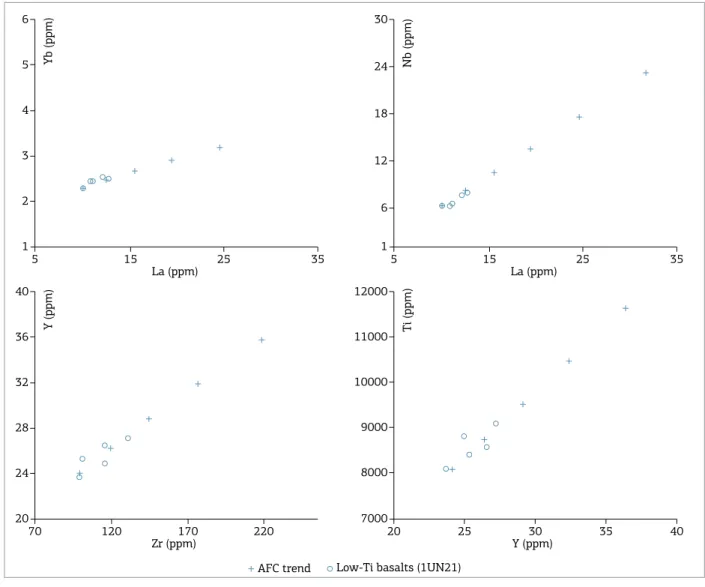
of La/Ybn ratios (~16%) by fractional crystallization. Instead, AFC seems to explain the variation of some trace elements (eg. Y, Ti, Zr, La, and Yb) within this L‑Ti suite. Results of AFC modelling (Fig. 13) showed that such variations can be attributed to 10% to 13% fractional cristallization of oli‑ vine (10 vol.%) and augite (90 vol.%) concomitant to assi‑ milation of upper crust rocks (Taylor & McLennan 1981) at shallow‑level magma chambers (r = 0.3).
Borehole 1UN26 is located northwards the study area (Fig. 1) and comprises both L‑Ti tholeiites at its top (~ 69 to 100 m) and H‑Ti tholeiites at its base (> 103 m) (Tab. 1). Drilling was stopped at ~ 108 m and textural variations indicate that the intrusion may be at least 60 m thick. In the lowermost H‑Ti section of the borehole, La/Ybn and MgO variations can be explained by 31% of fractio‑ nal crystallization solely of augite, giving rise to an extract with MgO = 10 wt.%. In the uppermost L‑Ti section of the borehole, the La/Ybn ratios decrease (from 3.4 to 3.1) with decreasing MgO contents (from 5.61 to 3.99 wt.%) which is not in agreement with the greater incompatibi‑ lity of La compared to Yb during the fractionation of oli‑ vine and/or augite and/or plagioclase. he same applies for AFC taking place in shallow‑level magma chambers with La‑rich contaminants. However, with the exception of sample 1UN26/68.40m, located at the contact with the overlain sandstones, the La/Ybn ratios of the other L‑Ti tholeiites in borehole 1UN26 could be explained by 20% fractional crystallization of olivine (12%) and augite (88%). he MgO variation of these samples can also be explained by the same amount of fractional crystallization involving an extract with MgO = 11.50 wt.%. It should be noted that the L‑Ti samples of borehole 1UN26 cannot be related with those of boreholes 1UN19 and 1UN21 due to incongruent La/Ybn variations among parental and most evolved compositions found in these three boreholes. he REE patterns of the uppermost 1UN26 L‑Ti sam‑ ple at the contact with the overlain sandstone and of sample 1UN26/76.30m located about 8m below (Fig. 14) show the same anomalously fractionation of La and Ce depicted by the luid‑contaminated samples in borehole 1UN32. Binary mixing modelling showed that 9% contamination by luids with La/Ybn = 20 could generate the La/Ybn ratio (3.4) of sample 1UN26/68.40m in contact with overlain sandsto‑ nes. Similarly, 5%, 15%, and 30% contamination would require contaminating luids with La/Ybn ratios of 40, 6.7 and 13.4, respectively. If the amount of contamination can be directly related to the volume of veins, then the scarce occurrence of the latter indicates that the contaminant luid would have La/Ybn ~ 40 as a maximum value.
MANTLE SOURCES
DISCRIMINATION AND MODELLING
OF PARTIAL MELTING PROCESSES
Representative samples of parental magmas of the L‑Ti and H‑Ti discriminated before are shown on Table 4. he REE patterns of these samples display La/Ybn and La/Nbn ratios greater than unity (Fig. 15), pointing to at least a contri‑ bution from enriched mantle sources on the generation of the L‑Ti and H‑Ti suites in the study area likely to be rela‑ ted with the subcontinental lithospheric mantle (SCLM).
Geochemical modelling was performed to put constraints on partial melting processes associated with the Parnaíba tholeiites. he equation of modal batch partial melting (Wood & Fraser 1976) was used in the modelling and bulk partition coeicients were calculated with data compiled by Rollinson (1993) unless otherwise indicated. Residual mantle
mineralogy was taken from Maaløe & Aoki (1977) with alu‑ minium‑rich phases ranging from 1 to 5 vol.%.
Figure 13. Bivariate diagrams with AFC curves for F = 0.1 intervals. The L‑Ti tholeiites of borehole 1UN21 are
shown. Partition coeicients (Kd) from Rollinson (1993), with the exception of Ti, Y, and Zr (Johnson 1998).
6
5
4
3
2
1
Yb (ppm)
5 15 25 35
La (ppm)
30
24
18
12
6
1
Nb (ppm)
5 15 25 35
La (ppm)
Y (ppm) 40
36
32
28
24
20
Y (ppm)
70 120 170 220
Zr (ppm)
AFC trend Low‑Ti basalts (1UN21) 12000
11000
10000
9000
8000
7000
Ti (ppm)
20 25 30 35 40
Figure 14. Chondrite‑normalized REE diagram for samples from borehole 1UN26. Normalization factors from Evensen et al. (1978).
Rock/Chondrite
100
10
1UN32/248.30 m 1UN32/243.70 m
Boreholes 1UN06 and 1UN32 comprise H‑Ti suites and are about 20 km apart and modelling was performed to test for the hypothesis of their parental compositions being related to diferent degrees of partial melting from the same mantle source. he patterns of these samples in a chondrite‑normalized multielemental diagram (Fig. 16) show the typical Nb negative anomaly of continental lood basalts (Peate 1997). Sr and P negative anomalies are not attributed to mantle compositions but instead to possible cryptic apatite inclusion‑bearing plagioclase fractionation (Cox et al. 1979) considering the degree of evolution of parental compositions. he spiked patterns for mobile incom‑ patible elements may be due to small degrees of alteration.
A garnet harzburgite residual source could generate the (La/Yb)n ratio (2,2) of the H‑Ti sample 1UN32/254,10m but this would require an extremelly high Kd value (~35; Irving & Frey 1978) and a (La/Yb)n ratio lower than unity which is not consistent with the enriched characteristic of mantle sources as depicted by their patterns in multielemental diagrams. Partial melting of a harzurgitic source with La/Yb ratio 1.6 times greater than chondritic values, lesser amounts of residual garnet (1 vol.%) and a lower Kd value (~ 1,67; Irving & Frey 1978) could give rise to both 1UN06 and 1UN32 H‑Ti parental tholeiites within the range (25% – 45%) required to generate tholeiitic basalts (eg., Mysen & Kushiro 1977). It should be noted that those parental mag‑ mas could also be generated by a harzburgitic source with La/Yb ratio 1.8 times greater than chondritic values and 3 vol.% of residual spinel (Fig. 17). Considering the grea‑ ter enrichment factor associated with the spinel peridotite source as well as no evidence for diferent degrees of La/Yb fractionation in the multielemental diagram due to garnet control, these H‑Ti tholeiitic suites are likely to be related to an enriched spinel‑bearing harzburgitic mantle source.
Boreholes 1UN19 and 1UN21 comprise L‑Ti suites and are about 400 km apart from each other so that derivation
from a single mantle source would indicate regional‑scale geochemical heterogeneties in the SCLM. he patterns of these samples in a chondrite‑normalized multielemental diagram (Fig. 18) show a Nb negative anomaly similarly to samples from boreholes 1UN06 and 1UN32. Other negative anomalies may have resulted from the same process depicted for borehole 1UN06 and 1UN32. As with the latter, there is no evidence for retention of garnet in the residual source in the patterns of the L‑Ti suites in the chondrite‑normali‑ zed multielemental diagram (Fig. 18).
It should be noted that the two L‑Ti parental com‑ positions have the same La/Ybn ratio (3.0) but diferent MgO contents meaning that they had to be generated by diferent amounts of partial melting from diferent mantle sources. In accordance to derivation from the zone
Sample MgO (La/Yb)n (La/Nb)n Suite
1UN06/176.20m 6.49 2.1 1.3 H‑Ti
1UN19/559.00m 5.92 3.0 1.7 L‑Ti
1UN21/282.10m 6.63 3.0 1.6 L‑Ti
1UN26/108.91m 5.54 2.9 1.3 H‑Ti
1UN26/76.30m 5.49 2.9 1.6 L‑Ti
1UN32/254.10m 6.68 2.2 1.4 H‑Ti
Table 4. Representative samples of parental magmas, their respective wells, MgO content (wt.%) and (La/Yb)n and (La/Nb)n ratios. High‑TiO2 (H‑Ti) and low‑TiO2 (L‑Ti) suites are indicated.
Figure 15. Chondrite‑normalized REE diagram for samples representing parental compositions in the study area. Normalization factors from Evensen
et al. (1978).
Rock/Chondrite
100
10
1UN32/254.10 m 1UN26/68.40 m 1UN06/176.20 m 1UN19/559.0 m 1UN21/282.10 m 1UN26/108.91 m
La Ce Pr Nd Pm Sm Eu Gd Tb Dy Ho Er Tm Yb Lu
Figure 16. Chondrite‑normalized multielemental diagram for samples representing H‑Ti parental compositions in boreholes 1UN06 and 1UN32. Normalization factors from Thompson (1982).
1UN32/ 254.10 m (MgO=6.69 wt.%; La/Yb n=2.2; La/Nb n=1.4
1UN06/ 176.20 m (MgO=6.49 wt.%; La/Yb n=3.0; La/Nb n=1.6
Rock/Chondrite (except Rb, K, and P)
100
10
of stability for spinel, the modal batch partial melting modelling showed that a harzburgitic mantle source with 3 vol.% of residual spinel could generate the L‑Ti suites either by 25% partial melting or by 45% partial melting from sources with La/Yb ratios 2.4 and 2.7 times grea‑ ter than the chondritic values, respectively. Keeping the parameters of the modelling, the results can also apply to the parental compositions of the L‑Ti and H‑Ti tho‑ leiites from borehole 1UN26 with similar MgO contents and the same La/Ybn ratios (Fig. 19).
In summary, the results of the partial melting models indicate that the Parnaíba L‑Ti and H‑Ti tholeiitic suites in the study area cannot be related to a single mantle source implying lateral geochemical heterogeneities in the SCLM within the spinel stability zone.
PETROGENETIC MODEL
A petrogenetic model that integrates the results shown in the previous sections is presented in Figure 20.
he Parnaíba tholeiites in the study area were deri‑ ved from an enriched harzburgitic source in the zone of spinel likely to be related with the SCLM. he L‑Ti and H‑Ti tholeiitic suites represented by samples in borehole 1UN26 located far north (~ 3.5oS) can be generated by
greater (45%) and minor (25%) amounts of partial mel‑ ting from respectively more (La/Ybn = 2.8) and less (La/ Ybn = 2.4) enriched portions of the SCLM. he same applies to the L‑Ti tholeiitic suites in boreholes 1UN19
Figure 17. F versus La/Ybn diagram with the modal batch partial melting curve. Modal composition in the mantle residue (olivine:orthopyroxene:clinopyroxene:spinel = 68:27:2:3) is from McKenzie & O’Nions (1991). The amount (%) of partial melting and their respective La/Ybn ratios are indicated. Crystal‑liquid partition
coeicients from Arth (1976) e Schock (1979). 0
2.0
1.0 3.0 4.0 5.0
La/Yb
n
0 0.1 0.2 0.3 0.4 0.5 0.6 0.7 0.8 0.9
25%; 2.2 35%; 2.1
1 F
1UN19/ 559.00 m (MgO=5.92 wt.%; La/Yb n=3.0; La/Nb n=1.7
1UN21/ 282.10 m (MgO=6.63 wt.%; La/Yb n=3.0; La/Nb n=1.6
Rock/Chondrite (except Rb, K, and P)
100
10
Ba RbTh K Nb Ta La Ce Sr Nd P Sm Zr Hf Ti Tb Y TmYb
Figure 18. Chondrite‑normalized multielemental diagram for samples representing L‑Ti parental compositions in boreholes 1UN19 and 1UN21. Normalization factors from Thompson (1982).
Figure 19. Chondrite‑normalized multielemental diagram for samples representing L‑Ti and H‑Ti parental compositions in borehole 1UN26. Normalization factors from Thompson (1982).
Rock/Chondrite (except Rb, K, and P)
100
10
1UN19/ 559.00 m (MgO=5.92 wt.%; La/Yb n=3.0; La/Nb n=1.7
1UN21/ 282.10 m (MgO=6.63 wt.%; La/Yb n=3.0; La/Nb n=1.6
Ba RbTh K Nb Ta La Ce Sr Nd P Sm Zr Hf Ti Tb Y TmYb
and 1UN21 (the latter located far south in the study area; ~ 7.5oS). On the other hand, the H‑Ti tholeiitic suites in
boreholes 1UN06 and 1UN32 are related with a less enri‑ ched mantle source (La/Ybn = 1.8).
As such, the model proposes that the SCLM underne‑ ath the Parnaíba basin is geochemically heterogeneous on a scale of on a scale of hundreds of square kilometers. It is diicult to ascertain whether such heterogeneity is solely lateral since vertical heterogeneities seem to be necessary to explain the occurrence of L‑Ti and H‑Ti suites in the same borehole (1UN26).
diameter). Although basaltic magma chambers can be mapped along a few hundreds of kilometers worldwide, such as many layered intrusions (eg. Smith & Kapp 1963, Namur et al. 2013), the existence of small basaltic magma chambers have been proved by geophysical and geochemical studies in slow‑spreading ridge segments in the ocean loor (eg. Sleep 1975). Small magma chambers
seem to be more liable to undergo extensive diferentia‑ tion compared to large ones and, as such, will give rise to a wider compositional range of basalts (Nisbet & Fowler 1978). A densely fractured upper crust could provide a number of conduits fed from these magma chambers which in turn would give rise to various intrusions and eventually lows. Such conduits could well extend up to
Figure 20. Petrogenetic model for the Parnaíba tholeiites in the study area.
NNE (~30o)
1UN26 1UN32
1UN06 1UN19 1UN21
SSW (~210o)
0 km
38 km
Continental Crust
SCLM
90 km
Lower limit of the spinel stability zone TBL=MBL
Scale: V=4H
120
km 90 60 30 0
Asthenosfhere
Well Legend:
Dykes and sills
High Ti magmatic chamber
Low Ti magmatic chamber
Mantle reservoir (1)
Mantle reservoir (2)
Shear zone
Partial melting zone (Low‑Ti) in the mantle reservoir (1) Partial melting zone (High‑Ti) in the mantle reservoir (2)
Possible partial melting zones (High‑Ti) in the mantle reservoir (2)
(La/Yb)n: La/Yb normalized
Lower heat transfer near MBL/TBL
Higher heat transfer near MBL/TBL
Greater amouts of partial melting
Figure 21. Discriminant diagram of low‑TiO2 suites of Paraná‑Etendeka Province (Peate 1997) with samples of low‑TiO2 basalts of the Parnaíba Basin studied by other authors (Bellieni et al. 1990, Ernesto et al. 2004)
and studied in this thesis. The discriminant ield for
the low‑TiO2 basalts of Paraná‑Etendeka are shown.
T
i/Zr
150
100
100 200 300 400
50
0 0
Ti/Y Sardinha Formation (L‑Ti) L‑Ti (this work)
Mosquito Formation (L‑Ti) Esmeralda
Gramado
the sedimentary basin and give rise to the diabase sills studied in this work.
TECTONIC CONTROLS
ON MAGMA GENERATION
he lack of geochronological data prevent reined corre‑ lations of the L‑Ti and H‑Ti tholeiites in the present study with tholeiitic basalts and diabases previously studied in the Parnaíba basin. he Mosquito and Sardinha basalts in the Parnaíba basin overlap when ploted on typical bivariate dis‑ criminant plots proposed for L‑Ti and H‑Ti suites elsewhere (eg. Peate 1997) as do the tholeiites of the present study (Fig. 21). As a gross approximation, the tholeiites sampled from the boreholes may be related to the Sardinha basalts since they are located eastwards the basin where most of the outcrops of the latter are found (Fig. 1). So, discussions will focus as much as possible on tectonic processes regardless the geodynamics possibly related with the studied tholeiites. The boreholes align parallell to the NNE‑trending Transbrasiliano lineament, which in turn follows approxi‑ mately the lateral geochemical heterogeneities proposed in the petrogenetic model. Obviously, the extent of this late‑ ral geochemical variation in the SCLM is diicult to cal‑ culate due to the restricted sampling from the boreholes. Nevertheless, preliminarly it could be asserted that lateral extensions oblique to N‑S direction seem to be more plau‑ sible giving rise to NE‑SW, NW‑WE or even E‑W trending
borderlines. his rule out the control of the Transbrasiliano Lineament on tectonic processes that might have almalga‑ mated distinctive lithosphere during past tectonic events. he origin of the geochemical provinciality depicted by the existence of L‑Ti and H‑Ti tholeiitic suites in the Parnaíba basin may not be related to diferent amounts of lithospheric thinning but instead to diferential heat conduction from the underlain asthenospheric mantle. he nature of such thermal anomaly is beyond the scope of this work but≈the diferent amounts of heat conduction needed to explain the diferent amounts of partial melting of the SCLM may be related with an irregular, negative topography of the ther‑ mal (and mechanical) boundary layer (Fig. 20) inherited from previous orogenic processes.
CONCLUSIONS
he geochemical data obtained for tholeiitic basalts and diabases from borehole samples located easterwards the Parnaíba basin pointed to the existence of six tholeiitic sui‑ tes being three L‑Ti and three H‑Ti ones in the study area. Results from geochemical modelling showed that fractional crystallization of augite and olivine and AFC can explain some relevant trace element and trace element ratios varia‑ tions within suites. Local in‑conduit, luid‑driven conta‑ mination was also discriminated in two boreholes. Mantle sources for the six tholeiitic suites are likely to be within the spinel stability zone in a variably enriched harzburgi‑ tic SCLM which seems to be in agreement with the exis‑ tence of a relatively narrow continental crust underneath the sedimentary basin. Diferent degrees of partial melting from this heterogeneous source can account for the trace element compositions of the parental liquids. Lateral and/ or vertical, local‑scale mantle heterogeneities seem not to have been controled by the Transbrasiliano Lineament but to reactivation of distinctive lithospheres amalgamated during previous orogenetic processes.
ACKNOWLEDGMENTS
Abelha M. 2013. Bacia do Parnaíba. Rio de Janeiro: ANP. 122 slides, color. Material elaborado para a 12.ª rodada de licitações de petróleo e gás. ANP, Superintendência de Deinição de Blocos. Disponível em: <http://www.brasil-rounds.gov.br/arquivos/Seminarios_R12/ apresentacao/r12_04_parnaiba.pdf>. Acesso em: 25 maio 2014.
Aguiar G.A. 1969. Bacia do Maranhão: Geologia e Possibilidades de Petróleo. Recife, DNPM/CPRM. 75p. Relatório n.º 371.
Arth J.G. 1976. Behaviour of trace elements during magmatic processes – a summary of theoretical models and their applications. Journal of Research of the United States Geological Survey, 4:41-47. Assumpção M., Feng M., Tassara A., Julià J. 2013. Crustal thickness map of Brazil: Data compilation and main features. Journal of South American Earth Sciences, 43:74-85.
Baksi A.K. & Archibald D.A. 1997. Mesozoic igneous activity in the
Maranhão province, northern Brazil: 40Ar/ 39Ar evidence for separate
episodes of basaltic magmatism. Earth and Planetary Science Letters, 151(3-4):139-153.
Bellieni G., Piccirillo E.M., Cavazzini G., Petrini P., Comin-Chiaramonti P., Nardy A.J.R., Civetta A.J., Meli A.J., Zantedeschi P. 1990. Low‑ and high TiO2, Mesozoic tholeiitic magmatism of the Maranhão basin (NE‑brazil) ‑ K–Ar age, geochemistry, petrology, isotope characteristics and relationships with Mesozoic low- and high
TiO2 lood basalts of the Paraná Basin (SE‑Brazil). Neues Jahrbuch
Mineralogischer Abhandlungen, 162:1-33.
Bertrand H. 1991. The Mesozoic Tholeiitic Province of Northwest Africa: a volcanotectonic record of the early opening of Central Atlantic. In: Kampunzu A.B. & Lubala R.T. (Eds.), Magmatism in Extensional Structural Settings. The Phanerozoic African Plate. Berlin, Springer-Verlag, p. 147-188.
Bond G.C., Nickeson P.A., Kominz M.A. 1984. Breakup of a supercontinent between 625 Ma and 555 Ma: new evidence and implications for continental histories. Earth and Planetary Science Letters, 70(2):325-345.
Castro D.L., Fuck R.A., Phillips J.D., Vidotti R.M., Bezerra F.H.R., Dantas E.L. 2014. Crustal structure beneath the Paleozoic Parnaíba Basin revealed by airborne gravity and magnetic data, Brazil. Tectonophysics, 614:128-145.
Cox K.G., Bell J.D., Pankhurst R.J. 1979. The interpretation of igneous
rocks. London, George Allen & Unwin, 450p.
DePaolo D.J. 1981. Trace element and isotopic efects of combined
wall‑rock assimilation and fractional crystallization. Earth and
Planetary Science Letters, 53:189-202.
Erlank, A.J., Marsh, J.S., Duncan, A.R., Miller, R., Hawkesworth, C.J., Betton, P.J. & Rex, D.C. 1984. Geochemistry and petrogenesis of the Etendeka volcanic rocks from SW Namibia. Special Publication of the Geological Society of South Africa, 13, 195-246.
Ernesto M., Marques L.S., Bellieni G., Piccirillo E.M., DeMin A., Pacca I.G., Martins G., Macedo J.W.P. 2004. As Rochas Toleíticas Mesozoicas do Nordeste do Brasil: Distribuição Espacial e Temporal dos Sucessivos Episódios Magmáticos. In: Congresso Brasileiro de Geologia, 42., 2004, Araxá. Anais do XLII Congresso Brasileiro de Geologia. CD. p.783.
Evensen N.M., Hamilton P.J., O’Nions R.K. 1978. Rare‑earth abundances in chondritic meteorites. Geochimica et Cosmochimica Acta, 42(8):1199-1212.
Faure G. 1986. Principles of isotope geology. New York, John Wiley & Sons, 590p.
REFERENCES
Fodor R.V., Sial A.N., Mukasa S.B., McKee E.H. 1990. Petrology, isotope characteristics, and K‑Ar ages of the Maranhão, northern Brazil, Mesozoic basalt province. Contributions to Mineralogy and Petrology, 104(5):555-567.
Goes A.M.O., Souza J.M.P., Teixeira L.B. 1990. Estágio exploratório e perspectivas petrolíferas da Bacia do Parnaíba. Boletim de Geociências da Petrobras, 4:55-64.
Hansen J. 2015. A numerical approach to sill emplacement in isotropic media: do saucer-shaped sills represent “natural” intrusive tendencies in the shallow crust? Tectonophysics, 664:125-138.
Hoyle J., Elderield H., Gledhill A., Greaves M. 1984. The behavior of the rare earth elements during mixing of river and seawaters. Geochimica et Cosmochimica Acta, 48:143-149.
Humphries S.E. 1984. The mobility of the rare earth elements in the crust. In: Henderson P. (Ed.). Rare earth element geochemistry. New York: Elsevier. p.317‑342
Irvine T.N. & Baragar W.R.A. 1971. A Guide to the Chemical
Classiication of the Common Volcanic Rocks. Canadian Journal of
Earth Sciences, 8(5):523-548.
Irving A.J. & Frey F.A. 1978. Distribution of trace elements between garnet megacrysts and host volcanic liquids of kimberlitic to rhyolitic composition. Geochimica et Cosmochimica Acta, 42:771-787.
Jenner G.A. 1996. Trace Element Geochemistry of Igneous Rocks: Geochemical Nomenclature and Analytical Geochemistry. In:
Wyman D.A. (Ed.), Trace Element Geochemistry of Volcanic Rocks:
Applications for Massive Sulphide Exploration. Canada, Geological Association of Canada, v.12, p.51-77.
Jenner G.A., Longerich H.P., Jackson S.E., Fryer B.J. 1990. ICP‑MS – a powerful tool for high precision trace element analyses in earth sciences: evidence from analyses of selected U.S.G.S. reference samples. Chemical Geology, 83:133-148.
Johnson K.T.M. 1998. Experimental determination of partition coeicients for rare earth and high‑ield‑strength elements between clinopyroxene, garnet, and basaltic melt at high pressures. Contributions to Mineralogy and Petrology, 133(1-2):60-68.
Le Bas M.J, Le Maitre R.W, Streckeisen A., Zanettin B. 1986. A chemical classiication of volcanic rocks based on the total
alkali‑silica diagram. Journal of Petrology, 27:745-750.
Le Maitre R.W. (Ed.). 2002. Igneous Rocks. A Classiication and
Glossary of Terms: Recommendations of the International Union of Geological Sciences Subcommission on the Systematics of Igneous Rocks. 2nd. ed. Edinburg, Cambridge University Press. 236p.
Lima Neto H.C. 2013. Sismicidade e correlação com feições
geológicas: o caso do lineamento Pernambuco e seu entorno. Doctoring thesis, Universidade Federal do Rio Grande do Norte, Rio Grande do Norte, 171p.
Maaløe S. & Aoki K. 1977. The major element composition of the upper mantle estimated from the composition of lherzolites. Contributions to Mineralogy and Petrology, 63:161-173.
Mackenzie W.S., Donaldson C.H., Guilford C. 1982. Atlas of Igneous
Rocks and their Textures. London, Longford. 148p.
McKenzie D. & O’Nions R.K. 1991. Partial melt distributions from inversion of rare earth element concentrations. Journal of Petrology, 32:1021-1091.
Merle R., Marzoli A., Bertrand H., Reisberg L., Verati C., Zimmermann C., Chiaradia M., Bellieni G., Ernesto M. 2011. 40Ar/39Ar ages and
Sr–Nd–Pb–Os geochemistry of CAMP tholeiites from Western
Maranhão basin (NE Brazil). Lithos, 122(3-4):137-151.
Middlemost E. 1989. Iron oxidation ratios, norms and the
classiication of volcanic rocks. Chemical Geology, 77:19-26.
Mysen B.O. & Kushiro I. 1977. Compositional variations of coexisting phases with degree of melting of peridotite in the upper mantle. American Mineralogists, 62:843-865.
Namur O., Humphreys M.C.S., Holness M.B. 2013. Lateral reactive iniltration in a vertical gabbroic crystal mush, Skaergaard intrusion, East Greenland. Journal of Petrology, 54:985-1016.
Nisbet E.G. & Fowler M.R. 1978. Mid‑Atlantic Ridge at 37º and 45ºN: some geophysical and petrological constraints. Geophys. Journal R. Astron. Society, 54:631-660.
Oliveira D.C. & Mohriak W.U. 2003. Jaibaras trough: an important element in the early tectonic evolution of the Parnaíba interior sag basin, Northern Brazil. Marine and Petroleum Geology, 20(3-4):351-383.
Pearce J.A. 1983. Role of the sub-continental lithosphere in magma genesis at active continental margins. In: Hawkesworth C.J. & Norry M.J. (Eds.). Continental basalts and mantle xenoliths. Nantwich, Cheshire: Shiva Publications, p.230-249.
Peate D.W. 1997. The Parana‑Etendeka province. In: Mahoney J.J.
& Coin M.F. (Eds.). Large igneous provinces: continental, oceanic
and planetary lood volcanism. American Geophysical Union, 100, p.217-245. Geophysical Monograph Series.
Piccirillo E.M. & Meli A.J. (Eds.). 1988. The Mesozoic Flood Volcanism
of the Paraná Basin: Petrogenetic and Geophysical Aspects. São Paulo, Instituto Geofísico, Astronômico e Ciências Atmosféricas, Universidade de São Paulo, 600p.
Porto A.L. & Pereira E. 2014. Seismic Interpretation of Igneous Intrusions and Their Implications for an Unconventional Petroleum System in Southeastern Parnaiba Basin, Northeastern Brazil.
In: American Geophysical Union, Fall Meeting 2014. Abstract #V51B-4753.
Rodrigues R. 1995. A Geoquímica Orgânica na Bacia do Parnaíba. Porto Alegre (RS). Tese (doutorado). Universidade Federal do Rio Grande do Sul, Rio Grande do Sul, 225p.
Roeder P.L. & Emslie R.F. 1970. Olivine‑liquid equilibria. Contributions
to Mineralogy and Petrology, 29:275-289.
Rollinson H.R. 1993. Using Geochemical Data: Evaluation, Presentation, Interpretation. Edinburgh: Longman, 352 p.
Schock H.H. 1979. Distribution of rare‑earth and other trace elements in magnetites. Chemical Geology, 26:119-133.
Sleep N.H. 1975. Formation of oceanic crust: some thermal constraints. Journal of Geophysical Research, 80:4037-4042.
Smith C.H. & Kapp H.E. 1963. The Muskox Intrusion, a recently discovered layered intrusion in the Coppermine River Area, Northwest Territories, Canada. Mineralogical Society of America, 1:30-35. Taylor S.R. & McLennan S.M. 1981. The composition and evolution of the continental crust: rare earth element evidence from
sedimentary rocks. Philosophical Transactions of the Royal Society
of London, A301:381-399.
Thompson R.N. 1982. Magmatism of the British Tertiary Volcanic Province. Scottish Journal of Geology, 18(1):49-107.
Tsay A., Zajacz Z., Sanchez‑Valle C. 2014. Eicient mobilization and fractionation of rare‑earth elements by aqueous luids upon slab dehydration. Earth and Planetary Science Letters, 398:101-112.
Vaz P.K., Rezende N.G.A.M., Wanderley Filho J.R., Travassos W.A.S. 2007. Bacia do Parnaíba. Boletim de Geociências da Petrobras, 15:253-263.
Wilson M. 1989. Igneous petrogenesis: a global tectonic approach.
Canada, Harper Collins Academic, 466p.
Wood B.J. & Fraser D.G. 1976. Elementary thermodynamics for
geologists. Oxford, Oxford University Press. 303p.