894 Brazilian Journal of Physics, vol. 34, no. 3A, September, 2004
A Dirac Description of
1
S
0
+
3
S
1
−
3
D
1
Pairing in Nuclear Matter
B. Funke Haas, B. V. Carlson, and Tobias Frederico
Departamento de F´ısica, Instituto Tecnol´ogico de Aeron´autica
12228-901, S˜ao Jos´e dos Campos, SP, Brazil
Received on 7 October, 2003
We develop a Dirac-Hartree-Fock-Bogoliubov description of nuclear matter pairing in1
S0and 3
S1 − 3
D1
channels. Here we investigate the density dependence ot the1
S0and 3
S1− 3
D1pairing fields in asymmetric
nuclear matter, using a Bonn meson-exchange interaction between Dirac nucleons. In this work, we present preliminary results.
1
Introduction
Nonrelativistic calculations of1
S0+ 3
S1− 3
D1in
symmet-ric nuclear matter, using standard nucleon-nucleon interac-tions, yeald a1
S0pairing gap of about the expected size, but
an extremely large pairing gap, of the order of 10 MeV, in the3
S1− 3
D1channel [1, 2, 3, 4, 5]. It has been suggested
that relativistic effects substantially reduce this pairing gap [6], as is the case for1
S0pairing at densities near saturation
[7]. However, the size of the pairing gap has also been found to be related to the energy of the virtual/bound state in the vacuum of the channel under consideration [7]. This would imply a much larger pairing gap in the3
S1− 3
D1channel,
corresponding to the deuteron in the vacuum, than that in the
1
S0channel, which corresponds to the two-nucleon virtual
state in the vacuum.
2
The Formalism
We take the hamiltonian form of the HFB equation to be
hk−µk ∆¯†k
¯
∆k −hT k+µk
Ukn
Vkn
=εkn
Ukn Vkn , where
hk =α·k+βM+βΣk
and
hT k=BhT−kB† =α·k+βM+βΣT k
with
ΣT k=BΣT−kB†.
The indexndenotes the 16 solutions to the HFB equation. The self-consistency equations may be written as
βΣk=
j,αβ
γ0Γjα(0)Dαβj (0)
d3
q
(2π)3Tr[γ0Γjβ(0)g(q)]
−
d3
q
(2π)3γ0Γjα(k−q)D
αβ
j (k−q)g(q)γ0Γjβ(q−k)
and ¯ ∆k =
d3
q
(2π)3B(γ0Γjα(k−q))
T
B†Dαβ j (k−q)
×f¯(q)γ0Γjβ(q−k),
where the indexjrefers to the different mesons exchanged and the indices αandβ are their Lorentz/isospin indices. The normal and anomalous densities,g(q)andf(q), respec-tively, are given by
g(q) =
n
UqnUqn† and f¯(q) =
n
VqnUqn† ,
with the sum overnrunning over the appropriate set of so-lutions of the HFB equation.
We take for the Dirac and isospin structure of the mean fields
βΣk =
βΣs0(k) + Σ00(k) +α·ˆkΣv0(k)
⊗1
+ βΣsi(k) + Σ0i(k) +α·kˆΣvi(k)
⊗τi
and ¯
∆k = [ ¯∆si(k) +β∆¯0i(k) +α·ˆk∆¯T i(k)]⊗τi
+ [ ¯∆1(k)γ5γ·ξˆ+ ¯∆2(k)γ5γ·Y2(ˆk)·ξˆ
+ ∆¯3(k)γ0γ5γ·ξˆ+ ¯∆4(k)γ0γ5γ·Y2(ˆk)·ξˆ
+ ∆¯5(k)ˆk·ξ γˆ 5+ ¯∆6(k)( ˆξ×kˆ)·γ]⊗1,
where the rank two tensorY2(ˆk)is given by
Y2(ˆk)ij =
1 √
2(3 ˆkiˆkj−δij).
The densities can be decomposed similarly, where the com-ponent densities can be obtained with the appropriate traces,
gs0(q) =
1 8
n
Uqn† β⊗1Uqn,f¯si=
1 8
n
Uqn† 1⊗τiVqn, etc.
The vertices and propagators of the mesons are given in Table 1, where we have defined
˜
dα(q) =
1
m2
α−q2
B. Funke Haas, B. V. Carlson, and Tobias Frederico 895
We will neglect retardation effects in the following so that the composite form-factor/reduced propagator will take the form
dα(q) =
1
q2
+m2
α
Λ2
α−m
2
α
Λ2
α+q
2
2 .
We will denote the remaining factors of the vertices as the bare vertices.
To obtain the reduced self-consistency equations, we substitute these decompositions in the unreduced equations, calculate and take traces. The equations for the components of1
S0pairing field that result are uncoupled integral
equa-tions of the form
¯
∆si(k) = −
d3
q
(2π)3
gσ2dσ(k−q) +g
2
δdδ(k−q)
4gω2dω(k−q)−4g
2
ρdρ(k−q)
−
k−q
2f
π
mπ
2
dπ(k−q)
+
fη
mη
2
dη(k−q) f¯si(q)
The equations for thel = 0andl = 2components of
3
S1− 3
D1pairing field reduce to coupled equations. To
un-couple these further, we make an additional approximation - we replace the components of the mean field and pairing field by their (spherically symmetric) angular averages.
TABLE 1. Meson-nucleon vertices and propagators. The factor
Fi(q)is the vertex form factor.
meson vertex propagator
σ gσFσ(q) 1⊗1 Dσ(q) =−d˜σ(q)
δ gδFδ(q) 1⊗τk Dδkl(q) =−δkld˜δ(q)
ω gωFω(q)γµ⊗1 Dµνω (q) =gµνd˜ω(q)
ρ gρFρ(q)γµ⊗τk Dρµk,νl(q) =gµνδkld˜ρ(q)
π mfπ
πFπ(q)iγµq µ
γ5⊗τk Dklπ(q) =−δkld˜π(q)
η mfη
ηFη(q)iγµq µ
γ5⊗1 Dη(q) =−d˜η(q)
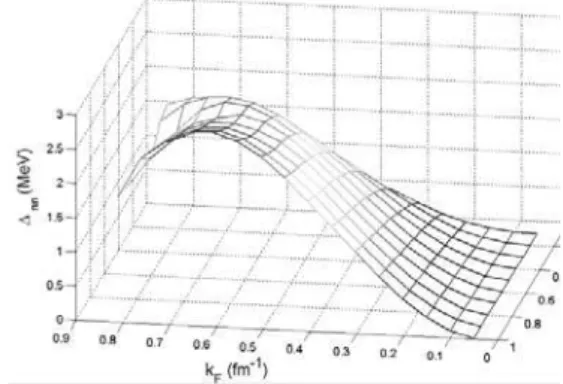
Figure 1. Proton-proton gap as a function of the asymmetry param-eterαand density for pure standard pairing.
Figure 2. The same as Fig. 1 for neutron-neutron pair.
Figure 3. The same as Fig. 1 for proton-proton pair, in calculations for1
S0+ 3
S1− 3
D1pairing.
Figure 4. The same as Fig. 3 for neutron-neutron pair.
896 Brazilian Journal of Physics, vol. 34, no. 3A, September, 2004
3
Results and Conclusions
In Figs. 1 and 2 we show the pairing gap for the pp and nn pairs as a function of asymmetry and density, calculated numerically for pure standard pairing in nuclear matter. In Figs. 3 to 5, we show pp, nn and quasi-deuteron pairings gaps for standard plus quasi-deuteron pairing. We have found that pairing in these two channels coexists in asym-metric nuclear matter. This mixed state is the ground state of nuclear matter in the region in which it exists.
References
[1] M. Baldo, I. Bombaci, and U. Lombardo, Phys. Lett. B283, 8 (1992).
[2] T. Alm, B. L. Friman, G. R¨opke, and H. Schulze, Nucl. Phys. A551, 45 (1993).
[3] M. Baldo, U. Lombardo, and P. Schuck, Phys. Rev. C52, 975 (1995).
[4] T. Alm, G. R¨opke, A Sedrakian, and F. Weber, Nucl. Phys. A606, 491 (1996).
[5] U. Lombardo,P. Nozi´eres, P. Schuck, H-J. Schulze, and A. Se-drakian, Phys. Rev.64, 64314 (2001).
[6] Ø. Elgarøy, L. Engvik, E. Osnes, and M. Hjorth-Jensen, Phys. Rev. C57, R1069 (1998).