Artigo
*e-mail: [email protected]
BIOCHEMICAL PROPERTIES OF Bacillus sp. ITP-001 LIPASE IMMOBILIZED WITH A SOL GEL PROCESS
Nayara Bezerra Carvalho, José Murillo P. Barbosa, Maria Vanessa S. Oliveira, Alini T. Fricks, Álvaro S. Lima e Cleide Mara F. Soares*
Instituto de Tecnologia e Pesquisa, Av. Murilo Dantas, 300, 49032-490 Aracaju - SE, Brasil
Recebido em 5/3/12; aceito em 16/7/12; publicado na web em 7/12/12
This work presents biochemical characterization of a lipase from a new strain of Bacillus sp. ITP-001, immobilized using a sol gel process (IB). The results from the biochemical characterization of IB showed increased activity for hydrolysis, with 526.63 U g-1
at pH 5.0 and 80 °C, and thermal stability at 37 °C. Enzymatic activity was stimulated by ions such as EDTA, Fe+3, Mn+2, Zn+2, and
Ca+2, and in various organic solvents. Kinetic parameters obtained for the IB were K
m = 14.62 mM, and Vmax = 0.102 mM min-1 g-1.
The results of biochemical characterization revealed the improved catalytic properties of IB. Keywords: biochemical; lipase from Bacillus immobilized; sol gel process.
INTRODUCTION
Lipases can be used for reactions such as esterification, inter-esterification, and hydrolysis. Although most lipases are more robust than many enzymes, their industrial use as catalysts in hydrolysis and synthetic organic chemistry need different strategies, such as immobilization, in order to solve drawbacks including limited stabil-ity, difficulties in separating products from the lipase, and problems arising upon reuse of the biocatalyst.1-5 The feasibility of the genetic approach to modification of enantioselectivitywas demonstrated with lipase A from B. subtilis, and also represents a strategy for future applications in the immobilization process.6
Immobilization experiments with lipases from Bacillus, although limited in number, have illustrated the vast potential for optimization of the properties of these biocatalysts for particular applications.6 Similarly, immobilized enzymes may also exhibit much better func-tional properties than the corresponding free lipase, while enantiose-lectivity may also be dramatically improved.7 Different methods of immobilization for other types of lipases have been described; some authors have suggested hydrophobic materials are the most suitable supports for lipase immobilization, preferably by encapsulation within a polymer matrix, or silica glasses, obtained by sol gel techniques.8 The hydrolysis of triglyceride esters to yield free fatty acids and glycerol represents one important group of chemical reactions relevant to industrial processing of natural oils and fats. Hydrolysis is the primary reaction for the production of free fatty acids, which may then be inter-esterified, trans-esterified, or converted into high-value fatty alcohols.9,10 The current main-stream technologies for hydrolysis are based on high-temperature, high-pressure processes in contact with steam or superheated liquid water, involving high temperatures and requirements for high-pressure equipment. The best known process is the Colgate Emery process, which typically requires operating temperatures of 250 °C and a reaction pressure of 50 bar.9 Enzymatic fat splitting (hydrolysis) has been studied extensively using enzymes immobilized on hydrophobic polymeric supports, and also using enzymes freely attached at a liquid–liquid interface.8 The elevated reaction temperature provides a higher conversion rate; minimal risk of microbial contamination; higher solubility of the substrates; and lower viscosity of the reaction medium, favoring mass transfer. Thermostability is dependent on the structure of the
enzyme, the environment (solvent), pH, temperature, the presence of additives (organic solvents, ions), and immobilization.6,11 Due to different applications, the biochemical properties of each type of reaction are extremely important. Improvements in lipase behavior at extreme temperatures can be achieved through a wide variety of immobilization techniques.6,12
Practical examples with immobilized lipases from Bacillus have been described in the literature. Gel entrapment combines reduced structural strain for the enzyme, as it is captured in its native form, and a specific microenvironment that can enhance the stability and activity of the lipase. In comparison, with covalent attachment and cross-linking, the enzyme molecule can be bound to the carrier or another protein in a way that hinders the reaction, by distorting the active conformation of the enzyme or blocking access of the substrate to the active site. Lipases from Bacillus have been successfully immo-bilized by gel entrapment in copolymers of methacrylic acid, dodecyl methacrylate, and a cross-linker - N,N-methylene bisacrylamide, as well as with alginate.13-16
The immobilized enzymes did not differ substantially in ther-mostability from the native lipases. The preparations demonstrated good synthetic activity in alkanes as solvents (n-hexane, n-heptane, n-octane, n-nonane), and moderate reusability. In some cases, metal ions and surfactants increased the activity of the enzyme.13,17 Some studies have been reported describing the biochemical properties for reaction hydrolysis of olive oil only free lipase from Bacillus or the same genus, under the following conditions: lipases from Bacillus sp. L2 (pH 8.0, 70 °C and t1/2 = 3.5 h), Geobacillus sp. TI (pH 9.0, 70 °C and t1/2 = 70 min), Bacillus sp. THL027 (pH 7.0 and 70 °C) and Bacillus sphaericus 205y (pH 7.0-8.0, 55 °C).6 Studies have been performed on production of the lipase from Bacillus sp. ITP-001, isolated from petroleum-contaminated soil in Brazil but to date, im-mobilization of this enzyme using a sol-gel technique has not been studied for this lipase.18-20
Bacillus sp. ITP-001 lipase immobilized using a sol gel technique. The biochemical characteristics analyzed were temperature, pH, thermal stability, stability in the presence of ions and solvent in the study of the kinetic parameters of hydrolysis of olive oil.
EXPERIMENTAL
Enzyme and chemicals
Lipase was obtained by fermentation of a newly isolated Bacillus sp. isolated from petroleum-contaminated soil by the Institute of Research and Technology (Aracaju, Sergipe, Brazil). Enzyme pro-duction was performed under optimal fermentation conditions at a temperature of 37 °C, and using a substrate inductor oil (palm oil) as described by Feitosa et al..19 Lipase obtained from the fermented medium was purified using ammonium sulphate, membrane dialyse 25 cut-off 10,000-12,000 Da), and an aqueous two-phase system containing a polymer (PEG-8000), phosphate buffer and NaCl, with nominal lipase activity of 906.67 U g-1, as described by Barbosa et al..20 For sol gel encapsulation, the silane precursor was tetrae-thoxysilane, supplied by Acros Organic (NJ, USA), used without further purification. Ethanol (minimum 99%), ammonia (minimum 28%), hydrochloric acid (minimum 36%) and gum arabic were ob-tained from Synth (São Paulo, Brazil). Olive oil (low acidity) was purchased at a local market. Water was purified by reverse osmosis and deionized through a Milli-Q four-cartridge organic-free water purification system. Other chemicals were of analytical grade and used as received.
Lipase immobilized by the sol gel process
For immobilization, the methodology previously established by patent PI0306829-323 was used, briefly: 30 mL of tetraethoxysilane were dissolved in 36 mL of absolute ethanol under an inert nitrogen atmosphere. To this mixture, 0.22 mL of hydrochloric acid dissolved in 5 mL of ultra-pure water were slowly added, and mixed (at 200 rpm) for 90 min at 35 ºC. Subsequently, 10 mL of lipase solution (1440 U mg-1), 8 mL of PEG solution (5 mg mL-1), and 1 mL of ammonium hydroxide dissolved in 6 mL of ethanol were added (hydrolysis solution). The mixture was kept under static conditions for 24 h to complete the chemical condensation. The bulk gel was washed with n-heptane and acetone, and dried under vacuum at room temperature for 24 h. The dried gels were then crushed to a powder with particle sizes in the 180-250 µm range, having the following porous structure and properties: 200 m² g-1, 35 Å and 0.200 cm³ g-1, for surface area and mean pore volume, respectively.
Lipolytic activity assay
Hydrolytic activities of immobilized lipase were assayed using the oil emulsion method according to Soares et al.24 The substrate was prepared by mixing 50 mL of olive oil with 50 mL of Arabic gum solution (7% w/v). The assay mixture, consisting of 5 mL of the substrate, 2 mL of 100 mM sodium phosphate buffer (pH 7.0), and 100 mg of immobilized enzyme, was incubated for 10 min at 37 °C with stirring at 80 rpm. The reaction was terminated by the addi-tion of 2 mL of acetone:ethanol:water (1:1:1) in approximately 0.3 µL of reaction mixture. The liberated fatty acids were titrated with potassium hydroxide solution (0.04 M) in the presence of phenol-phthalein as an indicator. All enzymatic activity determinations were replicated at least three times. One unit (U) of enzyme activity was defined as the amount of enzyme liberating 1 µmol of free fatty acid per min (µmol min-¹). Analyses of hydrolytic activities performed
on immobilized lipase were used to determine the coupling yield η (%) according to Equation 1:
(1)
in which US corresponds to the total enzymatic activity recovered on the support, and U0 represents the enzyme units offered for immobilization.
Optimal pH and temperature
The effect of pH on the lipolytic activity of the immobilized lipase was determined by incubating the biocatalyst between pH 2.0-10.5. The buffers used were 0.1 M citric acid-sodium citrate (pH 2.0-5.0), 0.1 M potassium phosphate (pH 6.0-8.0), and 0.1 M bicarbonate-carbonate (pH 2.0-10.5). The optimal temperature for activity of the immobilized lipase was determined in the 25-100 °C range in the same 0.1 M potassium phosphate buffer (pH 7.0). Effect of different metal ions and organic solvents on the lipase
To examine the effects of different metal ions on the activity of the lipase, the immobilized lipase was pre-incubated at 37 °C in citrate buffer (0.1 M, pH 5.0) for 1 h with various metal ions at a final concentration of either 0.1 or 10 mM. The ions tested included Co+2, EDTA, Fe+3, Mn+2, and Zn+2. To study the influence of Ca+2, the immobilized lipase was pre-incubated for 30 h at a concentration of 1.0 or 10 mM. The effect of particular organic solvents on enzyme activity was examined by the addition of 10 or 30% acetone, aceto-nitrile, ethanol, isopropanol, methanol, or pyridine for 3 h at 37 °C in buffer (pH 5.0). Lipase activity in the presence of metal ions or organic solvents was compared with the control in the absence of metal ions and organic solvents, whose activity was taken as 100%. Thermal and operational stability
The thermostability of the immobilized enzyme was investigated over 5 h (with sampling each 1 h) by pre-incubating the enzyme at different temperatures (37, 50, 60, 70, and 80 °C) in buffer at pH 5.0. The operational stability and reusability of the immobilized system was determined by conducting hydrolysis reactions in consecutive batches using the same immobilized enzyme. Each batch process consisted of 10 min of hydrolysis reaction at a temperature of 37 °C and pH 5.0. After each batch, the immobilized enzyme was washed with hexane once and reused for the next cycle of hydrolysis. Determinations of kinetic constants
Km and vmax of the immobilized lipase were determined by measu-ring enzymatic activity with various concentrations of olive oil substrate (1-70%, w/v) over 60 min. Kinetic constants were calculated using the linearization methods of Lineweaver-Burk, Hanes-Wolf, Eadie-Scatcharel, and Wolf-Augustinisson-Hofstee, as well as by fitting to a non-linear model. The degree of fit of each model to the experimental data was based on the magnitude of the mean relative error (P), and estimated (SE), as calculated by Equations 2 and 3, respectively:
(2)
(3) where Y and Ŷ are experimentally observed values, and values calculated for the model, respectively, and GLR is the degrees of freedom in the model.
RESULTS AND DISCUSSION
Lipase production and immobilization
Purification of the enzyme was performed as described by Barbosa et al.,20 entailing stepwise precipitation with ammonium sulfate up to 80% saturation, in an aqueous two-phase system con-sisting of polyethylene glycol and potassium phosphate salt. Studies have shown that after the purification step, the enzyme is present at a purification factor of about 210 fold. Following this step, the lipase from Bacillus sp. ITP-001 was immobilized on a hydrophobic matrix obtained by a sol gel technique, and analyzed to determine the extent of the activity recovered (RA) by hydrolysis of olive oil. The activity recovered from the immobilized lipase was 50% (Table 1). Soares et al.25 reported a value of 31.98% for coupling yields of the Candida rugosa lipase immobilized by a sol gel technique. The value obtained in this work suggests that the immobilization was satisfactory; ho-wever, it is necessary to study the biochemical properties, including thermal and operational stability.
Effect of pH and temperature on activity
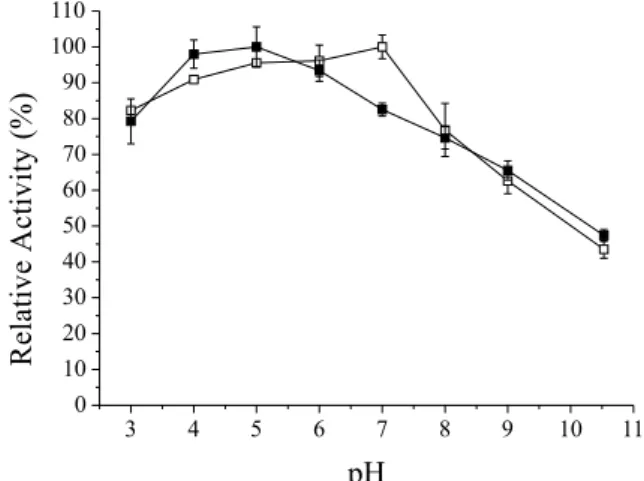
The optimal pHs for lipases are usually between 6.0 and 8.0, but experimental protocols vary with respect to length of time and incubation conditions adopted.26,27 Figure 1 shows relative activity as a function of pH of the lipase from Bacillus sp. ITP-001, in both the free and immobilized forms. Data on the free enzyme were ob-tained by Barbosa et al.28 and used for comparison. The optimal pH of the immobilized lipase from Bacillus sp. ITP-001 was 5.0, which showed a hydrolytic activity of 488.69 U g-1; there was also slightly acidic pH in the enzyme activity which can be considered constant and decreases its activity in alkaline pH values. Barbosa et al.28 concluded that this lipase in free form is most active in a pH range between 4.0 and 7.0, with maximal activity at pH 7.0, followed by loss of some of its activity at strongly alkaline pH values; however, it was observed in this study that increasing the pH to 5.0 resulted in a gradual reduction in activity of the immobilized enzyme. Shift of the optimum pH from neutral to more acid, comparing free versus immobilized enzyme, is presumably due to variations in the ionization state of the system’s components as the pH changes; as suggested by Kennedy and Cabral29 in a study of the analytical aspects of synthetic immobilized enzymes.
Similar findings of a near neutral optimal pH have been described in the literature by several authors using lipases from other sources, in both free and immobilized forms.2,30 According to Guncheva and Zhiryakova,6 the free lipases from Bacillus exhibit extreme alkaline tolerance, with maximum activities at pH values of between 9.5 and 12.0. In contrast, Sugihara et al.31 reported that lipases from Bacillus sp. show maximal activity at pH 5.0 and 6.0. Kanwar et al.32 studied the lipase from Bacillus coagulans BTS-1 immobilized by adsorption on celite and silica matrix, and found that activity was higher at an acidic pH of 5.5. Sathish et al 33 conducted a study of the influence of pH (3.0-8.0) on lipase activity produced by a Bacillus isolated from soil samples collected in India, and found that between pH 3.0 and 5.0 the enzyme showed no lipase activity; only at pH 6.5 did the lipase become more active. However, Kumar et al.34 using lipase from Bacillus immobilized on silica BTS-3 by physical adsorption, found an optimum pH of around 8.5. Riaz et al.35observed that the improvement in the pH for lipase produced by Bacillus sp. FH5, using p-nitrophenyl laurate as the substrate, was 9 and 10 for free and immobilized enzymes, respectively.
The difference in optimum pH observed in these studies may be attributable to the type of lipase and immobilization technique used. Thus, the results obtained in this work for immobilized lipase in sol gel matrix show behavior similar to those described in some articles in the literature using different supports and immobilization techniques.33,36
As can be seen in Figure 2, the optimum temperature for preparations of lipase from Bacillus sp. ITP-001, whether free or
Figure 1. Effect of pH on the hydrolytic activity relative of immobilized ()
and free ()27 Bacillus sp. ITP-001
Table 1. Recovery of immobilized lipase activity of Bacillus sp. ITP 001 on hydrophobic matrix obtained by sol-gel technique
Biocatalyst Lipase from Bacillus sp. ITP-001 Enzyme added Enzyme mass (g) 2.7
UA (U) 2248
Enzyme Immobilized MS (g) 6
EA (U/g) 188
A Total (U) 1128
RA (%) 50
UA - unit added; MS - dry weight of biocatalyst; A - enzymatic activity; U = unit; RA = Recovery Activity; Reaction conditions: 37 ºC and pH 5.0
Figure 2. Effect of pH on the hydrolytic activity relative of immobilized ()
immobilized, was 80 °C.28 It should be noted that the relative activity ranged between 75 and 100% over the temperature range studied, and the primary hydrolytic activity was 488.69 and 526.63 U g-1 at 37 and 80 °C, respectively. We concluded that high temperatures do not cause a sudden decrease in the activity.
According to the effect of temperature on lipase activity repor-ted in several studies, optimal activity was reached between 30 and 65 °C.37,38 However, some lipases have higher activities at temperatures above 70 °C.39,40 Ghori et al.41 used a lipase from Bacillus sp. FH5, which was isolated from tannery waste, and observed the effect of various temperatures (10-80 °C) on the residual activity of the lipase at pH 9.0. These authors noted the optimal temperature for the lipase was 60 °C, and showed increased activity of Bacillus sp. lipase at elevated temperatures.
Studies reported by Riaz et al.,35 showed that the lipolytic activity of the lipase produced by Bacillus sp. FH5 was determined using p--nitrophenyl laurate as the substrate. In this case, a sharp decrease in the activity of the immobilized enzyme at 55 °C was observed. Various studies in the literature have reported reactions performed in organic medium but only very few papers have describe aqueous medium. However, the use of immobilized lipases to catalyze organic synthetic reactions at temperatures of around 45 °C has also been reported.42 In geranyl butyrate synthesis, a maximum yield was achieved at 65 °C using the lipase of P. aeruginosa MTCC-4713 immobilized in hydrogel. By contrast, the synthesis of methyl acrylate was found to be maximal (80.8 mM) at 45 °C, while at 55 and 65 °C, there was decrease in the ester yield, perhaps due to the denaturation of lipase, as well as an alteration in the 3D structure of the enzyme.16 Effect of CaCl2 on activity and stability
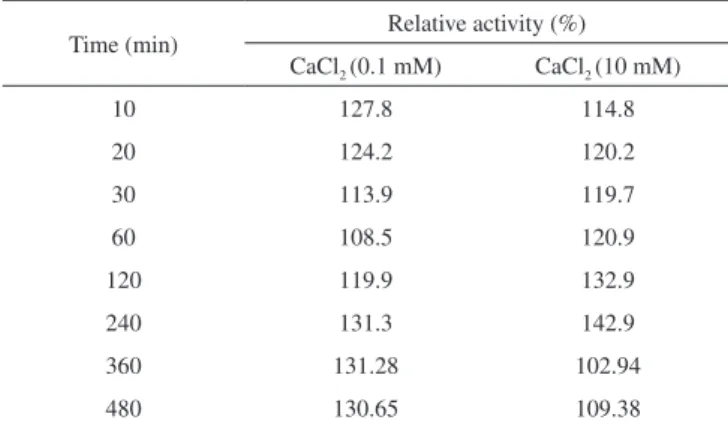
Calcium ions can stimulate hydrolytic catalysis by lipases via the following mechanisms: activation of the lipase by changing the conformation of the enzyme, by increasing the adsorption of lipase on an oil/water interface, and by removing fatty acids from the oil/ water interface so the lipase can act on other water molecules.43 As shown in Table 2, Ca+2 produced a positive effect on the Bacillus sp. ITP-001 lipase, reaching a maximum of 142% (369.2 U/g) relative activity after 240 min of contact with 10 mM Ca+2, and 177% (424.8 U/g) after 480 min of contact with 0.1 mM Ca+2, yielding the enzy-matic activity and control activity with 260 and 240 U/g, respectively. Effect of metal ions and solvents on lipase
Ions have a stimulatory effect, probably because the salt exerts a screening effect and disperses the enzyme molecules. They provide a driving force for substrate binding and catalysis by lowering energy barriers in the ground and/or transition states, and enhance enzyme activity through conformational transitions triggered upon binding to a site where the ion makes no direct contact with the substrate.44
In the presence of EDTA, Fe+3 or Mn+2 ions, the immobilized lipase from Bacillus sp. ITP-001 showed higher hydrolytic activity or rela-tive activity as evidenced in Table 3. It was observed that varying the concentration (mM) had no effect on the enzyme’s activity, except in the case of Zn+2 and Fe+3, where increasing the concentration affected activity, while for Co+2 concentrations, both the enzyme activities re-mained near the control, representing ions without the enzyme. EDTA chelation has activity that influences the formation of the enzyme-substrate complex, resulting in a “chelation process”. Some studies have reported that the effect of EDTA can be either stimulatory or nil on lipase activity, while others have shown an inhibitory effect.28,45
Lipases are known for their ability to work in both aqueous and organic solvents. Table 4 shows the relative lipolytic activity of the lipase from Bacillus sp. ITP-001 in the presence of organic solvents. It was observed that the lipolytic activity increased in almost all solvents tested, except for ethyl alcohol at either 10 or 30% (v/v,) and in 30% (v/v) isopropyl alcohol. These results are consistent with the literature in general, because in many cases the immobilization of a lipase promotes higher activity against some organic solvents, possibly due to a selective adsorption of enzyme that is adhered to the substrate, making it more accessible to solvent. This results in the disruption of high molecular weight aggregates, rendering a gre-ater number of active sites accessible to the enzyme’s substrate.46-49 Barbosa et al.28 utilized the lipase from Bacillus sp. ITP-001 in free form, and found that 30% (v/v) pyridine solvent showed the only positive effect, 110.5% in relative activity; the main negative effect was inactivation of the lipase in the presence of free ethyl alcohol, as in the study by Ghori et al..41 In a study of the lipase from Bacillus coagulans BST-3, immobilized by covalent binding to Nylon-6, the enzyme was stable when incubated for 30 min in the presence of n-heptane, chloroform, or isopropanol, but unstable in the presence of ethanol, acetone, or n-hexane.50
Table 2. Influence of Ca+2 on the hydrolytic activity of immobilized lipase
from Bacillus sp. ITP-001
Time (min) Relative activity (%) CaCl2 (0.1 mM) CaCl2 (10 mM)
10 127.8 114.8
20 124.2 120.2
30 113.9 119.7
60 108.5 120.9
120 119.9 132.9
240 131.3 142.9
360 131.28 102.94
480 130.65 109.38
Reaction conditions: 37 ºC and pH 5.0
Table 3. Influence of ions on the hydrolytic activity or relative activity of immobilized lipase from Bacillus sp. ITP-001
Ions Hydrolytic activity (U/g) at concentration (mM) Relative activity (%) at concentration (mM)
0.1 10 0.1 10
EDTA* 610.9 725.3 125.2 148.6
Fe3+ 624.0 580.6 127.9 118.9
Mn2+ 517.4 585.2 106.0 119.9
Zn2+ 516.6 472.3 105.8 96.8
Co2+ 478.0 478.3 97.9 98.0
According to Pereira et al.51, inhibition of enzyme activity in the presence of solvents is due to a decrease in the hydration layer present near the active site, which is necessary for the enzyme to perform its activities. This activity can also be related to log P, which is an indicator of the hydrophobicity coefficient of substances, and is used as a measure of polarity.
Studies show that enzyme activity is generally low in solvents which have log P (logarithm of the partition coefficient in a standard octanol/water biphasic system) less than 2, is moderate in solvents at log P of between 2 and 4, and is high in non-polar solvents with log P greater than 4. Therefore, increasing solvent polarity causes a large increase in the amount of water needed for the reaction, as solvents with higher affinities for water tend to remove it in larger quantities from the protein’s surface. The log P values for the solvents studied are: ethanol -0.24, acetone -0.23, isopropanol 0.29, acetonitrile -0.33, methanol -0.76, and pyridine 0.71.52-54 The results obtained in this study failed to confirm the general rule because the solvents used have low log P yet resulted in higher enzyme activities in most cases. Therefore, we found that moderate values of log P are suitable for the activity of the biocatalyst.
Kinetic parameters
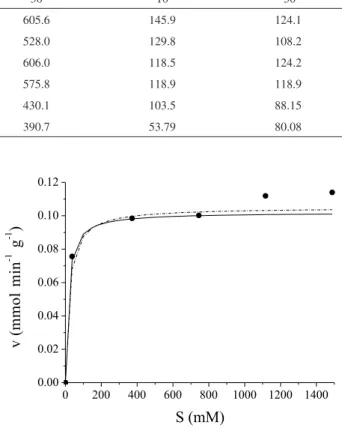
The effect of substrate concentration on the free and immobilized enzyme was studied using olive oil as the substrate in hydrolysis reactions at pH 5 and 37 ºC. Table 5 shows the values of Km and vmax for different methods of determining the kinetic parameters of the hydrolysis reaction, and Figure 3 compares the methods that confor-med better to the kinetic models.
The model that best fitted the experimental data was Lineaweaver-Burk, with a Km of 14.62 mmol and a vmax of 0.102 mmol min-1 g-1 (Figure 3); the activation energy was 5.62 kcal/mmol. According to Sgarbieri et al.55 the values of activation energy for denaturation of
enzymes fall between 12-100 kcal mol-1. We can hence conclude that the energy required for the hydrolysis reaction occurring in the presence of immobilized Bacillus sp. ITP-001 cannot denature it. The corresponding Km and vmax values for the free enzyme determined previously by Barbosa et al.28 were 105.26 mmol and 0.116 mmol min-1.g-1, respectively.
Comparing the values obtained for the free and immobilized enzymes provides important information about the interaction of the enzyme and its support. According to Guncheva and Zhiryakova,6 the conformational structure of this enzyme is different from other lipases; it does not have the lid open or closed in the transition stage, which allows us to consider an increased availability of the active site in the immobilized enzyme. Therefore, the decrease in Km for the immobilized enzyme indicates a substantial increase in the affinity of the substrate for the active site, possibly due to exposure to the substrate after nucleophilic attack produced by the negative charge on the oxygen which is stabilized by hydrogen bonds of the Ile12 (isoleucine) and Met78 (methionine) residues at the active site of the enzyme.
Thermal and operational stability
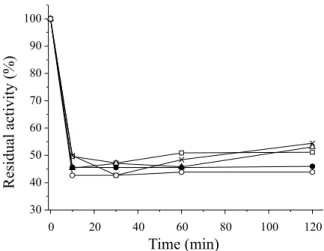
Figure 4 shows the variations in activity of the immobilized lipase after heat treatment (37-80 °C) for 120 min. It was found that the im-mobilized lipase from Bacillus sp. ITP-001 showed thermal stability at 37 °C, and maintained residual activity in the range of 50%, confirm-ing previous results in which the enzyme was also active at a reaction temperature of 37 °C. The same profile was observed for the lipase from Bacillus sp. ITP-001 in the free form, which remained stable at Table 4. Influence of solvents on the hydrolytic activity or relative activity of immobilized lipase from Bacillus sp. ITP-001
Solvents Log P
Hidrolytic activity (U/g) at concentration (%, v/v) Relative activity (%) at concentration (%, v/v)
10 30 10 30
Acetonitrile -0.33 711.9 605.6 145.9 124.1
Acetone -0.23 633.4 528.0 129.8 108.2
Methanol -0.76 578.4 606.0 118.5 124.2
Piridine 0,71 580.6 575.8 118.9 118.9
Isopropanol 0.29 505.1 430.1 103.5 88.15
Ethanol -0.24 262.4 390.7 53.79 80.08
Reaction conditions: 37 ºC and pH 5.0. Enzyme activity of control: 488 U/g
Table 5. The values of mean relative error (P), estimated (SE) and kinetics parameters (Km and vmax) using olive oil emulsion method as a substrate
Model vmax
(mmol/min g) Km (mmol) P* E**
Lineaweaver-Burk 0.102 14.62 8.26 0.011
Hanes-Wolf 0.118 75.43 11.50 0.017
Eadie-Scatcharel 0.125 125.00 12.90 0.021
Wolf-Augustinisson-Hofstce
0.120 103.80 12.11 0.020
Nonlinear 0.105 19.96 9.11 0.011
* Average relative error. ** Estimated average error. Reaction conditions: 37 ºC, pH 5.0 and 10 min.
Figure 3. Comparison of experimental data () with kinetic models of
moderate temperatures according to Barbosa et al.28 The encapsulated lipase exhibited good activity in hydrolysis reactions, but only moder-ate reusability, maintaining only 20% activity after the second reuse.
According to Kumar et al.34 the lipase from Bacillus BTS-3 immobilized by physical adsorption on silica is thermally stable at temperatures of 55, 60, 65, and 70 °C; this behavior can also be observed in the study by Kanwar et al.,32 where the immobilized lipase from Bacillus coagulans BTS-1 showed thermal stability at a temperature of 50 °C. The studies by Kumar et al.33and Kanwar et al.32 reported thermal stability at high temperatures, in contrast to observations for the lipase in the present study; perhaps this tolerance could be the protection of the enzyme promoted by the sol gel immo-bilization technique for encapsulation and adsorption. Thermostability is one of the characteristics required of enzymes with potential for industrial application such as lipases, since many processes occur at a temperature of around 50 ºC.40
CONCLUSIONS
Bacterial lipases play an important role as hydrolases, and we have demonstrated the occurrence of an extracellular lipase derived from cultures of Bacillus sp. ITP-001. To exploit lipases of Bacillus sp. ITP-001 for performing hydrolysis reactions, it is important to characterize these enzymes biochemically. The present study of the lipase from Bacillus sp. ITP-001 immobilized in a sol gel matrix sho-wed optimum activity at 80 ºC and pH 5.0, and thermal stability at 37 °C. Of the metal ions tested, the lipase was found to be activated by Ca+2, EDTA, Fe+3, and Mn+2, and also activated in almost all solvents tested, except for ethyl alcohol and isopropyl alcohol. Values of Km and vmax were 14.62 mmol and 0.102 mmol min-1 g-1, respectively, and the activation energy was 5.62 kcal mmol-1. These properties make the immobilized lipase from Bacillus sp. ITP-001 highly attractive for future biotechnological applications.
ACKNOWLEDGEMENTS
The authors thank CNPq, CAPES and UNIT for their financial support of this work, and for research scholarships.
REFERENCES
1. Soares, C. M. F.; Santos, O. A. A.; Castro, H. F.; Zanin, G. M.; J. Non-Cryst. Solid 2006, 352, 3469.
2. Simões, A. S.; MoriI, R. Y.; Faria, R., Castro, H. F.; Mendes, A. A.; Quim. Nova 2011, 34, 33.
3. Yang, G.; Wu, J.; Xu, G.; Yang, L.; Colloids Surf., B 2010, 78, 351. 4. Zhang, D.; Yuwen, L.; Xie, Y.; Li, W.; Li, X.; Colloids Surf., B 2009, 89,
73.
5. Zarcula, C.; Corîci, L.; Croitoru, R.; Ursoiu, A.; Peter, F.; J. Mol. Catal. B: Enzym. 2010, 65, 79.
6. Guncheva, M. E.; Zhiryakova, D.; J. Mol. Catal. B: Enzym. 2011, 68, 1. 7. Mateo, C.; Palomo, M. J.; Lorente-Fernadez, G.; Guisan, M. J.;
Lafuente-Fernandez, R.; Enzyme Microb. Technol. 2007, 40, 1451. 8. Pinheiro, R. C.; Soares, C. M. F.; Castro, H. F.; Moraes, F. F.; Zanin, G.
M.; Appl. Biochem. Biotechnol. 2008, 146, 203.
9. Liu, C. H.; Changand, J. S.; Bioresour. Technol. 2008, 99, 1616. 10. Zhou, G.; Chen, Y.; Xu, Z.; Microporous Mesoporous Mater. 2009, 119,
223.
11. Pack, S. P.; Yoo, Y. J.; J. Biol. Macromol. 2005, 35, 169. 12. Kim, J.; Grate, J. W.; Wang, P.; Chem. Eng. Sci. 2006, 61, 1017. 13. Kanwar, S. S.; Chauhan, G. S.; Chimni, S. S.; Chauhan, S.; Rawat, G.
S.; Kaushal, R. K.; Appl. Polym. Sci. 2006, 100, 1420.
14. Kanwar, S. S.; Kaushal, R. K.; Verma, M. L.; Kumar, Y.; Azmi, W.; Gupta, R.; Chimni, S. S.; Chauhan, G. S.; Indian J. Biotechnol. Biophys. 2007, 6, 68.
15. Kanwar, S. S.; Sharma, C.; Verma, M. L.; Chauhan, S.; Chimni, S. S.; Chauhan,G. S.; J. Appl. Polym. Sci. 2008, 109, 1063.
16. Verma, M. L.; Kanwar, S. S.; J. Appl. Polym. Sci. 2008, 110, 837. 17. Verma, M. L.; Chauhan, G. S.; Kanwar, S. S.; Acta Microbiol. Immunol.
Hung. 2008, 55, 327.
18. Carvalho, N. B.; Souza, R. L.; Castro, H. F.; Santos, O. A.; Zanin, G. M.; Lima, A. S.; Soares, C. M. F.; Appl. Biochem. Biotechnol. 2008, 150, 25. 19. Feitosa, I. C.; Barbosa, J. M. P.; Orelana, S. C.; Lima, A. S.; Soares, C.
M. F.; Acta Sci. Technol. 2010, 32, 27.
20. Barbosa, J. M. P.; Souza, R. L.; Fricks, A. T.; Zanin, G. M.; Soares, C. M. F.; Lima, A. S.; J Chromatogr., B: Anal. Technol. Biomed. Life Sci. 2011, 879, 3853.
21. Sharma, R.; Chisti, Y.; Banerjee, U. C.; Biotechnol. Adv. 2001, 19, 627.
22. Khan, M. S.; Li, X.; Shen, W.; Garnierbb, G.; Colloids Surf., B 2010, 75, 239.
23. Zanin, G. M.; Castro, H. F.; Moraes, F. F.; Santos, O. A. A.; Soares, C. M. F.; INPI Patent submission No. PI0306829-3, 2003.
24. Soares, C. M. F.; Castro, H. F.; Moraes, F. F.; Zanin, G. M.; Appl. Bio-chem. Biotechnol. 1999, 77-79, 745.
25. Soares, C. M. F.; Santos, O. A.; Castro, H. F.; Moraes, F. F.; Zanin, G. M.; Appl. Biochem. Biotechnol. 2004, 113, 307.
26. Shu, C. H.; Xu, C. J.; Lin, G. C.; Process Biochem. 2006, 4, 734. 27. Kamini, N. R.; Fujii, T.; Kurosu, T.; Iefuji, H.; Process Biochem. 2000,
36, 317.
28. Barbosa, J. M. P.; Souza, R. L.; Fricks, A. T.; Melo, C. M.; Soares, C. M. F.; Lima, A. S.; Quim. Nova 2012, 35, 1173.
29. Kennedy, J. F.; Cabral, J. M. S.; Immobilized enzymes, John Wiley and Sons: New York, 1983.
30. Gupta, R.; Ramnani, P.; Appl. Biochem. Biotechnol. 2004, 40, 191. 31. Sugihara, A.; Tani, T.; Tominaga, Y.; J. Biochem. 1991, 109, 211. 32. Kanwar, S. S.; Srivastava, M.; Chimni, S. S.; Ghazi, I. A.; Kaushal, R.
K.; Joshi, G. K.; Acta Microbiol. Immunol. Hung. 2005, 51, 57. 33. Sathish, K. M.; Karrunakaran, C. M.; Anbuselvi, S.; Int. J. Biotechnol.
2009, 5, 361.
34. Kumar, S.; Pahujani, S.; Ola, R. P.; Kanwar, S. S.; Gupta, R.; Acta Mi-crobiol. Immunol. Hung. 2006, 53, 219.
35. Riaz, M.; Shah, A. A.; Hameed, A.; Hasan, F.; Anna. Microbiol, 2010, 60, 169.
36. Kanwar, S. S.; Kaushal, R. K.; Verma, M. L.; Kumar, Y.; Chauhan, G. S.; Gupta, R.; Chimni, S. S.; Ind. J. Microb. 2005, 45, 187.
Figure 4. Thermal stability of the enzyme immobilized lipase from Bacillus
37. Bacha, A. B.; Gargouri, Y.; Ben Ali, Y.; Miled, N.; Reinbolt, J.; Mejdoub, H.; Enzyme Microb. Technol. 2005, 37, 309.
38. Gaur, R.; Gupta, A.; Khare, S. K.; Process Biochem. 2008, 43, 1040. 39. Bradoo, S.; Rathi, P.; Saxena, R. K.; Gupta, R.; J. Biochem. Bioph. Meth.
2002, 51, 115.
40. Kambourova, M.; Kirilova, N.; Mandeva, R.; Derekova, A.; J. Mol. Catal. B: Enzym. 2003, 22, 307.
41. Ghori, M. I.; Iqbal, M. J.; Hameed, A.; Braz. J. Microb. 2011, 42, 22. 42. Kumar, A.; Kanwar, S. S.; Bioresour. Technol. 2011, 102, 2162. 43. Salleh, A. B.; Rahman, R. N. Z. R. A.; Nova Biomed. 2006, 159. 44. Di Cera, E.;. J. Biol. Chem. 2006, 281, 1305.
45. Dharmsthiti, S.; Ammaranond, P.; J. Ind. Microbiol. Biotechnol. 1998, 21, 75.
46. Liu, Y.; Jin, Q.; Shan, L.; Liu, Y.; Shen, W.; Wang, X.; Ultrason. Sonochem. 2008, 15, 402.
47. Santos, J. C.; Mijone, P. D.; Nunes, G. F. M.; Perez, V. H.; Castro H. F.; Colloids Surf., B 2008, 61, 229.
48. Vaidya, B. C.; Singhel, K.; Rekha, S.; Colloids Surf., B 2008, 61, 101. 49. Wu, J. C.; Wong, Y. K.; Chang, K. W.; Tay, C. Y.; Chow, Y.; Talukder, M.
M. R.; Biocatal. Biotransform. 2007, 25, 459.
50. Pahujani, S.; Kanwar, S. S.; Chauhan, G.; Gupta, R.; Bioresour. Technol. 2008, 99, 2566.
51. Pereira, E. B.; Castro, H. F.; Moraes, F. F.; Zanin, G. M.; Appl. Biochem. Biotechnol. 2001, 91, 739.
52. Laane, C.; Boeren, S.; Vos, K.; Veeger, C.; Biotechnol. Bioeng. 1986, 30, 81.
53. Ahmad, R. M. Y.; William, A. A.; Murray, M.; Enzyme Microb. Technol. 1998, 23, 438.
54. Adlercreutz, P.; Biocatalysis in non-conventional media, in Applied Biocatalysis, Harwood Acad Publis Netherlands: Singapure, 2000. 55. Sgarbieri, V. C.; Proteínas em alimentos protéicos: propriedades,