522 Brazilian Journal of Physics, vol. 38, no. 3B, September, 2008
Hadron Production in the Nucleus Fragmentation Region
Marcos Andr´e Betemps∗ Conjunto Agrot´ecnico Visconde da Grac¸a,
Universidade Federal de Pelotas Rua Eng. Ildefonso Simoes Lopes, 2791, 96060-290 Pelotas, Rio Grande do Sul, Brazil
Maria Beatriz Gay Ducati†
Instituto de F´ısica,
Universidade Federal do Rio Grande do Sul Caixa Postal 15051, 91501-970 Porto Alegre,
Rio Grande do Sul, Brazil (Received on 20 June, 2008)
The RHIC hadron production data in hadronic collisions at the forward rapidities may hint the evidence of the Color Glass Condensate (CGC). However, in the opposite region, backward rapidities, new effects should be important in order to describe the observables. In this work, the charged hadron andπ0productions are investigated in the fragmentation region of the nucleus (backward rapidities) consideringdAuandppcollisions in the context of the Color Glass Condensate. In the backward rapidity region, only the proton can be treated as a CGC, and the largexnuclear effects need to be considered in order to describe the cross section. The results are shown by means of the nuclear modification ratio comparing the proton-nucleus and proton-proton cross sections and such ratio presents some dependences on the largexnuclear effects.
Keywords: Color Glass Condensate; Backward Rapidities; Hadron Production
1. INTRODUCTION
The hadron production in the high energy hadronic colli-sions at RHIC [1] is one of the recent data that should indi-cate the existence of the Color Glass Condensate (CGC) [2] in the forward rapidity region. The ratio between deuterium-proton and deuterium-proton-deuterium-proton differential cross sections, consid-ering the transverse momentum distributions, is employed to investigate the existence of the Color Glass Condensate. This ratio presents a Cronin enhancement at moderate transverse momentum and more central rapidities, and a suppression at forward ones. The suppression of the ratio with rapidity is re-lated to the quantum evolution of the gluons in the target, and is being considered as one of the evidences of the Color Glass Condensate [3].
Looking to the opposite region in the detector (backward rapidities), new effects like large x nuclear effects or final state effects, should be relevant in order to describe the ob-servables. At this region the nucleus can not be considered as a Color Glass Condensate, once the large x components contribute to the cross section, and only the proton should be treated in this way. Considering the recently measured hadron nuclear modification at backward rapidities, it shows a pro-nounced peak as more negative values are reached (∼ −2) for 0.5 GeV<pT <4 GeV [4], which is not well understood.
However, as we will show in this work, it should be due to final states interactions.
The main goal of this work is to investigate the hadron pro-duction at backward region considering the Color Glass
Con-∗[email protected]
densate approach. The CGC theory is well justified at forward rapidities, where the nucleus interacts by means of the small xpartons. The use of this approach at the backward kine-matical region need to be carefully analyzed. In recent works [5, 6] the CGC approach is considered in order to describe the proton-proton collision, which implies to describe the proton as a CGC. If it is so, them we are free to change proton and nucleus in the CGC approach, and investigate the largex nu-clear effects in the nucleus, by means of the nunu-clear parton distributions, while the proton being described by the CGC theory.
Considering this goal, the paper is organized as follows. In the next section, we discuss the hadron production at back-ward rapidities, presenting all the quantities in order to obtain the cross section for the hadron production. In section 3 we present and discuss the main results of this work and in section 4 the conclusions of the work are presented.
2. HADRON PRODUCTION
Marcos Andr´e Betemps and Maria Beatriz Gay Ducati 523
in Deuterium-Nucleus collisions, could be written in the form,
d2σdA→hX(Backward)
dyd2p T
= 1 2π
Z 1
xF
dx2
x2
xF
½
fq/A(x2,pT)NF
µx
2
xF
pT,x1
¶
Dh/q(xF x2
,pT)
+ fg/A(x2,pT)NA
µ x2
xF
pT,x1
¶
Dh/g(xF x2
,pT)
¾
, (1)
where pT, yand xF are the transverse momentum, rapidity
and the Feynman-xof the produced hadron, respectively. The variablex1denotes the momentum fraction of a projectile
par-ton, f(x1,p2T) is the projectile parton distribution functions
(nucleus indAor proton in ppcollisions) andD(z,p2T) rep-resents the parton fragmentation functions into hadrons (we use the KKP fragmentation function [8]). In Eq. (1),NF(˜k,x)
andNA(˜k,x)are the fundamental and adjoint representations
of the forward dipole amplitude in momentum space, which represent the probability for scattering of a quark and a gluon of the deuterium (or proton), respectively. Moreover, for this kinematical regionxF= √pT
se−
y, and the momentum fraction
of the target partons is given byx2=x1e−2y.
Concerning the nuclear parton distribution function, we use CTEQ5 [9] as the parton distribution function (PDF) of free protons and the EKS parametrization for the nuclear parton distributions (nPDF) [10, 11]. EKS parameterization gives the nPDF as the free proton PDF multiplied by a factor,
fqA(x,Q) =RAq(x,Q)fqp(x,Q), (2) and is available only at leading order. We perform the investi-gation considering other nuclear parton distribution proposed by Sassot and de Florian (nDS) [12] which gives the nPDF as a convolution of the free proton PDF and a weight function:
fqA(x,Q) = Z A
x
dy
yWq(y,A)f
p q
µx y,Q
¶
. (3)
However, this parametrization is not well behaved at largex, as can be seen in the Fig. 1, where the ratio between nuclear and nucleon parton distributions functions RF2 is presented.
For this reason, the results in this work are obtained with the EKS parametrization. In the Fig. 1 the distinct nuclear effects should be identified: Fermi motion effects (0.8<x), EMC effects (0.3<x<0.8), anti-shadowing (0.1<x<0.3) and shadowing effects (x<0.1).
The dipole scattering amplitude parametrization is consid-ered from the DHJ parametrization [5]. This parametrization was proposed in order to describe the forward region ofdAu collisions at RHIC, and present explicit Geometric Scaling violation. The dipole scattering amplitude proposed in the DHJ model was based in the parameterization porposed by Kharzeev, Kovchegov and Tuchin, which incorporates GS vi-olation [13], however, in the DHJ model, this GS vivi-olation is
10−5
10−4
10−3
10−2
10−1
100
x 0
0.5 1 1.5 2
RF
2
nDS (Q=1 GeV) EKS (Q=1 GeV) EKS (Q=3 GeV) nDS (Q=3 GeV)
FIG. 1: Comparison between EKS and nDS parametrization at small Q. At largexthe nDS parametrization predicts negative values for the ratio between nuclear and proton structure functions.
strong. The DHJ model is written in the form, NA(pT,x) =
Z
d2reipT~·~r
× ·
1−exp µ
−1 4(r
2Q2
s(x))γ(pT,x)
¶¸
. (4)
In this parameterization, the problems that appear in the Fourier transformation [14] are prevented by the pT
depen-dence of theγinstead of the rdependence. The expression forNF is obtained by means of the replacementr2Q2s(x)→
(CF/CA)r2Q2s, whereCF/CA=4/9. The anomalous
dimen-sionγof the DHJ parameterization has the form, γ(pT,x) = γs+∆γ(pT,x)
γ(pT,x) = γs+(1−γs)
log(p2 T/Q2s(x)
λy+d√y+log(p2T/Q2 s(x))
, (5)
wherey=log 1/x. The saturation scaleQsand the parameter
λare taken from the GBW model [15]. In this parameteriza-tion,d=1.2 is determined by the fit procedure to the RHIC data on hadron production andγs=0.628. The GS violation
in the DHJ model is represented by the term∆γ(pT,x)in the
equation 5.
524 Brazilian Journal of Physics, vol. 38, no. 3B, September, 2008
forπ0production is presented as a function of the transverse
momentum of the produced hadron.
0.5 1 1.5 2 2.5 3 3.5 4
pT (GeV)
10−10
10−9
10−8
10−7
10−6
10−5
10−4
10−3
10−2
10−1
100
d
2N/dyd 2p
T
(GeV
−1) (
π
0)
pp (y=−2) pp (y=−3) pp (y=−4) dA (y=−2) dA (y=−3) dA (y=−4)
FIG. 2:π0production at RHIC energies inppanddAucollisions.
Analyzing the Fig. 2 we verify the expected behavior, the spectra is enlarged to more central rapidities (the behavior is similiar for charged hadron production). In these calculations noKfactor is under consideration (theKfactor should sim-ulate NLO contributions). It should be interesting to address that the calculations performed here are justified only at back-ward rapidities. It should not describe the cross section in the central rapidity region, since at this kinematical regime, the proton should not be described as a Color Glass Condensate. It is an approximation, which is considered reasonable only at backward or forward rapidities.
Having discussed the hadron production at the backward rapidities, in the next section the nuclear modification ratio is investigated at this kinematical region.
3. RESULTS AND DISCUSSIONS
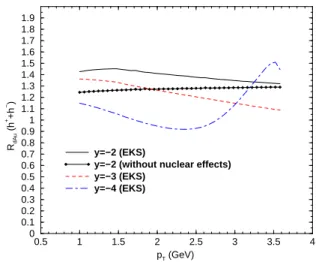
The cross section presented in this work is evaluated in the LO calculation. In order to describe the data, aKfactor should be employed. It should be verified that in the forward rapidi-ties theppanddAuspectra are described considering the same K factor at same rapidity and energy. This implies that the production mechanism is the same considering pp anddAu processes at forward rapidities, and the saturation effects are being considered in both cases. In the backward rapidities, new effects are present in the nucleus (largexeffects), which are not present in the proton. This should be the main approx-imation realized in this work: we consider the sameKfactor inppanddAucollision at backward rapidities, in order to in-vestigate the nuclear modification factor, which is defined in the form,
RdA=
d2N(dA)/dyd2pT
d2N(pp)/dyd2p T
. (6)
In this definition, we have not included any normalization fac-tor. The normalization of the ratioRdA is a crucial point of
this investigation, however, we intend to analyse this aspect in a complete version of this work, which is in progress [16]. At
the moment, we will investigate only thepTdependence of the
ratioRdAconsideringπ0and charged hadron productions. In
the Fig. 3 and 4 the nuclear modification ratio is investigated for these observables at RHIC energies √s=200 GeV and backward rapiditiesy=−2,−3,−4. We consider the CTEQ5 LO parametrization for the free proton, deuterium without nu-clear effects and EKS parametrization for the nunu-clear parton distributions.
0.5 1 1.5 2 2.5 3 3.5 4
pT (GeV)
0 0.1 0.2 0.3 0.4 0.5 0.6 0.7 0.8 0.9 1 1.1 1.2 1.3 1.4 1.5 1.6 1.7 1.8 1.9
RdAu
(
π
0)
y=−2
y=−2 (without nuclear effects) y=−3
y=−3 (without nuclear effects) y=−4
y=−4 (without nuclear effects)
FIG. 3: Nuclear modification ratio for theπ0 production at RHIC energies.
In order to identify the largexeffects in the nuclear modi-fication factor, we perform calculations with and without nu-clear effects. In the cross section (Eq. 1), the integration over x2with the limitsxF and 1, implies that all the nuclear effects
forx>xFare contributing to the cross section. Only
concern-ing the fragmentation function the results presented here are distinct considering charged hadron andπ0productions.
0.5 1 1.5 2 2.5 3 3.5 4
pT (GeV)
0 0.1 0.2 0.3 0.4 0.5 0.6 0.7 0.8 0.9 1 1.1 1.2 1.3 1.4 1.5 1.6 1.7 1.8 1.9
RdAu
(h
++h
−)
y=−2 (EKS)
y=−2 (without nuclear effects) y=−3 (EKS)
y=−4 (EKS)
FIG. 4: Nuclear modification ratio for the charged hadron production at RHIC energies.
In the Fig. 3 the nuclear modification factor for theπ0
Marcos Andr´e Betemps and Maria Beatriz Gay Ducati 525
This behavior is due to the largexeffects present in this re-gion. The anti-shadowing, EMC and Fermi motion are con-tributing to the cross section and the net result is an increment of the nuclear cross section, since theRF2 is larger than 1 for
anti-shadowing and Fermi motion regions. For y=−3 the nuclear effects provide a reduction of the nuclear modifica-tion ramodifica-tion at large pT (EMC effect) and an increment on the
RdA at small pT (anti-shadowing effect). Considering very
backward rapidities, the nuclear effects implies that theRdAis
reduced at smallpT (EMC effect) and present a peak at large
pT, which is due to the dominance of the Fermi motion effect.
In the Fig. 4 the nuclear modification factor for the charged hadron production is presented. The conclusions considering the charged hadron are the same obtained in theπ0production,
once the calculation are distinct only concerning the fragmen-tation function.
4. CONCLUSIONS
In this work, the large x nuclear effects (Fermi motion, EMC and antishadowing) provide a reduction of the nuclear modification ratio in some RHIC kinematical regions, how-ever, these effects should implie in an increment in the ratio RdAfor other regions. The behavior of the ratioRdA is
simi-lar consideringπ0and charged hadron productions. We verify
that the nuclear effects at backward rapidities at RHIC ener-gies provide an increment on the ratioRdA fory=−2. For y=−3, the nuclear effects produce an increment in the ra-tioRdAat small pT and a reduction of the ratio at large pT.
Consideringy=−4, only at large pT the largexnuclear
ef-fects provides a strong increment on the nuclear modification factor, which is associated to the Fermi motion nuclear effect. The results obtained in this work should be interesting to compare with the nuclear modification factor data at RHIC backward rapidities for the hadron production [4] (the data present the nuclear modification factor from the central ra-pidites up toy=−2). This investigation will be present in a complete version of this work, which includes a comparison with the RHIC data and an estimation of the magnitude of the final state effects contributions. The results presented in this contribution should be contrasted with eletromagnetic observ-ables at this kinematical region [7], which should be another way of investigation of the largexnuclear effects, that we in-tend to address in a near future.
Acknowledgments:
We would like to thanks to all participants of the II Latin American Workshop on High Energy Phenomenology due to the excellent discussions. This work was partially financed by the Brazilian funding agencies CNPq and FAPERGS.
[1] I. Arseneet al.[BRAHMS Collaboration], Phys. Rev. Lett.91, 072305 (2003); Phys. Rev. Lett.93, 242303 (2004); Phys. Rev. Lett.94, 032301 (2005);
J. Adamset al. [STAR Collaboration], Phys. Rev. Lett. 97, 152302 (2006).
[2] E. Iancu, A. Leonidov and L. McLerran, Nucl.Phys.A692, 583 (2001); E. Ferreiro, E. Iancu, A. Leonidov and L. McLerran, Nucl. Phys. A701, 489 (2002); J. Jalilian-Marian, A. Kovner, L. McLerran and H. Weigert, Phys. Rev. D55, 5414 (1997); J. Jalilian-Marian, A. Kovner and H. Weigert, Phys. Rev. D 59, 014014 (1999);ibid.59, 014015 (1999);ibid.59, 034007 (1999).
[3] J. L. Albacete, N. Armesto, A. Kovner, C. A. Salgado and U. A. Wiedemann, Phys. Rev. Lett.92, 082001 (2004). [4] S.S. Adler, et al. PHENIX Collaboration. Phys. Rev. Lett. 94,
082302 (2005).
[5] A. Dumitru, A. Hayashigaki and J. Jalilian-Marian, Nucl. Phys. A765, 464 (2006); Nucl. Phys. A770, 57 (2006).
[6] D. Boer, A. Utermann, E. Wessels, arXiv:0711.4312 [hep-ph].
[7] M. A. Betemps, M. B. Gay Ducati and E. G. de Oliveira, Phys. Rev. D74, 094010 (2006)
[8] B. A. Kniehl, G. Kramer and B. Potter, Nucl. Phys. B582, 514 (2000).
[9] H. L. Laiet al.[CTEQ Collaboration], Eur. Phys. J. C12, 375 (2000).
[10] K. J. Eskola, V. J. Kolhinen and C. A. Salgado, Eur. Phys. J. C 9, 61 (1999).
[11] K. J. Eskola, V. J. Kolhinen and P. V. Ruuskanen, Nucl. Phys. B 535, 351 (1998).
[12] D. de Florian and R. Sassot, Phys. Rev. D69, 074028 (2004). [13] D. Kharzeev, Y. V. Kovchegov, K. TUchin, Phys. Lett. B599,
23 (2004).
[14] M. A. Betemps and M. B. Gay Ducati, Phys. Rev. D70(2004) 116005; Phys. Lett. B636, 46 (2006).
[15] K. Golec-Biernat, M. Wusthoff, Phys. Rev. D 59, 014017 (1999);ibid.60, 114023 (1999).