O
RIGINALA
RTICLE Revista Brasileira de FisioterapiaFoot posture and classification of the plantar
arch among adolescent wearers and
non-wearers of high-heeled shoes
Postura do pé e classificação do arco plantar de adolescentes usuárias e não
usuárias de calçados de salto alto
Patrícia A. O. Pezzan, Isabel C. N. Sacco, Silvia M. A. João
Abstract
Objectives: To investigate the relationship between foot posture and plantar arch among adolescent wearers and non-wearers of high-heeled shoes. Methods: Thirty-six female adolescents aged 13 to 20 years were selected and grouped as 16 high-heel non-wearers and 20 high-heel non-wearers. Foot posture was analyzed using photos, firstly barefoot and, secondly, after wearing previously standardized high-heeled platform shoes for an hour. The analysis was performed using the software SAPo. Barefoot impressions were taken, and the Chipaux-Smirak Index was calculated to classify the plantar arch of the foot. For statistical analyses, the paired t test was
used to investigate equality between the right and left sides. The Shapiro-Wilk adherence test was performed, followed by inferential analysis using the non-parametric Wilcoxon test, the Mann-Whitney test and Spearman’s correlation coefficient. The significance level used was 0.05. Results: There was no correlation between the type of plantar arch and foot posture among the female adolescents studied. However, the rearfoot angle was significantly different, with rearfoot varus after wearing the shoes in both groups. The plantar arch in the wearers group presented smaller values for the Chipaux-Smirak Index. Conclusions: There is no correlation between foot posture and the type of plantar arch, although these variables are influenced by high-heeled shoes.
Article registered in the Australian New Zealand Clinical Trials Registry (ANZCTR) under the number ACTRN12608000300370.
Key words: plantar impression; adolescent; feet; posture; biophotogrammetry.
Resumo
Objetivos: Correlacionar a postura dos pés com o arco plantar de adolescentes usuárias e não usuárias de calçados de salto alto.
Métodos: Foram selecionadas 36 adolescentes, 16 no grupo de não usuárias e 20 no grupo de usuárias, com idade entre 13 e 20 anos.
A postura do pé foi analisada por fotos nas condições descalça e com calçado de salto alto tipo Anabella, previamente padronizado, após terem permanecido com ele por uma hora. Sua análise foi realizada pelo software SAPO. A impressão plantar foi realizada
descalça e, a partir dela, calculado o Índice de Chipaux – Smirak para classificação do arco plantar. Para análise estatística, utilizou-se o teste t pareado para verificar igualdade entre lados direito e esquerdo. Foi realizado o teste de aderência Shapiro Wilk e, então,
a análise inferencial por meio dos testes não paramétricos de Wilcoxon, o teste de Mann-Whitney e a correlação de Spearman. O nível de significância adotado foi de 0,05. Resultados: Não foi encontrada correlação entre o tipo de arco plantar e a postura do pé das adolescentes estudadas. Porém, o ângulo do retropé se mostrou significativamente diferente, apresentando varo de retropé após a colocação do calçado em ambos os grupos, e o arco plantar do grupo de usuárias apresentou valores menores quanto ao Índice Chipaux – Smirak. Conclusões: Não existe correlação entre a postura do pé e o tipo de arco plantar, embora essas variáveis tenham sofrido influência do calçado de salto alto.
Artigo registrado na Australian New Zealand Clinical Trials Registry (ANZCTR) sob o número ACTRN12608000300370.
Palavras-chave: impressão plantar; adolescente; pés; postura; biofotogrametria.
Received: 30/08/2008 – Revised: 17/01/2009 – Accepted: 17/03/2009
Department of Physical Therapy, Speech Pathology and Occupational Therapy, School of Medicine, Universidade de São Paulo (USP), São Paulo (SP), Brazil
Correspondence to: Patrícia Angélica de Oliveira Pezzan, Rua Estados Unidos, 191 - apto 41, Jardim Quisisana, CEP 37701-243, Poços de Caldas (MG), Brasil, e-mail: [email protected]
Introduction
The stages of child development are closely linked to the variations in posture that arise as a response to the balance problems derived from changes in body proportion1. Ado-lescents also face this challenge, which renders the prepu-bertal and postpuprepu-bertal phases crucial to the formation and structuring of posture2,3. Several factors can influence the formation of good posture during this stage including longer school hours from age ten, therefore longer periods of time in the sitting position and heavier loads of notebooks in the children’s backpacks4,5.
he type of shoe worn is an external factor that can in-luence the posture of the distal extremity ( foot and ankle), gait and the type of plantar arch. In this respect, the habit of wea-ring high-heeled shoes must be highlighted, as it has become increasingly more common among teenagers from an earlier age6-11. Although high-heeled shoes are important accessories in women’s apparel, the main concern is the improper wear which compromises the health of feet, legs, and spine12.
Recent studies6,7,13 have shown that high-heeled shoes shift the center of the body mass forward, placing the ankle in plantar flexion, causing an overload on the forefoot and transferring the pressure peaks from the 3rd, 4th, and 5th metatarsal heads to the 1st and 2nd metatarsals. In this po-sition, the triceps surae becomes shortened, which results in decreased contractile strength6-8,11. The shortening of the posterior leg muscles due to the constant wearing of these shoes can increase the incidence of ankle sprains and foot fractures, as it reduces balance and step velocity12.
With the forward displacement of the line of gravity, high-heel wearers must compensate for this efect. his compensa-tion may be carried out by means of postural changes developed over the time one wears these shoes6,9-11. hese changes were observed in some studies on trunk, knees, and ankles, and they do not follow a set of rules, i.e. each individual adopts a dife-rent posture composed of difedife-rent combinations of segmental changes to counterbalance the forward displacement of the center of gravity11.
According to Mathieson, Upton and Prior14 and to Neu-mann15, biomechanical changes in the plantar fascia and the muscles that sustain it can bring about changes in the plan-tar arch. When the fascia is elongated and/or the muscles are weakened, the medial longitudinal arch collapses, a con-dition known as flat foot. According to the same authors, when this condition is combined with excessive pronation of the subtalar joint, the rearfoot becomes valgus. Conversely, when the fascia and/or the muscles are tense or shortened, there will be an increase in the plantar arch called cavus
foot, and when this is combined with supination of the sub-talar joint, the rearfoot becomes varus. However, no studies have been found in the literature to establish the correlation between foot posture and the medial longitudinal arch in adolescents.
Considering that the target population of the present study consisted of growing teenagers, the detection of these postu-ral data, alongside the characteristics of the type of foot, may support therapy procedures and be particularly preventive in this population. herefore, the study aimed to investigate the relationship between the foot posture and the plantar arch of adolescent high-heel wearers and non-wearers.
Methods
Case study
he study included female adolescents aged 13 to 20 ye-ars old16, who were enrolled at private schools in the cities of Poços de Caldas (MG) and São Paulo (SP). hey were divided into two groups: non-wearers of high-heeled shoes, compri-sing 16 girls with a mean weight of 51.2 kg, mean height of 1.63 m and mean age of 16 years and 7 months; and the group of high-heel wearers, with 20 girls, mean weight of 52.4 kg, mean height of 1.62 m and mean age of 17 years and 8 months. All participants or legal guardians signed an informed consent form. his research was approved by the Committee of Ethics of the School of Medicine – Universidade de São Paulo (USP), under the protocol number 236/06.
Figure 2. Representation of the straight line segments used to calculate
the CSI.
CSI= b/a; a=widest section of the metatarsal head region, b=narrowest section of the longitudinal arch region.
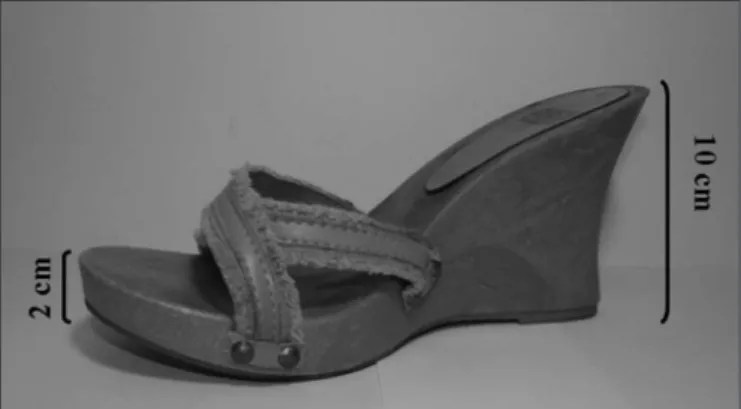
Figure 1. High-heeled shoes worn in this study.
Foot posture assessment
his analysis was carried out by applying photogramme-try. he pictures were taken in a reserved, well-lit room with a digital SONY H7, 8.1 mega pixel camera positioned parallel to the ground on a tripod 1 m from the loor and 2.40 m from the participant, ensuring a full body shot21. he camera was swi-veled and locked at 90º from the horizontal position in order to focus longitudinally on the adolescent’s body. During the photogrammetric assessment of the rearfoot, the adolescents remained in a standing position next to a plumb line 15 cm from the wall. To maintain this distance, a 15 x 60 cm ethyl vinyl acetate (EVA) rectangle was positioned between the wall and the participant21. A 7.5 cm EVA rectangle was placed be-tween the adolescents’ feet to maintain the standard posture. he participants were also asked to keep their feet in the most comfortable position, therefore no foot alignment position was imposed, respecting Fick’s angle.
For the analysis of the rearfoot angle that characterized the foot posture, the following anatomical landmarks were marked on the right and left legs: (1) a point on the mid line of the leg, (2) a point on the calcaneal tendon at a mean height calculated
from the two malleoli and calcaneus22. he irst picture was taken in the posterior view, with the participant in the orthos-tatic position and barefoot. After that, the participant put on the previously standardized high-heeled shoes provided by the researcher and wore them for one hour while standing or walking for the postural adaptations to take place7. he second picture was then taken.
The pictures were analyzed by the posture assessment software, SAPO23. It interprets negative values for this angle as rearfoot varus or supinated feet, and positive values as being valgus or pronated feet. Nevertheless, the values re-present an estimate of the posture of this foot joint complex in the frontal plane.
Assessment of the type of medial longitudinal arch
his assessment is carried out by means of a foot impres-sion obtained with a podograph. A single impresimpres-sion was taken of both feet while standing, with bilateral weightbe-aring24 after wearing the shoe. he Chippaux-Smirak Index (CSI) as described by Forriol and Pascual25 was used to collect the anthropometric measures of the feet and to analyze the medial longitudinal arch. To calculate this index, two tan-gents were drawn: one through the most medial points and another through the most lateral points of the regions of the metatarsal heads and calcaneus. Next, two parallel straight lines were drawn: the irst between the most medial and the most lateral points of metatarsal head region, thus obtaining the widest section of the impression (segment a); and the se-cond over the narrowest section of the medial longitudinal arch (segment b). Both segments were measured, and the va-lue of b was divided by a. For this index, the reference vava-lues were: 0 cm - cavus foot; 0.01 to 0.29 cm - normal foot; 0.30 to 0.39 cm - intermediate foot; 0.40 to 0.44 cm - lowered foot; and 0.45 cm or more - lat foot (Figure 2).
Statistical analysis
For the statistical data analysis, we used the software Ex-cel 2003 and Statistica v.7. A paired t test was used to verify
the equality between the right and left sides. The equality between then was confirmed (p>0.05), thus both sides were analyzed together as a single sample, comprising 32 feet in the non-wearer group and 40 in the wearer group. The Shapiro-Wilk goodness-of-fit test was applied and found no normal distribution of the data. Inferential analysis was then carried out by means of Wilcoxon non-parametric tests to compare the barefoot and shod conditions, and the Mann-Whitney test to compare the non-wearer and wearer
groups. The test for equality of two proportions was used in the analysis of the CSI classification. To investigate the re-lationship between the dependent variables concerning the position of the rearfoot and arch index, we used Spearman’s non-parametric correlation test. A significance level of p<0.05 was adopted.
Results
By means of Wilcoxon’s test, we compared both groups for the rearfoot angle in the barefoot and shod conditions. Both groups had statistically signiicant diferences after wearing the high-heeled shoe. he rearfoot angle was varus after the shoe was worn (Table 1).
By using the Mann-Whitney test, we compared the non-we-arer and wenon-we-arer groups for both conditions and found that the wearer group had a wider varus angle of the rearfoot than the non-wearers in both conditions (Table 2). he Mann-Whitney test allowed the comparison of foot width for both groups and showed signiicant statistical diferences between them. he wearers had lower values for the foot arch, thus indicating hi-gher foot arches (Table 3). Also by means of the Mann-Whitney
test, both groups were compared for CSI values, and the results revealed lower values for the wearer group (Table 4).
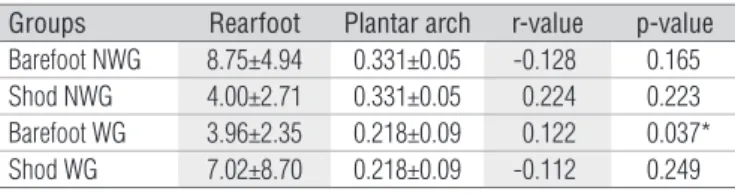
he test for equality of two proportions was used to com-pare the CSI classiication for the groups and showed the percentage of foot type for each group (Table 5). he Spear-man correlation test was used to investigate the correlations between the variables of the rearfoot angle and the plantar arch index. No satisfactory correlation was found between the analyzed variables (Table 6).
Discussion
his study aimed to investigate the relationship between the foot posture and the plantar arch of adolescent wearers and non-wearers of high-heeled shoes. No signiicant correla-tion was found between the foot posture and the plantar arch index. Few studies were found in the literature with a metho-dology similar to the one adopted in this investigation or that correlated foot posture by means of the rearfoot angle and foot impression; nonetheless, one can mention the work developed by Penha et al.26, who were also unable to detect any correlation between these variables when they were analyzed in children.
Rearfoot angle (degrees) Mean Median Standard Deviation CV Q1 Q3 CI p-value
NWG Shod -1.55 -2.60 3.75 -243% -3.60 -1.60 2.04 0.001*
Barefoot 9.45 8.40 5.73 61% 5.90 13.90 3.11
WG Shod -7.38 -5.00 9.33 -126% -8.80 -2.60 4.09 <0.001*
Barefoot 2.76 2.20 3.71 134% 1.35 4.68 1.63
NWG=non-wearer group; WG=wearer group, CV=coefficient of variation, Q1=1st quartile, Q3=3rd quartile and CI=confidence interval.
Table 1. Rearfoot angle for the wearer and non-wearer groups and comparison between barefoot and shod conditions according to the Wilcoxon test.
Rear-foot angle (degrees) Mean Median Standard Deviation CV Q1 Q3 CI p-value
Barefoot NWG 9.45 8.40 5.73 61% 5.90 13.90 3.11 0.003*
WG 2.76 2.20 3.71 134% 1.35 4.68 1.63
Shod NWG -1.55 -2.60 3.75 -243% -3.60 -1.60 2,04 0.009*
WG -7.38 -5.00 9.33 -126% -8.80 -2.60 4,09
NWG=non-wearer group; WG=wearer group, CV=coefficient of variation, Q1=1st quartile, Q3=3rd quartile and CI=confidence interval.
Table 2. Comparison of the rearfoot angle between the non-wearer group versus the wearer group for the barefoot and shod conditions according
to the Mann-Whitney test.
Length (cm) Mean Median Standard Deviation Q1 Q3 CI p-value
Forefoot NWG 8.21 8.20 0.50 8.00 8.60 0.24 0.712
WG 8.17 8.20 0.33 8.05 8.30 0.15
Plantar arch NWG 2.71 2.65 0.48 2.40 3.03 0.23 <0.001*
WG 1.83 2.05 0.79 1.60 2.40 0.35
Heel NWG 4.46 4.50 0.42 4.08 4.73 0.21 0.230
WG 4.61 4.70 0.33 4.38 4.90 0.14
*p<0.05; NWG=non-wearer group; WG=wearer group, CV=coefficient of variation, Q1=1st quartile, Q3=3rd quartile and CI=confidence interval.
he foot posture analysis showed that both the wearers and non-wearers of wedge-heeled platform sandals had a val-gus posture (rearfoot angle) when barefoot. he group of non-wearers had a mean angle of 9.45º, and the group of non-wearers, a mean angle of 2.76º. Such indings are similar to those reported by other researchers, who found values ranging from 0º to 7º valgus in children aged six to 16 years27, and from 5º to 7º in children aged seven to eight years26. here is a physiological val-gus in the barefoot condition for the ankle posture of children and adolescents. However, the wearer group had a signiicantly lower valgus value than the non-wearer group. his suggests that, over time, these wearers applied a compensatory strategy of postural adaptation, placing their feet as close as possible to 0º for the rearfoot angle, which consequently led to a greater
varus value for this group in the shod condition. his may ex-plain the fact that, although both groups signiicantly changed the rearfoot angle after wearing the wedge-heeled platform sandals and assumed a varus position, the wearers showed a greater varus than the non-wearers, with a mean -7.38º for wearers compared to -1.55º for non-wearers.
High-heeled shoes keep the ankle and the foot in a po-sition that causes the extensors and invertors to shorten, which may explain the varus position assumed by the ankle for better stabilization and balance. According to Gastwirth et al.28, high-heeled shoes have a limitation in the subtalar joint pronation, which, these authors claim, may be related to problems afecting the knee, hip, and lumbar spine. he indings put forward by these researchers, alongside those of the present study, corroborate the descriptions given by Snow and Williams7. After studying the pronation angle in women’s shoes of varying heel heights, they found greater rearfoot pronation with low-heeled shoes compared to medium- and high-heeled shoes. According to the same authors, prolonged supination causes laxity of the lateral ligaments of the ankle and foot7, contributing to the instability of this joint11.
The data show that the high-heeled shoe wearers have a narrower plantar arch compared to the non-wearers, which suggests a tendency toward cavus foot and corroborates the study developed by Gastwirth et al.28. Yung-Hui and Wei-Hsien13 stated that, in addition to the changes in the pressure peaks of the sole, the force generated in the initial contact with the ground during gait with high-heeled shoes is transmitted to the skeleton as a shockwave that appears to harm the soft tissues. This in turn may lead to symptoms such as fatigue and pain in the legs, feet and spine, a condi-tion found among high-heel wearers18. Furthermore, these factors may eventually lead to degenerative joint disease13. Although the measurements of the heel width did not reveal any significant differences, Rolf29 reported that the high-he-eled shoe narrows the width of the heel while maintaining the extension of the ankle, thus reducing the participation of the heel in sustaining the body and increasing the partici-pation of the tip of the foot as verified by other authors6-8,12.
Another factor that must be taken into account regarding the changes to the plantar arch is the displacement of the cen-ter of gravity when wearing high-heeled shoes6,7. his accessory afects the body’s center of gravity indirectly and may lead to localized pain in the supporting regions of the feet and to an-talgic posture with postural adaptations, as previously descri-bed by Tokars et al.30. Opila et al.6 concluded that, because the overload is transferred to the forefoot and to the triceps surae, now in a shortened condition, there will be a reduced capacity to develop contractile force. herefore, high heeled shoes may
Indices Chippaux-Smirak Index
NWG WG
Mean 0.33 0.22
Median 0.34 0.26
Standard Deviation 0.06 0.09
1st Quartile 0.30 0.20
3rd Quartile 0.35 0.28
CI 0.03 0.04
p-value <0.001*
*p<0.05; NWG=non-wearer group; WG=wearer group; CI=confidence interval.
Table 4. Foot impression analysis according to the
Chippaux-Smirak index for the plantar arches of the non-wearer and wearer groups according to the Mann-Whitney test.
Classification NWG WG p-value Qty % Qty %
Chippaux - Smirak
Cavus 0 0.0% 2 10.0% 0.193
Intermediate 10 65.6% 1 5.0% <0.001*
Normal 4 25.0% 17 85.0% <0.001*
Lowered 2 12.5% 0 0.0% 0.104
*p<0.05; NWG=non-wearer group; WG=wearer group.
Table 5. Classification of the Chippax-Smirak index for the plantar
arches of the non-wearer and wearer groups according to the test for equality of two proportions.
Groups Rearfoot Plantar arch r-value p-value
Barefoot NWG 8.75±4.94 0.331±0.05 -0.128 0.165
Shod NWG 4.00±2.71 0.331±0.05 0.224 0.223
Barefoot WG 3.96±2.35 0.218±0.09 0.122 0.037*
Shod WG 7.02±8.70 0.218±0.09 -0.112 0.249
*p<0.05; NWG=non-wearer group; WG=wearer group.
Table 6. Correlation between the rearfoot parameters and the arch index
according to the Chippaux-Smirak classification in the non-wearer and wearers groups according to the Spearman correlation test.
play a central role in triggering changes in the plantar arch, as the shortened muscles are vital to the maintenance of the arch as well as ankle and foot posture.
he results also showed a signiicant diference for some of the classiication items for the references of the index used in the present study. Regarding the Chippaux-Smirak index in the wearer group, most of the participants (85 to 90%) had normal feet. In the non-wearer group, however, most parti-cipants had intermediate feet (65.6%), showing that in this age group the feet sufer changes when submitted to the pre-viously mentioned muscle shortening and possible posture disorders caused by prolonged high-heeled shoe wear. his suggests that these shoes could afect the normal develop-ment of the plantar arch.
he data collected in the current study indicate a tendency for wearers of wedge-heeled platform sandals to structure the position of the feet in varus. hey also indicate a narrower plantar arch when compared to the non-wearers, suggesting a tendency toward cavus foot. his study and data in the litera-ture suggest that prolonged high-heeled shoe wear, especially when it starts during the developmental phase, may lead to an inadequate foot alignment and, ultimately, less eiciency in the mechanics of the movement.
With regard to the high variability of the measures as shown in the tables, it is worth noting that it may indicate the inluence of measurement errors on the indings. hus, the presence of measurement errors should be investigated by calculating the standard error of the measure, based on a reliability measure.
Limitations of the study
It must be admitted that possible diferences in the correla-tion could have been evinced if the number of participants had been greater. It must also be considered that high-heeled shoes are present in the apparel of most of the adolescent wearers and non-wearers at some point during the week, even if they have been wearing the shoes for less than one year.
Conclusion
he analysis of the results suggests that there is no corre-lation between the posture of the feet and the type of plantar arch. herefore, it cannot be concluded that adolescents with varus or valgus feet tend to have cavus or lat feet, respectively.
1. Asher. C. Variações de postura na criança. São Paulo: Manole; 1976.
2. Magee DJ. Orthopedic physical assessment. 3ª ed. Philadelphia: WB Saunders Company; 1997.
3. Madeira JS, Frederico BR, Braga ES, Barbosa L. Prevalência de lombalgia em acadêmicos de fisioterapia no ambulatório de um hospital universitário. Fisioter Bras. 2002;3(6):371-6.
4. Grimmer KA, Williams MT, Gill TK. The associations between adolescent head-on-neck posture, backpack weight, and anthropometric features. Spine. 1999;24(21):2262-7.
5. Detsch C, Luz AMH, Candotti CT, Oliveira DS, Lazaron F, Guimarães LK, et al. Prevalência de alterações posturais em escolares do ensino médio em uma cidade no Sul do Brasil. Rev Panam Salud Publica. 2007;21(4):231-8.
6. Opila KA, Wagner SS, Schiowitz S, Chen J. Postural alignment in barefoot and high-heeled stance. Spine.1988;13(5):542-7.
7. Snow RE, Williams KR. High heeled shoes: their effect on center of mass position, posture, three-dimensional kinematics, rearfoot motion and ground reaction forces. Arch Phys Med Rehabil. 1994;75(5): 568-76.
8. Opila-Correia KA. Kinematics of high-heeled gait. Arch Phys Med Rehabil. 1990;71(5):304-9.
9. de Lateur BJ, Giaconi RM, Questad K, Ko M, Lehmann JF. Footwear and posture: Compensatory strategies for heel height. Am J Phys Med Rehabil. 1991;70(5):246-54.
10. Esenyel M, Walsh K, Walden JG, Gitter A. Kinetics of high-heeled gait. J Am Podiatr Med Assoc. 2003;93(1): 27-32.
11. Sacco ICN, Melo MCS, Rojas GB, Naki IK, Burgi K, Silveira LTY, et al. Análise biomecânica e cinesiológica de posturas mediante fotografia digital: estudo de casos. Rev Bras Ciênc Mov. 2003;11(2):25-33.
12. Franklin ME, Chenier TC, Brauninger L, Cook H, Harris S. Effect of positive heel inclination on posture. J Orthop Sports Phys Ther. 1995;21(2):94-9.
13. Yung-Hui L, Wei-Hsien H. Effects of shoes inserts and heel height on foot pressure, impact force, and perceived comfort during walking. Appl Ergon. 2005;36(3):355-62.
14. Mathieson I, Upton D, Prior TD. Examining the validity of selected measures of foot type: a preliminary study. J Am Podiatr Med Ass. 2004;94(3): 275-81.
15. Neumann DA. Kinesiology of the musculoskeletal system: foundations for physical rehabilitation. 1ª ed. St Louis: Mosby; 2002.
16. Vitalle MSS, Tomioka CY, Juliano Y, Amancio OMS. Índice de massa corporal, desenvolvimento puberal e sua relação com a menarca. Rev Assoc Med Bras. 2003;49(4):429-33.
17. Ctenas MLB, Vitolo MR. Crescendo com saúde: o guia de crescimento da criança. São Paulo: Editora e Consultoria em Nutrição; 1999.
18. Rose Jr D. Esporte e atividade física na infância e na adolescência: uma abordagem multidisciplinar. Porto Alegre: Artmed Editora; 2002.
19. Foss ML, Keteyian SJ. Fox: bases fisiológicas do exercício e do esporte. Rio de Janeiro: Guanabara Koogan; 2000.
20. Dahl MT. Limb length discrepancy. Pediatr Clin North Am. 1996;43(4):849-65.
21. Iunes DH, Castro FA, Salgado HS, Moura IC, Oliveira AS, Bevilaqua-Grossi D. Confiabilidade intra e interexaminadores e repetibilidade da avaliação
postural pela fotogrametria. Rev Bras Fisioter. 2005;9(3):327-34.
22. Watson AW, MacDonncha C. A reliable technique for the assessment of posture: assessment criteria for aspects of posture. J Sports Med Phys Fitness. 2000;40(3):260-70.
23. SAPO – Portal do projeto software para avaliação postural. [atualizada em janeiro 2007; acesso em 12 Maio 2007. Disponível em: http://www.sapo. incubadora.fapesp.br/portal
24. Tsung BY, Zhang M, Fan YB, Boone DA. Quantitative comparison of plantar foot shapes under different weight-bearing conditions. J Rehabil Res Dev. 2003;40(6):517-26.
25. Forriol F, Pascual J. Footprint analysis between three and seventeen years of age. Foot Ankle. 1990;11(2):101-4.
26. Penha PJ, Onodera AN, Sacco ICN, João SMA. Correlação entre postura de tornozelo e impressão plantar de crianças de 7 e 8 anos. In Anais do XII Congresso Brasileiro de Biomecânica; 2007; São Pedro SP. p. 683-88.
27. Sobel E, Levitz S, Caselli M, Brentnall Z, Tran M. Natural history of the rearfoot angle: preliminary values in 150 children. Foot Ankle Int. 1999;20(2):119-25.
28. Gastwirth BW, O’Brien TD, Nelson RM, Manger DC, Kindig SA. An electrodynographic study of foot function in shoes of varying heel heights. J Am Podiatr Med Assoc. 1991;81(9):463-72.
29. Rolf IP. A integração das estruturas humanas. São Paulo: Martins Fontes; 1988.
30. Tokars E, Motter AA, Moro ARP, Gomes ZCM. A influência do arco plantar na postura e no conforto dos calçados ocupacionais. Fisioter Bras. 2003;4(3):157-62.