Original article (short paper)
The effects of foot morphology and
anthropometry on unipodal postural control
Angelica C. Alonso
Universidade de São Paulo, São Paulo, SP, Brasil Universidade São Judas Tadeu, São Paulo, SP, Brasil
Mark Peterson
University of Michigan Health System, Ann Arbor, MI, United States.
Márcia R. Duganieri Luiz E. Garcez-Leme
Luis Mochizuki
Universidade de São Paulo, São Paulo, SP, Brasil
Danilo S. Bocalini
Universidade São Judas Tadeu, São Paulo, SP, Brasil
Natalia M. S. Luna Alexandra C. Canonica
Júlia M. D. Greve
Universidade de São Paulo, São Paulo, SP, Brasil
Abstract––The maintenance of posture is a constant challenge for the body, as it requires rapid and accurate responses to unforeseen disturbances, which are needed to prevent falls and maintain balance. The purpose of the present study was to compare different types of plantar arch in relation to postural balance, and analyze the relationships between variations the plantar arch and anthropometric characteristics of the feet with unipedal static balance. We evaluated 100 men and women between the ages of 20 and 40 years old, to determine anthropometry and posturography with a force platform. There was a weak correlation between plantar arches and anthropometric measurements and postural balance, except for the length of the male foot, which showed a correlation between increased size and poorer static balance. We conclude that the type of plantar arch does not inluence postural balance, and of the anthropometric factors, only foot length was related to postural balance.
Keywords: postural balance, anthropometry, plantar arch.
Introduction
Maintaining posture is a constant challenge for the human body, as it requires rapid and accurate responses to unforeseen dis-turbances, particularly in unstable situations, which are needed to prevent falls and maintain balance. Awareness of the body’s position in space is determined by the integration of the visual, vestibular and somatosensorial systems (Alonso et al., 2012; Riemann, Myers, & Lephart, 2003). And the study of postural control is important for diagnosing balance disorders, as well as for assessing the effects of both therapeutic interventions and fall prevention programs (Alonso et al., 2012; Kejonen, Kauranen & Vaharanta, 2003; Molikova et al., 2006). One of the tasks related to postural control is the ability to maintain an upright, erect position (i.e., to maintain the projection of the
center of gravity within a support base deined by the position of the feet).(Alonso, Greve & Camanho, 2009; Alonso et al., 2012)
in individuals with pronated and supinated feet compared with those with neutral feet.
Alonso et al. (2012) and Cote et al. (2005) reported that balance measurements should be controlled in order to avoid errors in analyzing the results, and suggest that anthropometric factors also be included in this type of evaluation. Studies seek-ing normative data for variables that might inluence balance are needed, since there is no consensus regarding the contribution of anthropometric factors on postural balance. Speciically, there have been very few studies which have explored the contribution of anthropometric characteristic of the feet on postural balance. Therefore, the purpose of this study was to compare differ-ent types of plantar arches in relation to postural balance, and analyze the relationship between variations the plantar arches and anthropometric characteristics of the feet with unipedal static balance.
Methods
Participants
One hundred men and women, aged 20-40 years old, who did not practice regular physical activity, were evaluated (n=50 women 26.4±5.1 years old, and n=50 men 28±6.1 years old). All the participants gave their written informed consent to par-ticipate in this study, which was approved by the University of São Paulo Medical School (# 1256/06). The inclusion criteria were: (1) no history of injury or surgery to the lower limbs or trunk; (2) not engaged in regular physical activity over the previous six months, as deined by the International Physical Activity Questionnaire (IPAQ); (3) absence of any disease or functional impairment of the auditory, vestibular, or propriocep-tive systems; and (4) no current use of medications that might affect postural balance.
Procedures
The anthropometric measurements were performed in ac-cordance with the International Society for the Advancement of Kinanthropometry (ISAK) standard (Clarke, 1993). Foot length was measured from the extremity of the heel to the extremity of the hallux. Foot width was measured by the distance from the 1st to the 5th metatarsal, and ankle width was measured as the distance between the medial and lateral malleoli. All the mea-surements were performed by the same evaluator, using a metric tape measure and a pachymeter both from Sanny (Brazil). The evaluation of foot angle was based on the footprint, standing on two legs, with bilateral distribution of load, using a pedigraph. Next, the Clark angle, or alpha angle (angle α) was calculated indirectly, from the footprint made (Figure A). For the measure-ment of alpha angle (α) a straight line was drawn from point
Arch Index was calculated: An angle A’ and feet with angles of between 0 and 29.9° are considered lat; from 30° to 34.9°, as low-arched; from 35° to 41.9°, intermediary, and above 42°, as high-arched.
The balance assessment (posturography) was performed on a portable force platform (AccuSwayPlus, AMTI®, MA, USA). For data acquisition, the force platform was connect-ed to a signal-amplifying interface box (PJB-101) that was linked to a computer by means of an RS-232 cable. The data were gathered and stored using Balance Clinic1 software, conigured to a frequency of 100 Hz with a fourth-order Butterworth ilter and a cutoff frequency of 10 Hz. All sub-jects assumed a unipedal position with the arms suspended
alongside the body and the eyes ixed on a point located at a
distance of one meter. Three measurements were performed for 30 seconds each. The arithmetic means of the results were calculated from the three tests conducted under each condition. The parameters used to measure the subjects’ sta-bility were: root mean square of the displacements from the center of pressure (COP) in the medial-lateral plane (XSD) and anterior-posterior plane (YSD); mean velocity calculated from the total displacement of COP in all directions (VAvg); and elliptical area encompassing 95% of displacement from the COP. (Alonso et al., 2012)
Statistical analysis
The data was stored and analyzed in the SPSS 20.0 software. The Kolmogorov-Smirnov test was used to ascertain whether the continuous variables presented normal distribution. For comparison between different types of plantar arches and static postural balance the Kruskal-Wallis test was used.
Spearman’s correlation coeficient was used to correlate the dependent variables (posturographic parameters) with the independent variables (anthropometric foot characteristics), in the whole population and separated according to gender. An alpha of 5% was used for all statistical tests.
Results
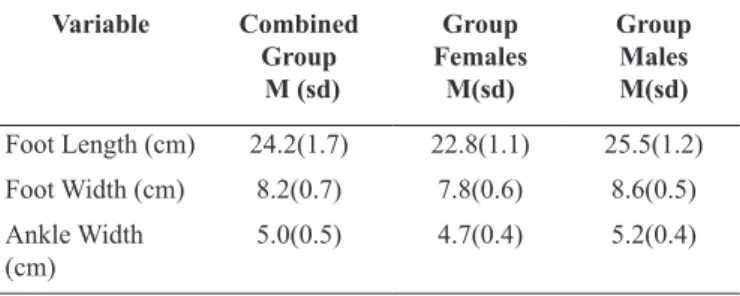
The anthropometric foot characteristics of the volunteers are described in Table 1.
Table 1. Mean and standard deviation of the anthropometric foot characteristics.
Variable Combined
Group M (sd)
Group Females
M(sd)
Group Males M(sd)
The correlation between foot length and foot width was 0.69 (P≤0.001). Of the 100 individuals, 57 had similar feet (i.e., they presented the same type of plantar arch in both feet), with the remaining 43 showing differences in arch between the right and left feet. The distribution of plantar arch types among the volunteers is shown in Table 2.
Table 2. Descriptive analysis of the plantar arches characteristics.
Combined Group
F (%)
Male Group
F (%)
Female Group F (%)
Flat (0 to 29.9°) 24 (12) 3 (3) 20 (20) Low-arch (30° to 34.9°) 40 (20) 1 (1) 40 (40)
Intermediary (35° to 41.9°) 42 (21) 15 (15) 27 (27)
High-arch ( ≥42º ) 94 (47) 81 (81) 13 (13)
Caption: F= frequency; % percentage
In the comparison between variation in plantar arches and static postural balance (stabilometric parameters), no signiicant differences were found (Table 3).
Table 3. Comparative table of the types of plantar arches and the bal-ance data.
Flat Foot
Medi-an
Low-arch Foot Median
Intermedi-ary Foot Median
High-arch Foot Median
p
Medial-lateral sway (cm)
0.43 0.44 0.46 0.47 0.51
Medial-lateral ampl sway (cm)
2.47 2.48 2.50 2.59 0.49
Anterior-posterior sway (cm)
0.65 0.67 0.65 0.62 0.63
Anterior-posterior ampl sway (cm)
3.44 3.52 3.38 3.39 0.93
Sway Velocity (cm/s)
3.04 2.81 3.03 3.1 0.65
Sway Area (cm2) 5.39 5.81 5.56 5.5 0.90
There was a positive correlation only between the length of the legs and postural balance in men who inluenced the results in combined group. On average, individuals with longer feet had greater oscillation in the anterior-posterior and medial-lateral planes, and the area of the combined group (table 4).
Table 4. Correlation between the anthropometric measurements of the foot and balance, N=200 feet.
Angle (°) r(p)
Foot Length (cm) r(p)
Foot width (cm)
Ankle Width (cm)
Combined group
Medial-lateral sway (cm) .77 (.28) .22 (.00)* .08 (.22) .04 (.53)
Medial-lateral ampl sway (cm) .06 (.33) .22 (00)* .09 (.19) .04 (.50)
Anterior-posterior sway (cm) -.06 (.33) .15 (.02)* .02 (.74) .01 (.82)
Anterior-posterior ampl sway (cm) -.04 (.49) .15 (.02)* -.02 (.72) -.02 (.76)
Sway Velocity (cm/s) .12 (.07) .19 (.00)* .02 (.68) .06 (.38)
Sway Area (cm2) .00 (.97) .22 (.00)* .08 (.25) .04 (.55)
Female group
Medial-lateral sway (cm) -.01 (.89) .01 (.88) .02 (.80) -.09 (.37)
Medial-lateral ampl sway (cm) -.03(.70) .06 (.54) .02 (.82) -.08 (.38)
Anterior-posterior sway (cm) -.12 (.21) .08 (.43) .06 (.53) -.12 (.22)
Anterior-posterior ampl sway (cm) -.95 (.35) .09 (.35) -.11 (.25) -.09 (.33)
Sway Velocity (cm/s) .11 (.25) .05 (.56) -.12 (.22) .03 (.75)
Sway Area (cm2) -.12 (.22) .68 (.50) -.25 (.80) -.11 (.25)
Male group
Medial-lateral sway (cm) -.04 (.68) .32 (.00)* .02 (.84) -.06 (.50)
Medial-lateral ampl sway (cm) -.03 (.69) .27 (.00)* .02 (.83) -.06 (.52)
Anterior-posterior sway (cm) -.11 (.24) .29 (.00)* .00 (.94) -.05 (.59)
Anterior-posterior ampl sway (cm) -.10 (.31) .27 (.00)* -.06 (.52) -.08 (.43)
Sway Velocity (cm/s) -.09 (.37) .15 (.13) -.08 (.42) -.18 (.06)
Sway Area (cm2) -.10 (.32) .36 (.00)* .02 (.78) -.01 (.91)
Spearman’s correlation, * p≤0.05
Discussion
Considering that the foot is the base of support in all orthostatic positions, there are several factors related to foot morphology that may inluence balance. However, there have been very few studies to determine the relationship between foot types and balance, and the ones that do exist have failed to include anthropometric characteristics of the feet such as width and length. Clarke (1993) analyzed the angle foot, as this is a simple technique that is well-described in the literature. Moreover, static posturography has also been examined, by Swanenburg, Bruin, Favero, Uebelhart and Mulder (2008), using the center of pressure (COP) oscillation on a force plat-form, and deined as the point of application of the result of the vertical forces acting on the support surface. (Corriveau, Hébert, & Prince, 2000).
Our indings suggest that morphological variation in plan-tar arches seems to have no effect on static balance, which corroborates the data of Cote et al. (2005) and Ferreira et al. (2010). However, in both previous studies, the investigators used other forms of classiications of the foot. Hertel, Gay and Denegar (2002) found that the area of displacement of the COP was higher in individuals with high-arched foot, and Tsai et al. (2006) reported that individuals with pronated and supinated feet showed higher postural oscillation than those with neutral feet. However, these studies did not evaluate the anthropometric measurements of the feet, particularly length, which may have inluenced the results.
In the combined group analysis, greater foot length was associated with higher stabilometric parameters, with the exception of COP speed. Interestingly, when the data were stratiied by gender, these results were found only in the male group. This has been shown in other studies and is likely due to the larger feet among men (Kejonen et al., 2003; Molikova et al., 2006) The higher oscillation of the COP (area and amplitude of displacement) in the male group may have been simply due to a greater surface area of the platform being occupied. This certainly does not necessarily indicate poorer balance and a higher risk for falls, especially given that there was no increase in COP speed. In fact, previous studies by Alonso et al. (2012) and Chou et al. (2009) demonstrated that an increase in the size of the support base can improve the balance.
Although we found a positive correlation between the foot length and the foot width (r=0.69 P≤0.001), neither of these measurements seemed to inluence balance. This contradicts the indings of Chiari, Rocchi & Capello (2002) in which foot width was related to balance. However, that study was conducted by bipedal standing balance task.
The methodological limitations of this study can be attribut-ed to the multifactorial characteristics of balance. The systems used to evaluate vision, labyrinthine activity and the associat-ed neuromotor responses, integratassociat-ed with posturography and
Conclusion
Postural balance was not inluenced by plantar arch type, in-dependent of gender. Related to anthropometric factors only the foot length was inluenced by unipodal static balance in males.
References
Alonso, A.C., Luna, N.M., Mochizuki, L., Barbieri, F., Santos, S., &
Greve, J.M.D.A. (2012). The inluence of anthropometric factors
on postural balance: the relationship between body composition and posturographic measurements in young adults. Clinics, 67(12), 1433-1441. doi:10.6061/clinics/2012(12)14
Alonso, A.C., Greve, J.M.D.A., & Camanho, G.L. (2009). Evaluating the center of gravity of dislocations in soccer players with and without reconstruction of the anterior cruciate ligament us-ing a balance platform. Clinics, 64(3), 163-70. doi: 10.1590/ S1807-59322009000300003
Chiari, L., Rocchi, L., & Capello, A. (2002). Stabilometric parame-ters are affected by anthropometry and foot placement. Clinical Biomechanics, 17, 666–677. doi: http://dx.doi.org/10.1016/ S0268-0033(02)00107-9
Chou, S.W., Cheng, H.K., Chen, J.H., Ju, Y.Y., Lin, Y.C., & Wong,
M.K.A. (2009). The Role of the Great Toe in Balance Performance.
Journal of Orthopaedic Research: Oficial Publication of the
Orthopaedic Research Society, 27(4), 549-54. doi: 10.1002/ jor.20661
Clarke, H.H. (1993). An objective method of measuring the height of
the longitudinal arch in foot examinations. Research Quarterly, 4(3), 99-107. doi:
10.1080/23267402.1933.10626636
Corriveau, H., Hébert, R., & Prince, F. (2000). Intrasession reliability
of the “center of pressure minus center of mass” variable of postural control in the healthy elderly. Archives of Physical Medicine and Rehabilitation, 81(1), 45-48.
Cote, K.P., Brunet, M.E., Gansneder, B.M., & Shultz, S.J. (2005). Effects of pronated and supinated foot postures on static and dynamic postural stability. Journal of Athletic Training, 40(1), 41-46. Retrieved from: http://www.ncbi.nlm.nih.gov/pmc/articles/ PMC1088344/pdf/i1062-6050-40-1-41.pdf
Ferreira, A.S., Gave, N.S., & Silva, A.F.J. (2010). Inluence of feet and knees morphology on balance during bipodal stance. Fisioterapia em Movimento 23(2), 193-200. Retrieved from: http://www.scielo. br/pdf/fm/v23n2/03.pdf
Hertel, J., Gay, M.R., & Denegar, C.R. (2002). Differences in postural
control during single-leg stance among healthy individuals with different foot types. Journal of Athletic Training, 37(2), 129-132. Retrieved from: http://www.ncbi.nlm.nih.gov/pmc/articles/ PMC164334/pdf/attr_37_02_0129.pdf
Kejonen, P., Kauranen, K., & Vaharanta, H. (2003). The relationship
Papers of the Medical Faculty of the University Palacḱ, Olomouc, Czechoslovakia, 150(2), 261-265. Retrieved from: http://mefanet. upol.cz/BP/2006/2/261.pdf
Riemann, B.L., Myers, J.B., & Lephart, S.M. (2003). Comparison of the ankle, knee, hip, and trunk corrective action shown during
single-leg stance on irm, foam, and multiaxial surfaces. Archives of Physical Medicine and Rehabilitation, 84, 90-5. doi: http://dx.doi. org/10.1053/apmr.2003.50004
Swanenburg, J., Bruin, E.D., Favero, K., Uebelhart, D., & Mulder, T. (2008). The reliability of postural balance measures in single and dual tasking in elderly fallers and non-fallers. BMC Musculoskeletal Disorders, 9, 162. doi: 10.1186/1471-2474-9-162
Tsai, L.C., Yu, B., Mercer, V.S., & Gross, M.T. (2006). Comparison of different structural foot types for measures of standing pos-tural control. The Journal of Orthopaedic and Sports Physical Therapy, 36(12), 942-953. Retrieved from: http://www.jospt.org/ doi/pdf/10.2519/jospt.2006.2336
Appendix
Figure A. Parameters to calculate Clarke angle (α).
Authors’ note
Angelica C. Alonso, afil iated with the , Laboratory for the Study of
Movement, Department of Orthopedics and Traumatology, School of Medicine, University of São Paulo, São Paulo, Brazil.
Mark Peterson is afiliated with the Department of Physical Medicine and Rehabilitation, University of Michigan Health System.
Márcia R. Duganieri, Luiz E. Garcez-Leme, Luis Mochizuki, Natalia
M. S. Luna, Alexandra C. Canonica and Júlia M. D. Greve are afil -iated with the , Laboratory for the Study of Movement, Department of Orthopedics and Traumatology, School of Medicine, University of São Paulo, São Paulo, Brazil.
Danilo S. Bocalini is afiliated with the Master’s Program Science on
Aging, University São Judas Tadeu, São Paulo, Brazil.
Corresponding author
Angelica Castilho Alonso
Movement Study Laboratory (LEM). Rua Ovídeo Pires de Campos, 333, Cerqueira Cesar, São Paulo, 05403-010, Brazil.
Email: [email protected]
Manuscript received on October 15, 2015 Manuscript accepted on January 11, 2016
Motriz. The Journal of Physical Education. UNESP. Rio Claro, SP, Brazil