TEMAS LIVRES FREE THEMES
1 Departamento de Odontologia Social e Preventiva, Faculdade de Odontologia, Universidade Federal de Minas Gerais. Av. Antônio Carlos 6627, Pampulha. 31270-901 Belo Horizonte Brasil. alessandratrindademachado @yahoo.com.br
Who did not appear? First dental visit absences in secondary care
in a major Brazilian city: a cross-sectional study
Quem não compareceu? Ausências às primeiras consultas
odontológicas na atenção secundária em um município brasileiro
de grande porte: um estudo transversal
Resumo O estudo teve como objetivo identificar possíveis fatores associados ao não comparecimen-to à primeira consulta agendada em 2011, de usu-ários residentes em Belo Horizonte, Minas Gerais, referenciados, a partir da atenção primária, para diferentes especialidades odontológicas da aten-ção secundária da Secretaria Municipal de Saúde (SMSA). Foi realizado um estudo transversal uti-lizando-se pesquisa em base de dados secundários do Sistema de Regulação da SMSA. A variável dependente foi “não comparecimento” à consulta agendada e as variáveis independentes analisa-das foram: idade, tempo na fila de espera, sexo, distrito sanitário de origem e especialidade para a qual o usuário foi referenciado. Entre as 6.428 primeiras consultas odontológicas agendadas para 2011 nas especialidades selecionadas para análise, 32,9% não foram realizadas em função da ausên-cia do usuário. A partir da análise bivariada foi verificada associação estatisticamente significante entre o não comparecimento do usuário e as cinco variáveis independentes. Adultos jovens, do sexo masculino, residentes em determinados distritos, referenciados para as especialidades de cirurgia e endodontia e que ficaram mais tempo na fila de espera, apresentaram maior frequência de não comparecimentos.
Palavras-chave Serviços de saúde bucal, Mecanismos de avaliação de cuidados em saúde, Atenção secundária
Abstract The study sought to identify possible factors associated with non-attendance at first dental appointments scheduled in 2011 of users living in Belo Horizonte, Minas Gerais, who were referred from primary care to different dental spe-cialties in secondary care within the public health services of the city. A cross-sectional study was conducted based on research in secondary data bases of the public health regulatory system. The dependent variable was “no shows” for scheduled appointments, and the independent variables were age, time on the waiting list, gender, health district, and the specialty to which the individual was referred. Among the 6,428 first dental visits scheduled for 2011 in the specialties selected for analysis, 32.9 % were not performed due to the absence of the user. Bivariate analysis revealed a statistically significant association between non-attendance of the user and the five indepen-dent variables. Young adults, male, and resiindepen-dent in given districts who were referred to the special-ties of surgery and endodontics and who waited longer on the waiting list exhibited a higher fre-quency of no-shows.
Key words Dental health services, Health care evaluation mechanisms, Secondary care
Alessandra Trindade Machado 1 Marcos Azeredo Furquim Werneck 1 Simone Dutra Lucas 1
M
a
c
ha
d
Background
The absence of a user at a scheduled appointment without prior cancellation may be designated as a “no-show”1. One can use the acronym DNA (did
not attend/no-show) to designate such an ab-sence2. The failure of individuals to attend
sched-uled dental appointments has been the subject of various discussions and studies and represents a major challenge to the comprehensiveness of health care. This phenomenon is reported in the context of primary and secondary public dental services, in private practices as well as in institu-tions of higher education3-12. The evaluation of
non-attendance at the first appointment in sec-ondary care is important because it can impact an individual’s access to this level of care, thus compromising the continuity of health care. This problem has been investigated3-12; however,
with-out a distinction between a failure to attend fur-ther appointments and a no-show specifically at the first appointment has not yet been resolved. This phenomenon is not limited to the dental field: other studies indicate high levels of absence in medical specialties as well3,13-26. Even with
dif-ferent health care models, this problem has been reported in different countries4-6,8,10,13,16,17,21,25-28.
Seven attributes of health care define its qual-ity: (1) efficacy: the ability of care, at its best, to improve health; (2) effectiveness: the degree to which attainable health improvements are real-ized; (3) efficiency: the ability to obtain the great-est health improvement at the lowgreat-est cost; (4) optimality: analysis the most advantageous bal-ance between health care costs and its benefits; (5) acceptability: the adaptation of health care to expectations, desires and values of patients and their families; (6) legitimacy: it refers to the ac-ceptability of society in relation to health care offered; (7) equity: attribute that determines dis-tributive justice. Public policies based on quality of care should include efficiency and effectiveness in their framework29, and the of non-attendance
could impact negativelly the health care. Note that efficiency is also referred to as a legal norm, inserted in the Constitution from the Brazilian Constitutional Amendment (EC) n.19/98 with the call Administrative Reform, Reform of Public Management and Managerial State Reform. The application of the principle in dealing with issues and public services is a constitutional duty of the State and of public officials30,31.
Some factors associated with failure to at-tend scheduled medical and dental appoint-ments that have been reported in the literature
include: difficulties associated with transpor-tation5,26, the distance between the unit and the
service user’s residence17,26, the scheduled
ap-pointment time5,18,20, day of the week2,13,24, waiting
time in the queue9,13,14,17,19,21,32, user age4,17,18,20-23,
gender4,9,20-22,26, forgetfulness12,20,28,33, labor
rea-sons5,9,12,22,26,33, illness of themselves or relatives12,33,
socioeconomic status4,5,21,23,26, educational level4,
perception of a lack of need4,22, travel12, prior
warning about the scheduled visit22, and fear of
pain4. The issue of non-attendance impacts the
quality of service, compromises the final results of health care, leads to inefficiency in the utilization of structural capacity, and generates unnecessary costs to the system3,8-10,13,15,17,23,24,34. The
identifica-tion of factors associated with non-attendance may contribute to an optimal use of human and physical resources, continuity of care, and great-er customgreat-er satisfaction in that it can promote access to secondary care. Non-attendance at the first appointment involves postponing access to secondary care because the patient must return to primary care for a new referral.
Thus, this study aimed to identify factors as-sociated with not attending primary dental con-sultations in secondary care in a large Brazilian city.
Methods
A descriptive and analytical cross-sectional study was performed in Belo Horizonte, Brazil in 2011, using secondary data from Local Regulation System of the Brazilian National Health System (SUS).
Study Area: Research Field
The city of Belo Horizonte is the capital of the state of Minas Gerais, which is located in south-east Brazil and has a population of 2,375,151 in-habitants35. It is divided into nine administrative
regions, each represented in the public health system as a health district that belongs to the net-work of health care at the local level. The public health system in Belo Horizonte is composed of 147 primary health care units designed as pref-erential entry points for the population to access health services and secondary and tertiary care services.
aúd
e C
ole
tiv
a,
20(1):289-298,
2015
Specialty Centers (CEO)36,37. Until April 2011,
the city had only one CEO enabled by the Min-istry of Health (Ordinance No. 1.064/GM of July 4, 2005)38: Center-South CEO is located in the
Center-South health district. Center-South CEO involves 41 dentists working in different areas: 14 professionals in endodontics; 6 in periodontics; 7 in prosthodontics; one in temporomandibular dysfunction; two in radiology; one in dentistry for patients with special needs; three in oral sur-gery; five in pediatric dentistry; and two in or-thodontics. Approximately 4,000 consultations per month are offered39.
The flow of referrals to secondary care in-volves an evaluation by a professional in primary care, who, based on municipal clinical proto-cols, fills out a routing request. The consultation is scheduled with software called the National Regulatory System (Sisreg). The individual is referred to secondary care and is inserted in the electronic queue. The schedule for secondary care following this electronic queue. There are quotas for specialist consultations available for each basic health unit. In Belo Horizonte, dental specialties were added to Sisreg in 2006, within routine services40.
Characterization of the universe
Referrals of individuals of both genders that were 18 years of age or older, living in Belo Hori-zonte, and referred by primary care to secondary oral health care of the municipality were includ-ed in this study. We evaluatinclud-ed data from indi-viduals referred to the following specialties: oral surgery, endodontics, periodontics and temporo-mandibular dysfunction. The specialties of pedi-atric dentistry, dentistry for patients with special needs and orthodontics were excluded from the analysis because such individuals require an adult to accompany them to a scheduled appointment, and their appointment thus also depends on this adult in charge. The specialty of radiology was also excluded because it is a diagnostic special-ty. The specialty of prosthodontics was excluded because most individuals are referred there from endodontics and are therefore not referred from primary care. Referrals of individuals with more than one primary care appointment in 2011 were excluded because it would not be possible to as-sess, for example, if double scheduling was indic-ative of the patient’s no-show or if it occurred due to various clinical reasons for that individ-ual. Non-attendances for reasons other than the absence of the patient were not assessed. The data
were supplied by the Sisreg software that belongs to the city of Belo Horizonte.
Study variables
The dependent variable was no-show2 of the
user at the first scheduled secondary care den-tal appointment in the Center-South CEO. The five independent variables were age (stratified by median value), time on the waiting list (stratified by median value in days), gender, health district of origin and the specialty to which the user was referred.
Statistical Methods
Data were managed with Microsoft Access (Microsoft Corporation, USA). For statistical analysis, we used the Statistical Package for So-cial Sciences (IBM SPSS, USA), version 19.0. All tests were conducted with a significance level of 5%. Pearson’s chi-squared test was used to com-pare the dependent variable with the categorical variables (age, time on the waiting list, gender, health district, and specialty). All variables that presented a significance level less than 0.20 in the bivariate analysis were included in the multivar-iate Poisson regression with robust variance. The measure of association was the prevalence ratio (PR) with a confidence interval (CI) of 95%. This was estimated by the multivariate analysis and the Wald test. Values of p < 0.05 were considered to be significant.
Ethical Aspects
The study was submitted to and approved by the Ethics Committee for Human Research of Federal University of Minas Gerais in the city of Belo Horizonte.
Results
M
a
c
ha
d
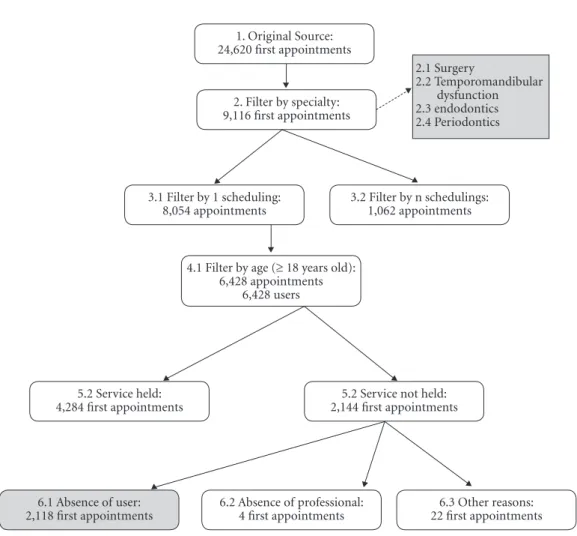
of the professional in charge, and 22 were due to other reasons, which were not specified in the Sis-reg information system. The first consultations that resulted in no service performed due to the absence of the professional or other reasons (n = 26) were excluded because the event of interest is the non-performance of clinical care due to the absence of the individual. Thus, the universe was composed of 6,402 (100%) first consultations of individuals 18 years of age or older who had ei-ther received clinical care (n = 4,284; 66.9%) or had not (n = 2,118; 33.1%) (Figure 1).
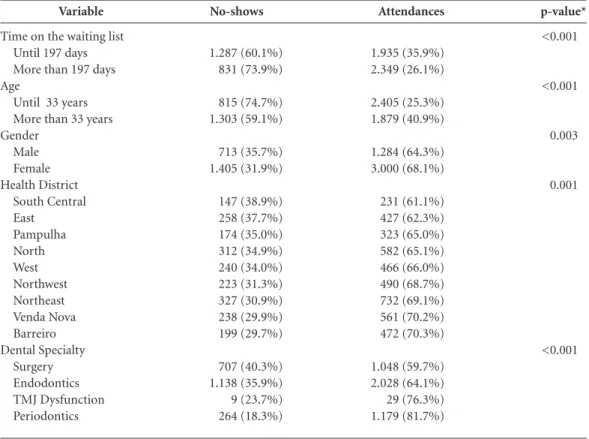
The highest percentage of no-shows to the first appointments occurred in the specialties of dental surgery (40.3%) and endodontics (35.9%) (p < 0.001). Males had a higher percentage of no-shows (35.7%) than females (31.9%) (p = 0.003). The largest percentage of no-shows was from
those referred from South Central (38.90%) and East (37.70%) districts (p = 0.001). Younger in-dividuals had a higher frequency of no-shows (p < 0.001), and the longer individuals spent in a queue, the higher frequency of no-shows (p < 0.001) (Table 1).
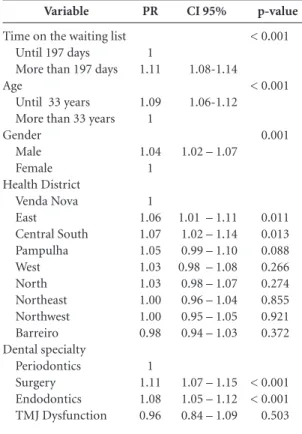
Using a multivariate analysis (Table 2), the variables of time in the queue, age, gender, health district of origin and the specialty to which the user was referred were independently and sig-nificantly associated with non-attendance in the first specialized dental consultation. Male indi-viduals attended appointments less often when compared to females. Individuals from the South Central and East districts showed up less often than those from the Venda Nova district. Individ-uals referred to the specialty of endodontics and oral surgery had significantly higher frequencies
Figure 1. Flow chart of population sample.
1. Original Source: 24,620 first appointments
2. Filter by specialty: 9,116 first appointments
3.1 Filter by 1 scheduling: 8,054 appointments
3.2 Filter by n schedulings: 1,062 appointments
4.1 Filter by age (≥ 18 years old): 6,428 appointments
6,428 users
5.2 Service not held: 2,144 first appointments
6.1 Absence of user: 2,118 first appointments
5.2 Service held: 4,284 first appointments
6.2 Absence of professional: 4 first appointments
6.3 Other reasons: 22 first appointments 2.1 Surgery
2.2 Temporomandibular dysfunction 2.3 endodontics 2.4 Periodontics
aúd
e C
ole
tiv
a,
20(1):289-298,
2015
of non-attendance in relation to those referred to the specialties of periodontics or temporoman-dibular dysfunction. Younger individuals exhib-ited a higher frequency of no-shows, and a higher frequency of absence was observed with a longer time spent in a queue.
Discussion
From this descriptive and analytical cross-sec-tional study, it was determined that the non-at-tendance of individuals to secondary dental care is multifactorial and an important issue for the service organization.
Even though software to assist in the regula-tion of secondary healthcare consultaregula-tions exists in this large city, it was not sufficient to reduce the percentage of no-shows for scheduled dental visits in the recent years. This remained around approximately 30% while the quantification and qualification of factors associated with the prob-lem were ordered by public policies with the aim of finding a solution41,42.
The time on the waiting list, as it related to organizational aspects22, was a factor associated
with no-shows. Some studies showed that the time in the queue is a strong predictor of indi-viduals’ no-shows9,13,14,17,19,21,32. In high-need cases
(perceived by the patient), a long wait for treat-ment in secondary care can lead to a search for alternative solutions, either through private ser-vices or even returning to primary care (e.g., for emergency care).
Although there are municipal protocols for each dental specialty to refer patients to second-ary care, no assurance can be given that these patients will be closely followed by primary care professionals. Additionally, inadequacies can ex-ist in the process of making referrals18,43; for
ex-ample, clinical reasons underlying a need for a referral might best be solved by an individual’s own primary caregiver. Thus, an increase in the effectiveness of primary care 18 and the
appropri-ate referrals18,43 may contribute to a reduction of
time spent in a queue12,28.
The institutionalization of the practices not-ed previously12,18,44, with effective intervention
Variable
Time on the waiting list Until 197 days More than 197 days Age
Until 33 years More than 33 years Gender
Male Female Health District
South Central East
Pampulha North West Northwest Northeast Venda Nova Barreiro Dental Specialty
Surgery Endodontics TMJ Dysfunction Periodontics
Table 1. Bivariate analysis of factors associated with no-shows at first dental appointments in secondary care, Belo Horizonte, Brazil, 2011.
No-shows
1.287 (60.1%) 831 (73.9%)
815 (74.7%) 1.303 (59.1%)
713 (35.7%) 1.405 (31.9%)
147 (38.9%) 258 (37.7%) 174 (35.0%) 312 (34.9%) 240 (34.0%) 223 (31.3%) 327 (30.9%) 238 (29.9%) 199 (29.7%)
707 (40.3%) 1.138 (35.9%) 9 (23.7%) 264 (18.3%)
Attendances
1.935 (35.9%) 2.349 (26.1%)
2.405 (25.3%) 1.879 (40.9%)
1.284 (64.3%) 3.000 (68.1%)
231 (61.1%) 427 (62.3%) 323 (65.0%) 582 (65.1%) 466 (66.0%) 490 (68.7%) 732 (69.1%) 561 (70.2%) 472 (70.3%)
1.048 (59.7%) 2.028 (64.1%) 29 (76.3%) 1.179 (81.7%)
p-value*
<0.001
<0.001
0.003
0.001
<0.001
M
a
c
ha
d
procedures aimed at reducing wait lists or even increasing the number of vacancies, can posi-tively impact the number of appearances for first consultations of secondary care. For example, one can periodically update wait lists by checking for changes in the patient’s address, phone con-tact, death or even the completion of treatment in other services12. No information is available
on whether a patient has been properly informed by a dentist’s primary caregiver about the nature and importance of the specialized treatment to which that patient was referred22; neither was
information available regarding a patient’s per-ceived need to wait in a non-physical queue or to cancel appointments in cases in which the pa-tient no-showed or opted for private service.
In endodontics, one possible explanation for the large number of no-shows could be that pa-tient perception of a delay in obtaining specialist treatment led to a search for endodontic treat-ment in the private sector or even to extraction of the tooth (especially in cases involving pain,
which would make a specialized consultation un-necessary). If the patient were to proceed in this way and not cancel the scheduled appointment, his absence will be recorded as a no-show2.
How-ever, it is possible that no-shows in dental surgery could be associated with a fear of generating ab-sences at work or an inability to perform produc-tive activity at work due to a possible need to rest after a procedure. Another hypothesis is that no-shows could be related to subjective perceptions, such as fear or phobias of an invasive treatment or harm associated with surgery44.
A significant association was determined be-tween the no-shows and the age of the individu-als, as the frequency was higher among younger adults, which is in accordance with previous re-sults reported in the literature4,17-23. One possible
explanation for no-shows in this group could be labor reasons5,9,12,22,26,33 related to economically
active age groups, making the attendance at sec-ondary care more difficult. In addition, there is the possible resistance of employers to accept dental treatment certificates as allowances of absence from work12. A possible solution would
be to offer alternative care shifts that could serve people who are unable to receive care during business hours.
There was an association between the no-shows and the gender of the user, which was sig-nificantly higher among men9,21,22. This may be
related to the distribution of males and females in the labor market, with more men working in the formal market, which might hinder their atten-dance at scheduled appointments that have been assigned by the secondary care service according to availability. According to the International Labor Organization, there is a disproportion-ate concentration of women in part-time work and informal jobs compared to men; women’s access can be limited to certain jobs because of their reproductive roles or because they assume the main responsibility for the care of children or dependents45. The greater integration of women
in the informal market (compared to men) may contribute to increased opportunities for attend-ing medical appointments.
Studies have shown that women utilize more health services than men46,47. Indeed, in this
study, there was a significantly higher number of females that attended first-time appointments in secondary care (n = 4,405) compared to males (n = 1,997). This may mean that more women were treated in primary care and referred to second-ary care. The larger turnout among women could also be attributed to differences in perceived need
Variable
Time on the waiting list Until 197 days More than 197 days Age
Until 33 years More than 33 years Gender Male Female Health District Venda Nova East Central South Pampulha West North Northeast Northwest Barreiro Dental specialty Periodontics Surgery Endodontics TMJ Dysfunction
Table 2. Multivariate analysis of factors associated with no-shows at first dental appointments in secondary care, Belo Horizonte, Brazil, 2011.
PR 1 1.11 1.09 1 1.04 1 1 1.06 1.07 1.05 1.03 1.03 1.00 1.00 0.98 1 1.11 1.08 0.96 CI 95% 1.08-1.14 1.06-1.12
1.02 – 1.07
1.01 – 1.11 1.02 – 1.14 0.99 – 1.10 0.98 – 1.08 0.98 – 1.07 0.96 – 1.04 0.95 – 1.05 0.94 – 1.03
1.07 – 1.15 1.05 – 1.12 0.84 – 1.09
aúd
e C
ole
tiv
a,
20(1):289-298,
2015
between the genders and a possibly higher value placed on health by women. Although there is no consensus in the literature, studies have indicat-ed a greater association of consultation no-shows among females4,26. This discrepancy may be due
to different methodologies or even the socio-cul-tural characteristics of the population, as ob-served in studies conducted in the United Arab Emirates4 and Saudi Arabia26.
A lower percentage of attendance was found for consultations among individuals of the Cen-tral-South health district, where the CenCen-tral-South CEO. Therefore, in this case we cannot relate the absence of individuals with the geographic dis-tance of the specialized care unit. Previous stud-ies have identified an association between non-at-tendance and low socioeconomic status, and the Central-South health district is marked by strong social inequalities4,5,21,23,26. Because there is no data
on the socioeconomic status of each individual studied, it is difficult to evaluate this association. Moreover, despite the existence of the protocols mentioned for referring users to secondary care, organizational characteristics of health centers belonging to different health districts should be considered because these could determine the percentage of no-shows. These aspects deserve further investigation to achieve a better under-standing of the phenomenon.
In addition to the economic impacts to the health care system3,9,10,13,15,17,23,24,34,
non-atten-dance at the first specialized dental appointments also implies a delay in an individual’s access to secondary care in this large city because they will need to return to primary care to be re-examined by the general dentist before another referral is made, which returns individuals to the waiting list again. The discontinuity of secondary care dental treatment can compromise the compre-hensiveness of care, in relation to the interface between primary and secondary care48, and can
impact care outcomes15,17-23. The user may even
return to primary care as an emergency case, thus overloading the primary care practitioners.
We worked with secondary data, which were restricted the listed variables and were not suf-ficient to discuss all possible obstacles to the non-attendance of the individuals to primary dental consultations in secondary care. An avail-able database for subsequent analysis should in-clude other variables, such as the socioeconomic status of the user, her/his schooling level, and her/his occupation at the time of scheduling, as well as an updated registration form with an ad-dress and telephone number.
It is not possible to confirm whether individu-als have been warned about a scheduled appoint-ment in a timely manner so that they might plan for attendance22 and reschedule previous
com-mitments if necessary. Moreover, it is not known whether addresses and telephone numbers in the database were updated for the primary contact. In this were the case, an absence of a consultation in secondary care could be due to an inability to make contact, as opposed to a deliberate absence. Furthermore, the nature of this study did not allow for the verification of whether a non-at-tendance was due to a perceived need by the in-dividual4,22 or due to limited information about
their own health needs. It is not known whether an individual was duly informed by the dentist as to the primary reason for the referral or about the features and importance of the required spe-cialized treatment. It is also not known whether individuals were informed about the importance of communicating to the secondary care provid-er in a timely mannprovid-er in the event of cancellation so that another appointment could be scheduled.
In an effort to reduce no-show consulta-tions and to achieve better utilization of capac-ity, several proposals have been presented in the literature, including models developed from secondary data that can be used as predictors of no-shows by managers17 and reminder systems19.
Furthermore, in order to circumvent profes-sional idleness and inefficient utilization of the capacity generated by a patient’s non-attendance at scheduled appointments, mechanisms such as overbooking can be implemented. There are studies that have aimed to improve overbooking techniques, based on sophisticated mathematical model propositions34. However, it is important
that the pursuit of efficiency in dealing with pub-lic assets does not confpub-lict with the humanization of care, which can occur when individuals who are overbooked attend an appointment but fail to obtain the care they need.
Bearing in mind the continental character of Brazil, these results cannot be extrapolated to the rest of the country. However, in addition to working with a reliable database, our study used a representative sample on the topic, including different specialties in a large municipality. Fur-thermore, we analyzed the non-attendance spe-cifically at first consultations, which did not oc-cur in the studies reported previously1,3-6,8-10,13-21.
M
a
c
ha
d
for providers to develop mechanisms to provide other opportunities for these individuals to con-tinue treatment. Thus, the associations identified in this study should be considered in the plan-ning of public health services.
The preparation of consistent proposals for interventions that aim to tackle this problem re-quires in-depth knowledge. Issues pertaining to the subjectivity of an individual may result in concealing complexities, which could substanti-ate and justify the use of a qualitative approach. In addition, an evaluation of this phenomenon
from the perspective of different social partici-pants in health services may also be valuable.
Conclusions
A high proportion of young adults and males that lived in one of the studied regions in Belo Horizonte who had been referred to surgery and endodontic specialists and who waited in queues for long periods of time exhibited a higher fre-quency of no-shows at first scheduled dental ap-pointments in secondary care.
Collaborations
AT Machado participated in the conception and study design, data collection and analysis, the in-terpretation, and the organization of the article. MAF Werneck participated in the data analysis and in the organization of the paper. SD Lucas participated in the conception and study design and in the organization of the paper. MHNG Abreu conceived and coordinated the study and participated in data collection and analysis, in-terpretation, the writing of the article. All authors read and approved the final manuscript.
Acknowledgements
aúd e C ole tiv a, 20(1):289-298, 2015
Lee VJ, Earnest A, Chen MA, Krishnan B. Predictors of failed attendances in a multi-specialty outpatient centre using electronic databases. BMC Health Serv Res [serial on the Internet] 2005 August [cited 2012 Jan 18]; 5(51):[about 8p.]. Avaiable from: http://www. biomedcentral.com/content/pdf/1472-6963-5-51.pdf Moore CG, Wilson-Witherspoon P, Probst JC. Time and money: Effects of no-shows at a family practice residency clinic. Fam Med 2001; 33(7):522-527. Parikh A, Gupta K, Wilson AC, Fields K, Cosgrove NM, Kostis JB. The effectiveness of outpatient appointment reminder systems in reducing no-show rates. Am J Med
2010; 123(6):542-548.
Neal RD, Hussain-Gambles M, Allgar VL, Lawlor DA, Dempsey O. Reasons for and consequences of missed appointments in general practice in the UK: question-naire survey and prospective review of medical records.
BMC Fam Pract [serial on the Internet] 2005 November [cited 2013 Jan 12]; 6(47):[about 6p.]. Avaiable from: http://www.biomedcentral.com/content/pdf/1471-2296-6-47.pdf
Sharp DJ, Hamilton W. Non-attendance at gener-al practices and outpatient clinics: Locgener-al systems are needed to address local problems. BMJ 2001; 323(7321):1081-1082.
Frankel S, Farrow A, West R. Non-attendance or non-invitation? A case-control study of failed outpa-tient appointments. BMJ 1989; 298(6684):1343-1345. Waller J, Hodgking P. Defaulters in general practice: who are they and what can be do about them? Fam Pract 2000; 17(3):252-253.
George A, Rubin G. Non-attendance in general prac-tice: a systematic review and its implications for access to primary health care.Fam Pract 2003; 20(2):178-184. Bickler CB. Defaulted appointments in general prac-tice. J R Coll Gen Pract 1985; 35(270):19-22. Alhamad Z. Reason for missing appointments in gen-eral clinics of primary health care center in Riyadh Mil-itary Hospital, Saudi Arabia. Int J Med Sci Public Health
2013; 2(2):258-267.
Wogelius P, Poulsen S. Associations between dental anxiety, dental treatment due to toothache, and missed dental appointments among six to eight-year-old Danish children: a cross-sectional study. Acta Odontol Scand 2005; 63(3):179-182.
Skaret E, Raadal M, Kvale G, Berg E. Factors related to missed and cancelled dental appointments among ado-lescents in Norway. Eur J Oral Sci 2000; 108(3):175-183. Donabedian A. Seven pilars of quality. Arch Pathol Lab Med 1990; 114(11):1115-1118.
Meirelles HL. Brazilian Administrative Law. 26ª ed. São Paulo: Malheiros; 2003.
Moraes GO. Jurisdictional Control of the Public Admin-istration. 2ª ed. São Paulo: Dialética; 1999.
Lacy N, Paulman A, Teuter M, Lovejoy, B. Why we don’t come: patient perceptions on no-shows. Ann Fam Med
2004; 2(6):541-545.
Murdock A, Rodgers C, Lindsay H, Tham TCK. Why do patients not keep their appointments? Prospective study in a gastroenterology outpatient clinic. J R Soc Med 2002; 95(2):284-286.
17. 18. 19. 20. 21. 22. 23. 24. 25. 26. 27. 28. 29. 30. 31. 32. 33. References
Tuso PJ, Murtishaw K, Tadros W. The easy access pro-gram: A way to reduce patient no-show rate, decrease add-ons to primary care schedules, and improve pa-tient satisfaction. Perm J 1999;3(3):68-71.
Ellis DA, Jenkins R. Weekday affects attendance rate for medical appointments: large-scale data analysis and implications.PLoS ONE [serial on the Internet]. 2012 [cited 2013 Jan 15]; 7(12):[about 9 p.]. Avaiable from: http://www.ncbi.nlm.nih.gov/pmc/articles/PMC35 21765/
Schmalzried HD, Liszak J. A model program to reduce patient failure to keep scheduled medical appoint-ments. J Community Health 2012;37(3):715-718. Ismail AI, Saeed MH, Al-Silwadi FM. Missed dental appointments in the United Arab Emirates. J Int Dent Med Res 2011; 4(3):132-138.
Albarakati S. Appointments failure among female pa-tients at a dental school clinic in Saudi Arabia. J Dent Edu 2009; 73(9):1118-1124.
Rood HD, Stern MR. Failed attendances at hospital dental clinics among young patients with cleft lip and palate. Cleft Palate Craniofac J 2007; 44(1):92-94. Wang NJ, Aspelung GO. Children who break dental ap-pointments. Eur Arch PaediatrDent 2009; 10(1):11-14. Almog DM, Devries JA, Borrelli JA, Kopycka-Kedzier-awski DT. The reduction of broken appointment rates through an automated appointment confirmation sys-tem. J Dent Educ 2003; 67(9):1016-1022.
Awartani F. Broken appointment behavior in a dental school environment. J Cont Dent Pract 2003; 4(4):100-107.
George A, Hoshing A, Joshi N. A study of the reasons for irregular dental attendance in a private dental col-lege in a rural setup. Indian J Dent Res 2007; 18(2):78-81.
Bender AS, Molina LR, Mello ALS. Absenteeism in sec-ondary care and its implications for primary care. Rev Espaço para a Saúde 2010; 11(2):56-65.
Zaitter WM , Silva M, Biazevic MG, Michel-Crosato E, Pizzatto E. Evaluation of patient access to medical spe-cialty of Endodontics in two health units in the city of Curitiba (PR). RSBO 2009; 6(4):414-421.
Norris J, Kumar C, Chand J, Moskowitz H, Shade S, Willis DR. An empirical investigation into factors af-fecting patient cancellations and no-shows at outpa-tient clinics. Decision Support Systems [serial on the In-ternet] 2012 [cited 2013 Jan 29];[about 16 p.]. Avaiable from: http://www.sciencedirect.com/science/article/pii /S0167923612003235
M
a
c
ha
d
LaGanga LR, Lawrence SR. Clinic overbooking to im-prove patient access and increase provider productivity. DSJ 2007; 38(2):251-276.
Brazilian Institute of Geography and Statistics (IBGE).
Cities. Brasil: IBGE; 2010. [cited 2012 Feb 23]. Available from: http://www.ibge.gov.br/cidadesat/topwindow.ht m?1
Brasil. Ministry of Health (MS). National Coordina-tion of Oral Health. Departament of Primary Care.
Guidelines of the National Oral Health. Brasília: MS; 2004 [cited 2011 Mar 28];[about16p.]. Avaiable from: http://portal.saude.gov.br/portal/arquivos/pdf/politica _nacional_brasil_sorridente.pdf
Roncalli AG. Epidemiologia e saúde bucal coletiva: um caminhar compartilhado. Cien Saude Colet 2006; 11(11):105-114.
Brasil. Ministry of Health (MS). Ordinance No. 1.064/ GM of July 4, 2005. Habilita Centros de Especiali-dades Odontológicas - CEO a receberem os incenti-vos financeiros destinados à implantação e ao custeio dos serviços especializados de saúde bucal e dá outras providências. Diário Oficial da União 2005; 5 Jul. Municipal Health Secretary of Belo Horizonte (SMSA/ BH). Management Report 2010. Belo Horizonte: SMSA; 2011.
Brasil. Ministry of Health (MS). National Regulation System (Sisreg). Brasília: MS; 2013 [cited 2012 Oct 22]. Avaiable from: http://portal.saude.gov.br/portal/saude/ profissional/visualizar_texto.cfm?idtxt = 36608& Municipal Health Secretary of Belo Horizonte (SMSA/ BH). Municipal Health Plan in Belo Horizonte 2005-2008. Belo Horizonte: SMSA; 2005 [cited 2011 Jan 10]. Avaiable from: http://www.enf.ufmg.br/internatorural/ textos/manuais/planomunicipaldesaude20052008.pdf.
Municipal Health Secretary of Belo Horizonte (SMSA/ BH). Municipal Health Plan in Belo Horizonte 2010-2013. Belo Horizonte: SMSA; 2010 [cited 2011 Jan19]. Avaiable from: http://portalpbh.pbh.gov.br/pbh/ecp/ files.do?evento = download
Davies RF. Waiting lists for health care: a necessary evil?
CMAJ 1999; 160(10):1469-1470.
Mc Neil DW, Berryman ML. Components of dental fear in adults? Behav Res Ther 1989; 27(3):233-236. International Labour Office (ILO). Freedom of asso-ciation in practice: lessons learned. Geneva: ILO; 2008. [cited 2011 Feb 13]. Avaiable from: http://www.ilo.org/ declaration/lang--en/index.htm
Pinheiro RS, Viacava F, Travassos C, Brito, AS. Gender, morbidity, access and utilization of health services in Brazil. Cien Saude Colet 2002; 7(4):687-707.
Macintyre S, Ford G, Hund K. Do women “overreport” morbidity? Men’s and women’s responses to structured prompting on a standard question on long standing ill-ness. Soc Sci Med 1999; 48(1):89-98.
Morris AJ, Burke FJT. Primary and secondary den-tal care: how ideal is the interface?Br Dent J 2001; 191(12):666-670.
Artigo apresentado em 07/03/2014 Aprovado em 23/05/2014
Versão final apresentada em 25/05/2014 34.
35.
36.
37.
38.
39.
40.
41.
42.
43. 44. 45.
46.
47.