FREE THEMES
1 Departamento de Odontologia Social e Preventiva, Faculdade de Odontologia, Universidade Federal de Minas Gerais. Av. Antônio Carlos 6627, Pampulha. 31270-901 Belo Horizonte MG Brasil. [email protected]
Availability of hospital dental care services under sedation
or general anesthesia for individuals with special needs
in the Unified Health System for the State of Minas Gerais
(SUS-MG), Brazil
Abstract This study identified the demographic characteristics of individuals and dental treat-ment care under sedation/general anesthesia in a hospital environment in the Unified Health Sys-tem in the State of Minas Gerais (SUS-MG). All Hospitalization Authorizations (AIHs) for Dental Treatment for Patients with Special Needs proce-dures were evaluated between July 2011 and June 2012. Demographic and health care variables for treatment were also assessed. Hospitalization rates per 10,000 inhabitants, and health care cov-erage provided in the state of Minas Gerais and in each of the Broader Health Regions were calculat-ed. Descriptive analysis of data was carried out by calculating the central trend and variability fre-quency and measurements. All 1,063 AIHs paid during the study period were evaluated, which is equivalent to a rate of 0.54 hospitalizations per 10,000 individuals. The majority of the patients were adult, male, diagnosed with mental or be-havioral disorders and resident in 27.7% of the municipalities in Minas Gerais. The procedures were performed in 39 municipalities and the care coverage was equal to 1.58%. The study reveals a classic demographic and clinical profile of patient attendance. Difficulties in establishing a network of dental care were identified.
Key words Dental care for the disabled, Hospital
information systems, Public health
Jacqueline Silva Santos 1
Déborah Andrade Valle 1
Andréa Clemente Palmier 1
João Henrique Lara do Amaral 1
S
ant
Introduction
People with special needs (PSN) may be at a higher risk for developing oral diseases when they present with difficulties related to their oral hygiene and chewing, eat soft and/or carbohy-drate-rich foods, take sugary medications or xe-rostomia-inducing drugs, or have limited access
to dental services1-3. Dental care for these groups
may also be difficult because of the limitations presented by PSNs or by the professional in the oral health care team, resulting in dental treat-ment under general anesthesia or sedation in a
hospital setting4. The indications for the
provi-sion of dental treatment under general anesthesia or sedation can be medical, mental or psycholog-ical, including intellectual deficiency, physical limitations, mobility problems, behavioral
disor-ders and chronic diseases5-8.
In Brazil, efforts have been made in recent decades to organize actions toward oral health services for PSNs, from primary care to hospi-tal-based sedation and general anesthesia, thus
strengthening the Política Nacional de Saúde da
Pessoa com Deficiência (National Health Policy
for People with Disability)9-14. In 2010, the
Min-istry of Health created a health program known as Tratamento Odontológico para Pacientes com Necessidades Especiais (Dental Treatment for Pa-tients with Special Needs), which was included in the list of procedures offered by the Brazilian
Unified Health System (SUS – Serviço Único de
Saúde) and incorporates sedation and/or
anes-thesia in the hospital environment12. In 2012,
the State of Minas Gerais organized their hospi-tal system to include an oral health care network (Rede de Atenção à Saúde Bucal) aimed at extend-ing the guarantee of integral care to PSNs. Such a network functions under the premise that the number of referrals for dental treatment under general anesthesia or sedation is inversely propor-tional to the level of organization of primary care, and those referrals must only be made in specific
cases5,15,16. The Oral Health Care Network of the
State of Minas Gerais was developed according to
the Plan of Guidance for Regionalization (Plano
Diretor de Regionalização, PDR-MG), which con-sists of 853 municipalities in 77 Health Regions. These regions are part of 13 Wide Health Regions.
Each of the latter has 1 to 3 municipalities as their
headquarters17. Dental treatment under sedation
and/or general anesthesia in hospitals for PSNs should be provided at one of the 19 headquarters
in the State16. This procedure is defined,
accord-ing to the unified table from the Management System for the Table of Procedures, Medication &
Othesis, Prosthesis and Materials of SUS (
Siste-ma de Gerenciamento da Tabela de Procedimen-tos, Medicamentos e Órtese, Prótese e Materiais do
SUS - SIGTAP)18, as dental services performed at
a hospital under sedation or general anesthesia on patients with one or more temporary or perma-nent limitations of intellectual, physical, sensorial or emotional origin that prevent them from re-ceiving conventional dental treatment.
This approach is characterized as the main procedure that generates an Authorization for Hospital Admission (AHA) from the Brazilian Code of Occupation (BCO) for dental surgeons. It also features a complementary attribute, which includes the value of the anesthetic, and is com-patible with secondary dental procedures (from the list of primary care services) and special procedures (from the list of services of medium complexity/specialized care), which, once
com-pleted, will generate remuneration19.
Regarding the organization of the oral health care network, the use of hospital dental services under sedation and/or general anesthesia by SUS-MG on PSNs must be described and as-sessed to collaborate toward managing decision making. The assessment of health includes an ex-amination of the following dimensions: structure (resources and organization), process (services
or goods produced) and results20. Health
e C
ole
tiv
a,
20(2):515-524,
2015
Methods
This was a descriptive quantitative study us-ing secondary data from AHAs, State of Minas Gerais, registered as ‘payment settled’. The latter referred to the completion of dental treatment in PSNs from June 2011 to July 2012.
The State of Minas Gerais (MG), located in the Southeastern Region of Brazil, is the second most populated state, with the third largest Gross Domestic Product in the country. The estimated population of MG in 2013 was 20,593,356 inhab-itants, living in 853 municipalities.
The Hospital Information System-SUS (SIH/ SUS), National Registration System for Health Establishments (SCNES) and Health Secretariat for the State of Minas Gerais (SES-MG) databas-es were consulted.
In February 2013, using the SIH/SUS and SES-MG databases, an audit was performed on the number of AHAs with payment settled in MG for completed dental treatment from June 2011 to July 2012, according to the municipality where the admission occurred. The information from both databases was subsequently compared to check for diverging information regarding paid AHAs. The database was then exported to SPSS for Windows v.19.0 to be rechecked for pos-sible mismatches, which, if present, were correct-ed using information from the SES-MG. The lat-ter was chosen due to the availability of detailed information regarding each AHA entry.
All of the settled AHAs registered in the SES-MG database were analyzed. The variables inves-tigated were as follows: month and year of pro-cedure, gender, age (years), age group (children: up to 9 years old, adolescents: 10 to 19 years old, adults: 20 to 59 years old, elderly: 60 years or older), principal diagnosis (International Classi-fication of Diseases – ICD), patient’s municipal-ity of residence, municipalmunicipal-ity where the hospital procedure was performed (Center, South-cen-tral, Jequitinhonha, East, East-south, Northeast, Northwest, North, West, Southeast, South, North-ern Triangle, SouthNorth-ern Triangle), hospital ward (surgery, medicine, pediatrics, day hospital), rea-son for admission (elective, urgency/emergency), procedure performed (SIA/SUS table), Brazilian Code of Occupation (BCO) of the dental surgeon performing the procedures, number of days in hospital for the patient, and patient’s chaperone.
The admission rates were calculated per 10,000 inhabitants for the State of MG and for each of the Wide Health Regions, using the
popu-lation numbers obtained from PDR-MG/201117.
The service coverage for the State of MG and each of the Wide Health Regions was estimated by dividing the number of AHAs by the estimat-ed number of PSNs in neestimat-ed of dental treatment
under sedation and/or general anesthesia21-23.
Ac-cording to IBGE21 and the Ministry of Health22,
6.7% of the population may require special needs dental treatment. Among those, 5% may need hospital treatment under sedation and/or
gener-al anesthesia23, indicating that 0.34% of the
gen-eral population may require this management approach.
Descriptive analysis of the variables of inter-est was calculated in terms of frequency, mea-sures of central tendency and variability. No confidence intervals were performed because the study population was analyzed as a census.
This study was approved by the Research Ethics Committee of the Universidade Federal de Minas Gerais.
Results
All 1,063 settled AHAs in the studied period were assessed. The percentage of AHAs in the months evaluated in 2012 was 50.2%. Regarding all of the months studied, the lowest number of settled AHA was 67, and the highest was 108.
The mean age was 28.5 (± 18.2) years, ranging
from zero to 90 years. The first, second and third age quartiles were 15, 25 and 39 years, respective-ly. The percentage of children, adolescents, adults and elderly people treated were 15.0%, 21.4%, 56.0% and 7.6%, respectively, most of whom were female (61.0%).
defor-S
ant
mities and chromosomal anomalies (1.0%), neo-plasms (0.8%), diseases of the circulatory system (0.8%), diseases of the blood and hematopoietic organs, as well as some immunological disorders (0.4%), endocrine and metabolic diseases (0.4%) and diseases of the digestive system (0.2%).
The patients were from 236 municipalities of MG, which corresponds to 27.7% of the to-tal number of municipalities in that State, with 2 patients from Três Rios in the State of Rio de Janeiro.
Of the 853 municipalities in MG, 39 (4.6%) performed the procedures, of which 16 (41.0%) were Wide Health Region headquarters, and 14 (35.9%) offered the service only to patients resid-ing in the same municipality. In the latter group, 43 hospitals performed the procedures.
Regarding the type of hospital ward, the high-est frequencies were related to surgery (72.7%) and day hospital (12.6%) wards. Urgent admis-sions comprised 59.9% of the AHAs. Practically all of the events (98.6%) were performed outside of the ITU.
In addition to the procedure “Dental Treat-ment for PSNs”, which was present in 100% of the AHAs, a detailed entry for the provision of other specific dental procedures was observed in 544 (51.2%) AHAs. From the total entries for Dental Treatment for PSNs with a BCO for dental
surgeons (N = 1,200), 71.4% were general dental practitioners. Other dental specialties, includ-ing surgery and maxillofacial trauma (21.3%), special care dentistry (2.4%), periodontology (1.6%), geriatric dentistry (1.4%), endodon-tics (1.3%) and dental radiology and imaging (0.5%), also provided services.
In most AHAs (94.1%), a single-day stay was registered per patient. The highest number of days in the hospital was 33 (n = 1). In 76.0% of the AHAs, no stays were registered for chaper-ones, while 22.4% registered a one-day stay. The highest number of days registered for a chaper-one was 26 days (n = 1).
Table 1 shows the variation in the frequency of municipalities, resident population and num-ber of hospital-based dental treatments under sedation or general anesthesia for PSNs in the different Wide Health Regions.
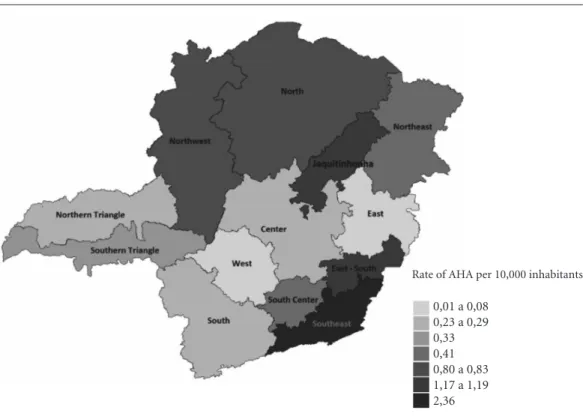
The admission rate per 10,000 inhabitants of the State of Minas Gerais was 0.54. Figure 1 shows the rates per Wide Health Region.
Table 2 shows the population estimate of PSNs who can request hospital-based dental treatment under sedation and/or general anes-thesia, as well as the service coverage per Wide Health Region in MG. The service coverage during the period and location (MG) analyzed was 1.58%.
Wide Health Region
Center South center Jequitinhonha East
East-South Northeast Norwest North West Southeast South
Northern Triangle Southern Triangle
Total
Number of municipalities
103 (12.1%) 50 (5.9%) 29 (3.4%) 86 (10.1%) 53 (6.2%) 57 (6.7%) 33 (3.9%) 86 (10.1%) 55 (6.4%) 94 (11.0%) 153 (17.9%) 27 (3.2%) 27 (3.2%)
853 (100%)
Table 1. Number of municipalities, population and number of hospital-based dental treatments under sedation
and/or general anesthesia per person with special needs, according to Wide Health Regions, Minas Gerais, between July 2011 and June 2012.
Population
6,145,218 (31.1%) 727,516 (3.7%) 374,199 (1.9%) 1,458,884 (7.4%) 667,926 (3.4%) 811,856 (4.1%) 657,378 (3.3%) 1,585,946 (8.0%) 1,201,980 (6.1%) 1,575,629 (8.0%) 2,625,589 (13.3%) 1,190,043 (6.0%) 706,088 (3.6%)
19,728,252 (100%)
Number of procedures (%)
179 (16.8%) 30 (2.8%) 44 (4.1%) 2 (0.2%) 80 (7.5%) 34 (3.2%) 53 (5.0%) 132 (12.4%) 10 (0.9%) 373 (35.1%) 74 (7.0%) 28 (2.6%) 24 (2.3%)
1,063 (100%)
e C
ole
tiv
a,
20(2):515-524,
2015
Wide Health Region
Center South center Jequitinhonha East
East-South Northeast Norwest North West Southeast South
Northern Triangle Southern Triangle
Total
Estimated
Population*
20,894 2,474 1,272 4,960 2,271 2,760 2,235 5,392 4,087 5,357 8,927 4,046 2,401
67,076
Table 2. Estimated Population of PSNs that can request hospital-based dental treatment under sedation
and/or general anesthesia and coverage under the Wide Health Region, Minas Gerais, from July 2011 to June 2012.
Number of AHA
179 30 44
2 80 34 53 132 10 373 74 28 24
1,063
Service coverage (%)
0.86 1.21 3.46 0.04 3.52 1.23 2.37 2.45 0.24 6.96 0.83 0.69 1.00
1.58
* Estimation of people with special needs who can request dental treatment under sedation and/or general anesthesia (= 0.34% of the general population).
Source: SES-MG, PDR-MG/2011.
Figure 1. Admission rate/10,000 inhabitants, per Wide Health Region.
Source: SES-MG, PDR-MG/2011 database.
Rate of AHA per 10,000 inhabitants
S
ant
Discussion
Assistance was provided mostly to adult males, originating from all of the regions of MG, with a diagnosis of mental illness and behavioral disor-der. Low service coverage was observed.
The predominance of this type of dental treatment in adult patients may be related to pa-tient size and physical strength as well as involun-tary movements, which may render conventional techniques of behavioral management unable to
achieve adequate control for treatment24,25 and
is especially true in males, thus further compli-cating management in the presence of cognitive and mental changes. The relatively low priority given to prompt oral health care by relatives may be related to the challenges they face. That is, the patients’ health conditions represent a demand for continued care to maintain life, which might
complicate access to health services25,resulting in
a higher number of adults requiring care under sedation and/or general anesthesia. Due to the descriptive nature of this study, such hypotheses must be investigated in studies with analytical potential.
Studies evaluating patients undergoing den-tal treatment under general anesthesia have re-ported that most individuals have mental or
cognitive impairment25-27. For this modality of
treatment in PSNs by SUS12, there are 2,442
ICD-10 codes that would allow an AHA entry, which is rather comprehensive, considering that AHAs include this modality of dental treatment beyond the context of disability. The concept of a person with a disability and persons with special needs may overlap, and regarding dental care, not ev-ery person with a disability has special needs and
vice versa. The term PSN, used in this study, is in accordance with the specialty ratified by the
Fed-eral Dental Council (Conselho Federal de
Odonto-logia - CFO) and the description by the Ministry of Health for dental procedures.
The demographic and clinical profiles identi-fied in this study may be useful to promote fur-ther investigations into the current demand for tertiary care so that services can be organized to include, whenever possible, assistance at the primary and secondary levels, thus reducing the number of procedures under sedation and/or
general anesthesia28,29.
The lack of access for PSN residents in the majority of municipalities in MG may signify that their local administration offers a resolute primary care to this population or that they do not guarantee the integrality of care, for instance, due to a lack of service availability, signifying a deficiency in the organization of the Oral Health
Care Network of SUS-MG16,30-32. The treatment of
patients from other States, despite low numbers, may complicate the administration of services in the municipality of Juiz de Fora, for example, due to its geographic proximity to the State of Rio de Janeiro.
Two situations were identified from the re-sults obtained in this study, indicating malprac-tice in terms of the organization of the Oral
Health Care Network in SUS-MG16,30-32. First, the
minority of service provider municipalities were Wide Health Region headquarters. Second, a sig-nificant proportion of the municipalities were identified as having provided the service exclu-sively to residents of their own territory, suggest-ing the presence of operational difficulties for the implementation of the guidelines of regional-ization of the specialized oral health services in SUS-MG.
Urgent admissions presented a higher fre-quency than elective admissions, suggesting that referrals were made during acute stages of oral diseases due to a lack of adequate intervention at the appropriate time in the primary care
set-ting30. The type of ward used for treatment may
reflect the availability in the hospital network of MG.
A general dental practitioner most frequently performed dental treatment for PSNs—an in-teresting finding because previous studies have demonstrated that Brazilian dental surgeons have difficulties providing services to such
individu-als, even at the outpatient level33. When
self-as-sessed as being well trained to provide this type of service, dental surgeons are the professionals
that most frequently see these patients34. Further
studies aimed at understanding the availability of human resources for this type of service are needed.
anesthe-e C
ole
tiv
a,
20(2):515-524,
2015
tist or the dental surgeon and that the procedure involved a rigorous integrated approach by the
health team35.
The frequency of treatment under sedation/ general anesthesia varied among the Wide Health Regions in the State of Minas Gerais but not with the frequency of the number of municipalities or the resident population in each of those regions. When the rate for this type of dental service was determined, as a function of the population that potentially needs it, the coverage was far from ideal. Several factors may be at play in this
sit-uation, including funding for the procedure36
and the attitude of the professionals28. Historical
reasons for hospital organization, in general and in terms of assistance to PSNs, may also explain the low coverage. In the 1990s, a significant de-crease (22.2%) in hospital coverage by SUS was
reported37. The decrease in AHAs at private
hos-pitals was not compensated by the mild increase
in AHAs at State hospitals38. In addition to bed
restrictions, policies regarding the organization of hospital-based dental services for PSNs and the presence of dentists in a hospital
environ-ment, per se, being relatively recent occurrences
may have posed difficulties in the availability of an infrastructure for hospital-based dental
treat-ment16,19,39. Additionally, the timid capacitation
of professionals to work in this area may, once
again, explain the low coverage detected28,39,40. An
evaluation of the contribution of dental surgeons to the hospital network in the State of Sao Pau-lo revealed that Hospital Dentistry is still at the
foundation level41, a finding that is similar to that
in the present study. The analysis of service cov-erage identified a potential accumulated need, which will have to be remedied by the adminis-tration.
The present study has limitations that are common to studies that are based on secondary data in the area of health, potentially generating distortions, such as the quality and standardiza-tion of AHA form complestandardiza-tion. An evaluastandardiza-tion of results on the care provided and patient and fam-ily satisfaction should also be considered. Analyt-ical studies on factors associated with patient us-age of dental services under sedation and/or gen-eral anesthesia for PSNs that consider the region-al distribution of the population are region-also needed. To evaluate the provision of dental services to
PSNs throughout the network, prior evaluation of the different levels of care (primary, secondary and tertiary) would be necessary. At the second-ary level, this evaluation could be performed via data collected at the Centers of Dental Specialties (Centros de Especialidade Odontológica). At the primary level, however, this information has not yet been made available. Evaluation approaches could be applied to assess how professional work
‘within’ and ‘among’ the levels in the system35.
The choice of study period was justified by the starting month and year being marked by the effective implementation of Regulation/GM
nº 1.032, of May 5th, 201012, which included the
aforementioned dental service in the Table of Procedures, Medication, Ortheses, Prostheses and Special Materials – OPM/SUS. The month and year selected as the endpoint of the investi-gation reflect a guarantee of a full twelve-month evaluation, thus avoiding the possible loss of a tendency of a procedure being performed at a specific time of the year. Data collection was fi-nalized shortly before adherence of the munici-palities to Resolution SES-MG nº. 3.238, of April
18th, 201216, which approved financial support
and established criteria for the implementation of hospital dental services under general anes-thesia or sedation in MG. Therefore, the data presented in this study must be interpreted con-sidering the aforementioned aspects; however, they may also serve as a useful initial analysis of service provision to this group of patients.
In so far as the literature could be consulted, the present study presented was the first popu-lation-based description of hospital dental care to PSNs in a Brazilian State. In addition to the information on demographic and service provi-sion profiles, the use of referral parameters for planning and programming oral health actions and services is one of the key elements in the process of organizing the Oral Health Care Net-work, based on the health needs presented by the population.
Conclusions
anesthe-S
ant
Collaborations
JS Santos, DA Valle, AC Palmier, JHL Amaral and MHNG Abreu participated equally in all stages of preparation of the article.
e C ole tiv a, 20(2):515-524, 2015
Minas Gerais. Secretaria de Estado de Saúde. Resolu-ção SES-MG nº 3.238, de 19 de abril de 2012. Aprova o incentivo financeiro e estabelece critérios para a im-plantação e/ou implementação de serviços de assistên-cia odontológica com uso de anestesia geral ou sedação em ambiente hospitalar no estado de Minas Gerais. Imprensa Oficial do Estado de Minas Gerais 2012; 19 abr. Minas Gerais. Secretaria de Estado de Saúde. Delibera-ção CIB-SUS/MG nº 978, de 16 de novembro de 2011. Aprova o ajuste do Plano Diretor de Regionalização/ PDR-MG 2011 e diretrizes para o ajuste em 2013. Im-prensa Oficial do Estado de Minas Gerais 2013; 10 dez. Brasil. Ministério da Saúde. DATASUS. SIGTAP - Sis-tema de Gerenciamento da Tabela de Procedimentos,
Medicamentos e OPM do SUS. Brasília; 2013. [acessado
2013 fev 27]. Disponível em: http://sigtap.datasus.gov. br.
Brasil. Ministério da Saúde (MS). Secretaria de Aten-ção à Saúde. Departamento de AtenAten-ção Básica. Coor-denação Geral de Saúde Bucal. Nota Técnica - Infor-me referente à Portaria Nº 1.032/GM de 05/05/2010, Tratamento Odontológico para Pacientes com Neces-sidades Especiais. Brasília; 2010. [acessado 2013 jan 20] Disponível em: http://189.28.128.100/dab/docs/geral/ Nota_Tecnica_Portaria_Tratamento_PNE.pdf Donabedian A. The quality of medical care. Science 1978; 200(4344):856-864.
Instituto Brasileiro de Geografia e Estatística (IBGE).
Censo Demográfico 2010. Resultados gerais da amostra.
Rio de Janeiro; 2010.
Brasil. Ministério da Saúde (MS). Secretaria de Atenção à Saúde. Departamento de Ações Programáticas e Es-tratégicas. Coordenação Geral de Saúde Mental. Saúde
Mental em Dados. Brasília: MS; 2007.
Park MS, Sigal MJ. The role of hospital-based dentistry in providing treatment for persons with developmental delay. J Canadian Dental Assoc 2008; 74(1):353-357. Musselman RJ, Roy EK. Hospital management of the handicapped child. Dent Clin North Am 1974; 18(3):699-709.
Castro AM, Marchesoti MGN, Oliveira FS, Novaes MSP. Avaliação do tratamento odontológico de pacien-tes com necessidades especiais sob anespacien-tesia geral. Rev
Odontol UNESP 2010; 39(3):137-142.
Wang YCY, Lin, IH, Huang CH, Fan SZ. Dental anes-thesia for patients with special needs. Acta Anaesthesiol
Taiwan 2012; 50(3):122-125.
Marta SN. Programa de assistência odontológica ao pa-ciente especial: uma experiência de 13 anos Rev Gaucha
Odontol 2011; 59(3):379-385.
O’Donnel, D. The special needs patient. Treatment in general dental practice: is it feasible? Int Dent J 1996; 46(4):315-319.
Messieha Z. Risks of general anesthesia for the special needs dental patient. Spec Care Dentist 2009; 29(1):21-25.
Mendes EV. As redes de atenção à saúde. Cien Saude
Colet 2010; 15(5):2297-2305.
Minas Gerais. Secretaria de Estado de Saúde de Minas Gerais (SESMG). Plano Diretor de Regionalização da
Saúde de Minas Gerais. Belo Horizonte: SESMG; 2010.
16. 17. 18. 19. 20. 21. 22. 23. 24. 25. 26. 27. 28. 29. 30. 31. References
US Department of Health and Human Services. Oral
Health in America: A Report of the Surgeon General.
Ro-ckville: US Department of Health and Human Services, National Institute of Dental and Craniofacial Research, National Institutes of Health; 2000.
Glassman P. A review of guidelines for sedation, anes-thesia, and alternative interventions for people with special needs.Spec Care Dentist 2009; 29(1):9-16. Buchhholtz KJ, King RS. Policy and Proposals That Will Help Improve Access to Oral Care Services for In-dividuals With Special Health Care Needs.N C Med J 2012; 73(2):124-127.
Dall Magro AK, Dall Magro E, Kuhn GF. Perfil clínico dos pacientes especiais tratados sob anestesia geral no Hospital São Vicente de Paulo de Passo Fundo entre os anos de 2005 e 2010. RFO 2010; 15(3):253-256. Minas Gerais. Secretaria de Estado de Saúde (SES).
Atenção em saúde bucal. Belo Horizonte: SES; 2006.
Haddad AS, Maretti MBC. Anestesia geral no trata-mento odontológico de pacientes com necessidades es-peciais. In: Haddad AS, organizador. Odontologia para pacientes com necessidades especiais. São Paulo: Pascat; 2007. p. 502-503.
Dougherty N. The dental patient with special needs: a review of indications for treatment under general anes-thesia. Spec Care Dentist 2009; 29(1):17-20.
Savanheimo N, Sundberg SA, Virtanen JI, Vehkalahti MM. Dental care and treatments provided under ge-neral anaesthesia in the Helsinki Public Dental Service.
BMC Oral Health 2012; 12:45.
Brasil. Ministério da Saúde (MS). Secretaria Nacional de Assistência à Saúde (SNAS). Coordenação de Saú-de Bucal. Manual Programa Nacional de Assistência
Odontológica Integrada ao Paciente Especial. Brasília:
MS; 1992.
Brasil. Ministério da Saúde (MS). Secretaria de Atenção à Saúde. Política Nacional de Saúde da Pessoa Portadora de Deficiência. Brasília: MS; 2008.
Brasil. Ministério da Saúde (MS). Secretaria de Aten-ção à Saúde. Departamento de Ações Programáticas Estratégicas. Política Nacional de Saúde da Pessoa com Deficiência. Brasília: MS; 2010.
Brasil. Ministério da Saúde. Portaria/GM nº 1.032, de 05 de maio de 2010. Inclui procedimento odontológico na Tabela de Procedimentos, Medicamentos, Órteses e Próteses e Materiais Especiais do Sistema Único de Saúde - SUS, para atendimento às pessoas com neces-sidades especiais. Diário Oficial da União 2010; 5 mai. Decreto nº 7.612, de 17 de novembro de 2011. Institui o Plano Nacional dos Direitos da Pessoa com Deficiên-cia-Plano Viver sem Limite. Diário Oficial da União 2011; 17 nov.
Brasil. Ministério da Saúde. Portaria/GM nº 793, de 24 de abril de 2012. Institui a Rede de Cuidados à Pessoa com Deficiência no âmbito do Sistema Único de Saúde. Diário Oficial da União 2012; 24 abr.
S
ant
Minas Gerais. Secretaria de Estado de Saúde. Delibera-ção CIB/SUS-MG nº 1.676, de 10 de dezembro de 2013. Institui a Rede de Atenção à Saúde Bucal no SUS-MG e dá outras providências. Imprensa Oficial do Estado de
Minas Gerais 2013; 11 dez.
Fonseca ALA, Azzalis LA, Fonseca FLA, Botazzo C. Aná-lise qualitativa das percepções de cirurgiões-dentistas envolvidos nos atendimentos de pacientes com neces-sidades especiais de serviços públicos municipais. Rev
Bras Crescimento Desenvolv Hum 2010; 20(2):208-216.
Dao LP, Zwetchkenbaum S, Inglhart MR. General den-tists and special needs patients: does dental education matter? J Dent Educ 2005; 69(10):1107-1115.
Scott C, Hofmeyer A. Networks and social capital: a re-lational approach to primary heathcare reform. Health Res Policy Syst 2007; 5:9.
Rashewsky S, Parameswaran A, Sloane C, Ferguson F, Epstein R. Time and cost analysis: pediatric dental rehabilitation with general anesthesia in the office and the hospital settings. Anesth Prog 2012; 59(4):147-153. Nunes A, Santos JRS, Barata RCB, Vianna SM.
Medin-do as desigualdades em saúde no Brasil. Brasília: OPS,
IPEA; 2001.
Ribeiro JM. Desenvolvimento do SUS e racionamen-to de serviços hospitalares. Cien Saude Colet 2009, 14(3):771-782.
Godoi APT, Francesco AR, Duarte A, Kemp APT. Odontologia hospitalar no Brasil. Uma visão geral. Rev
Odontol UNESP 2009; 38(2):105-109.
Aranega AM, Bassi AP, Ponzoni D, Wayama MT, Esteves JC, Garcia Júnior IR. Qual a importância da Odonto-logia Hospitalar? Rev Bras Odontol 2012; 69(1):90-93. Costa ACO, Rezende NPM, Martins FM, Santos PSS, Gallottini MHC, Ortega KL. A odontologia hospitalar no serviço público do estado de São Paulo. Rev Assoc
Paul Cir Dent 2013; 67(4):306-313.
Article submitted 10/03/2014 Approved 21/07/2014
Final version submitted 23/07/2014 32.
33.
34.
35.
36.
37.
38.
38.
40.