Association between language and hearing disorders –
risk identification
Alessandra Giannella Samelli,* Silmara Rondon-Melo, Camila Maia Rabelo, Daniela Regina Molini-Avejonas
Disciplina de Fonoaudiologia, Departamento de Fisioterapia, Fonoaudiologia e Terapia Ocupacional, Faculdade de Medicina (FMUSP), Universidade de Sao Paulo, Sao Paulo, SP, BR.
OBJECTIVE:To identify children at risk for hearing and/or language disorders and to investigate the association between these risks by conducting pre-validated hearing and language screenings.
METHODS:The study was conducted during a polio vaccination campaign in August of 2013 in basic health units in western Sa˜o Paulo. Parents of children between 2 and 5 years of age were asked to complete two screening tools: a hearing questionnaire (regarding hearing development) and a language production and comprehension scale (including the major language development milestones). The screening tools were administered by different researchers. We compared the risk of having language disorders among children at risk for hearing lossversuschildren not at risk, as well as the attributable risk and odds ratios. Chi-squared tests and logistic regression analyses were used.
RESULTS:The study included 479 children with a mean age of three and one-half years, of whom 26.9% were identified as at risk for deficits in language production, 8.6% were at risk for deficits in language com-prehension and 14% were at risk for hearing disorders. The children at risk for hearing disorders were twice as likely as those not at risk to exhibit language production and comprehension deficits.
CONCLUSION: The results of this study highlight the importance of establishing and adopting low-cost procedures such as screenings to identify children at risk of developing language and/or hearing disorders in early childhood.
KEYWORDS: Language Disorders; Hearing Disorders; Risk Assessment.
Samelli AG, Rondon-Melo S, Rabelo CM, Molini-Avejonas DR. Association between language and hearing disorders – risk identification. Clinics. 2017;72(4):213-217
Received for publication onSeptember 13, 2016;First review completed onOctober 18, 2016;Accepted for publication onDecember 13, 2016 *Corresponding author. E-mail: [email protected]
’ INTRODUCTION
The question of whether hearing disorders caused by con-ductive problems are associated with language disorders remains controversial (1-3). While some authors report that conductive hearing loss can negatively affect the develop-ment of speech and language (3-5), others have found the opposite (1,7-9).
This lack of consensus among researchers warrants further investigation. A study with 1524 children with primary language impairment (PLI) found that children who had an abnormal audiological profile (excluding children with sensorineural hearing loss) were 63% more likely to have PLI than children who had a normal audiological profile (5).
Schönweiler et al. (4) emphasize the need to identify chil-dren with and without hearing loss in studies assessing speech
and language, since hearing loss has been shown to play an important role in speech and language impairments.
Early intervention could substantially improve the develop-ment of communication among children who are at risk for or who have already been diagnosed with speech, language and/or hearing disorders. However, these children still face many barriers, and they may experience difficulty accessing professionals and health services for this type of intervention (10). Consequently, the use of low-cost strat-egies such as screenings and/or questionnaires could faci-litate access and early identification among populations at risk for these disorders, especially in developing coun-tries (11-14).
In the present study, we sought to identify children at risk for hearing and language disorders and to investigate the association between these risks using previously validated screening tools for each of the areas.
’ PATIENTS AND METHODS
This cross-sectional study was approved by the ethics com-mittee of the School of Medicine at the University of São Paulo (FMUSP) (no
778/08 and 072/11). DOI:10.6061/clinics/2017(04)04
Copyright&2017CLINICS–This is an Open Access article distributed under the terms of the Creative Commons License (http://creativecommons.org/licenses/by/ 4.0/) which permits unrestricted use, distribution, and reproduction in any medium or format, provided the original work is properly cited.
The study was conducted during a polio vaccination campaign in August of 2013 in basic health units (Unidades Básicas de Saúde) in western São Paulo. Parents of children between 2 and 5 years of age were invited to participate in the study while their children were waiting to be vaccinated. The parents who agreed to participate were asked to sign an informed consent form and to fill out a socioeconomic form (15). The parents then completed the screening described below and received information regarding language and hearing development as part of a campaign promoting speech and hearing health.
1. Hearing Screening –this questionnaire was designed to
identify children at risk for hearing loss (14) and includes questions about health history (pre-, peri-, and post-natal), development, communication skills, and hearing com-plaints. For each item, a response indicating risk for hearing loss received a score of 1. The total scores on the ques-tionnaire were classified into two categories: 0-3 points ("passed") and 4 points or more ("failed"). The sensitivity of the questionnaire is 97.67%, and the specificity is 48.53% (14).
2. Language production (LP) and language comprehension (LC) screening–the American Speech-Language Hearing
Association (ASHA) ‘‘How does your child hear and talk?’’(16) language development scale considers all the major developmental milestones for LP and LC for each age group in early childhood. Each negative answer (indicating a risk for language disorders) received a score of -1, and each positive answer received a score of+1. A score of 0 was assigned when the parent was unsure of the answer to an item. A positive total score indicated the child‘‘passed’’the screening, while a negative score indicated failure. A score of 0 indicated that the child should be followed for at least one year. The questionnaire used in this study was a validated Portuguese version of the American tool published by the ASHA, and the age group division was consistent with the age group division in the original (17). This instrument’s sensitivity is 94.4%, and its specificity is 82.4% (18).
It is important to note that the two screening tests were administered by different interviewers, which ensured that the interviewers who administered the hearing screening were unaware of the child’s score on the LP and LC screen-ing, and vice versa. The researchers trained the interviewers to ensure uniformity in the administration of the question-naires. The questionnaires were tested in a pilot study, but the data were not included in the results of the present study.
All the subjects who failed one or both screenings were referred to comprehensive speech-language and/or hearing assessments. Following those assessments, any subjects identi-fied as having language disorders and/or hearing loss were referred to an intervention.
We calculated the risk of language disorders among chil-dren at risk for hearing loss (Risk for exposed) and children not at risk for hearing loss (Risk for unexposed). We also measured the proportion of cases attributed to the risk factor that could be avoided if the risk factor were eliminated entirely (attributable risk) as well as the odds ratio, which indicates the odds that a specific outcome will occur given a particular exposure compared to the odds of the outcome occurring in the absence of that exposure.
Descriptive statistics and hypothesis tests were employed in the data analysis. Chi-squared tests were used to compare two categories of data, and ANOVAs were used to compare the means of the data. A logistic regression model was used to test the effect of risk associated with each variable after adjusting for age. The level of significance was set at 5%.
’ RESULTS
The study included 479 children, 242 boys (50.5%) and 237 girls (49.5%), with a mean age of three and one-half years (SD: 1.73 years).
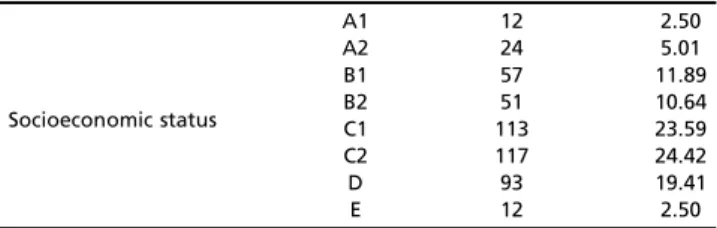
The distribution of the participating children by socio-economic status is presented in Table 1.
Of the 479 children included in the study, 129 (26.9%) failed the LP screening, 41 (8.6%) failed the LC screening, and 67 (14%) failed the hearing screening.
The rate of failure on the LP and LC screening was signi-ficantly higher among the children who failed the hearing screening (Table 2). Whereas the children at risk for hearing loss had a failure rate of 49.25% (CI: 37.65-60.94%) on the LP screening, the children with no risk of hearing loss had a failure rate of 23.3% (CI: 19.47-27.63%). The children at risk for hearing loss had a 19.4% (CI: 11.57-30.56%) failure rate on the LC screening, while those with no risk had a failure rate of 6.79% (CI: 4.71-9.67%).
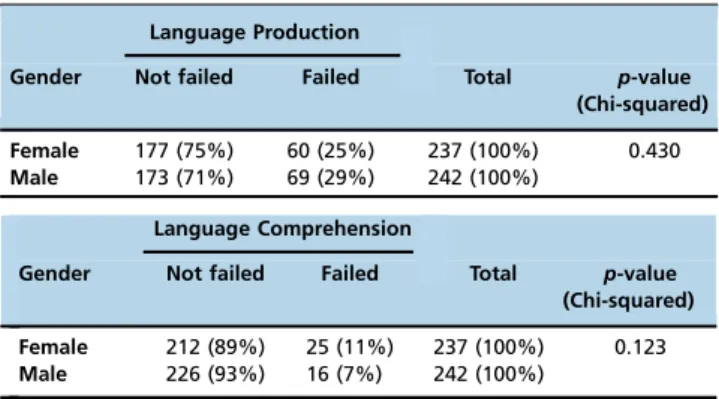
There were no significant differences between genders in terms of risk for LP or LC deficits (Table 3), indicating that gender does not influence the risk of having such deficits.
The children at risk for LP or LC deficits were younger than the children with no risk, but the difference was signi-ficant only for LP (Table 4).
No significant differences were observed for gender; there-fore, we used a logistic regression model to compare the responses for the LP screening with those for the hearing screening, controlling for the age variable (adjusted).
Based on the estimates for the odds ratios and probabilities obtained from the logistic regression model for the LP screening,
Table 1-Distribution of children by socioeconomic status.
Socioeconomic status
A1 12 2.50
A2 24 5.01
B1 57 11.89
B2 51 10.64
C1 113 23.59
C2 117 24.42
D 93 19.41
E 12 2.50
Table 2-Absolute (and relative) frequencies of LP and LC responses according to hearing screening results.
Language Production
Hearing Not failed Failed Total p-value
(Chi-squared)
Not failed 316 (77%) 96 (23%) 412 (100%) o0.0001
Failed 34 (51%) 33 (49%) 67 (100%)
Language Comprehension
Hearing Not failed Failed Total p-value
(Chi-squared)
Not failed 384 (93%) 28 (7%) 412 (100%) 0.0006
we observed that when comparing children one year apart in age, the probability of observing LP deficits in the older child was 0.79 times that of observing LP deficits in the younger child (lower limit=0.69; upper limit=0.91; po0.01). In other
words, in one year, the chance of LP deficits decreases approximately 21%.
The chance of exhibiting LP deficits was 3.84 times higher among the children with hearing deficits than among those without such deficits (lower limit=2.21; upper limit=6.7,po0.01).
That is, the chance of LP deficits was 2.84 times greater in the children with hearing deficits than in those without.
Table 5 presents combinations of the variables age (2 to 5 years) and hearing (deficit or no deficit) and their res-pective probabilities for LP deficits as estimated by the model.
According to the estimates of the odds ratios and prob-abilities obtained from the logistic regression model for the LC variable, we observed that the probability of exhibit-ing LC deficits was 3.30 times higher among the children with hearing deficits (lower limit=1.61; upper limit=6.76;
po0.01) than among those without. That is, the chance
of having LC deficits was 2.30 times greater among the children with hearing deficits than among those without such deficits.
The estimated probabilities of exhibiting LC deficits accord-ing to the hearaccord-ing screenaccord-ing results are presented in Table 6.
’ DISCUSSION
In the current study, the observed rate of failure on the language screening was 26.9%. No studies of the rate of failure on language screenings are available in the literature.
However, previous studies reported speech-language dis-order prevalence rates ranging from 5% to 19%, depending on the criteria used to define the disorders and the age of the participants (20). It is important to highlight that this variability is due to discrepancies in the definition of speech and language disorders, the severity and type of commu-nication impairments included in the definition, the nature of the surveyed population and differences in the methodolo-gical procedures used across the studies (21,22).
Additionally, socioeconomic status should be considered (12,13,23-26), as this variable may explain the greater failure rates observed on the language tests in our study relative to previous studies. In the current research, most of the parti-cipants belonged to economic class E (the lowest economic class according to the Brazilian classification), and most of the parents had not completed primary education, which differs from many of the previous studies (13,23-26).
In our study, the children had a failure rate of 8.6% on the LC screening. There are no previous population studies investigating LC deficits in children between 0 and 5 years of age. Considering that LC precedes LP, the results of the present study highlight the importance of early assessment of LC to understanding a child’s capacity for developing LP skills (13). Furthermore, this knowledge is important for the provision of primary care and early intervention.
Consistent with the prevalence rates reported by previous studies, 14% of the participants in the current study failed the hearing screening (5,27-30). It is important to note that the prevalence of hearing loss in children varies from 3.9% to 24.5% worldwide, and the prevalence of middle ear disorders ranges from 7.3% to 36.2% (31). These differences in prevalence rates are likely due to the use of different evaluation protocols and to different characteristics of the studied populations, as noted by Olusanya (31).
The failure rate for LP and LC was significantly higher among children who failed the hearing screening. Thus, our findings support previous results suggesting that hearing loss can have a negative influence on the development of language in terms of both production and comprehension (4,5).
Table 5-Estimates of failure probability for LP for each hearing and age combination.
Hearing Age Probability
Not failed 2 28.7%
3 24.2%
4 20.3%
5 16.9%
Failed 2 60.7%
3 55.2%
4 49.5%
5 43.8%
Legend: A logistic regression model was used to test the effect of risk (probability) associated with each variable after adjusting for age.
Table 6-Estimates of the probability of LC deficits according to hearing screening results.
Hearing Probability
Not failed 6.8%
Failed 19.4%
Legend: A logistic regression model was used to test the effect of risk (probability) associated with each variable.
Table 3-Absolute (and relative) frequencies of LP and LC responses by gender.
Language Production
Gender Not failed Failed Total p-value
(Chi-squared)
Female 177 (75%) 60 (25%) 237 (100%) 0.430
Male 173 (71%) 69 (29%) 242 (100%)
Language Comprehension
Gender Not failed Failed Total p-value
(Chi-squared)
Female 212 (89%) 25 (11%) 237 (100%) 0.123
Male 226 (93%) 16 (7%) 242 (100%)
Table 4-Age (in means and standard deviations) for each LP and LC response.
Not failed Failed p-value
(ANOVA)
LP Mean Standard
Deviation
Mean Standard
Deviation
3.65 1.76 3.16 1.64 0.006
Not failed Failed p-value
(ANOVA) LC Mean Standard
Deviation
Mean Standard
Deviation
The literature describes that deficits in attention, decoding, comprehension, memory, processing and the effective use of auditory information are among the types of damage that can result from even mild hearing loss (32). The aforementioned skills are closely related to the acquisition and development of language (33).
We did not observe significant differences between genders in terms of deficits in LP or LC. These findings are con-sistent with those of Tomblin et al. (34), whose results sug-gest that although boys generally present higher prevalence rates for language disorders, the difference is not statisti-cally significant for PLI. Likewise, Pereira, Befi-Lopes and Samelli (5) found no significant interaction between gender and PLI. However, the results of a systematic review (35) revealed a trend for a higher prevalence of language dis-orders among males.
The children who failed the LP screening in the cur-rent study were significantly younger, on average. There is individual variation in language development, and this variation is most evident in the expressive language of younger children: one 18-month-old baby may use short sentences while another may produce only isolated words (36). Over time, these differences diminish, and skill levels begin to level off at approximately three years of age (37).
Because we identified that age played a role in LP failure, we compared responses for the LP screening to those for the hearing screening while controlling for age. This analysis revealed that a one-year increase in age resulted in a 21% lower probability of failing the LP screening. This finding confirms the results of a previous study, in which approxi-mately half of the children who exhibited delays during the first months of language development eventually caught up with their same-age peers in subsequent years (38).
Given that untreated language disorders persist at a significant rate, ranging between 40 and 60% (20), it is very important to use screening for early detection and diagnosis and to provide immediate intervention (10). Screening should be performed regardless of age given the importance of language for an individual’s overall development.
Identifying possible hearing loss is critical among chil-dren with language disorders, since the relationship between these variables can complicate individual profiles (4). In the present study, children at risk for hearing loss had a 2.84 greater chance of developing LP deficits than children with no risk for hearing loss. Similarly, children at risk for hearing loss were 2.30 times more likely than those with no risk to develop LC deficits. As indicated by previous studies (3-6), our findings highlight the influence of hearing on the development of expressive and receptive language.
This study found that of the children at risk, the largest proportion were at risk for LP disorders, followed by hearing loss and LC disorders.
Additionally, children at risk for hearing loss were twice as likely to display LP deficits as children with no risk for hearing loss. The same pattern was observed for LC deficits. The results of this study highlight the importance of estab-lishing and adopting low-cost procedures such as surveys and screening for the early identification of children at risk for language and hearing disorders. Finally, our findings emphasize the need for health professionals to evaluate hearing in children with speech and language impairments and speech and language in children with hearing impair-ments as early as possible.
’ AUTHOR CONTRIBUTIONS
All the authors participated sufficiently in the conception and design of the work, in the data analysis and in writing the manuscript to take public responsibility for it.
’ REFERENCES
1. Campbell TF, Dollaghan CA, Rockette HE, Paradise JL, Feldman HM, Shriberg LD, et al. Risk factors for speech delay of unknown origin in 3-year-old children. Child Dev. 2003;74(2):346-57, http://dx.doi.org/ 10.1111/1467-8624.7402002.
2. O’Connor TE, Perry CF, Lannigan FJ. Complications of otitis media in Indigenous and non-Indigenous children. Med J Aust. 2009;191(9 Suppl): S60-4.
3. Uclés P, Alonso MF, Aznar E, Lapresta C. The importance of right otitis media in childhood language disorders. Int J Otolaryngol. 2012;2012: 818927.
4. Schönweiler R, Ptok M, Radü HJ. A cross-sectional study of speech- and language-abilities of children with normal hearing, mild fluctuating conductive hearing loss, or moderate to profound sensoneurinal hearing loss. Int J Pediatr Otorhinolaryngol. 1998;44(3):251-8, http://dx.doi.org/ 10.1016/S0165-5876(98)00075-5.
5. Pereira MB, Befi-Lopes DM, Samelli AG. Association between audio-logical profile and primary language impairment in children. Int J Pediatr Otorhinolaryngol. 2015;79(1): 53-7, http://dx.doi.org/10.1016/j.ijporl. 2014.11.003.
6. Winskel H. The effects of an early history of otitis media on children’s language and literacy skill development. Br J Educ Psychol. 2006;76 (Pt 4):727-44, http://dx.doi.org/10.1348/000709905X68312.
7. Harsten G, Nettelbladt U, Schalén L, Kalm O, Prellner K. Language development in children with recurrent acute otitis media during the first three years of life. Follow-up study from birth to seven years of age. J Laryngol Otol. 1993;107(5):407-12, http://dx.doi.org/10.1017/S00222 15100123291.
8. Roberts JE, Rosenfeld RM, Zeisel SA. Otitis media and speech and lan-guage: a meta-analysis of prospective studies. Pediatrics. 2004;113(3 Pt 1): e238-48, http://dx.doi.org/10.1542/peds.113.3.e238.
9. Johnson DL, McCormick DP, Baldwin CD. Early middle ear effusion and language at age seven. J Commun Disord. 2008;41(1):20-32, http://dx.doi. org/10.1016/j.jcomdis.2007.03.001.
10. Ciccia AH, Whitford B, Krumm M, McNeal K. Improving the access of young urban children to speech, language and hearing screening via tele-health. J Telemed Telecare. 2011;17(5):240-4, http://dx.doi.org/10.1258/ jtt.2011.100810.
11. Samelli AG, Rabelo CM, Vespasiano AP. Development and analysis of a low-cost screening to identify and classify hearing loss in children: a proposal for developing countries. Clinics. 2011;66(11):1943-8. 12. Samelli AG, Rondon S, Oliver FC, Junqueira SR, Molini-Avejonas DR.
Referred speech-language and hearing complaints in the western region of São Paulo, Brazil. Clinics. 2014;69(6):413-9, http://dx.doi.org/10.6061/ clinics/2014(06)08.
13. Silva GM, Couto MI, Molini-Avejonas DR. Risk factors identification in children with speech disorders: pilot study. Codas. 2013;25(5):456-62, http://dx.doi.org/10.1590/S2317-17822013000500010.
14. Samelli AG, Rabelo CM, Pereira MB, Portela MN, Sanches SG, Neves-Lobo IF. Comparison of screening methods for conductive hearing loss identification in children: low cost proposal. J Med Screen. 2012;19(1):1-7, http://dx.doi.org/10.1258/jms.2012.011051.
15. Critério de Classificac¸ão econômica Brasil. 2015. Available in: http://
www.abep.org/criterio-brasil. Accessed in: October 7th, 2016.
16. ASHA.‘‘How does your child hear and talk?’’. http://www.asha.org/ public/speech/development/chart/
17. Fernandes FD, Molini-Avejonas DR. Processos de intervenc¸ão nos
distúrbios de linguagem infantil. In: Lamônica DAC, Brito DBO (eds). Tratado de Linguagem: perspectivas contemporâneas. Ribeirão Preto: Booktoy, 2016.
18. Molini-Avejonas DR, Fernandes FD, Rondon-Melo S. Sensitivity and specificity of a protocol for identification of speech and language dis-orders in children. J Speech Lang Hear Res. 2017 (in press).
19. Molini-Avejonas DR, Aboboreira MS, Couto MI, Samelli AG. Insertion and performance of Speech-Language Pathology and Audiology in Family Health Support Centers. Codas. 2014;26(2):148-54, http://dx.doi. org/10.1590/2317-1782/2014011IN.
20. Nelson HD, Nygren P, Walker M, Panoscha R. Screening for speech and language delay in preschool children: systematic evidence review for the US Preventive Services Task Force. Pediatrics. 2006;117(2):e298-319, http://dx.doi.org/10.1542/peds.2005-1467.
Speech Lang Pathol. 2007;16(4):359-67, http://dx.doi.org/10.1044/1058-0360(2007/039).
22. Harrison LJ, McLeod S. Risk and protective factors associated with speech and language impairment in a nationally representative sample of 4- to 5-year-old children. J Speech Lang Hear Res. 2010;53(2):508-29, http://dx. doi.org/10.1044/1092-4388(2009/08-0086).
23. Isotani SM, Azevedo MF, Chiari BM, Perissinoto J. Expressive language of two year-old pre-term and full-term children. Pro Fono. 2009;21(2):155-9, http://dx.doi.org/10.1590/S0104-56872009000200012.
24. Rezende MA, Beteli VC, Santos JL. Evaluation of language and personal social abilities by the Denver Test II in institutions of infantile education. Acta Paul Enferm. 2005;18(1):56-63, http://dx.doi.org/10.1590/S0103-21002005000100008.
25. Biscegli TS, Polis LB, Santos LM, Vicentin M. Nutritional status and neurodevelopment of children enrolled in a day care center. Rev Paul Pediatr. 2007;25(4):337-42, http://dx.doi.org/10.1590/S0103-05822007000 400007.
26. Scopel RR, Souza VC, Lemos SM. Family and school environment influ-ences on language acquisition and development: literature review. Rev CEFAC. 2012;14(4):732-41, http://dx.doi.org/10.1590/S1516-184620110 05000139.
27. Cruz MS, Oliveira LR, Carandina L, Lima MC, César CL, Barros MB, et al. Prevalence of self-reported hearing loss and attributed causes: a popula-tion-based study. Cad Saude Publica. 2009;25(5):1123-31, http://dx.doi. org/10.1590/S0102-311X2009000500019.
28. Martines F, Bentivegna D, Di Piazza F, Martinciglio G, Sciacca V, Martines E. The point prevalence of otitis media with effusion among primary school children in Western Sicily. Eur Arch Otorhinolaryngol. 2010;267(5): 709-14, http://dx.doi.org/10.1007/s00405-009-1131-4.
29. Khairi Md Daud M, Noor RM, Rahman NA, Sidek DS, Mohamad A. The effect of mild hearing loss on academic performance in primary school
children. Int J Pediatr Otorhinolaryngol. 2010;74(1):67-70, http://dx.doi. org/10.1016/j.ijporl.2009.10.013.
30. Al-Rowaily MA, AlFayez AI, AlJomiey MS, AlBadr AM, Abolfotouh MA. Hearing impairments among Saudi preschool children. Int J Pediatr Otorhinolaryngol. 2012;76(11):1674-7, http://dx.doi.org/10.1016/j.ijporl. 2012.08.004.
31. Olusanya B. Early detection of hearing impairment in a developing country: what options? Audiology. 2001;40(3):141-7, http://dx.doi.org/ 10.3109/00206090109073109.
32. Sanes DH, Wooley SM. A behavioral framework to guide research on central auditory development and plasticity. Neuron. 2011;72(6):912-29, http://dx.doi.org/10.1016/j.neuron.2011.12.005.
33. Schirmer CR, Fontoura DR, Nunes ML. Language and learning disorders. J Pediatr. 2004;80(2 Suppl):S95-103, http://dx.doi.org/10.2223/1173. 34. Tomblin JB, Records NL, Buckwalter P, Zhang X, Smith E, O’Brien M.
Prevalence of specific language impairment in kindergarten children. J Speech Lang Hear Res. 1997;40(6):1245-60, http://dx.doi.org/10.1044/ jslhr.4006.1245.
35. Law J, Boyle J, Harris F, Harkness A, Nye C. Prevalence and natural history of primary speech and language delay: findings from a systematic review of the literature. Int J Lang Commun Disord. 2000;35(2):165-88, http://dx.doi.org/10.1080/136828200247133.
36. MacWhinney B. A unified model of language acquisition. In: Kroll JF & De Groot AMB (eds).Handbook of bilingualism: Psycholinguistic approaches. New York: Oxford University Press. 2005;pp.49-67.
37. Alt M, Plante E, Creusere M. Semantic features in fast-mapping: perfor-mance of preschoolers with specific language impairment versus pre-schoolers with normal language. J Speech Lang Hear Res. 2004;47(2): 407-20, http://dx.doi.org/10.1044/1092-4388(2004/033).
38. Bee H, Boyd D. A crianc¸a em Desenvolvimento. 12th ed. Porto Alegre: