in smokers: emergency for smoking abstinence
Alterações metabólicas, hormonais e nutricionais de
fumantes: urgência para a abstinência tabágica
Gláucia Renata Souza Rodrigues
1, Marcela Melquíades
1, Maria Alvim Leite
2, Maíra Barros Louro
2,
Carmen Perches
3, Ana Lúcia de Almeida Vargas
4, Sheila Cristina Potente Dutra Luquetti
1,5,
Aline Silva de Aguiar Nemer
1,5,6ABSTRACT
Objective: To evaluate the biochemical and nutritional status of smokers in treatment for
smoking cessation and its association with anthropometric parameters. Methods: This is a
cross-sectional study with convenience sample. Adult smokers were assessed at the start of treatment in the Interdisciplinary Center for Tobacco Research and Intervention of the Univer-sity Hospital of the Federal UniverUniver-sity of Juiz de Fora (CIPIT/HU-UFJF). We evaluated the body mass index (BMI), conicity index (CI); waist circumference (WC), percentage of body fat (%BF), fasting glycemia, cortisol, insulin, total cholesterol (TC), LDL-c, HDL-c, triglycerides (TG) and
metabolic syndrome (MS). Results: Most participants (52.2%) had MS and high cardiovascular
risk. The fasting glycemia was abnormal in 30.4%. There was a signiicant positive correlation between BMI and WC (r = 0.90; p = 0.0001), %BF (r = 0.79; p = 0.0001), CI (r = 0.65; p = 0.0001), glycemia (r = 0.42; p = 0.04) and TG (r = 0.47; p = 0.002). The CI presented positive correction with insulin (r = 0.60; p = 0.001), glycemia (r = 0.55; p = 0.007), TG (r = 0.54; p = 0.008) and %BF (r = 0.43; p = 0.004). Patients with longer duration of smoking had a higher risk of developing MS
(OR = 9.6, p = 0.016). Conclusion: The smokers evaluated had increased risk for developing
MS, especially those with longer duration of smoking, requiring urgent smoking cessation.
RESUMO
Objetivo: Avaliar o peril bioquímico e nutricional de fumantes em tratamento para a
cessa-ção tabágica e sua associacessa-ção com parâmetros antropométricos. Métodos: Trata-se de um
estudo transversal com amostra de conveniência. Adultos fumantes foram avaliados no início do tratamento no Centro Interdisciplinar de Pesquisa e Intervenção em Tabagismo do Hospi-tal Universitário da Universidade Federal de Juiz de Fora (CIPIT/HU-UFJF). Foram avaliados o índice de massa corporal (IMC), índice de conicidade (IC), circunferência da cintura (CC), per-centual de gordura corporal (%GC), glicemia de jejum, cortisol, insulina, colesterol total (TC),
1 Universidade Federal de Juiz de Fora, Hospital Universitário (UFJF/HU), Residência Multiproissional em Saúde do Adulto, Juiz de Fora, MG, Brazil.
2 Instituto de Ciências Biológicas, Departamento de Nutrição, Iniciação Cientíica do Curso de Nutrição, UFJF, Juiz de Fora, MG, Brazil. 3 UFJF/HU, Laboratório de Análises Clínicas, Juiz de Fora, MG, Brazil.
4 UFJF/HU, Centro Interdisciplinar de Pesquisa e Intervenção em Tabagismo (CIPIT), Juiz de Fora, MG, Brazil. 5 UFJF, Instituto de Ciências Biológicas, Departamento de Nutrição, Juiz de Fora, MG, Brazil.
6 Universidade Federal de Ouro Preto (UFOP), Programa de Mestrado em Saúde e Nutrição, Ouro Preto, MG, Brazil.
Correspondence address to: Aline Silva de Aguiar Nemer
Universidade Federal de Juiz de Fora, Instituto de Ciências Biológicas, Departamento de Nutrição, Cidade Universitária
36036-900 – Juiz de Fora, MG, Brazil Telephone: (+ 55 32) 2102-3234 E-mail: [email protected]
Received in 7/29/2013 Approved in
10/15/2013
Keywords
colesterol LDL-c, HDL-c, triglicéridos (TG) e síndrome metabólica (SM). Resultados: A maioria dos participantes possuía SM e alto risco cardiovascular. A glicemia de jejum estava alterada em 30,4%. Houve correlação positiva signiicativa entre IMC e CC (r = 0,90; p = 0,0001), %GC (r = 0,79; p = 0,0001), IC (r = 0,65; p = 0,0001), glicemia (r = 0,42; p = 0,04) e TG (r = 0,47; p = 0,002). O IC também apresentou correlação positiva com insulina (r = 0,6; p = 0,001), glicemia (r = 0,55; p = 0,007), TG (r = 0,54; p = 0,008) e %GC (r = 0,43; p = 0,004). Pacientes com maior
tempo de tabagismo tiveram maior risco de desenvolver SM (O = 9,6; p = 0,016). Conclusão:
Os fumantes avaliados tiveram maior risco de desenvolver SM, especialmente aqueles que fumavam por mais tempo, requerendo urgência para a cessação tabágica.
cortisol12,13. In addition, chronic smokers are at increased risk
for developing insulin resistance and inadequate compensa-tory response of insulin secretion, which promotes the asso-ciation of smoking with an increased risk of type 2 diabetes mellitus14.
Evaluation of endocrine-metabolic changes that pro-mote tobacco use, can aid understanding of factors involved in the changes of body weight and the development of chronic diseases associated with smoking. This article aims to evaluate the biochemical and nutritional status of smokers at the start of treatment for smoking cessation and its associa-tion with anthropometric indices.
METHODS
This is a cross-sectional study with convenience sampling conducted in smokers treated in the second half of 2011 by the Interdisciplinary Center for Tobacco Research and Inter-vention of the University Hospital of the Federal University
of Juiz de Fora (CIPIT/HU-UFJF).We evaluated individuals of
both sexes, aged between 19 and 59 years who agreed to participate and signed the Free and Clariied Consent Term. Enrollment for the study was voluntary. Pregnant women, nursing mothers and patients with severe psychiatric disor-der and diseases that interfere with nutritional and metabo-lic status (infectious, kidney, cardiac, endocrine or liver disea-ses) were excluded. Pregnant women, breastfeeding women and patients with severe psychiatric disorders and diseases that interfere with the nutritional and metabolic (infectious, renal, cardiac, endocrine or liver disease) were excluded. All patients enrolled by CIPIT/HU-UFJF the second half of 2011 were invited to participate in the study. However, only 30 smokers efectively started treatment, but only 23 were in-cluded in this study because of the exclusion criteria. The proposal was approved by the Ethics in Research Committee of the University Hospital from UFJF (CAAE: 0067.180.420-11).
In the irst day of follow-up, clinical history and anthro-pometric measurements and the degree of nicotine de-pendence were assessed in each of the smokers for trained professionals and students working on the ambulatory.
Palavras-chave
Tabagismo, doenças cardiovasculares, dislipidemias, sobrepeso.
INTRODUCTION
Smoking represents one of the main modiiable risk factors for chronic diseases such as cardiovascular diseases, diabetes mellitus and cancer, is considered the most important public
health problem in the present1. The World Health
Organiza-tion (WHO) estimates that 1.2 billion people are smokers and that this number could rise to 1.6 billion in 2030. Total deaths worldwide, caused by smoking, are about 5 million a year. In Brazil are estimated about 200 000 deaths/year as a result
of tobacco dependence2. According to the Surveillance
Sys-tem Risk and Protective Factors for Chronic Diseases Survey Telephone (VIGITEL), smoking prevalence among the adult population of the 27 Brazilian capitals was 14.8%, higher in
men (18.1%) than in women (12.0%)3.
The cigarette consists of approximately 4,720 toxic
sub-stances4, and nicotine the main substance responsible for
tobacco dependence and the development of chronic
dis-eases, particularly cardiovascular disease5. Each cigarette
contains an average of 7-9 mg of nicotine, of which it is es-timated that slightly more than 1 mg to be absorbed by the
smoker4.
Cigarette smoking acts at various levels in the patho-genesis of chronic diseases, among them the metabolic
syndrome (MS) and cardiovascular disease6. Risk factors of
metabolic origin have been described to explain its harmful efects on the cardiovascular system, such as hypertension, decreased plasma levels of HDL-cholesterol (HDL-C), hyper-triglyceridemia, impaired fasting glucose and abdominal
obesity7. According to the Institute of Diabetes Federation8,
the presence of increased abdominal fat, two risk factors listed above characterize the MS and are able to increase the overall mortality by 1.5 times and cardiovascular diseases 2.5-fold5,9.
Endocrine disorders can also be present in smokers and corroborate, directly or indirectly to the development of co-morbidities related to tobacco use. Studies have shown in-creased plasma levels of cortisol, especially in the irst hour
after smoking10,11. The increase of this hormone is associated
Clinical histories were collected type information duration of smoking, age at initiation of smoking, number of cigarettes smoked per day, among others. Was used the Fagerström Nicotine Dependence Test (FNDT) to measure the degree
of nicotine dependence15,16. The questionnaire has six
ques-tions that are intended to identify the smokers’ behavior, and for each question there is a corresponding score. The total score obtained in the six responses resulted in a score that indicates the degree of dependence: low (0-4 points), mod-erate (5 points) or high (5-10 points).
Anthropometric nutritional assessment was performed at the beginning of the treatment. Body weight (BW), height, waist circumference (WC) and abdominal circumference (AC) were measured in private rooms and with
standardi-zed protocols17. The BW measurement was performed
us-ing electronic digital balance (Welmy®), and the patient was evaluated shoeless and wearing light clothing. Height was measured using a stadiometer attached to a balance with the patient standing, barefoot, with arms outstretched to the sides and heels together, erect head with eyes ixed on the horizon, touching the vertical rod of the stadiometer.
To assess the nutritional status, body mass index (BMI) was calculated by the formula: BMI = weight (kg)/height
(m2). The classiication was performed as proposed by17, for
adults, or Lipschitz18, for the elderly patients. The percentage
of body fat (%BF) was estimated by BMI, using the following formulas: Men [%fat = 1.218 (BMI) – 10.13] and women [%fat
= 1.48 (BMI) – 7]19. The values obtained were classiied
ac-cording to the proposed by Lohman (1991)20.
WC was made with a lexible and inextensible measuring tape, with the individual standing, identiied the midpoint between the last rib and the iliac crest, in the natural curva-ture. From this point was measured the circumference and the reading of the measurement was made at the time of
expiration17. The interpretation of the results followed the
cutofs WC ≥ 90 cm for men and WC ≥ 80 cm for women, indicating risk of cardiovascular disease measures that ex-ceeded these values. AC was measured using lexible and inextensible measuring tape encircling the abdomen at the umbilicus scar. The conicity index was calculated using the equation: CI = waist circumference (m) / [0.109 x (√ P (kg) /
E (m)] according to the protocol proposed by Valdez21. This
measure assesses the presence of cardiovascular risk from the high cutof points 1.25 and 1.18 for men and women,
respectively22.
The Laboratory assessments were performed after the participants had fasted overnight, blood samples were drawn to measure serum total cholesterol (TC), HDL cho-lesterol (HDL-C), triacylglycerols (TG), and plasma glucose, insulin and cortisol. These tests were performed at the Labo-ratory of Clinical Analyses of University Hospital of Federal University of Juiz de Fora, using speciic kits available in the
laboratory. Glucose tolerance was estimated using the re-sistance index Homeostasis Model Assessment (HOMA-IR) calculated by measuring fasting blood glucose and insulin, according to the following formula: [glucose
(mmol/L)xinsu-lin (U/mL)/22.5]23. Insulin resistance was classiied individuals
who had HOMA-IR > 4.6524.
Blood pressure was measured with the patient seated after 5 minutes of rest, according to standard procedures,
being classiied as high blood pressure ≥ 130/85 mmHg25.
For all participants, the adult IDF definition of the
metabolic syndrome was applied26. According to the IDF8
definition, an individual has the metabolic syndrome if he or she has central adiposity plus at least two of the following criteria: 1) triglycerides ≥ 150 mg/dL, 2) HDL cholesterol < 40 mg/dL, 3) systolic blood pressure ≥ 130 mmHg or diastolic blood pressure ≥ 85 mmHg, 4) fasting plasma glucose ≥100 mg/dL or previously diagnosed type 2 diabetes.
Statistical analysis
Statistical analysis was performed using Epi-Info 6.0 and SPSS 12.0. First, we conducted a descriptive analysis of the mea-sured parameters (nutritional status and biochemical tests), using mean, standard deviation and maximum and mini-mum values of proportion, as the variable type to be descri-bed. After analysis of the data normality by the Shapiro-Wilk comparisons of continuous variables of anthropometry and biochemical tests were conducted by nonparametric test (Mann-Whitney U test). Categorical variables were compared by chi-square. The association between hormone levels and the variables of interest was veriied by Spearman correla-tion. We used logistic regression to assess the risk of develo-ping MS compared to the duration of smoking. In all analyzes was considered the signiicance level of 0.05.
RESULTS
The study involved 23 smokers at the start of treatment. Of these, the majority were women (73.9%), with a mean age of 43.7 ± 11 years. Of all individuals, 82.6% started smoking before adulthood, 69.6% were light smokers, 26.1% modera-te smokers and 4.3% heavy smokers. The degree of nicotine dependence, as measured by the FTND, appeared high in 65.2% of subjects (Table 1).
The mean BMI was 28.28 ± 6.46 kg/m², of which 65.2% were overweight (overweight n = 7 / obesity n = 8) and 82.6% central obesity from the measurement of WC. The presence of MS was seen in 52.2% patients. The IC was used as a discriminator for high cardiovascular risk and this was found in 52.2% of individuals, and of these, 75% also had MS.
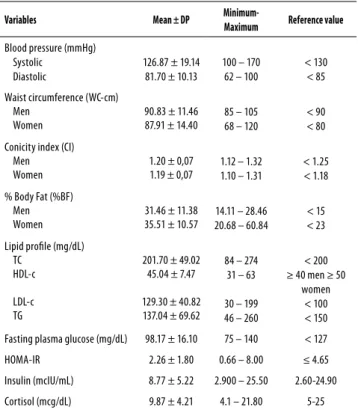
are shown in table 2.Among the characteristics of smokers can observe that the %BF was increased in 69.6% of subjects, serum concentrations of TC and LDL-c levels were elevated, respectively 52.2% and 78.3% individuals. The HDL-c was be-low the recommended values in 65.2% of patients. Hypertri-glyceridemia was observed in 39.1% subjects. It was found impaired fasting glucose 30.4% while 8.7% of patients had glucose levels compatible with diabetes (≥ 126 mg/dL). Only one individual (4.3%) had serum cortisol and insulin above the reference values. The presence of impaired glucose toler-ance, assessed by HOMA-IR was found in 13% of participants. Although the mean values of systolic and diastolic be within the reference values, 30.4% of subjects had increased blood pressure.
There was no association between the number of ciga-rettes/day and the degree of nicotine dependence with hormone levels, metabolic and anthropometric parameters. However, patients with longer duration of smoking had a higher odds of developing MS (OR = 9.6, p = 0.016) (Table 3). There was a positive correlation between BMI and WC (r = 0.90; p = 0.0001), %BF (r = 0.79; p = 0.0001), CI (r = 0.65; p = 0.0001), glycemia (r = 0.42; p = 0.04) and TG (r = 0.47; p = 0.002). The CI presented positive correction with insulin (r = 0.60; p = 0.001), glycemia (r = 0.55; p = 0.007), TG (r = 0.54; p = 0.008) and %BF (r = 0.43; p = 0.004). There was also a positive correlation between insulin and WC (r = 0.74; p = 0.001) and CI (r = 0.60; p = 0.001) (Table 4).
Table 1. Characteristics of smoking at the beginning of treatment for smoking cessation
Variables n %
Age of onset of smoking
9 a 19 years 19 82.6
20 a 39 years 4 17.4
> 40 years 0 0.0
Total 23 100.0
Number of cigarettes smoked per day
1-20 (Light consumption) 16 69.6
21-40 (Moderate consumption) 6 26.1
> 41 (Heavy consumption) 1 4.3
Total 23 100.0
Duration of smoking
≤ 10 years 3 13.0
> 10 years 20 87.0
Total 23 100.0
Degree of dependence
Low 3 13.1
Moderate 5 21.7
High 15 65.2
Total 23 100.0
Table 2. Cardiovascular and metabolic parameters at the beginning of treatment for smoking cessation
Variables Mean ± DP
Minimum-Maximum Reference value
Blood pressure (mmHg) Systolic
Diastolic
126.87 ± 19.14 81.70 ± 10.13
100 – 170 62 – 100
< 130 < 85
Waist circumference (WC-cm) Men
Women
90.83 ± 11.46 87.91 ± 14.40
85 – 105 68 – 120
< 90 < 80
Conicity index (CI) Men Women
1.20 ± 0,07 1.19 ± 0,07
1.12 – 1.32 1.10 – 1.31
< 1.25 < 1.18
% Body Fat (%BF) Men Women
31.46 ± 11.38 35.51 ± 10.57
14.11 – 28.46 20.68 – 60.84
< 15 < 23
Lipid proile (mg/dL) TC
HDL-c
LDL-c TG
201.70 ± 49.02 45.04 ± 7.47
129.30 ± 40.82 137.04 ± 69.62
84 – 274 31 – 63
30 – 199 46 – 260
< 200 ≥ 40 men ≥ 50
women < 100 < 150
Fasting plasma glucose (mg/dL) 98.17 ± 16.10 75 – 140 < 127
HOMA-IR 2.26 ± 1.80 0.66 – 8.00 ≤ 4.65
Insulin (mcIU/mL) 8.77 ± 5.22 2.900 – 25.50 2.60-24.90
Cortisol (mcg/dL) 9.87 ± 4.21 4.1 – 21.80 5-25
Table 3. Odds ratio of presence of metabolic syndrome according to the duration of smoking
Duration of smoking MS (n) OR P
0-20 years 1 1.00
0.016
21-30 years 3 3.30
> 30 years 7 9.63
Table 4. Association between anthropometric, biochemical and nutritional parameters at the beginning of treatment for smoking cessation
Association between BMI and anthropometric and biochemical parameters
Variables r p
WC 0.90 0.0001
%BF 0.79 0.0001
Glycemia 0.42 0.04
TG 0.47 0.002
CI 0.65 0.0001
Association between IC and anthropometric and biochemical parameters
Variables r p
WC 0.86 0.004
Glycemia 0.55 0.007
TG 0.54 0.008
%BF 0.43 0.004
Association between insulinaemia and anthropometric parameters
Variables r p
WC 0.74 0.001
DISCUSSION
The results of this study indicate that smokers at initiation of treatment had increased risk for developing chronic disea-ses such as cardiovascular disease, type 2 DM and MS, since most of these individuals have changes in lipid proile, in-crease fasting glucose and blood pressure and overweight and obesity abdominal. It was also found that smokers with longer smoking had higher odds of developing MS.
The WHO considers smoking as a disease in expansion,
with a mean age of initiation of 15 years27. The present study
corroborates this inding, since the average age of smoking initiation was found to be 16.35 ± 4.72 years. In study
con-ducted by Prigol et al.5, the degree of nicotine dependence
was directly related to the age of onset of smoking, and the individuals who started smoking before age 20 were classi-ied with high nicotine dependence, factor related with in-creased risk of coronary heart disease.
The degree of nicotine dependence, assessed by the FTND was high in more than half of the volunteers. However, no correlation was found between this variable with none of the other variables. Some studies have reported a correlation between the number of cigarettes smoked and alteration in lipid proile or even on other risk factors associated with MS, such as abdominal obesity, increased blood pressure and
in-creased fasting glucose5,28-30. In the present study, this
obser-vation was not found. This inding may be explained by the fact that it occurred an evaluation point and not monitoring the number of cigarettes smoked over the years. However, a positive association was observed between the presence of MS and the duration of smoking, which revealed that in-dividuals who smoke for more than 30 years, possessed 9.6 times greater risk of developing MS (p = 0.016).
Studies suggest that nicotine promotes increased en-ergy expenditure and reduces appetite, which explains why smokers having a lower BMI than nonsmokers, and the
com-mon weight gain after smoking cessation12,31,32. In contrast,
it is observed that heavy smokers (> 40 cigarettes/day) tend to have higher body weight than light smokers (< 20 ciga-rettes/day). Suggests that heavy smokers are more likely to adopt behaviors that favor weight gain, such as low physical activity, low intake of fruits and vegetables and high intake
of alcohol12. Besides being overweight, these behaviors also
contribute to the appearance of other cardiovascular risk factors such as increased WC, changes in BP and changes in lipid and glycemic proiles. In this study there was no correla-tion between the number of cigarettes smoked per day and BMI. However, it should be emphasized again the need for an assessment of the number of cigarettes smoked normal-ly, since it was observed that, when selected for treatment, some individuals have reduced the number of cigarettes smoked per day.
It is very common to use anthropometric indices to clas-sify individuals as to the risk of development of chronic de-generative diseases. In addition to BMI, another index that has been used is the IC, an indicator of abdominal obesity able to assess the presence of high cardiovascular risk.
Ac-cording Pitanga and Lessa22 the IC can be considered the
best indicator of high cardiovascular risk when compared to WC and BMI, described as intermediate and low discrimina-tory power of high cardiovascular risk, respectively. In this study, more than half (52.1%) of smokers had elevated car-diovascular risk according to the IC.
BMI showed good association with visceral adiposity, %BF, and alterations of plasma glucose and triglycerides.
Ac-cording to Bray and Bellanger33, obesity is a major risk factor
for cardiovascular disease, diabetes and dyslipidemia, the lat-ter being characlat-terized by elevated serum TG and low serum concentrations of HDL-C. BMI was also associated with IC, in-dicating a positive correlation between increased body mass and increased cardiovascular risk.
In addition to BMI, the IC was correlated with insulin, glucose, triglycerides and the %BF. Why be an indicator of abdominal obesity, it is expected that this index shows a positive correlation with these variables. Moreover, visceral adipose tissue increases the plasma concentrations of free fatty acids in plasma, and these increase hepatic glucose
pro-duction, inhibit insulin action in the liver28 and increase the
production of very low density lipoprotein (VLDL)13. Studies
indicate increased levels of blood pressure in smokers
com-pared with nonsmokers28,34. In this study, the prevalence of
change in blood pressure was 30.4%. In cross-sectional study
by Nakashita et al.29, the prevalence of hypertension in light
smokers (< 20 cigarettes/day) was 51%.
Of all patients, over 90% had some type of alteration lipid proile, being common association between increased plasma levels of LDL-C and decreased HDL-c (52%). These changes are usually associated with increased sympathetic
activity caused by nicotine28 and represent a future risk for
the onset of atherosclerosis, being more signiicant in
chron-ic smokers5. The abdominal obesity shown in smokers may
also contribute to the increased incidence of dyslipidemia, since the increase in visceral adiposity is associated with
increased plasma lipoprotein9,35. Thus, the high percentage
of abdominal obesity found may be related to changes ob-served in the lipid proile.
Regarding glucose, it was observed that although the mean values were within the normal range, about a third (30.4%) patients had blood glucose greater than or equal
to 100 mg/dL. Nakashita et al.29 in cross-sectional study with
in-sulin resistance28, promoting glucose metabolism disorders,
leading to hyperglycemia14.
Serum concentrations of the hormones insulin and
corti-sol were increased in only one smoker. Chiolero et al.12
report-ed that in healthy men, chronic smoking is associatreport-ed with increased insulin levels, independent of other factors known to inluence the sensitivity to this hormone. Although serum cortisol did not increase in most patients evaluated in this study, other authors have shown that smoking increases cir-culating levels of this hormone and others such as catechol-amines, and growth hormone actions that are antagonistic to insulin and may contribute to insulin resistance and higher
blood glucose levels between smokers28,36. Excess abdominal
fat may also explain the occurrence of IR, since the present study showed a correlation between insulinemia and WC.
There is evidence that smoking leads to an increase in visceral fat mass, which is inluenced by the concentration
of cortisol12,28,29. One of the characteristics of this hormone is
increased lipogenesis in visceral adipose tissue13. Other
stud-ies have shown increased levels of this hormone in
smok-ers, especially in the irst hour after smoking10,11. Although
the analysis of these hormones have been performed in the morning (fasting), a limiting factor for the result was the lack of standardization between the time of the last cigarette and examination.
The main limitation of this study was to have a cross-sec-tional design and evaluation of one group of smokers, which afects the interpretation of results, since the small sample of patients and absence of a temporal sequence that prevents establish causal links between exposure and disease devel-opment factor. Moreover, the absence of a control group was a factor that prevented comparisons were made with data from healthy individuals of the same sex and age. How-ever, the study will be continued to compare the changes that were observed at the beginning with the changes at the end of treatment. For this analysis there is no need for a control group. However, the study was positive in indicating the urgency of smoking cessation, conirming the harmful efects of tobacco on the health of these individuals, and in-dicates the need for multidisciplinary team in the treatment of smokers.
In conclusion, the smokers evaluated at the beginning of treatment for smoking cessation have changes in lipid proile, increased fasting glucose, increased blood pressure, overweight and abdominal obesity, which may contribute to the development of chronic diseases, particularly cardio-vascular diseases, type 2 DM and MS. Regardless of the num-ber of cigarettes smoked per day, the proile of smokers had evaluated increased risk for developing MS, especially those with longer duration of smoking. Smokers require urgently for smoking cessation, to prevent metabolic complications associated with tobacco use. These results reinforce the im-portance of the multidisciplinary team involved in treatment
strategy, aimed not only smoking cessation as well as pre-vention of diseases associated with smoking and improving the quality of life.
INDIVIDUAL CONTRIBUTIONS
Gláucia Renata Souza Rodrigues – Contributed to data collection, interpretation of the data and also contributed to drafting the article, revising it critically and approval of the inal version to be published.
Marcela Melquíades – Contributed to data collection, interpretation of the data and also contributed to drafting the article, revising it critically and approval of the inal ver-sion to be published.
Maria Alvim Leite – Contributed to data collection, lit-erature review, interpretation of the data and also contrib-uted to drafting the article, revising it critically and approval of the inal version to be published.
Maíra Barros Louro – Contributed to data collection, literature review, interpretation of the data and also contrib-uted to drafting the article, revising it critically and approval of the inal version to be published.
Carmen Perches – Contributed to biochemical analysis, interpretation of the data and also contributed to drafting the article, revising it critically and approval of the inal ver-sion to be published.
Ana Lúcia de Almeida Vargas – Participated in the project design contributed to conception, interpretation of results, drafting of article, approval of inal version to be pub-lished.
Sheila Cristina Potente Dutra Luquetti – Participated in the project design contributed to conception, interpreta-tion of results, drafting of article, approval of inal version to be published.
Aline Silva de Aguiar Nemer – Participated in the proj-ect design contributed to conception, interpretation of results, drafting of article, approval of inal version to be published.
DECLARATION OF INTERESTS
None declared.
ACKNOWLEDGMENTS
The authors thanks to Residência Multiproissional em Saúde do Adulto (HU/UFJF).
Lu-quetti SCD thanks to Coordination for the Enhancement of Higher Education Personnel (Coordenação de Aperfeiçoa-mento de Pessoal de Nível Superior – Capes) and State of Minas Gerais Research Foundation (Fundação de Amparo à Pesquisa do Estado de Minas Gerais – Fapemig).
REFERENCES
1. WHO. World Health Organization. WHO report on the global tobacco epidemic, 2011: warning about the dangers of tobacco. Geneva: WHO, 2011. Available from: http:// whqlibdoc.who.int/publications/2011/9789240687813_eng.pdf
2. WHO. World Health Organization. The tobacco industry documents. What they are, what they tell us, and how to search them. A practical manual. Washington DC: WHO, 2002. Available from: www.who.int/tobacco/communications/TI_manual_content.pdf
3. Vigitel Brasil 2011: Vigilância de fatores de risco e proteção para doenças crônicas por inquérito telefônico. Ministério da Saúde, Secretaria de Vigilância em Saúde – Brasília: Ministério da Saúde; 2012. Available from: http://portalsaude.saude.gov.br/portalsaude/ arquivos/pdf/2012/Ago/22/vigitel_2011_inal_0812.pdf
4. Rosemberg J. Pandemia do Tabagismo – Enfoques Históricos e Atuais. São Paulo: Secretaria Estadual de Saúde; 2002.
5. Prigol M, Marmentini F, Grazziotin NA, Macedo SMD. Efeito do tabagismo sobre o peril lipídico e suas implicações em detentos internos do Presídio Estadual de Erechim-RS. Rev Bras Anal Clin. 2007;39(1):3-8.
6. Wilsgaard T, Jacobsen BK. Lifestyle factors and incident metabolic syndrome. The Tromsø Study 1979-2001. Diabetes Res Clin Pract. 2007;78:217-24.
7. Ishizaka N, Ishizaka Y, Toda E, Hashimoto H, Nagai R, Yamakado M. Association between cigarette smoking, metabolic syndrome, and carotid arteriosclerosis in Japanese individuals. Atherosclerosis. 2005;181:381-8.
8. International Diabetes Federation – IDF. The IDF consensus worldwide de inition of the Metabolic Syndrome, 2006. Available from: http://www.idf.org/webdata/docs/IDF_ Meta_def_inal.pdf
9. Rosini N, Rosini AD, Mousse DM, Rosini GD. Prevalência de síndrome metabólica e estratiicação de risco para DAC em pacientes hipertensos-tabagistas. Rev Bras Anal Clin. 2007;39(3):223-6.
10. Xue Y, Morris M, Ni L, Guthrie SK, Zubieta JK, Gonzalez K, et al. Venous plasma nicotine correlates of hormonal efects of tobacco smoking. Pharmacol Biochem Behav. 2010;95(2):209-15.
11. Mello NK. Hormones, nicotine, and cocaine: clinical studies. Horm Behav. 2010;58:57-71.
12. Chiolero A, Faeh D, Paccaud F, Cornuz J. Consequences of smoking for body weight, body fat distribution, and insulin resistance. Am J Clin Nutr. 2008;87:801-9.
13. Suplicy HL. Obesidade visceral. Resistência à insulina e hipertensão arterial. Rev Bras Hipertens. 2000;2:136-41.
14. Xie XT, Liu Q, Wu J, Wakui M. Impact of cigarette smoking in type 2 diabetes development. Minireview Acta Pharmacol Sin. 2009;30(6):784-7.
15. Heartherton TF, Kozlowski LT, Frecker RC, Fagerström KO. The Fargerstrom Test for Nicotine Dependence: a revision of the Fagerström Tolerance Questionnaire. Br J Addict. 1991;86:1119-27.
16. Halty LS, Hüttner MD, Netto ICO, Santos VA, Martins G. Análise da utilização do Questionário de Tolerância de Fagerström (QTF) como instrumento de medida da dependência nicotínica. J Bras Pneumol. 2002;28(4):180-6.
17. World Health Organization. Obesity: preventing and managing the global epidemic. Report of a WHO Consultation. Geneva, World Health Organization; 1998. Technical Report Series, 894.
18. Lipschitz DA. Screening for nutritional status in the elderly. Primary Care. 1994;21(1):55-67.
19. Black D, James WPT, Besser GM, Brook CGD, Craddock D, Garrow JS, et al. Obesity. A report of the Royal College of Physicians. Clin Med. 1983;17:5-65.
20. Lohman TG. Advances in body composition assessment. Champaign, Human Kinetics Publishers, Champaign, Il. 1992; 150 pages, Monograph. Available from: http://pen. sagepub.com/content/18/3/283.1.extract
21. Valdez R, Seidell JC, Ahn YI, Weiss KM. A new index of abdominal adiposity as an indicator of risk for cardiovascular disease. A cross-population study. Int J Obes Relat Metab Disord. 1993;17(2):77-82.
22. Pitanga FJG, Lessa I. Indicadores antropométricos de obesidade como instrumento e triagem para risco coronariano elevado em adultos na cidade de Salvador-Bahia. Arq Bras Cardiol. 2005;85(1):26-31.
23. Salgado ALFA, Carvalho L, Oliveira AC, Santo VN, Vieira JG, Parise ER. Insulin Resistence Index (HOMA-IR) in the diferentiation of patients with non-alcoholic fatty liver disease and healthy individuals. Arq Gastroenterol. 2010;47(2):165-9.
24. Sociedade Brasileira de Diabetes. Diretrizes (SBD). São Paulo 2009 [Internet]. Available from: http://www.diabetes.org.br/attachments/diretrizes09_inal.pdf
25. Expert Panel on Detection, Evaluation, and Treatment of High Blood Cholesterol in Adults (Adult Treatment Panel III). Executive Summary of the Third Report of the National Cholesterol Education Program (NCEP). JAMA. 2001;285(19),2486-97.
26. Alberti KG, Zimmet P, Shaw J. IDF Epidemiology Task Force Consensus Group: the metabolic syndrome – A new worldwide definition. Lancet. 2005;366:1059-62.
27. WHO. World Health Organization. Tobacco & the Rights of the Child, 2001: Available from: http://whqlibdoc.who.int/hq/2001/WHO_NMH_TFI_01.3_Rev.1.pdf
28. Balhara YPS. Tabacco and metabolic syndrome. Indian J Endocrinol Metab. 2012;16(1):81-7.
29. Nakashita Y, Nakamura M, Kitamura A, Kiyama M, Ishikawa Y, Mikami H. Relationships of cigarette smoking and alcohol consumption to metabolic syndrome in Japanese men. J Epidemiol. 2010;20:391-7.
30. Nakanishi N, Takatorige T, Suzuki K. Cigarette smoking and the risk of the metabolic syndrome in middle-aged Japanese male oice workers. Indust Health. 2005;43:295-301.
31. Mineur YS, Abizaid A, Rao Y, Salas R, DiLeone RJ, Gündisch D, et al. Nicotine decreases food intake through activation of POMC neurons. Science. 2011;332(6035):1330-2.
32. Chatkin R, Chatkin JM. Tabagismo e variação ponderal: a isiopatologia e genética podem explicar esta associação. J Bras Pneumol. 2007;33(6):712-9.
33. Bray GA, Bellanger T. Epidemiology, trends, and morbidities of obesity and the metabolic syndrome. Endocrine. 2006;29(1):109-17.
34. Primatesta P, Flaschetti E, Gupta S, Marmot MG, Poulter NR. Association between smoking and blood pressure: evidence from the Health Survey for England. Hypertension. 2001;37:187-93.
35. Lima WA, Glaner MF. Principais fatores de risco relacionados às doenças cardiovasculares. Artigo de revisão. Rev Bras Cineantropom Desempenho Hum. 2006;8(1):96-104.