Axel Legay and Azadeh Farzan (Eds.): International Workshop on Verification of Infinite-State Systems (INFINITY 2009) EPTCS 10, 2009, pp. 62–76, doi:10.4204/EPTCS.10.5
Pushdown Automata
∗Nguyen Van Tang
Research Center for Verification and Semantics National Institute of Advanced Industrial Science and Technology
Toyonaka, Osaka, 560-0083 Japan [email protected]
Visibly pushdown automata (VPA), introduced by Alur and Madhusuan in 2004, is a subclass of pushdown automata whose stack behavior is completely determined by the input symbol according to a fixed partition of the input alphabet. Since its introduce, VPAs have been shown to be useful in various context,e.g.,as specification formalism for verification and as automaton model for process-ing XML streams. Due to high complexity, however, implementation of formal verification based on VPA framework is a challenge. In this paper we consider the problem of implementing VPA-based model checking algorithms. For doing so, we first present an improvement on upper bound for determinization of VPA. Next, we propose simple on-the-fly algorithms to check universality and in-clusion problems of this automata class. Then, we implement the proposed algorithms in a prototype tool. Finally, we conduct experiments on randomly generated VPAs. The experimental results show that the proposed algorithms are considerably faster than the standard ones.
1
Introduction
Visibly pushdown automata [1] are pushdown automata whose stack behavior (i.e. whether to execute a push, a pop, or no stack operation) is completely determined by the input symbol according to a fixed partition of the input alphabet. As shown in [1], this class of visibly pushdown automata enjoys many good properties similar to those of the class of finite automata. The main reason for this being that is, each nondeterministic VPA can be transformed into an equivalent deterministic one. Therefore, checking context-free properties of pushdown models is feasible as long as the calls and returns are made visible. As a result, visibly pushdown automata have turned out to be useful in various context,
e.g. as specification formalism for verification and synthesis problem for pushdown systems [3, 4, 11], as automaton model for processing XML streams [10, 9], and as AOP protocols for component-based systems [12, 13].
As each nondeterministic VPA can be determinized, all problems that concern the accepted languages such as universality and inclusion problems are decidable. To check universality for a nondeterminis-tic VPAMover its alphabetΣ(that is, to check if L(M) =Σ∗), the standard method is first to make it complete, determinize it, complement it, and then checks for emptiness. To check the inclusion prob-lemL(M)⊆L(N), the standard method computes the complement ofN, takes its intersection withM
and then, check for emptiness. This is costly as computing the complement necessitates a full deter-minization. This explosion is in some sense unavoidable, because determinization for VPAs requires exponential time blowup [1]. Therefore, one of the questions raised is that whether one can implement
efficiently operations like determinization as well as decision procedures like universality ( or. inclusion) checking for VPAs.
During the recent years, a new approach called antichain method has been proposed to imple-ment efficiently operations like universality or inclusion checking on nondeterministic word or tree au-tomata [14, 6]. Unfortunately, the antichain technique cannot be directly used for checking universality and inclusion of VPA. This is because the set of configurations of a VPA is infinite and thus, computing the set of antichains may not terminate. In this paper, we focus on the problem of checking universality and inclusion for VPAs. We make the following contributions towards to this overall goal.
• First, we present an improvement on upper bound for determinization of VPA. In [1], Alur and Madhusudan showed that any nondeterministic VPA withnstates can be translated into a deter-ministic one with at most 2n2+n states. Here, we show that this upper bound can be made tighter. More precisely, we optimize Alur-Madhusudan’s determinization procedure, and show that any nondeterministic VPA withnstates can be transformed into a deterministic one with at most 2n2 states.
• Second, we apply the standard method to check universality and inclusion problems for nondeter-ministic VPA. This method includes two main steps: determinization and reachability checking for non-accepting configurations. For determinization, we use the Alur-Madhusudan’s procedure [1]. For reachability checking, we apply the symbolic techniqueP-automata [7, 8] to compute the sets
of all reachable configurations of a VPA.
• Third, we present an on-the-fly method to check universality of VPA. The idea is very simple that we perform determinization and reachability checking byP-automaton simultaneously. For
checking universality of nondeterministic VPA M, we first create the initial state of the deter-minized VPAMd and, initiate aP-automatonAto represent the initial configuration ofMd.
Sec-ond, construct new transitions departing from the initial states, and update theP-automatonA.
Then, the determinized VPAMd is updated using new states and transitions of A(which corre-spond to pairs of the states and topmost stack symbols ofMd), and so on. When a non-accepting state is added toA, we stop and report thatMis not universal.
• Fourth, we also propose a new algorithmic solution to inclusion checking for VPAs using on-the-fly manner. Again, no explicit determinization is performed. To solve the language-inclusion problem for nondeterministic VPAs,L(M)⊆L(N), the main idea is to find at least one wordw
accepted byMbut not accepted byN,i.e., w∈L(M)\L(N).
• Finally, we have implemented all algorithms in a prototype tool (written in Java 1.5) and tested them in a series of experiments. Although the standard methods (as well as on-the-fly ones) have the same worst case complexity, our preliminary experiments on randomly generated visibly push-down automata show a significant improvement of on-the-fly methods compared to the standard ones.
2
Visibly Pushdown Automata
2.1 Definitions
In this section we briefly recall the notions and properties of visibly pushdown automata. Readers are referred to the seminal paper [1] for their more details.
LetΣbe the finite input alphabet, and letΣ=Σc∪Σr∪Σi be a partition ofΣ. The intuition behind the partition is:Σcis the finite set ofcall(push) symbols,Σris the finite set ofreturn(pop) symbols, and
Σiis the finite set ofinternalsymbols. Visibly pushdown automata are formally defined as follows:
Definition 1 Avisibly pushdown automaton(VPA) M overΣis a tuple(Q,Q0,Γ,∆,F)where Q is a finite
set of states, Q0⊆Q is a set of initial states, F⊆Q is a set of final states,Γis a finite stack alphabet with
a special symbol⊥(representing thebottom-of-stack), and∆=∆c∪∆r∪∆i is the transition relation, where∆c⊆Q×Σc×Q×(Γ\ {⊥}),∆r⊆Q×Σr×Γ×Q, and∆i⊆Q×Σi×Q.
If (q,c,q′,γ) ∈∆c, where c∈Σc and γ 6=⊥, there is a push-transition from q on input c where on readingc, γ is pushed onto the stack and the control changes from state qtoq′; we denote such a transition byq−−−→c/+γ q′. Similarly, if(q,r,γ,q′), there is apop-transition fromqon inputr whereγ is read from the top of the stack and popped (if the top of the stack is⊥, then it is read but not popped),
and the control state changes fromqtoq′; we denote such a transitionq−−−→r/−γ q′. If(q,i,q′)∈∆i, there is aninternal-transitionfromqon inputiwhere on readingi, the state changes fromqtoq′; we denote such a transition byq−→i q′. Note that there are no stack operations on internal transitions.
We writeStfor the set ofstacks{w⊥ |w∈(Γ\ {⊥})∗}. Aconfigurationis a pair(q,σ)ofq∈Q
andσ∈St. The transition function of a VPA can be used to define how the configuration of the machine changes in a single step: we say(q,σ)→−a (q′,σ′)if one of the following conditions holds:
• Ifa∈Σcthen there existsγ∈Γsuch thatq−−−→a/+γ q′andσ′=γ·σ
• Ifa∈Σr, then there existsγ∈Γsuch thatq−−−→a/−γ q′and eitherσ=γ·σ′, orγ=⊥andσ=σ′=⊥ • Ifa∈Σi, thenq→−a q′andσ=σ′.
A (q0,w0)-run on a word u=a1· · ·an is a sequence of configurations (q0,w0) a1
→(q1,w1)· · · an →
(qn,wn), and is denoted by(q0,w0) u
→(qn,wn). A worduis accepted byMif there is a run(q0,w0) u
→
(qn,wn)withq0∈Q0,w0=⊥, andqn∈QF. The languageL(M)is the set of words accepted byM. The
languageL⊆Σ∗is avisibly pushdown language(VPL) if there exists a VPAMwithL=L(M).
Definition 2 A VPA M isdeterministic if|Q0|=1and for every configuration(q,σ)and a∈Σ, there
are at most one transition from(q,σ)by a. For deterministic VPAs (DVPAs) we denote the transition relation byδ instead of∆, and write:
2.2 Determinization
As shown in [1], any nondeterministic VPA can be transformed into an equivalent deterministic one. The key idea of the determinization procedure is to do subset construction, but postponing handling push transitions. The push transitions are stored into the stack and simulated at the time of matching pop transitions. The construction has two components: a set ofsummary edges S, that keeps track of what state transitions are possible from a push transition to the corresponding pop transition, and a set ofpath edges R, that keeps track of all possible state reached from initial states. For completeness, let us briefly recall the original determinization procedure [1] as below.
LetM= (Q,Γ,Q0,∆,F)be a nondeterministic VPA. We construct an equivalent deterministic VPA
M′= (Q′,Γ′,Q′0,∆′,F′)as follows: Q′ =2Q×Q×2Q,Q′0={(IdQ,Q0)}whereIdQ={(q,q) |q∈Q}, F′={(S,R)|R∩F6=∅},Γ′=Q′×Σc, and the transition relation∆′=∆i′∪∆′c∪∆′ris given by:
• Internal:For everya∈Σi,(S,R)→−a (S′,R′)∈∆′iwhereS′={(q,q′)| ∃q′′∈Q:(q,q′′)∈S,q′′ a
− →
q′∈∆i}, andR′={q′| ∃q∈R:q→−a q′∈∆i}.
• Push:For everya∈Σc,(S,R)−−−−−−→a/+(S,R,a) (IdQ,R′)∈∆′cwhereR′={q′| ∃q∈R:q a/+γ
−−−→q′∈∆c}.
• Pop:For everya∈Σr,
– if the stack is empty : (S,R)−−−→a/−⊥ (S′,R′)∈∆′r where S′ ={(q,q′) | ∃q′′∈Q:(q,q′′)∈
S,q′′−−−→a/−⊥ q′∈∆r}andR′={q′ | ∃q∈R:q−−−→a/−⊥ q′∈∆r}.
– otherwise:(S,R)−−−−−−−→a/−(S′,R′,a′) (S′′,R′′)∈∆′
r, where
R′′ =
q′ ∃q∈R′:(q,q′)∈U pdate
S′′ = {(q,q′)| ∃q3∈Q:(q,q3)∈S′,(q3,q′)∈U pdate}
U pdate =
(
(q,q′)
∃q1∈Q,q2∈R:(q1,q2)∈S,
q a
′/+γ
−−−→q1∈∆c,q2 a/−γ
−−−→q′∈∆r
)
Theorem 1 ([1, Theorem 2]) Let M be a VPA. The VPA M′is deterministic and L(M′) =L(M). More-over, if M has n states, one can construct M′ with at most2n2+n states and with stack alphabet of size
|Σc| ·2n2+n.
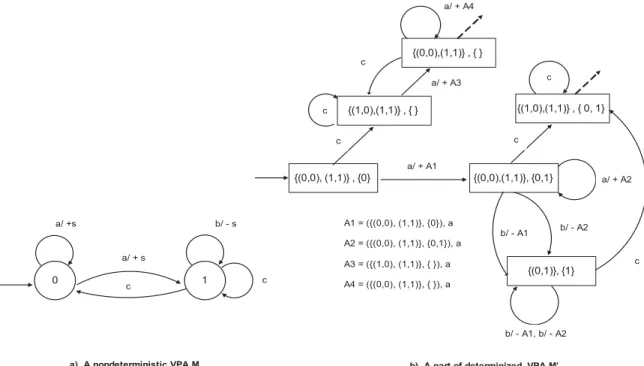
Example 1 We illustrate the original determinization procedure by an example in Figure 1.
2.3 An Improvement on Complexity for Determinization
During implementation of VPA’s operations, we found that the set of summariesSin the determinization may contain unnecessary pairs in the sense that these pairs do not keep information of reachable states. In other words, for any state (S,R) of the determinized VPA, Π2(S) does not always equal to R in
whichΠ2 is the projection on the second component. In the following, we present an optimization for
{(0,0), (1,1)} , {0} {(0,0),(1,1)}, {0,1}
{(0,1)}, {1}
b/ - A1
a/ + A2
b/ - A2 a/ + A1
b/ - A1, b/ - A2 A1 = ({(0,0), (1,1)}, {0}), a
A2 = ({(0,0), (1,1)}, {0,1}), a
A3 = ({(1,0), (1,1)}, { }), a
A4 = ({(0,0), (1,1)}, { }), a
{(1,0),(1,1)} , { 0, 1}
c
c c
{(1,0),(1,1)} , { }
c c
{(0,0),(1,1)} , { }
a/ + A3 c
a/ + A4
b) A part of determinized VPA M’
0 1
a/ +s
a/ + s
b/ - s
a) A nondeterministic VPA M
c c
Figure 1: An example for determinization of VPA
2.3.1 OptimizeS-Component
We first optimize Alur-Madhusudan’s determinization of VPA by minimizing the set of summaries S. Given a finite setX, let us denoteIdX={(q,q)|q∈X}.
LetM= (Q,Γ,Q0,∆,F)be a nondeterministic VPA. We construct an equivalent deterministic VPA
Md= (Q′,Γ′,Q0′,∆′,F′)as follows:Q′=2Q×Q×2Q,Q′0={(IdQ0,Q0)}whereF
′={(S,R)|R∩F6=∅},
Γ′=Q′×Σc, and the transition relation∆′=∆′i∪∆′c∪∆′ris given by:
• Internal:For everya∈Σi,(S,R)→−a (S′,R′)∈∆′iwhereS′={(q,q′)| ∃q′′∈Q:(q,q′′)∈S,q′′ a
− →
q′∈∆i}andR′={q′| ∃q∈R:q−→a q′∈∆i}
• Push:For everya∈Σc,(S,R)−−−−−−→a/+(S,R,a) (IdR′,R′)∈∆′cwhereR′={q′| ∃q∈R:q a/+
γ
−−−→q′∈∆c}
• Pop:For everya∈Σr,
– if the stack is empty : (S,R)−−−→a/−⊥ (S′,R′)∈∆′r where S′ ={(q,q′) | ∃q′′∈Q:(q,q′′)∈
S,q′′−−−→a/−⊥ q′∈∆r}andR′={q′ | ∃q∈R:q−−−→a/−⊥ q′∈∆r}.
– otherwise:(S,R)−−−−−−−→a/−(S′,R′,a′) (S′′,R′′)∈∆′
r, where
R′′ =
q′ ∃q∈R′:(q,q′)∈U pdate
S′′ = {(q,q′)| ∃q3∈Q:(q,q3)∈S′,(q3,q′)∈U pdate}
U pdate =
(
(q,q′)
∃q1,q2∈Q:(q1,q2)∈S,
q a
′/+γ
−−−→q1∈∆c,q2 a/−γ
−−−→q′∈∆r
Remark 1 The main differences of our construction with the original one are: (1) we initiate the initial state as(IdQ0,Q0) instead of(IdQ,Q0); and (2) after reading a push symbol, the automaton will enter
the state(IdR′,R′)instead of(IdQ,R′).
Lemma 1 For a given nondeterministic VPA M, let Mdbe the deterministic VPA constructed from M as above. Then,Π2(S) =R for any state(S,R)of Md, whereΠ2is the projection on the second component.
Proof 1 Since states of Md are generated on-the-fly manner, we prove the lemma by induction on the length of input words. Let w be an input word.
1. If|w|=0, the lemma holds because Q′0= (IdQ0,Q0)andΠ2(IdQ0) =Q0.
2. If|w|=1, then w=a∈Σ. Consider three cases of a:
• If a∈Σi: Based on the construction of transitions, we have(IdQ0,Q0)
a
−
→(S,R)∈∆′i where S={(q,q′)| ∃q′′∈Q0:(q,q)∈IdQ0,q
a
−
→q′∈∆i}and R={q′| ∃q∈Q0:q−→a q′∈∆i}. It
is easy to verify thatΠ2(S) =R. • If a∈Σc: The proof is trivial.
• If a∈Σr: Since the stack now is empty, the proof is similar to the case of internal symbols.
3. If|w|=2, assume that w=a1a2. The proof is trivial for the cases: a1∈Σi∪Σc∧a2∈Σi∪Σc; a1∈ Σi∧a2∈Σr. We now check the last case: a1∈Σc∧a2∈Σr. After reading a1, the current state of
Mdis(S,R)(withΠ2(S) =R by the induction assumption) and the stack content is(IdQ0,Q0,a1)⊥.
On reading a2, a new transition of Md is created: (S,R)
a/−(IdQ0,Q0,a1)
−−−−−−−−−→(S′,R′)∈∆′r where R′=
{q′ | ∃q∈Q0:(q,q′)∈U pdate}, S′={(q,q′) | ∃q∈Q:(q,q)∈IdQ0,(q,q
′)∈U pdate}, and
U pdate={(q,q′)| ∃q1,q2∈Q:(q1,q2)∈S,q a1/+γ
−−−→q1∈∆c,q2 a2/−γ
−−−→q′∈∆r}. It is easy to see in this case thatΠ2(S′) =R′=Π2(U pdate).
4. Now, let us assume that the lemma holds with|w|=n. Without loss of generality, we suppose that
w=w1a1w2a2· · ·wk where in w1 every call is matched by a return, but there may be unmatched
returns; wi (i=2· · ·k) are well-matched words, and ai(i=1· · ·k) are calls. After reading w, Md will have its stack(Sk−1,Rk−1,ak−1)· · ·(S1,R1,a1)⊥and its control state will be(Sk,Rk). By the assumption, we haveΠ2(Sk) =Rk. Assume that Mdread an input symbol ak. There are three cases of ak:
• If ak ∈Σi: The automaton will go to the control state(S′,R′). Similar to the proof for the case|w|=1, we getΠ2(S′) =R′.
• If ak∈Σc: The proof is trivial.
• If ak∈Σr: The automaton changes control state to(S′,R′)and pops the stack symbol
(Sk−1,Rk−1,ak−1). Namely,(Sk,Rk)
ak/−(Sk−1,Rk−1,ak−1)
−−−−−−−−−−−−→(S′,R′)∈∆′r,
R′ =
q′ ∃q∈Rk−1:(q,q′)∈U pdate
S′ = {(q,q′)| ∃q,q3∈Q:(q,q3)∈Sk−1,(q3,q′)∈U pdate}
U pdate =
(
(q,q′)
∃q1,q2∈Q:(q1,q2)∈Sk,
q−−−→a1/+γ q1∈∆c,q2 a2/−γ
−−−→q′∈∆r
)
2.3.2 RemoveR-Component
As can be seen in the previous section, the componentSin a state ofModsatisfies the conditionΠ2(S) =
R. Therefore, we can further optimize this determinization procedure by using the second component of the summarySas the set of reachable states.
LetM= (Q,Γ,Q0,∆,F)be a nondeterministic VPA. We construct an equivalent deterministic VPA
Mod = (Q′,Γ′,Q′0,∆′,F′) as follows: Q′ =2Q×Q, Q′
0=IdQ0 where F
′={S |Π
2(S)∩F 6=∅}, Γ′=
Q′×Σc, and the transition relation∆′=∆i′∪∆′c∪∆′ris given by:
• Internal:For everya∈Σi,S−→a S′∈∆′i whereS′={(q,q′)| ∃q′′∈Q:(q,q′′)∈S,q′′ a
−
→q′∈∆i}.
• Push:For everya∈Σc,S−−−−−→a/+(S,a) IdR′ ∈∆′cwhereR′={q′| ∃q∈Π2(S):q a/+
γ
−−−→q′∈∆c}.
• Pop:For everya∈Σr,
– if the stack is empty : S−−−→a/−⊥ S′ ∈∆′rwhereS′={(q,q′) | ∃q′′∈Q:(q,q′′)∈S,q′′ a/−⊥
−−−→
q′∈∆r}.
– otherwise:S a/−(S
′,a′)
−−−−−→S′′∈∆′r, where
S′′ = {(q,q′)| ∃q3∈Q:(q,q3)∈S′,(q3,q′)∈U pdate}
U pdate =
(
(q,q′)
∃q1,q2∈Q:(q1,q2)∈S,
q a
′/+γ
−−−→q1∈∆c,q2 a/−γ
−−−→q′∈∆r
)
The next theorem immediately follows from the above construction.
Theorem 2 For a given nondeterministic VPA M of n states. One can construct a deterministic VPA Mod such that L(Mod) =L(M). Moreover, the number of states and stack symbols of Mod in the worst case are2n2 and|Σc| ·2n2, respectively.
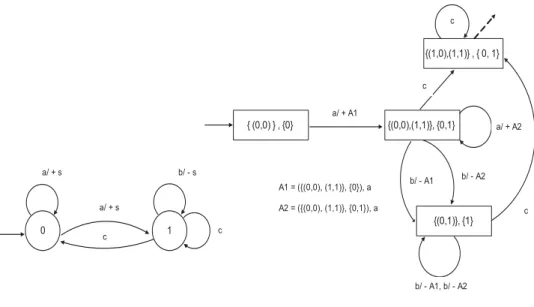
Example 2 We illustrate the optimized procedure by determinizing non deterministic VPA M in Fig-ure 1. The result of this optimized determinization is given in FigFig-ure 2. We can see that the size of the determinized VPA is reduced.
Remark 2 We should mention a fact that the model of nested words was proposed in [2] for represen-tation of data with both a linear ordering and a hierarchically nested matching of items. Recall that the input word of VPA has an implicit nesting structure defined by matching occurrences of symbols in Σcwith symbols inΣr. In nested words, this nesting is given explicitly, and thus they defined finite-state acceptors (with out stacks) for nested words, so-called nested word automata. One can interpret a nested word automaton as a visibly pushdown automaton over classical words. As shown in [2], a nondetermin-istic nested word automaton with n states can be translated into a determinnondetermin-istic nested word automaton with at most 2n2 states. In this paper, we show that the direct determinization of VPAs can be made tighter. As stack-based implementation is the most natural way in modeling recursive programs, we hope that our simple improvement on determinization procedure of VPAs is still useful.
3
Universality and Inclusion Checking
{ (0,0) } , {0} {(0,0),(1,1)}, {0,1}
{(0,1)}, {1}
b/ - A1
a/ + A2
b/ - A2 a/ + A1
b/ - A1, b/ - A2 A1 = ({(0,0), (1,1)}, {0}), a
A2 = ({(0,0), (1,1)}, {0,1}), a
{(1,0),(1,1)} , { 0, 1}
c
c c
b) A part of optimized VPA Mod
0 1
a/ + s
a/ + s
b/ - s
a) A nondeterministic VPA M
c c
Figure 2: An example for optimized determinization of VPA
3.1 Emptiness Checking
Apushdown system(see [5, 7], for example) is pushdown automaton that is regardless of input symbols. Bouajjaniet al.[5] have introduced an efficient symbolic method to compute reachable configurations of a pushdown system (This method was extended for model checking LTL properties of pushdown systems by Esparza et al. [7, 8]). The key of their technique is to use a finite automaton so-called
P-automaton to encode a set of infinite configurations of a pushdown system. It is easy to see that
theP-automaton technique can be used to solve emptiness problem for pushdown automata (or, visibly
pushdown automata). To check the emptiness of a pushdown automatonM, the first step is to compute the set of its reachable configurations usingP-automata. Second, if there exists an accepting configurations,
we conclude that the language ofMis not empty.
In the following, we adapt P-automata technique to checking emptiness of visibly pushdown
au-tomaton. Our definition, though in essence do not differ from the one in [5, 7, 8], has been tailored so that concepts discussed in this paper are easily related to the definition. Given a VPAP= (Q,Γ,Q0,∆,F), a P-automaton is used in order to represent sets of configurationsCofP. AP-automaton usesΓas the
input alphabet, andQas set of initial states. Formally,
Definition 3 (P-automata) 1. AP-automaton of a VPAPis a finite automaton A= (P,Γ,δ,Q,FA)
where P is the finite set of states,δ⊆P×Γ×P is the set of transitions, Q is the set ofinitial states
and FA⊆P is the set offinal states.
2. A P-automatonacceptsorrecognizesa configuration(p,w) if p−→w q, for some p∈Q, q∈FA.
The set of configurations recognized byP-automaton A is denoted by Con f(P).
For a VPAP= (Q,Γ,Q0,∆,F)and the set of configurationsC, letAbe aP-automaton
0 1 a/ + s
a/ + s
b/ - s
c c
f 0
0
q0,s 0
s
s s
s
1 s
q1,s 1
s
s
1
s
s ε
⊥
a) A VPA M b) a P-automaton for Conf(M)
ε
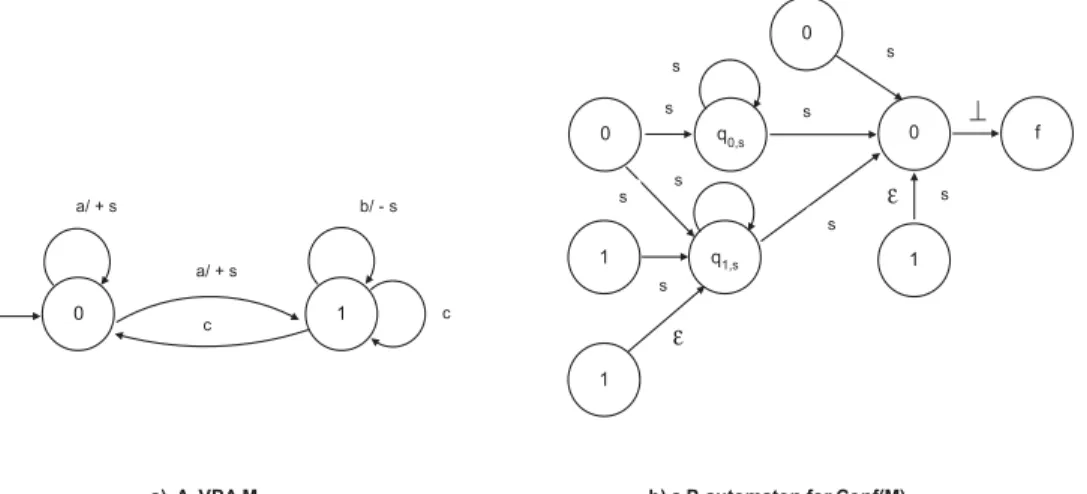
Figure 3: An example ofP-automata
ε-moves. We denote the relationq(−→ε )∗·−→ ·γ (−→ε )∗·pby =⇒γ. Formally,A
post∗ is obtained fromAin two stages:
• For each pair(q′,γ′)such thatPcontains at least one rule of the formq−−−→a/+γ′ q′∈∆c, add a new statep(q′,γ′)toA.
• Add new transitions toAaccording to the following saturation rules:
1. Internal:Ifq−→a q′∈∆i andq=⇒γ pin the current automaton, add a transition(q′,γ,p).
2. Push:Ifq a/+γ
′
−−−→q′∈∆candq=⇒γ pin the current automaton, first add(q′,γ′,p(q′,γ′)), and then add(p(q′,γ′),γ,p).
3. Pop:Ifq−−−→a/−γ q′∈∆randq=⇒γ pin the current automaton, add a transition(q′,ε,p).
Example 3 Let us revisit nondeterministic VPA M in Figure 1. AP-automaton for the set of all
reach-able configurations of M is given in Figure 3.
3.2 Universality Checking
In this section, we propose an on-the-fly method to solve the universality and inclusion problems for visibly pushdown automata. We first briefly recall the standard method in the next subsection.
3.2.1 Standard Methods
qis not a final location. Whenever a rejecting configuration is found, we stop and report that the original VPA is not universal. Otherwise, if all reachable configurations of determinized VPA are accepting configurations, the original VPA is universal.
3.2.2 On-the-fly Methods
To improve efficiency of checking, we perform simultaneously on-the-fly determinization andP-automata
construction. There are two interleaving phases in this approach. First, we determinize VPAMstep by step (iterations). After each step of determinization, we update the P-automaton. Then, using the P-automaton, we perform determinization again, and so on. It is crucial to note that this procedure
terminates. This is because the size of theMod is finite, and the P-automaton construction is
termi-nated. However, once a rejecting state is added to theP-automaton, we stop and report that the VPA
is not universal. Let Conf(Mod) and Rejecting-Conf(Mod) denote the sets of reachable and rejecting configurations ofMod, respectively. With the above observation, the following lemma holds:
Lemma 2 Let M be a nondeterministic VPA. The automaton M is not universal iff there exists a rejecting reachable configuration of Mod,i.e.,Conf(Mod)∩Rejecting-Conf(Mod)6=∅.
Therefore checking universality ofMamounts to finding a rejecting configuration ofMod. In Algo-rithm 1, we present an on-the-fly way to explore such rejecting configurations.
Algorithm 1On-the-fly algorithm
Input:A nondeterministic VPAM= (Q,Q0,Γ,∆,F)
Result:Universality ofM
begin
Create the initial state of the determinized VPAMod;
InitiateP-automatonAto present the initial configuration ofMod; Apost∗←−A;
Create transitions ofMod departing from the initial state;
while(the set of new transitions ofMod is not empty)do
Update theP-automatonApost∗ using new transitions ofMod; ifa rejecting state is added toApost∗ then
return False; end if
UpdateMod using new transitions ofA post∗; end while
return True; end
Having said this, time complexity of the on-the-fly method is same as the complexity of the standard one. However, if the input VPA is not universal, the on-the-fly method is significantly faster. This is because the on-the-fly method does not need to perform full determinization, and thus it will immediately stop whenever a rejecting state is found.
q2 q3 q1 q4 q5 q6 ⊥ f q1 ⊥
q1,γ′
q2 ⊥
⊥ γ′
q3 ⊥
q4 q2,γ’
q6 γ′ γ′ a/γ′ b c/⊥ a/γ′ b q5 γ′ a b c a b
〈q1,⊥〉
〈q2,γ′⊥〉
〈q3,⊥〉
〈q4,⊥〉
〈q5,γ′γ′⊥〉
〈q6,γ′⊥〉 Update determinized VPA
using states + top-of-stack symbols of frontier
Update P-automaton P-automaton Determinized VPA Reachable Configurations A rejecting state added
Stop + No
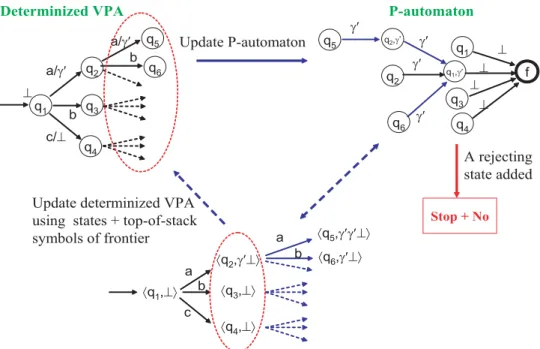
Figure 4: Simulation for On-the-fly Method
1. At the first time, assume that the initial state q1of determinized VPA Modis created.
2. Then, the P-automaton A is constructed which includes two states {q1,f} and one transition
q1−→⊥ f , where f is a unique final state. P-automaton A represents a set of initial configurations {(q1,⊥)}of Mod.
3. Update Modusing A. Suppose that Modhas new states{q2,q3,q4}; and new transitions{q1 a/+γ′
−−−→
q2,q1−→b q3,q1 c/− ⊥
−−−→q4}.
4. UpdateP-automaton A using new transitions of Mod. A has new states{q
2,q3,q4,p(q1,γ′)} and
transitions{q2 γ′
−→ p(q1,γ′),p(q1,γ′) ⊥
−→ f,q3
⊥
−→ f,q4
⊥
−→ f}.
5. Again, update Modusing new transitions of A, and so on.
3.3 Inclusion Checking
LetAandBbe two VPAs. We want to check whether L(A)⊆L(B). The standard method is to check whetherL(A×B) =∅, whereBis the complement ofB.
The on-the-fly approach tries to find if there exists at least a wordw∈L(A)\L(B). If such a wordw
was found, we can conclude thatL(A)*L(B). Otherwise,L(A)is a subset ofL(B). To do so, similar to the case of universality checking, we perform on-the-fly determinization forBand simultaneouslyP
Table 1: Universality checking for VPA generated by random 1
number of states
ON-THE-FLY 5 10 20 30 40 50 60 70 80 90 100
success 50 50 50 50 50 50 50 50 50 50 46
total time 23 46 52 71 110 186 210 274 247 407 686
timeout number (60s) 0 0 0 0 0 0 0 0 0 0 4
number of states
STANDARD 5 10 20 30 40 50 60 70 80 90 100
success 21 1 0 0 0 0 0 0 0 0 0
total time 456 31 0 0 0 0 0 0 0 0 0
timeout number (60s) 29 49 50 50 50 50 50 50 50 50 50
readingw, A leads to an accepting configuration whereasBod leads to a rejecting configuration. This means that there exists a wordw∈L(A)\L(B). In this case, we stop and report thatL(A)*L(B).
It is crucial to note that, ifL(A)⊆L(B), the on-the-fly approach needs to fully determinizeB, and this is similar to the standard approach. Therefore, in the worst case, the time complexity of the on-the-fly approach equals to that of the standard one.
4
Implementation and Experiments
We have implemented the above approaches for testing universality and inclusion of VPA in a prototype tool. The package is implemented in Java 1.5.0 on Windows XP. To compare the on-the-fly algorithm with the standard algorithm, we run our implementations on randomly generated VPAs. All tests are per-formed on a PC equipped with 1.50 GHz IntelR CoreTMDuo Processor L2300 and 1.5 GB of memory.
During experiments, we fix the size of the input alphabet to|Σc|=|Σr|=|Σi|=2, and the size of the stack alphabet to|Γ|=3. We first set parameters of the tests as follows:
Definition 4 (random 1) Thedensity of final states f=||QF||=1and thedensity of transitionsr= ka
|Q|=2,
where kais the number of transitions for each input symbol a.
We ran our tests on randomly VPA generated by the parameter random 1. We have tried VPAs sizes from 10 to 100. We generated 50 VPAs for each sample point, and setting timeout to 60 seconds. The experimental results are given in Table 1. We found that all successfully checked VPAs are not universal, and thus we omit the row for universal results in the table. The experiments shows thatSTANDARDcan solve for generated VPA instances with 5 states only. It gets stuck when the number of states greater than or equal to 10. Meanwhile,ON-THE-FLYis significantly efficient thanSTANDARD, they can check for almost VPAs.
The parameter random 1 does not guarantee the completeness of VPAs. Therefore, the probability of being universal is very low. In order to increase the probability of being universal, we set a new parameter as below:
Definition 5 (random 2) Thedensity of final statesf=||QF|| and thedensity of transitionsr:Q×Σ→N; r(q,a)depends on not only the input symbol a but also on the state q. In particular, we select r(q,a) =2
Table 2: Universality checking for VPA generated by random 2, f = 0.6
number of states
ON-THE-FLY 5 10 15 20 30 40 50
success 50 43 33 18 6 2 0
total time 68 1425 2310 1950 1024 345 0 timeout number (180s) 0 7 17 32 44 48 50
number of states
STANDARD 5 10 15 20 30 40 50
success 20 0 0 0 0 0 0
total time 3240 0 0 0 0 0 0
timeout number (180s) 0 50 50 50 50 50 50
Table 3: Checking inclusion withr(q,a) =2, f=0.5
number states of A and B
ON-THE-FLY (10,5) (100,5) (200,5) (500,5) (1000,5) (3000,5)
success 20 20 15 7 5 2
total time 27 910 830 336 1257 357
timeout number (300s) 0 0 13 15 15 18
As can be seen, with random 2, a VPA with 10 states has 200 transitions. We again test for various sizes of VPAs from 5 to 50. We ran with 50 samples for each point, setting timeout to 180 seconds. The results are reported in Table 2. For this parameter, results ofSTANDARDare almost timeout even with only 5 states.ON-THE-FLYbehaves in significantly better ways than those ofSTANDARD.
We also performed experiments for inclusion checkingL(A)⊆L(B). For this, we selected parameter random 2 for f =0.5. We generated various sizes ofA(10, 100, 200, 500, 1000, and 3000 states) and
B(5 and 10 states). We ran with 20 samples for each point, setting timeout to 300 seconds. For this test,STANDARDdoes not work well, it get all timeout for the smallest size(10,5). Meanwhile,
ON-THE-FLYbehaves in a significant way. The detailed experimental results ofON-THE-FLYfor inclusion
checking are reported in Table 3.
5
Related Work
The model ofnested wordswas proposed in [2] for representation of data with both a linear ordering and a hierarchically nested matching of items. Recall that the input word of VPA has an implicit nest-ing structure defined by matchnest-ing occurrences of symbols inΣc with symbols inΣr. In nested words, this nesting is given explicitly, and thus they defined finite-state acceptors (with out stacks) for nested words, so-called nested word automata. One can interpret anested wordautomaton as a visibly push-down automaton over classical words. As shown in [2], a nondeterministic nested word automaton with
n states can be translated into a deterministic nested word automaton with at most 2n2 states. In this
determinization procedure of VPAs is still useful.
The first implementation of VPA, named VPAlib 1, only works for basic operations such as union, intersection, and determinization. In their implementation, however, determinization was performed in an exhaustive way. Namely, unreachable states and redundant transitions were also generated. Therefore their determinization easily gets stuck with VPAs of small size. We implemented our prototype tool upon the top ofVPAlib. In particular, we first reused and improved data structures as well as basic operations ofVPAlib. Next, we implemented determinization on-the-fly manner, in which only reachable states and necessary transitions were created. Then, we usedP-automata technique to check emptiness (as well
as computing reachable configurations) of VPAs. Finally, we implemented the standard and on-the-fly methods to check universality and inclusion of VPAs.
6
Conclusion
In this paper we have shown that the upper bound for determinization of VPA can be made tighter. Our improvement comes from a simple observation that, in Alur-Madhusudan determinization procedure, the set of summaries S may contain unnecessary pairs in the sense that these pairs do not keep information of reachable states. We exploit this observation to present a new algorithm for determinization by keeping the second component of S always equal to R. This leads to an optimization of the determinization algorithm by using the second component of the summary edge S as the set of reachable states R and this permits to construct a deterministicV PAwith only 2n2 states.
We also have presented on-the-fly algorithms for testing universality and inclusion of nondeterminis-tic VPAs. In summary, to check universality of a nondeterminisnondeterminis-tic VPAM, the intuition behind on-the-fly manner is try to find whether there exists a wordwsuch thatw∈/L(M). Similarly, to check inclusion
L(M)⊆L(N), the ideas behind is to find whether there exists at least a wordwsuch thatw∈L(M)\L(N). All algorithms has been implemented in a prototype tool. Although the ideas of the on-the-fly methods are simple, the experimental results showed that the proposed algorithms are considerably faster than the standard ones, especially for the cases universality / inclusion do not hold.
Finally, we should emphasize that we need to improve our tool (as well as algorithms) to check larger examples. On the other hand, we also need to consider to apply the tool to case studies in practice. At the moment, the data structures for VPA are rather naive. That is why the running time of our tool is not fast. It would be interesting to explore a more compact data structure. For this, we plan to manipulate VPA using BDD-based representation. Despite these many limitations, however, we believe that this paper provides a first stepping-stone for developing a VPA-based model checker.
Acknowledgements:I would like to thank Professor Mizuhito Ogawa and Nao Hirokawa for helpful discussions on this work. Thanks also go to Ha Nguyen for fruitful discussions aboutVPAlib’s source code, and anonymous referees for their valuable comments and suggestions in improving the paper. Last but definitely not least, I am grateful to Axel Legay for his comments and support in preparing this final version.
References
[1] R. Alur and P. Madhusudan (2004): Visibly pushdown languages. In:Proc. of the 36th ACM Symposium on Theory of Computing (STOC’04), pp. 202–211. ACM Press.
[2] R. Alur and P. Madhusudan (2009): Adding Nesting Structure to Words. In:Journal of ACM, Volume 56(3). ACM Press.
[3] R. Alur, K. Etessami, P. Madhusudan (2004):A temporal logic of nested calls and returns. In:Proc. of the 10th International Conference on Tools and Algorithms for the Construction and Analysis of Systems (TACAS’04), LNCS 2988, pp. 467–481. Springer-Verlag.
[4] R. Alur, S. Chaudhuri, and P. Madhusudan (2006): A fixpoint calculus for local and global program flows. In:
Proc. of the 33rd Annual ACM SIGPLAN - SIGACT Symposium on Principles of Programming Languages (POPL’06), pp. 153–165. ACM Press.
[5] Ahmed Bouajjani, Javier Esparza and Oded Maler (1997): Reachability Analysis of Pushdown Automata: Application to Model-Checking. In:Proc. of the 8th International on Conference Concurrency Theory (CON-CUR’97), LNCS 1243, pp. 135–150. Springer Verlag.
[6] Ahmed Bouajjani, Peter Habermehl, Lukas Holik, Tayssir Touili, and Tomas Vojnar (2008): Antichain-based Universality and Inclusion Testing over Nondeterministic Finite Tree Automata. In: Proc. of the 13th International Conference on Implementation and Applications of Automata (CIAA’08), LNCS 5148, pp. 57– 67. Springer-Verlag.
[7] J. Esparza, D. Hansel, P. Rossmanith, and S. Schwoon (2000): Efficient algorithms for model checking push-down systems. In: Proc. of the 12th International Conference on Computer Aided Verification (CAV 2000), LNCS 1855, pp. 232–247. Springer-Verlag.
[8] J. Esparza, A. Kucera, and S. S. Schwoon (2003): Model-checking LTL with regular valuations for pushdown systems. In:Information and Computation, 186(2), pp. 355–376. Elsevier Publisher.
[9] V. Kumar, P. Madhusudan, and M. Viswanathan (2007): Visibly pushdown automata for streaming XML. In:
Proc. of 16th International World Wide Web Conference (WWW2007), pp. 1053–1062.
[10] C. Pitcher. C. Pitcher (2005): Visibly pushdown expression effects for XML stream processing. In: Proc. of PLAN-X’05, pp. 5–19.
[11] C. L¨oding, P. Madhusudan, and O. Serre (2004): Visibly pushdown games. In:Proc. of the 24th International Conference on Foundations of Software Technology and Theoretical Computer Science (FSTTCS04), LNCS 3328, pp. 408–420. Springer-Verlag.
[12] D. H. Nguyen and M. S¨udholt (2006): VPA-based aspects: better support for AOP over protocols. In:Proc. of the 4th International Conference on Software Engineering and Formal Methods (SEFM’06), pp. 167–176. IEEE Computer Society.
[13] D. H. Nguyen and M. S¨udholt (2007): Property-preserving evolution of components using VPA-based aspects. In:Proc. of DOA’07, LNCS 4803, pp. 613–629. Spinger-Verlag.